
This guide explains metaverse token development from the first idea to launch day. It covers the kinds of tokens a virtual world needs, how to design an in-world economy that lasts, the chains and standards to build on, and the steps, cost and time to launch. It is written for game studios, brands and founders who want a token with a real job inside a game, a virtual world or an online community.
The metaverse token market looks very different in 2026 than it did in 2021. Most of the big names now trade at less than 2% of their peak price. So this guide also shows what went wrong, with live numbers, and how newer designs such as Axie’s bAXS fix it. That way, you can plan your token with facts instead of hype.
In this guide:
- The five kinds of metaverse tokens, and a simple way to pick the right token standard for each item
- How a metaverse token economy works, with real cases from Axie and Decentraland
- Where the top metaverse tokens stand in October 2026, and the lessons for builders
- The 9 steps to create a metaverse token, the chains that fit games best, and the 2026 rules
- Cost and time ranges, so you can budget before you talk to a team
See How Our MVP System Can Launch Your Metaverse Token Faster
Metaverse Token Development — done right.
- MVP System:Create and deploy your Metaverse token 90% faster.
- Cross-Chain Ready:Build on Ethereum, BSC, Polygon, or your preferred blockchain.
- Smart Utility:Enable in-world payments, NFTs, and DAO governance.
- Brand & Customization: Your design, your economy, your rules.
- Revenue Engine:Power your metaverse with staking, token burns, and marketplace fees.
See a free demo of your Metaverse Token in 48 hours — before you invest a cent.
Book a Free Demo to discover how our Metaverse Token Development Company can take you from concept to launch in just 2–4 weeks.
What Is Metaverse Token Development?
Metaverse token development is the work of designing, coding, testing and launching the tokens that run a virtual world. These tokens pay for items and services, prove who owns land or avatars, reward players, and give the community a vote. Smart contracts handle all of it, so users can own, trade and use their assets without a middleman.
The metaverse itself is a shared 3D online space. It mixes games, virtual reality (VR), augmented reality (AR), social apps and blockchain. Blockchain is the part that makes ownership real. Without it, the items you buy in a game belong to the game company. With it, they sit in your own wallet, and you can sell them or take them elsewhere.
Most metaverse projects use more than one token. A common setup has a money token for trading, NFTs for land and items, and often a voting token. These tokens are built on standards such as ERC-20, ERC-721 and ERC-1155, so wallets, marketplaces and exchanges can read them.
The market is smaller and more careful than it was. On 2 October 2026, all the metaverse tokens on CoinGecko were worth about $2.47 billion together, and about $472 million of them traded in a day. Gaming tokens (GameFi) added about $3.95 billion more. That is still a real market, but buyers now judge tokens by how they are used, not by promises.
Here is how a metaverse token differs from a regular coin:
- Purpose: Bitcoin or a general coin is built to store or move value anywhere. A metaverse token has a job inside one world or a group of worlds, such as buying land, crafting items or voting on updates.
- Demand: A regular coin’s demand comes from the wider market. A metaverse token’s demand comes mostly from people who play, build and spend inside the world.
- Form: Many metaverse assets are NFTs (one of a kind) rather than coins that are all the same. A sword, a land plot and an avatar can all be tokens.
These are the basics. Next, let’s look at the kinds of tokens a metaverse needs.
Types of Metaverse Tokens
A virtual world is a small economy, and each part of it needs a different token. Pick the types first, because they decide the token standards, the contracts and the economy design.
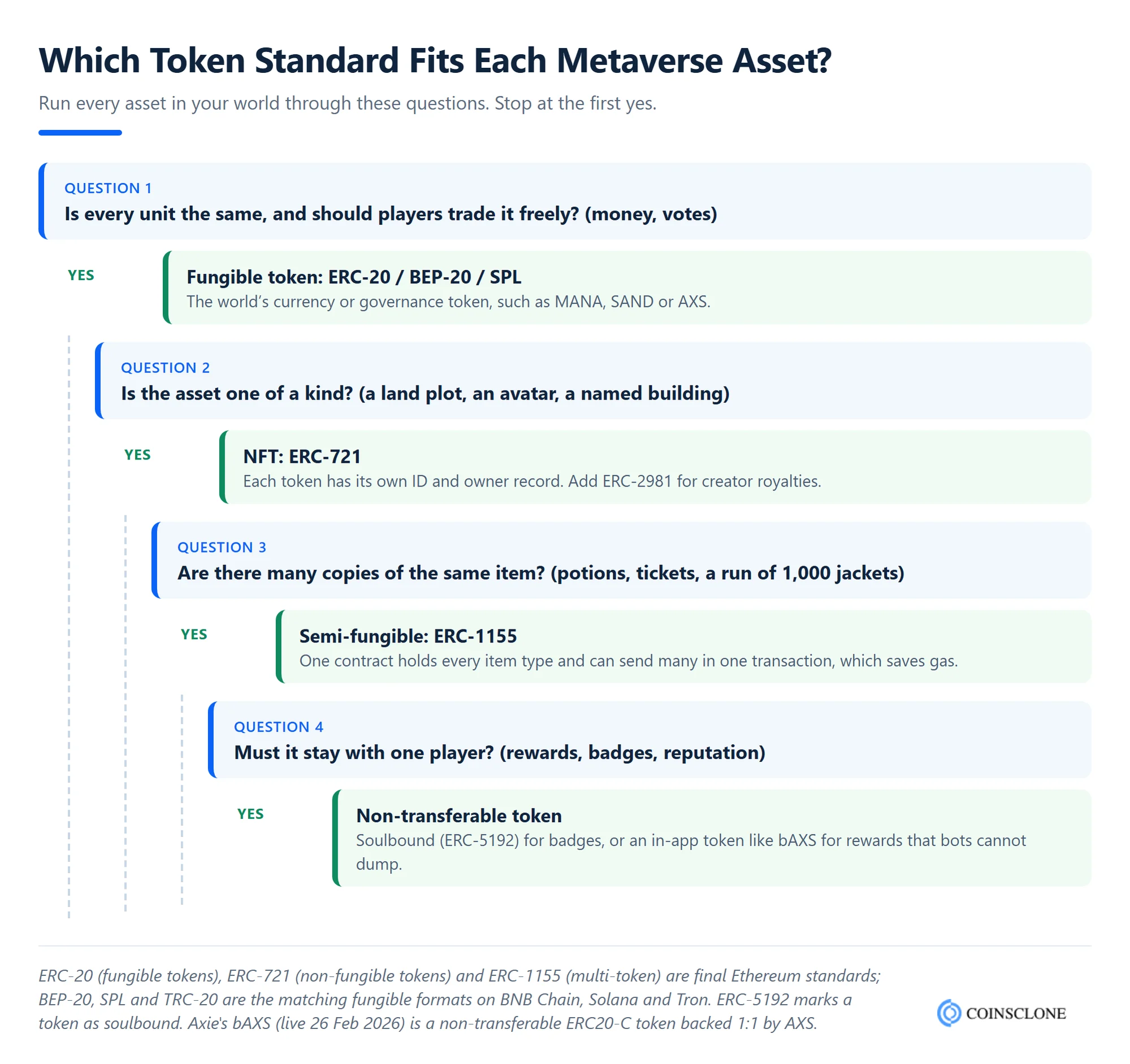
- Currency (utility) tokens: The main money of the world. Players use it to buy land, items, passes and services. MANA in Decentraland and SAND in The Sandbox are examples. These are fungible tokens, so every unit is the same.
- Governance tokens: These give holders a vote on updates, fees and treasury spending. Often the currency token does both jobs, as AXS does for Axie Infinity.
- NFT assets: Land plots, avatars, buildings and rare items. Each one is unique and has its own owner record, usually as an ERC-721 token.
- Semi-fungible items: Items with many copies, such as potions, tickets or a limited run of 1,000 jackets. ERC-1155 lets one contract hold all of them, which saves gas. Our guide to ERC-1155 token development explains this standard in detail.
- In-app or non-transferable tokens: Rewards, badges and credits that must stay with one player. They stop bots from farming and dumping rewards. Axie’s bAXS, launched in February 2026, is the best-known example. Soulbound tokens work in a similar way for badges and identity.
The tree below shows how to match each in-world asset to a standard.
Our Metaverse Token Development Approaches
We offer flexible ways to work, based on your project’s scope and how fast you need to launch.
Development from Scratch
We build your token from the ground up, with custom smart contracts designed for your project. This gives you full control over how your virtual economy runs and makes sure the token fits your brand.
Hire Token Developers
Grow your team fast by hiring our developers. They bring the skills you need to speed up the build, review smart contracts and connect your token to wallets, games and marketplaces.
These are the main ways to work with Coinsclone. Next, let’s look at the features a metaverse token needs.
Features While Creating a Metaverse Token
Below are the core features that make a metaverse token useful and ready to grow.
1. Virtual Economy Utility
The token is the main money of the virtual world. People use it for everything from event tickets to services and tips for creators. This gives users a steady reason to hold and spend the token inside the world.
2. Tokenized Virtual Assets
Land, buildings and clothing become unique digital assets (NFTs). Because these items live on the blockchain, users truly own them. They can prove they own an item and sell or trade it, much like a house or a car.
3. Interoperable Token Standards
We use shared standards such as ERC-20, ERC-721 and ERC-1155, so your tokens are not trapped in one world. Users can move their assets to wallets, marketplaces and exchanges that support the same standard.
4. Built-In Sinks and Fees
The contracts include ways for tokens to leave the supply or flow to a treasury, such as burns, crafting costs and sales fees. This keeps supply in check as the player base grows. The tokenomics section below shows why this matters.
5. Royalties and Creator Payouts
NFT contracts can carry a royalty setting (ERC-2981), so creators earn a share when their items resell on marketplaces that honor it. Your own marketplace can enforce it in full.
6. Voting and Treasury Controls
Holders can vote on fees, rewards and new features. A multi-signature treasury and a time delay on changes keep any single person from moving funds alone.
With these features in place, the token does more than move value. Next, let’s see how to design the economy behind it.
Metaverse Tokenomics: How to Keep the Economy Healthy
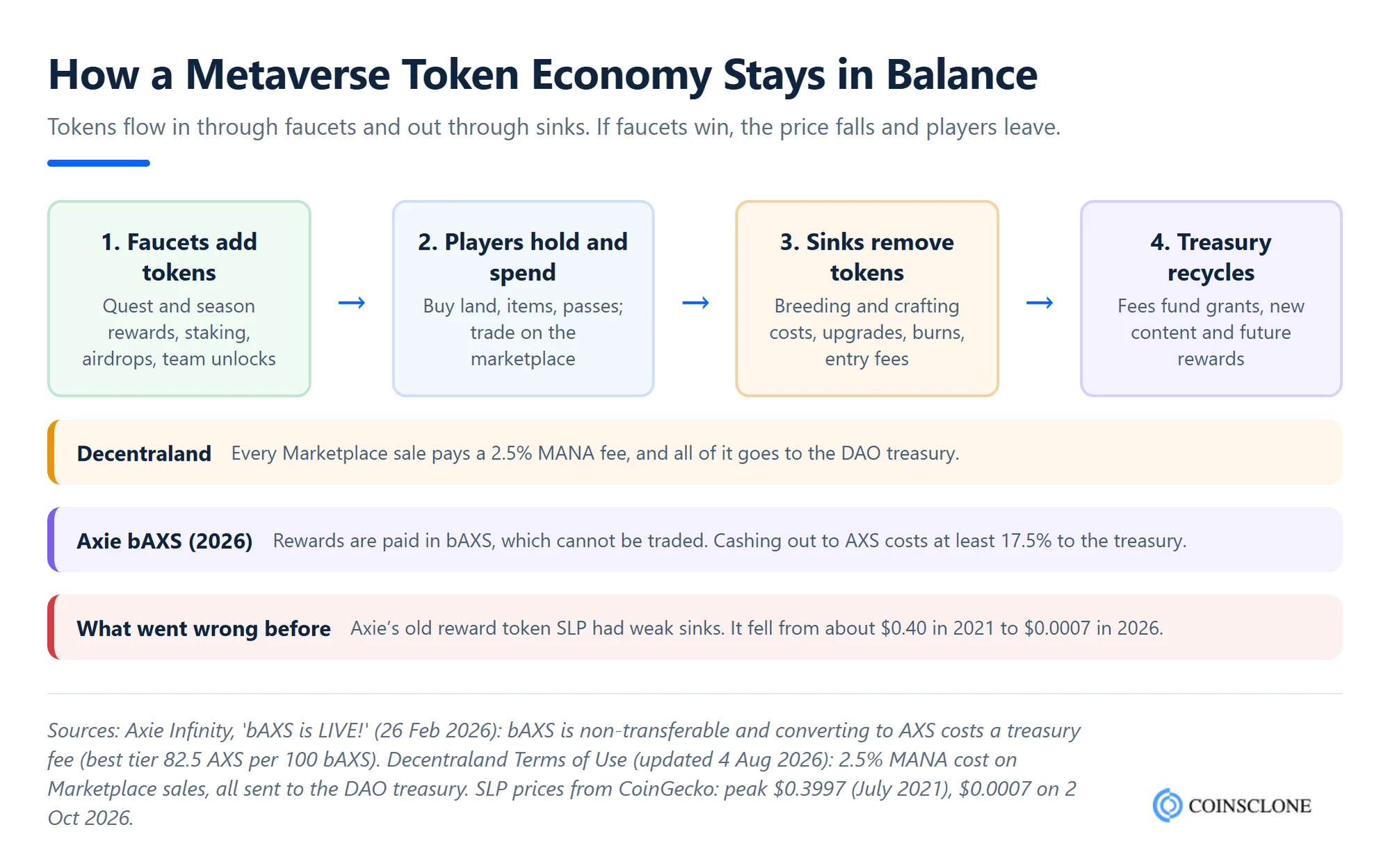
Tokenomics is the set of rules for how tokens enter and leave your world. It decides whether your token lasts. Most failed metaverse tokens did not fail because of bad code. They failed because rewards created tokens faster than players spent them.
Each game economy has two sides:
- Faucets add tokens: quest rewards, play-to-earn payouts, staking rewards, airdrops and team unlocks.
- Sinks remove tokens or send them to a treasury: land sales, crafting and breeding costs, upgrades, entry fees, burns and marketplace fees.
If faucets run faster than sinks, prices fall and players who came to earn leave. Axie Infinity’s reward token, SLP, is the classic case. It peaked near $0.40 in July 2021 and traded at about $0.0007 on 2 October 2026, per CoinGecko. That is a 99.8% drop.
Newer designs fix this in a few ways:
- Non-transferable rewards: In February 2026, Axie made bAXS live. Each bAXS is worth 1 AXS inside the game, but it cannot be traded or sent. Players spend it on breeding, forging and staking. Turning bAXS back into AXS costs a fee that goes to the treasury, so even the best tier gets only 82.5 AXS for 100 bAXS.
- Fees to a treasury: Decentraland takes a 2.5% MANA fee on each sale in its Marketplace. All of it goes to the DAO’s fund, per the Decentraland terms updated in August 2026. The DAO then pays for grants and upgrades.
- Fixed supply and slow unlocks: Cap the supply and give users the largest share. Then lock team and investor tokens with a cliff and a vesting plan that runs for years.
Before you write any code, model your economy in a spreadsheet. Estimate how many tokens rewards create each day at 1,000, 10,000 and 100,000 players, and how many your sinks remove. If the gap grows with scale, change the design now. It is far cheaper than fixing it after launch.
Benefits of Creating a Metaverse Token
A well-built token brings clear gains to your project and your users.
1. Smart Contracts
Metaverse tokens run on smart contracts. These contracts follow set rules, so users can trade without middlemen and every action follows the same terms.
2. Interoperability
Tokens built on common standards work with many wallets, marketplaces and exchanges. Bridges and multi-chain setups let your token reach users on more than one network.
3. True Ownership
When items become tokens, users truly own them and can pass them on. Governance features also give holders a vote on decisions about the platform.
4. Monetization
The token acts as money in your world. Users buy and sell with it, and you earn from primary sales, fees and premium features. Creators can earn too, which brings more content and more users.
5. Security and Transparency
Every transaction is stored on a public ledger that cannot be altered. Users can check ownership and supply at any time, which builds trust.
6. Wide Range of Assets
From game characters to a plot of land, one token system can hold many kinds of items. This variety helps you attract players, collectors and brands to your platform.
These tokens act as a bridge between virtual and real value. Next, let’s look at how the best-known metaverse tokens are doing today.
Top Metaverse Tokens in 2026 and What They Teach Builders
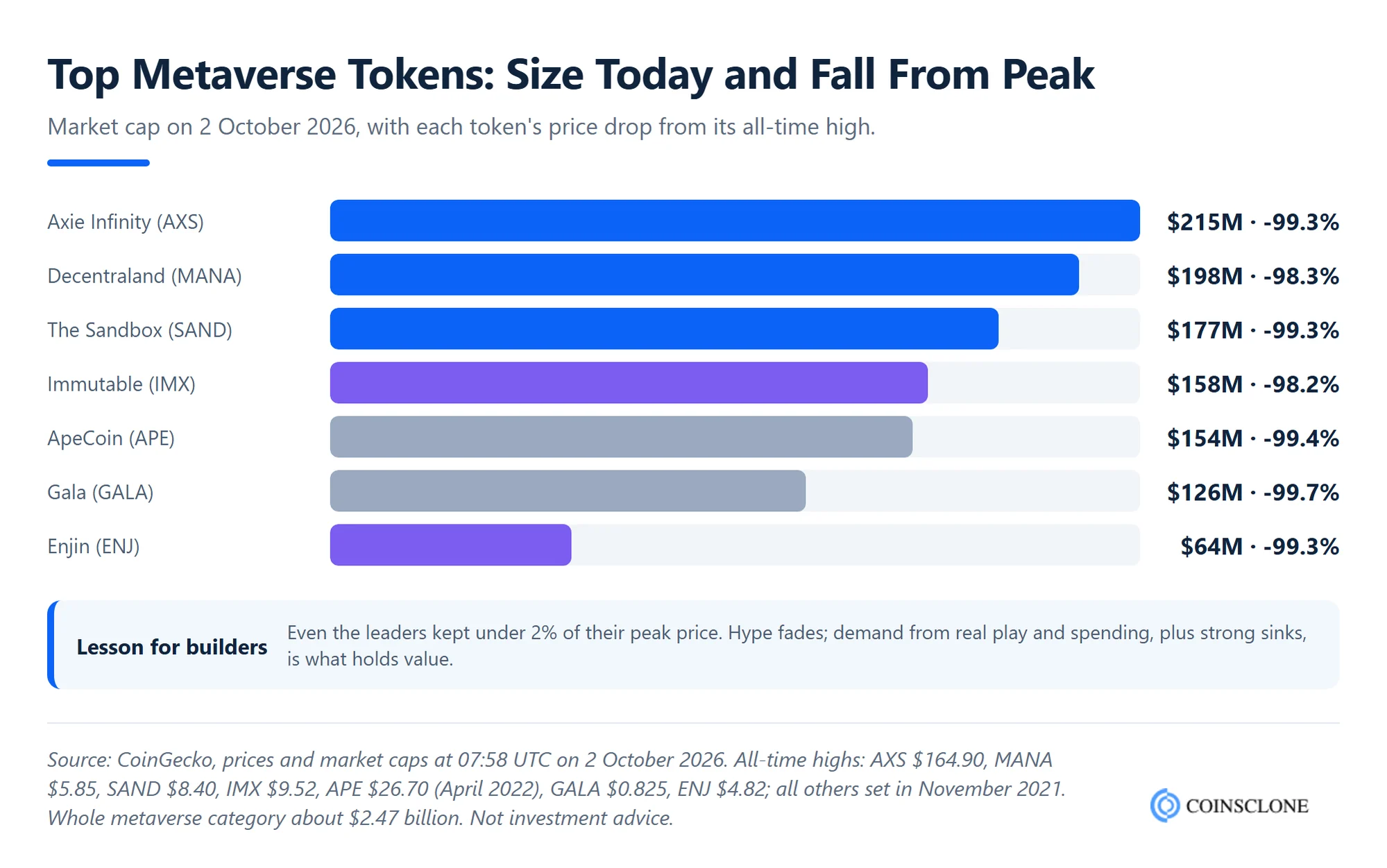
The first wave of metaverse tokens grew huge in 2021 and then fell hard. Looking at where they stand now is the best lesson for anyone building a new one. The figures below come from CoinGecko on 2 October 2026. They are not investment advice.
Axie Infinity (AXS)
Axie Infinity is a play-to-earn game where players collect, breed and battle creatures called Axies. AXS is its governance and staking token, worth about $215 million. The game’s early economy ran on SLP, a reward token that lost almost all its value as rewards outran spending. In 2026, Axie moved its rewards to bAXS, a non-transferable token backed by AXS. The game runs on Ronin, which became an Ethereum layer 2 in May 2026.
Decentraland (MANA)
Decentraland is a 3D virtual world on Ethereum where users own land plots, wearables and names as NFTs. MANA is the currency for buying them, with a market cap of about $198 million. Holders vote on rules through the Decentraland DAO, which is paid for in part by the 2.5% Marketplace fee.
The Sandbox (SAND)
The Sandbox is a virtual world where users build, own and sell games and experiences on plots called LAND. SAND is its currency and governance token, worth about $177 million. Creators use VoxEdit to make 3D models and Game Maker to design games without code. Owners can rent or sell their LAND.
Immutable (IMX)
Immutable is a blockchain network built for games on Ethereum. IMX pays for fees and staking on the network, with a market cap of about $158 million. It shows a shift in the market: much of the value has moved from single worlds to the networks that many games share.
Enjin (ENJ)
Enjin Coin powers the Enjin Blockchain, a network built for NFTs and game items. Game makers use ENJ to create items that players can carry across games that support Enjin. Its market cap is about $64 million.
Other well-known names include ApeCoin (APE) at about $154 million and Gala (GALA) at about $126 million. Every token on this list trades at 98% to 99.7% below its all-time high. The lesson is clear: hype brings users in, but only real use and a balanced economy keep them.
After seeing how these tokens grew and fell, you may want to build a better one. Here are the industries where metaverse tokens work today.
Industries We Assist with Metaverse Token Development
1. Gaming and Entertainment: We create play-to-earn and in-game tokens. Players own their items, trade them on open markets and vote on game updates.
2. Virtual Real Estate: We build NFT land tokens that let firms buy, sell and lease virtual plots. Smart contracts collect the rent and run the plots on their own.
3. Digital Art, Media and NFTs: We help creators launch tokens with built-in royalties, so artists earn when their digital art or music resells.
4. Fashion and Retail: We build wearable and loyalty tokens. Brands use them to sell digital twins of real clothes and to give VIP access to virtual shops and product drops.
5. Social Media and Community Platforms: We design SocialFi tokens that reward users for creating content and let communities run themselves through votes (DAOs).
These are the main fields we serve. Now, here is how the build works.
Step-by-Step Process of Metaverse Token Development
Creating a metaverse token takes more than writing a contract. Here are the nine steps we follow.
1. Define the Token’s Job
Start with what the token does in your world. Is it a currency, a reward, a vote, a piece of land or an item? Write down every way a user earns it and every way they spend it.
2. Design the Tokenomics
Set the total supply, who gets what share, and when each share unlocks. Then map your faucets and sinks, and test the model at different player counts. This step decides whether your economy holds up.
3. Select a Blockchain
The chain sets your fees, speed and audience. Games with many small actions need low fees and fast blocks, so most new projects pick a layer 2 or a gaming chain. The next section compares the main options.
4. Choose Token Standards
Pick a standard for each asset type: ERC-20 or BEP-20 for currency, ERC-721 for unique land and avatars, ERC-1155 for items with many copies. Use a non-transferable design for rewards that must stay with one player.
5. Build the Smart Contracts
Write the contracts for supply, transfers, minting, burns, fees, royalties, staking and voting. Use audited libraries such as OpenZeppelin where you can, and keep admin powers small and clear.
6. Audit and Test
Run full tests on a testnet, then get an outside security audit. Fix every issue, test again, and publish the report. Users, exchanges and partners now expect it.
7. Connect Wallets, Games and Marketplaces
Link the token to your game client, your marketplace and popular wallets. Embedded wallets and sponsored gas let new players start without buying crypto first.
8. Deploy and Verify
Deploy to the main network, verify the source code on the block explorer, and move admin keys to a multi-signature wallet.
9. Launch and Grow
Add trading liquidity if the token will trade, apply for exchange listings, and launch your first season of rewards. Watch the economy each week and adjust rewards and sinks as the player base grows.
For a wider view of these steps for any token, see our guide on how to create a crypto token. A team that has built many tokens can save you time at each stage. Next, let’s compare the chains.
Top Supported Blockchain Networks for Metaverse Token Development
Choosing the right blockchain is one of the biggest decisions in your project. In 2026, most new game tokens launch on low-fee networks. Ethereum mainnet stays the home of costly assets such as rare land.
| Network | Why teams pick it for a metaverse | Best for |
| Ethereum | Largest NFT market and the most trusted chain; home of MANA, SAND and APE | High-value land and governance tokens |
| Ethereum layer 2s (Base, Arbitrum, Optimism) | Ethereum security with fees of a cent or less | Currency tokens and in-game items |
| Ronin | Ethereum layer 2 since May 2026, built around games such as Axie | Web3 games with a large casual audience |
| Immutable | Gaming network with built-in tools for game items and marketplaces | Studios that want ready-made game tooling |
| Polygon | Low fees, wide brand and game adoption | Loyalty, fashion and brand worlds |
| BNB Chain | Low fees and a large retail user base in Asia | Currency tokens and play-to-earn games |
| Solana | Fast blocks and very low fees | Games with many small actions |
| Avalanche | Custom chains (L1s) for a single game | Large studios that want their own network |
| Tron | Low fees and wide TRC-20 support | Payment-style currency tokens |
Selecting the right blockchain is only the first step. To turn it into a working virtual economy, you need a team that knows the details of each network.
How Much Does Metaverse Token Development Cost?
The cost depends on how many tokens you need, the features, the chain, the audit and how much liquidity you add. A single currency token sits at the low end. A full set with a currency token, NFT land, items, staking and voting sits at the high end.
| Cost item | Typical 2026 range | What pushes it up |
| Gas to deploy on Ethereum | About $1.50 | Gas spikes, many contracts, several chains |
| Smart contract work | $5,000 to $50,000+ | NFTs and items, staking, vesting, voting, royalties |
| Security audit | $5,000 to $15,000 basic; $40,000 to $150,000+ complex | Code size, new logic, a second audit firm |
| Legal review | $10,000 to $50,000 | Number of countries, token sale, profit promises |
| Starting trading liquidity | $5,000 to $100,000 | Pairs, chains, how stable you want the price |
| Total | About $25,000 to $350,000+ | The sum of the low and high ends above |
Gas comes from the Etherscan gas tracker on 1 October 2026. The other ranges come from published 2026 token cost guides, and they match our guide to the cost to create a crypto token. The full game, 3D world or marketplace around the token is a separate budget.
How Long Does It Take?
Time grows with scope. Coinsclone quotes these timelines for its token work:
- Token contract only: 1 to 2 weeks
- Contract plus distribution (vesting, airdrops, sale): 3 to 5 weeks
- Contract plus a utility layer (staking, voting, fee capture): 6 to 10 weeks
- Complete token stack with a dApp: 3 to 5 months
An outside audit and the fix-and-test loop can add a few weeks to any of these.
Rules and Risks for Metaverse Tokens in 2026
The rules for crypto tokens changed a lot in 2026, and they shape how you design a metaverse token.
- United States: On 17 March 2026, the SEC and CFTC issued a joint guide that sorts crypto assets into five groups. One group is digital collectibles. Most in-game items and art NFTs fit there. But if you sell a token and promise buyers a profit from your team’s work, the sale can still count as a security.
- European Union: MiCA does not cover crypto assets that are truly one of a kind, so a single land plot or avatar is often outside it. A currency token is not. Most public sales of a currency token need a white paper sent to the regulator first. Small sales are exempt.
- Bots and farming: Rewards that anyone can withdraw draw bots. Use non-transferable rewards, limits per account and checks on suspicious play.
- Thin markets: Low trading volume makes prices easy to move. Plan liquidity and avoid launching too many tokens at once.
Get legal advice in each country you target before you sell any token.
Why Choose Coinsclone for Metaverse Token Development?
Coinsclone has built crypto and blockchain products since 2018. Our team has delivered 350+ platforms for 200+ clients across 20 industries, including tokens, NFT marketplaces, wallets and exchanges. We shape every token around your economy, your chain and your users, and we stay with you after launch.
If you want a token for your game or virtual world, see our metaverse token development company services for scope and a quote. Planning a full virtual land platform instead? Our Decentraland clone script gives you a ready base to build on.
The metaverse is now a smaller but more serious market. The projects that last are the ones with real use and a balanced economy. With the right plan and the right team, your token can be one of them. Contact us to get started.
Frequently Asked Questions
1. What does a metaverse token development company do?
This kind of company builds blockchain tokens for virtual worlds. It designs the tokenomics, picks the token standards, writes the smart contracts, tests and audits them, and deploys the tokens on your chosen network. It also connects them to wallets, games and marketplaces so users can own, trade and spend their assets.
2. How does metaverse token development work?
It starts with the token’s job and its tokenomics. Then the team picks a blockchain such as Ethereum, a layer 2 or BNB Chain, writes the smart contracts, tests and audits them, and deploys the token. Last, it links the token to the game or world and launches it.
3. What types of tokens can be developed for the metaverse?
You can build five kinds. Currency tokens and governance tokens are usually ERC-20 or BEP-20, and one token often does both jobs. ERC-721 NFTs work for land and avatars, since each one is one of a kind. ERC-1155 tokens suit items with many copies. Tokens that cannot be sent suit rewards and badges. Most projects use two or three of these together.
4. What blockchain standards are used for metaverse tokens?
The most common are ERC-20 and BEP-20 for fungible tokens, and ERC-721 or ERC-1155 for NFTs and items. ERC-2981 adds creator royalties. These shared standards keep your tokens compatible with wallets and marketplaces.
5. How do metaverse tokens differ from traditional cryptocurrencies?
A traditional coin such as Bitcoin is built to store or move value anywhere. A metaverse token has a job inside a virtual world, such as buying land, crafting items or voting on updates. Its value depends mostly on how many people play and spend inside that world.
6. How secure are tokens created by a metaverse token development company?
Tokens are secured by the blockchain and by smart contracts that enforce the rules. A professional team adds tests, an outside code audit and multi-signature admin keys. This lowers the risk of bugs and stolen funds, though no code is risk-free.
7. What can metaverse tokens be used for?
People use them to pay inside the world, own items, vote, earn staking rewards and buy event tickets. They also use them to trade land, wearables and rare items in 3D worlds and games.
8. How much does it cost to create a metaverse token?
A simple token with an audit can start near $25,000 once you add legal review and starting liquidity. A full set of tokens with NFTs, staking and voting can pass $350,000. The game or virtual world around the token is a separate cost.
9. How long does it take to develop a metaverse token?
A token contract alone takes 1 to 2 weeks. A token with staking, voting or fee features takes 6 to 10 weeks. A complete token stack with a dApp takes 3 to 5 months, plus a few weeks for an outside audit.
See How Our MVP System Can Launch Your Metaverse Token Faster
Metaverse Token Development — done right.
- MVP System:Create and deploy your Metaverse token 90% faster.
- Cross-Chain Ready:Build on Ethereum, BSC, Polygon, or your preferred blockchain.
- Smart Utility:Enable in-world payments, NFTs, and DAO governance.
- Brand & Customization: Your design, your economy, your rules.
- Revenue Engine:Power your metaverse with staking, token burns, and marketplace fees.
See a free demo of your Metaverse Token in 48 hours — before you invest a cent.
Book a Free Demo to discover how our Metaverse Token Development Company can take you from concept to launch in just 2–4 weeks.