

Prediction markets let people put money on what they think will happen next. Users trade on election results, sports scores, crypto prices and big news, and the price of each outcome shows the crowd’s odds. Augur was the first big decentralized prediction market on Ethereum. An Augur Markets clone script gives you that same design, ready to brand and launch, without building every smart contract from zero.
This guide explains what the script is and what happened to Augur itself, from its 2018 launch to its 2026 reboot. You will see how an Augur-style market settles a disputed result, which features to copy, and what to fix. We also compare Augur with Polymarket and Kalshi and cover the launch steps, cost and time. Every Augur fact here comes from its own blog and public data, checked in October 2026.
In this guide:
- What Augur is in 2026, and why it went quiet before its reboot
- How Augur settles a disputed market with staked bonds and a fork
- How to pick a resolution model for your own platform
- Augur vs Polymarket vs Kalshi, side by side
- The steps, cost and time to launch your own
See How Our MVP System Can Launch Your Prediction Market Platform Faster
Augur Markets Clone Script — Decentralized Prediction Markets Built for the Future.
- MVP System:Launch your prediction market platform 90% faster with our ready-to-deploy solution.
- Decentralized Market Engine: Built-in market creation, dispute resolution, trading, and automated settlements — no complex development needed.
- Brand & Customization: Customize your platform name, markets, trading rules, UI, and preferred blockchain.
- Revenue Engine:Earn through trading fees, market listings, liquidity incentives, and platform commissions.
Get a free branded demo of your prediction market platform in just 48 hours — before you invest a cent.
Book a Free Call to discover how our Augur Clone Script can take you from idea to a live decentralized prediction market platform in just 8–12 weeks.
What Is an Augur Markets Clone Script?
An Augur Markets clone script is ready-made software for running your own decentralized prediction market like Augur. It comes with smart contracts for markets and payouts, a trading engine, wallet login, a result and dispute system and an admin panel. You then add your brand, your chain, your fees and your rules.
Users buy shares in an outcome, such as “Will ETH close above $5,000 this year?”. Each share costs between $0 and $1, and the price reads as a chance. A price of 70 cents means the crowd sees a 70% chance. When the event ends, each winning share pays $1 and each losing share pays nothing.
Since the hard parts are built and tested, you can spend your time on users, liquidity and growth. The script lets startups enter the prediction market space faster and at a lower cost than a build from scratch.
What Is Augur?
Augur is a prediction market and oracle protocol on Ethereum. Jack Peterson, Joey Krug and Jeremy Gardner founded it in 2014. It raised funds in a public token sale in August 2015 and went live on Ethereum mainnet in July 2018, according to its history on Wikipedia). Its REP token holders report and confirm the result of each market.
Augur shaped every on-chain prediction market that came after it. Here is how it changed over the years:
- 2018, v1: The first fully decentralized prediction market went live. Gas fees were high, and daily users fell from 265 to 37 within a month.
- 2020, v2: Trading moved to the DAI stablecoin, results came in 24 hours instead of 7 days, and “Invalid” became an outcome users could trade.
- 2021, Augur Turbo: A faster sports betting app launched on Polygon with Chainlink data for scores, which cut fees sharply.
- 2022 to 2024: Trading dried up and the team went quiet. Newer sites such as Polymarket took the lead.
- 2025 to 2026, the reboot: The Lituus Foundation restarted Augur in April 2025. It is building Augur Lituus, a shared oracle for other apps, with ChainSafe, while a team called Dark Florist works on a new consumer market. In 2026 Augur ran its first live fork to test its dispute system.
So Augur today is mostly an oracle project, not a busy trading site. That is good news for founders. The Augur design is proven and open, and the market for a user-friendly Augur-style platform is wide open.
Why Startups Are Building Augur-Style Prediction Markets in 2026
The wider market gives founders good reason to look. Trading on Kalshi and Polymarket doubled in two months this year, from $25.7 billion in May 2026 to $53.0 billion in July, according to Pew Research Center. Here are the main reasons businesses build a platform like Augur.
- Trust Through Code: Users like markets where smart contracts hold the money and pay winners. No company can freeze or change a payout.
- Several Ways to Earn: An Augur-style market earns from trading fees, market creation fees, liquidity fees, premium tools and sponsored markets.
- Strong Network Effects: More traders bring better prices. Better prices bring more traders, and the site grows its own community.
- Room Beside the Giants: Kalshi and Polymarket lead in volume. A niche, regional or community market can still win its own crowd.
- A Proven, Open Design: Augur’s open-source code and research give you a tested model for trustless results. Let’s see how the clone software works in real time.
How an Augur Markets Clone Script Works
Here is how our Augur Markets clone script runs a market from start to finish.
- User Sign-Up and Wallet: Users connect a Web3 wallet such as MetaMask or WalletConnect. This gives secure login and lets them trade straight from their own wallet.
- Market Creation: A user or admin creates a market. They set the question, the possible results, the end date and the rules for settling it. Augur-style markets often ask the creator to post a small bond, which they get back if the market resolves cleanly.
- Listing by Category: New markets are sorted into crypto, politics, sports, finance and entertainment, so users find them fast.
- Trading Outcome Shares: Users buy and sell shares in the outcome they believe in. Prices move with demand, so they always show the crowd’s latest view.
- Liquidity: An automated market maker (AMM) or an order book keeps trading smooth, so users can enter and exit with little slippage.
- Reporting the Result: After the event, a reporter posts the result and stakes tokens on it. In Augur, this is a REP holder.
- Dispute Window: Anyone who thinks the result is wrong can challenge it by staking more. If no one disputes, the result stands.
- Automatic Payouts: Once the result is final, the smart contract pays $1 for each winning share. Settlement is quick, open and trustless.
By combining all these steps, an Augur Markets clone script helps you launch a secure prediction market platform like Augur.
How Augur Settles a Disputed Market
The result system is what made Augur famous, and it is the hardest part to get right. Most clone guides skip it with one line about “decentralized oracles”. Here is how it really works.
In Augur v2, a reporter stakes REP on a result. Anyone can dispute it by staking on a different answer. Each new round needs twice the stake of the last, and rounds run weekly. If a dispute grows past 2.5% of all REP, the whole system forks. Each REP holder must then move their tokens into the “universe” of the result they believe is true. Those who back the true result earn a 40% return from the losers’ pot, per Augur’s own account. Lying gets more costly at every step.
This is no longer just theory. In April 2026, a community member disputed a market on NASA’s Artemis II launch to force a live test. After eight weeks of rising stakes, the fork began. When the move window closed on 3 August 2026, more than half of the 11 million REP supply had moved to the “Yes” side, and only about 1,786 REP backed “No”. The winning token now trades on Kraken under the AUGUR ticker, as the Augur team reported.
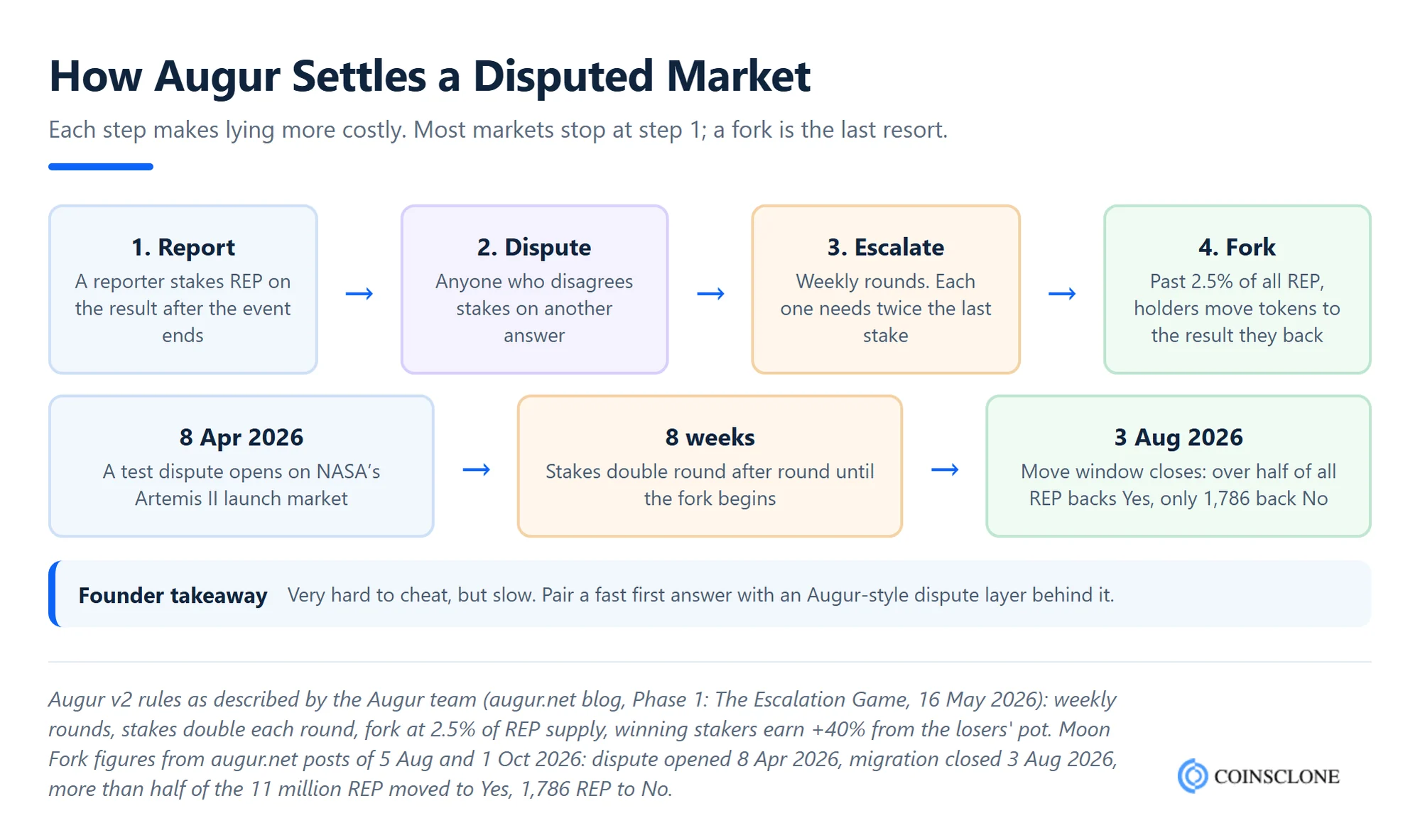
The lesson for founders is clear. A fork is a strong last line of defence, but it took about four months. Most users will not wait that long for a payout. That is why many new platforms pair a fast first answer with an Augur-style dispute layer behind it.
Core Features of Our Augur Markets Clone Script
Our Augur Markets clone script comes with the key features you need to launch and grow a modern decentralized prediction market.
- Open Market Creation: Users create and join prediction markets without a middleman. You can also limit creation to admins or trusted users.
- Three Market Types: Run yes/no markets, multiple-choice markets and scalar markets, such as “What will BTC’s price be on 31 December?”.
- An “Invalid” Outcome: Like Augur v2, unclear or badly worded markets can resolve as Invalid, so traders get a fair refund.
- AMM Liquidity: An automated market maker keeps a price on every market, even new ones, so users can always trade.
- Order Book Option: Add limit orders for busy markets, so active traders get tighter prices.
- Stablecoin Trading: Price every market in USDC, USDT or DAI, so users think in dollars, not in volatile tokens.
- Multi-Chain Support: Deploy on Ethereum, Polygon, Arbitrum, Base or BNB Chain for wider reach and lower fees.
- Web3 Wallet Support: Users trade from their own wallets and deal with smart contracts directly.
- Simple Trading Screen: A clean screen makes it easy to find markets, trade and track rewards, for new and expert traders alike.
- Admin Dashboard: Admins control markets, fees, users and reports from one place.
- Portfolio Tracking: Users see open positions, profits and market moves in real time.
- Transaction History: A clear record of every trade helps users make informed choices.
- Revenue Tracking: Built-in analytics show admins revenue, volume and key metrics.
- Dispute Tools: Admins can manage reports and disputes so every market settles fairly.
- Scalable Design: The platform handles more users, more trades and new features without slowing down.
Security Features of Our Augur Markets Clone Script
Security decides whether a prediction market wins trust or loses it. Our Augur Markets clone software comes with strong security features. Here they are.
- Smart Contract Audits: We test and audit the smart contracts closely to find and fix weak spots before launch.
- Multi-Signature Protection: Key admin actions need more than one approval, which cuts the risk of misuse.
- KYC/AML Support: You can add identity checks to meet the rules where you operate.
- Data Encryption: User data and trade history are encrypted to guard against breaches.
- Fraud Detection: The system flags odd activity, such as wash trading, so you can act fast.
- DDoS Protection: Shields the platform from denial-of-service attacks and keeps it online.
- Two-Factor Authentication: Adds an extra layer of protection to user accounts.
- Secure Admin Panel: Strong login and role-based access keep the admin side locked down.
These features make our Augur Markets clone script robust and help you launch a prediction market users can trust.
Build a Prediction Market Platform Your Users Trust Confidently!!!
Launch an Augur Markets-like prediction platform with enterprise-grade security features to protect users’ assets and business operations…
Augur vs Polymarket vs Kalshi: Which Model Suits Your Startup?
Many prediction markets have launched since Augur, each with its own model. Augur remains one of the top prediction market clone scripts for founders who want full decentralization. Polymarket and Kalshi lead in volume with very different designs. Here is how they compare in October 2026.
| Factor | Augur | Polymarket | Kalshi |
| Type | Fully decentralized protocol | On-chain market, plus a CFTC-licensed US arm | CFTC-regulated US exchange |
| Main chain | Ethereum (Turbo ran on Polygon) | Polygon | No blockchain needed to trade |
| Money used | DAI in v2 | USDC | US dollars |
| Custody | Non-custodial | Non-custodial on its global site | Custodial |
| Who resolves | REP holders, with disputes and forks | UMA oracle (global site) | The exchange |
| Status in 2026 | Rebooting as an oracle; first live fork in 2026 | Market leader | Market leader in the US |
| Best clone fit | Trustless, community-run markets | Crypto trading audiences | Licensed event trading |
The money tells the story. Polymarket held about $327 million in deposits on 2 October 2026, while Augur held about $2.1 million, per DefiLlama. Augur’s peak was $13.3 million in January 2021.
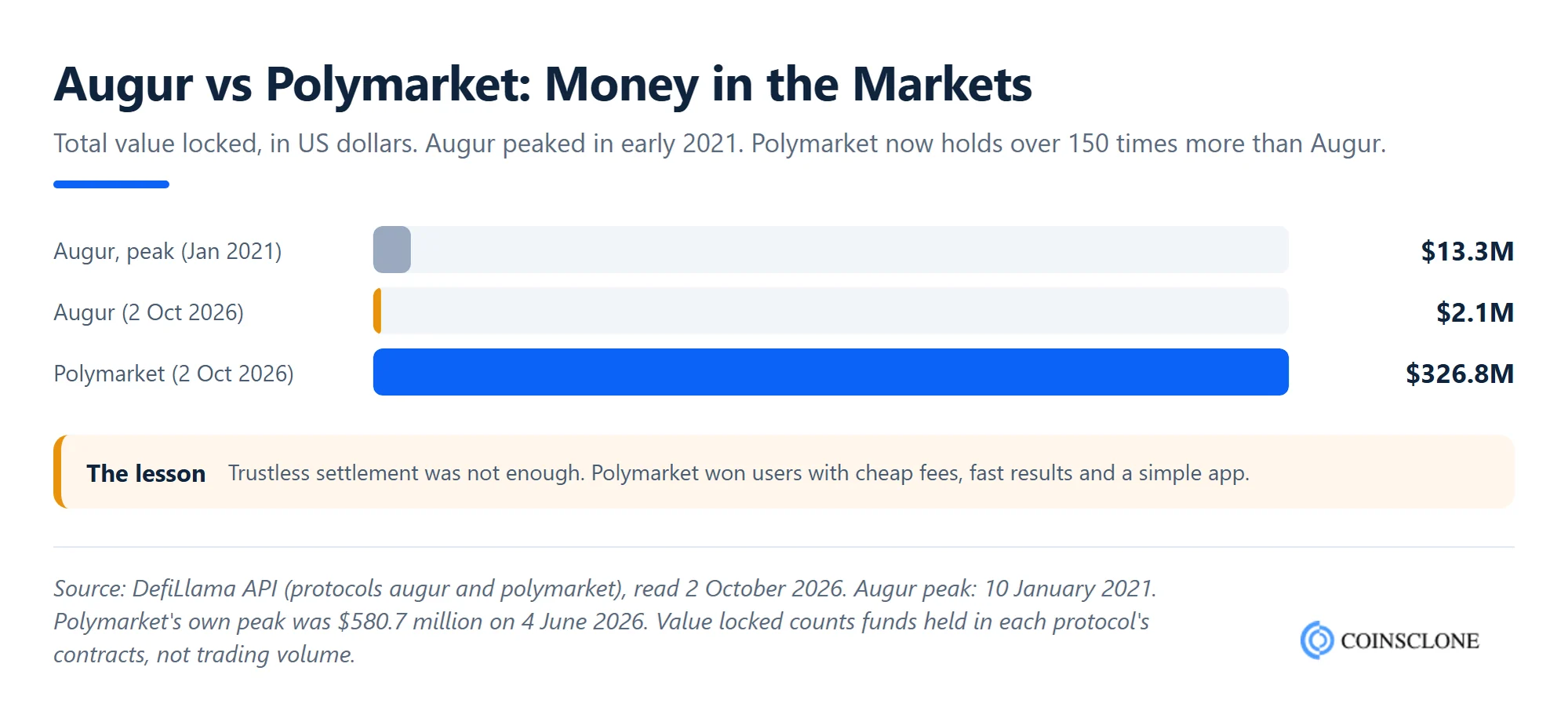
Augur’s design won on trust but lost on speed, cost and ease of use. Polymarket kept the on-chain core and added a simple app, cheap fees and fast results. The best Augur clone takes both lessons: trustless settlement plus a smooth user experience. Want a different model? See our Polymarket clone script and Kalshi clone script guides.
Pick a Resolution Model for Your Platform
Who decides the result is the biggest choice in any prediction market build. It shapes trust, speed, cost and your legal risk. Augur’s full fork model is the most trustless, but it is not the only option, and your clone script can mix several.
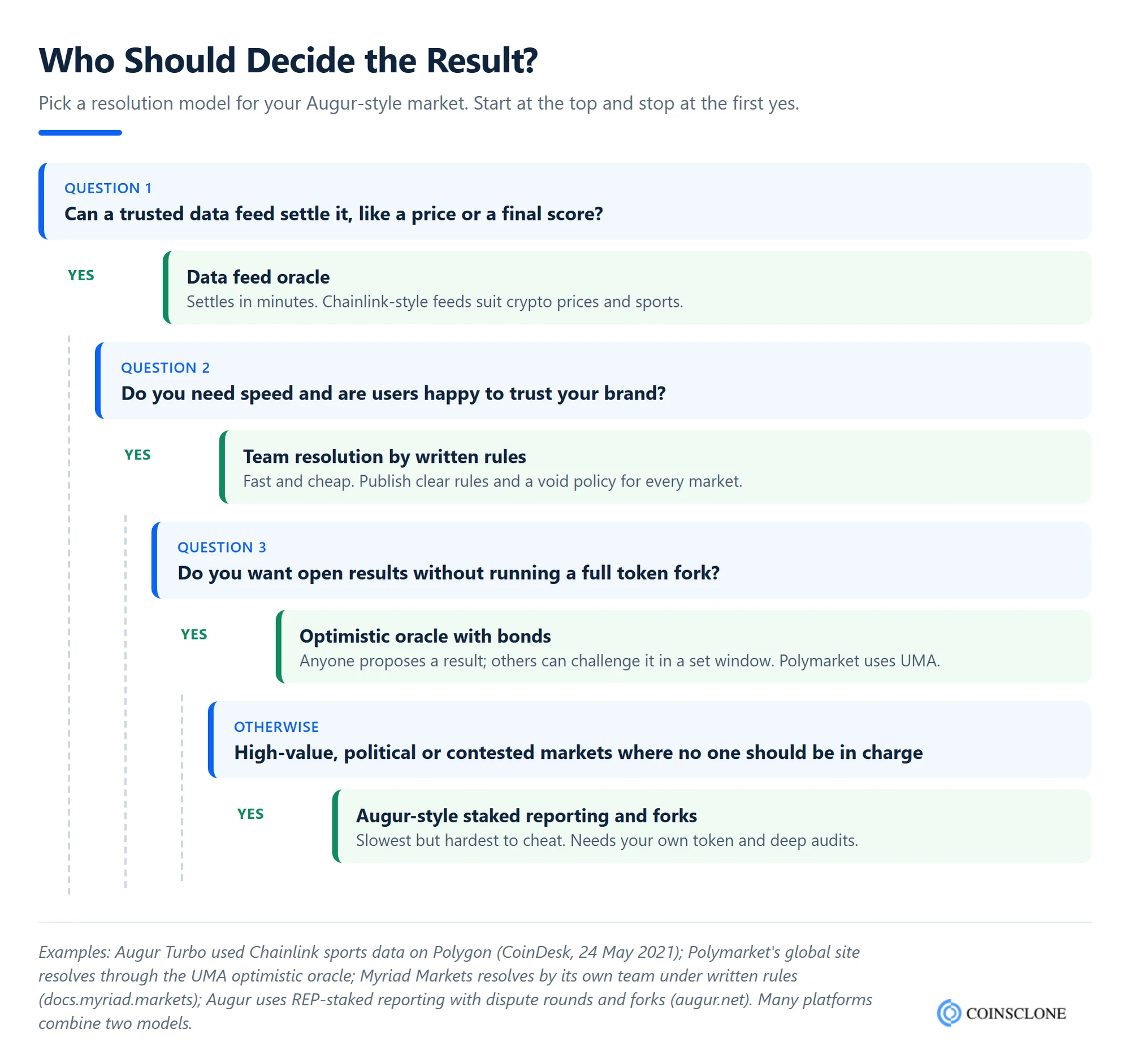
- Data Feed: For prices and sports scores, a feed such as Chainlink settles markets in minutes. Augur Turbo used this for sports.
- Team Resolution: Your own desk posts results by written rules. It is fast and simple, but users must trust you.
- Optimistic Oracle: Someone proposes a result with a bond, and others can challenge it during a set window. Polymarket uses UMA this way.
- Staked Reporting with Forks: The Augur model. It is slow but very hard to cheat, so it suits high-value or political markets.
Business Benefits of Using an Augur Markets Clone Script
Building a prediction market from scratch takes a long time and a big budget. An Augur Markets clone script lets you launch a fully working decentralized platform with far less effort. Here are the main gains.
- Faster Launch: The core features are built, which cuts build time and gets you to market sooner.
- Several Income Streams: You can earn from trading fees, market creation fees, liquidity fees and premium plans from day one.
- Community-Driven Growth: Market creators, traders and liquidity providers all bring in new users, so the site grows on its own.
- Global Reach: Blockchain and Web3 wallet support let you reach users in many countries, where local rules allow.
- Lower Running Costs: Smart contracts handle settlements, payouts and trades. That means less manual work and lower costs.
- Less Tech Risk: You skip the hardest parts, such as market math, dispute logic and payout contracts. They are already built and tested.
With an Augur clone script, you launch faster, earn from more sources and build a prediction market that can grow with the industry.
How an Augur-Style Prediction Market Makes Money
A prediction market can earn from many sources at once. Here are the main ones for a platform like Augur.
- Trading Fees: Take a small cut of each trade or each winning payout.
- Market Creator Fees: Augur let creators set their own fee on each market. You can share it with them and keep a platform cut.
- Reporting Fees: In Augur, REP holders earned fees for reporting results. Your own token can play the same role.
- Market Listing Fees: Charge users or partners to create or feature a market.
- Liquidity Fees: Earn part of the fees when you fund your own market pools.
- Affiliate Fees: Augur v2 added fees for front ends that bring in trades. Paying partners spreads your markets across more sites.
- Premium Tools and Data: Sell advanced charts, alerts, API access and market data to traders, funds and media.
Volume drives every one of these streams, so plan for it from day one. To see how the market leader earns, read how Polymarket makes money.
7 Key Steps to Build a Prediction Market Platform Like Augur Using a Clone Script
Follow these steps to launch a prediction market that stands out and earns a strong return.
1. Define Your Niche and Check the Rules
Pick your audience and market types, such as sports, finance, politics or crypto. A clear niche sets you apart and draws a loyal user base. Then get legal advice for each country you target. Real-money prediction markets fall under betting or trading rules in many places. The US, for example, treats them as event contracts under the CFTC, which flagged Augur’s similarity to binary options back in 2018.
2. Choose the Blockchain Network
Pick a chain with the right mix of security, speed and low fees. Ethereum, Polygon, Arbitrum, Base and BNB Chain are popular options. Augur’s early users paid high Ethereum gas fees, which is why it later moved sports trading to Polygon.
3. Customize Platform Features
Shape the clone script around your brand, market types, fees, rewards and governance model.
4. Set Up Smart Contracts and Resolution
Deploy the smart contracts that create markets, hold funds and pay winners. Then connect your result system: a data feed, your own team, an optimistic oracle or Augur-style staked reporting.
5. Add Liquidity
Seed your first markets with an AMM pool or market makers. This lets users buy and sell at fair prices from day one and makes the site feel alive.
6. Test and Audit the Platform
Test every flow, from deposits to disputes and payouts. Then get an outside security audit to find weak spots before launch.
7. Launch and Scale
Go live, bring in users and market your platform. Keep improving it based on user feedback so people stay and trade more.
At Coinsclone, we build this on our ready prediction market clone script, shaped to the Augur model with your chain, result system and brand.
Ready to Build Your Own Augur-like Prediction Market Platform?
Accelerate your journey with our Augur Markets Clone Script and launch a feature-rich platform tailored to your business goals.
Augur Markets Clone Script Cost and Timeline
Cost depends on your trading engine, chain, result system and how much you change. Here is how published 2026 agency cost guides compare.
| Route | What you get | Typical public quotes |
| Ready clone script | Core markets, AMM, wallets, admin panel and your brand | About $5,000 to $20,000 |
| Standard build | Clone script plus custom design, more market types and disputes | About $25,000 to $50,000, 8 to 12 weeks |
| Advanced build | Order book, multi-chain, your own token and mobile apps | About $50,000 to $100,000, 12 to 16 weeks |
| Custom build from scratch | Your own engines, contracts and oracle | Up to $300,000 or more |
Outside audits, legal advice, liquidity and marketing come on top. The things that raise the bill most are:
- A Staked Dispute System: Augur-style bonds, rounds and forks need careful contract design and a deeper audit.
- An Order Book: It needs a matching engine and live data feeds on top of the contracts.
- More Chains: Each chain needs its own deployment, testing and liquidity.
- Mobile Apps: Native iOS and Android apps add weeks of work.
- Compliance: Identity checks, region blocks and legal reviews add cost and time.
Industries Using Augur-Style Prediction Markets
Augur-style prediction markets help many industries forecast what comes next, using the wisdom of the crowd and open blockchain records.
- Crypto and Web3: Users predict price moves, protocol upgrades and chain events. It gives your community a new reason to take part.
- Sports: Fans predict match results, tournament winners and player stats. Sports drove much of the 2026 volume jump.
- Finance: Users predict stock moves, rate cuts, jobs data and gold or oil prices.
- Elections and Politics: Users predict who wins a vote and which laws pass. The odds often become news on their own.
- Entertainment and Media: Users predict award winners, box office hits, TV shows and celebrity events.
- Enterprise Decision Tools: Firms run internal markets to forecast project risk, sales and product launches using staff insight.
Technology Stack Behind an Augur Markets Clone Script
The tech stack decides how fast, safe and scalable your platform is. Here is what powers ours.
1. Blockchain and Smart Contracts
Ethereum, Polygon, Arbitrum or BNB Chain run the core. Smart contracts create markets, hold funds, settle results and pay winners. We write them in Solidity for EVM chains, or Rust for Solana.
2. Oracles and Resolution
The oracle links your markets to real-world results. Chainlink is widely used for prices and sports scores. UMA’s optimistic oracle and Augur-style REP reporting cover events that no data feed can settle.
3. Back End and Storage
Node.js with Express.js builds the APIs that keep off-chain data in sync with the chain. IPFS or Arweave store market details for good. MongoDB or PostgreSQL index trades for fast lookups.
4. Front End and User Interface
React.js or Next.js powers fast, live trading screens. Web3.js or Ethers.js connect the app to the chain. MetaMask and WalletConnect handle secure Web3 login.
Our Augur Markets clone script is built on proven tools for smooth trading, secure funds and a great user experience.
Partner with Coinsclone to Build a Prediction Platform like Augur
Coinsclone is a top Prediction Market Platform Development Company. Since 2018 we have delivered 350+ platforms for 200+ clients across 20 industries. We build prediction markets in the style of Augur, Myriad Markets, Polymarket and Kalshi, and we offer white-label software and clone scripts for a fast, cost-effective launch.
Our Augur Markets clone script is secure, customizable and scalable, so you can shape it around your own needs. We support you from the first call to well after launch, so you can go live with confidence.
Turn your idea into a thriving Web3 business with a prediction market built around your vision.
Frequently Asked Questions
What is an Augur clone script?
An Augur clone script is ready-made software for launching a decentralized prediction market like Augur. It includes smart contracts for markets and payouts, a trading engine, wallet login, a result and dispute system and an admin panel, all ready to brand.
How does an Augur Markets clone script work?
Users connect a wallet and buy shares in an outcome at a price between $0 and $1. After the event, a reporter posts the result and anyone can dispute it by staking more. Once the result is final, the smart contract pays $1 for each winning share.
What happened to Augur? Is it still active?
Augur launched in 2018 and was the first big decentralized prediction market. Trading faded after 2021 as gas costs and a hard user experience pushed people to newer sites. The Lituus Foundation restarted it in April 2025. In 2026 it ran its first live fork and is now building Augur Lituus, a shared oracle for other apps.
Can the Augur clone script be customized?
Yes. You can change the design, market types, categories, fees, chain, stablecoin and result system. You can also add your own token, an order book and mobile apps.
How long does it take to launch a platform like Augur?
A branded clone script with core features can launch in a few weeks. Public 2026 quotes put a standard build at about 8 to 12 weeks and an advanced build with an order book and apps at 12 to 16 weeks.
How much does it cost to build a prediction market like Augur?
Published 2026 agency cost guides run from about $5,000 to $20,000 for a ready clone script to $50,000 to $100,000 for an advanced build. A full custom build can pass $300,000. Audits, legal work and liquidity come on top.
See How Our MVP System Can Launch Your Prediction Market Platform Faster
Augur Markets Clone Script — Decentralized Prediction Markets Built for the Future.
- MVP System:Launch your prediction market platform 90% faster with our ready-to-deploy solution.
- Decentralized Market Engine: Built-in market creation, dispute resolution, trading, and automated settlements — no complex development needed.
- Brand & Customization: Customize your platform name, markets, trading rules, UI, and preferred blockchain.
- Revenue Engine:Earn through trading fees, market listings, liquidity incentives, and platform commissions.
Get a free branded demo of your prediction market platform in just 48 hours — before you invest a cent.
Book a Free Call to discover how our Augur Clone Script can take you from idea to a live decentralized prediction market platform in just 8–12 weeks.