
Margin trading exchange development is the work of building a crypto exchange where traders can borrow funds and trade bigger positions than their own balance. It is one of the most wanted features on any trading platform. Binance, Kraken, OKX and Bybit all run it, and in May 2026 Kraken opened regulated spot margin to all eligible US traders.
This guide explains how margin trading works inside an exchange, the parts you need to build, and the numbers behind it. You will see a worked liquidation example, the rules in key markets, what a build costs in 2026 and how long it takes. Coinsclone has built crypto trading platforms since 2018, so we also show how our team builds yours.
In this guide:
- How margin, leverage, margin level and liquidation fit together, with real numbers
- Isolated vs cross margin, and which one your exchange should offer first
- The core modules: lending pool, interest engine, risk engine and liquidation engine
- The rules for margin in the US, UK, EU, Dubai and Singapore as of October 2026
- Cost ranges, launch times and a step-by-step build plan
See How Our MVP System Can Launch Your Margin Trading Exchange Faster!
Margin Trading Exchange Development — done right.
- MVP System : Launch your Margin trading platform up to 90% faster.
- Leverage & Risk Control : Pre-built modules for margin trading, liquidation.
- Brand & Customization : Your design, your tokens, your leverage model.
- Revenue Engine : Earn from trading fees, funding rates, liquidations, and premium user tiers.
See a free branded demo of your Margin Exchange in just 48 hours — before you invest a cent.
Book a Free Demo to discover how our Margin Trading Exchange can take you from idea to live platform in 8-12 weeks.
What Is Margin Trading Exchange Development?
Margin trading exchange development means adding borrowing to a crypto exchange. A trader locks some funds as collateral. Then the exchange lends them more, so they can buy or sell a bigger amount. The platform tracks each loan, charges a fee on it and closes risky trades before the loan goes bad.
So a margin exchange is more than a spot exchange with a “5x” button. It needs a lending pool, an interest engine and a risk engine that watches prices every second. It also needs a liquidation engine that can sell fast in a falling market. These parts protect both the trader and the exchange.
You can build all of this from scratch, or start from a white label crypto exchange that already has the margin module and tune it to your market. Either way, the logic is the same, so let us start with how margin trading works.
What is Crypto Margin Trading?
Margin trading lets a trader use borrowed funds to buy or sell crypto. The trader’s own money is the “margin”, and it acts as collateral for the loan. As a result, they can open positions that are bigger than their account balance.
For example, a trader with $1,000 can open a $3,000 position at 3x. If the price rises 10%, they make $300 instead of $100. But if it falls 10%, they lose $300, plus interest on the loan. In short, margin makes gains and losses bigger by the same amount.
You will often see a few terms around margin trading:
- Margin: The trader’s own funds, locked as collateral.
- Leverage: How many times bigger the position is than the margin, written as 3x, 5x or 10x.
- Margin level: The value of the account divided by what it owes. It shows how safe a loan is.
- Margin call: A warning that the margin level is low and the trader should add funds.
- Liquidation: The forced sale of a position when the margin level falls too far.
Margin Trading vs Leverage Trading
People often use the two terms as if they mean the same thing, but they are not quite the same. Leverage is the multiple, such as 5x. Margin is the deposit that backs it. You can’t get leverage without margin, so the two always go together.
The real split is between spot margin and futures. In spot margin trading, the trader borrows real coins or stablecoins and buys or sells real assets. They pay interest on the loan. In futures and perpetual trading, nobody borrows coins. Instead, traders hold contracts, and they pay or receive funding fees. This guide covers spot margin. For contracts, see our guide to crypto derivatives exchange development. For a wider look at leverage products, see crypto leverage trading platform development.
How Does Margin Trading Work in a Crypto Exchange?
Consider a trader on an exchange that offers margin. First, they move funds into a margin account. That first deposit is the margin. Next, they choose the leverage, and the exchange lends the rest. For instance, a $10,000 trade at 10:1 leverage needs $1,000 of margin, and the exchange lends $9,000.
Rules and leverage limits differ from one exchange to the next. Crypto margin usually runs from 2x to 10x. For example, Binance offers up to 5x on Cross Margin Classic, 10x on Isolated Margin and 20x on Cross Margin Pro, per its margin trading guide. Kraken caps US spot margin at 10x. Forex brokers, by contrast, often allow 30:1 to 50:1 on major currency pairs, because those prices move far less than crypto.
Once the trade is open, the exchange keeps checking the margin level. Binance, for example, defines it as total assets divided by total loans plus interest. On its 3x Cross Margin Classic account, a margin level between 1.1 and 1.3 triggers a margin call, and a level at or below 1.1 triggers liquidation, per its margin level rules.
All the while, the loan cost keeps growing. Binance bills the loan by the hour, and Kraken bills its borrow cost six times a day. This is one reason high leverage is risky: the higher the multiple, the smaller the price move that wipes out the margin. At 10x, a 10% fall erases the whole deposit. The worked example below shows how the numbers play out at a safer 3x.
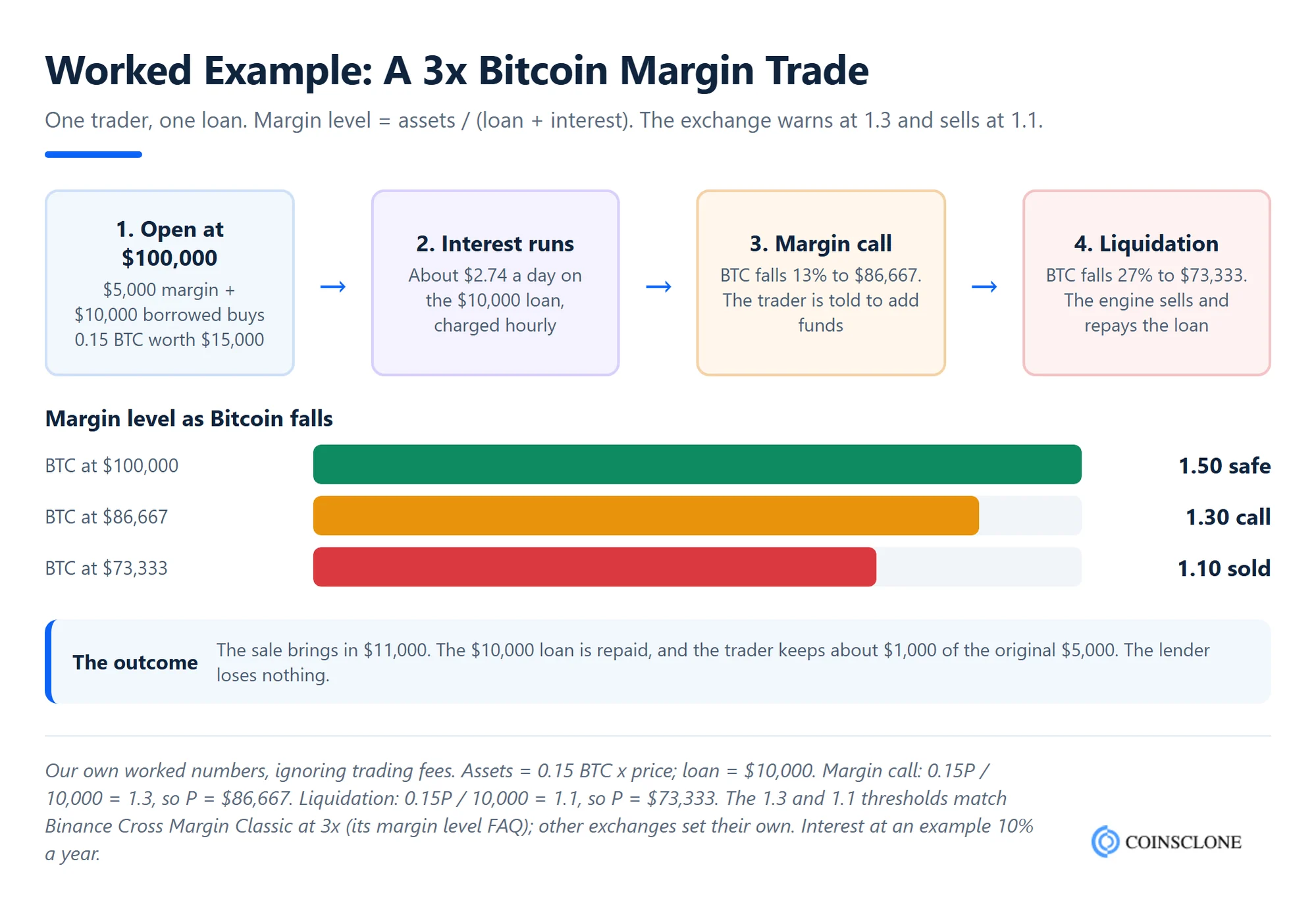
So in this example the price must fall more than 26% before the exchange steps in. Your platform has to get this maths right for each account, each second, using a fair index price, not one exchange’s last trade.
Isolated Margin vs Cross Margin
Most exchanges offer two margin modes, and your platform should support both.
- Isolated margin: Each position has its own margin. If it is liquidated, the trader loses only that margin, and the rest of the account is safe. This mode suits new traders and risky coins.
- Cross margin: All the funds in the margin account back every open position. A winning trade can hold up a losing one, so positions survive longer. However, one bad trade can drain the whole account.
| Point | Isolated margin | Cross margin |
| Collateral | Set per position | Whole margin account |
| Worst case | Lose that position’s margin | Lose the whole margin account |
| Best for | New traders, single bets, volatile coins | Active traders with several hedged positions |
| Risk engine load | Simpler: one check per position | Harder: the whole account is checked as one |
Start with isolated margin on a short list of liquid pairs. It is easier to explain, easier to risk-manage and kinder to new users. Then add cross margin once your risk engine and liquidity are proven.
Core Modules of a Margin Trading Exchange
A margin exchange shares the base of any crypto exchange: user accounts, KYC, wallets, an order book, a matching engine and an admin panel. On top of that, it adds a set of modules that handle loans and risk. The diagram below shows how money moves through them.
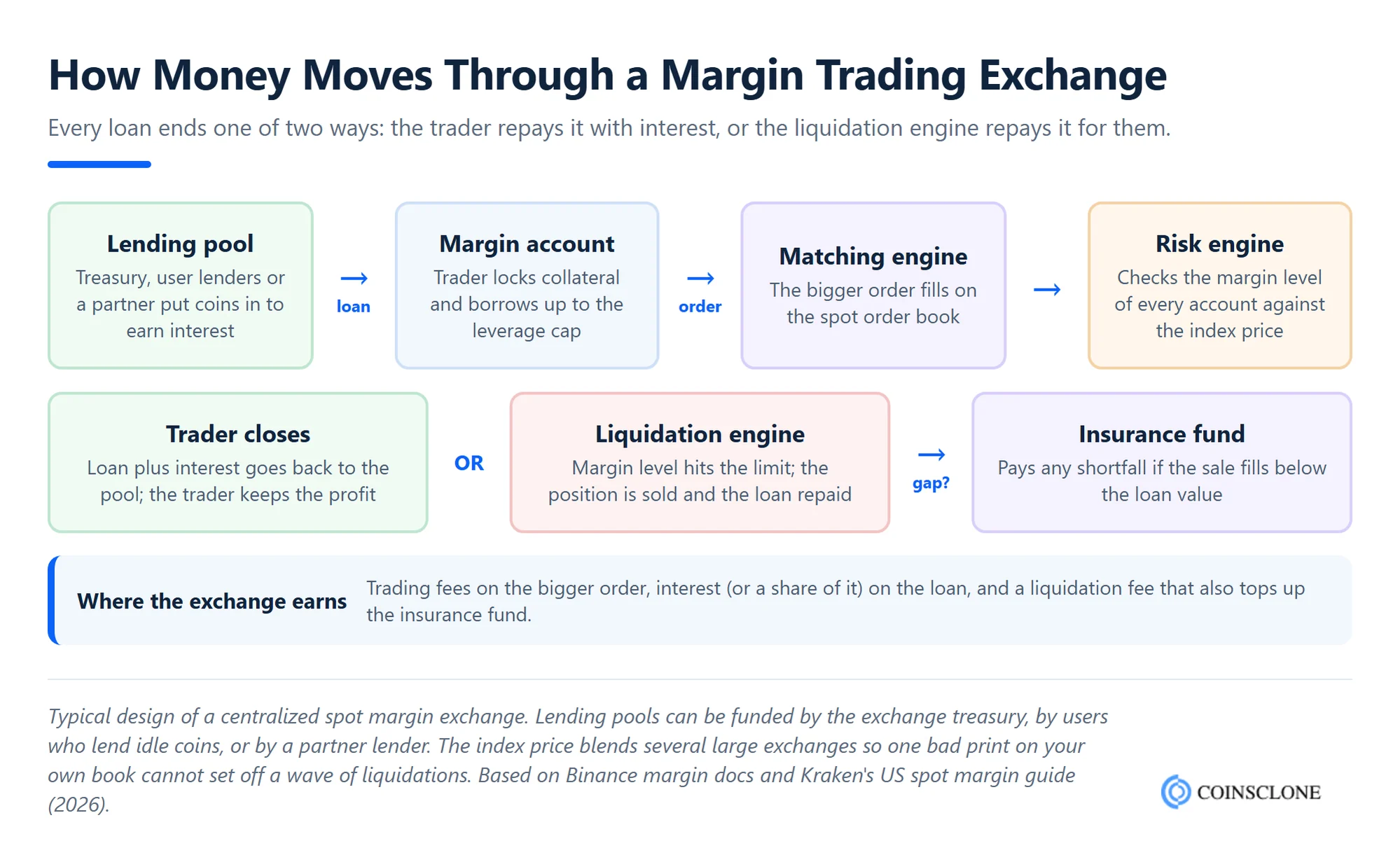
- Lending pool: The source of the borrowed funds. It can be the exchange’s own funds, users who lend spare coins for a fee, or a partner lender.
- Interest engine: Sets the borrow rate for each coin, often based on how much of the pool is in use, and charges it by the hour.
- Index price feed: Blends prices from several big exchanges, so one bad trade on your book cannot trigger mass liquidations.
- Risk engine: Works out the margin level of every account in real time and sends margin calls.
- Liquidation engine: Sells trades that cross the limit, in parts when it can, so the order book is not flooded.
- Insurance fund: Covers any gap when a position closes below the value of its loan, so lenders are always repaid.
These modules decide whether your exchange survives a sharp crash. Therefore, test them against real past crashes, such as the drops of March 2020 and November 2022, before you go live.
Desirable Features of Margin Trading Exchange Development
In addition to margin trading, you need a set of trading and safety features to win and keep users. Here are the features to plan for:
- Fast matching engine: Matches orders in microseconds, even during market spikes.
- Market making: Bots or partners that keep the order book deep, so liquidations do not crash the price. Our crypto market making software covers this.
- Layered safety: 2FA, cold storage for most funds, locked payout addresses and anti-phishing codes.
- Multi-coin wallet: Let users pay in and take out each coin you list, with hot and cold wallets.
- Data privacy rules: Follow the privacy laws in each market you serve, such as GDPR in the EU.
- Risk rules: Caps per coin, loan limits per user and stepped safety margins for big trades.
- Robust admin panel: Controls for rates, leverage, listings, user limits and the insurance fund.
- Conditional trading: Stop-loss, take-profit and trailing stops that run on their own.
- Sub-accounts: Extra accounts for traders who run more than one style of trade.
- Leverage options: Let users pick their multiple per trade, within the limits you set.
- Crypto derivatives options: Futures and perpetuals as a later add-on for advanced users.
- Advanced order types: Limit, market, stop-limit, OCO and post-only orders.
- Auto-deleveraging: A last step that trims the top winning trades if the insurance fund runs dry.
- Partial close trades: Users can close part of a position to free margin.
- Insurance funds: A reserve that absorbs losses from liquidations that close below the loan value.
- Pre-trade risk view: Show the liquidation price and borrow cost before the user confirms, as Kraken now does.
By building these features, you give traders the tools they expect and protect your platform at the same time. You can get all of them as one package from a trusted crypto exchange development company such as Coinsclone.
Reasons to Invest in Leverage Margin Trading Exchange Development
Active traders want margin, and many smaller exchanges still do not offer it. That gap is your opening. Meanwhile, the lending market is now on a sounder footing. Here are the main reasons to build one.
Amplified Returns From Trading Fees
Margin makes every trade bigger, so the same users pay more in fees. For instance, if your exchange charges a 0.1% fee, a trader who opens a $100,000 position with $10,000 of margin at 10x pays $100 on that one order. Without margin, the same trader would pay $10.
Enhanced Revenue Streams
Margin also adds income that a spot exchange does not have:
- Interest on loans: Each borrowed coin earns a fee for each hour it is out. On a $10,000 loan at 10% a year, that is about $2.74 a day.
- Liquidation fees: Many exchanges charge a small fee when they force-close a trade, which also feeds the insurance fund.
- Lending spread: If users supply the pool, you keep a share of the interest they earn.
- Premium tiers: Higher loan limits, lower rates or API access for pro traders.
Increase User Base and Boost Profit
Margin brings in active traders, and they trade more often than casual buyers. It also keeps your current users from moving to a bigger exchange to get leverage. In turn, more trading deepens your order book, which draws in more users.
A Healthier Lending Market
Crypto lending has grown up since the 2022 lender failures. Galaxy Research’s Q2 2026 lending report shows loans backed by crypto fell to $56.16 billion as traders cut back in an orderly way, not in a 2022-style panic. What’s more, big central lenders passed DeFi apps for the first time since 2023.
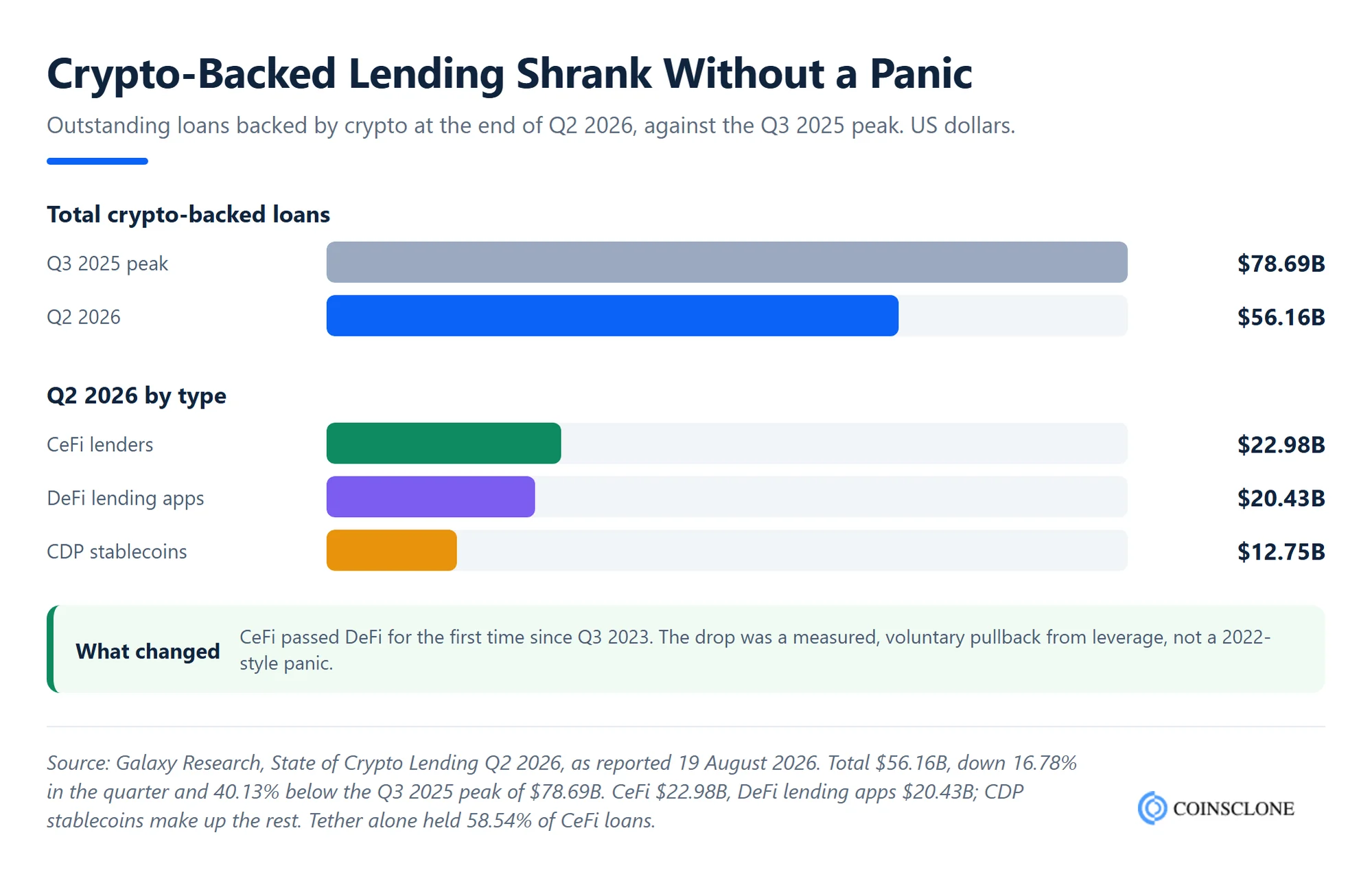
For you, this means two things. First, borrowing demand is real and large, even in a calmer market. Second, rules such as the FCA’s new UK regime now require over-collateralised loans for retail users, so build them in from day one.
Margin Trading Rules and Licences in 2026
Margin is the most closely watched part of a crypto exchange, because it involves lending to the public. Check the rules in every market you plan to serve before you build. Here is where the main markets stand as of October 2026:
| Market | Regulator | What it means for a margin exchange |
| United States | CFTC | Leveraged crypto trades for retail users must run through a CFTC-registered firm. Kraken did this in May 2026 through its registered futures broker (FCM). |
| United Kingdom | FCA | Final rules (PS26/11, June 2026) allow crypto borrowing for retail users with a fit check, consent for each loan and over-collateralised loans. Firms can apply from 30 Sept 2026; the rules start on 25 Oct 2027. |
| European Union | ESMA and national regulators | MiCA covers crypto trading and custody but not crypto lending and borrowing. Leveraged products can count as MiFID II derivatives, so get legal advice. |
| Dubai | VARA | Margin needs explicit approval under the Exchange Services Rulebook, plus client fit checks and separate margin accounts. |
| Singapore | MAS | Licensed crypto firms may not offer credit, margin or leverage to retail customers, under MAS consumer protection guidelines in force since June 2025. |
Read the UK details in the FCA’s policy statement PS26/11. For the US model, see Kraken’s launch of CFTC-regulated spot margin. If Europe is your first market, our guide to a MiCA-compliant crypto exchange covers the licence steps.
In practice, many new exchanges launch spot trading in a market with clear rules first. Then they switch on margin, country by country, once the licence allows it. So your software should let you turn margin on or off by region and by user type.
How to Develop a Crypto Exchange with Leverage Margin Trading?
Building a crypto exchange with margin trading is not as hard as it sounds if you start from tested software. In a fast market, being early matters, so a ready-made base is often the smart move. Here is the build plan step by step:
- Plan the business: Pick your target market, your user type and the pairs you will offer on margin.
- Check the rules: Confirm what each market allows, then line up the licence and a legal adviser.
- Choose the build route: White label software for speed, or a custom build for a new model.
- Set the risk rules: Caps, safety margins, loan limits and borrow rates for each coin.
- Fund the pool and the insurance fund: Decide who lends, how much, and how big the reserve must be.
- Bring in buyers: Add market makers or a trading partner, so forced sales always have buyers.
- Build and brand: Add your design, apps, KYC and wallets, then test the risk engine against past crashes.
- Run a beta: Start with low leverage and a small user group, and watch the forced-sale logs closely.
- Launch and grow: Open to all users, then raise limits and add pairs as the data allows.
If you want a fast start, our premium white label crypto exchange software is a ready-to-deploy exchange with margin trading and other key plug-ins. You can also model it on a known platform with our Binance clone script.
Factors To Consider For Developing a Crypto Margin Trading Software
Before you build, weigh these factors:
- What makes you stand out: Know what makes your exchange different, such as a region, a coin list or a user type.
- Gaps in rival platforms: Note the pros and drawbacks of the margin exchanges your users already know, and fix the weak spots on yours.
- Laws in your market: Check the rules in each country where you plan to launch, as shown above.
- Your budget: Plan for the build, the licence, the lending pool, the insurance fund and marketing.
- The right partner: Pick a white label crypto exchange provider with live margin clients and round-the-clock support.
- Safety: Guard against hacks, inside jobs and price games.
- Testing: Run a full beta and a security audit before launch.
- Marketing: After launch, promote your exchange to your target traders with clear risk warnings.
How Much Does Margin Trading Exchange Development Cost?
The cost depends mostly on the build route. Published 2026 agency cost guides put a white label exchange at about $15,000 to $60,000. A custom margin trading exchange usually costs about $80,000 to $300,000, while large multi-asset platforms with institutional features can pass $700,000.
| Build route | Typical cost (USD) | Time to launch |
| White label exchange with margin module | $15,000 to $60,000 | 4 to 6 weeks (7 to 10 with fiat rails, 9 to 13 with mobile apps) |
| Custom margin trading exchange | $80,000 to $300,000 | 6 to 9 months or more |
| Institutional, multi-asset platform | $300,000 to $700,000+ | 12 months or more |
Launch times for white label come from Coinsclone’s published delivery times. Cost ranges reflect 2026 agency cost guides.
The build is only part of the budget, though. You also need funds for the lending pool and the insurance fund, a licence in each market, KYC checks, price feeds, market makers and security audits. For a full breakdown, see our guide to the cost to develop a cryptocurrency exchange.
Why Choose Coinsclone For Margin Trading Exchange Development?
Coinsclone is a leading crypto exchange development company that has built crypto platforms since 2018. We have delivered 350+ platforms for 200+ clients across 20 industries. We offer all kinds of crypto exchange clone scripts, such as the Binance clone script, plus premium white label crypto exchange software at fair rates.
Our margin trading exchange comes with the trading features and risk modules described above. Our team knows how much the margin feature matters to traders, so we built it into the core of our exchange software rather than adding it on top.
Here is what you get with our margin trading exchange development service:
- Fast launch: A standard white label exchange goes live in 4 to 6 weeks.
- Fair pricing: You pay for setup and changes, not to rebuild every part.
- API links: Connect market makers, KYC tools and price feeds.
- Room to grow: Add futures, P2P, staking or a launchpad when you are ready.
- Full control: Set leverage, interest rates and a wide range of borrow limits from the admin panel.
- Responsive apps: Web, Android and iOS apps for your traders.
Have questions about margin trading exchange development? Talk to our experts and check out our free demo.
Elevate your Trading Platform
kickstart your Custom Margin Trading Exchange Now!
Related Articles
- Spot Trading Crypto Exchange Development Guide
- Hybrid Crypto Exchange Development Guide
- Crypto Derivatives Exchange Development Guide
- How to Start a Crypto Exchange
- How to Start a P2P Crypto Exchange
Frequently Asked Questions
What is the difference between margin trading and leverage trading?
Leverage is the size boost, such as 5x, and margin is the deposit that backs it. You can’t get leverage without margin. In spot margin trading, traders borrow real coins and pay interest. In futures, they trade contracts and pay funding fees instead of interest.
How does leverage work in margin trading?
The trader puts up margin, and the exchange lends the rest. At 5x, $1,000 of margin opens a $5,000 position, with $4,000 borrowed. Gains and losses are five times bigger, and the position is closed if the margin level falls below the exchange’s limit.
Can margin trading be added to an existing crypto exchange?
Yes. You add a margin account type, a lending pool, an interest engine, a risk engine and a liquidation engine to your current exchange. They connect to your existing order book and wallets. Test the new modules against past crashes, and check your licence covers margin, before you switch it on.
What security features does a margin trading exchange need?
It needs the usual exchange safety tools: 2FA, cold storage, locked payout addresses and audits. On top of that, it needs a fair index price to stop price games, caps per coin, loan limits per user and a fund that covers losses when trades are sold by force.
Is crypto margin trading legal?
It depends on the market. The US allows it for retail users only through CFTC-registered firms. The UK will allow retail crypto borrowing under new FCA rules from 25 October 2027. Singapore bars licensed crypto firms from offering margin to retail users. Always check with a local legal adviser.
How much does it cost to build a margin trading exchange?
Published 2026 agency cost guides put a white label exchange at $15,000 to $60,000 and a custom margin exchange at $80,000 to $300,000. Large institutional platforms can pass $700,000. You also need funds for the lending pool, insurance fund and licences.
How long does it take to build a crypto margin trading exchange?
A white label exchange from Coinsclone takes 4 to 6 weeks, 7 to 10 weeks with fiat rails and 9 to 13 weeks with mobile apps. A custom build usually takes 6 to 9 months or more.
See How Our MVP System Can Launch Your Margin Trading Exchange Faster!
Margin Trading Exchange Development — done right.
- MVP System : Launch your Margin trading platform up to 90% faster.
- Leverage & Risk Control : Pre-built modules for margin trading, liquidation.
- Brand & Customization : Your design, your tokens, your leverage model.
- Revenue Engine : Earn from trading fees, funding rates, liquidations, and premium user tiers.
See a free branded demo of your Margin Exchange in just 48 hours — before you invest a cent.
Book a Free Demo to discover how our Margin Trading Exchange can take you from idea to live platform in 8-12 weeks.