Many teams want to launch a MiCA-compliant perpetual DEX like Hyperliquid and serve traders across Europe. But there is a catch most guides miss. MiCA, the EU’s crypto rulebook, does not cover perpetual futures. In the EU, perps are derivatives, so they fall under MiFID II. And in February 2026, the EU markets watchdog said they likely count as CFDs for retail traders.
This guide explains what “MiCA-compliant” really means for a perp DEX in October 2026. You will see which EU rules apply to each part of the platform, the three routes teams use to reach EU traders, the features you need, and the real costs, such as much lower leverage. Every rule links to the law or the watchdog, and every market figure is dated.
In this guide:
- The short answer: MiCA covers your token, your stablecoin collateral and any spot trading. The perps themselves fall under MiFID II.
- The retail limits: ESMA’s February 2026 statement points to CFD rules, which cap retail leverage on crypto at 2:1.
- Three routes: a licensed EU venue, a licensed front end on a shared engine, or a decentralized protocol that blocks EU users.
- What to build: KYC, client tests, leverage limits by client type, trade monitoring and full records.
- Real examples: One Trading, Kraken and Gemini already offer perps in the EU under MiFID II licences.
Build a MiCA-Compliant Perpetual DEX Like Hyperliquid — Faster & Smarter!
Perpetual DEX Development — built for the future of regulated decentralized trading.
- MiCA-Ready MVP System: Launch a perpetual DEX aligned with evolving EU compliance standards.
- Hyperliquid-Like Trading Engine: Deliver fast order execution, deep liquidity, and seamless perpetual trading
- Custom Branding & Market Setup : Launch under your brand with tailored trading pairs, fees, and platform features.
- Built-In Revenue Engine : Generate revenue through trading fees, liquidity programs, and premium trading services.
Get a free branded demo of your MiCA-compliant perpetual DEX within 48 hours — see the platform before making any investment.
Book a Free Demo to discover how our Hyperliquid Clone Script helps you go from idea to a regulated, MiCA-ready perpetual DEX in just 8 -12 weeks.
MiCA-Compliant Perpetual DEX Like Hyperliquid: What It Really Means
A perpetual DEX lets traders open leveraged long or short positions on futures that never expire, often from their own wallet. Hyperliquid is the top example. It runs its order books on its own Layer 1 chain, fills orders in about 0.2 seconds, and handled about 42% of onchain perp DEX volume on 15 October 2026. You can see how it works in our guide to Hyperliquid architecture.
Here is the key legal point. MiCA says in Article 2(4) that it does not cover crypto that counts as a financial instrument. A perp is a derivative. Under MiFID II, the EU’s rulebook for trading products such as futures, that makes it a financial instrument. So no perp DEX can get a MiCA licence for its perps.
In practice, a MiCA-compliant perpetual DEX like Hyperliquid means a platform that:
- Offers the perps under MiFID II, through a licensed investment firm or trading venue, or keeps EU users out.
- Follows MiCA for the crypto around the perps: the token, the stablecoins used as margin, spot trading and custody.
- Meets the shared EU rules: money laundering checks, the travel rule for transfers and DORA for IT safety.
That mix gives EU traders a safe, clear and lawful place to trade perps. It also builds the trust you need to win users and partners.
Hyperliquid and EU Rules in October 2026
Hyperliquid is still the market leader, but it does not hold an EU licence. Here is where things stand, as of 16 October 2026:
- Market size: Hyperliquid’s public API listed 178 live perp markets, with about $9.1 billion of 24-hour volume and $11.8 billion of open interest. Its maximum leverage was 40x on BTC.
- Policy push: on 30 September 2026, Hyperliquid’s policy group asked the EU to treat perps under MiFID II, not MiCA, and not as CFDs, The Block reported. Its point: on an order book, the venue does not take the other side of your trade. A CFD broker does.
- A licensed front end idea: the same letter said a licensed firm could run its own markets on Hyperliquid through HIP-3. It would set its own leverage limits and let in only checked wallets through an onchain allowlist.
- The HYPE token: EU exchanges list HYPE under MiCA. For example, OKX Europe published a MiCA white paper for HYPE to admit it to trading on its own platform.
- No final answer yet: the EU’s public call for views on its MiCA review closed on 30 September 2026. The EU has not said if perps will stay under MiFID II or get a new class.
Which EU Rules Apply to Each Part of a Perp DEX
In EU law, a perp DEX is not one product. Each layer has its own rulebook. This table maps them.
| Part of the platform | EU rulebook | What it asks of you |
| Perp contracts | MiFID II and MiFIR, plus national CFD rules for retail | A licence to run the venue or deal with clients, product rules, retail leverage caps, trade reports |
| Retail sales of perps | PRIIPs Regulation | A Key Information Document for each product |
| Governance or fee token | MiCA Title II | A white paper before you sell it to the public or list it |
| Stablecoins used as margin | MiCA Titles III and IV | Use stablecoins from approved issuers, such as Circle’s USDC |
| Spot trading and custody | MiCA CASP rules | A CASP licence; the grace period ended on 1 July 2026 |
| Crypto transfers | Transfer of Funds Regulation (2023/1113) | Travel rule data on every transfer, in force since 30 December 2024 |
| IT and cyber risk | DORA | IT risk rules, incident reports and testing, in force since 17 January 2025 |
| Money laundering | EU AML rules, with a new AML law from 10 July 2027 | KYC, sanctions checks and reports of suspect activity |
The takeaway: MiCA still matters, but it is only part of the job. The perps carry the toughest rules. If you only plan spot trading, our guide to a MiCA-compliant crypto exchange in the EU covers that path.
Why Perpetual DEXs Need to Adapt to MiCA and MiFID II
As the EU fills in its crypto rules, perp DEXs must change how they work to keep serving European traders. Here is why it matters now.
- Evolving Regulatory Landscape: MiCA now fully applies, and ESMA, the EU markets watchdog, has said perps are likely CFDs. A perp DEX that ignores both risks fines or forced exits.
- Built-In Compliance: compliance works best when it is part of the design. KYC, risk limits and records are much harder to add after launch.
- Enhanced User Protection: EU rules focus on retail traders. Clear risk warnings, fair margin rules and loss limits are now expected.
- Operational Resilience: under DORA, firms must show they can handle outages and cyber attacks, and report big outages fast.
- Market Integrity: watchdogs want venues to spot wash trading, spoofing and insider trading, and to report it.
- Future Regulatory Developments: the MiCA review may change how perps are classed. A platform with clean records and rules it can swap out can adapt fast.
If you adapt early, your perp DEX keeps the strengths of onchain trading and earns its place in the EU.
The CFD Question: What ESMA Said in February 2026
On 24 February 2026, ESMA published a public statement on derivatives in scope of the CFD measures. It said products sold as “perpetual futures” are likely contracts for difference (CFDs). It also said a product’s trade name does not change how it is classed.
If your perps count as CFDs, these rules apply to retail traders in each EU country:
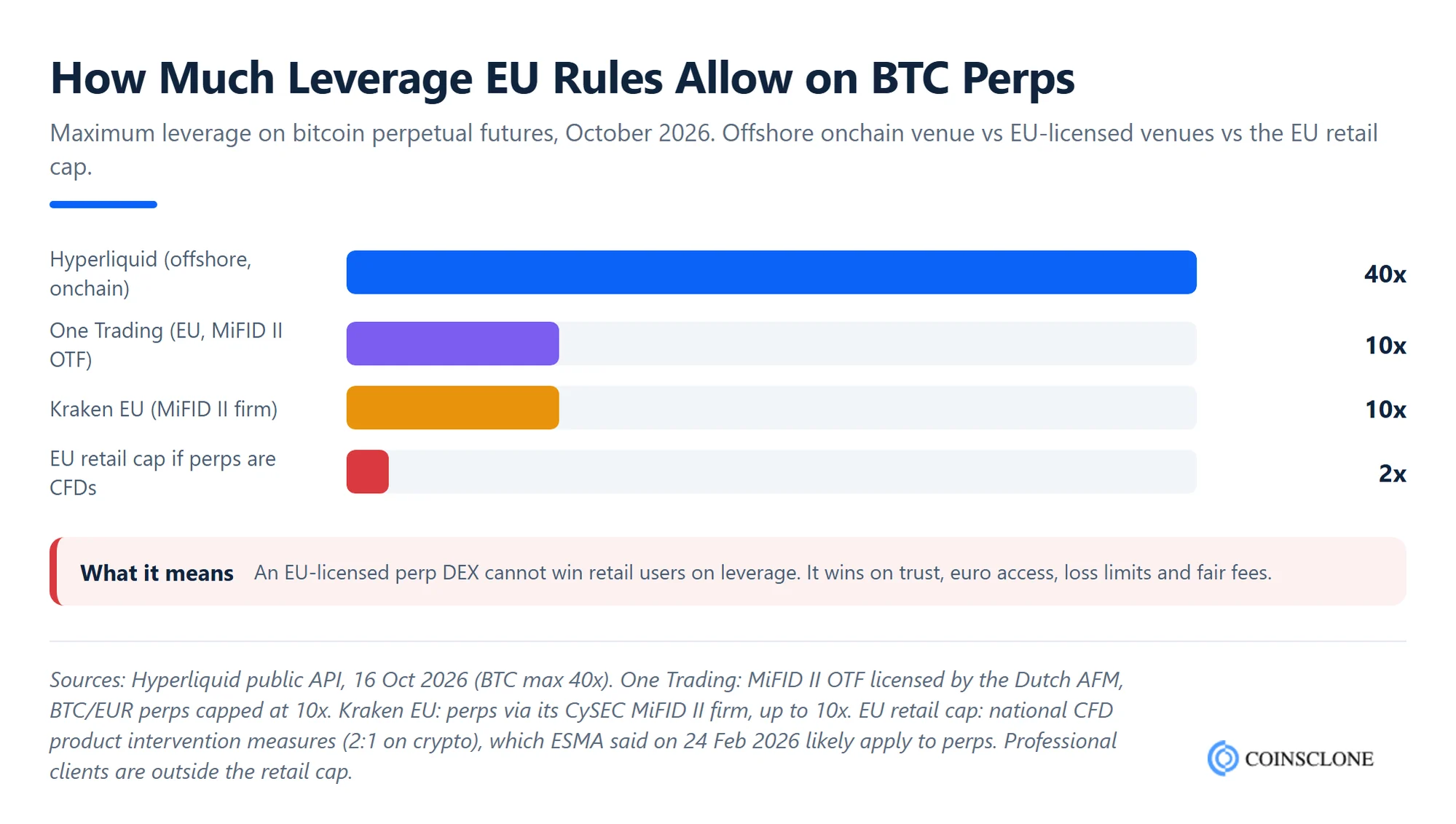
- Leverage cap: at most 2:1 on crypto, so traders must post at least 50% margin.
- Margin close-out: positions close once margin falls to half of what is required.
- Negative balance protection: a retail trader can never lose more than the money in the account.
- Risk warning: a standard warning that shows the share of retail accounts that lose money.
- No incentives: no bonuses or perks to draw in retail traders.
ESMA also said MiFID II product rules and client tests apply, and that each product needs a Key Information Document. It warned firms not to build setups that dodge these rules, such as sending EU retail clients to a firm outside the EU.
Pro clients are outside the CFD rules, so EU venues can offer them higher leverage. Each venue must still check how ESMA’s statement applies to its own products and its retail clients.
Three Routes to Offer Perps to EU Traders
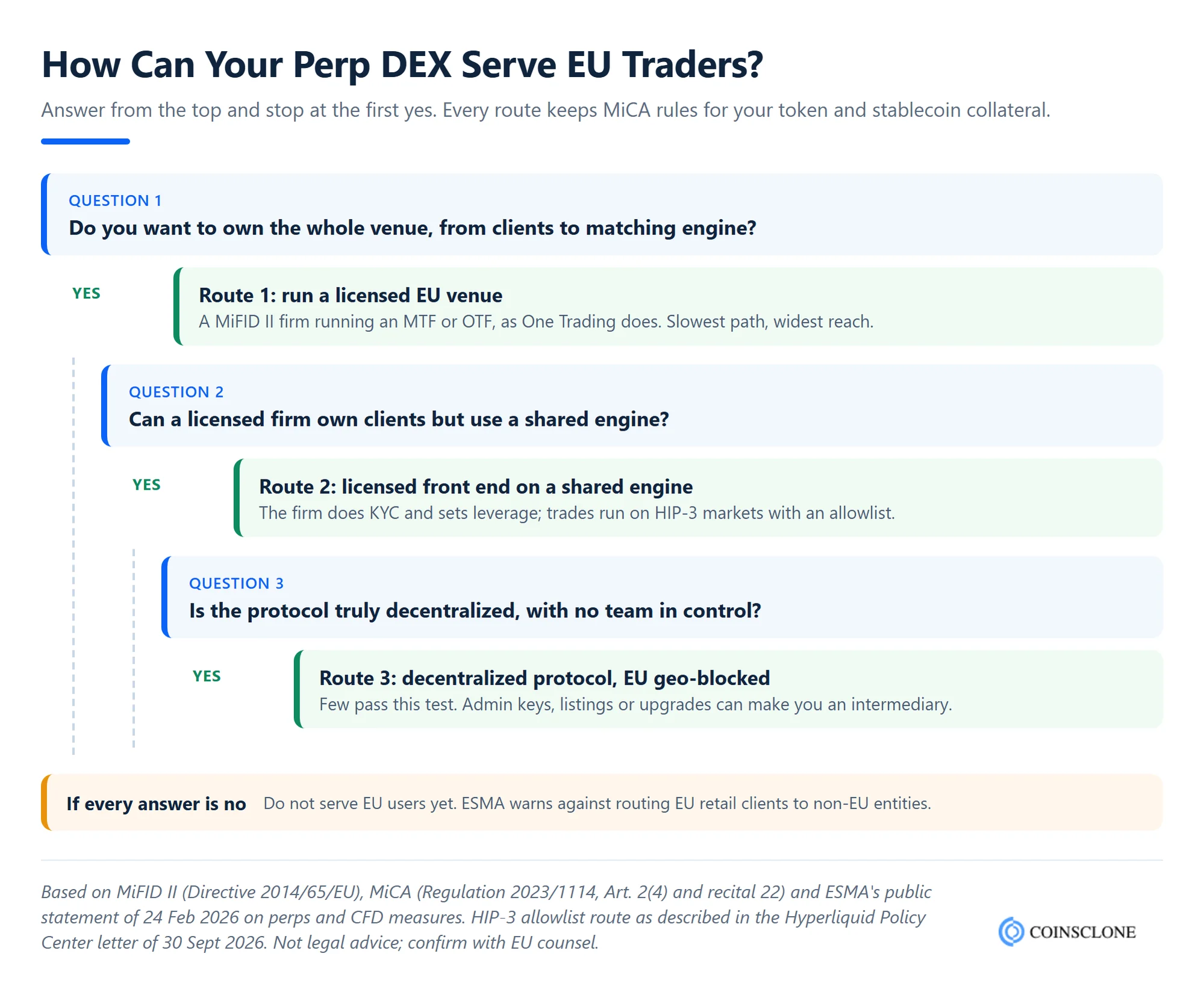
Teams that want EU users usually pick one of three routes. Each one shapes your licence, your tech and your growth.
Route 1: Run a Licensed EU Venue
You set up or buy a MiFID II firm and run your perps market as a licensed trading venue, known as an MTF or an OTF. This is the cleanest route, and you own the whole stack, from clients to the matching engine.
Some firms already do this. One Trading launched BTC/EUR and ETH/EUR perps in April 2025 under an OTF licence from the Dutch AFM, with leverage capped at 10x. Kraken offers perps in the EU through its CySEC-licensed MiFID II firm, and Gemini got a MiFID II licence in Malta in May 2025. OKX Europe went a different way in April 2026, with “X-Perps” that carry a five-year expiry date.
Trade-off: this is the slowest and most costly route. Under MiFID II, the watchdog has up to six months to decide once your file is complete. And EU law asks firms that trade on their own account to hold €750,000 of starting capital. If this is your route, our crypto derivatives exchange development service covers the build for this kind of venue.
Route 2: Put a Licensed Front End on a Shared Engine
Here a licensed firm owns the client, while trades run on a shared onchain engine. The firm runs KYC, client tests and leverage limits, then sends orders to markets it controls. On Hyperliquid, that means HIP-3 markets with an allowlist, as Hyperliquid’s policy group described. Our guide to Hyperliquid builder codes and HIP-3 explains how those markets work.
Trade-off: you still need the licence, but you skip building a full matching engine. You also depend on another chain’s rules, uptime and fees.
Route 3: Stay Fully Decentralized and Block EU Retail
MiCA’s recital 22 says services run in a fully decentralized way, with no one in the middle, fall outside its scope. Some teams build toward that, then block EU users at the front end. Many offshore perp venues block EU users or simply stay outside the EU’s reach.
Trade-off: few platforms pass the “fully decentralized” test. A team that picks listings, upgrades contracts or holds admin keys may still count as the one in the middle. And you give up the EU market.
Key Compliance Requirements for a Perpetual DEX Like Hyperliquid in the EU
To run a perp DEX for EU traders, build the rules into the platform, the team and the daily work. Here are the core needs.
Get the Right Licences
You need a MiFID II licence for the perps, and a MiCA CASP licence if you also offer spot trading or custody. Under MiCA, a firm that runs a trading platform needs at least €150,000 of starting capital. The local watchdog then has 25 working days to check that your file is complete and 40 working days to review it. Map your business model with an EU lawyer before you serve a single EU user.
Implement KYC and AML
Even if users keep their own keys, a licensed firm must know its clients. Plan for ID checks, sanctions checks and ongoing trade monitoring. Add travel rule data to every crypto transfer, as the EU has required since 30 December 2024.
Run Appropriateness Checks
Under MiFID II, retail users must pass a short test, called an appropriateness test, before they trade risky products such as perps. It checks what they know and how much they have traded. If a user fails, you must warn them, and your rules may block them from trading.
Enhance Risk Transparency
Traders should know the risks before they open a leveraged trade. Publish your fees, funding method, margin rules and how positions get closed, in plain words. For retail products, add the standard CFD risk warning and a Key Information Document.
Establish Robust Governance
Set clear rules for who decides what: listings, leverage limits, upgrades and emergency steps. Write down your rules on risk, safety and conflicts of interest. Watchdogs will ask who controls the platform, so the answer must be clear.
Maintain Transaction Records
Log every order, trade, transfer and contract action, and keep it ready for audits. MiFIR also asks you to report trades in perps. Onchain data helps here, but you still need records that tie each trade to a known client.
Strengthen Cybersecurity
Audit your smart contracts before launch and after each upgrade. Use multisig or MPC controls for admin keys, and guard the platform against DDoS attacks. DORA also asks for outage reports, stress tests and checks on your key tech suppliers.
Prevent Market Abuse
Watch for wash trading, spoofing, price rigging and insider trading. EU market abuse rules require venues to spot and report suspect orders. Live trade monitoring is a must.
Enable Regulatory Reporting
Rules will keep changing, most of all after the MiCA review. Build reporting as a separate module, so you can add reports and change limits without a rebuild.
With these in place, you can launch a perpetual DEX like Hyperliquid that is safe, trusted and ready to grow in Europe.
How a Compliant Front End Fits on a Hyperliquid-Style Engine
The hardest design problem is joining two worlds. The trading engine is open and onchain. The client side must know who each trader is and what they may do. Most EU-ready designs put a rules layer between the two.
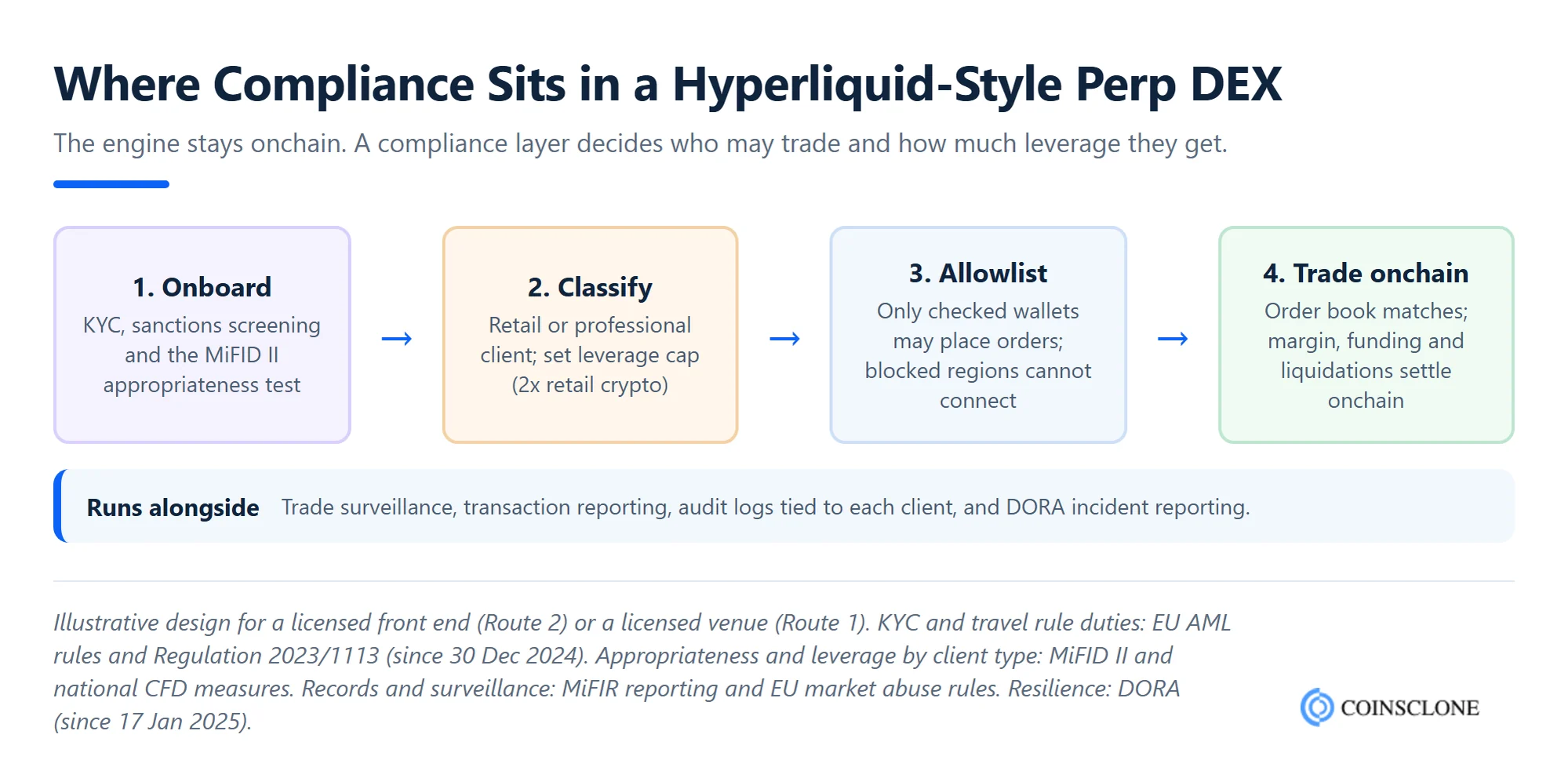
In this setup, a wallet can only trade once the firm adds it to an allowlist after KYC. The leverage limit for that wallet depends on whether the user is a retail or pro client. Trades still settle onchain, while the firm keeps the records watchdogs ask for.
Tech Stack for a MiCA-Compliant Perpetual DEX Like Hyperliquid
The right tech stack gives you speed, safety and room to adapt as rules change. Here is what most EU-ready perp DEXs use.
- Blockchain Networks: Hyperliquid runs its own chain, and many new perp DEXs use their own chain or a fast rollup. You can also launch markets on Hyperliquid through HIP-3, or use an EVM chain such as Arbitrum, BNB Chain or Base.
- Frontend and Backend Tech: React or Next.js for the trading app. Node.js, NestJS, Go or Rust for the backend, APIs and the matching engine.
- Smart Contracts: Solidity with Hardhat or Foundry for EVM contracts that handle margin, payouts and forced closes, with allowlist checks built in.
- Database and Cloud: PostgreSQL and a fast store for order and trade data, on AWS, Google Cloud or Azure, with backups and recovery plans that meet DORA.
- Compliance Tools: a KYC provider, a travel rule network, wallet screening and a trade monitoring tool.
- Outside Services: Chainlink or Pyth for price feeds, wallets such as MetaMask, and a stablecoin approved under MiCA, such as Circle’s USDC, for margin.
The right stack delivers a smooth trading experience and keeps you ready for new rules.
Want to see how Hyperliquid works? Read our Hyperliquid Architecture Explained guide to see what powers its speed and scalability.
Core Features of a MiCA-Compliant Hyperliquid-Like DEX
A MiCA-compliant Hyperliquid-like DEX joins fast onchain trading with the safeguards EU rules expect. These features matter most.
- On-Chain Order Book: fast, open trade execution for perps, even in volatile markets.
- Leverage Rules by Client Type: set lower caps for retail traders and higher caps for checked pro clients.
- Negative Balance Protection: the engine closes losing trades early, so retail traders never lose more than they put in.
- Advanced Risk Management: live margin checks, automatic forced closes and caps on open positions in each market.
- Allowlist and Geo-Blocking: only checked wallets can trade, and users from blocked regions cannot reach the app.
- Market Surveillance: real-time alerts for wash trading, spoofing and odd price moves.
- Security Setup: audited smart contracts, multisig admin keys and DDoS shields.
- User Disclosures: clear risk warnings, fees, funding rules and a Key Information Document for each product.
- Compliance Dashboard: one place for staff to review KYC, alerts, reports and audit logs.
Together, these features give users a fast platform they can trust, and give regulators the controls they look for.
Benefits of a MiCA-Compliant Perpetual DEX Like Hyperliquid
A perp DEX built on the rules brings real business value, not just legal safety.
- Access the European Market: an EU licence can be passported across the EU and EEA, so one approval opens a market of about 450 million people.
- Build User Trust: clear rules, loss limits and audits show users their funds are safe.
- Attract Institutional Investors: funds and trading firms prefer licensed venues with clear rules and records.
- Reduce Operational Risks: building the rules in from day one avoids forced shutdowns, fines and costly rebuilds.
- Create a Competitive Advantage: few venues offer perps to EU traders under a licence today, so early movers can stand out.
- Support Sustainable Business Growth: a flexible compliance layer lets you adapt when the MiCA review lands.
These benefits make compliance a growth tool, not just a cost.
Challenges in Building a MiCA-Compliant Perpetual DEX
Building a compliant perp DEX is harder than building a plain one. Here are the main challenges and how teams handle them.
Staying Open While Knowing Your Clients
You must know your clients and control access, yet keep the speed and openness of onchain trading. Most teams solve this with a licensed front end and an allowlist, and keep the engine and payouts onchain.
Lower Leverage Than Offshore Venues
EU retail traders can get at most 2:1 leverage on crypto CFDs, while Hyperliquid offers up to 40x on BTC. You win EU users with trust, fair fees, euro access and safety, not with leverage.
Implementing KYC Without Losing Users
ID checks, client tests and travel rule data add steps to sign-up. Keep the flow short, explain each step and let users finish checks on mobile.
Smart Contract Security
A perp DEX holds user margin in smart contracts, so a single bug can be costly. Run audits, offer a bug bounty and set up live monitoring. Keep uptime high, as DORA expects.
Clear Control and Reporting
Watchdogs want clear decisions, sound controls and full records. Automate reports where you can, and keep audit-ready files up to date.
Keeping Up With New Rules
The MiCA review could change how perps are classed in the EU. Keep your rules in modules, so you can change leverage caps, products or reports without stopping trading.
Cost and Timeline to Launch
Your timeline has two tracks that run side by side: the build and the licence.
- Build: at Coinsclone, a white label DEX launches in 5 to 7 weeks, and a standard custom DEX takes 10 to 14 weeks. Rule modules, such as KYC, allowlists and trade monitoring, add to the scope.
- MiCA CASP licence: 25 working days to check your file is complete, then 40 working days for the review.
- MiFID II licence: the watchdog has up to six months to decide once your file is complete.
Plan for capital, legal fees, audits and running costs on top of the build. For build costs and the full step-by-step process, see our guide on how to create a perpetual DEX like Hyperliquid.
Why Choose Coinsclone to Build a MiCA-Compliant Perpetual DEX Like Hyperliquid?
Crypto firms in Europe need perp DEXs with safe contracts, KYC and AML, leverage rules by client type and strong governance. Those features build user trust and draw in larger traders.
Coinsclone has been building crypto platforms since 2018, with 350+ platforms delivered for 200+ clients across 20 industries. As a skilled DEX development company, we offer a Hyperliquid clone script that you can extend with the compliance modules your licence needs. Our team handles design, build, audits and support after launch. We also work with your lawyers on the licence side. Whether you are building a new perp venue or upgrading one, we help you launch a platform that is ready for EU traders and for new rules.
Frequently Asked Questions
Does MiCA apply to perpetual DEXs?
Only in part. MiCA does not cover crypto that counts as a financial instrument, and perps are derivatives under MiFID II. MiCA still covers a perp DEX’s token, the stablecoins used as margin and any spot trading or custody it offers to EU users.
Are perpetual futures legal in the EU?
Yes, when a licensed firm offers them. Perps fall under MiFID II, and ESMA said in February 2026 that they are likely CFDs. Where they count as CFDs, retail traders get a 2:1 leverage cap on crypto, negative balance protection and standard risk warnings.
Is Hyperliquid regulated in the EU?
No. As of October 2026, Hyperliquid does not hold an EU licence for its perps. Its policy group has asked the EU to treat perps under MiFID II. EU exchanges such as OKX Europe list its HYPE token under MiCA.
What licence do you need to offer crypto perps in Europe?
You need a MiFID II licence, usually as a firm that runs a trading venue or deals with clients. One Trading, Kraken and Gemini all offer perps in the EU this way. If you also offer spot crypto trading or custody, you need a MiCA CASP licence too.
Build a MiCA-Compliant Perpetual DEX Like Hyperliquid — Faster & Smarter!
Perpetual DEX Development — built for the future of regulated decentralized trading.
- MiCA-Ready MVP System: Launch a perpetual DEX aligned with evolving EU compliance standards.
- Hyperliquid-Like Trading Engine: Deliver fast order execution, deep liquidity, and seamless perpetual trading
- Custom Branding & Market Setup : Launch under your brand with tailored trading pairs, fees, and platform features.
- Built-In Revenue Engine : Generate revenue through trading fees, liquidity programs, and premium trading services.
Get a free branded demo of your MiCA-compliant perpetual DEX within 48 hours — see the platform before making any investment.
Book a Free Demo to discover how our Hyperliquid Clone Script helps you go from idea to a regulated, MiCA-ready perpetual DEX in just 8 -12 weeks.
References: 1) ESMA public statement on perpetual futures and CFD measures (24 February 2026)
2) MiCA, Regulation (EU) 2023/1114 (official text)
3) MiFID II, Directive 2014/65/EU (official text)
4) Hyperliquid Trade App (official trading platform)