

Starting a crypto exchange is a licensing and liquidity problem wearing a software costume. The matching engine is the cheapest part to acquire, and it is not what kills new exchanges. This guide covers the seven decisions in the order that saves money, with the licence classes, capital requirements and timelines that apply in 2026.
Learn How to Start Your Own Crypto Exchange — the Fast, Smart Way!
Building a crypto exchange doesn’t have to take years. With our proven MVP System, you can go from idea to live exchange in weeks — not months.
- MVP Launch: Start with a ready-made exchange framework to go live 90% faster.
- Liquidity & Wallets: Instantly access pre-integrated trading, wallets, and liquidity pools.
- Branding & Customization: Launch under your own name, with your tokens and unique markets.
- Monetize: Earn from trading fees, token listings, staking, and more.
💬 Get a free branded demo of your exchange in just 48 hours — see your platform live before you invest a cent.
👉 Book a Free Demo to learn exactly how to start your own crypto exchange and go live in 8–12 weeks.
How to Start a Crypto Exchange in 2026
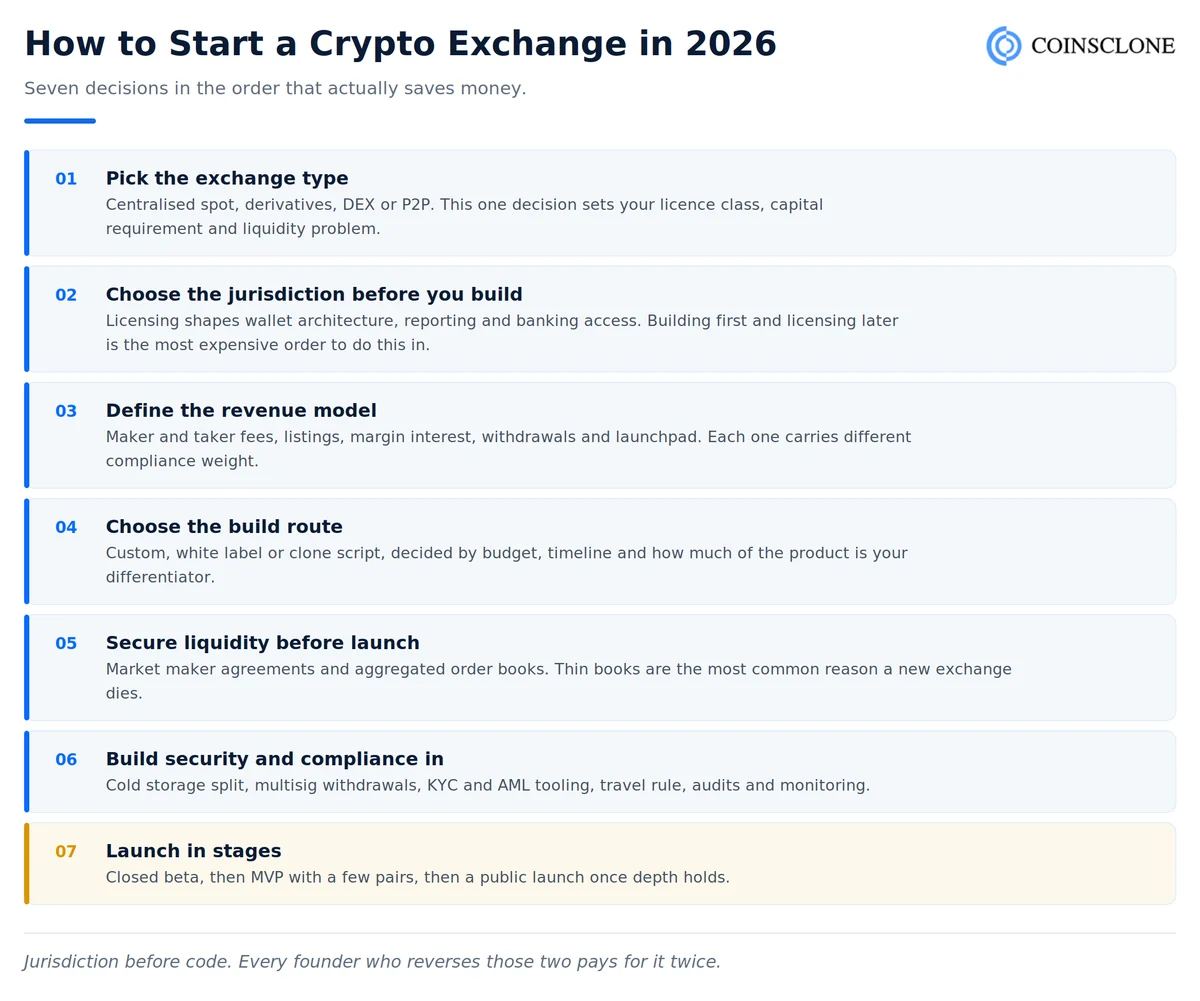
To start a crypto exchange you choose the exchange type, secure a licence in a jurisdiction that fits your target users, define the revenue model, pick a build route, contract liquidity, implement custody and compliance, then launch in stages. Doing these in order matters more than doing any one of them perfectly.
- Choose the exchange type, because it sets your licence class and capital requirement
- Choose the jurisdiction before writing code, since compliance shapes architecture
- Define the revenue model against realistic volume, not aspirational volume
- Choose the build route: custom, white label or clone script
- Contract liquidity before launch, not after
- Build custody, KYC and AML in rather than adding them later
- Launch in stages, from closed beta to a few pairs to public
Which Type of Cryptocurrency Exchange Should You Build?
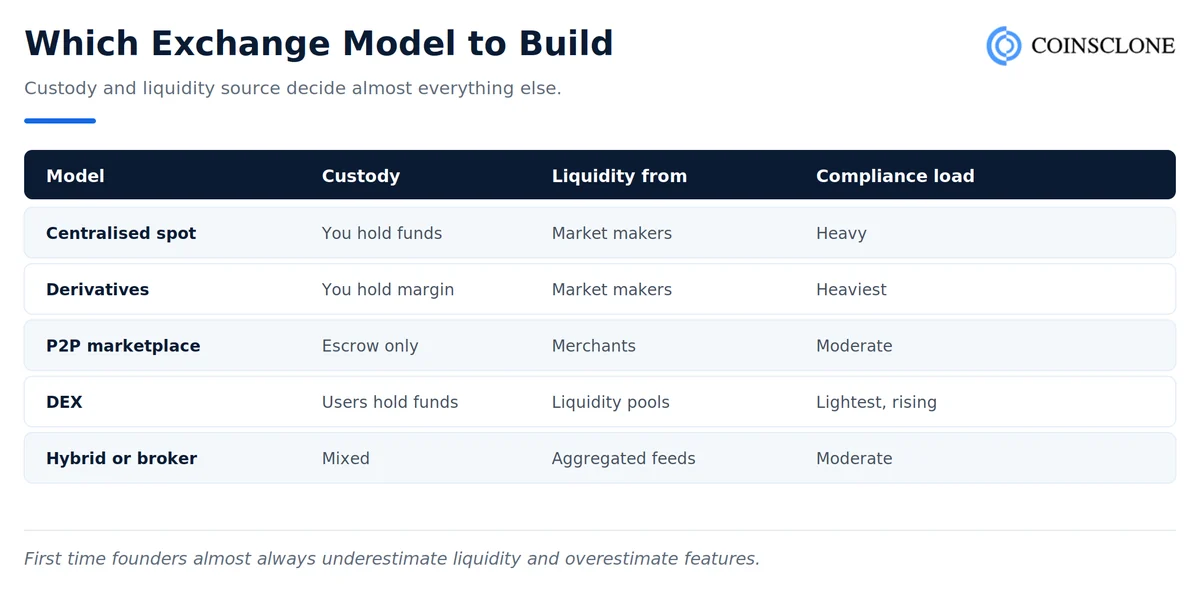
The choice is between a centralised spot exchange, a derivatives exchange, a P2P marketplace and a decentralised exchange, and it is decided by who holds custody and where liquidity comes from. Centralised spot is the usual starting point because the compliance and risk load is manageable.
- Centralised spot: you hold funds, liquidity comes from market makers, compliance is heavy but well mapped.
- Derivatives: highest revenue per user and the heaviest licensing and risk management load.
- P2P: you escrow rather than custody, liquidity comes from merchants, and the model works where banking rails are the real barrier.
- DEX: users hold their own funds and liquidity comes from pools, which removes custody risk and adds incentive design problems.
How to Create a Centralized Crypto Exchange
A centralized exchange needs a matching engine, custodial wallet infrastructure with a hot and cold split, KYC and AML tooling, fiat rails and an admin console, all under a licence that permits custody. The defining requirement is that you are holding other people’s money, which is what triggers most of the regulation.
- Custody obligations drive wallet architecture, so fund segregation has to be designed in from the start.
- Fiat deposits require a banking partner willing to serve a crypto business, which is often the longest lead item.
- Under MiCA, running a trading platform sits in the highest capital class at 150,000 euros.
How to Create a Decentralized Exchange
A DEX is built from smart contracts, a liquidity pool design and a front end, with no custody and no order book in the classic sense. The engineering is smaller and the economics are harder, because you have to pay for liquidity through incentives rather than contract it.
- Audited smart contracts are non-negotiable, and audits are a real line item.
- Liquidity provider incentives are an ongoing cost, not a launch cost.
- Regulatory treatment is tightening, and a front end operated by an identifiable team is increasingly treated as a regulated activity.
Crypto Exchange Licence Requirements in 2026
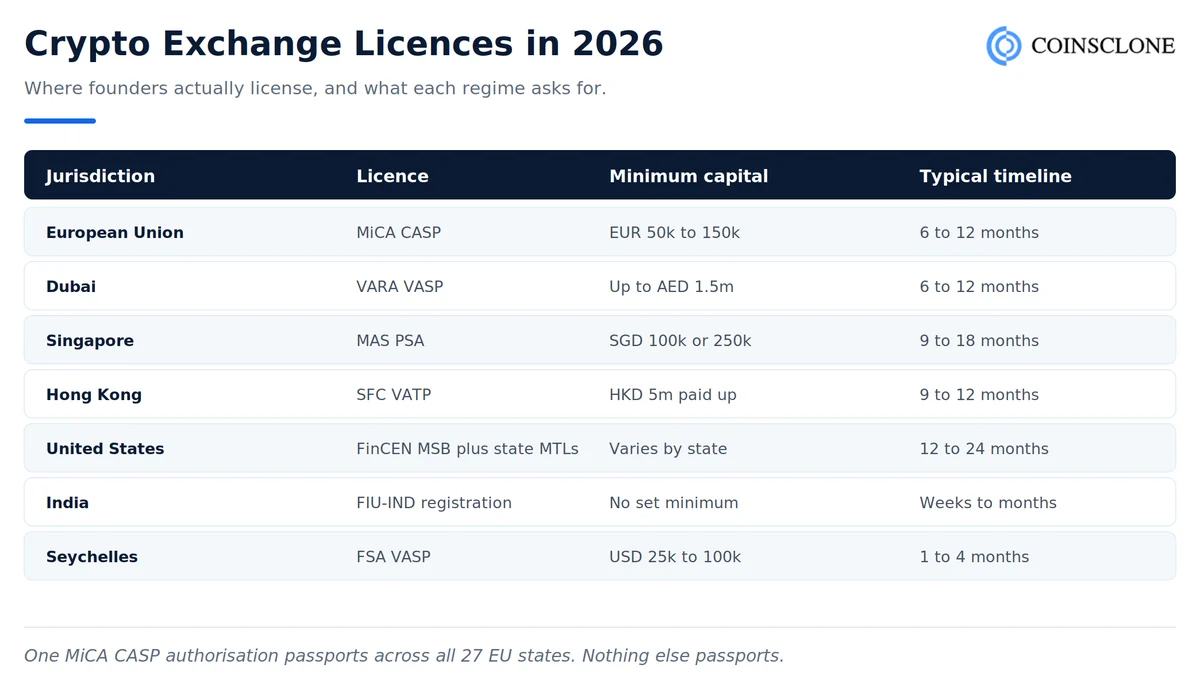
Licensing is the step that determines everything downstream, and the regimes are no longer interchangeable. The European Union’s MiCA is the only framework that passports, giving one CASP authorisation coverage across all 27 member states.
- European Union: MiCA CASP, with minimum capital of 50,000, 125,000 or 150,000 euros by service class, or a quarter of prior year fixed overheads if higher. The transitional window for firms operating under old national regimes closed on 1 July 2026.
- Dubai: VARA issues modular VASP licences, with capital requirements reaching AED 1.5 million for exchange and custody services.
- Singapore: MAS licences under the Payment Services Act, from SGD 100,000 for a standard payment institution to SGD 250,000 for a major payment institution.
- Hong Kong: the SFC VATP regime requires HKD 5 million paid up capital, and only around a dozen licences had been issued by early 2026.
- United States: FinCEN MSB registration plus money transmitter licences state by state, with New York’s BitLicense and California’s DFAL as separate regimes.
- India: registration with FIU-IND as a reporting entity under the PMLA, with no separate exchange licence.
How to Register a Cryptocurrency Exchange
Registering an exchange means incorporating a local entity, appointing a resident director and a local AML officer, documenting your compliance programme, and submitting to the regulator with proof of capital. Local substance is now close to universal, so a mailbox company no longer clears most regimes.
- Expect to show a physical office, a resident officer and a named compliance function.
- Regulators assess your AML programme, custody model and technology governance, not just your paperwork.
- Most operating exchanges end up holding two or three licences across their target markets rather than one.
How to Start a Cryptocurrency Exchange in the USA
Serving US users means FinCEN MSB registration at the federal level plus money transmitter licences in each state you operate in, which is the longest and most expensive path in this guide. New York and California run their own separate regimes on top.
- State by state licensing commonly runs 12 to 24 months and is the reason many founders start elsewhere.
- Surety bonds, minimum net worth and examination requirements vary by state.
- A realistic US strategy is a phased state rollout rather than a national launch.
How to Start a Cryptocurrency Exchange in India
In India an exchange registers with the Financial Intelligence Unit as a reporting entity under the Prevention of Money Laundering Act, and there is no separate exchange licence to obtain. The build must handle 1% TDS deduction and Schedule VDA ready reporting from day one, because those are what users judge you on.
- FIU-IND registration is the legal test of whether a platform may serve Indian users.
- INR rails through UPI, IMPS, NEFT and RTGS decide whether users can fund an account at all.
- Gains are taxed at a flat 30% with no loss set off, which shapes how Indian users trade and therefore your volume assumptions.
Cryptocurrency Exchange Business Model
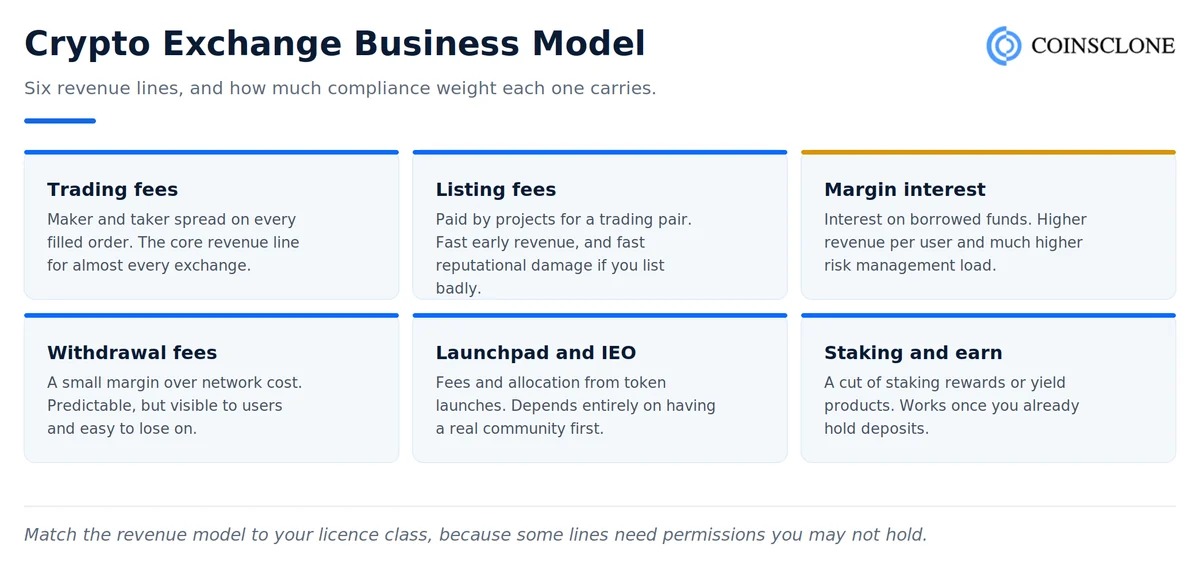
Exchanges earn from maker and taker trading fees, token listing fees, margin interest, withdrawal fees, launchpad allocations and staking products. Trading fees are the core line, and everything else depends on having volume first.
- Trading fees scale with volume, which means they depend entirely on liquidity.
- Listing fees give fast early revenue and can cost you credibility just as fast.
- Margin and derivatives generate more revenue per user and require risk systems most first-time teams do not have.
- Some revenue lines need permissions your licence class may not cover, so check before you plan around them.
Cryptocurrency Exchange Business Plan
A crypto exchange business plan needs five things a generic template will not give you: the licence you are applying for, your liquidity sourcing plan, your realistic volume assumptions, your capital runway, and your fiat banking route. Investors and regulators both read for these.
- Regulatory plan: target jurisdiction, licence class, timeline and the compliance team behind it.
- Liquidity plan: which market makers, on what terms, and what depth you are committing to at launch.
- Financial model: volume assumptions tied to a real acquisition plan, not a percentage of global trading volume.
- Runway: most exchanges need 12 to 24 months of operating cost before revenue stabilises.
How to Develop a Cryptocurrency Exchange
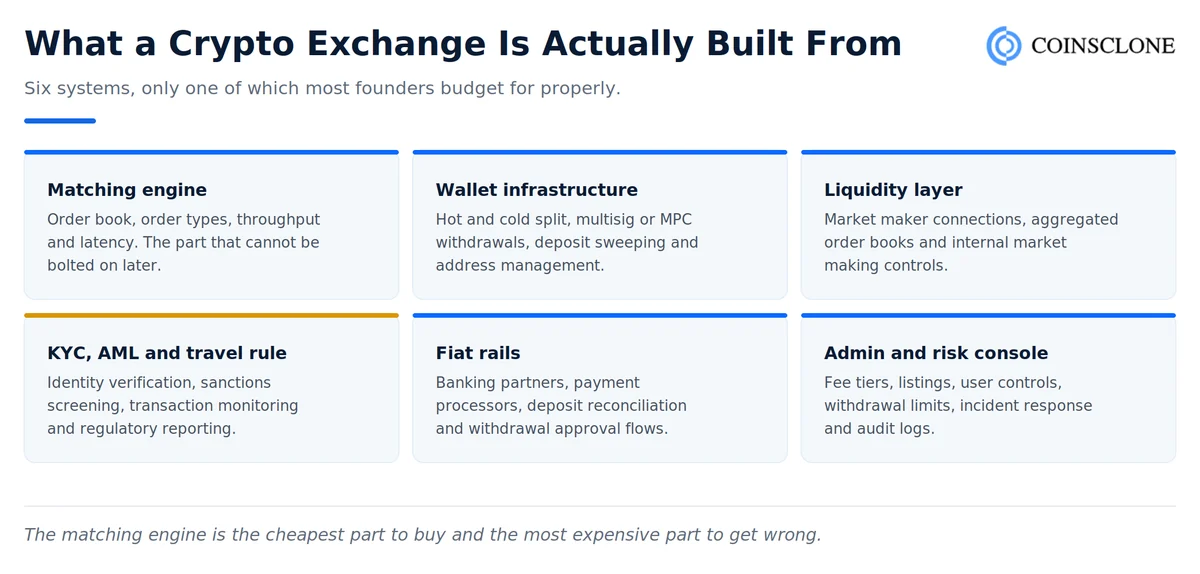
A crypto exchange is six systems: a matching engine, wallet infrastructure, a liquidity layer, KYC and AML tooling, fiat rails and an admin and risk console. Founders routinely budget for the first and underestimate the other five.
- The matching engine handles the order book, order types and throughput, and it cannot be replaced later without downtime.
- Wallet infrastructure covers the hot and cold split, multisig or MPC withdrawal approvals and deposit sweeping.
- The admin console is where fee tiers, listings, withdrawal limits and incident response actually live.
White Label, Clone Script or Custom Build
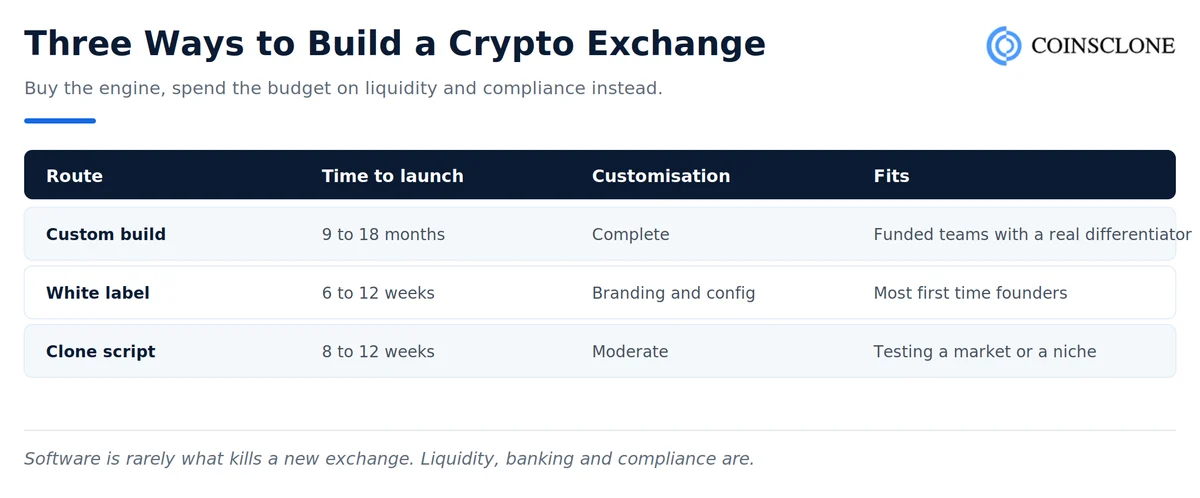
White label software launches in roughly 6 to 12 weeks with branding and configuration level customisation, a clone script takes a similar time with more room to modify, and a custom build takes 9 to 18 months with complete control. Most first-time founders should buy the engine and spend the saved budget on liquidity and compliance.
- Custom: justified when the exchange itself is your differentiator and you are funded to prove it.
- White label: the default for a first launch, because it converts an engineering problem into a configuration one.
- Clone script: suits testing a specific market or niche before committing to a platform build.
How to Build Liquidity for a New Exchange
New exchanges source liquidity from contracted market makers, aggregated order books from larger venues, and eventually their own users. Nothing else on this list matters if the first trades quote a wide spread, because traders leave and do not come back.
- Market maker agreements should specify spread targets, uptime and depth at defined price levels, not just a monthly fee.
- Aggregated liquidity from a larger venue is the fastest way to show depth on day one.
- Launch with a small number of pairs so the depth you do have looks credible, then expand.
Cost to Start a Crypto Exchange
The cost is driven by four things: licence and legal substance, software route, liquidity commitments and the first 12 to 24 months of operating cost. Published year one figures range from under 10,000 dollars for a minimal offshore structure to well over a million for a fully licensed US launch, with institutional grade licensing commonly cited at 250,000 to 500,000 dollars in legal and substance alone.
- Licence cost varies more than any other line, from tens of thousands offshore to seven figures in New York.
- Software is the most predictable cost and usually the smallest of the four.
- Ongoing costs run roughly 30% to 50% of year one spend annually, covering compliance, hosting, liquidity and support.
How Long Does It Take to Launch a Crypto Exchange?
The software is rarely the constraint. A white label platform can be live in 6 to 12 weeks, while licensing runs from about a month in the fastest offshore regimes to 24 months for a US or UK route, so the licence timeline sets the launch date.
- Run licensing and development in parallel rather than in sequence.
- Banking relationships often take longer than expected and should start early.
- Build the compliance stack during development, because retrofitting it is the most common cause of delay.
Common Mistakes When Starting a Crypto Exchange
The recurring failures are predictable: building before licensing, underestimating liquidity, over-spending on features, and planning for profitability in year one. Almost none of them are technical.
- Building first: compliance requirements change wallet architecture and reporting, so retrofitting is expensive.
- Thin liquidity: traders judge execution above all else and leave quickly.
- Feature sprawl: validate demand before funding a custom build.
- Optimistic runway: most exchanges need 12 to 24 months before revenue stabilises.
Frequently Asked Questions
Do I need a licence to start a crypto exchange?
In most jurisdictions yes, especially if you handle fiat or hold customer funds. Some offshore regimes allow a registration rather than a full licence, but that limits banking access and user trust.
How much liquidity do I need to start?
There is no fixed figure. What matters is depth at the spread traders actually trade on, which is why new exchanges contract market makers with defined spread and depth commitments rather than a lump sum.
When does a crypto exchange become profitable?
Most exchanges need 12 to 24 months for revenue to stabilise, and profitability depends on trading volume, fee structure and how disciplined you are about operating cost.
Can I start small and scale later?
Yes, and it usually works better. A small pair list with credible depth beats a long pair list with thin books, and you can add pairs as liquidity supports them.
Do I need banking partnerships before launch?
If you support fiat deposits, yes, and it is often the longest lead item in the whole project. Crypto-only launches can defer it, but should still plan the route.
What team do I need to run a crypto exchange?
Beyond engineering, you need a compliance officer, customer support, a liquidity manager and security operations. Legal and risk functions get added as volume grows.
Learn How to Start Your Own Crypto Exchange — the Fast, Smart Way!
Building a crypto exchange doesn’t have to take years. With our proven MVP System, you can go from idea to live exchange in weeks — not months.
- MVP Launch: Start with a ready-made exchange framework to go live 90% faster.
- Liquidity & Wallets: Instantly access pre-integrated trading, wallets, and liquidity pools.
- Branding & Customization: Launch under your own name, with your tokens and unique markets.
- Monetize: Earn from trading fees, token listings, staking, and more.
💬 Get a free branded demo of your exchange in just 48 hours — see your platform live before you invest a cent.
👉 Book a Free Demo to learn exactly how to start your own crypto exchange and go live in 8–12 weeks.
Build Your Crypto Exchange with Coinsclone
Coinsclone builds crypto exchanges for founders who would rather spend their budget on licensing and liquidity than on rebuilding a matching engine. Our work covers the trading engine, wallet and custody architecture, liquidity integration, KYC and AML tooling, fiat rails and the admin and risk console, delivered as custom, white label or clone based builds.
We start from a live demo rather than a proposal document, so you can see the platform before committing. Talk to our team about your target market, licence route and launch timeline, and we will map the fastest path to going live.