

We are all impressed by the success of crypto exchanges, but the true hero behind them is blockchain. It is a shared ledger that many machines keep in sync, so no one party can change a record in secret. Without that clear and tamper-proof base, crypto apps simply could not work the way they do today. If you want to know how to build a blockchain application, this guide walks you through the whole path, from the first “do we even need a blockchain?” check to launch and upkeep.
You will learn how a blockchain app works under the hood, how to pick a chain and a tech stack that fit your idea, and how long each type of build takes. The market is moving fast, too: MarketsandMarkets puts the blockchain market at USD 54.08 billion in 2026, rising to about USD 611 billion by 2031. So it pays to plan well before you write a line of code.
In this guide:
- A quick test to see whether your idea needs a blockchain at all
- The parts of a blockchain app and how they talk to each other
- A 7-step build plan, with the 2026 tools teams actually use
- How to choose between Ethereum, layer 2s, Solana, Hyperledger Fabric and Corda
- Real build timelines in weeks, plus what drives the cost
How to Build a Blockchain Application
Here is the short answer. To build a blockchain application, you:
- Define the problem: confirm that several parties need to share records they cannot change on their own.
- Pick the chain: choose a public, private, hybrid or group (consortium) blockchain, then a platform.
- Study rivals: see what similar apps offer and where they fall short.
- Design the app: plan the screens, the smart contracts and what data lives on chain or off chain.
- Build and test: write the smart contracts, the front end and the back end, then test in stages.
- Audit and deploy: get the code checked, launch on a test network, then go live.
- Maintain: watch, patch and upgrade the app as the chain and your users change.
The rest of this guide explains each step in detail. First, though, it helps to know what a blockchain app is and how it works.
What Are Blockchain Applications?
When most people talk about blockchain, they think of crypto, right? But there is way more to it, especially when it comes to building apps. A blockchain application is a program whose key records and rules live on a network of many computers instead of just one. Because of this, it is very hard for anyone to change or hack the data. Each new batch of records goes into a “block”, which is sealed with a unique code and linked to the block before it.
These apps now show up in all sorts of fields, like finance, health care and shipping. One great feature they often have is smart contracts. A smart contract is code on the chain that runs by itself when set terms are met, so no middleman is needed. It saves time, cuts mistakes and builds trust. Apps that run their main logic through smart contracts are often called dApps (decentralized apps).
How Does a Blockchain Application Work?
The special feature of a blockchain network is that every member shares the same data, sorted into a chain of ordered blocks. Each block’s data is run through a hash function, which turns it into a unique code called a hash. Think of the hash as a fingerprint for the block. If anyone changes even one letter inside the block, the hash changes, so tampering is easy to spot.
Additionally, each block holds the hash of the block before it, which links them together in a chain. That link is what makes blockchain so secure: to fake one old record, an attacker would have to redo every block after it, on most of the network, at once. The very first block, known as the “genesis block”, is unique because it has no block before it to point to.
What a Blockchain App Is Made Of
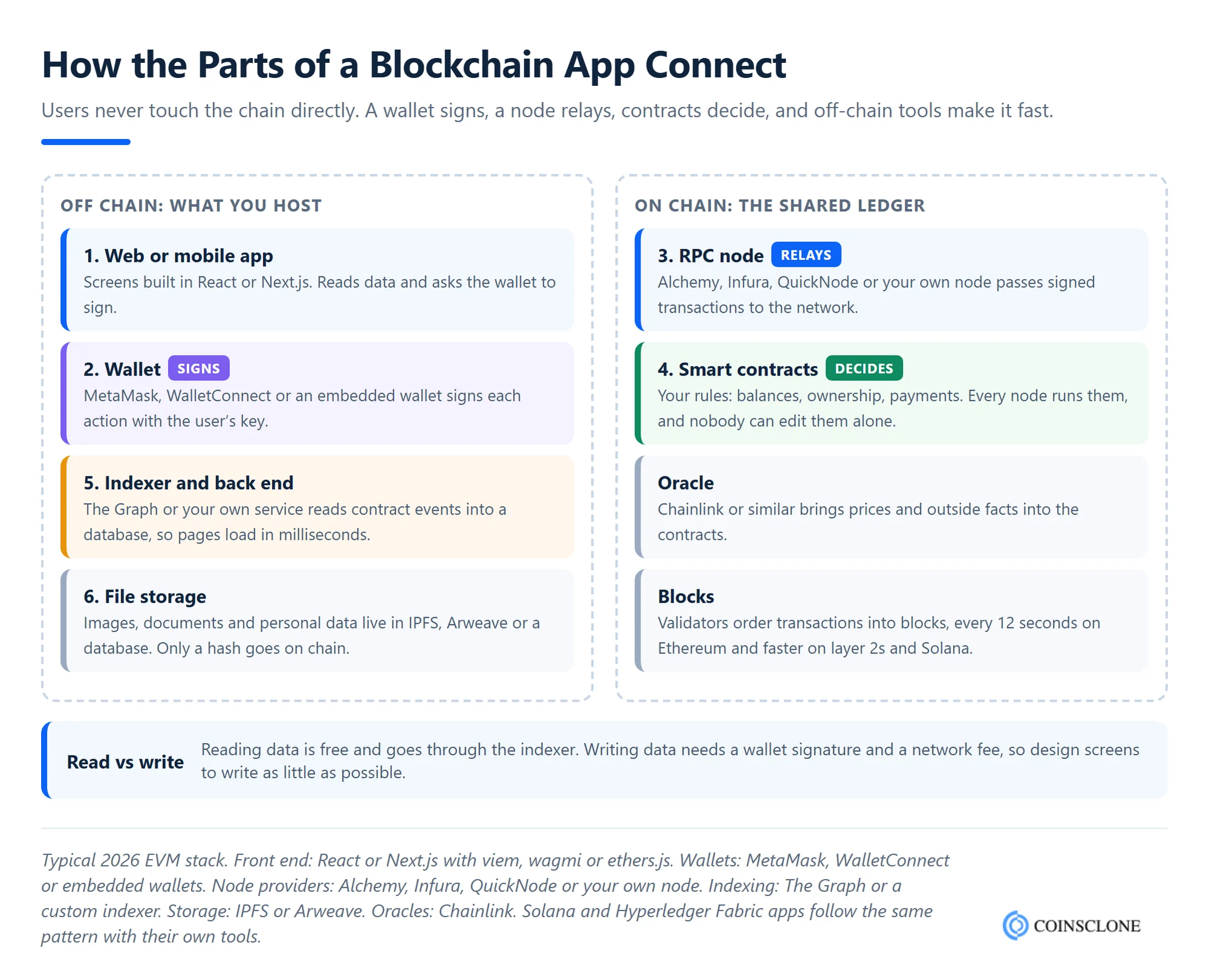
A real app is more than a chain. Users click buttons on a normal web or mobile screen. A wallet signs their actions. A node provider passes the signed transaction to the network, and smart contracts run the rules. Around that core sit tools that read data back quickly and store big files cheaply. The diagram below shows how these parts fit together.
Transaction Process
Here is what happens when you send a transaction on Bitcoin’s blockchain from your crypto wallet. First, the transaction goes to the memory pool (mempool), where it waits until a miner picks it up. The miner then bundles it with others into a new block and starts mining, which means racing to find a valid hash for that block.
To do this, miners add a changing number called a nonce and hash the block again and again. They keep adjusting the nonce until the hash falls below the target the network sets. Once a miner finds it, the block joins the chain and the transaction gets its first confirmation. Bitcoin aims for one block about every 10 minutes, and many exchanges wait for several more blocks before they treat a payment as final.
Most apps today run on proof of stake chains instead of mining. Ethereum, for example, moved to proof of stake in 2022. Validators there lock up ETH as a stake and take turns proposing a block every 12 seconds. The idea stays the same: the network agrees on one order of blocks, and nobody can rewrite it alone.
Now let us see how to develop a blockchain app, step by step.
How to Build a Blockchain Application: 7-Step Tutorial for Beginners
To build a blockchain application, you first need to be clear on its purpose and the problem it solves. Next, you choose a blockchain platform that suits your project, design the smart contracts and plan your security. After that, you build, test, audit and launch, then keep the app healthy over time. Here is a detailed breakdown of the seven main steps:
- Analyze the industry and confirm you need a blockchain
- Choose the right blockchain type and platform
- Do competitor research
- Design your blockchain app
- Development and testing
- Audit and deployment
- Maintenance and support
Step 1: Analyze the Industry and Confirm You Need a Blockchain
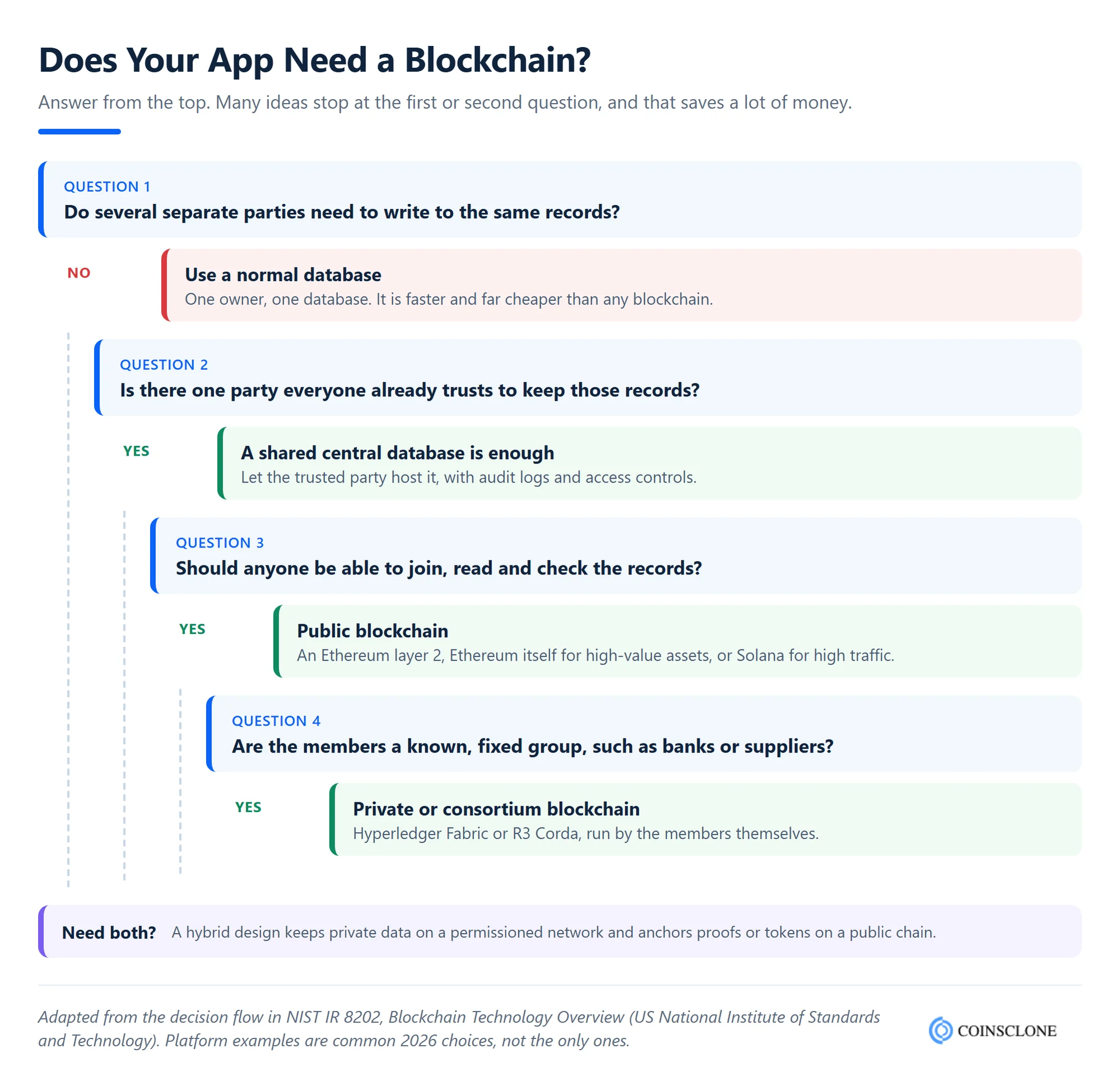
Start with one blunt question: does this idea really need a blockchain? A shared ledger is slower and costs more to run than a normal database. It earns its place only when several parties must write to the same records and none of them should control those records alone. The US standards body NIST makes the same point in its blockchain technology overview. The decision tree below turns that advice into four quick questions.
If the answer is yes, look at how your industry already uses blockchain. Numerous fields use it today, such as gaming, banking and finance, insurance, health care, real estate and supply chains. Our guide to the use cases of blockchain goes deeper, but here is a quick tour.
Gaming
Gaming has grown from a hobby into a pro sport with real money at stake. Blockchain lets players truly own in-game items as tokens, trade them freely and prove that rare items are rare. Sky Mavis (Axie Infinity and the Ronin chain), Dapper Labs (NBA Top Shot and the Flow chain) and Animoca Brands (The Sandbox) are well-known blockchain gaming firms.
Real Estate
Buying and selling property often carries the risk of piles of paperwork, fraud and errors in public records. With blockchain, a real estate business can cut down on paper records. The chain helps record, track and transfer land titles while keeping them accurate and easy to check. Propy and ChromaWay are two firms that have used blockchain for property deals and land records.
Healthcare
The hardest part of health care data is that many separate systems store it. These systems hold private details about patients, which makes them a prime target for attacks. A shared ledger lets clinics, labs and drug makers check records without handing all the raw data to one central store. In the US drug supply chain, for example, blockchain networks help firms meet tracing rules under the DSCSA, as our guide to blockchain in pharmacy explains.
Banking and Finance
For clear records, speed and ease of use, the finance sector leans on blockchain apps. Payments, clearing and settlement can all run faster on a shared ledger. JPMorgan runs its blockchain payments arm under the name Kinexys, and BlackRock launched its tokenized fund BUIDL on Ethereum in March 2024. Visa and Stripe also move money with stablecoins on public chains, and Western Union launched its own USDPT stablecoin on Solana in 2026.
Supply Chain
Blockchain is now part of supply chain work too. When many firms work together, a shared ledger can track and show every step, which makes the whole chain clear. Imagine a restaurant that wants to know where its meat comes from. With blockchain, it can trace the history of each cut it serves. Farming, shipping and fashion brands use the same idea to track their goods. Walmart, for one, has used Hyperledger Fabric to trace food from farm to shelf.
Step 2: Choose the Right Blockchain Type and Platform
Next, choose the type of blockchain that suits your business. Based on who can join and who confirms the data, blockchains come in 4 types:
1. Permissionless blockchain (public): Anyone can join, send transactions and help verify them, often without sharing who they are. Bitcoin and Ethereum are public blockchains.
2. Permissioned blockchain (private): Only approved users can access it, and a set of rules governs the deals between members. Firms mostly prefer private blockchains for internal use. Our guide to private blockchain development covers this path in depth.
3. Hybrid blockchain: Some firms take the best of both. In this setup, you control who can see certain data, while other data stays open to the whole network.
4. Consortium blockchain: Also called a federated blockchain, it is shared by a set group of firms, such as banks in one market. A handful of chosen nodes (validators) start, receive and confirm transactions.
Once you know the type, pick the platform. The table below compares the main options in 2026.
| Platform | Type | Smart contract language | Best fit |
| Ethereum | Public | Solidity, Vyper | High-value DeFi, tokens and assets that need the most trusted chain |
| Ethereum layer 2s (Arbitrum, Base, Optimism) | Public | Solidity | Consumer apps that need Ethereum security at a few cents or less per action |
| Solana | Public | Rust (Anchor) | Fast trading, payments and games with heavy traffic |
| BNB Chain, Polygon PoS | Public | Solidity | Low-fee apps aimed at large retail user bases |
| Hyperledger Fabric | Private / consortium | Go, Java, JavaScript | Supply chains and business networks with known members |
| R3 Corda | Private / consortium | Kotlin, Java | Banks, trade finance and insurance |
Layer 2 networks bundle many transactions and post them to Ethereum in one go. Since the Dencun upgrade in March 2024 and the Fusaka upgrade in December 2025, the cost of posting that data has dropped sharply. As a result, most new consumer apps on Ethereum now launch on a layer 2.
There are also two ways to get a chain under your app:
Craft a New Blockchain
This choice lets you build a new chain where you control every part, from how nodes agree to how payments work. Despite the high cost, it gives you the most freedom. Today, teams that want their own chain often launch an app chain or rollup from a ready kit, such as the OP Stack, Arbitrum Orbit or Cosmos SDK, instead of writing a chain from zero.
Build on a Leading Blockchain Platform
The more common way is to build on a well-known blockchain. You put your smart contracts on a live network such as Ethereum, a layer 2 or Solana, and you get its safety and users for free. If you need a private network, you can also fork an open-source codebase, like Hyperledger Fabric or Corda, and run it on your own servers. How strong a network is depends on how many independent nodes check its transactions.
Step 3: Do Competitor Research
After planning, look at your rivals and find out what they are up to. This shows you the common features users expect and where current apps fall short. List their strengths and weaknesses, read their user reviews and try their apps yourself. Social media like LinkedIn, X and Discord can help you spot rivals and hear what users complain about. On public chains, you can even read their contracts and usage on a block explorer like Etherscan. This is an important step before you design anything.
Step 4: Design Your Blockchain App
Now design your blockchain application. It might start as a written concept or a clickable prototype. A written concept explains how the product will be used, so that users and backers can judge whether it is useful and doable. After you collect feedback on it, you build a prototype that includes:
- Drawings
- Mock-ups
- Tested information layout
- Product designs
Then design the APIs that link the screens to the back end. At this stage, also make three choices that are hard to change later:
On-chain vs off-chain data: Every byte stored on a public chain costs fees and stays public forever. Keep balances, ownership and rules on chain. Put large files and personal data off chain, in a database or in storage like IPFS or Arweave, and store only a hash on chain as proof.
Upgrades: Smart contracts cannot be edited once deployed. If you need to fix bugs later, plan how to upgrade from day one, such as the proxy patterns in OpenZeppelin’s upgrade docs. Then guard the upgrade key so that several people must sign, with a time delay.
User onboarding: New users struggle with seed phrases and gas fees. Smart accounts and embedded wallets let people sign in with an email or passkey, while your app pays their gas.
Step 5: Development and Testing
In this phase, you write the smart contracts, build the front end and back end, and connect them. Here is the tech stack most teams use in 2026:
- Smart contract languages: Solidity or Vyper on Ethereum and EVM chains, Rust on Solana, Move on Aptos and Sui, Go or Java for Hyperledger Fabric chaincode.
- Contract frameworks: Hardhat and Foundry for writing, testing and deploying. Truffle and Ganache were retired by Consensys in 2023, so skip old tutorials that use them.
- Contract building blocks: OpenZeppelin Contracts for tested token, access and upgrade code, so you do not rewrite the basics.
- Front end: React or Next.js, with viem, wagmi or ethers.js to talk to the chain.
- Wallets: MetaMask, WalletConnect and other common wallets for sign-in and signing, or embedded wallets for new users.
- Back end and data: Node.js, Go or Python code, a node host such as Alchemy, Infura or QuickNode, and The Graph or your own tool to read chain data fast.
- Oracles and storage: Chainlink for price feeds and outside data, IPFS or Arweave for files.
If your app runs its logic through smart contracts, our smart contract creation guide covers that part in detail. For dApps that move money, such as lending, swaps or yield, our DeFi and dApp development team builds and audits the full stack.
Moreover, a blockchain app is built and released in several versions. That makes the testing ladder a big part of the work:
Pre-alpha: First, there is the version that has not yet had formal testing. Once the client approves it, it moves to alpha. Here, developers test the code with white-box methods, meaning they test with full sight of the code.
Alpha: In this version, the team runs unit tests and fuzz tests on the smart contracts, on a local chain and then on a public test network such as Sepolia. Fuzz tests throw thousands of random inputs at the code to find edge cases.
Beta: Once the alpha passes, the app moves to beta. It now has the full feature set but may still have unknown bugs. The team shares it with a group of real users outside the company to test how it works in practice.
Release candidate: Once the beta is approved, the team freezes the code into a release candidate. This is the build that goes to the auditors and then to launch.
Our guide to blockchain testing services explains each test layer, from unit tests to load tests.
Step 6: Audit and Deployment
Before launch, get your smart contracts audited by an outside security firm, and fix every issue it finds. This step matters more than any other. Chainalysis counted $3.4 billion in crypto stolen in 2025. The biggest single loss, about $1.5 billion from the Bybit exchange in February 2025, came through a tampered signing screen, not a contract bug. The FBI tied that attack to North Korea. So secure the whole app: contracts, admin keys, servers and the screens people sign on.
After the audit, deploy the app to a test network first to check every feature with real wallets. Then deploy the contracts to the main network, verify the source code on the block explorer and publish the contract addresses. The admin manages the release of each app version. If your app is a hybrid, with parts on chain and parts off chain, you also deploy the back end to a cloud server and the mobile apps to the App Store and Google Play.
Finally, check the rules where you launch. If your app handles crypto for users in the EU, the MiCA regulation has applied in full since 30 December 2024. In the US, the GENIUS Act set federal rules for payment stablecoins in July 2025. Rules like these can shape your sign-up flow, custody design and data storage, so plan for them early.
Step 7: Maintenance and Support
This phase covers updates to the OS, tools and code packages, new features and changes that fit your needs as they grow. It also means fixing tech issues, watching the contracts for odd moves and keeping an emergency pause ready. Chains upgrade too, so test your app against each major network upgrade before it goes live. Maintenance and support are key to the long-term success of any blockchain app.
Overall, plan for real server costs. If you run your own Ethereum node instead of renting one, ethereum.org lists a 2 TB NVMe SSD as the floor and 4 TB as the safer size. Now you know how to build a blockchain application. You may still wonder what the business gains are, so read on.
Business Benefits of a Blockchain App
There are several solid advantages to building a blockchain app. Let us uncover the top perks.
Public Verification
A key perk of a public blockchain is that anyone can check its records. People anywhere can view the activity on the chain, which builds trust between parties who have never met.
Transparency
Clear records come from logging every deal in a shared ledger. This helps prevent fraud and corruption, because anyone can trace a transaction and confirm it is real.
Privacy
Blockchain can also protect privacy. On Bitcoin, for instance, users send funds from addresses instead of names. Private and consortium chains go further and show each record only to the members who need it.
Immutability
Blockchain uses cryptography to block unwanted changes and keep transactions secure. Once data is added to the chain, it cannot be deleted or altered.
Easy Transactions
Blockchain makes transactions simple by cutting out middlemen. This helps a business lower costs, speed up its work and settle deals in seconds or minutes instead of days.
Cryptocurrency Exchange
Blockchain-based crypto apps offer a safe way to buy and sell crypto fast. Blockchain helps teams build easy-to-use apps with low fees and quick transactions.
High Security
Strong cryptography protects each user’s transactions, and a blockchain blocks people who are not allowed to join the network. Because the data is spread across many nodes, there is no single server for an attacker to take down.
So, impressed by the benefits above? Let us find out how long a build takes and what it costs.
How Long Does It Take to Build a Blockchain Application?
Build time depends far more on scope than on the chain you pick. A white label product, where the core is already built and tested, can launch in weeks. A custom app built from scratch takes months, because every contract needs fresh code, tests and an audit. The chart below shows the build times Coinsclone publishes for its main product types.
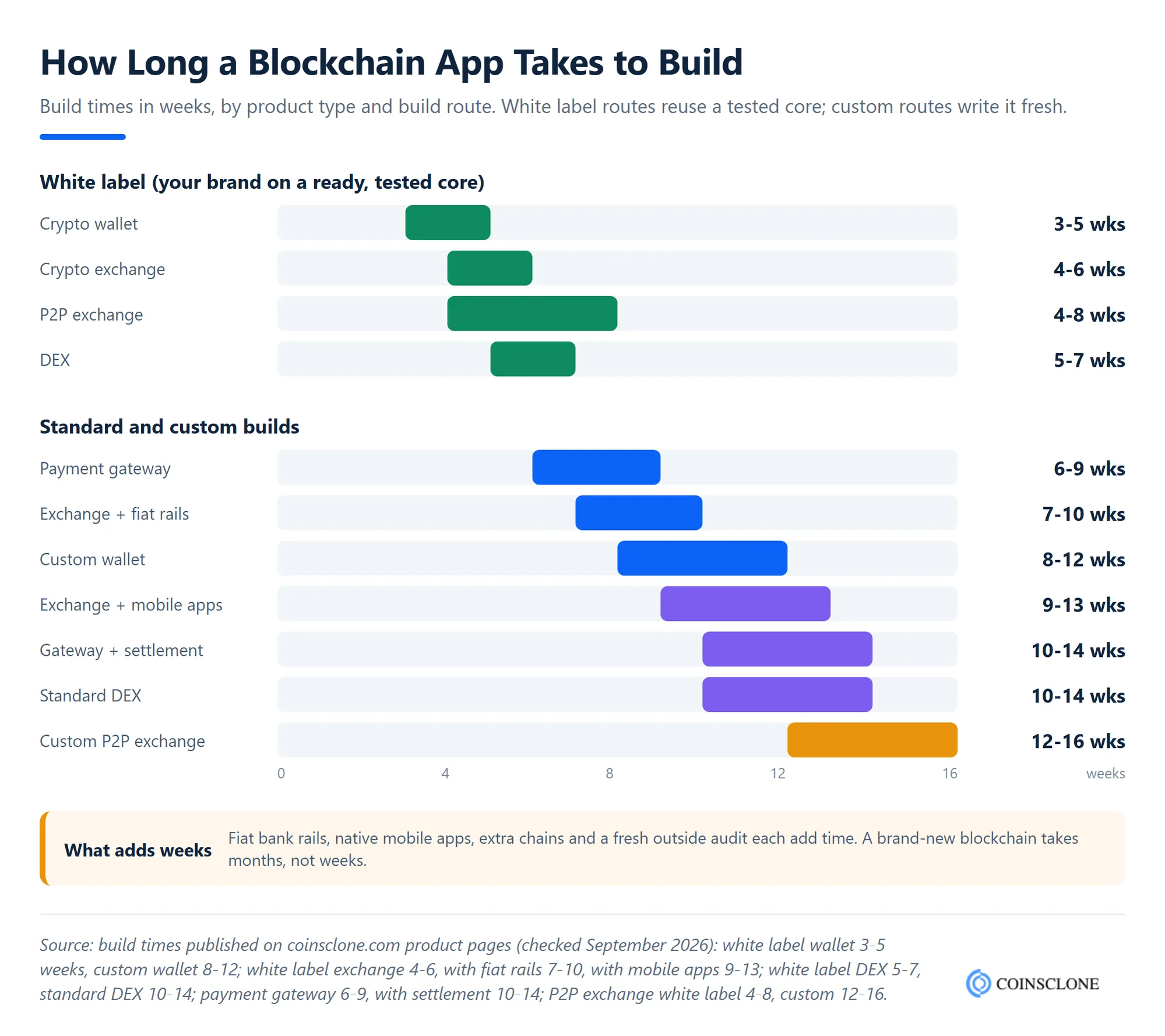
In short, a white label product with your brand can go live in about 3 to 8 weeks. A standard custom build usually takes 8 to 14 weeks. Each extra layer, such as fiat bank rails, mobile apps or a fresh audit, adds a few weeks on top.
How Much Does It Cost to Build a Blockchain Application?
The cost of a blockchain app depends on several factors, such as:
- The type of app you are building
- How complex the features are
- The blockchain platform you choose
- Outside services, like node hosts, KYC checks and data feeds
- Smart contract audits, which are a must for any app that holds user funds
- The number of platforms you target (web, iOS, Android)
- Where your build team is based
Here are some examples of blockchain projects by level of difficulty:
- Low complexity: Payment apps and single smart contracts, such as a token.
- Medium complexity: dApps on an existing chain, hybrid apps with parts on chain and off chain, and white label platforms.
- High complexity: A new blockchain or app chain built from scratch, or a full DeFi protocol with many linked contracts.
Running costs matter too. On a layer 2 or Solana, each user action often costs a cent or less in network fees, while Ethereum mainnet costs more and swings with demand. You will also pay for node access, cloud hosting, fast data reads and safety checks. For a full breakdown by app type and build stage, see our guide on how much blockchain app development costs.
Overall, building a blockchain app with an in-house team is the most expensive route. It gives you full control over the build, so firms with deep pockets can choose it. If not, a wise choice is to hire blockchain developers from a team that has shipped apps like yours, which keeps your budget and time plan in check.
Final Thoughts
In the fast-moving world of blockchain, turning your crypto idea into a real product takes the right mix of skill and fresh thinking. As you set out on this journey, let Coinsclone be the compass that guides you. Since 2018, Coinsclone has delivered 350+ platforms for 200+ clients across 20 industries, from exchanges and wallets to payment gateways, tokens and DeFi apps. From smart contract code to easy-to-use design, our team shapes your blockchain app so your firm can grow on solid ground. So why settle for plain when you can build something great? Let Coinsclone be the builder behind your blockchain app.
Invest in Innovation – Build Your Blockchain Application With Coinsclone
Cost-effective, White-Label Solution, Premium Features, and Customizable.
Frequently Asked Questions
How do you build a blockchain application?
Start by confirming that your idea needs a shared, tamper-proof ledger. Then pick a blockchain type and platform, study your rivals and design the app. After that, write and test the smart contracts, front end and back end. Finally, get an outside audit, launch on a test network, go live and keep the app maintained.
What programming language is used to build blockchain apps?
It depends on the chain. Solidity is the main language for Ethereum and other EVM chains, with Vyper as an option. Solana uses Rust, Aptos and Sui use Move, Hyperledger Fabric uses Go, Java or JavaScript, and Corda uses Kotlin or Java. The front end is most often built in JavaScript or TypeScript with React.
What factors beyond technical specs influence blockchain platform selection?
Factors like community support, rules in your market and how mature the tools and wallets are all shape the choice. Also weigh the fees your users will pay and the number of active users already on that chain.
What challenges arise in testing beta versions of blockchain apps and how are they addressed?
The main challenge is finding unknown bugs before real money is at stake, since contracts cannot be edited after launch. Teams handle this with repeated testing rounds, fuzz testing, public test networks, user feedback loops and an outside audit before release.
How much does it cost to develop a blockchain application?
The cost depends on the app type, features, chain, audits and the number of platforms you target. A white label product costs far less than a custom build, and a new blockchain costs the most. Our blockchain app development cost guide breaks it down by app type.
How long does it take to deploy a blockchain app?
A white label blockchain app with your brand can launch in about 3 to 8 weeks. A standard custom build usually takes 8 to 14 weeks, and complex custom platforms take 12 to 16 weeks or more. Fiat rails, mobile apps and audits each add time.
Is blockchain the right choice for my business?
It is the right choice when several parties need to share records that none of them should control alone, and when a clear audit trail adds real value. If one company owns all the data and everyone trusts it, a normal database is faster and cheaper.
Related Articles
How Much Does Blockchain App Development Cost?