
This guide assumes you have already decided a private network is the right architecture and that participants and governance are agreed. If those are still open, start with the private blockchain overview article instead, because the decisions below are difficult to reverse and expensive to make twice. What follows is the implementation sequence: the topology choices that must be settled before any code is written, the five build phases, the platform choice between Fabric-style and EVM-based networks, and the failures that most commonly break these deployments in production.
How Do You Build a Private Blockchain, Step by Step?
Private blockchain development runs in five phases, and the first two are business decisions rather than engineering ones. Teams that start at phase three ship a network nobody else joins.
The sequence, before any of the detail:
- Agree the participants and the governance. Who joins, who validates, who can remove a member, and how a rule changes. This takes longer than the build and it cannot be retrofitted.
- Decide the topology. Validator distribution, data visibility, what goes on-chain and what stays off it with only a hash committed.
- Choose the platform. Hyperledger Fabric or an EVM-based private network, decided by your privacy model and your hiring pool rather than by preference.
- Build, integrate and test. Chaincode or contracts, then the integration work into ERP, identity and reporting, which is usually the largest workstream.
- Operate. Monitoring, key management, upgrades, and onboarding new members over time.
The rest of this guide covers each phase, the platform choice in detail, and the four things that most often break these deployments after launch.
What Do You Need in Place Before You Start?
Five things need answering before a project is worth starting, and a no on the first one usually means you want a database.
- More than one organization writes to the data. If a single company controls every record, a database with strong audit logging is cheaper, faster and easier to hire for.
- The parties do not fully trust each other. The ledger removes the need for one of them to be the authority. Where trust already exists, it adds cost and no capability.
- Named participants and private data. If anyone should be able to join and read, you want a public chain, not a private one.
- Somebody will actually join. A consortium network with one member delivers nothing. Participation is a commercial problem, not a technical one.
- The reconciliation cost is measurable. In money, not in principle. Projects justified by transparency alone rarely find a budget owner.
We would rather tell you at this stage than at phase four.
Topology Decisions to Settle Before Any Code
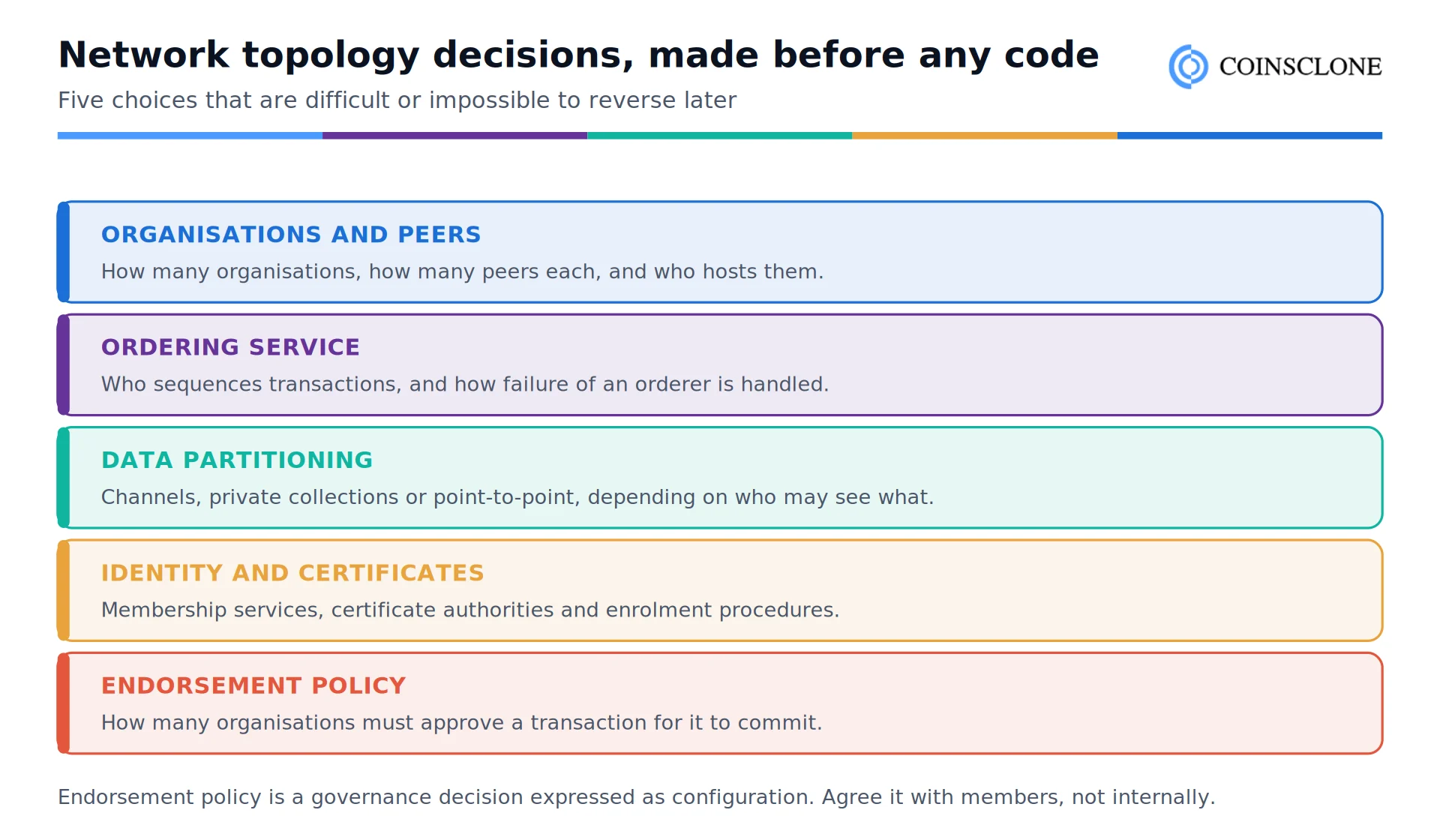
Organisations and peers. How many organizations participate, how many peers each runs, and who hosts them. This determines fault tolerance and who can independently verify state.
Ordering service. Who sequences transactions and how the failure of an ordering node is handled. Centralising this quietly undoes much of the reason for the network.
Data partitioning. Channels, private data collections or point-to-point transactions, depending on who may see what. This is the decision that determines whether competitors can participate.
Identity and certificates. Membership services, certificate authorities and enrolment procedures for people, applications and nodes.
Endorsement policy. How many organizations must approve a transaction before it commits.
Endorsement policy is a governance decision expressed as configuration. Agree it with members rather than setting it internally and presenting it afterwards.
Implementation, Phase by Phase
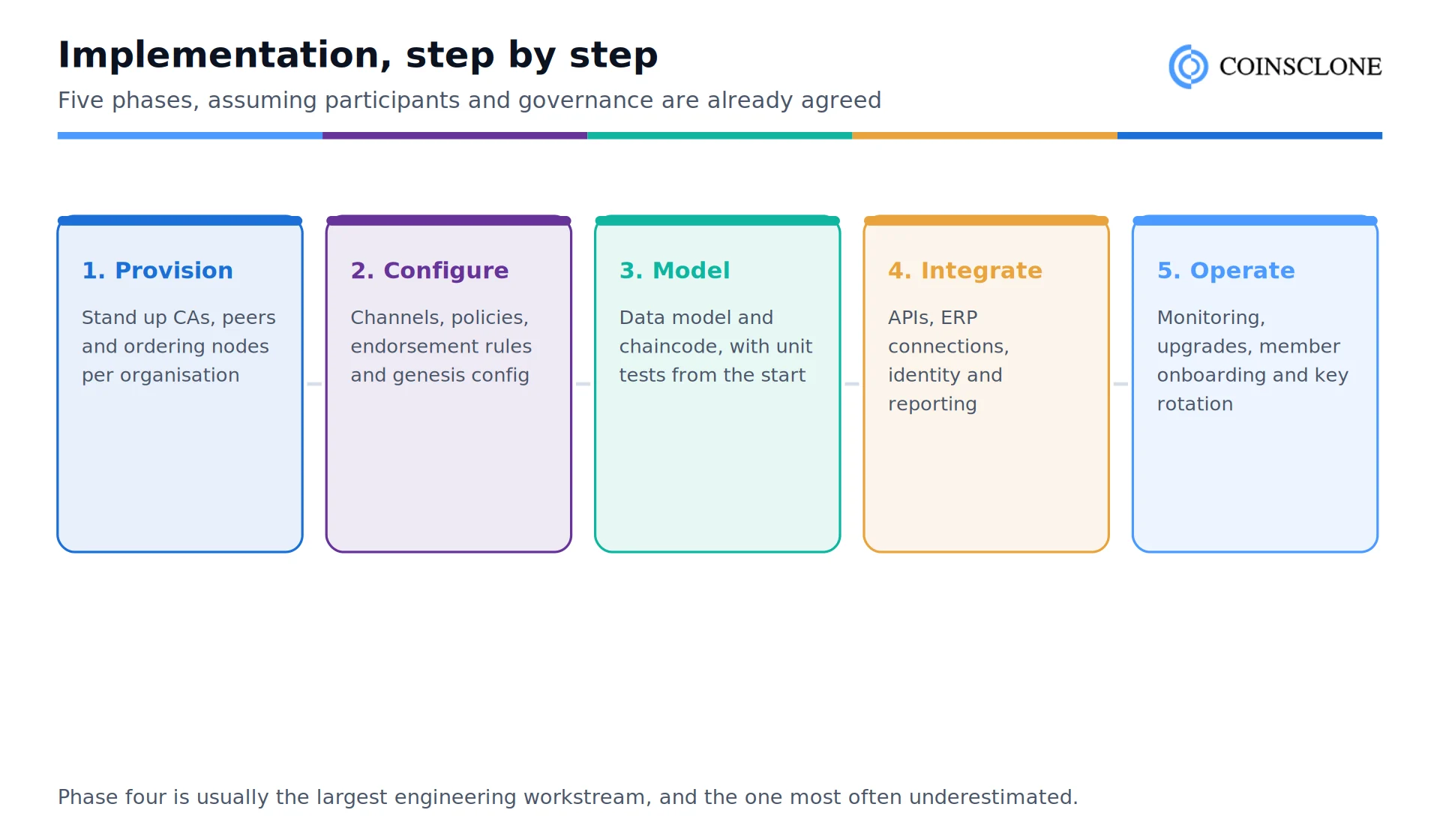
Phase one: provision. Stand up certificate authorities, peers and ordering nodes for each organization, ideally with each organization running its own rather than one party hosting everything.
Phase two: configure. Channels, policies, endorsement rules and genesis configuration.
Phase three: model. Data model and chaincode, with unit tests written alongside rather than afterwards. Decide explicitly what goes on-ledger and what stays in existing systems with only a reference committed.
Phase four: integrate. APIs, ERP connections, identity providers and reporting. This is usually the largest engineering workstream and the most commonly underestimated.
Phase five: operate. Monitoring, upgrades, member onboarding and key rotation.
Teams consistently plan phases one to three carefully and treat phase four as an afterthought, which is why timelines slip in the second half of these projects rather than the first.
How Long Does Private Blockchain Development Take?
Timelines are decided by agreement rather than by code, which is why a build estimate given before the governance conversation is not worth much.
What sits on the critical path, in the order it bites:
- Governance agreement. Onboarding, removal, dispute resolution and rule changes, signed by every founding member. Consistently the longest phase, and the one most proposals underprice.
- Integration. ERP, identity providers, reporting and existing databases. Usually the largest engineering workstream, and it depends on systems you may not control.
- Security review. Contracts or chaincode, plus the operational surface around key management and node access.
- Member onboarding. Each new participant needs credentials, infrastructure and their own internal sign-off.
Development itself is rarely the constraint. We commit to a date in the proposal once the participant list and the governance model are settled, because quoting before that is guesswork dressed as a schedule.
Hyperledger Fabric or an EVM-Based Private Network?
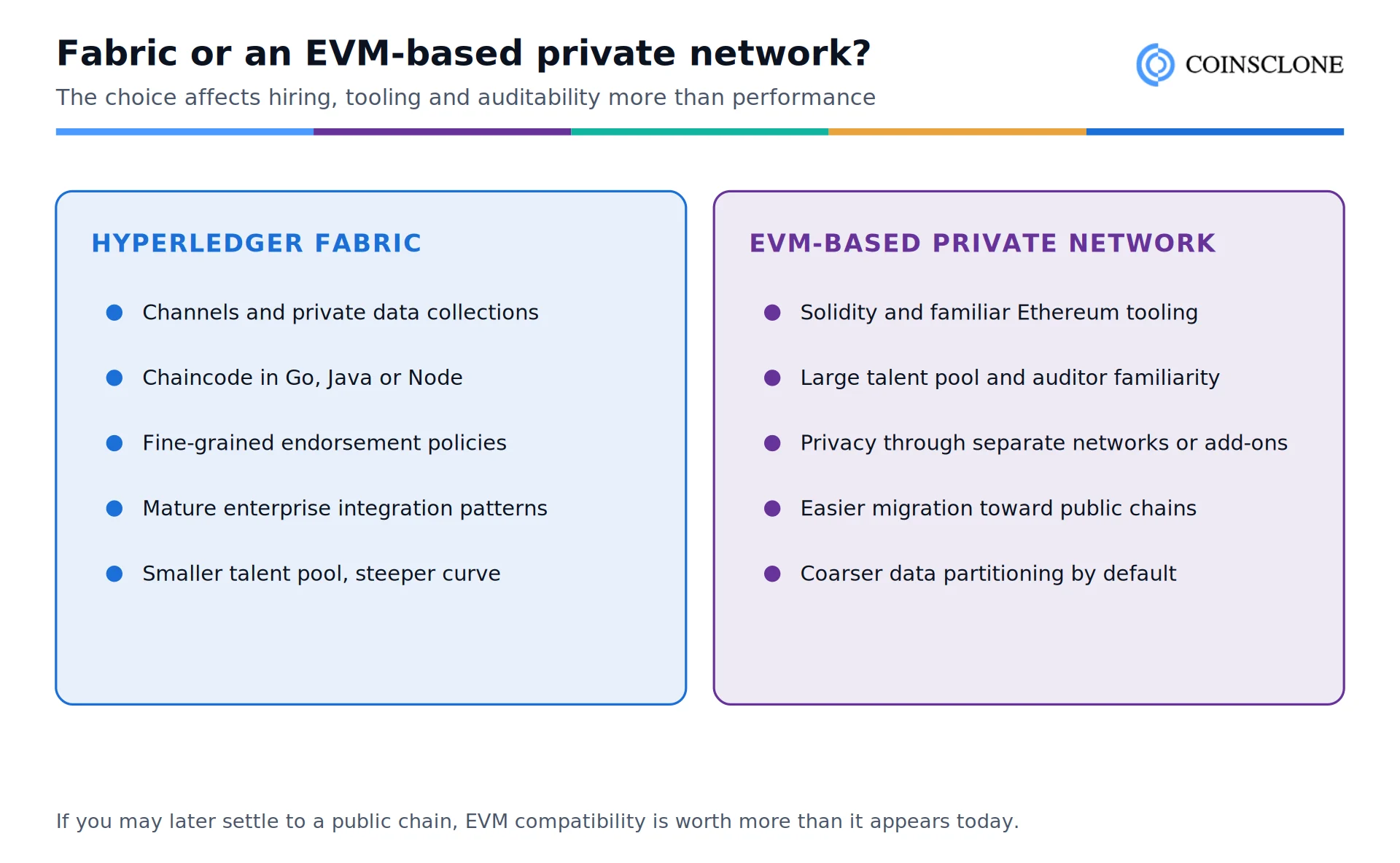
Fabric-style platforms offer channels and private data collections for fine-grained partitioning, chaincode in general-purpose languages, detailed endorsement policies, and mature enterprise integration patterns. The trade-off is a smaller talent pool and a steeper learning curve.
EVM-based private networks offer Solidity and familiar Ethereum tooling, a much larger talent pool, auditor familiarity, and an easier path toward public settlement later. Privacy is handled through separate networks or add-on layers rather than built-in channels, which makes data partitioning coarser by default.
The decision affects hiring, tooling and auditability considerably more than it affects performance. If there is any prospect of later settling to a public chain or issuing tokens that move beyond the consortium, EVM compatibility is worth more than it appears at the outset.
What Breaks Private Blockchain Deployments
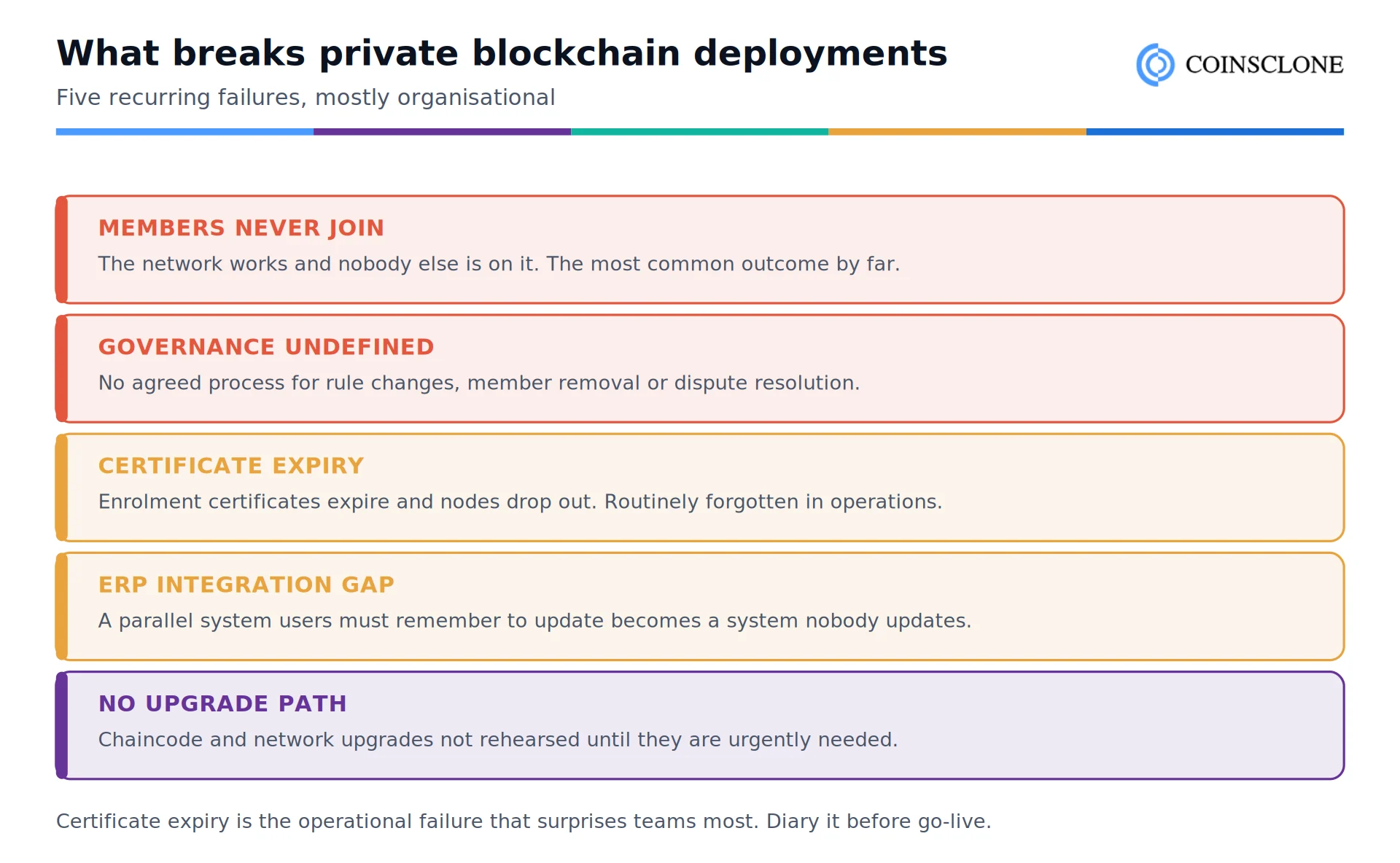
Members never join. The network works technically and nobody else is on it. This is the most common outcome by a wide margin and it is a commercial failure, not an engineering one.
Governance undefined. No agreed process for rule changes, member removal or dispute resolution, discovered at the first disagreement.
Certificate expiry. Enrolment certificates expire and nodes silently drop out. This is routinely forgotten and surprises teams more than any other operational issue.
ERP integration gap. A parallel system users must remember to update becomes a system nobody updates.
No upgrade path. Chaincode and network upgrades not rehearsed until they are urgently needed.
Diary certificate expiry before go-live. It is the operational failure that most often takes a working network offline.
Who Should Actually Build a Private Blockchain?
Private blockchain suits a narrow set of situations, and it is worth checking you are in one of them.
- Consortium settlement between competitors. Banks, insurers or carriers who need a shared record none of them operates alone.
- Regulated data exchange. Where a known, accountable node set is a requirement rather than a compromise, and an auditor needs to verify history independently.
- Multi-party supply chains. Provenance and custody across suppliers who have no contract with each other and no shared system.
- Internal ledgers under a compliance mandate. Where an immutable audit trail is specified by a regulator rather than chosen.
Where it does not suit: anything with a public tradeable token, since you cannot issue one on Fabric or Corda, and any single-organization process, where a database wins on every axis that matters.
Conclusion
Private blockchain implementation is largely an exercise in settling decisions that cannot be changed later: who runs what, who orders transactions, who sees which data, and who must approve a transaction. Get those agreed with members rather than internally, plan integration as the largest workstream rather than the last one, choose a platform on the basis of who you can hire and who can audit it, and diary certificate expiry before you go live.
Coinsclone builds enterprise-grade Web3 platforms including crypto exchanges, wallets, DEXs, NFT marketplaces, payment gateways and RWA tokenization, using customizable white-label clone scripts. Talk to our blockchain experts for a free consultation and live demo.
Frequently Asked Questions
How do you develop a private blockchain?
Settle network topology first: participating organizations and peers, the ordering service, data partitioning, identity and certificate management, and endorsement policy. Then provision nodes and certificate authorities, configure channels and policies, build the data model and chaincode with tests, integrate with existing systems, and establish operations.
What is an endorsement policy?
A rule specifying how many and which organizations must approve a transaction before it commits to the ledger. It is a governance decision expressed as configuration, and it should be agreed with consortium members rather than set unilaterally by whoever operates the network.
Should we use Hyperledger Fabric or an EVM-based network?
Fabric offers finer data partitioning through channels and private collections plus detailed endorsement policies, with a smaller talent pool. EVM-based networks offer familiar tooling, a much larger talent pool, auditor familiarity and an easier path to public settlement, with coarser default privacy.
How long does private blockchain development take?
The technical build is often shorter than the surrounding work. Provisioning and chaincode can move in weeks, while agreeing governance among members and integrating with ERP, identity and reporting systems typically takes months. Plan the commercial and integration workstreams in parallel.
What is the most common reason these projects fail?
Other organizations never join. The network functions technically while delivering nothing because consortium value depends entirely on participation. Treat member onboarding as a commercial workstream with its own owner and budget, running alongside the engineering.
What operational issues should we prepare for?
Certificate expiry causing nodes to drop out, undefined governance discovered at the first disagreement, integration gaps that leave a parallel system nobody updates, and unrehearsed upgrade procedures. Certificate expiry in particular should be diarised before go-live.
How much data should go on the ledger?
As little as necessary. Commit identifiers, hashes and state transitions that multiple parties must agree on, and keep documents, personal data and commercial detail in existing systems with only a reference on-ledger.