
Sending money abroad is now almost as easy as sending a text message. A big reason is blockchain technology, a shared digital ledger that many parties can write to but no single party can quietly change. The best blockchain use cases are no longer lab tests. Banks move billions on blockchains every day, shops take stablecoin payments, and big retailers trace food from the farm to the shelf in seconds.
This guide walks through the 10 blockchain use cases that are live in 2026, with a real example and a real number for each. You will also see which blockchains carry most of this activity, where blockchain has failed, and a simple test to check whether your own idea needs a blockchain at all.
In this guide:
- 10 real-world blockchain applications, from payments to healthcare, with named examples.
- How much value sits on blockchains today, from DefiLlama and rwa.xyz data.
- Which blockchains power these use cases, and why.
- The biggest problems with blockchain, and projects that shut down.
- A yes/no test to decide if your business needs a blockchain.
10 Real-World Blockchain Use Cases in 2026
We picked these blockchain use cases based on how widely they are used today, not on hype. Each one solves the same core problem: several parties need to share records they can all trust, without one middleman in charge.
1. Crypto and Digital Assets
The first and biggest user of blockchain is the crypto market. Like stocks, crypto has turned into a common investment and payment option all around the world. Blockchain makes these transfers fast, reliable and secure, with no bank in the middle.
Here is where crypto businesses use blockchain:
- Crypto exchanges: Big trading sites like Binance and Coinbase move coins in and out on-chain.
- DEX platforms: Decentralized exchanges run trades through smart contracts, with no company holding user funds.
- Crypto wallets and payment gateways: Wallets hold the keys, and gateways let shops accept crypto.
- Crypto tokens: Teams launch new tokens on existing chains like Ethereum, Solana or BNB Chain.
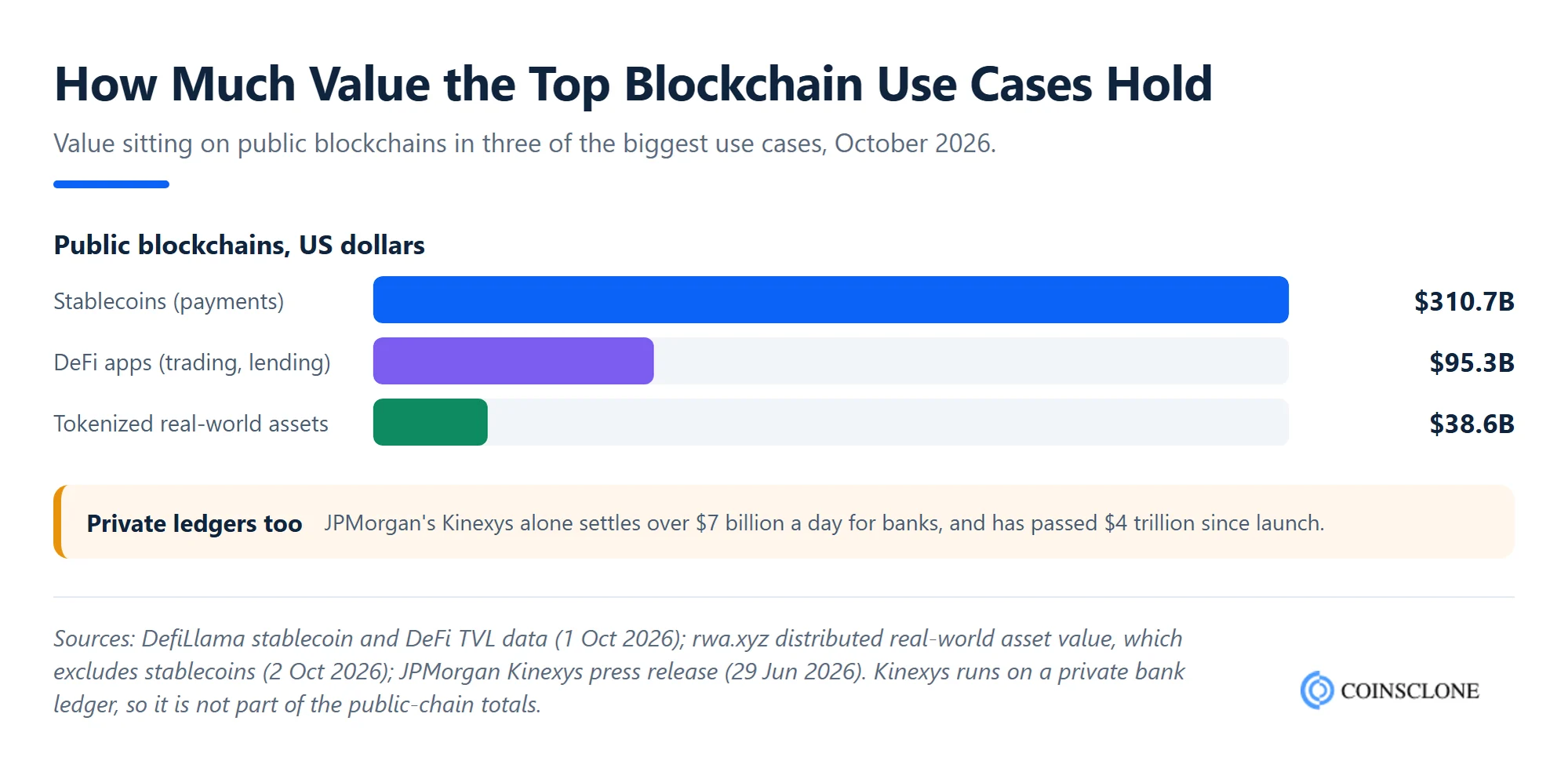
The scale is now huge. Stablecoins, tokens pegged to the dollar that power most crypto payments, had a supply of about $310.7 billion on 1 October 2026, per DefiLlama. DeFi apps for trading, lending and staking hold another $95.3 billion. Rules have caught up too. The EU’s MiCA law has applied in full since December 2024, and the US passed the GENIUS Act for stablecoins in July 2025.
2. Banking and Cross-Border Payments
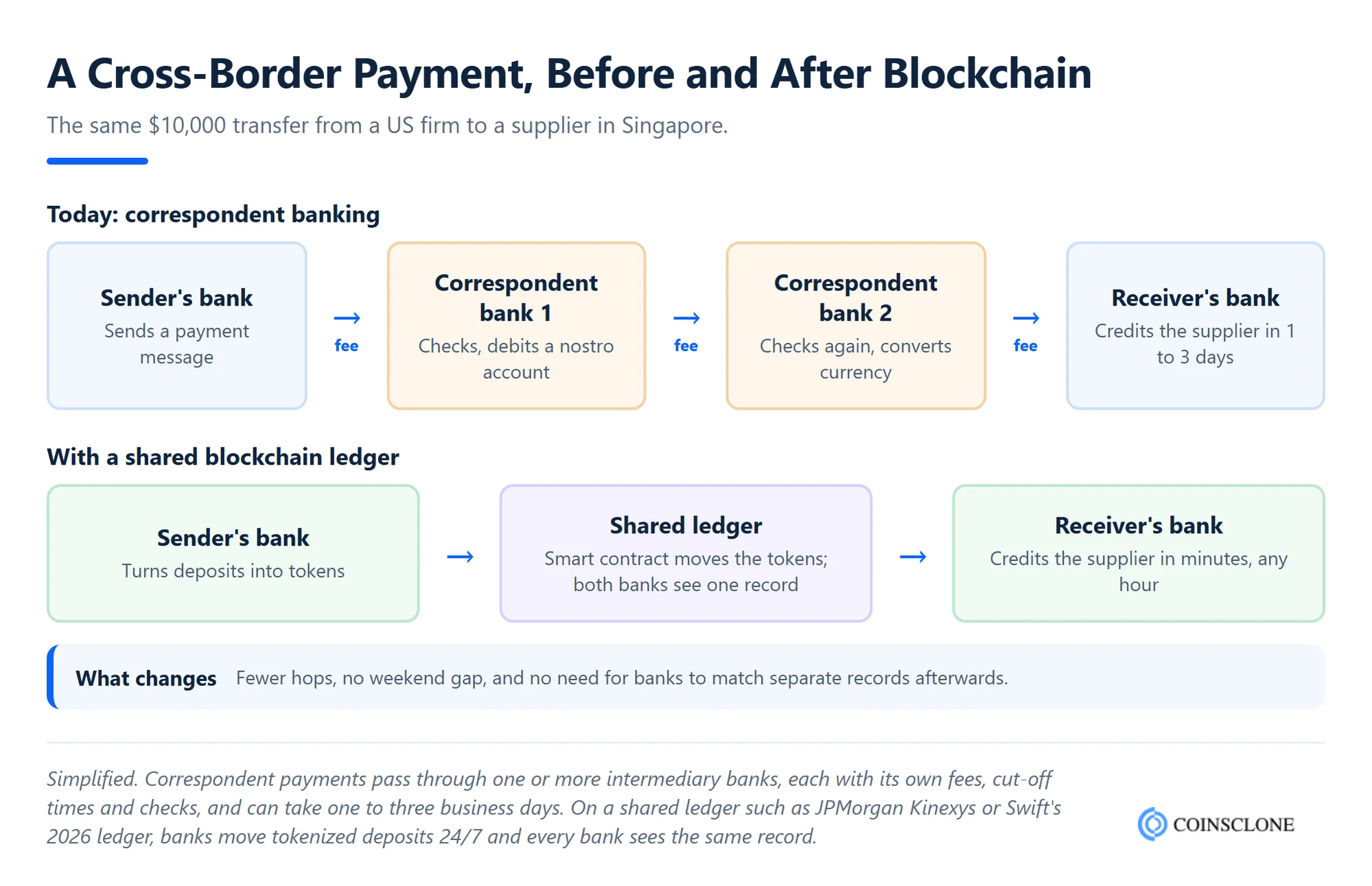
Banking and finance is one of the most digital sectors in the world. Yet cross-border payments still pass through several banks, and each one adds a fee and a delay. Blockchain lets banks share one ledger, so money moves in minutes, at any hour.
This is no longer a pilot. JPMorgan’s blockchain platform Kinexys has processed more than $4 trillion since launch and now averages over $7 billion a day, the bank said in June 2026. In July 2026, Swift opened its own blockchain ledger, with 17 banks lined up to test tokenized deposits that move 24/7.
Since the ledger cannot be edited after the fact, the payment record is the same for every bank. As a result, there is less room for fraud, and fewer disputes about who paid what.
Also Read – Blockchain In Finance – Benefits and Use Cases
3. Real Estate and Asset Tokenization
Many people put their money in property, but buying or selling a home takes a lot of paperwork. Blockchain cuts that work. Ownership, deeds and titles can be recorded on-chain and passed from seller to buyer without weeks of back-and-forth.
The bigger trend is tokenization. Here, a property, a bond or a fund is split into digital tokens, so investors can buy a small share. Tokenized real-world assets (RWAs) on public blockchains are now worth about $38.6 billion, per rwa.xyz in October 2026. The biggest slices are tokenized US Treasury funds from big fund firms such as BlackRock, plus private loans and tokenized gold. Real estate is a smaller but growing slice.
Want to tokenize property or funds? Coinsclone builds asset tokenization platforms with the token rules, buyer checks and dashboards you need.
4. Supply Chain and Logistics
Shipping goods is a vital job, and blockchain helps by giving every party in a supply chain the same record. Shipping details, tracking data and handovers are stored on a shared ledger. So no one can change a date or a temperature reading after the fact.
The best-known example is food. In a pilot built with IBM on Hyperledger Fabric, Walmart cut the time to trace a pack of mangoes to its farm from about 7 days to 2.2 seconds. That matters during a food recall, when every hour counts. Likewise, De Beers uses its Tracr platform to follow diamonds from the mine. Other common jobs include cold chain tracking, supplier payments and proof of origin.
Not every project has worked, though. Maersk and IBM shut down TradeLens, their shipping platform, in early 2023 because not enough of the industry joined. The lesson: a shared ledger only pays off when the whole network uses it.
5. Healthcare
Healthcare is one of the largest industries in the world, and it runs on sensitive records. Blockchain helps clinics, labs and health firms share data with less risk. It can log who viewed a record and when, so any change leaves a trace.
Estonia shows how this works. Its national e-Health record uses KSI blockchain to protect the integrity of medical records and of the logs that show who opened them, so any edit can be spotted. Patients can also log in to a health portal to see their past visits and prescriptions.
Drug tracking is a fast-growing area too. In the US, drug makers and pharmacies must trace each package to stop fake medicine, and some networks use blockchain to share that data. Read our guide to blockchain in pharmacy for how drug traceability works in 2026.
6. Smart Contract Applications
Smart contracts are a key part of nearly every use case on this list. A smart contract is a small program on a blockchain that runs by itself once set conditions are met. No one needs to approve each step, and no one can change the terms halfway.
Overall, this cuts the need for approvals, the risk of disputes, and fraud. Here is where smart contracts show up:
- Escrow: The payment is held and released only when the goods arrive.
- Royalties: Creators get a share every time their work is resold.
- Lending: DeFi apps give loans against crypto collateral with no loan officer.
- Payroll: Firms pay staff in stablecoins on a set date.
7. E-Commerce and Retail Payments
E-commerce sites now use blockchain mainly for payments. Since June 2025, Shopify merchants can accept USDC on Base, a stablecoin payment flow built with Coinbase and Stripe. Shops can keep the USDC or take payouts in their local currency. For a shop, this means lower card fees and faster cross-border sales.
Blockchain also helps retail with product proof. High-end brands give each item an on-chain record that proves it is real. Reward points can also become tokens that shoppers can trade. To accept crypto in your own store or app, a crypto payment gateway is the usual starting point.
8. Internet of Things
The Internet of Things (IoT) means billions of connected devices that share data. Blockchain gives these devices a shared, tamper-proof record, so one hacked device cannot quietly change the data for everyone.
For instance, in a smart home every appliance, from lights to alarms, is linked. A blockchain log can show which device sent which command and when. On a larger scale, Helium runs a wireless network where people host hotspots and earn tokens for providing coverage. Other uses include fleet tracking, smart meters and farm sensors.
9. Government Records and ID
Governments use blockchain to cut fraud and protect public records. Land registries are a common case, since a property title on a blockchain cannot be erased or quietly changed. Estonia’s KSI setup, noted above, guards state registries as well as health data.
ID is the next step. With a blockchain-based ID, a person can prove a fact, such as their age or degree, without handing over the full document. This way, people share only what a bank or an employer needs to see.
Voting is often listed as a use case, but be careful here. In theory, a blockchain vote is hard to tamper with and each voter can vote only once. In practice, blockchain voting is still at the pilot stage. Security experts have warned that the phone and the network around the vote are the weak points, not the ledger itself.
10. Insurance
Insurance firms are also using blockchain networks. The ledger stores policy details, insured amounts, clients and claims in one place that both the insurer and the client can check. This makes claims more transparent.
The strongest use case is parametric insurance. Here, a smart contract pays out by itself when a trusted data feed confirms an event, such as a delayed flight or a lack of rain. Etherisc runs crop and flight-delay cover this way. There is no claim form and no wait.
So, these are the top 10 use cases of blockchain technology. Beyond them, blockchain is used for energy trading between homes with solar panels, carbon credit tracking, digital art and NFTs, and proof of who owns a piece of content.
Which Blockchains Power These Use Cases?
Most blockchain applications run on a handful of large networks. Each one is good at a different job. The table below uses DefiLlama data from 1 October 2026.
| Blockchain | Value in DeFi apps | Stablecoins on the chain | Best known for |
| Ethereum | $53.7 billion | $146.0 billion | DeFi, tokenized funds, most RWAs |
| Tron | $5.6 billion | $93.9 billion | Low-cost USDT payments |
| Solana | $6.6 billion | $16.2 billion | Fast trading and payments |
| BNB Chain | $5.7 billion | $13.8 billion | Low-fee DeFi and tokens |
| Base | $6.4 billion | $5.1 billion | Shopify USDC payments, consumer apps |
Banks often pick private or permissioned chains instead. Swift’s new ledger, for example, is a permissioned network where only approved banks can join. The choice depends on who needs to write to the ledger and who needs to see it.
Why Businesses Use Blockchain
Blockchain is a digital ledger that stores data in blocks. Each block links to the one before it, and copies sit on many computers at once. As a result, the data is open to check but cannot be changed or deleted by one person. That simple design brings five main gains.
Immutable
Data stored on a blockchain cannot be changed, edited or deleted by anyone. So the trust in that data goes up. This makes blockchain a good fit for records that people may later dispute, such as payments, titles and audit logs.
Secure
Thanks to decentralization and cryptography, a blockchain has no single point to break into. Encrypted data and signed transactions sharply cut the risk of fraud and tampering.
Higher Transparency
A blockchain stores the same data in many places. Hence, everyone on the network sees the same version of the truth, and anyone with access can check it at any time.
High Speed
Blockchain transfers settle in seconds or minutes, at any hour. Traditional cross-border payments can take one to three days and stop on weekends.
Automation
Smart contracts run set actions without glitches. Once the conditions are met, the process runs by itself, with no third-party approval.
Problems and Limits of Blockchain
Blockchain is not the right tool for every job. Before you plan a project, keep these limits in mind:
- Network effect: A shared ledger only works if all the key players join. TradeLens closed for this reason, and the B3i insurance group went insolvent in 2022.
- Speed and cost: Public chains are slower than a normal database, and fees rise when the network is busy. Layer 2 networks help, but they add complexity.
- Garbage in, garbage out: A blockchain proves a record was not changed. It cannot prove the record was true when it was entered.
- Privacy rules: Data that cannot be deleted can clash with laws like the GDPR, so firms keep names and health data off the chain.
- Security outside the chain: Most crypto losses come from hacked keys, buggy smart contracts and scams, not from breaking the blockchain itself.
So, is blockchain still relevant in 2026? Yes, but in a narrower way than the hype years promised. The winners are payments, stablecoins and tokenized assets. Many “blockchain for all” tests quietly ended. For a longer take, see our honest look at whether blockchain is dead.
Does Your Business Need a Blockchain?
A simple test helps here. It comes from a well-known research paper by Karl Wüst and Arthur Gervais. Answer the questions in order, and stop at the first answer that fits.
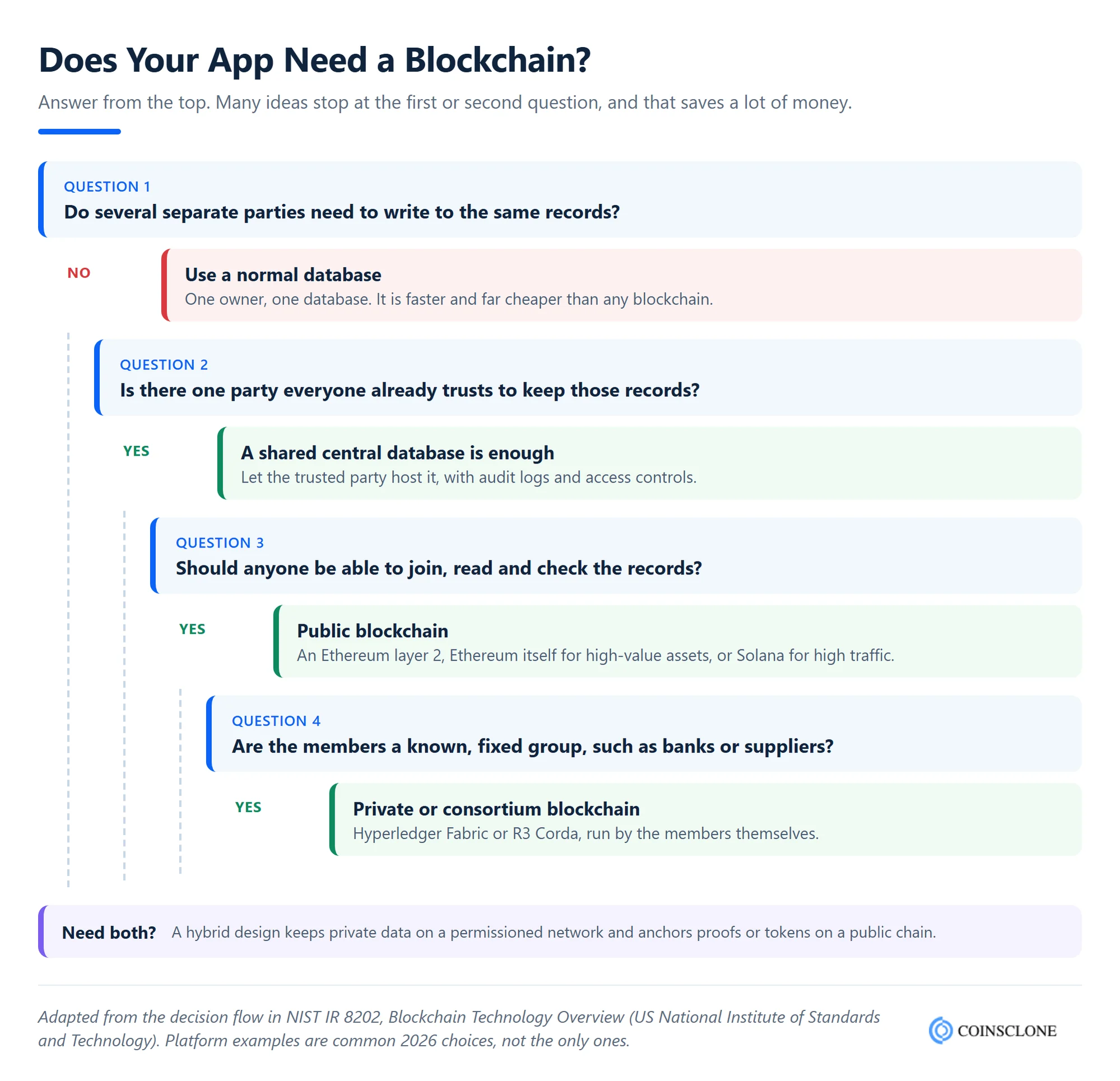
In short, if one trusted company can run the records, a normal database is cheaper and faster. Blockchain earns its place when several parties that do not fully trust each other must write to the same record.
Build Your Blockchain Application With Coinsclone
Coinsclone is a blockchain development company that has been building since 2018. Our team has shipped 350+ platforms for 200+ clients across 20 industries. We build crypto exchanges, wallets, payment gateways, tokens, DeFi apps and RWA platforms. We help you turn your blockchain idea into a working product without cutting corners on quality or security.
Don’t let your competitors overtake you in the blockchain race. Share your use case with our team, and we will help you pick the right chain, scope the build and launch faster.
Frequently Asked Questions
What are the main use cases of blockchain?
The main blockchain use cases in 2026 are crypto trading, stablecoin payments and bank transfers across borders. Others are tokenized assets, supply chain tracking, health records, smart contracts, IoT, ID and insurance. Payments and tokenized assets carry the most value today.
Which industries use blockchain the most?
Finance uses blockchain the most, through crypto, stablecoins, bank payments and tokenized funds. Supply chain, healthcare, retail, government and insurance follow. Each one uses blockchain to share records between parties that do not fully trust each other.
What are the top 5 blockchains?
By value held in apps, the top blockchains in October 2026 are Ethereum, Solana, Base, BNB Chain and Tron, per DefiLlama. Bitcoin is the largest coin by market value, but it hosts fewer apps. For stablecoin payments, Ethereum and Tron lead by a wide margin.
Is blockchain still relevant in 2026?
Yes. Banks such as JPMorgan settle billions a day on blockchain, Swift opened a blockchain ledger in July 2026, and stablecoin supply passed $310 billion. The hype has faded, but real use in payments and tokenized assets keeps growing.
What is replacing blockchain?
Nothing is replacing blockchain outright. Instead, it is blending into other systems. Layer 2 networks make it faster and cheaper, tokenized deposits bring it into banking, and AI agents are starting to pay each other in stablecoins. Some old enterprise pilots moved back to normal databases where one party could run the records.
What is the biggest problem with blockchain?
The biggest problem is adoption, not the technology. A shared ledger only pays off when every key party joins it. Other limits are speed and fees on busy public chains, privacy rules for personal data, and security risks from hacked keys and buggy smart contracts.