
Blockchain pharmacy drug traceability sounds like the use case the technology was built for. The reality is narrower, and considerably more useful, than either the enthusiasts or the sceptics suggest.
Here is the part most coverage gets wrong. DSCSA does not require a blockchain. It requires interoperable electronic data exchange, and the standard the FDA points to is GS1 EPCIS.
However, a ledger still earns a place on top of that foundation, specifically in verification, investigation and returns integrity.
This guide sets out what the rules actually require, who they apply to, where blockchain genuinely adds value, why industry-wide adoption stalled despite a successful FDA pilot, and what you can put to work today.
Key Takeaways
DSCSA does not require blockchain. It requires interoperable electronic data exchange using GS1 EPCIS.
Small dispensers must comply by 27 November 2026. Large dispensers’ exemption expired in November 2025.
Serialization alone is no longer enough. A compliant barcode still fails if transaction data does not move electronically.
Blockchain adds value in verification, duplicate detection, shared trust and investigator trails, on top of EPCIS.
Adoption stalled on coordination, not feasibility. Competing networks never interoperated.
What Is the DSCSA November 2026 Deadline?
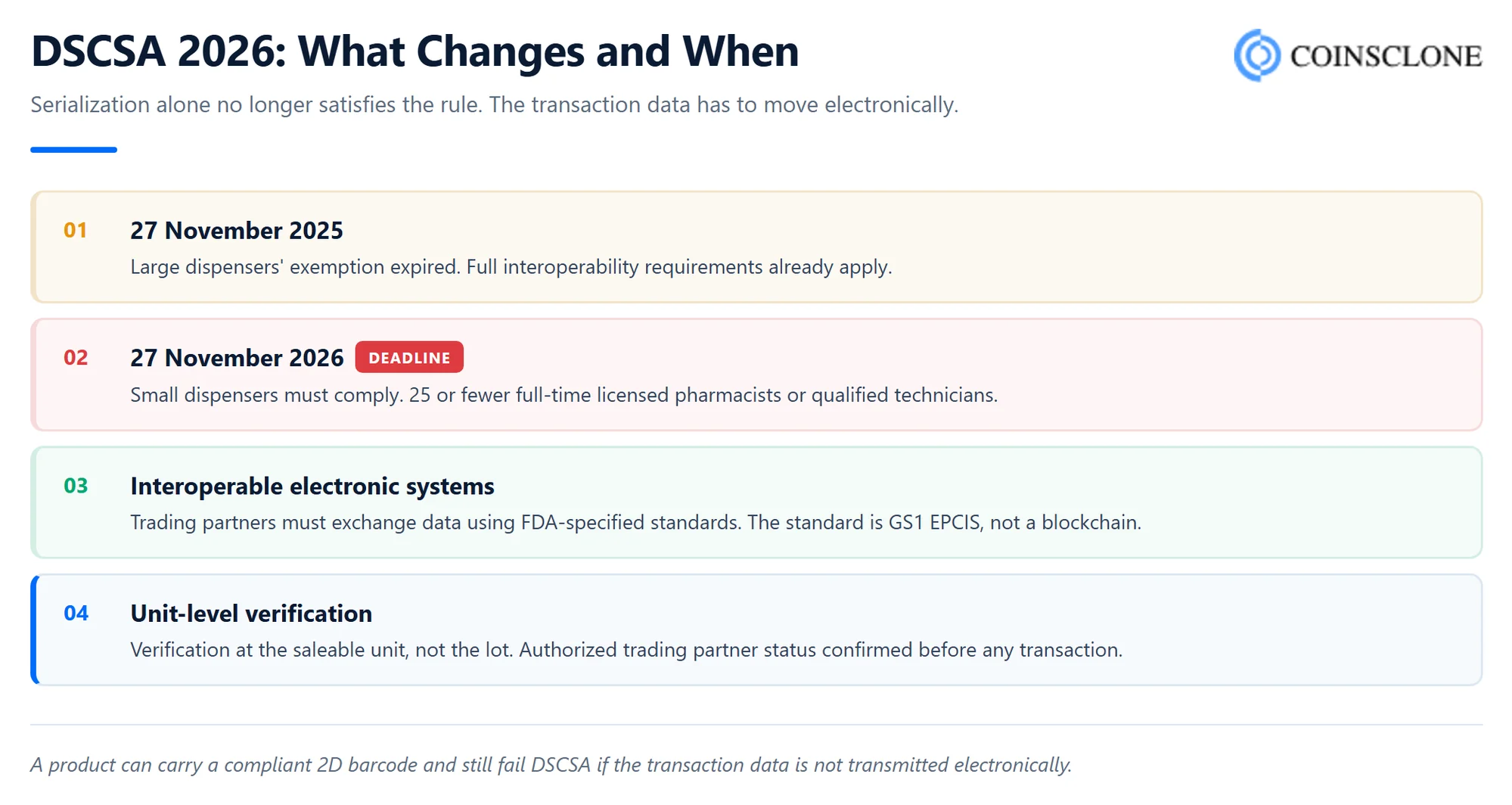
Small dispensers must meet full DSCSA interoperability requirements by 27 November 2026. Large dispensers’ exemption already expired on 27 November 2025.
From that date, trading partners must exchange transaction data through interoperable electronic systems using FDA-specified standards, with EPCIS as the data format. Verification must occur at the saleable unit level rather than the lot level, and authorized trading partner status must be confirmed before any transaction.
Serialization alone no longer satisfies the rule: a product can carry a compliant 2D barcode and still fail if transaction data is not transmitted electronically.
Who Must Comply With DSCSA?
Every authorized trading partner in the US prescription drug supply chain: manufacturers, repackagers, wholesale distributors and dispensers, which includes pharmacies.
Manufacturers reached their enforcement date in May 2025 and wholesale distributors followed in August 2025. Dispensers with 26 or more full-time employees came into scope in November 2025. Dispensers with 25 or fewer are treated as small dispensers, with the later 2026 date.
Obligations differ by role, but the interoperability requirement to send, receive and store EPCIS data applies across the chain. Trading partner status must be verified before transacting, which makes onboarding checks an operational requirement rather than a paperwork exercise.
Does DSCSA Require Blockchain?
No. DSCSA requires interoperable electronic data exchange, and the standard the FDA points to is GS1 EPCIS, not a distributed ledger.
EPCIS is the GS1 standard for communicating serialization events between trading partners: who shipped what, when, to whom and in what condition. Blockchain can sit alongside EPCIS as a shared verification layer, and it is not a substitute for it. Systems that replace EPCIS with a proprietary ledger schema fail interoperability.
Any vendor presenting blockchain as the compliance mechanism has misread the rule, which is a useful screening question when evaluating one.
What Is Serialization in Pharma Drug Traceability?
Serialization is the assignment of a unique identifier to each saleable unit of a drug product, encoded in a 2D barcode carrying the product code, serial number, lot and expiry.
In practice, it enables unit-level verification, which is what DSCSA requires from late 2026 rather than the lot-level checks that preceded it. Manufacturers serialize and transmit data at shipment; wholesale distributors receive, store and forward that data with every transfer.
However, the identifier only helps if the accompanying transaction data moves electronically with the product. That gap is where most compliance failures sit.
Where Does Blockchain Help and Where Does EPCIS Do the Work?
This distinction matters, because conflating them leads to buying the wrong system.
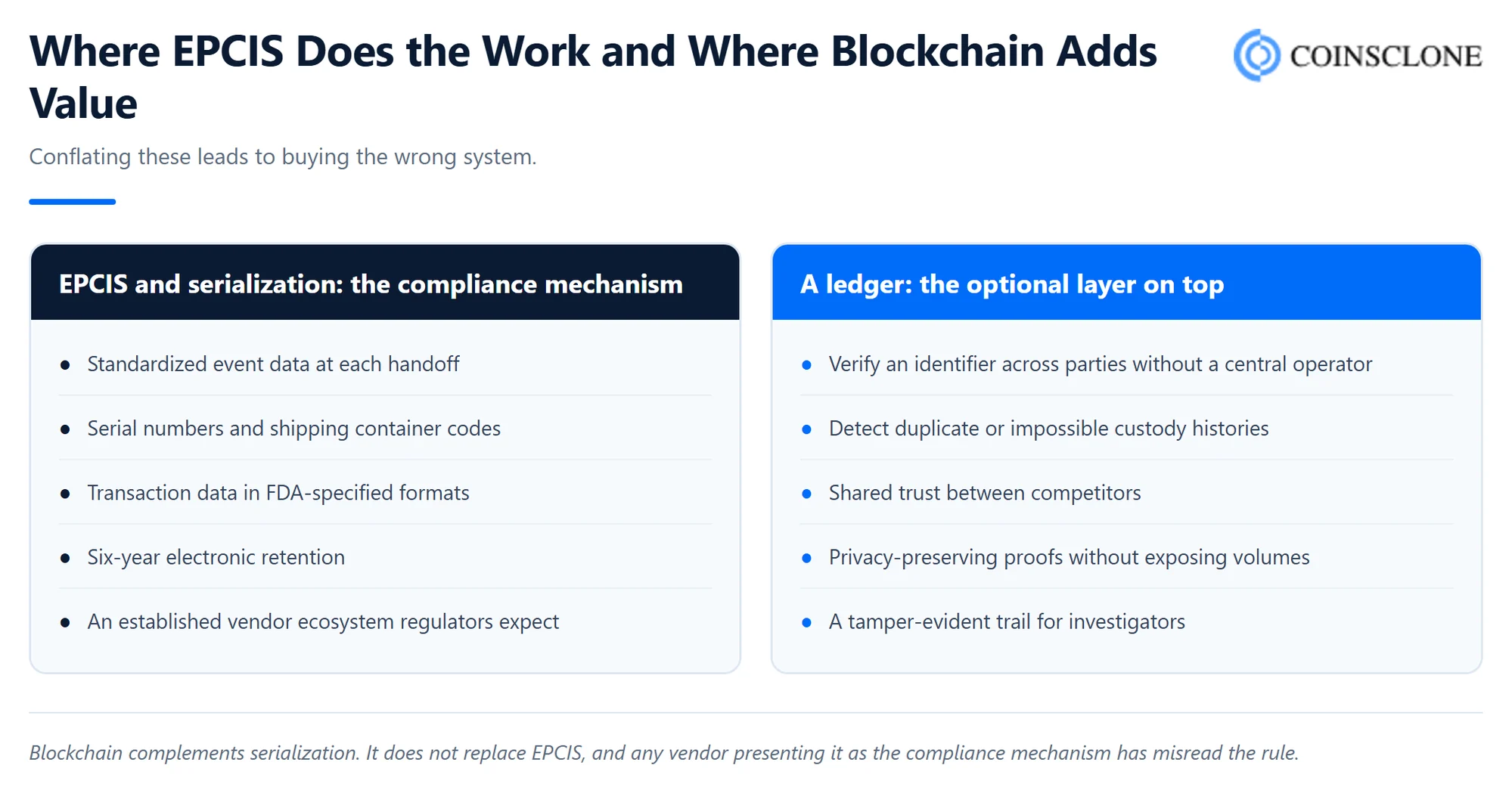
EPCIS and serialization are the actual compliance mechanism. Standardized event data at each handoff, serial numbers and shipping container codes, transaction information exchanged in specified formats, and six-year electronic retention. This is supported by an established vendor ecosystem and it is what regulators expect to see.
A ledger adds value in verifying a product identifier across parties without a central operator, detecting duplicate or impossible custody histories, providing shared trust between competitors, enabling privacy-preserving proofs so participants can verify claims without exposing volumes, and giving investigators a tamper-evident trail.
In short, blockchain complements serialization infrastructure. It is not a substitute for EPCIS event data.
How Does Blockchain Prevent Counterfeit Drugs?
It makes counterfeits detectable rather than impossible, by providing a shared custody record that no single participant can revise after the fact.
For example, a verifiable chain of custody lets a pharmacy confirm that a specific serial number carries a legitimate history through authorized trading partners. It does not prevent a counterfeiter from copying a genuine barcode, which is why physical authentication features remain necessary alongside the digital record.
So the strongest honest claim is narrow: nobody can quietly alter the record after entry. In an investigation, that matters.
Why Did Industry-Wide Drug Traceability Adoption Stall?
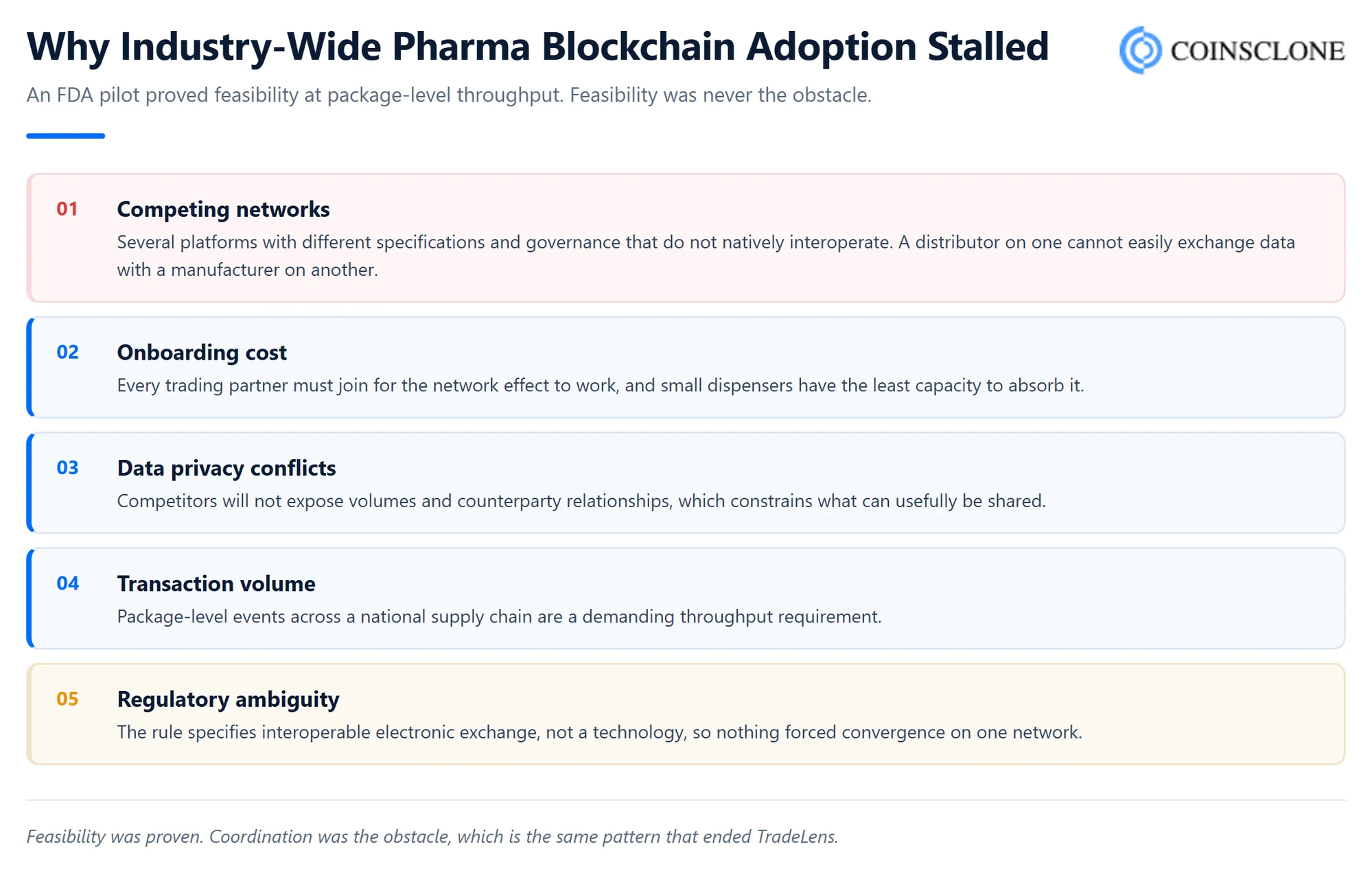
An FDA pilot demonstrated that a blockchain network could handle package-level tracing at the required throughput while preserving privacy through cryptographic techniques. Feasibility was never really the obstacle. Five structural barriers were.
Competing networks. Several separate platforms exist with different technical specifications, governance models and participant requirements, and they do not natively interoperate. A distributor on one cannot straightforwardly exchange data with a manufacturer on another.
Onboarding cost. Every trading partner must join for the network effect to work, and small dispensers have the least capacity to absorb that cost.
Data privacy conflicts. Competitors will not expose volumes and counterparty relationships, which constrains what can usefully be shared.
Transaction volume. Package-level events across a national supply chain are a demanding throughput requirement.
Regulatory ambiguity. The rule specifies interoperable electronic exchange rather than a particular technology, so there was never a mandate to converge on one network.
This is the same failure pattern that ended the largest supply chain blockchain project: the technology worked and the network did not form.
Which Blockchain Drug Traceability Uses Work Today?
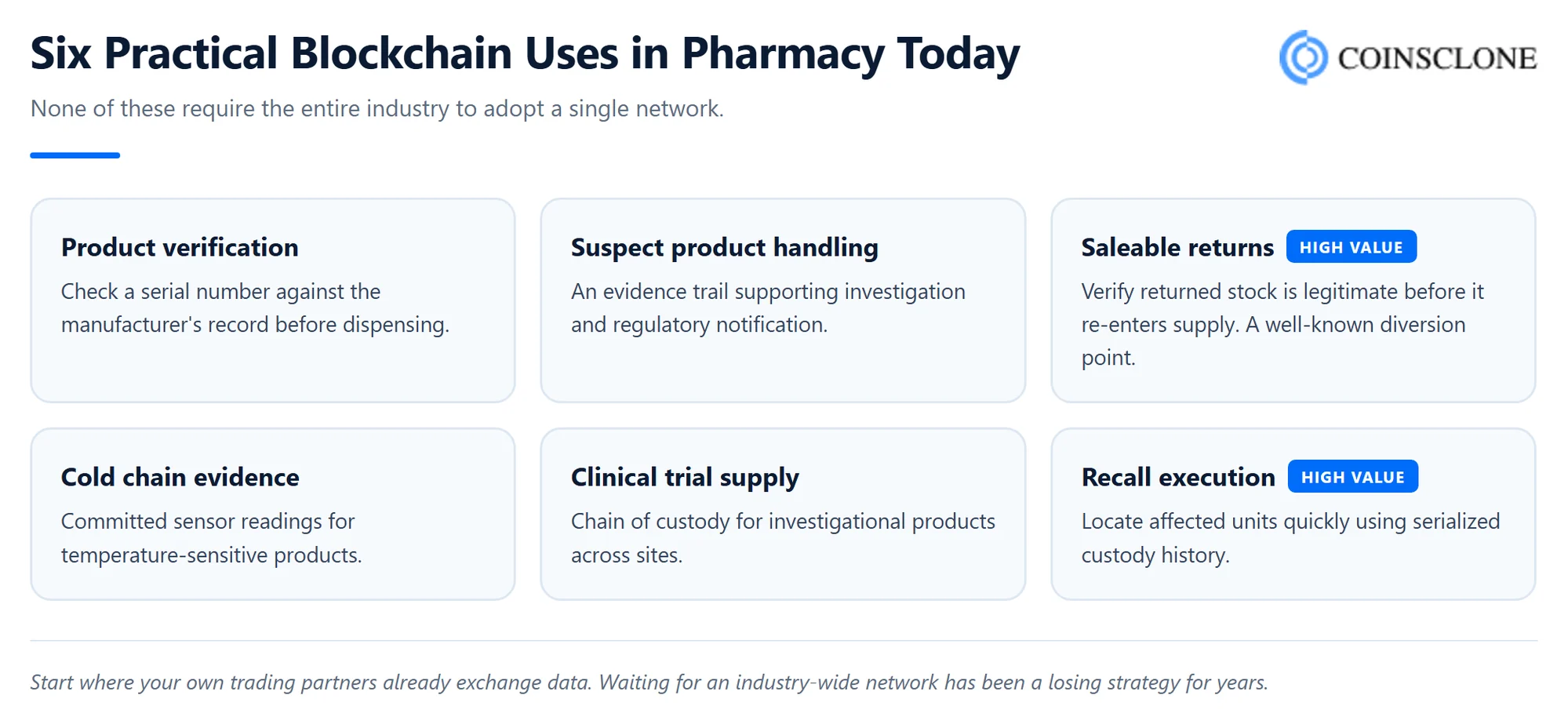
Six applications that do not require the entire industry to adopt a single network.
Product verification against a manufacturer’s record before dispensing.
Suspect product handling, with an evidence trail supporting investigation and regulatory notification.
Saleable returns, verifying that returned stock is legitimate before it re-enters supply, which is a well-known diversion point.
Cold chain evidence for temperature-sensitive products.
Clinical trial supply, maintaining chain of custody for investigational products across sites.
Recall execution, locating affected units quickly using serialized custody history.
Start where your own trading partners already exchange data. Waiting for an industry-wide network has been a losing strategy for several years.
Conclusion
DSCSA is a serialization and data exchange rule, not a blockchain rule. Get EPCIS event data flowing correctly first, because that is what the deadline requires and what trading partners will refuse product without.
Then treat a ledger as an optional layer on top, useful specifically where several parties need to verify a claim without a central operator and without exposing commercial detail to each other. Buy it for verification, investigation and returns integrity rather than for compliance. And when a vendor presents blockchain as the way to meet DSCSA, ask which FDA standard they are implementing. The answer should be EPCIS. Approach blockchain pharmacy drug traceability that way, and you buy the layer that helps without paying for the one the rule never asked for.
Coinsclone builds enterprise-grade Web3 platforms including pharmaceutical traceability and verification systems, supply chain consortium networks, IoT cold chain anchoring, smart contract development and audit, and RWA tokenization, using customizable white-label solutions. Talk to our blockchain experts for a free consultation and a live demo.
FAQ
Q: What is the DSCSA November 2026 deadline?
Small dispensers, meaning those with 25 or fewer full-time employees, must meet full DSCSA interoperability requirements by 27 November 2026. Large dispensers’ exemption expired on 27 November 2025, and manufacturers and wholesale distributors came into scope earlier that year.
Q: Does DSCSA require blockchain?
No. It requires interoperable electronic data exchange using FDA-specified standards, and the standard is GS1 EPCIS. Blockchain can sit alongside EPCIS as a verification layer but is not the compliance mechanism, and any vendor presenting it as one has misread the rule.
Q: What is EPCIS in pharma?
The GS1 standard for communicating serialization events between trading partners: who shipped what, when, to whom and in what condition. DSCSA’s interoperability requirement is built on EPCIS-based data exchange, which is why systems using a proprietary schema fail interoperability.
Q: What is serialization in pharmaceuticals?
Assigning a unique identifier to each saleable unit, encoded in a 2D barcode carrying product code, serial number, lot and expiry. It enables the unit-level verification DSCSA requires, replacing lot-level checks, and it only works if transaction data moves electronically alongside the product.
Q: Who must comply with DSCSA?
Manufacturers, repackagers, wholesale distributors and dispensers including pharmacies. Obligations differ by role but the requirement to send, receive and store EPCIS data applies across the chain, and trading partner status must be verified before any transaction.
Q: How does blockchain prevent counterfeit drugs?
It makes them detectable rather than impossible. A shared custody record lets a pharmacy confirm a serial number has a legitimate history through authorized partners. It does not stop a counterfeiter copying a genuine barcode, so physical authentication features remain necessary.
Q: Why did blockchain adoption stall in pharma?
Not for technical reasons. Competing networks that do not interoperate, onboarding cost falling hardest on small dispensers, competitors unwilling to expose volumes, demanding throughput at package level, and a rule that never mandated converging on one network.
Q: What can a pharmacy do with blockchain today?
Product verification before dispensing, suspect product investigation with an evidence trail, saleable returns verification, cold chain evidence, clinical trial supply custody, and faster recall execution using serialized history. None require industry-wide adoption.
Q: Is a 2D barcode enough for DSCSA compliance?
No. A product can carry a fully compliant barcode and still fail if the transaction data is not transmitted electronically to the next trading partner. Serialization is necessary and no longer sufficient on its own.
Q: What happens if a pharmacy is not DSCSA compliant?
The commercial consequence usually arrives before the regulatory one. Trading partners can refuse non-compliant product regardless of enforcement activity, which makes readiness a supply continuity issue rather than only a legal one.