
A test suite that would comfortably pass any web application will miss most of what actually breaks a smart contract. That gap is exactly why blockchain testing services exist as a specialism rather than a line item.
Consider the difference. Contracts cannot be patched after deployment. They hold money directly. Anyone can call any public function, with any input, at any time.
As a result, conventional QA covers roughly two of the seven layers a blockchain project needs.
This guide sets out all seven layers, separates testing from audit since the two get confused constantly, names the tools that do the real work, and explains why the job continues long after launch.
Key Takeaways
Blockchain testing services cover seven layers. Conventional QA covers roughly the first two.
Fork testing, fuzzing and invariant testing are what a cheaper proposal usually omits.
An audit and a test suite are not substitutes. Reach high coverage first, or you pay auditors to find missing unit tests.
The standard tool stack is Foundry or Hardhat, Slither, and Echidna for property-based testing.
Testing continues after deployment, because oracles and bridges change without asking you.
What Is Blockchain Testing?
Blockchain testing is the verification of a distributed application across its contract logic, node network, consensus behavior and integration layers, including failure conditions that conventional QA does not simulate.
It covers what standard testing does not: adversarial economic conditions, chain reorganizations, node failures, gas limits and transaction ordering exploits. The defining constraint is that deployed contracts usually cannot be patched, so defects found after launch are incidents rather than bug reports.
It spans functional, security, performance and integration testing rather than replacing any of them.
What Is the Difference Between a Smart Contract Audit and Blockchain Testing?
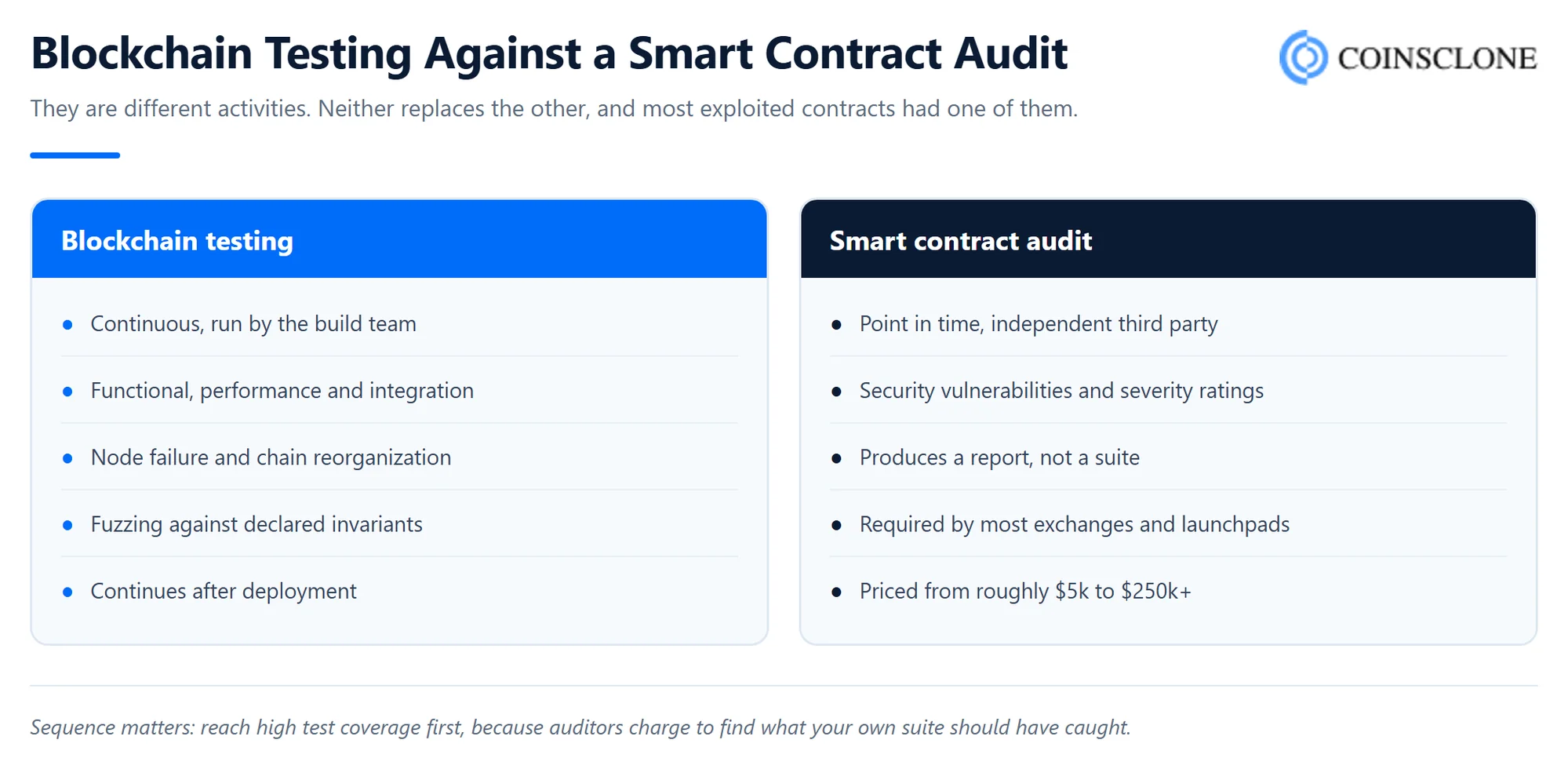
An audit is a point-in-time security review by an independent third party. Testing is a continuous engineering activity run by the build team throughout development and after deployment.
Audits look for vulnerabilities and produce a report with severity ratings. Testing verifies that the system behaves correctly under expected and adversarial conditions. An audit does not replace a test suite, and a passing test suite does not replace an audit. Most serious exploits occurred in contracts that had at least one of the two.
Sequencing matters: reach high test coverage first, because auditors charge to find issues your own suite should have caught. We cover audit pricing and duration in smart contract development services.
What Are the Seven Layers?
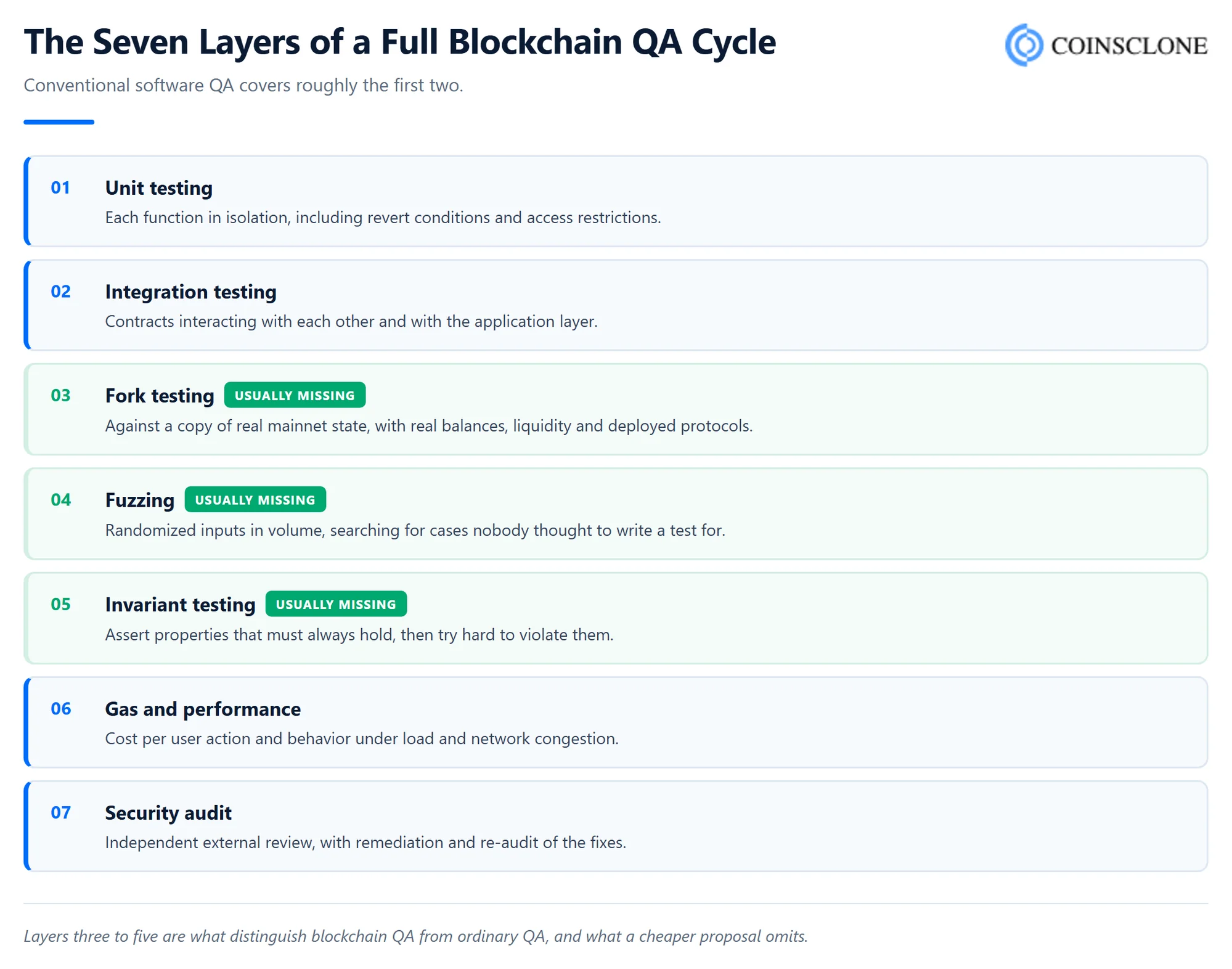
Unit testing confirms each function behaves correctly in isolation, including revert conditions and access restrictions.
Integration testing covers contracts interacting with each other and with the application layer.
Fork testing runs against a copy of real mainnet state, with real balances, real liquidity and real deployed protocols, which surfaces problems local test chains never reveal.
Fuzzing throws randomized inputs at the contract in volume, searching for cases nobody thought to write a test for.
Invariant testing asserts properties that must always hold, such as total supply never exceeding a cap, then tries hard to violate them.
Gas and performance testing measures cost per user action and behavior under load and network congestion.
Security audit is independent external review, with remediation and re-audit of the fixes.
Layers three to five are what distinguish blockchain QA from ordinary software QA, and they are the ones most commonly missing from a cheaper proposal.
What Tools Are Used for Blockchain Testing?
The standard stack is Foundry or Hardhat for development and unit testing, Slither and Mythril for static analysis, and Echidna or Foundry’s fuzzer for property-based testing.
Foundry runs tests in Solidity with built-in fuzzing, which has made it the common default for new projects.
Slither performs static analysis across a contract’s control and data flow, catching known vulnerability patterns cheaply before any dynamic testing runs.
Echidna and fuzzing generally are what find the edge cases hand-written tests miss, by generating thousands of random inputs against stated invariants.
What Is Fuzz Testing in Smart Contracts?
Fuzz testing generates large volumes of random inputs against a contract to find states that violate a property you declared should always hold.
You define an invariant, such as total supply always equalling the sum of balances, and the fuzzer searches for any sequence of calls that breaks it. It finds arithmetic edge cases, unexpected call orderings and state combinations that example-based unit tests do not reach, because you never thought to write them.
Invariant quality decides the value. A fuzzer testing a weak property returns a clean result that proves very little, which is why reviewing the invariants matters more than reviewing the fuzzing configuration.
What Does Blockchain Testing Catch That Normal QA Does Not?
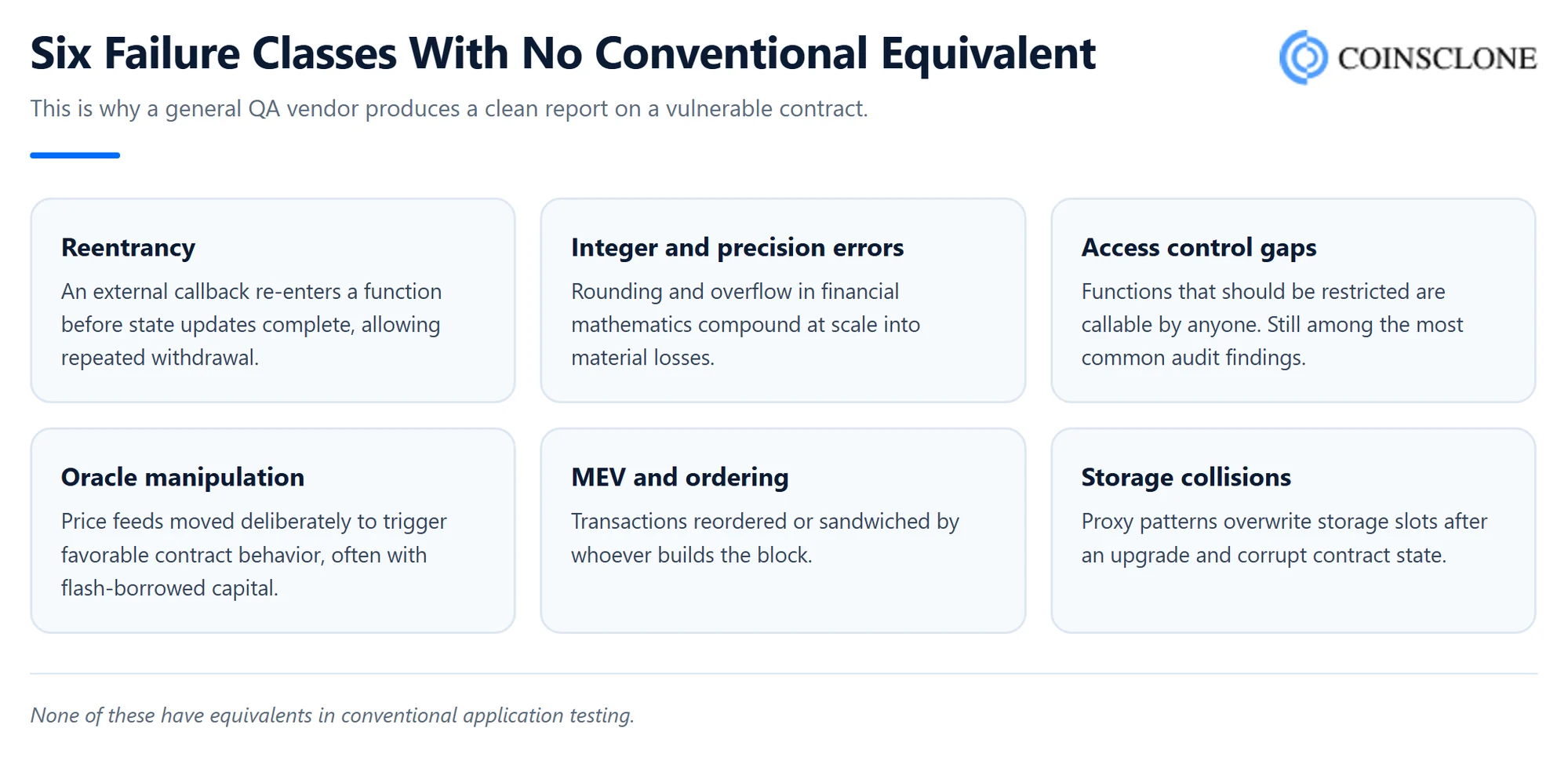
Six failure classes with no equivalent in conventional application testing.
Reentrancy, where an external callback re-enters a function before state updates complete, allowing repeated withdrawal.
Integer and precision errors, where rounding and overflow in financial mathematics compound at scale into material losses.
Access control gaps, where functions that should be restricted are callable by anyone, which remains one of the most common findings in audits.
Oracle manipulation, where price feeds are moved deliberately to trigger favorable contract behavior, often using flash-borrowed capital.
MEV and transaction ordering, where transactions are reordered or sandwiched by whoever builds the block.
Upgrade and storage collisions, where proxy patterns overwrite storage slots after an upgrade and corrupt contract state.
None of these have equivalents in conventional application testing, which is precisely why a general QA vendor with no blockchain specialism will produce a clean report on a vulnerable contract.
Why Does Testing Continue After Deployment?
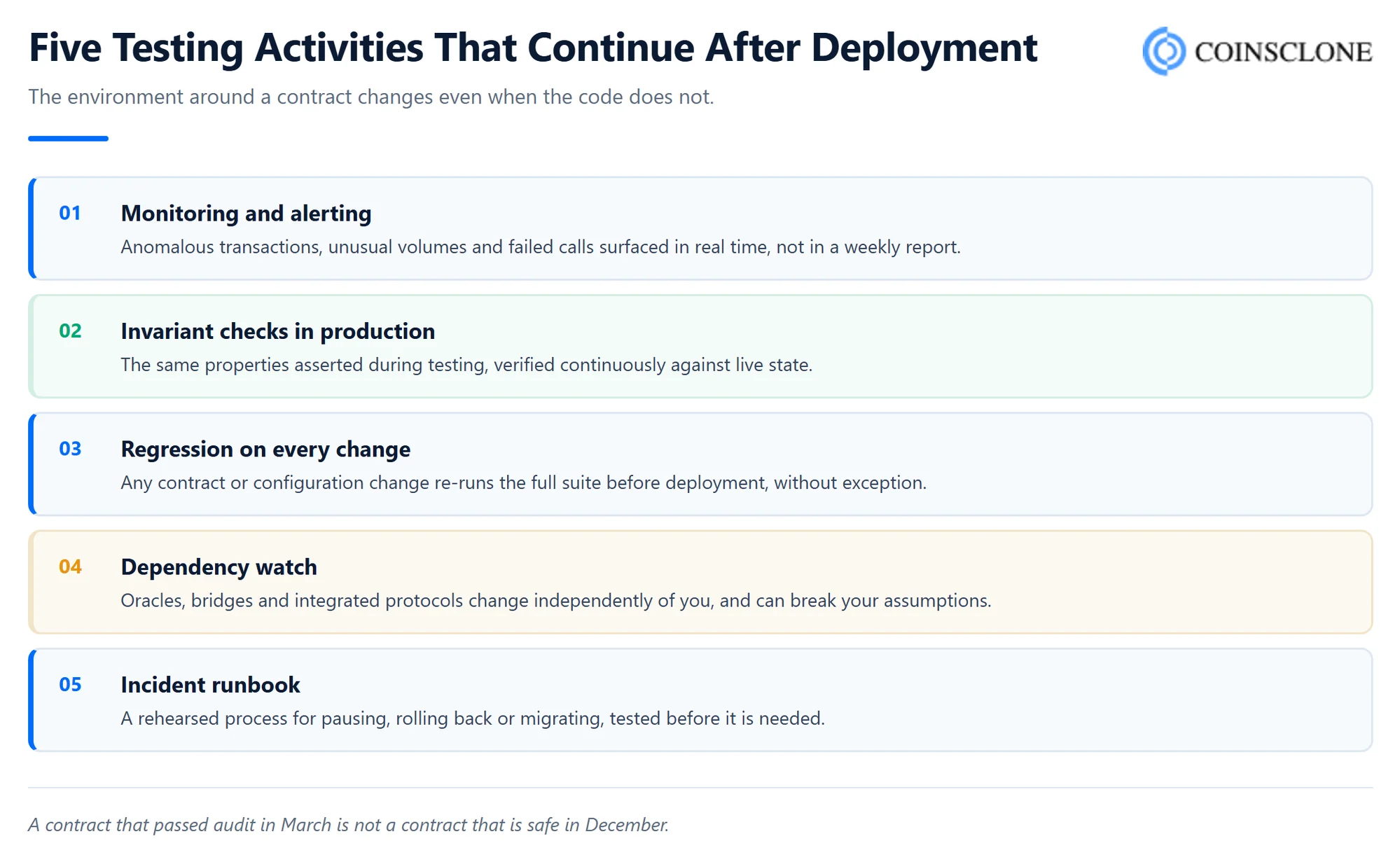
Because the environment around a contract changes even when the code does not.
Monitoring and alerting for anomalous transactions, unusual volumes and failed calls, surfaced in real time rather than discovered in a weekly report.
Invariant checks in production, verifying the same properties asserted during testing continuously against live state.
Regression on every change. Any contract or configuration change re-runs the full suite before deployment, without exception.
Dependency watch. Oracles, bridges and integrated protocols change independently of you, and their changes can break your assumptions.
Incident runbook. A rehearsed process for pausing, rolling back or migrating when something goes wrong, tested before it is needed.
A contract that passed audit in March is not a contract that is safe in December, because the environment around it has changed even if the code has not.
What Should You Ask a Testing Partner?
Seven questions that separate a blockchain specialism from a general QA vendor with a crypto page.
Do you run fork tests against real mainnet state, and can you show one? What is your invariant coverage, and who writes the invariants? Which fuzzing tool do you use and for how many runs? Can you show a report where you found a reentrancy or oracle manipulation issue? Do you test upgrade paths and storage layout across proxy versions? What do you hand over, and can we run the suite ourselves afterwards? And what does your post-deployment monitoring cover?
Question one is the fastest filter. A vendor who has never run a fork test is doing conventional QA on a blockchain project.
Conclusion
Blockchain testing is a specialism because the failure classes are specific to the environment, the cost of a defect is a permanent loss of funds rather than a patch release, and the adversary is anyone with a wallet.
Cover all seven layers rather than the first two. Treat testing and audit as complementary, sequencing coverage before external review so you are not paying auditors to find missing unit tests. Write invariants carefully, because a fuzzer is only as useful as the property it is testing. And keep testing after deployment, because the oracles, bridges and protocols your contract depends on will change without asking you. Treated that way, blockchain testing services stop being a line item and start being what keeps your contract solvent.
Coinsclone builds and tests enterprise-grade Web3 platforms including smart contract development, audit coordination and full QA cycles, crypto exchanges, DEXs, wallets, NFT marketplaces and payment gateways, using customizable white-label solutions. Talk to our blockchain experts for a free consultation and a live demo.
FAQ
Q: What is blockchain testing?
Verification of a distributed application across contract logic, node network, consensus behavior and integration layers, including adversarial conditions, chain reorganizations, node failures and transaction ordering exploits that conventional QA does not simulate.
Q: What is the difference between a smart contract audit and blockchain testing?
An audit is a point-in-time independent security review producing a report. Testing is continuous engineering work run by the build team. Neither replaces the other, and reaching high test coverage before an audit avoids paying auditors to find missing unit tests.
Q: What are the seven layers of blockchain testing?
Unit testing, integration testing, fork testing against real mainnet state, fuzzing, invariant testing, gas and performance testing, and independent security audit. Layers three to five distinguish blockchain QA from ordinary QA and are usually missing from cheaper proposals.
Q: What tools are used for blockchain testing?
Foundry or Hardhat for development and unit tests, Slither and Mythril for static analysis, and Echidna or Foundry’s built-in fuzzer for property-based testing. Foundry has become the common default because it runs tests in Solidity with fuzzing included.
Q: What is fuzz testing in smart contracts?
Generating large volumes of random inputs to find states that violate a declared invariant, such as total supply always equalling the sum of balances. It finds arithmetic edge cases and call orderings that hand-written tests never reach, and its value depends entirely on the quality of the invariant.
Q: What is fork testing?
Running tests against a copy of real mainnet state, with real balances, real liquidity and real deployed protocols. It surfaces integration problems that a clean local test chain cannot, which is why a vendor who has never run one is doing conventional QA.
Q: What vulnerabilities does blockchain testing catch?
Reentrancy, integer and precision errors, access control gaps, oracle manipulation, MEV and transaction ordering issues, and storage collisions after proxy upgrades. None have equivalents in conventional application testing.
Q: Does testing stop once a contract is deployed?
No. Monitoring, production invariant checks, regression on every change, dependency watch on oracles and bridges, and a rehearsed incident runbook all continue. The environment around a contract changes even when the code does not.
Q: How much does blockchain testing cost?
It depends on contract complexity, the number of integrations and whether invariants must be written from scratch. The larger and more predictable cost is the independent audit that follows, which is priced separately and typically runs from several thousand to six figures by complexity.
Q: Can a general QA vendor test a blockchain application?
For the first two layers, yes. They will not catch reentrancy, oracle manipulation or storage collisions, because those failure classes do not exist in conventional software, which is how a vulnerable contract receives a clean report.