
The features of an NFT marketplace decide whether people stay, buy and come back. An NFT marketplace is a platform where users create, buy, sell and trade NFTs in a safe way. Big names like OpenSea and Rarible show what a good one looks like. Yet the market in 2026 is tougher than in 2021. Buyers still spent about $182.7 million on NFTs in the 30 days to 16 October 2026, per CryptoSlam, but they now expect easy logins, card payments and real safety.
To create a successful NFT business, startups should focus on the features that keep users safe, help them find what they want and make each sale smooth. A well-built, feature-rich market also helps creators and collectors, and it opens more ways for you to earn. In this blog, we cover the 10 must-have features every NFT market needs at launch, then the full list of extra features by group, and which ones to build first for your model.
In this guide:
- The 10 must-have features to launch with, and why each one matters in 2026
- A full list of core, engagement, advanced, add-on and admin features
- What changed lately: email login, card checkout, gas-free sales and enforced royalties
- Real data on phishing, and the signing safety features that stop it
- Which extra features to build first, and how features change your cost and time
Also Explore – If you want to understand what an NFT Marketplace is and how it works, here is an exclusive article that provides you with complete knowledge about it >>>> A Guide for NFT Marketplaces.
Now, let’s dive in…
Discover the Must-Have Features of an NFT Marketplace for a Winning Platform
NFT Marketplace Development — built for seamless user experience.
- Core Functionalities: Explore essential Features of NFT Marketplace
- User-Centric Design: Intuitive interface, advanced search, and wallet integration.
- Admin & Analytics: Manage listings, users, and monitor performance effortlessly.
- Revenue-Ready: Monetize through trading fees, NFT drops, and premium listings.
See a free branded demo of your NFT marketplace in 48 hours — before you invest a cent.
Book a Free Demo to see how implementing the right Features of NFT Marketplace can make your platform stand out in just 8–12 weeks.
Features of an NFT Marketplace: The 10 Must-Haves
An NFT market can have dozens of features. However, only a handful are needed on day one. The table below lists the 10 must-have features of an NFT marketplace, what each one does and why it matters now. Every other feature in this guide can come later.
| # | Must-have feature | What it does | Why it matters in 2026 |
| 1 | Storefront | Shows each NFT with its creator, price, history and royalty | Buyers check proof before they pay |
| 2 | Sign-up and login | Email, social or wallet login | Buyers new to crypto may not own a wallet yet |
| 3 | Wallet integration | Connects MetaMask, Phantom, Coinbase Wallet and more | Crypto natives expect their own wallet to work |
| 4 | Payment options | Card checkout plus crypto and stablecoins | Card buyers widen your audience far beyond crypto users |
| 5 | Search and filters | Finds NFTs by price, trait, chain and popularity | Large sets are useless if people cannot find items |
| 6 | Listing and sale types | Fixed price, auctions and offers | Sellers want choice in how they sell |
| 7 | Minting tools | Single, batch and lazy minting | Creators can list without paying gas up front |
| 8 | Smart contracts and royalties | Run each sale and pay creators with ERC-2981 | Artists and brands pick markets that pay them |
| 9 | Security and signing safety | Audits, 2FA, clear signing prompts, scam warnings | One bad signature can empty a user’s wallet |
| 10 | Admin dashboard | Users, fees, moderation and reports | You cannot run, grow or police a market without it |
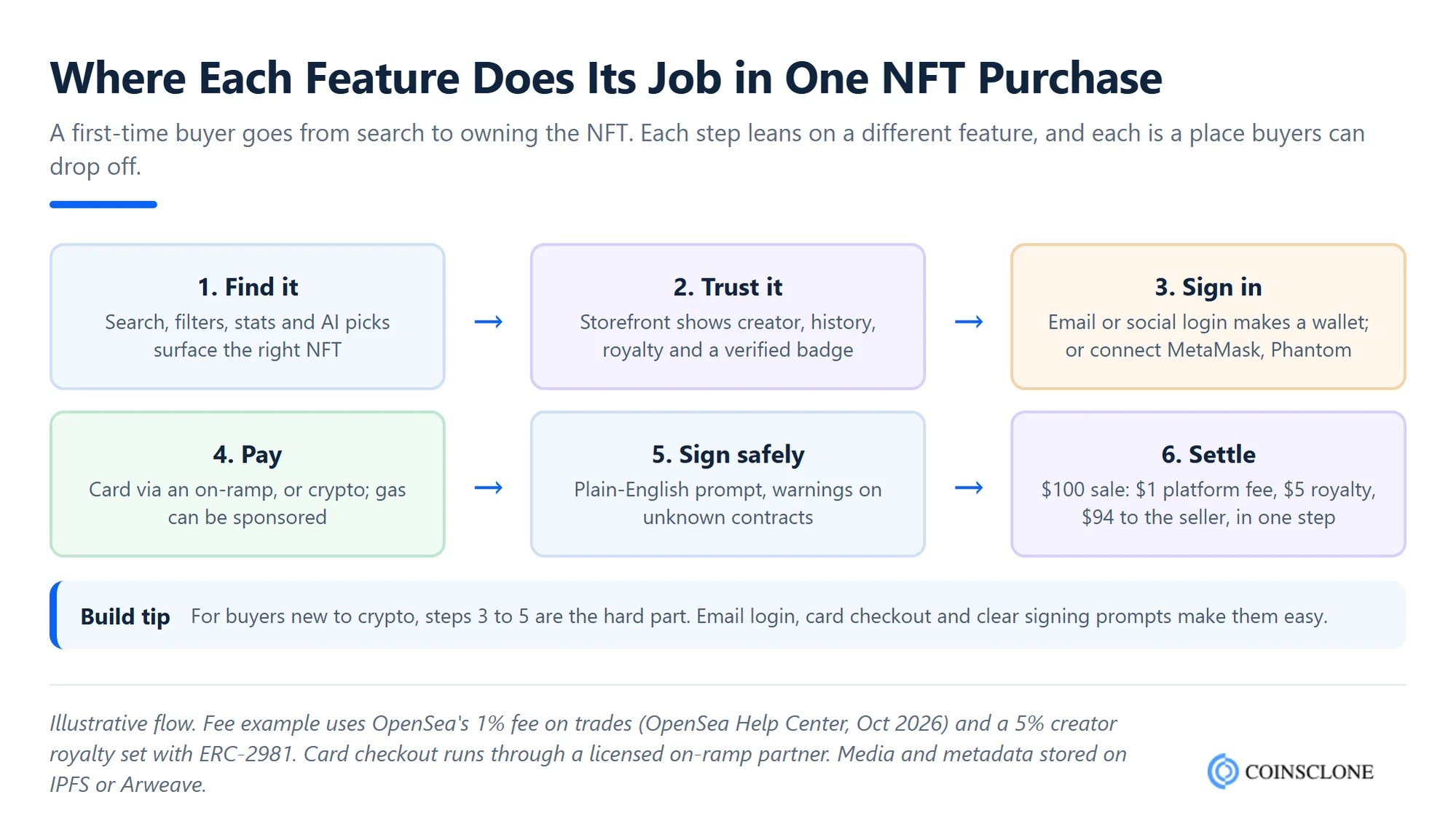
To see how these fit together, follow one buyer through a single purchase. Each step leans on a different feature, so a weak link anywhere costs you the sale.
Importance of Features in an NFT Marketplace
Features of an NFT marketplace are the backbone of a platform and act as a bridge between the market and the user. They also meet different needs and bring a range of use cases to an NFT ecosystem.
Marketplace Performance
The features decide how well the platform performs in a crowded NFT market. The speed of each trade, the traffic you can handle and the way users interact all depend on them. In short, features are “the building blocks of the NFT marketplace”. This matters even more now, since the leaders have cut fees hard. OpenSea charges 1% on NFT trades, and Blur and OKX NFT charge 0%. So you win on experience and focus, not on price.
Security Factors
Strong safety tools like ID checks, two-step login, passkeys and scam alerts are vital in NFT markets. These security-focused features of an NFT marketplace earn user trust and cannot be skipped. As you will see below, many user losses now come from signing bad messages, not from hacked servers.
More NFT Creators and a Bigger Ecosystem
When users trust your NFT market, they feel safe about each trade. In turn, that trust draws NFT creators who want to earn steady income, and the whole ecosystem grows.
Flexibility for Users
With a broad set of trading and social tools, the features of the NFT marketplace give users full freedom. Platforms can offer mobile apps, desktop apps and other channels, so users can trade NFTs anytime, anywhere.
In the next part, let’s look at the full list of features an NFT market can have, group by group.
Full List of NFT Marketplace Features
For an NFT market to run well, it needs the right features in the right order. These features of an NFT marketplace fall into five groups: Core, Engagement, Advanced, Add-on and Admin. The core group holds most of the 10 must-haves. The rest help you grow once the basics work.
Core Features of an NFT Marketplace
Here are the core features every NFT market should have. Building these well comes first.
Store-Front
The storefront shows the key details of each NFT, such as its name, collection, creator and royalty. Users get the full facts about an NFT in one place, including its sale history and current offers. It also covers the basic needs of a user, such as wallet connection, social sharing and a layout you can tailor. So design the storefront to look good and stay easy to browse. A “verified” badge for real collections also helps buyers avoid fake copies. Apart from meeting the many needs of users, the storefront gives each user a personal feel as well.
User Registration
User sign-up lets people create accounts fast and manage their NFT sets. A good sign-up flow balances ease of use, safety and wallet connection. In 2026, many markets also offer email, social or passkey login, which creates a wallet for the user in the background. This removes the biggest hurdle for buyers new to crypto. Sign-up is also the first step for identity checks, email checks and two-factor login.
Crypto Wallet Integration
Crypto wallets, or NFT wallets, store and give access to NFTs on the market. Users who already own a wallet expect to connect it in one click, so support the popular ones, such as MetaMask, Coinbase Wallet, Trust Wallet and Phantom. Multi-chain support is now common too, so users can reach several blockchains from one place. So both NFT wallet building and wallet links play a huge role in keeping users’ assets safe and earning trust in the platform.
Multiple Payment Options
Not every buyer holds crypto. That is why the best markets now let users pay by card, as well as in ETH, SOL, USDC or USDT. Card checkout usually runs through a licensed on-ramp partner, such as MoonPay or Crossmint, which also handles the ID checks. As a result, fans, gamers and brand customers can buy an NFT as easily as they shop online. Some markets also sponsor the gas fee, so the buyer pays one clear price.
Filter & Search
A strong filter and search tool, with many sub-groups, helps users find specific NFTs. It sorts NFTs by price range, relevance, popularity, rarity, traits and best sellers. Users can also sort by chain or by recent sales. So the filter and search engine lets users find what they want quickly, without delay.
Listing & Status
The listing feature lets users list their NFTs to sell or trade. Sellers can pick a fixed price, a timed auction or an open offer, and buyers can make offers on a single NFT or on a whole set. Each listed NFT also shows its recent sales, auction prices and bids. To get updates and alerts about an NFT, users can turn on push alerts. So the listing feature lets top creators earn from their work, while buyers can check an NFT fully before they buy.
NFT Minting
NFT minting turns a digital item into an NFT and records it on the blockchain. This feature lets creators show their work and list it on the market by deploying smart contracts and paying gas fees. Most markets now offer single minting, batch minting for large sets and lazy minting (covered below). The blockchain you pick also decides the gas fee for each mint. For instance, one NFT sale on Ethereum cost about $0.61 in gas on 1 October 2026, per Etherscan. Polygon, Base and Solana cost far less.
Security and Signing Protection
Security is no longer only about servers. Today, many users lose NFTs by signing a harmful message on a fake site. Wallet-drainer phishing took $83.85 million from 106,106 victims in 2025, per Scam Sniffer’s 2025 phishing report. That was down 83% from 2024, but “Permit” signatures were still the top attack route.
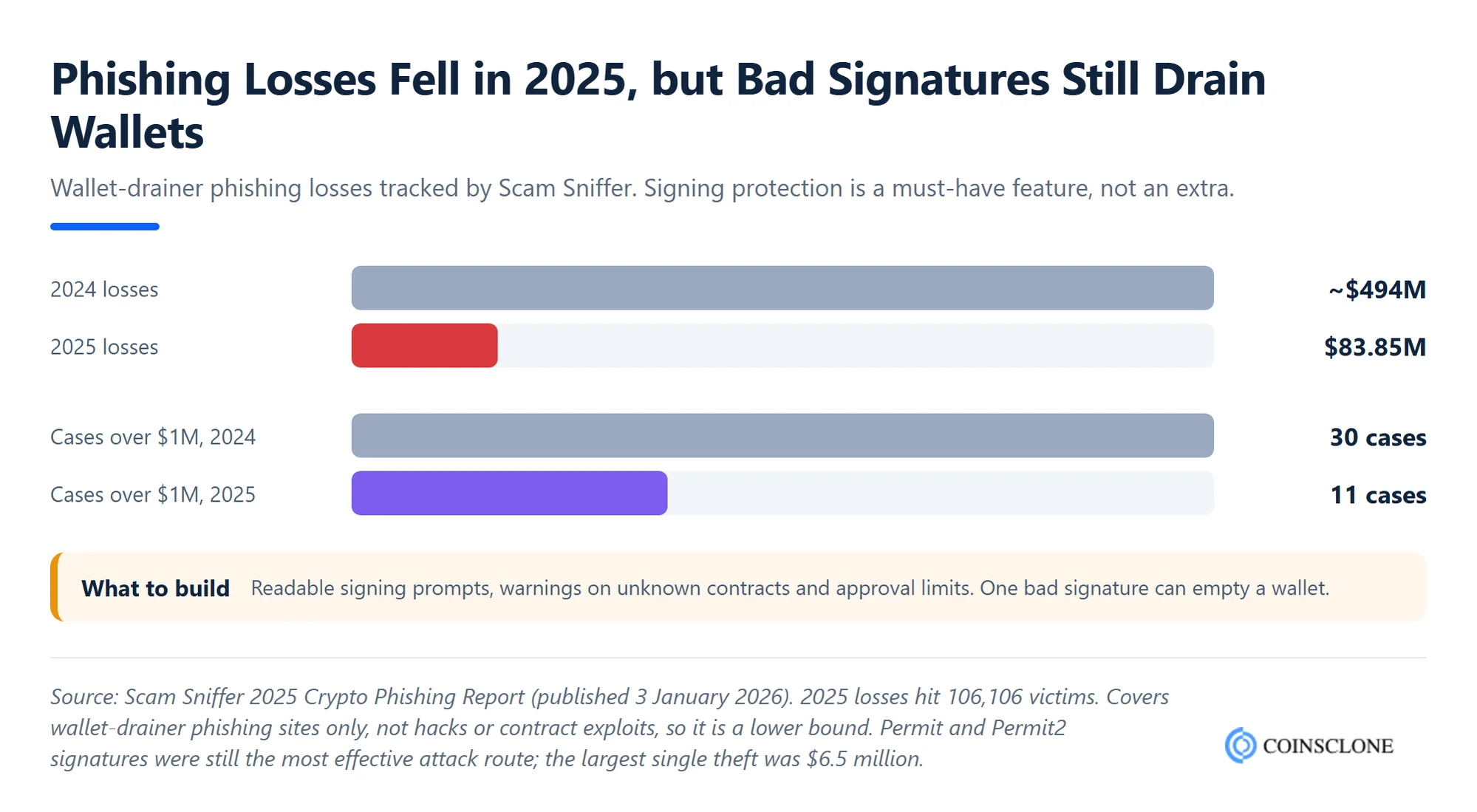
So a safe NFT market needs these security features:
- Clear signing prompts: Show users, in plain English, what they are about to sign and what it lets the other side do.
- Scam warnings: Flag unknown contracts, fake copies of popular sets and look-alike links.
- Account safety: Offer two-factor login, passkeys and alerts for new devices.
- Audited contracts: Get your smart contracts checked before launch and after every major change. Published 2026 agency cost guides put an NFT marketplace audit at about $5,000 to $25,000.
- Admin safety: Lock admin keys behind multi-sig wallets and watch trades in real time.
Engagement Features of NFT Marketplace
Next come the engagement features, which help users and creators find their way around and use the platform with ease. Adding them boosts activity and helps creators build a community.
Bidding Option
The auction and bidding feature is one of the main sources of activity on any NFT marketplace. Users can place bids on an NFT in an auction, and the highest bidder gets the NFT. The bidding tool also shows the latest bid, plus the highest and lowest bids for each NFT. On top of that, timed auctions and “buy now” prices together give sellers more ways to set a fair price. This is key to drawing more NFT users in.
Drops and Launchpad
A launchpad lets creators and brands release new sets on a set date. It usually comes with allowlists for early fans, mint limits per wallet and a countdown page. This matters for your income, because first sales earn the most. OpenSea, for example, takes 10% on mints in a first drop but only 1% on later trades, per the OpenSea Help Center. So a good launchpad can turn your market into the place where new sets start.
Community Engagement
The community feature lets NFT fans learn about current trends and popular NFTs on your platform. It also raises your platform’s profile through comments, links and talks. Along with that, key events like referral programs, bug bounty launches and new NFT airdrops are shared here, and it works as a tool for building trust.
Ratings & Reviews
The ratings and review system lets users share feedback on the services on the platform. Ratings and reviews build trust, openness and brand among new users. Users usually rate the NFTs, the creators or the trade services on the platform. For the long-term survival of NFT markets, ratings and reviews become a very strong feature.
Decentralization & Governance
Decentralization is one of the key traits of an NFT market. It keeps trades open and safe for users. It not only builds trust but also gives a fixed record of ownership and fair trades. In many markets, the community also helps run things, and token holders vote on key choices. This creates a fair system where users have a say in how the market grows.
Incentives & Rewards
NFT markets often add incentive and reward systems to boost activity, loyalty and growth. These come in many forms, such as staking rewards, royalty earnings, airdrops and loyalty programs. Adding these features increases user activity and draws NFT fans from around the world.
These reward strategies can be strengthened with NFT loyalty platform development to improve retention and long-term engagement.
Advanced Features of an NFT Marketplace
Some of the advanced features to keep in mind when you create an NFT market are…
Fractional NFTs
As you might have heard, F-NFTs or fractional NFTs split a high-value NFT into smaller shares that people can trade. This makes owning it open to more people. So adding this feature lets many users own a share of a single NFT, much like holding stock in a company. It also helps creators by bringing in more buyers and raising value. One caution, though: under new US SEC guidance from March 2026, most NFTs count as collectibles, but split shares can still be treated as securities. So get legal advice before you launch fractional NFT trading.
Cross-Chain Compatibility
Cross-chain support is a key part of a modern NFT market, letting users reach different blockchains through one platform. The feature has many benefits for your users, including wider reach and more NFTs from around the globe. It also lets you pick the cheapest or fastest chain for each kind of NFT.
Also Read: Cross-chain NFT Marketplace Development!
Embedded Wallets and Gas-Free Transactions
This is one of the biggest changes in recent years. Embedded wallets let users sign up with an email or a social account, and the platform creates a wallet for them behind the scenes. Account abstraction goes one step further. With ERC-4337, now a Final Ethereum standard, and EIP-7702, which went live in Ethereum’s Pectra upgrade, you can pay gas for your users, bundle steps into one click and add recovery options. As a result, a first-time buyer never has to buy ETH just to pay a fee.
Phygital Redemption
Phygital NFTs stand for real items, such as graded trading cards, watches or sneakers. The real item sits in a vault, and the buyer can trade the NFT or claim the item. This model is one of the strongest in the market today. Courtyard, which sells graded cards this way, made about $30.2 million in sales in the 30 days to 16 October 2026, per CryptoSlam collection rankings. To support it, you need redemption requests, shipping and proof of who holds each item.
Metaverse
This is an advanced feature that lets users enter virtual worlds and show their NFTs as virtual assets. NFTs prove who owns each metaverse asset, so users can trade them across many virtual worlds. This also makes NFTs work across platforms and takes their use beyond static collectibles. Today, it fits best for game and virtual world markets rather than general art markets.
AI-Powered Curation
Using machine learning, you can add AI-powered NFT curation as a feature. This smart system helps buyers find unique digital assets that match their tastes, which lifts activity and sales. It also makes NFT browsing easy and natural for users at every level. AI can also spot fake copies and odd price moves before users get hurt.
AR/VR previews for digital assets
Augmented Reality (AR) and Virtual Reality (VR) previews change the way people see digital assets by making them feel real. Instead of just viewing a flat image or a basic 3D model, users can see assets in a way that is close to real-world use. This is most useful for fashion, art, collectibles and other items people want to “try on” or place in a room.
Add-on Features of NFT Marketplace
Here are some of the add-on modules that an NFT market can offer.
Lazy Minting
Lazy minting is a low-cost feature that lets creators list their NFTs without paying gas fees up front. Instead of minting the NFT on the blockchain right away, the NFT is only minted when a buyer purchases it. So this process lowers the cost barrier for artists and creators and makes NFT creation open to more people. Learn how it works on a white label NFT minting platform.
NFT Stats
This feature shows the full NFT trend, price history and current status of a specific NFT, so users can refer to it before a trade. It usually covers floor price history, sales volume, holder counts and rarity scores. With live data and charts, users can trade more wisely. This data also helps users judge a fair price before a sale.
Royalty Management
NFT markets offer royalty options to creators who list their NFTs. Creators can set the share they get from each resale. This gives creators a steady income stream long after the first sale. The ERC-2981 standard lets an NFT state its royalty, but it cannot force a market to pay it. After 2023, most big markets made royalties optional. Blur, for instance, pays only a 0.5% floor on sets that do not force royalties.
If you want royalties enforced, look at creator token contracts such as Limit Break’s ERC-721C. OpenSea has supported enforced creator earnings through this standard since April 2024. The trade-off is that such NFTs can only sell on markets that honour the rule. So state your royalty policy clearly, since artists and brands now prefer markets that pay them.
Decentralized Storage
Store NFT media and metadata on IPFS or Arweave, not just your own servers. If your servers go down, the NFTs still show the right image. This matters more than ever. When Foundation closed in April 2026, it promised to keep its IPFS media pinned for a year so collectors would not lose their art. So plan what happens to your users’ NFTs if your site ever goes offline.
Help Center
Today, every NFT market offers customer support or a help center to fix user issues. Here, users can raise tickets for tech issues or bugs. The admin then takes the right steps to fix the problem as soon as possible. Some NFT markets even offer 24/7 support, so any user, anywhere, can raise a ticket at any time.
Admin Features of NFT Marketplace
These admin features keep the market running smoothly and help the whole platform perform well.
User Management
Admins can oversee all user activity, including sign-ups, KYC checks and account rights. This keeps the market safe and in line with the rules. By watching how buyers and sellers deal with each other, admins can also spot fraud or rule breaks quickly. In the end, strong user management keeps trust and safety across the whole ecosystem.
Revenue Management
NFT markets earn through listing fees, trade fees, mint fees, royalties and paid promotions. So admins need tools to track and tune each of these income streams. This includes setting fee rates, tracking earnings and paying royalties to creators. With clear revenue tools, the platform stays both profitable and creator-friendly.
Content Moderation
Admins review and approve NFTs before they are listed, to keep quality high and stop illegal or copied content. They can flag or remove assets that break community rules or someone’s rights to their work. Good moderation builds trust in the market and protects both creators and buyers. It creates a safe space that keeps people coming back.
Reporting & Analytics
Detailed dashboards let admins track how the platform performs in real time. Data on sales volume, user activity and trending assets helps admins make better choices. Regular reports also help spot growth chances and risks early. With these insights, admins can keep improving the user experience and running the market well.
Compliance Tools
If you take card payments, hold user funds or sell fractions, you need Know Your Customer (KYC) and Anti-Money Laundering (AML) checks. Many markets also screen wallets against sanctions lists. Rules differ by country. In the EU, for example, the MiCA regulation leaves out unique NFTs, but split shares and large sets of near-identical tokens can fall inside it. So build compliance tools that you can switch on per market.
These are the main features that popular NFT markets offer. Apart from that, you can add more add-on modules that make your market stand out. Each of these features also affects the overall cost of building an NFT market. That is why you should consult skilled NFT experts while planning your business.
Which NFT Marketplace Features Should You Build First?
You do not need every feature on day one. In fact, launching with too many features slows you down and drains your budget. Start with the 10 must-haves, then add the features that match your model. The decision tree below shows where to look first.
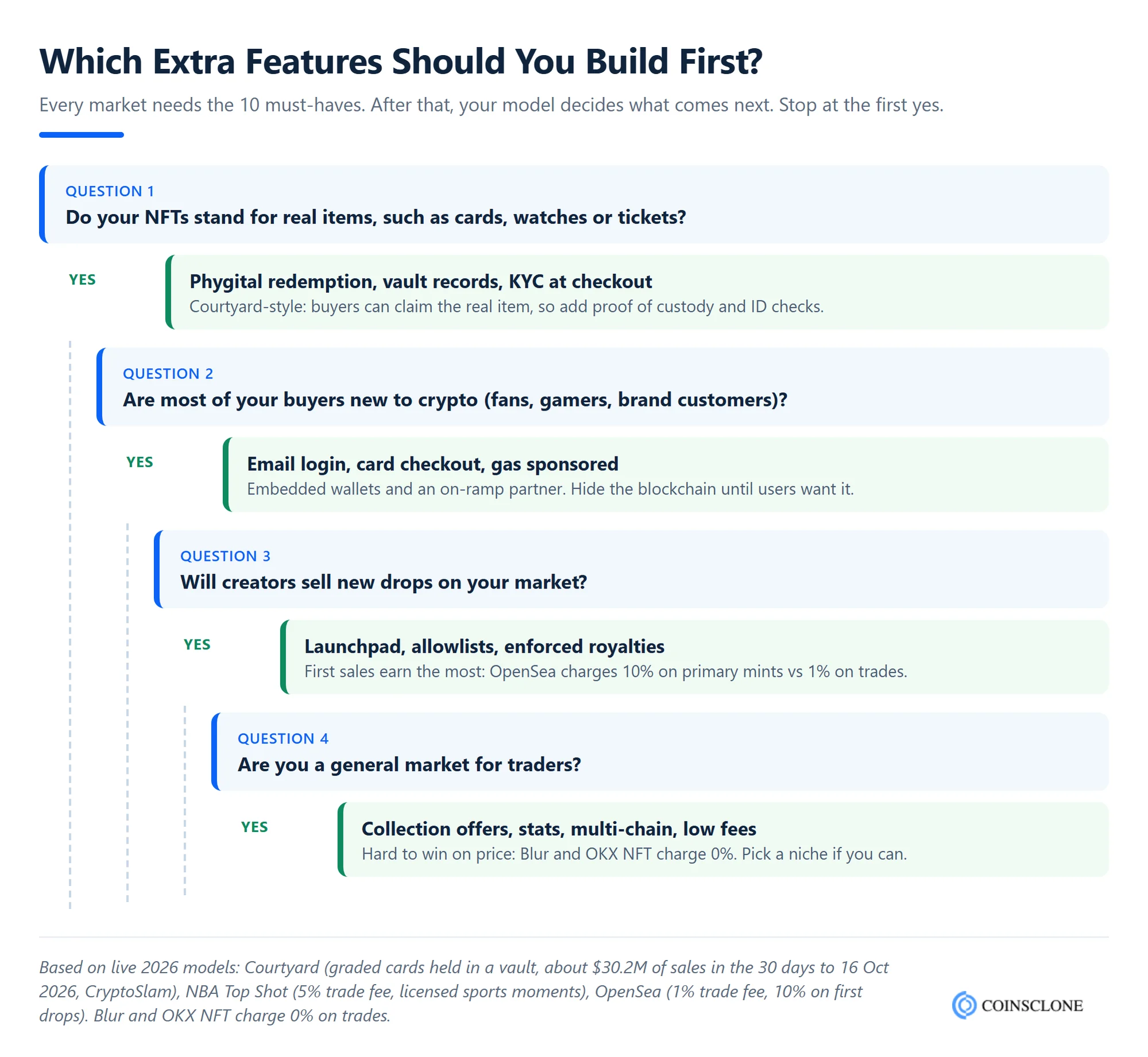
Here is a simple way to plan your roadmap:
- At launch: The 10 must-haves from the table above.
- First three months: Collection pages, activity feeds, creator dashboards, user profiles, push alerts and NFT stats.
- Later: The extras your model needs, such as a launchpad, phygital redemption, fractions, AI curation or AR previews.
How Features Change Your Cost and Time
Every feature adds build and test time. That is why the build path matters as much as the feature list. Published 2026 agency cost guides put the price ranges at:
| Build path | Typical cost | Best for |
| White label NFT marketplace | $10,000 to $30,000 | Fast launch with the core features |
| Custom MVP | $20,000 to $45,000 | A new idea that needs testing |
| Mid-tier platform | $40,000 to $80,000 | More chains, launchpad and richer tools |
| Enterprise build | $80,000 to $150,000 or more | Deep custom features and high traffic |
Add $5,000 to $25,000 for a smart contract audit, plus monthly running costs. For timing, Coinsclone’s published build times are 4 to 6 weeks for a white label NFT marketplace and 9 to 13 weeks for a standard build. For a full budget breakdown, see our guide to NFT marketplace development cost.
If you want the must-have features ready on day one, Coinsclone’s white label NFT marketplace software ships with them, and our team can add the extras your niche needs.
Final Takeaway!
We hope you’ve gained useful insights into the top features of an NFT marketplace that drive long-term success. Without these features, a market is likely to lose ground in today’s crowded space. In 2026, the winners make buying easy for people new to crypto, keep users safe at the moment they sign and serve one clear niche. Adding advanced and fresh features on top of that can be a major advantage.
As a leading NFT Marketplace Development Company, Coinsclone can help you build the best features of an NFT marketplace into your platform. We have been building since 2018 and have delivered 350+ platforms for 200+ clients across 20 industries. Our team has hands-on skill in building secure, scalable and feature-rich NFT markets. For any guidance on NFTs, you can always reach out to our business team.
Discover the Must-Have Features of an NFT Marketplace for a Winning Platform
NFT Marketplace Development — built for seamless user experience.
- Core Functionalities: Explore essential Features of NFT Marketplace
- User-Centric Design: Intuitive interface, advanced search, and wallet integration.
- Admin & Analytics: Manage listings, users, and monitor performance effortlessly.
- Revenue-Ready: Monetize through trading fees, NFT drops, and premium listings.
See a free branded demo of your NFT marketplace in 48 hours — before you invest a cent.
Book a Free Demo to see how implementing the right Features of NFT Marketplace can make your platform stand out in just 8–12 weeks.
Other Related Article,
NFT Marketplace Tech Stack – A Must-Know Startup Guide
Frequently Asked Questions
What are the key features of an NFT marketplace?
The key features are a storefront, sign-up and login, wallet connection, card and crypto payments, search and filters, listings with fixed prices, auctions and offers, minting tools, smart contracts with royalties, security and signing safety, and an admin dashboard. After launch, many markets add a launchpad, NFT stats, multi-chain support and phygital redemption.
Which features should an NFT marketplace MVP include?
An MVP should include the 10 must-haves: storefront, login, wallet connection, payments, search, listings, minting, smart contracts with royalties, security and an admin panel. Leave fractions, metaverse, AR previews and AI curation for later. This keeps the first build small, so you can test your niche with real users sooner.
What makes an NFT marketplace successful?
A clear niche, an easy first purchase and a business model that does not rely on trade fees alone. With OpenSea at 1% and Blur at 0%, new general markets struggle to win on price. Markets tied to real things, such as Courtyard’s graded cards or NBA Top Shot’s licensed moments, have done far better.
Do NFT marketplaces need KYC?
It depends on what you offer and where. If you take card payments, hold user funds or sell fractions, you will usually need KYC and AML checks. Card on-ramp partners often handle the ID checks for you. In the US, the SEC’s March 2026 guidance treats most NFTs as collectibles, while the EU’s MiCA can cover split shares. Get local legal advice.
How do NFT marketplaces make money?
They earn from trade fees, first-sale and mint fees, listing fees, paid spots, pack sales and services. For example, OpenSea charges 1% on trades and 10% on first drops, NBA Top Shot charges a 5% trade fee, and Courtyard charges nothing on trades and earns from selling packs.
How do royalties work and can they be enforced?
Creators set a royalty percentage that is paid to them on each resale. ERC-2981 lets an NFT state its royalty, but markets can choose not to pay it. To enforce royalties, creators can use creator token contracts such as ERC-721C, which OpenSea supports. The trade-off is that the NFTs can then only sell on markets that honour the rule.
Do I need a security audit before launch?
Yes. Your smart contracts hold users’ NFTs and money, so get them audited before launch and after every major change. Published 2026 agency cost guides put an NFT marketplace audit at about $5,000 to $25,000, based on how complex the contracts are.
How much does it cost to build an NFT marketplace with these features?
Published 2026 agency cost guides put a white label NFT marketplace at about $10,000 to $30,000 and a custom MVP at $20,000 to $45,000. Mid-tier platforms run $40,000 to $80,000, and enterprise builds $80,000 to $150,000 or more. Add $5,000 to $25,000 for an audit, plus monthly running costs.