
Customers have changed. Many no longer get excited by discounts, punch cards or “buy 10, get 1 free” deals, especially with global, digital-first brands. They want rewards they can own, show off and use for real perks. An NFT loyalty platform gives them that, because each reward is a digital token the customer holds in a wallet.
This guide covers NFT loyalty platform development from start to finish: what it is, how it works, the features to build, what it costs in 2026 and what happened to the big brand programs that went first. If you are a brand, startup or enterprise looking at blockchain loyalty, you will finish with a clear plan and fewer blind spots.
In this guide:
- How an NFT reward moves from a purchase to a perk at checkout, step by step
- Which NFT type and blockchain fit which kind of reward
- What happened to Starbucks Odyssey, Nike .SWOOSH, Reddit and Lufthansa Uptrip, and what that teaches you
- Cost ranges from published 2026 guides, plus the running costs most quotes leave out
- The core user, admin and security features, and the build steps we follow
See How Our MVP System Can Launch Your NFT Loyalty Platform Faster
NFT Loyalty Platform Development — turning loyalty into long-term growth.
- MVP System: Launch your NFT-based loyalty platform up to 90% faster.
- Rewards & Wallets: Pre-built NFT rewards, wallets, and redemption logic—no heavy coding needed.
- Brand & Customization: Your brand, your NFTs, your loyalty rules.
- Revenue Engine: Drive repeat sales, memberships, gamification, and premium rewards.
See a free branded demo of your NFT marketplace in 48 hours — before you invest a cent.
Book a Free Demo to discover how our NFT Loyalty Platform Development solution can take you from idea to live platform in just 8–12 weeks.
What is NFT Loyalty Platform Development?
NFT loyalty platform development means building a blockchain-based reward system that gives users NFTs when they engage with your brand. Users can own, trade and redeem these NFTs. Because the reward has real value, it gives people a stronger reason to come back.
Smart contracts run every reward on the platform, so the rules are clear and no one can quietly change a customer’s balance. In simple terms, the platform turns what customers do into NFT rewards that carry real use, not just a discount code.
Here is how this differs from the points program most brands run today.
| Traditional points program | NFT loyalty program | |
| Who holds the reward | The brand, inside its own database | The customer, in a wallet |
| Can it be traded or gifted | Rarely; points are locked to one account | Yes, if you allow it; you can also lock it |
| Where it works | Only with the brand or a few partners | With the brand, partners and any app that reads the token |
| How rules are enforced | Terms and conditions the brand can change | Smart contract code anyone can check |
| What it says about the customer | A balance number | A visible record of status, events and achievements |
Types of NFT Loyalty Platforms Brands Use
NFT loyalty platforms come in several types. The right one depends on your audience, your field and your goals. Here are the most popular ones.
- Brand-Centric: The platform serves a single brand. NFTs act as club memberships, access passes or member perks. This suits luxury and retail brands that want strong brand recall.
- Community-Driven: Members earn NFTs for taking part, not for buying. They build loyalty by adding to the community and joining events. This fits Web3 startups and DAOs that want growth through engagement.
- Tier-Based: Loyalty shows up as levels such as Silver, Gold and Platinum. Users move up as they engage more, and each level unlocks new perks. Large firms and subscription brands use this to keep members for years.
- Gamified: Users earn an NFT for finishing quests, challenges or missions. This makes earning rewards fun. It works well for gaming, fitness and education brands that want people to come back again and again.
- Cross-Brand & Multi-Partner: Users can redeem NFT rewards across several partner brands, so the loyalty grows across a whole network. This fits travel, lifestyle and fintech businesses.
Explore Which NFT Loyalty Model Fits Your Business!!!
Diverse NFT Loyalty Platform Development Approaches We Follow
Our build options work for every type of business, from startups to large firms.
Custom Development
At Coinsclone, we can build an NFT loyalty platform from scratch. Businesses that want full control and a unique product choose this route, as it gives the most room to personalise. There are no limits on loyalty rules or what the NFTs can do.
Choose this route if you want full ownership, room to scale and a clear edge over rivals. We start by turning your loyalty goals into secure smart contracts, a backend that can grow and screens your users find easy. The result is a platform built only for your business.
White Label NFT Loyalty Platform Software
White-Label NFT Marketplace Software is ready-made software that we tailor to your goals and brand. If you want to launch quickly without giving up reliability, white label is a strong choice. It is faster, it still lets you customise, and it costs less than a full build.
We adjust the reward logic, NFT perks and workflows so the platform fits your brand. Then we check that it stays stable and flexible as you grow.
Hire NFT Developers
You can hire our NFT developers, who know NFT loyalty platform development well, to help you build a stable platform. Large firms often prefer this. They keep control of the plan, can grow or shrink the team, and ship features faster than with a fully in-house team.
Our developers work closely with your team and follow your timelines, goals and processes. We aim for steady quality and sound code at every stage.
Detailed Working Process of NFT Loyalty Platform
Before you build an NFT loyalty platform, it helps to see how it works in real life. It may sound complex, but the flow is quite simple.
NFT Minting & User Enrollment
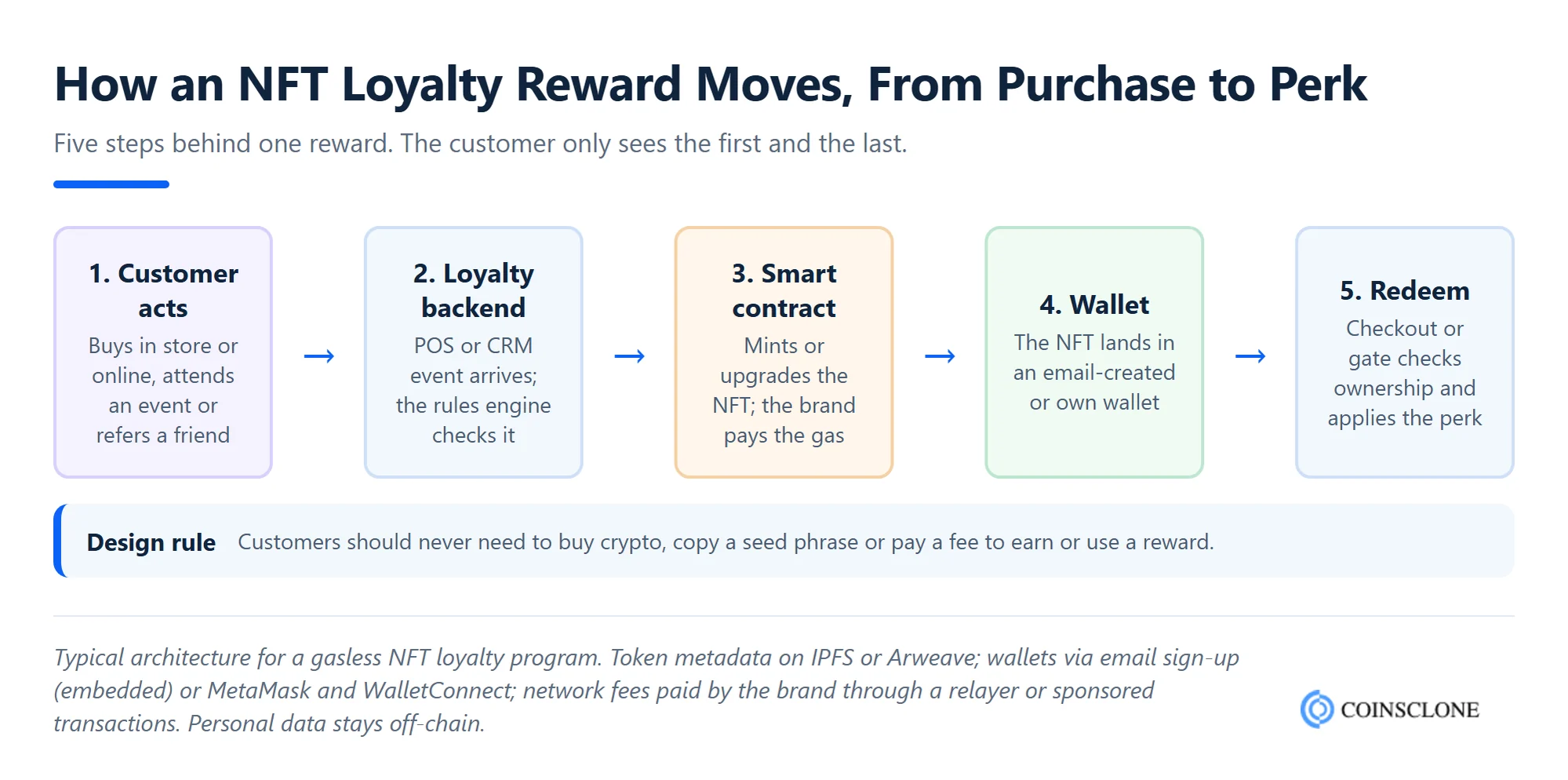
Users can join in two ways. They can link a crypto wallet they already have, such as MetaMask. Or they can sign up with an email address, and the platform makes a wallet for them in the background.
Once a user is on board, a set trigger event mints their NFT. The NFT’s image and details are stored on decentralised storage such as IPFS or Arweave.
Earning Rewards
After sign-up, the platform tracks what users do. Each meaningful action can count toward a reward. Common actions include buying items, hitting goals, going to events, referring friends and joining in with the community.
The smart contract checks each action and sends the NFT reward automatically, with no manual work.
Using, Redeeming and Upgrading NFTs
Based on your design, users can spend or use their NFTs to unlock special content, join members-only events, get discounts, use paid services or move up a tier.
The platform can also upgrade an NFT to a higher tier automatically as the user stays active.
Marketplace Integration
Many NFT loyalty platforms connect to a marketplace, either built in or external, so users can trade, sell or transfer their NFTs. Users can send NFTs to each other, resell them, use them on other apps and get real value back.
Choosing the NFT Type and Blockchain
Two early choices shape cost and user experience: which kind of NFT each reward should be, and which chain it lives on.
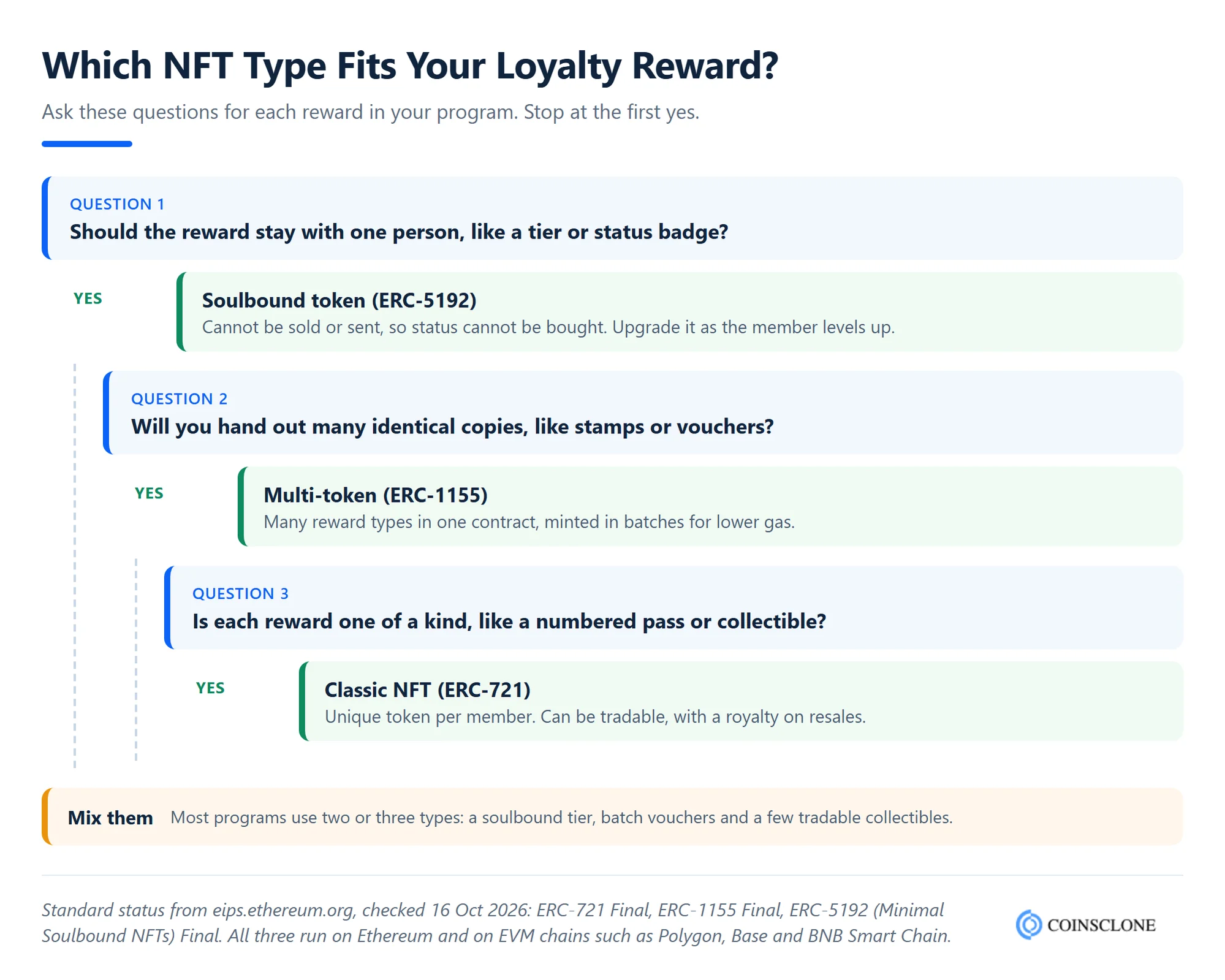
- Soulbound status tokens: A tier or badge that should stay with one person can use ERC-5192, the “minimal soulbound NFT” standard, which is Final. It blocks resale, so status cannot be bought.
- Repeat rewards and vouchers: When you hand out thousands of identical stamps or coupons, ERC-1155 keeps many reward types in one contract and mints them in batches, which saves gas.
- One-of-a-kind passes: A numbered member pass or a one-off art piece fits ERC-721. Our guide to NFT standards compares them in more detail.
- The chain: Most brands pick a low-fee network such as Polygon, Base or BNB Chain over Ethereum mainnet. For scale, a plain ERC-721 mint used about 69,600 gas in our 16 October 2026 test on BNB Smart Chain, about a quarter of a cent per mint. So 100,000 member mints cost roughly $250 in network fees.
- Gasless by default: Your customers should never need to buy crypto. Let the platform pay network fees through a relayer or sponsored transactions, and give email users a wallet in the background.
Real Brand NFT Loyalty Programs: Where They Stand in 2026
Big brands tested NFT loyalty from 2022 onward. Some programs have closed, and one is still growing. Here is where each stood as of October 2026.
| Program | Launched | Chain | Status in October 2026 |
| Lufthansa Group Uptrip | March 2023 | Polygon | Active. Passengers turn boarding passes into trading cards that can be minted as NFTs and earn miles, lounge vouchers and status. ITA Airways was added in July 2026. |
| Starbucks Odyssey | Beta in December 2022 | Polygon | Closed on 31 March 2024. Members’ Stamp NFTs moved to Nifty Gateway, which itself closed in February 2026. |
| Nike .SWOOSH | November 2022 | Polygon | Wound down. Nike said in December 2024 it would launch no more NFT collections, and the .SWOOSH site now redirects to Nike’s SNKRS launch page. |
| Nike RTFKT | Bought December 2021 | Ethereum | Closed. Wound down in January 2025 and sold in late 2025. |
| Reddit Collectible Avatars | 2022 | Polygon | Winding down. The Avatar Shop closed on 11 November 2025, and the in-app Vault was set to stop transfers on 1 January 2026. |
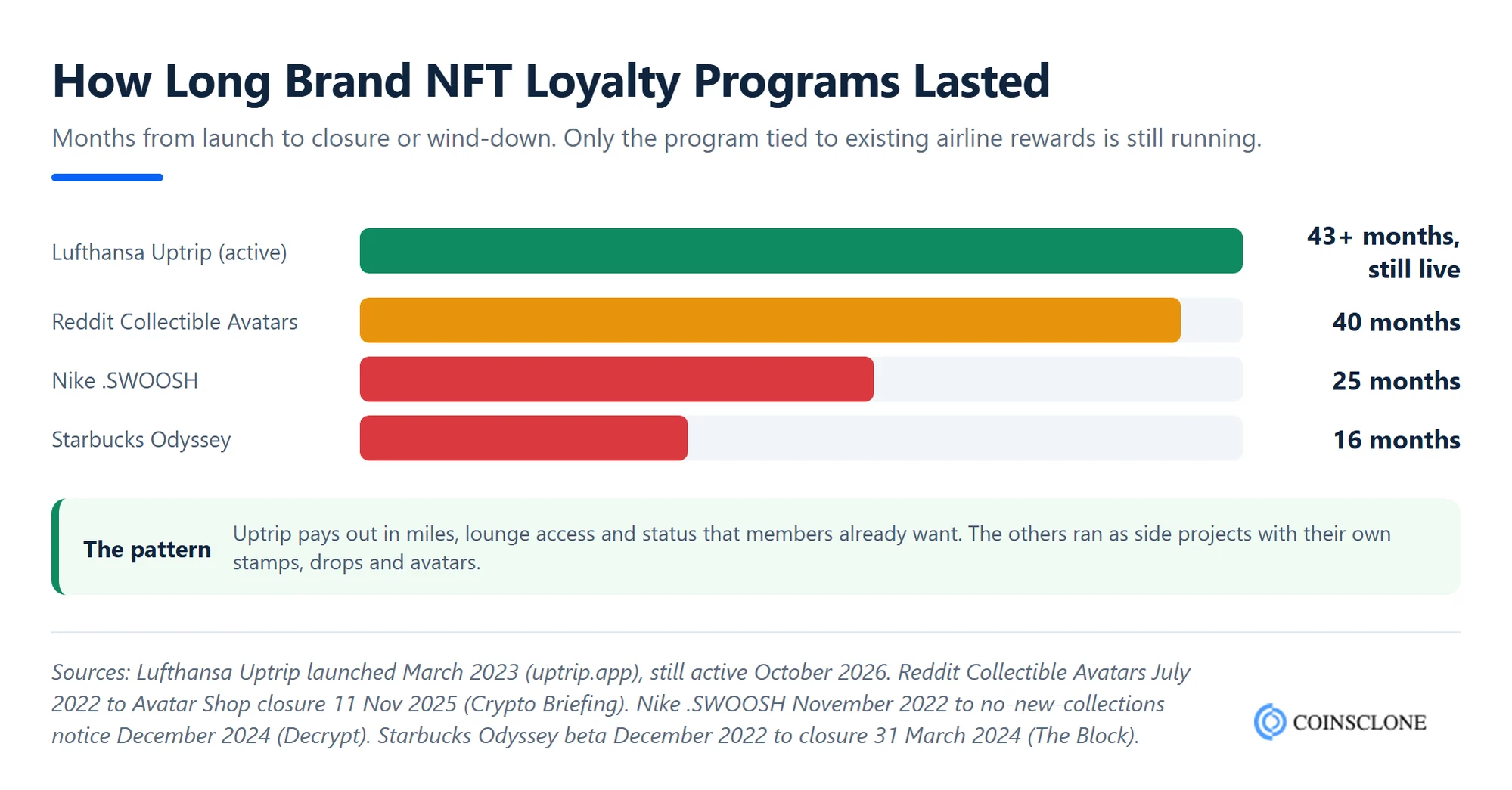
The dates come from The Block on the Odyssey closure, Decrypt on Nike’s NFT exit, Crypto Briefing on Reddit’s wind-down, the Uptrip site and The Flight Club on ITA Airways joining Uptrip.
What these programs teach:
- Tie NFTs to the program you already run. Uptrip pays out in Miles & More miles, lounge access and status that travellers already value. Odyssey and .SWOOSH ran as side projects with their own points and drops.
- Hide the crypto. Uptrip lets passengers collect cards first and mint later. Every extra wallet step loses users.
- Plan your exit on day one. Starbucks sent its Stamps to Nifty Gateway, and that marketplace has since closed too. Decide where tokens and their images will live if you ever close, and tell members up front.
- Reward use, not resale. When NFTs become trading assets, prices swing and holders care about floor prices, not your brand. Lock status tokens and keep tradable drops small.
Core Features of the NFT Loyalty Platform that We Develop
We build NFT loyalty platforms that grow with you, are easy to use and fit real business needs. Each one serves both users and admins and keeps security at the core.
User Features
These features decide whether users adopt the platform and keep using it.
- NFT Dashboard: Users see all their NFTs, track progress toward rewards and check their tier in one place.
- Token-Gated Access: Users treat their NFTs as keys that unlock special products, paid features and private, members-only events.
- Gamified Rewards & Quests: Missions, challenges and milestones give users a reason to engage often, which keeps them active on the platform.
- Secondary Marketplace: Users can buy, sell or list their reward NFTs in a built-in market, which gives them real value.
- Redemption System: Users swap their NFTs for real goods, online services, discounts and days out.
Admin Features
These features let businesses run the loyalty program with ease.
- NFT Minting & Management Engine: Admins create NFT collections, set reward rules, cap how many NFTs can be minted and manage sending them out from one panel.
- Smart Contract Control: Admins set reward logic, upgrade paths, upsells and expiry dates that trigger automatically, without rewriting the contracts.
- Analytics & Reporting Dashboard: See how users use the platform, how many engage with your NFTs, how many redeem rewards and how well each campaign pays back.
- Royalty Settings: Set a royalty rate, so the brand or creator earns a share each time an NFT is resold.
Security Features
Security is the backbone of any NFT loyalty platform. We add several layers of protection to keep the platform safe and trusted.
- Fraud Detection & KYC: Identity checks and behaviour checks stop people from creating fake accounts to farm rewards.
- Rate Limits & Anti-Bot Checks: Caps on how often users can claim stop bots from draining rewards.
- Multi-Factor Authentication: A second login step protects admin accounts and high-value users.
- Secure Storage (IPFS/Arweave): Decentralised storage keeps NFT images and details safe from changes or tampering over the long term.
- Smart Contract Audits: We test and audit every smart contract before launch and after major changes, to find weak spots early.
Experience Our NFT Loyalty Platform Features in Action!!!
Advanced Add-On Features for a Successful NFT Loyalty Platform
Here are advanced modules you can add to grow your user base and keep people engaged.
- AI-Driven Reward Personalization: Match rewards to what each user buys and does. People stay longer when rewards feel made for them.
- Dynamic NFT Upgrades: A dynamic NFT (dNFT) changes as the user stays active, for example with new art at each tier. This builds an emotional bond and keeps users engaged for the long haul.
- Event-Based Reward Triggers: Mint NFTs on their own when something happens, such as a product launch, a holiday sale or a user’s first year. This keeps the program fresh for as long as the customer stays.
- Game Modules: Make rewards something people play for, with leaderboards, XP and levels, streak rewards and short challenges. This keeps the program moving.
These add-ons improve the user experience, but their real value lies in what they unlock for your business. Let’s look at that next.
Business Benefits of an NFT Loyalty Platform
For startups and large firms, NFT rewards open new ways to grow, because customers own what they earn. Here is what you gain.
- More Repeat Visits: Because users own their NFTs, they feel more tied to the platform. This can lead to more return trips, fewer lost customers and a stronger bond with your brand.
- More Ways to Earn: You can earn from NFT sales, paid memberships, a cut of resales, partner deals, joint NFTs with other brands and paid members-only access.
- Better Brand Reach: NFTs travel across wallets, markets and online groups. Each one carries your brand to new people and places you in the Web3 space.
- Clear Data and Fair Rewards: Reward activity on the blockchain gives you a solid record of what users do. Rewards are visible to everyone, which builds trust and helps you make better decisions.
- Global Reach: NFT rewards are not tied to one country, so users anywhere can join. This lets you build a worldwide audience from day one.
Common Challenges and How to Avoid Them
NFT loyalty can fail for reasons that have little to do with the code. Plan for these early.
- Wallet friction: Seed phrases and gas fees scare off mainstream users. Use email sign-up with wallets created in the background, and pay network fees for your users.
- Speculation: If rewards become trading chips, holders care about resale prices instead of your brand. Make status rewards non-transferable and keep tradable drops limited.
- Shutdown risk: Programs close, and so do the marketplaces they rely on. Store NFT data on IPFS or Arweave, avoid relying on one marketplace and write a clear exit plan into your terms.
- Rules and law: In the EU, the MiCA regulation leaves out unique NFTs. But its recital 11 warns that NFTs issued in a large series can count as fungible, which brings them back into scope. In the US, the SEC chair said in November 2025 that he does not see digital collectibles as securities, though tokens sold as a way to make money still can be. Get legal advice before you let rewards be sold for money.
- Privacy: A blockchain record cannot be deleted, which clashes with data rules such as the EU’s GDPR. Keep names, emails and purchase history off-chain and store only token IDs on the blockchain.
- Contract bugs: One flawed contract can leak rewards at scale. Budget for an outside audit and test every reward rule before launch. Our guide to NFT smart contract development explains what an audit checks.
How much does it cost for NFT Loyalty Platform Development?
There is no single price, because scope varies so much. Published 2026 agency cost guides put a standard loyalty app at about $10,000 to $20,000 for a basic program, $20,000 to $60,000 for a mid-range one and $60,000 or more for an enterprise platform. Web3 loyalty apps with NFT or token rewards cost more, at about $30,000 to $300,000+, based on chains, features, links to other systems and security. White label setups start lower, and ready-made loyalty software costs about $50 to $500 a month.
These items move your budget the most:
| Cost driver | Why it matters |
| Build route | White label is the fastest and cheapest. A custom build costs the most but gives full control. |
| Number of chains | Each extra chain adds contracts, testing and wallet support. |
| Integrations | Links to your POS, CRM, ecommerce store or app add backend work. |
| Wallet onboarding | Email sign-up wallets and gasless minting need extra setup but lift sign-ups. |
| Security audit | An outside smart contract audit is a must before launch. |
| Gamification and AI | Quests, leaderboards, dynamic NFTs and personal rewards add design and test time. |
Plan for running costs too: hosting, storage, wallet service fees, network fees you pay for users, support and new campaigns. Network fees are often the smallest line. As shown above, 100,000 mints on a low-fee chain cost about $250.
The right budget depends on where your business is today, what it needs now and how you want the program to grow. Start with what matters most and keep the platform ready for what comes next.
Get Expert Guidance to Budget Your NFT Loyalty Platform !!!
Steps to Build an NFT Loyalty Platform
At Coinsclone, we shape each loyalty platform around your goals. Our process is clear and built for scale, security and business results.
- Strategic Planning: We start with your brand’s long-term goals and loyalty plan. Rather than jumping straight into code, we map how the platform will add value. We look at your goals, target users, loyalty actions, reward rules and what the NFTs should do. This planning makes your platform last.
- UI/UX Design: We design screens that even non-crypto users find easy. That means simple onboarding, clear reward tracking, attractive NFT displays, on-brand layouts and a mobile-first design. The goal is simple: make joining and earning effortless.
- Smart Contract & Backend Development: We write secure smart contracts that mint and redeem NFTs and send rewards automatically. This step covers the contract design, the backend and links to analytics and other tools. We check every layer for safety gaps.
- Wallet Integration: We add the wallets your users need, such as MetaMask, WalletConnect, wallets created by email sign-up and multi-chain wallets. This removes barriers so customers can join easily.
- Testing: Before launch, we test speed, stability and security. This covers feature tests, load tests, a smart contract audit and bug fixes, so the platform is safe and reliable.
- Deployment & Post-Launch Support: We then launch the platform on the mainnet and keep supporting you. We watch the platform, tune it and update it as the market and your users change.
Why Choose Coinsclone for NFT Loyalty Platform Development
Coinsclone is a well-known NFT Marketplace Development Company. We have been building blockchain products since 2018 and have delivered 350+ platforms for 200+ clients across 20 industries. Our team helps startups and large firms build reward platforms that grow with their users, from a simple NFT reward app to a full network shared by many brands.
For brands that want rewards minted at scale, our NFT minting platform development team builds the minting engine, batch drops and gasless claims behind the loyalty program. We stay with you after launch with updates, upgrades and technical help. Whether you are still exploring the idea or ready to build, we will help you move forward with clarity.
See How Our MVP System Can Launch Your NFT Loyalty Platform Faster
NFT Loyalty Platform Development — turning loyalty into long-term growth.
- MVP System: Launch your NFT-based loyalty platform up to 90% faster.
- Rewards & Wallets: Pre-built NFT rewards, wallets, and redemption logic—no heavy coding needed.
- Brand & Customization: Your brand, your NFTs, your loyalty rules.
- Revenue Engine: Drive repeat sales, memberships, gamification, and premium rewards.
See a free branded demo of your NFT marketplace in 48 hours — before you invest a cent.
Book a Free Demo to discover how our NFT Loyalty Platform Development solution can take you from idea to live platform in just 8–12 weeks.
Frequently Asked Questions
What is an NFT loyalty platform?
An NFT loyalty platform is a reward system on a blockchain that lets brands give NFTs as rewards. These NFTs can unlock perks such as discounts, memberships, special access or collectible benefits.
Why are brands using NFT loyalty programs?
Brands use NFT rewards to make loyalty more fun and personal. Unlike points, NFTs give customers something they own, clear rules and value they can trade, which builds stronger bonds.
Which industries can use NFT loyalty platforms?
Retail, online stores, gaming, music and film, travel, hotels and sports can all use NFT rewards to offer special perks and keep fans coming back.
How are NFTs used in loyalty and reward programs?
NFTs can work as membership passes, reward badges, discount vouchers, event passes or collectible achievements. Businesses can design them to match their brand and campaign goals.
How do customers redeem rewards from an NFT?
The customer connects their wallet or logs in at checkout, in the app or at an event. The platform checks that they hold the right NFT and then applies the perk, such as a discount, free item or entry. Some rewards are “burned” or marked as used so they cannot be claimed twice.
Can customers sell or gift their NFT loyalty tokens?
Yes, if you allow it. Tradable NFTs can be sold or sent to another wallet, and the brand can earn a royalty on resales. Many brands lock status tiers as soulbound tokens so they cannot be sold, and let only collectibles or vouchers move.
What happened to Starbucks Odyssey?
Starbucks closed its Odyssey NFT program on 31 March 2024. Members’ Stamp NFTs moved to Nifty Gateway, which has since closed as well. The lesson for brands is to plan where reward NFTs will live if a program or partner shuts down.
How long does it take to develop an NFT loyalty platform?
The timeline depends on how complex the platform is and how much you customise it:
- Basic Development: 8 to 12 weeks
- Ready Base with Custom Features: 12 to 16 weeks
- Development from Scratch: 16 to 24 weeks
The timeline may change based on integrations, testing and feature needs.