
A DeDust clone script is ready-made software that lets you launch a decentralized exchange like DeDust on the TON blockchain under your own brand. This guide explains what DeDust is in 2026, how its swap engine works, what the clone script includes, how the platform earns and how long a launch takes.
DeDust is still live, but it is far smaller than it was in 2024. Its locked value fell from about $398 million at the peak to under $5 million in October 2026. So this guide shows the parts of the DeDust model worth copying, the parts to fix and the real numbers to plan with.
In this guide:
- DeDust’s 2026 status, with its real value locked, volume and fees
- How one swap moves through DeDust’s vaults and pools, step by step
- The user, admin and security features of our DeDust clone script
- Worked fee revenue at DeDust’s real rates, and how it compares with STON.fi
- Where to get the software, what drives the cost and a realistic launch timeline
See How Our MVP System Can Launch Your TON-Based DEX Faster
DeDust Clone Script — TON Blockchain DEX Development.
- MVP System : Launch your Dedust-like decentralized exchange 90% faster.
- Liquidity & AMM : Pre-integrated TON-based pools and swap contracts — no coding required.
- Brand & Customization : Your interface, tokens, and liquidity structure
- Revenue Engine : Earn from swap fees, farming, and governance tokens
Get a free branded demo of your DeDust-like DEX in just 48 hours — before you invest a cent.
Book a Free Demo to discover how our DeDust Clone Script can take you from idea to a live TON-Powered DEX in just 8–12 weeks.
What Is a DeDust Clone Script?
A DeDust clone script is pre-built, tested software that copies the core features of DeDust, a decentralized exchange (DEX) and automated market maker (AMM) on TON. It gives you swap contracts, liquidity pools, a trading screen and an admin panel. So instead of building a TON exchange from scratch, you launch your own branded version in weeks.
Here is the key point many guides miss. DeDust is not an order book exchange. It is an AMM. Users trade against pools of tokens, and a formula sets the price. A good DeDust clone copies that pool logic and DeDust’s smart “vault” design, not just the look of the swap screen.
You can tailor the fees, tokens, pool types, design and user flow to fit your business. The smart contracts are tested and audited before launch. After launch, you get bug fixes, updates and tech support. DeDust runs only on TON, but your clone can also add bridges or EVM chains if your users trade there.
DeDust in 2026: Status and Key Numbers
Before you copy a platform, check that it still works as a business. DeDust is active, but its numbers tell a mixed story. Here is where it stands, based on DefiLlama’s DeDust data, the DeDust developer docs and DeDust’s public pools API, all checked on 16 October 2026.
| Item | DeDust today |
| Status | Active DEX on TON, live since November 2022; Protocol 2.0 since April 2023 |
| Value locked | $4.73 million, down from a $398.4 million peak on 21 July 2024 |
| Swap volume | $19.0 million in 30 days; $239 million in the last year; $3.25 billion all time |
| Share of TON DEX volume | About 13% over 30 days (STON.fi about 61%, TONCO V2 about 24%) |
| Pools | 52,340 pools; almost all volatile pools at a 0.25% fee, 18 stable pools at 0.05% |
| Fee range | 0.05% to 5% per swap, set per pool |
| Fees paid by traders | $63,797 in 30 days, of which $18,060 went to the protocol |
| Products | Classic pools, CPMM v2 pools, the Uranus memecoin launchpad and a swap Router API |
| Token | DUST, formerly SCALE; stakers receive the protocol’s share of swap fees |
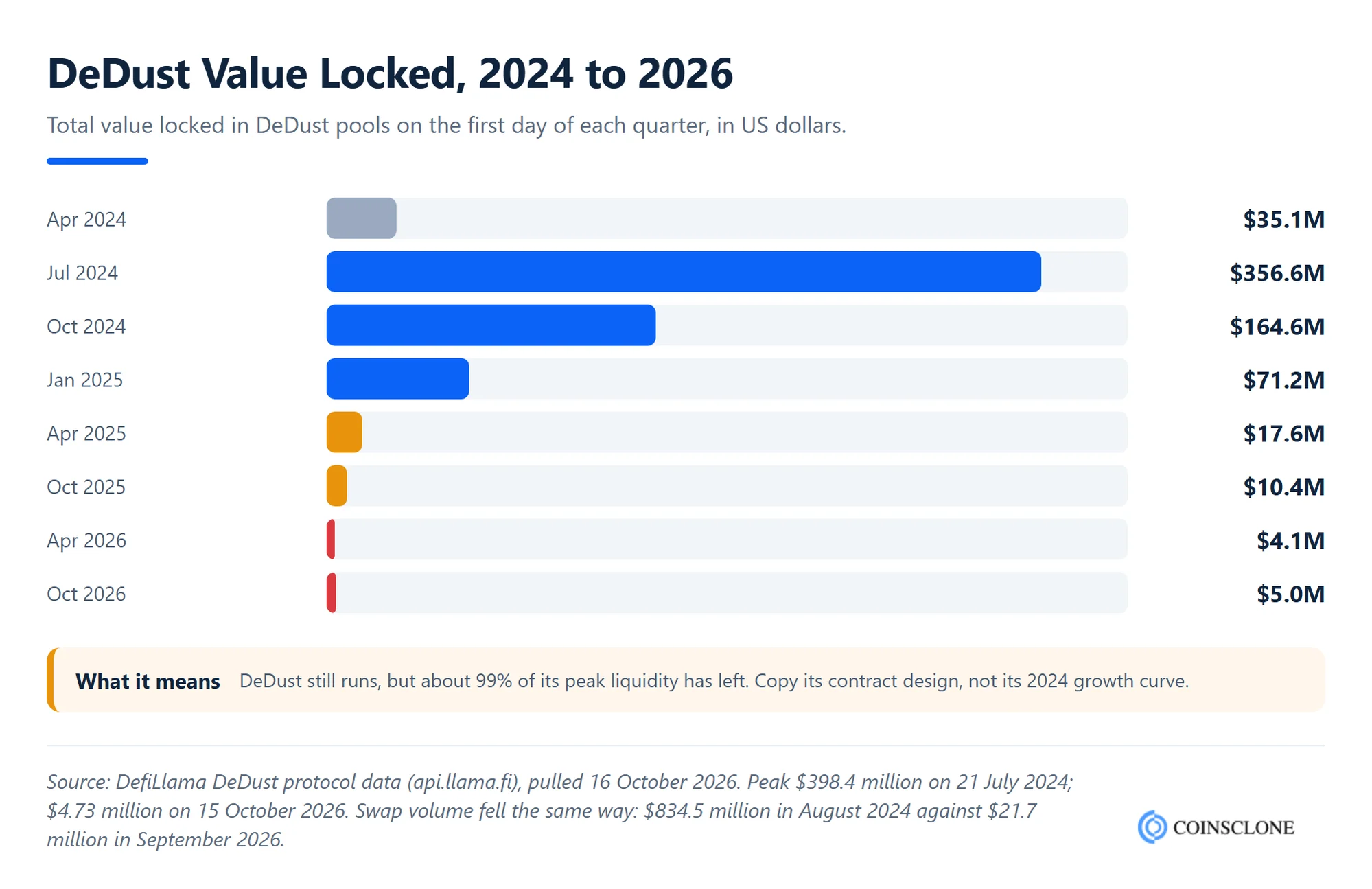
Three points stand out. First, DeDust peaked in mid 2024 and has since lost about 99% of its liquidity. Second, it still runs well and keeps shipping: CPMM v2 pools, a launchpad and a routing API all arrived after the peak. Third, TON’s own coin changed its name. Toncoin was renamed Gram (GRAM) in June 2026, while the network is still called TON. Your clone’s labels and pairs should use the new ticker.
So the lesson is simple. Copy DeDust’s contract design, which is sound and cheap to run. But plan your own liquidity, listings and user growth, because the brand alone did not hold users.
How a DeDust-Style DEX Works: Vaults, Pools and the Factory
DeDust’s design is its main strength, and it is the part worth copying. TON works differently from Ethereum. Every contract is a separate account, and contracts talk to each other by sending messages. DeDust built its exchange around that.
It uses four main parts:
- Asset: One shared format for every token type. Native TON and jettons (TON’s token standard) are handled the same way, so there is no need for a “wrapped TON” token.
- Vault: One vault per asset type holds the coins. It takes in deposits and pays out the result of a swap.
- Pool: Each pool holds no tokens itself. It only does the maths and tracks reserves. Volatile pools use the classic x × y = k formula. Stable pools use a curve built for assets of near-equal value, such as USDT and USDC.
- Factory: Creates new pools and vaults and helps the app find the right contract for any pair.
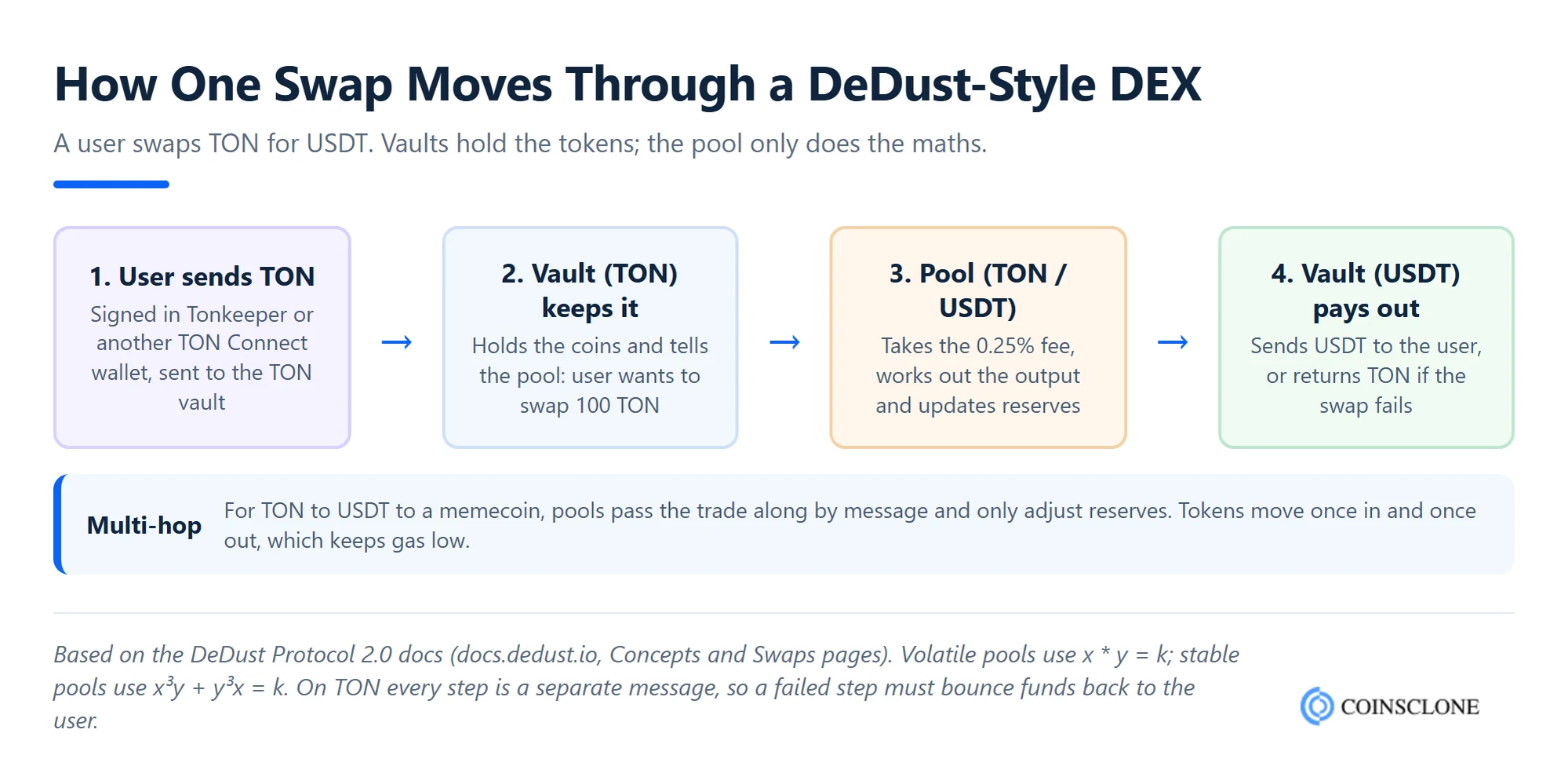
Here is why this matters for your business. In a multi-hop trade, such as TON to USDT to a memecoin, the pools only pass messages and adjust reserves. Tokens move once in and once out. That keeps gas low, which matters to small traders.
There is one catch. Because each step is a separate message, a step can fail halfway. DeDust’s own docs warn that sending funds to a contract that is not yet deployed can lose them for good. So a solid clone must check every contract first and bounce funds back to the user when a step fails.
What Works in the DeDust Model in 2026
DeDust’s newer CPMM v2 pools, described in the DeDust CPMM v2 docs, add features that a 2026 clone should include from day one:
- Claimable fees: Fees are kept apart from pool reserves. As a result, liquidity providers can claim their earnings at any time without pulling out their liquidity.
- Creator fees: The person who creates a pool can earn a set share of every swap in it. This draws new token projects to your exchange.
- Permanent liquidity locks: A token team can lock its liquidity forever to show buyers it cannot “rug pull”, while still claiming the trading fees.
- Built-in rewards: Anyone can fund a reward program for a pool, in one or more tokens, with no extra staking contracts.
- Partner and referrer fees: Wallets, bots and apps that send trades to you can add their own fee on top. This turns other apps into your sales channel.
- Fee choice per pool: A pool can collect its fees in either token, or always in TON.
DeDust also runs Uranus, a memecoin launchpad, and a Router API that finds the best quote and builds the swap message for TON Connect wallets. Both are worth copying. New tokens need a place to trade, so a launchpad that feeds them into your pools is a real growth engine. To go deeper on that model, see our Pump.fun clone script guide.
Why Create a Decentralized Exchange Like DeDust?
The DeFi market still offers firms new ways to serve traders beyond banks and big exchanges. Building a DEX like DeDust gives users new ways to trade and stake assets. These are among the growing Use Cases of DeFi. Users keep control of their funds and see every trade on-chain.
Easy Entry into the DeFi Market
A ready-made DEX lets you enter the market fast. It cuts build time and cost, and you start with code that has already worked on a live chain.
Decentralized Token Swaps and Staking
A DEX lets users trade and stake without a middleman. Users keep full control of their assets, and prices come from open pools rather than a company’s order desk.
Fast, Low-Fee Blockchain
TON is built to split work across many shards, so it can handle a lot of traffic at low cost. In addition, TON links closely with Telegram, which gives a TON exchange a direct path to a very large user base through mini apps and in-chat wallets.
Room to Add More Chains
DeDust itself runs only on TON. However, your clone can add bridges or EVM chains, so users can move assets across networks without juggling wallets. Projects like our Polymarket Clone Script use the same approach to reach users on more than one chain.
Given these strengths, a DeDust-like DEX is a sound way for a business to enter DeFi on TON. A DeDust clone script lets you take this model and launch it fast. Next, let’s look at the features.
Core Features of the DeDust Clone Script
The DeDust clone script comes with the features you need to run a fast, easy-to-use and scalable exchange. It covers trading, liquidity, rewards and full admin control.
Volatile and Stable Swap Pools
Users swap tokens against on-chain pools. Volatile pools suit most pairs, while stable pools give tighter prices on pairs like USDT and USDC. Every trade settles on-chain, so it stays open and easy to check.
Multi-Hop Routing
The router finds the best path across pools, such as TON to USDT to a new token, and completes it in one trade. Users get a better price without doing the hops by hand.
Liquidity Pool Management
Users can create pools, add liquidity and earn a share of the trading fees. With CPMM v2 pools, they can claim those fees at any time and lock liquidity for good if they wish.
TON Wallet Support
Users connect through TON Connect with wallets such as Tonkeeper, MyTonWallet and the wallet built into Telegram. If you add EVM chains, you can also support wallets like MetaMask and Trust Wallet.
Real-Time Trading Charts
Users see live, interactive price charts for each pair. This helps them decide when to trade based on current market data.
Smart Contract Trading
Every swap runs through a smart contract. Trades settle without a middleman, with no downtime and with fewer clicks for the user.
Token Launchpad
An optional Uranus-style launchpad lets anyone create a new token and start trading it at once. When it reaches set targets, its liquidity can move into your main pools.
Staking and Yield Farming
Users stake your platform token or LP tokens and earn rewards. This gives them a reason to keep their funds on your exchange.
Admin Dashboard
A simple dashboard lets admins manage users, pools, listings, fees, rewards and platform settings in one place.
Fee and Commission Management
Admins set the base fee per pool, the protocol’s share, creator fees and partner fees. This is the core of a lasting business model.
Overall, the DeDust clone script gives you a full, flexible and secure exchange that can grow with the TON user base. Next, let’s look at how we keep the platform and user funds safe.
Security Protocols in the DeDust Clone Script
Security is the top goal of the DeDust clone script. Users must trust that their funds and trades are safe, so we use several layers of protection.
Smart Contract Audits
Outside auditors review the code before launch. They check for backdoors, bugs and known attack patterns, and the report is shared with users. Every contract you change later needs its own review.
Non-Custodial Vault Contracts
User funds sit in vault contracts, not in company wallets. So no one at the company can move user funds. Your own treasury and admin keys go in multi-signature or cold storage.
Message and Bounce Handling
On TON, a swap is a chain of messages. The contracts check that every vault and pool is live before funds move, and they return funds to the user if any step fails.
Two-Factor Authentication (2FA)
Admins and staff sign in with a second step, such as a code from an app. This makes it much harder for an attacker to take over the admin panel.
SSL Encryption
All data between the user and the platform is encrypted in transit. This protects session data and admin logins from being intercepted.
Regular Software Updates
We release updates to fix weak spots, add improvements and keep up with TON network upgrades.
Role-Based Access Control (RBAC)
Each staff role gets only the rights it needs. Only approved people can reach sensitive tools in the admin dashboard.
Anti-Phishing Protection
Fake copies of DEX websites are a common way to steal funds. Anti-phishing codes, verified domains and clear wallet prompts help users spot a fake site.
Rate Limiting and DDoS Protection
Limits on API requests and DDoS protection stop attackers from flooding the platform and taking it offline.
Transaction Monitoring
Live tracking flags odd activity, such as sudden pool drains or price tricks, so your team can act fast.
Data Backups and Disaster Recovery
Platform data and settings are backed up often. If data is lost or an attack hits, you can restore the platform quickly.
These layers protect user funds and data from unauthorized access. When users feel safe, they come back and trade more. Now, let’s look at how a DeDust clone makes money.
Revenue Streams in the DeDust Clone Platform
The DeDust clone platform gives you several ways to earn while giving users real value. The earning options are built in from day one, so you can grow your DEX business step by step.
Trading Fees from Token Swaps
A small fee is charged on every swap. On DeDust it is usually 0.25%, and the protocol keeps 20% to 30% of it. The rest goes to liquidity providers. As volume grows, this becomes a steady income.
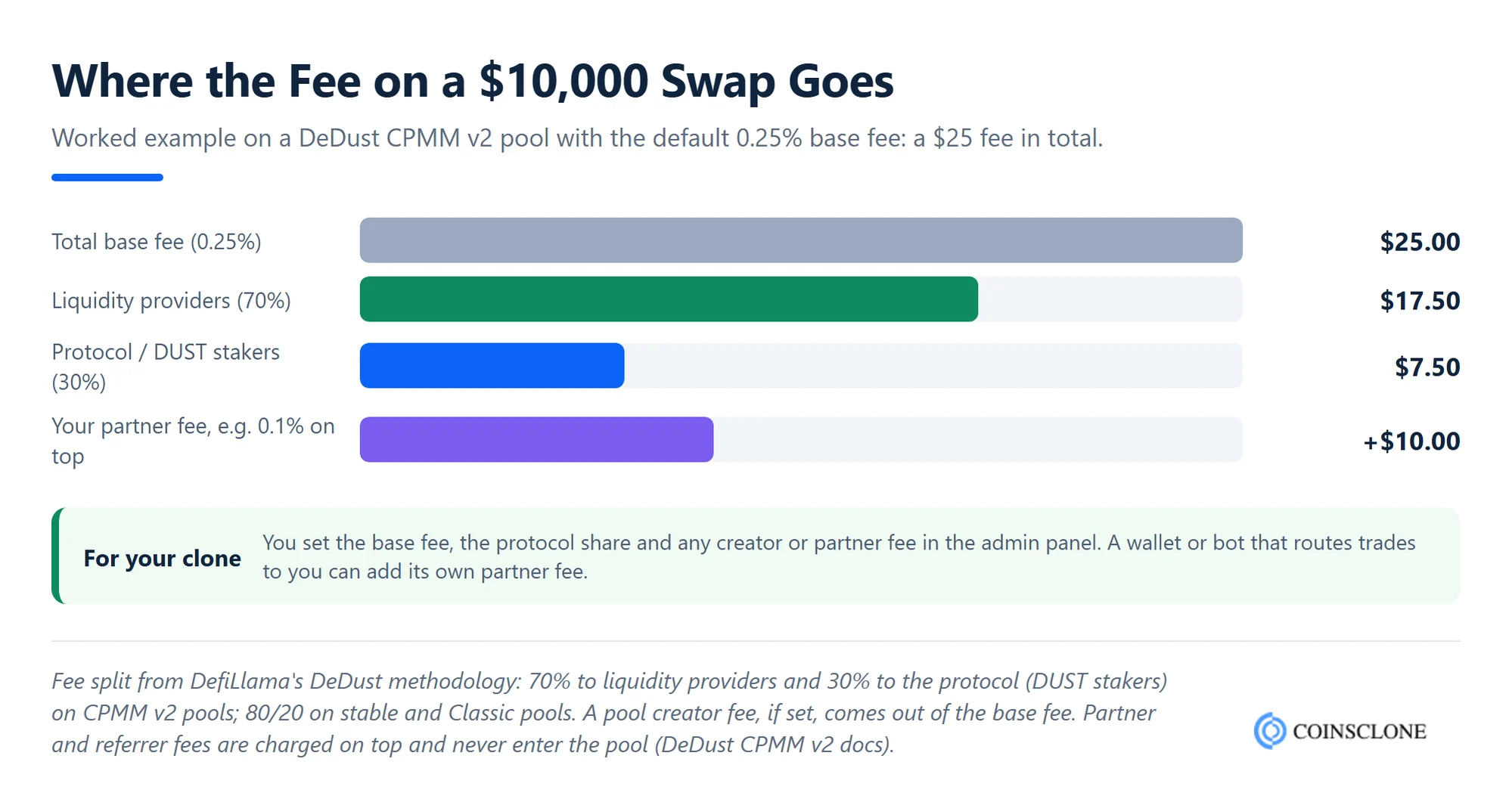
Here is what that means at different volumes, with a 0.25% base fee and a 30% protocol share:
| Monthly swap volume | Total fees paid by traders | Your protocol share (30%) |
| $10 million | $25,000 | $7,500 |
| $50 million | $125,000 | $37,500 |
| $250 million | $625,000 | $187,500 |
For a reality check, DeDust itself handled $19.0 million of swaps in the 30 days to mid October 2026. Traders paid $63,797 in fees, and $18,060 went to the protocol. So fees alone pay well only at high volume. That is why the other streams below matter.
Premium Features
You can offer premium tools, such as a White-Label DeFi Wallet for easy crypto management, through subscription plans or a one-time fee.
Staking and Yield Farming Incentives
You can keep a share of the fees or rewards from staking and farming programs. These programs draw liquidity to your pools while earning you passive income.
Fees for Listing and Launching Tokens
Token teams pay to be listed, promoted or launched through your launchpad. This gives them reach and gives you a steady source of income.
Partner and Referral Fees
Wallets, trading bots and Telegram mini apps can route trades to your pools and add their own fee. You can also earn a referral share when your app sends users to other services.
Cross-Chain Bridge Fees
If you add a bridge, a small fee on moving assets between chains adds another income line.
Spreading your income across several streams makes your cash flow steadier and helps you ride out market swings. These ideas match some of the top DeFi Business Ideas for founders today.
DeDust vs STON.fi: What to Learn From Both
DeDust’s main rival on TON is STON.fi. People often compare the two, so here are their numbers side by side, from DefiLlama’s TON DEX data checked on 16 October 2026.
| Item | DeDust | STON.fi |
| Value locked | $4.73 million | $24.42 million |
| Swap volume, 30 days | $19.0 million | $90.6 million |
| Share of TON DEX volume, 30 days | About 13% | About 61% |
| Protocol’s share of fees | 20% (stable and Classic pools) or 30% (CPMM v2) | One third |
| Who gets the protocol share | DUST token stakers | The protocol |
STON.fi now leads on both liquidity and volume. DeDust stands out on design, with its vault model, stable pools, creator fees and liquidity locks. A new TON exchange can take the best of both: DeDust’s contract design and STON.fi’s focus on deep liquidity for main pairs like TON and USDT.
Where To Get a DeDust Clone Software?
Choosing the right source for your DeDust clone script is key to a successful exchange. You can use open-source code, hire freelancers or work with a professional DEX clone script provider. Each choice has pros and cons, so check the source with care. The right one leads to a faster, safer and more scalable launch.
Open-Source Solutions
DeDust publishes an open SDK, and open-source DEX code is easy to find. It looks cheap, but it rarely comes with support, audits or the know-how needed to adapt and secure it. Without that, you could end up with a weak, out-of-date or half-built platform.
Hiring Freelancers
Freelancers offer a flexible option with a lower upfront cost. However, code quality often varies, deadlines slip and no one is accountable after launch. Worse than losing money on a half-built project is paying for its security gaps and upkeep for years.
Professional DEX Clone Script Providers
The safest choice is to work with an experienced DEX clone script provider. You get tested code, audits, fast launch and support, and the provider sets up the right tech for your business goals.
Compared with open source and freelancers, a professional provider gives you a faster launch, stronger security, easy scaling and a team that stays with you. That lowers your risk and cost over the long term.
Coinsclone is one of the leading providers of a DeDust clone script. We cover every step, from TON smart contracts and pool design to UI/UX, audits and technical support, so your exchange launches on time and is ready to compete in DeFi.
Ready to build a secure DEX like DeDust? Connect with Coinsclone to launch your DeDust-style DEX!
Cost-effective | White-Label Solutions | Premium Features | Fully Customizable | Live Demo Available
How to Launch a DEX Like DeDust: Steps and Timeline
Here is how a typical launch runs, from first call to live exchange:
- Plan the model: Pick your chain mix, pool types, fee levels, token plan and target users.
- Design the app: Build the swap screen, pool pages, launchpad and admin panel under your brand, as a web app or a Telegram mini app.
- Set up the contracts: Configure the vault, pool and factory contracts, fees, rewards and any launchpad rules.
- Connect wallets and data: Add TON Connect wallets, price charts, the router and indexers that track pools and trades.
- Test and audit: Run full tests on TON testnet, including failed-message cases, then complete outside audits.
- Seed liquidity and launch: Seed the main pairs, such as TON and USDT, set up rewards, then go live.
- Grow: Add listings, partner apps, a launchpad and new chains over time.
On timing, a white label DEX takes about 5 to 7 weeks. A standard build with more custom work takes about 10 to 14 weeks. Extra modules, such as a launchpad, bridges or mobile apps, add time.
What Drives the Cost of a DeDust Clone?
There is no single price for a DeDust clone, because the scope varies a lot. These are the main cost drivers:
- White label or custom build: A white label base costs far less than custom contracts.
- Pool design: Classic volatile pools are simpler than CPMM v2 pools with creator fees, locks and built-in rewards.
- Extra modules: A launchpad, staking, a bridge or a router API each add build and audit time.
- Audits: Published 2026 audit price guides put a simple token audit at roughly $5,000 to $15,000, and complex DeFi systems cost far more. Every contract you change needs its own review.
- Chains: Each added chain means more deployment, testing and liquidity work.
- Apps: A Telegram mini app or native Android and iOS apps add design and build work.
For a detailed breakdown on a similar AMM model, read our guide on the cost to build a DEX like PancakeSwap.
Why Should You Use Coinsclone’s DeDust Clone Script?
Coinsclone is a trusted Decentralized Exchange Development Company. We have been building crypto platforms since 2018 and have delivered 350+ platforms for 200+ clients across 20 industries. Our DeDust clone script is fully customizable and ready to deploy, so you can reach the market fast.
Our team handles the full build: TON smart contracts, vault and pool setup, launchpad and staking modules, multi-chain support, clean UI/UX and support after launch. If you want a wider build than a clone, our decentralized exchange development team can design a DEX around your own model. Our goal is to help you compete in DeFi with lower risk and strong performance.
Frequently Asked Questions
What is a DeDust clone script?
A DeDust clone script is ready-made DEX software that copies the core features of DeDust on TON. It includes swap pools, vault contracts, multi-hop routing, liquidity and reward tools and an admin panel, all under your brand.
Is DeDust legit and safe?
DeDust is a real exchange that has run on TON since November 2022, and DefiLlama tracks its pools and fees. Like any DEX, it carries smart contract risk, and fake tokens and copycat websites exist. Users should check the token address and the site address before every trade.
What are DeDust’s fees?
Most DeDust pools charge 0.25% per swap, and stable pools charge 0.05%. Across all pools, fees range from 0.05% to 5%. Liquidity providers get 70% to 80% of the fee, and the rest goes to DUST stakers.
What is the difference between DeDust and STON.fi?
Both are AMM exchanges on TON. In October 2026, STON.fi is larger, with about $24 million locked and about 61% of TON DEX volume. DeDust has about $4.7 million locked and about 13% of volume, and it stands out for its vault design, stable pools and creator fees.
What is the biggest DEX on TON?
By DefiLlama data for October 2026, STON.fi is the biggest DEX on TON by both value locked and 30-day volume. TONCO V2 and DeDust follow.
How long does it take to launch a DeDust clone?
A white label DEX takes about 5 to 7 weeks, and a standard build about 10 to 14 weeks. A launchpad, bridges or mobile apps add time.
Can I customize my DeDust clone script?
Yes. You can change the design, pool types, fee levels, protocol share, token plan, launchpad rules and supported chains. You can also add a Telegram mini app, staking or a router API for partner apps.
See How Our MVP System Can Launch Your TON-Based DEX Faster
DeDust Clone Script — TON Blockchain DEX Development.
- MVP System : Launch your Dedust-like decentralized exchange 90% faster
- Liquidity & AMM : Pre-integrated TON-based pools and swap contracts — no coding required.
- Brand & Customization : Your interface, tokens, and liquidity structure
- Revenue Engine : Earn from swap fees, farming, and governance tokens
Get a free branded demo of your DeDust-like DEX in just 48 hours — before you invest a cent.
Book a Free Demo to discover how our DeDust Clone Script can take you from idea to a live TON-Powered DEX in just 8–12 weeks.