
A white label digital asset exchange lets you launch your own trading platform on proven software instead of building one from scratch. You get a ready-made exchange, put your brand on it, set your fees and choose the coins and tokens you list. This guide explains how it works, what it costs, what the software does not give you, and how to pick the right provider.
Many traders have moved from traditional assets to digital ones. By 9 October 2026 the crypto market was worth about $2.78 trillion, with roughly $117 billion traded in a single day, according to CoinGecko. That demand is why founders keep asking the same question: how do you start a digital asset exchange without spending years and millions on the build? Read on for a clear answer.
In this guide:
- What a white label digital asset exchange is, and which assets it can list in 2026
- How a trade moves through the platform, step by step
- Real cost ranges, launch times and the trading volume you need to break even
- The licences and rules the software does not cover
- A checklist for choosing a provider, plus answers to common questions
What Is a White Label Digital Asset Exchange?
A white label digital asset exchange is a ready-made trading platform that one company builds and another company runs under its own brand. The code already includes the core parts: a matching engine, wallets, user and admin panels, and security tools. As a result, you can launch a trading platform quickly and with less risk.
It is a lower-risk method because the software is already tested. At the same time, you can still change the features, design and fees to suit your business.
Besides, the software lets you launch a platform that works much like a popular digital asset exchange. That brings real benefits for founders, which we cover below.
Which Digital Assets Can a White Label Exchange List?
“Digital asset” covers more than Bitcoin. In 2026 a white label exchange can support three main groups:
- Cryptocurrencies: CoinGecko tracks more than 22,000 active coins and tokens. Most new exchanges start with a short list of high-volume coins and add more as they grow.
- Stablecoins: Dollar-pegged coins such as USDT and USDC are the base pairs on most exchanges. Their supply reached about $311.6 billion on 9 October 2026, per DefiLlama.
- Tokenized real-world assets: Tokens that stand for bonds, funds, real estate or commodities. RWA.xyz puts the value of distributed tokenized assets at $39.02 billion (9 October 2026).
Keep in mind that tokens which count as securities need a securities licence, not just a crypto licence. If that is your market, see our guide on how to create a security token exchange or our white label tokenization platform.
How Does a White Label Digital Asset Exchange Help You Create a Platform?
Most companies follow one of two routes to build a digital asset exchange. The first is building from scratch. It often takes 12 months or more, costs far more, and needs a strong tech team.
On the other hand, you can launch a white label crypto exchange, which is cost-friendly. The cost of a white label crypto exchange solution is far lower than a custom build. It also comes with business benefits, and you can deploy it in weeks. That speed is a big reason startups choose this route.
Here is how the two routes compare:
| Factor | White label exchange | Built from scratch |
| Software cost | About $8,000 to $120,000 | About $80,000 to $400,000 or more |
| Time to launch | 4 to 13 weeks | Often 12 months or more |
| Tech team needed | Small; the vendor maintains the core | Large in-house team |
| Control over code | Depends on the licence you buy | Full |
| Tested in live markets | Yes | Only after launch |
Cost ranges from our white label crypto exchange cost guide, October 2026.
Before going deeper, let us look at how the software works.
How Does White Label Digital Asset Exchange Software Work?
The software is simple to use and hides most of the complexity. To make it easy to follow, we will first look at it from a user’s point of view.
Suppose a user wants to buy a digital asset on your exchange:
- The user first registers or logs in.
- If the platform is centralized, the user completes the KYC (know your customer) check.
- Once KYC is done, the platform creates a user account with a wallet. The user can then deposit fiat or crypto into the wallet.
- Next, the user picks a trading pair and an order type, such as a market or limit order. The order book shows live bids and asks.
- The trading engine matches the order with the best available price, and the user confirms the trade.
- The matching amount moves between wallets on the exchange’s ledger, and the order is complete.
Here is how the platform admin keeps control while a user buys crypto:
- Fees and content: The admin sets the trading fee for the exchange. The admin can also change any content on the website and manage the logo and branding.
- KYC and deposits: The admin approves or resets KYC and checks user deposits into the wallet.
- Markets and orders: The admin decides which pairs can be traded and reviews pending orders where needed.
- Withdrawals: Withdrawals pass risk checks and, where you set it up, admin approval before funds leave.
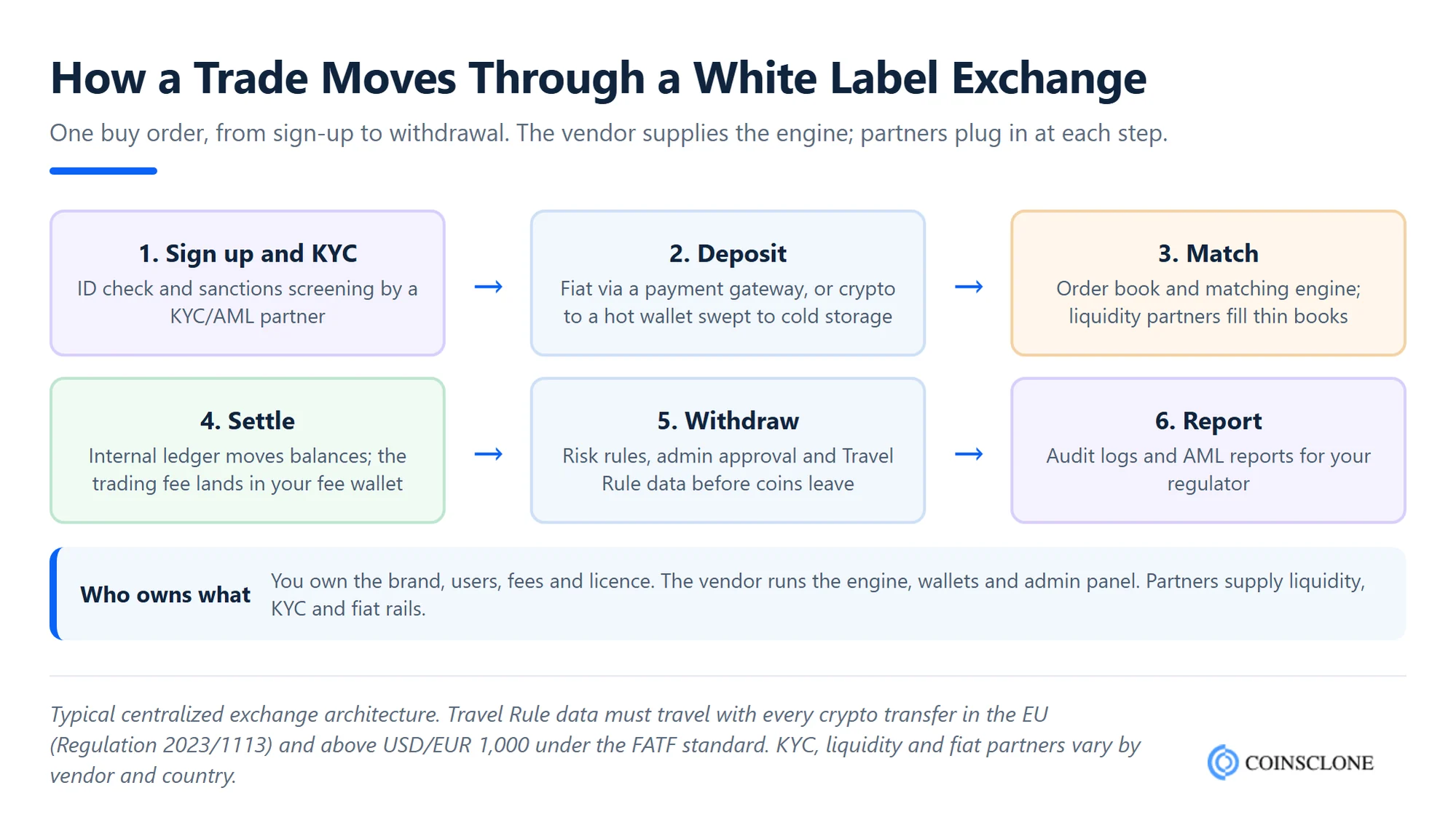
The diagram shows where outside partners plug in. In short, the vendor supplies the engine, but liquidity, KYC checks and fiat rails usually come from partners you connect. A smooth flow gives users a good first experience, which helps you grow your user base. If you also want branded mobile apps, see our white label exchange app solution.
What Are the Benefits of White Label Digital Asset Exchange Software?
As we said earlier, the benefits are the most attractive part of this software. They matter most for startups, so let us look at each one.
High-End Security
The software comes with security controls that protect user data and funds. Because it is already tested and audited, many common attacks are blocked from day one. Still, you should run your own security audit before launch.
Supports Multi-Currency
Users are not limited to a few coins. With good software, traders can access many coins, stablecoins and fiat pairs, which helps bring more users to the platform.
Intuitive UI/UX
Users want a clean interface that handles many trades without lag. The platform gives a real-time trading experience, with charts, order books and a simple buy flow that new traders understand.
Risk Management
Risk management is a key part of any exchange. The software flags errors and unusual activity. It supports two-factor authentication, KYC and AML checks to manage risk. If you feel unsure about these controls, it helps to start with an MVP build and add features in stages.
Better Liquidity Options
The software does not create liquidity on its own. Instead, it connects to crypto liquidity providers and market makers through APIs. Deep order books lower trading costs and reduce price swings for users, which attracts more traders.
Apart from these exchange benefits, there are some business benefits that founders should note:
- Customizable: Change design, fees, pairs and modules to suit your market.
- Tested code: Fewer bugs at launch, since the core is already proven.
- Cost-effective: You pay for setup and add-ons, not a full build.
- Faster launch: Weeks instead of a year or more.
- Easy to run: The admin panel handles daily tasks without coding.
- Less tech skill needed: The vendor maintains the core engine.
How Does a Digital Asset Exchange Make Money?
Profit is the main reason to start an exchange, so it helps to know where the money comes from:
- Trading fees: A small cut of each trade. For example, Binance charges regular spot traders 0.1% maker and 0.1% taker.
- Withdrawal fees: A flat fee per crypto withdrawal.
- Listing fees: Projects pay to list their token on your exchange.
- Instant-buy spreads: A small margin on simple buy and sell orders.
- Staking and earn products: A share of the rewards users earn.
- Margin and futures: Funding and interest income, where your licence allows it.
Trading fees alone need steady volume. The chart below shows how much.
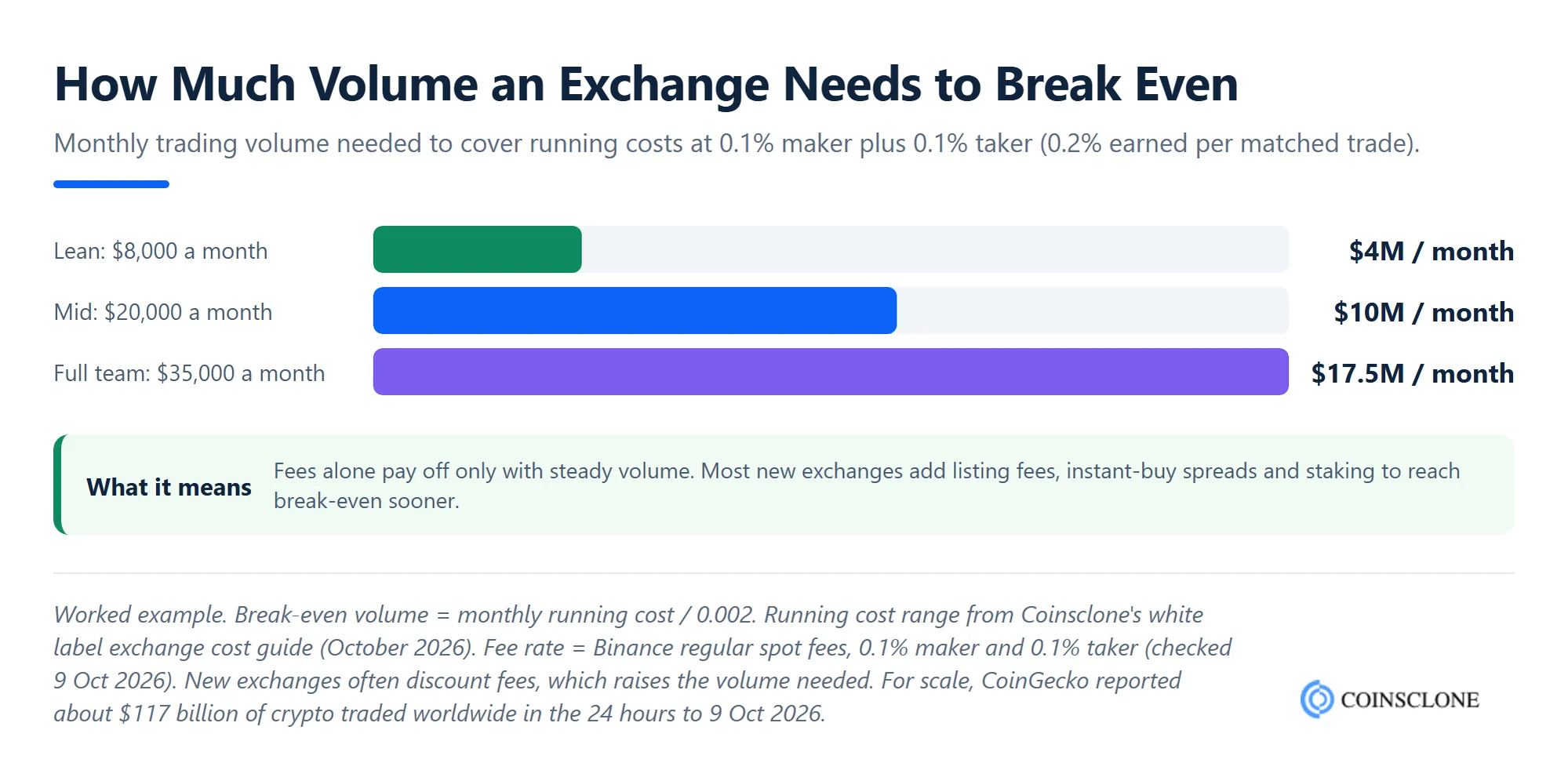
At 0.2% earned per matched trade, an exchange that costs $8,000 a month to run must match about $4 million of trades each month to cover costs. That is why most new exchanges mix several revenue streams from the start.
Features of White Label Digital Asset Exchange Software
Features are where many startups focus when they build a trading platform. Good features build trust with traders, so they must be strong from day one. Our white label exchange software includes these core features:
- User Dashboard
- Admin Dashboard
- KYC/AML
- Support System
- Different Order Types
- Crypto and Fiat Support
- Advanced Chart Tools
- Admin Profit Management
- Futures Trading
- IEO Launchpad
- API Documentation
- Multi-lingual
- Referral System
- Margin Trading
Moreover, the software has a full security stack:
- HTTPS authentication
- Jail login
- Anti-Denial of Service (DoS)
- Anti-Distributed Denial of Service (DDoS)
- End-to-end encryption
- Data encryption
- Cross-Site Request Forgery (CSRF) protection
- Server-Side Request Forgery (SSRF) protection
- Two-factor authentication
- SQL injection prevention
In 2026, two more items belong on every list: Travel Rule tools, which send sender and receiver details with each crypto transfer, and cold storage with multi-signature or MPC signing for most user funds.
What the Software Does Not Give You: Licences and Rules in 2026
This is the part most guides skip. White label software gives you the platform, but it does not give you the right to run an exchange. You still need your own licence, and the duty to follow the rules stays with you, not your vendor.
Here is what that means in the main markets:
- European Union: Under MiCA, you need authorisation as a crypto-asset service provider (CASP). The grace period for firms already operating ended on 1 July 2026, so new exchanges need a licence before they serve EU users. Operating a trading platform requires at least EUR 150,000 of own capital under Annex IV of the regulation. Our guide to a MiCA-compliant white label exchange in the EU covers the steps.
- Travel Rule: The EU’s Transfer of Funds Regulation applies the Travel Rule to every crypto transfer, with no minimum amount. Worldwide, the FATF reported in July 2026 that 83% of the countries it surveyed have Travel Rule laws.
- United States: Exchanges register with FinCEN as money services businesses and usually need state money transmitter licences. For stablecoins, the GENIUS Act was signed into law on 18 July 2025.
- Dubai: Virtual asset firms need a licence from VARA before they serve users in or from Dubai.
Licences take time. Under MiCA, the regulator has 25 working days to check that an application is complete and then 40 working days to assess it, and questions can pause the clock. So start the licence work at the same time as the software work. Our crypto license guide compares the main options by country.
How Much Does a White Label Digital Asset Exchange Cost?
Software is only one line in the budget. The chart below shows a realistic first year for a basic spot exchange.
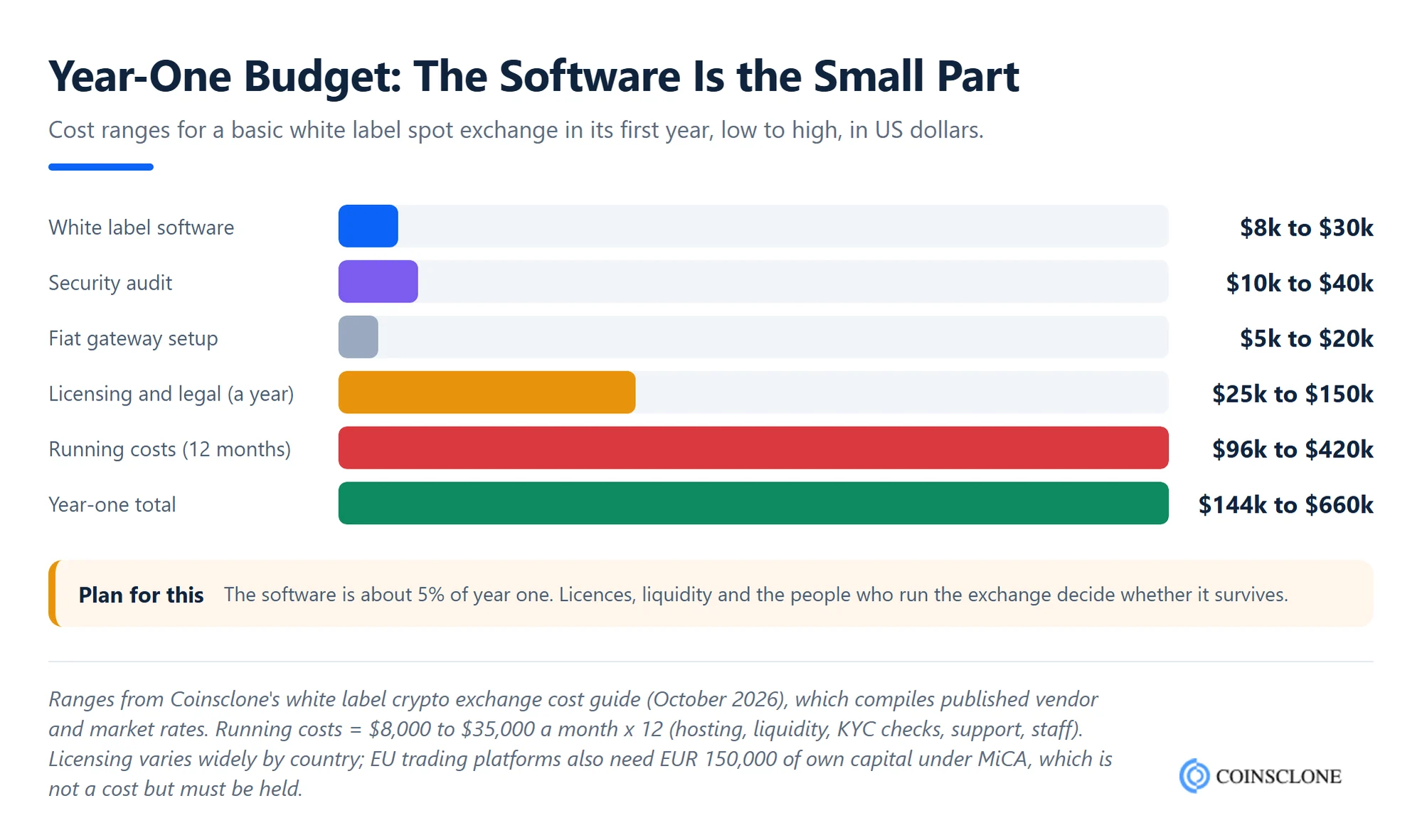
As a guide, a basic white label exchange costs about $8,000 to $30,000, and a feature-rich one about $20,000 to $120,000. On top of that, plan for a security audit, a fiat gateway, licensing and legal work, and $8,000 to $35,000 a month to run the platform. In total, year one often lands between $144,000 and $660,000. The exact figure depends on your country, your asset list and the size of your team.
How Long Does It Take to Launch?
With a white label build, the software side is fast. These are our standard timelines:
- Standard white label exchange: 4 to 6 weeks
- With fiat on-ramps and off-ramps: 7 to 10 weeks
- With iOS and Android apps: 9 to 13 weeks
By contrast, a custom build often takes a year or more. Keep in mind, though, that your licence may take longer than the software, so plan both tracks together.
How to Choose a White Label Exchange Provider
Picking the right provider is not easy, because many offers look alike on paper. Ask these questions before you sign:
- Who owns the code? Find out if you get the source code or only a hosted licence, and what happens if you stop paying.
- How is custody handled? Ask about hot and cold wallet splits, multi-signature or MPC signing, and who holds the keys.
- Where does liquidity come from? Check which liquidity providers and market makers the platform already connects to.
- What compliance tools are built in? Look for KYC/AML, transaction monitoring, Travel Rule support and reports for your regulator.
- Has it been audited? Ask for recent security audit results and live exchanges you can check.
- What does support cover? Confirm updates, bug fixes, uptime promises and response times after launch.
- What is the full cost? Compare setup fees, monthly fees, revenue shares and paid add-ons over three years, not just the first invoice.
Steps to Launch Your Digital Asset Exchange
Once you have a provider, the launch follows a clear path:
- Pick your market and licence: Decide which countries you will serve and start the licence application.
- Choose your assets and model: Spot only, or spot plus margin, futures or tokenized assets.
- Brand and configure: Set your logo, design, fees, trading pairs and languages.
- Connect partners: Add liquidity providers, KYC checks, fiat gateways and custody.
- Test and audit: Run load tests and a third-party security audit before real money moves.
- Launch and grow: Go live, watch volume and risk daily, and add revenue streams as you grow.
If you want the full business plan behind these steps, read our guide on how to start a cryptocurrency exchange.
Why Choose Coinsclone for a White Label Digital Asset Exchange?
Coinsclone has been building crypto platforms since 2018. Our team has delivered 350+ platforms for 200+ clients across 20 industries. We provide white label cryptocurrency exchange software that is easy to use and quick to deploy.
Also, our software removes the tech work involved in building from scratch, so you can focus on users, liquidity and your licence. A standard launch takes 4 to 6 weeks, and our team stays on hand after go-live to keep your exchange running smoothly.
Besides, the exchanges we deliver are full-featured and built to scale. Contact our experts for guidance on the right setup for your market and budget.
Kickstart your platform with a white label digital exchange
Click here to reach us instantly!
Frequently Asked Questions
How much does it cost to start a white label crypto exchange?
A basic white label exchange costs about $8,000 to $30,000 for the software, and a feature-rich one about $20,000 to $120,000. Add a security audit, fiat gateway, licensing and monthly running costs of $8,000 to $35,000. A realistic first-year budget is about $144,000 to $660,000.
How long does it take to launch a white label exchange?
The software takes about 4 to 6 weeks for a standard launch, 7 to 10 weeks with fiat rails and 9 to 13 weeks with mobile apps. Your licence may take longer, so start it at the same time.
Do I need my own licence to run a white label exchange?
Yes. The software does not come with a licence. In the EU you need MiCA authorisation as a crypto-asset service provider, in the US you register with FinCEN and usually need state licences, and in Dubai you need a VARA licence.
Who handles maintenance, updates and security?
The vendor usually maintains the core engine and ships updates and fixes under a support plan. You remain responsible for running the exchange, your users’ funds and meeting the rules in your licence. Check the support terms before you sign.
Can I customize the platform beyond the standard features?
Yes. Most providers let you change the design, fees, pairs and languages, and add modules such as margin, futures, staking or an IEO launchpad. Larger changes add cost and time, so list them before you get a quote.
Is KYC/AML necessary on a white label exchange?
For a centralized exchange, yes. Licensed exchanges must verify users, screen for sanctions and monitor transactions. In the EU, Travel Rule data must also travel with every crypto transfer.
Can a white label exchange have mobile apps?
Yes. Most providers offer branded iOS and Android apps. Adding them usually extends the launch to about 9 to 13 weeks.
What are the risks of a white label exchange?
The main risks are vendor lock-in, thin liquidity at launch, weak security if the code is not audited, and running without the right licence. Choosing a provider with source code access, audits and built-in compliance tools reduces these risks.