

A prediction market clone script is ready-made software that lets you launch a Polymarket or Kalshi-style platform in weeks, not months. The top 6 prediction market clone scripts in 2026 are Polymarket, Kalshi, Pariflow, Manifold Markets, Robinhood and Myriad Markets, and each one fits a different business model.
Demand is real. In the 30 days to 25 October 2026, prediction markets handled about $22 billion in trading, per DefiLlama. Kalshi led with $15.4 billion, and Polymarket took about $5.5 billion across its US and global exchanges. This guide compares the 6 scripts, then covers cost, open source options, liquidity, the rules and the build steps.
In this guide:
- The top 6 prediction market clone scripts, side by side, with the model and money each one uses
- What a clone script costs in 2026, and how it compares with open source code and a custom build
- How new platforms win liquidity, and what market makers ask for
- Where prediction markets are legal, from the US and EU to India
- A 9-step plan to launch a platform like Kalshi or Polymarket
Launch Your Prediction Market Platform Faster with Our Clone Script
Prediction Market Platform Clone Script — Built a Ready-to-Deploy Event Trading Solution
- Fast Deployment:Launch your platform up to 90% faster with our pre-built clone script.
- Advanced Market Engine: Includes event creation, real-time trading, automated settlement, and order matching.
- Custom Branding: Easily customize UI, markets, trading rules, and integrations.
- Revenue Model: Earn through trading fees, listings, and platform commissions.
Get a free branded demo of your prediction market platform within 48 hours and experience the system before making any investment.
Book a call with our experts to discover how our prediction market platform clone script can transform your idea into an event-trading platform in just 8–12 weeks.
Top 6 Prediction Market Clone Scripts in 2026
Each leading platform suits a different business model. Here are the top 6 prediction market clone scripts:
- Polymarket clone script
- Kalshi clone script
- Pariflow clone script
- Manifold Markets clone script
- Robinhood prediction market script
- Myriad Markets clone script
| Clone script | Model | Money used | Best for |
| Polymarket | Crypto order book, oracle resolution | USDC (settled as pUSD) | Crypto-native global audiences |
| Kalshi | Regulated exchange, event contracts | US dollars | Licensed, compliance-first businesses |
| Pariflow | Multi-category markets with tools for AI agents | Crypto | Global traders and bot builders |
| Manifold Markets | Social markets with AMM pricing | Play money | Communities, education, testing |
| Robinhood | Event contracts inside a trading app | Fiat | Brokers and fintech apps |
| Myriad Markets | Crypto markets inside media and apps | Points and USDC | Media, communities and new chains |
1. Polymarket Clone Script
Polymarket is the biggest crypto prediction market. Users buy “Yes” or “No” shares through a central limit order book on Polygon. They deposit USDC, and since the exchange upgrade of 28 April 2026, trades settle in pUSD, a token backed by USDC. Markets resolve through UMA’s optimistic oracle, which lets anyone dispute an outcome.
Polymarket now runs two exchanges. The global one is closed to US users. The US one opened after Polymarket bought QCEX, a CFTC-licensed exchange, for $112 million in July 2025, and the CFTC approved its amended order of designation in November 2025. In October 2025, Intercontinental Exchange (ICE), owner of the New York Stock Exchange, agreed to invest up to $2 billion.
A Polymarket clone script suits businesses that want a blockchain prediction market for crypto users worldwide. Coinsclone’s published timeline for a white label Polymarket-style platform is 5 to 7 weeks.
Key Features
- Yes/No outcome shares priced from $0 to $1
- Order book trading with limit and market orders
- Crypto wallet log-in and stablecoin payouts
- Oracle results with a dispute window
- Taker fees with maker rebates
- Market creation tools and admin approval
- Positions, profit and loss, and top trader lists
2. Kalshi Clone Script
Kalshi is a US exchange licensed by the Commodity Futures Trading Commission (CFTC), the main US futures watchdog. Users trade event contracts in dollars on economics, politics, weather, sports and more. Kalshi won a court case in 2024 that allowed election contracts. It is now the largest prediction market by volume, with about $15.4 billion in the 30 days to 25 October 2026.
A Kalshi clone script suits Kalshi clone development for a compliance-first event exchange with fiat payments and KYC. Coinsclone’s published timeline for a white label Kalshi-style platform is 6 to 8 weeks, but the licence usually sets the real launch date.
Key Features
- Event contracts with clear, published rules
- Bank and card payments with KYC sign-up
- Order book trading with market makers
- Trade size limits and abuse checks
- Results set by trusted public data
- Mobile apps for iOS and Android
3. Pariflow Clone Script
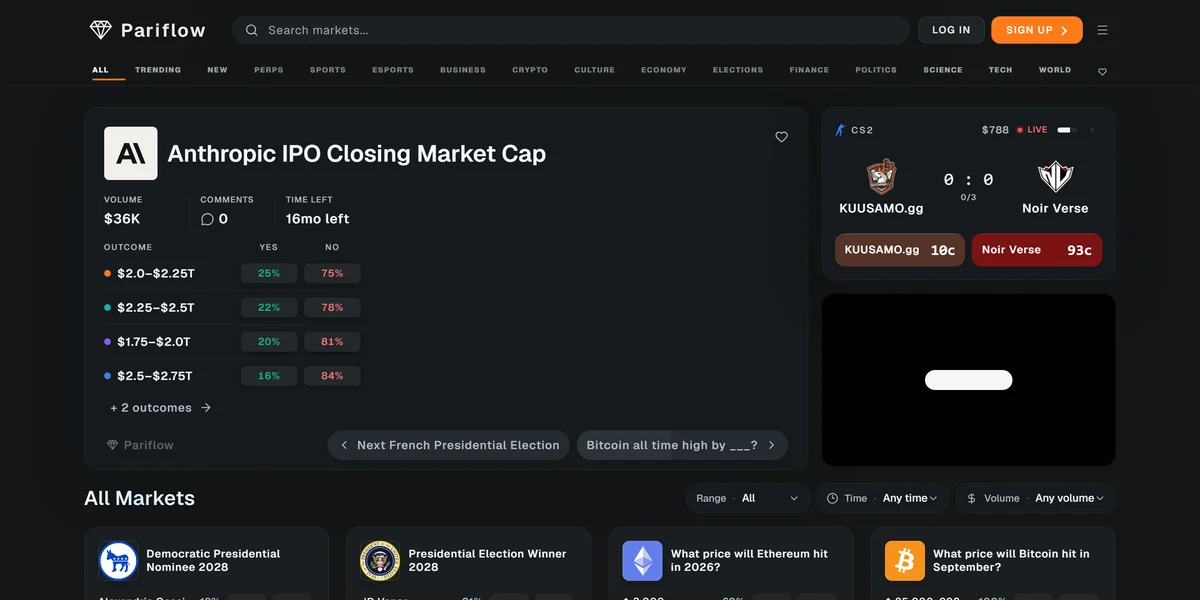
Pariflow is a newer prediction market. It lists trades on sports, esports, crypto, votes, the economy and science. Its own site says it may run worldwide through separate firms, and that its legal status varies by country. It is not regulated by the CFTC.
Pariflow stands out for traders who use bots. Its listing in QuickNode’s builder guide says it supports AI agents through MCP and a command-line tool, offers copy trading, and settles on Polygon and Tron. A Pariflow-style script suits a global site that wants to draw in bot traders.
Key Features
- Markets across sports, esports, crypto, politics and science
- Live odds and market signals
- Developer docs and an API for trading bots
- AI agent access through MCP and a command-line tool
- Copy trading, leaderboards and whale alerts
- Crypto deposits on low-fee networks
4. Manifold Markets Clone Script
Manifold Markets is a social prediction platform where anyone can create, share and trade on a market about almost any topic. Users discuss each market, follow top forecasters and build a track record over time.
Manifold uses play money called mana, so users can forecast without risking cash. That keeps it clear of most money rules and makes it a good fit for communities, schools and teams. If you want a prediction marketplace like Manifold, the clone keeps the social feed, open market setup and simple automatic prices.
Key Features
- Community-created prediction markets
- Play-money trading
- Automated market maker (AMM) pricing model
- Comments, follows and shared forecasts
- Easy to join, free to start
- Simple charts for each market
See our Manifold Markets clone script for details.
5. Robinhood Prediction Market Script
A Robinhood prediction market script puts event trading inside a simple trading app, so new users can join without learning a complex exchange. They browse markets, place a trade in a few taps and track results next to their stocks and crypto.
Robinhood added these markets in 2025 through Kalshi’s licensed exchange. In 2026 it went further. Rothera, its exchange joint venture with Susquehanna (formerly MIAXdx, also known as LedgerX), self-certified its first contracts with the CFTC in May 2026, while Kalshi still supplies many markets. The Robinhood clone script suits brokers and fintech apps that want event contracts on finance, politics, sports and world news.
Key Features
- Simple event contracts
- Easy trade screen
- Live prices and trend tracking
- Built-in trade charts and stats
- Clean design for phone and web
- Made for first-time traders
6. Myriad Markets Clone Script
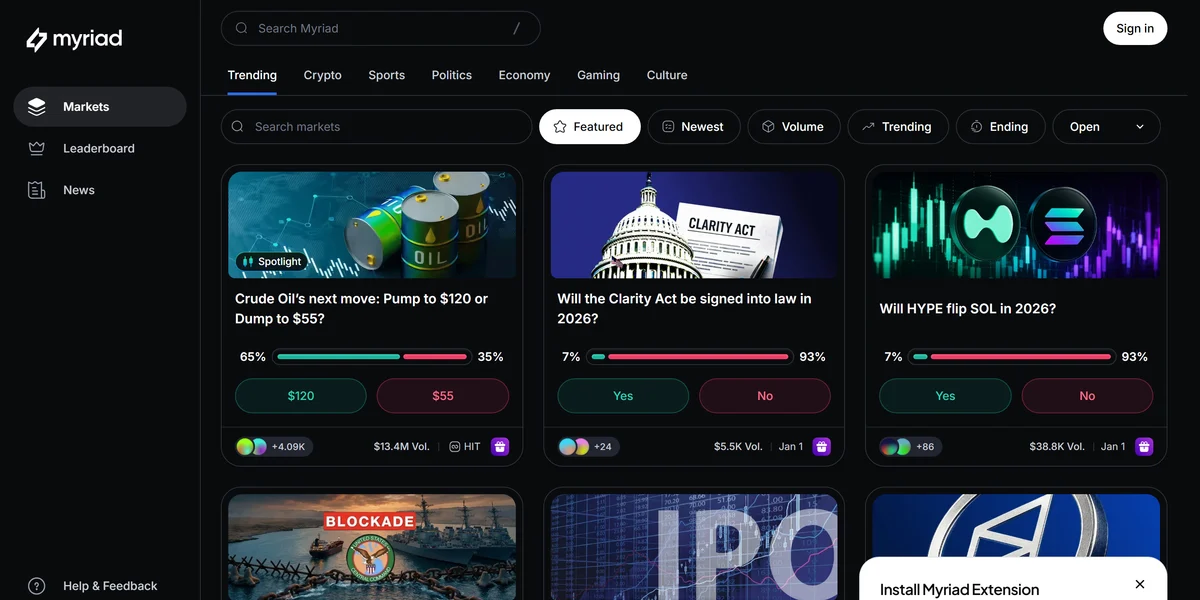
Myriad Markets brings prediction markets into media and community apps, so readers can trade on the stories they follow. DASTAN, the parent of Decrypt and Rug Radio, launched it in March 2025. It runs on Abstract, Linea and BNB Chain, with points markets for fun and USDC markets for real stakes.
Its trading volume is small, about $0.6 million in the 30 days to 25 October 2026 on DefiLlama. So the model’s value is engagement, not trading scale. A Myriad Markets clone script suits media firms, communities and new chains that want markets inside their own apps.
Key Features
- Markets embedded in articles and apps
- Crypto wallet and token payments
- Fast market creation for trending topics
- Points, leaderboards and rewards
- Social sharing of positions
Other Prediction Market Models Worth Knowing
Augur, launched in 2018, was the first fully on-chain prediction market, and many projects forked it. Today it is mostly dormant: its main code base has had no updates since July 2023. An Augur Markets clone script still suits teams that want full decentralisation and accept thin liquidity.
What Is a Prediction Market Clone Script?
A prediction market clone script is pre-built software that copies the core features of a leading platform such as Polymarket or Kalshi. It lets a business launch its own site where users trade on real-world events and earn when they are right.
A good script includes sign-up and KYC, event creation, Yes/No trading, payouts, admin tools and secure payments. You then add your brand, pick your markets and set your fees. The main goal is speed: you start from a tested core and spend your budget on users and liquidity instead.
Prediction Market Volume in 2026: Who Leads
Before you choose a model to clone, look at where the trading happens. The chart below shows the 30 days to 27 September 2026, and the order was the same in October.
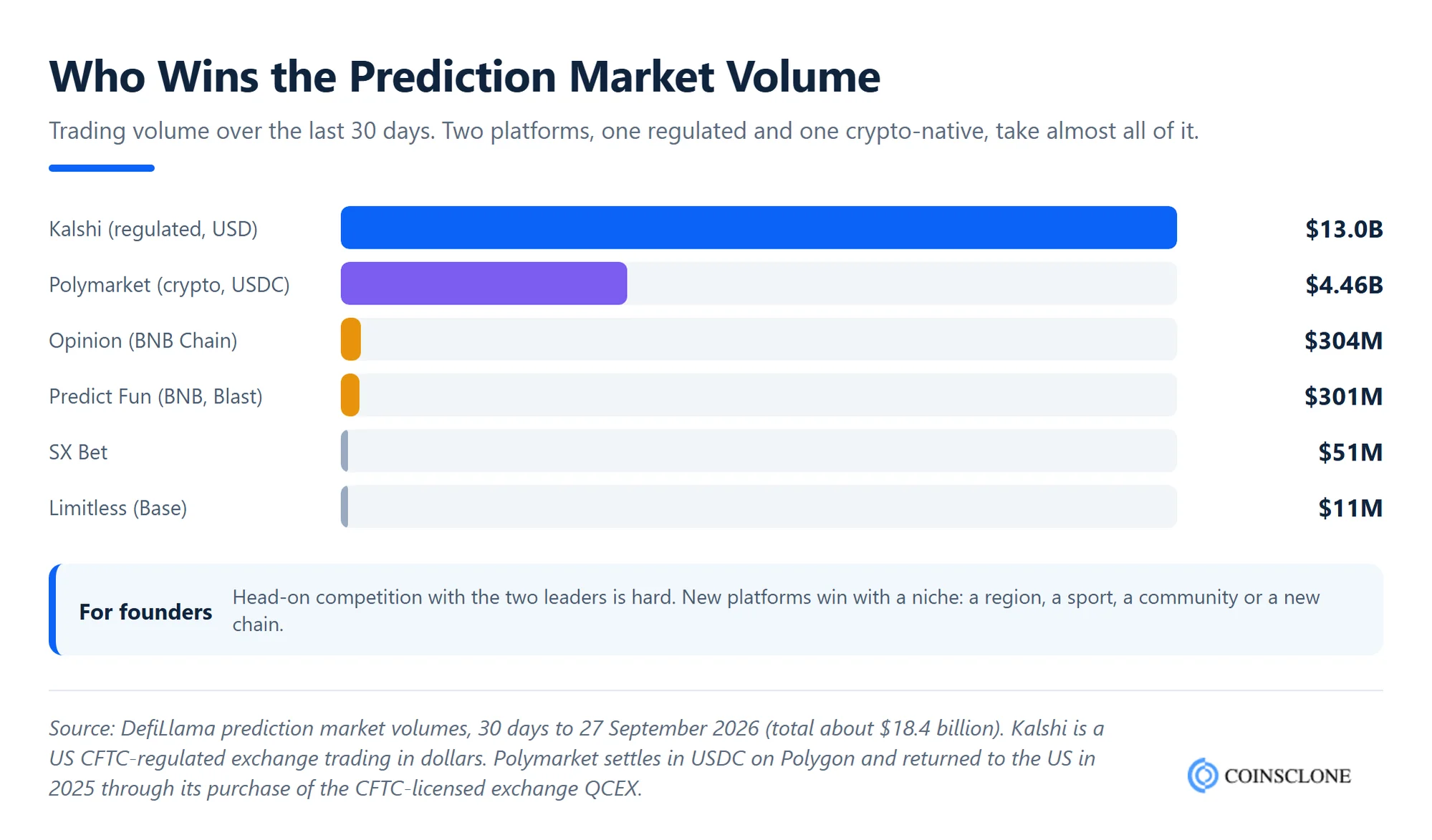
Two very different models lead. Kalshi is a US-regulated exchange that trades in dollars. Polymarket is a crypto site with a separate US exchange. Smaller sites such as Predict Fun and Opinion grow on BNB Chain and other networks by serving one niche well.
Note that sources count volume in different ways, so their totals differ. DefiLlama, used here, tracks each platform the same way, which makes it good for comparison.
Which Prediction Market Clone Script Should You Choose?
Choose by your licence and your users first, then by features. Here is the short answer for each case:
- You serve crypto users worldwide: Pick a Polymarket clone with stablecoin settlement and an oracle.
- You want to serve the US with real money: Pick a Kalshi clone, and plan for a CFTC licence or a licensed partner.
- You run a broker or fintech app: Pick a Robinhood-style script that adds event contracts to your app.
- You run a sportsbook or casino: Start with sports markets. Our guide on how sportsbooks can launch a prediction market covers the licence routes.
- You want a community or a test run: Pick a Manifold clone with play money.
- You run a media site or a new chain: Pick a Myriad clone that embeds markets in your content.
How Much Does a Prediction Market Clone Script Cost?
A white label prediction market costs about $10,000 to $30,000 for core features, or $30,000 to $100,000 with custom work, based on published 2026 agency cost guides. A custom on-chain build starts near $150,000. Some vendors charge $2,000 to $10,000 a month instead, often with a share of revenue.
The script is only part of the bill. Plan for these running costs too:
- KYC checks: Sumsub’s published price is $1.35 per check with a $149 monthly minimum.
- Oracle bonds: Polymarket markets typically use a $750 bond to propose a result, returned if no one disputes the result.
- Liquidity: Market maker rebates and rewards, often the biggest cost after launch.
- Licence and legal advice: A CFTC review of a new exchange runs on a 180-day clock once the file is complete.
For a full breakdown by feature, see our guide on prediction market development cost.
Clone Script vs Open Source vs Custom Build
A clone script is the fastest route to a real-money platform, open source code is the cheapest start for play money, and a custom build gives the most control. Here is how they compare:
| Route | Cost to start | Time to launch | Best for |
| White label clone script | About $10,000 to $100,000 | 5 to 8 weeks | Real-money launches on a budget |
| Open source code | Free code, paid dev time | Depends on your team | Play money, private groups, research |
| Custom build | From about $150,000 | 10 to 14 weeks for a standard scope | A unique product, token or chain |
Is There an Open Source Polymarket Clone on GitHub?
Yes, in part. Polymarket has published its exchange contracts on GitHub under the MIT licence, but not its full app, order book engine or admin tools. So you still need to build or buy the rest.
Can You Self-Host a Free Play-Money Prediction Market?
Yes. A February 2026 Reddit thread asked for a self-hosted, open source Polymarket-style site with fake money for a group of friends. The best-known answer is Manifold, which publishes its full code on GitHub under the MIT licence. Running it still takes a developer, hosting and upkeep, so a clone script is often cheaper once you count staff time.
Market Categories a Prediction Market Clone Script Supports
Most prediction market platforms offer markets in the same main categories. A good clone script lets you turn each one on or off to fit your audience and your licence:
- Politics and elections: Who wins a vote, which laws pass and who gets top jobs.
- Sports: Match winners, tournaments and player awards. Strict rules apply in many places.
- Crypto: Price levels, ETF approvals, token launches and network upgrades.
- Economy and finance: Rate cuts, price data, jobs reports and firm results.
- Tech and science: Product launches, AI milestones and space missions.
- Culture and entertainment: Awards, box office results and streaming charts.
- Weather and climate: Heat, storms and record seasons.
- World news: Peace deals, trade deals and global events.
Start with a few topics your audience cares about, then add more as liquidity grows.
How a Prediction Market Works, Start to Finish
Every market on a Polymarket or Kalshi-style site goes through the same five steps. Get them right and the rest is easy:
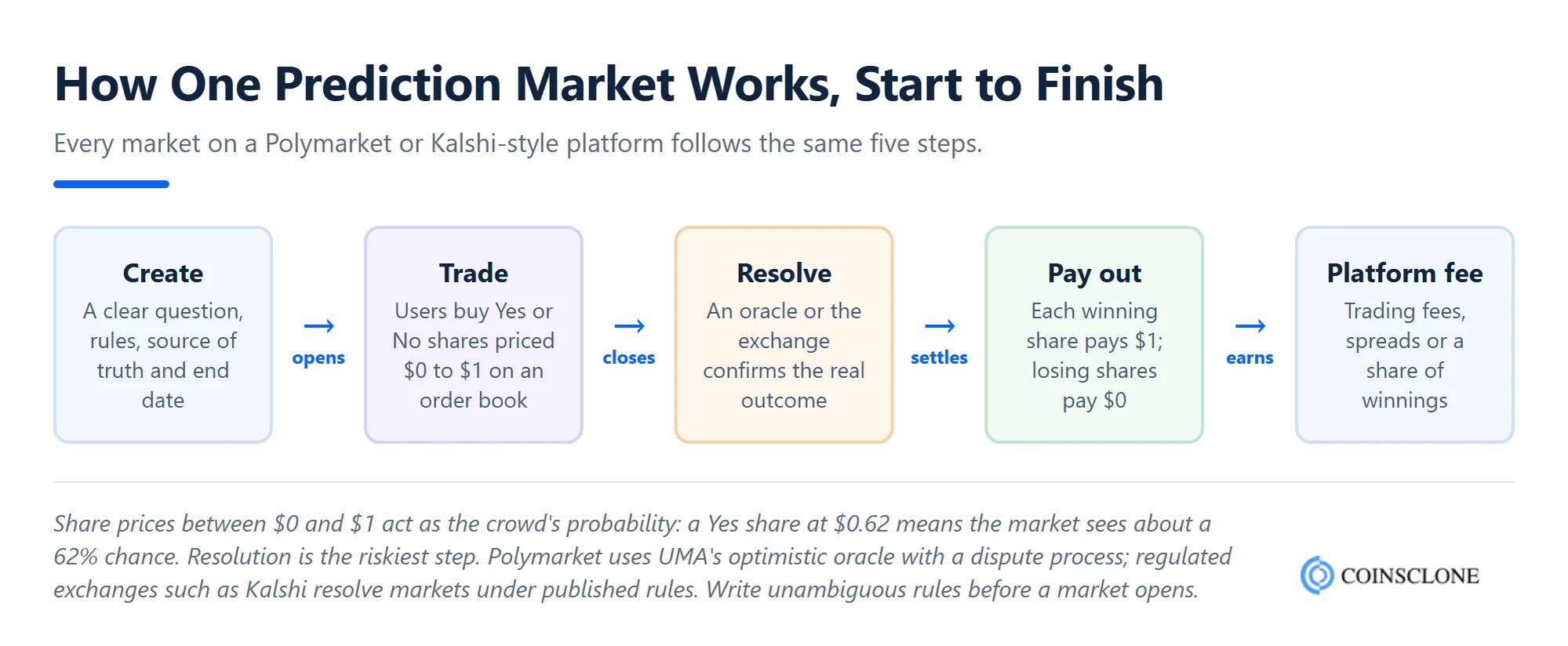
The share price works as the crowd’s odds. If a “Yes” share trades at $0.62, the market sees about a 62% chance that the event happens. When the event ends, each winning share pays $1 and each losing share pays nothing.
Resolution is the step that most often goes wrong. Vague questions lead to disputes, so write clear rules and name the data source before a market opens.
How Do You Get Liquidity for a New Prediction Market?
You pay market makers to post prices, and you pay for depth, not volume. Without them, spreads stay wide and users leave, so plan a maker budget before launch.
The leaders show how. Polymarket pays makers a daily rebate of 15% to 25% of the taker fees on their filled orders, plus liquidity rewards for orders that rest near the midpoint. Kalshi’s Liquidity Incentive Program pays $1 to $1,000 per market per day for resting orders, until 1 January 2027 unless changed. In contrast, Kalshi is ending its volume program after public claims of inflated volume, which it denies. That is why rewards should go to depth.
What Do Market Makers Need From a New Platform?
A fast, well-documented API. In a February 2026 r/Kalshi thread about what current platforms get wrong, a market maker said a good API and a near real-time websocket feed matter more than anything else. Delayed feeds and clumsy APIs make them stop quoting. So build the trading API, rate limits and data feeds as a core feature, not an extra.
How Prediction Market Platforms Make Money
- Trading fees: A small fee on each trade, or on taker orders only. Polymarket’s fee formula is highest at a 50 cent price and falls toward $0 and $1.
- Spreads and market making: The platform or its partners earn the gap between buy and sell prices.
- Fees on winnings or settlement: A small cut when positions pay out.
- Market creation fees: Charges for creating or promoting markets.
- Premium data and APIs: Selling market data to media, traders and researchers.
- Payment fees: Mostly on bank and card payments.
For a real example, see how Polymarket makes money.
Are Prediction Markets Legal? Rules by Region
It depends on the country and on what you list. Watchdogs see a prediction market as either a derivatives exchange or a gambling site. Markets on rates, jobs data and votes lean toward derivatives, while sports and shows lean toward gambling. A June 2026 Reddit thread from a founder made the same point: decide what you are legally building before you talk to a developer.
- United States: The CFTC regulates event contracts. Kalshi is a licensed exchange, and Polymarket’s US exchange won CFTC approval in November 2025. States still push back on sports contracts. On 1 September 2026, a Michigan court ordered Kalshi to keep blocking sports contracts there, with a $500,000-a-day fine for breaches.
- European Union: ESMA said in September 2026 that selling event contracts in the EU generally needs an authorisation the largest platforms lack. Several member states have blocked Polymarket.
- United Kingdom: Real-money prediction markets fall under gambling or financial rules, so you need the right licence.
- India: In August 2025, India passed the Promotion and Regulation of Online Gaming Act, which bans online money games. Opinion trading apps such as Probo stopped real-money trading soon after. Play-money markets remain the safer option there.
- Rest of Asia: Rules vary widely, and several countries restrict or block these platforms.
- Play-money platforms: Manifold-style platforms avoid most money rules, but still need clear terms.
Plan your licence, KYC and geo-blocking from the start, and get legal advice for each target market. Our guide to prediction market platform development covers the options in more detail.
How to Build a Prediction Market Like Kalshi or Polymarket With a Clone Script
A clone script lets you skip the core build and focus on your market, your brand and your users. Here are the steps:
Step 1: Define Your Business Model and Market Focus
Decide who you serve and what they will predict: sports, politics, crypto, finance or a niche community. Choose how you will earn, such as trading fees or market creation fees, and whether you will use real money or play money.
Step 2: Choose the Right Clone Script
Pick the model that fits your plan: Polymarket for crypto users, Kalshi for a regulated exchange, Manifold for play money, or Myriad for media and communities. Check that it includes market creation, trading, wallets or payments, user management and admin tools.
Step 3: Customize the Design and Features
Add your brand, colours and layout. Adjust the dashboard, categories, trading screen and reward system to suit your users.
Step 4: Integrate Payments or Crypto Wallets
Connect crypto wallets and stablecoins, card and bank payments, or both, so users can deposit, trade and withdraw safely.
Step 5: Set Up Market Rules and Resolution
Define how markets are created, what each question means, when it closes, which data source decides the outcome and how disputes work. Clear rules prevent most problems later.
Step 6: Add Security and Compliance
Use encryption, secure log-in and checks for fraud and price rigging. Add KYC and geo-blocking where your licence needs them.
Step 7: Test Everything
Test markets from creation to payout, including disputes, cancellations and edge cases, plus payments and any smart contracts.
Step 8: Launch and Onboard Users
Launch with a few popular markets and seed them with liquidity. Then grow through partners, content and your community.
Step 9: Monitor and Scale
Track volume, liquidity and user activity. Add new markets as they trend, and keep making the product better.
How to Choose the Best Prediction Market Clone Script Provider
Prediction markets handle real money, live prices and touchy outcomes, so pick your provider with care. Check these points:
Customization Capabilities
Can you change the design, categories, fees, payment methods and resolution rules to fit your model?
Security and Reliability
Look for encryption, safe payments, checks for price rigging and audited smart contracts if you use a blockchain.
Scalability and Performance
The platform must stay fast during big events, when thousands of users trade at once.
Trading API and Market Maker Tools
Ask to see the API docs and test the data feed speed. Market makers judge a platform on these first.
Post-Launch Assistance
Ongoing support for updates, new markets, incidents and scaling keeps the platform running smoothly.
Reputation and Client Feedback
Ask for live demos, case studies and client references before you decide.
Why Choose Coinsclone?
Coinsclone is a prediction market development company that has built blockchain products since 2018. We have delivered 350+ platforms for 200+ clients across 20 industries. Our team of developers, blockchain experts and designers builds secure event trading platforms that stay fast when trading spikes.
Our prediction market clone script ships with the order book, wallets, resolution tools and admin panel ready to brand. We support you from planning to launch and after. Read our step-by-step guide on how to build a prediction market platform like Polymarket, or explore our prediction market clone script.
Frequently Asked Questions
What is a prediction market clone script?
It is ready-made software that copies the core of a site like Polymarket or Kalshi: market setup, Yes/No trades, results and payouts. You brand it and launch fast.
Which prediction market is the biggest?
By volume, Kalshi is the largest, with about $15.4 billion traded in the 30 days to 25 October 2026, followed by Polymarket with about $5.5 billion across its two exchanges, according to DefiLlama.
What is the difference between a Polymarket clone and a Kalshi clone?
A Polymarket clone is built for crypto. It settles in stablecoins and uses an oracle to decide results. A Kalshi clone is built for a regulated exchange, with fiat payments, KYC and resolution under published rules.
How much does a prediction market clone script cost?
Published 2026 agency cost guides put a white label at about $10,000 to $30,000 for core features, or $30,000 to $100,000 with custom work. Liquidity, KYC and legal costs come on top.
How long does it take to launch a prediction market platform?
Coinsclone’s published timelines are 5 to 7 weeks for a white label Polymarket-style platform and 6 to 8 weeks for a Kalshi-style platform. Licensing can take longer.
Where should I start if I want to launch my own prediction market?
Start with your niche and your legal route, then pick the software. Founders in a June 2026 r/PredictionsMarkets thread put legal rules right after choosing a niche, because sports, finance and play money each need a different licence and script.
How do prediction markets make money?
Through trading fees, spreads, settlement fees, market creation fees, data sales and payment fees.
Are prediction markets legal?
It depends on the country. In the US, event contracts are regulated by the CFTC. The EU, the UK and India treat real-money markets as finance products or gambling, and both need a licence. Play-money platforms face fewer rules.
How are prediction markets resolved?
Crypto sites often use an oracle, such as UMA’s on Polymarket, with time for disputes. Regulated exchanges resolve markets against official data sources under published rules.
Can I add copy trading to a prediction market?
Yes. Copy trading lets users follow top traders on autopilot, and it is a popular add-on. See our crypto copy trading software.
Launch Your Prediction Market Platform Faster with Our Clone Script
Prediction Market Platform Clone Script — Built a Ready-to-Deploy Event Trading Solution
- Fast Deployment:Launch your platform up to 90% faster with our pre-built clone script.
- Advanced Market Engine: Includes event creation, real-time trading, automated settlement, and order matching.
- Custom Branding: Easily customize UI, markets, trading rules, and integrations.
- Revenue Model: Earn through trading fees, listings, and platform commissions.
Get a free branded demo of your prediction market platform within 48 hours and experience the system before making any investment.
Book a call with our experts to discover how our prediction market platform clone script can transform your idea into an event-trading platform in just 8–12 weeks.