

In July 2026, traders put about $53 billion through Kalshi and Polymarket in a single month, per The Block’s data dashboard. That was the World Cup month. In June, about 85% of Kalshi’s trading was sports, CoinDesk reported. Sports fans are now trading event contracts at a scale that rivals the books they used to bet with.
So the question for operators has changed. It is no longer “is this real?” but “how do we get in without losing what we have?” A sportsbook prediction market earns a fee on each trade instead of a hold. In the US, it also runs under CFTC rules instead of state gaming law. That changes your revenue, your licences and your legal risk all at once.
This guide is for sportsbook, DFS, iGaming and lottery firms. It compares the money, the four routes in, the state fights now in court, and the parts you must build yourself.
In this guide:
- The economics differ: US sportsbooks held about 10.2% of handle in 2025. An exchange taker fee on Kalshi’s formula is at most 1.75 cents on a 50 cent contract, and the exchange never loses on a result.
- The fastest route is a white label on a CFTC-registered exchange. Optimove and Plaee opened one such route on 24 September 2026.
- Your own broker status costs less than you might think: an introducing broker needs $45,000 of adjusted net capital, an FCM $1 million.
- State risk is live: Michigan can fine Kalshi $500,000 a day, and Nevada pushed FanDuel and DraftKings out over event contracts.
- You still own the hard parts: front end, wallet, KYC, geofencing, risk, market rules and liquidity.
What Is a Sportsbook Prediction Market?
A sportsbook prediction market is a sports trading product where customers buy and sell event contracts with each other instead of betting against the house. Each contract asks a yes or no question, such as “Will the Chiefs win?” A Yes contract pays $1 if the answer is yes and $0 if not. The price, say 62 cents, reads as a 62% chance.
The operator does not set odds or take the other side. Instead, an exchange matches buyers and sellers, a clearing house holds the money, and the platform earns a fee on each trade. Prices move with every order, and a customer can sell out before the game ends.
For a sportsbook, that sounds like a betting exchange. The difference is legal. In the US, these contracts trade on exchanges that the Commodity Futures Trading Commission (CFTC) calls designated contract markets, or DCMs. That is why they reach states where online sports betting is not legal, and why so many states are suing.
Prediction Market vs Sportsbook: How the Money Differs
A sportsbook is house-banked. You set the odds, you take the other side, and you keep what customers lose minus what you pay out. Across US books, that hold came to about 10.2% of handle in 2025. That is based on AGA figures of $166.94 billion bet and about $16.9 billion of revenue, as Legal Sports Report worked out. But any one weekend can go against you.
An exchange is peer to peer. It never takes a side, so it cannot lose on a result. It earns a small fee per trade instead. On Kalshi’s general fee formula, a taker pays 0.07 x contracts x price x (1 – price). That is 1.75 cents on a 50 cent contract and 0.63 cents on a 90 cent one. Polymarket’s sports fee rate is 0.05, as we explain in our breakdown of how Polymarket makes money.
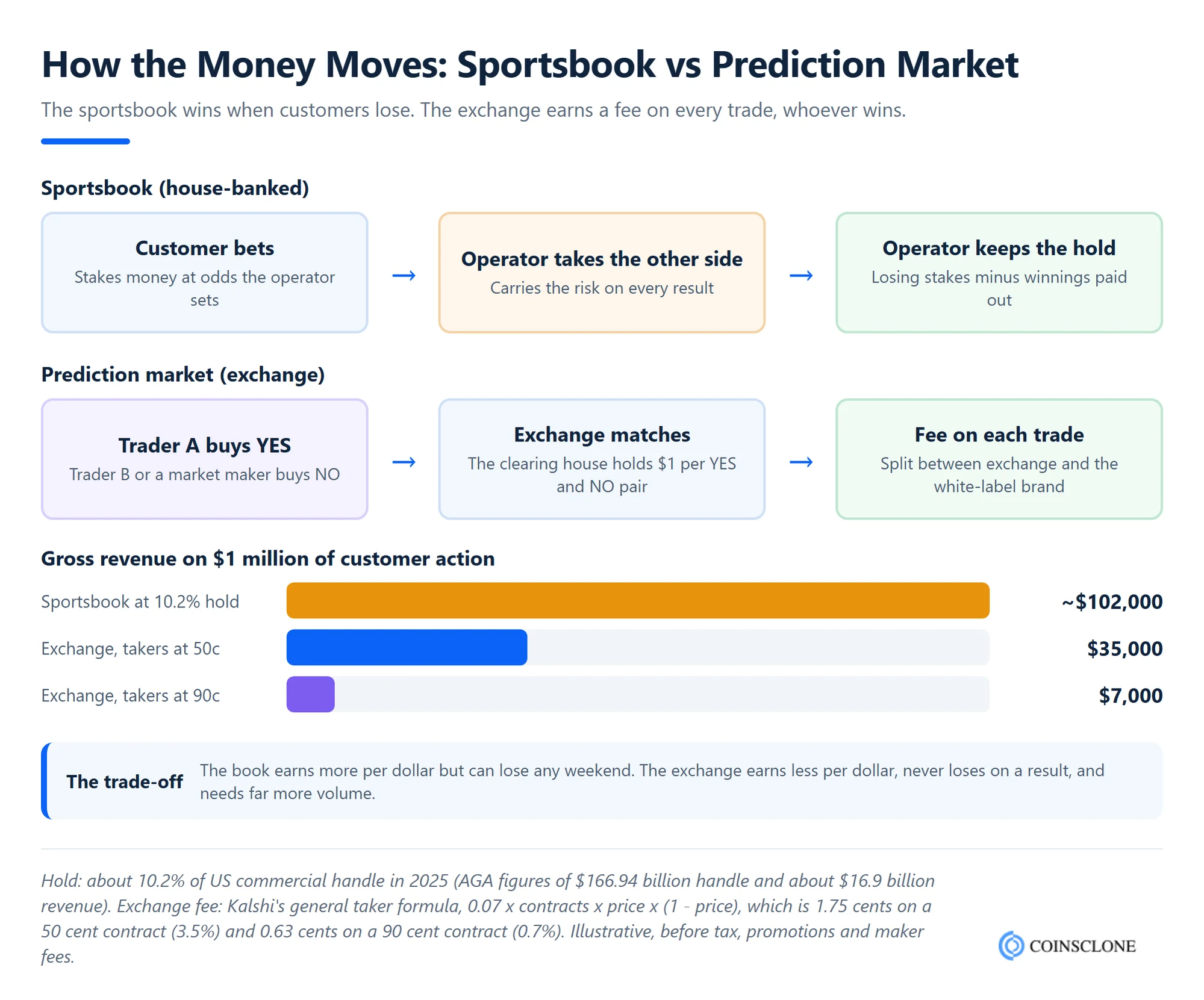
The worked numbers show the trade-off. On $1 million of customer action, a book at 10.2% hold averages about $102,000. An exchange earns $35,000 if takers buy at 50 cents, and nearer $7,000 if they buy at 90 cents. In short, the exchange earns less per dollar, so it needs much more volume, but it never has a losing Sunday.
| Sportsbook | Prediction market | |
| Who takes the risk | The operator, on every bet | No one; traders face each other |
| How you earn | Hold (customer losses minus payouts) | Fee per trade, plus data and listing deals |
| Typical take | About 10.2% of US handle in 2025 | Up to 3.5% of a taker’s spend at 50 cents, less at extreme prices |
| US regulator | State gaming boards, state by state | CFTC for the exchange; states dispute this for sports |
| Who sets prices | Your risk team and odds feed | Orders from customers and market makers |
| Winners | Often limited or closed | Welcome; they add liquidity |
Also, a white-label brand does not keep the whole fee. The exchange takes its share first, so get your split in writing before you compare routes.
Why Operators Are Moving In Now
Three things changed in 2026: the volume, the tools, and the number of rivals already in.
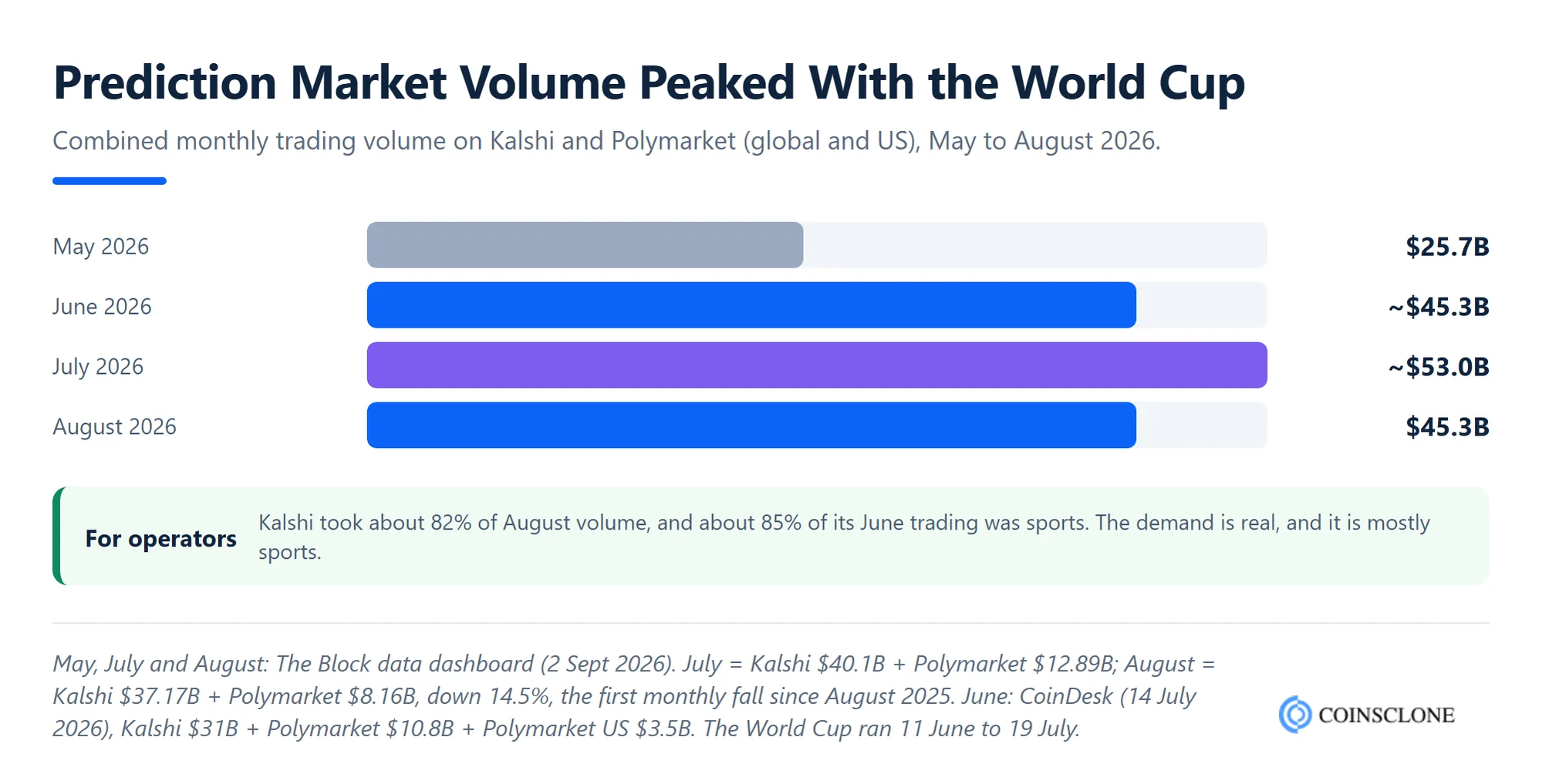
Volume. Combined Kalshi and Polymarket volume rose from $25.66 billion in May 2026 to about $53 billion in July, then fell 14.5% to $45.33 billion in August. Demand cooled after the World Cup but stayed far above spring levels.
Ready-made routes. On 24 September 2026, Optimove, a CRM firm, teamed up with Plaee to give its gaming clients a white-label way into event contracts under the CFTC. Plaee says it brings the trading screen, back office and access to trades through Crypto.com’s US exchange, which is a DCM. Optimove runs the marketing side. A week before, on 17 September, Genius Sports launched Prediction.com, a site where traders compare contracts across 11 apps, so being listed there matters.
Rivals already in. FanDuel Predicts launched with CME Group in December 2025. DraftKings bought the exchange Railbird. Betr bought an NFA-registered introducing broker on 20 May 2026 and plans to offer Polymarket-powered contracts.
Four Routes Into a Sports Prediction Market Platform
There are four routes in. They differ in speed, capital, control and how much of the fee you keep.
1. White Label on a CFTC-Registered Exchange
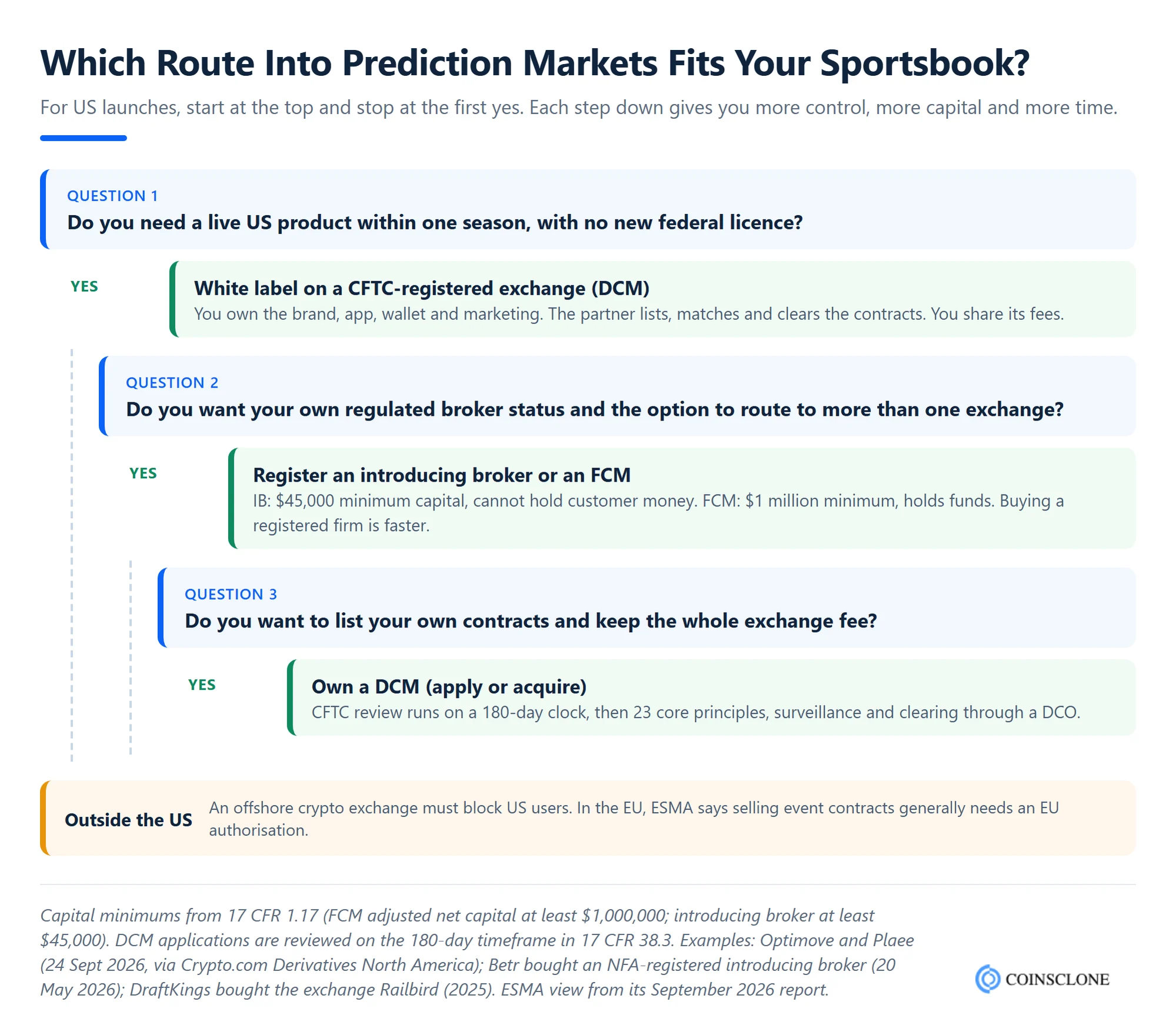
You run the brand, the app, the wallet and the marketing. A licensed partner lists the contracts, matches orders and clears trades. This is the Optimove and Plaee model, and it is the fastest way to a live US product. The trade-off is control: the partner decides which markets exist, and you share its fees.
2. Become an Introducing Broker or an FCM
Here you hold your own federal registration and send orders to one or more exchanges. An introducing broker (IB) brings in customers but cannot hold their money; it needs at least $45,000 of adjusted net capital under 17 CFR 1.17. A futures commission merchant (FCM) can hold customer funds and needs at least $1 million. Buying a firm that is already registered, as Betr did, skips the wait for NFA approval.
3. Own a DCM
This is the Kalshi and Railbird route. You list your own contracts and keep the full exchange fee. However, the CFTC takes up to 180 days to review a DCM bid. After that, you must meet 23 core rules, watch every trade for abuse and clear through a clearing house. You can check who already holds this status on the CFTC’s DCM list. For most firms, buying a DCM or teaming up with one is quicker than applying.
4. The Offshore Crypto Model
Outside the US, some operators run an on-chain order book settled in USDC, like the international Polymarket. It is cheap to launch and needs no CFTC status, but you must block US users. In Europe, ESMA said in September 2026 that selling event contracts generally needs an EU authorisation, which the largest platforms do not hold. Our Polymarket clone script page covers how that model is built.
| Route | Time to live | Capital and licence | Control | Fee you keep |
| White label on a DCM | Fastest; weeks of build plus partner onboarding | Partner holds the licence | Low | A negotiated share |
| IB or FCM | Months; faster if you buy a registered firm | $45,000 (IB) or $1 million (FCM) minimum | Medium | Broker fees, plus any exchange rebates |
| Own DCM | 180-day review, then build-out | Highest; full exchange compliance | Full | All of it |
| Offshore crypto | Fastest to build | Local licence where required; no US users | Full | All of it |
The State Fight: What It Means for Your Licences
For a licensed sportsbook, the biggest legal risk is to the licences you already hold.
Nevada went first. In November 2025, Flutter gave up its licences there for FanDuel, and DraftKings pulled its pending bids, Bloomberg reported. The state’s gaming board treats sports event contracts as wagering, even when a CFTC exchange lists them.
The 2026 cases show how wide the fight has become:
- Michigan: a state court order signed on 1 September 2026 keeps Kalshi’s sports contracts blocked in Michigan, with a $500,000 fine for each day of breach.
- Connecticut: the state told nine platforms to stop in early September. Underdog sued the state, as it had already sued five others.
- New York: the state sued Polymarket on 24 September 2026, having sued Kalshi in July.
- Federal courts: a federal appeals court has ruled that Ohio and Tennessee can enforce their gambling laws against Kalshi. New Jersey has asked the Supreme Court to take its case, and the NFL filed a brief backing the state on 8 October 2026.
- The CFTC: it has sent two new rules to the White House for review, The Block reported. One would treat event contracts as swaps. The other would bar casino-style products. Neither is final.
So what should you do? First, list every state where you hold a gaming licence and ask your lawyers how each board views event contracts. Second, plan to switch sports contracts off state by state, as FanDuel Predicts does where online betting is legal. Third, run the new product through its own company with its own compliance file. Above all, build geofencing that can change by state within hours, not weeks.
Launch Your Sportsbook Prediction Market
Prediction Market Development — done right.
- Operator Front End: A sports-first trading app with live prices, Yes/No buttons, cash-out by selling and your brand on every screen.
- Wallet and Funding: Card, bank and stablecoin deposits, kept separate from your sportsbook balances.
- KYC and Geofencing: Identity, age and state-level location checks that can switch a market off in one state fast.
- Risk and Market Tools: Surveillance alerts, restricted lists, market creation and result settlement from an admin panel.
Built to plug into the exchange partner or licence route you choose.
Book a Free Demo to see the operator layer for your sports prediction market.
What You Still Have to Build Yourself
Even on a white label, the partner only covers the exchange. The customer experience, and most of the compliance that touches the customer, sits with you.
- Front end and trading UX: a sports-first app with live prices, a ladder or simple Yes/No buttons, cash-out by selling, and parlays if your partner supports them. Your sportsbook users expect speed, not a trading terminal.
- Wallet and funding: deposits by card, bank and, where allowed, stablecoins, with a clear split between your sportsbook wallet and the funds held by the FCM or exchange.
- KYC and geofencing: ID checks, age limits and location checks in each state. In Michigan, a court even told Kalshi to use a location vendor that the state’s gaming board has licensed.
- Risk and surveillance: insider and wash-trade checks, restricted lists for athletes and staff, and audit logs. ESMA and the NFL have both flagged insider trading on these platforms.
- Market creation and resolution: which games and props to list, the named data source for each result, and rules for delays, abandoned games and overturned calls.
- Liquidity: deals with market makers, seed money for new markets and rewards, so the first customer does not see a wide spread and leave.
- CRM and safer play: welcome journeys, limits, self-exclusion and wording that avoids betting terms where your partner asks for it.
DFS firms that already run blockchain fantasy sports apps can reuse much of their wallet and KYC stack here.
Our prediction market platform development guide covers the engine side: order books, AMMs and settlement. The point here: the exchange is rented, but the product is yours. If you want your own event exchange later, a Kalshi clone script gives you the matching engine, contract rules and trade monitoring to build on.
Timeline and Cost Drivers
Timelines depend more on the licence route than on the code. On coinsclone.com, a white-label Kalshi-style event exchange takes 6 to 8 weeks. A standard custom exchange takes 12 to 16 weeks, and a full surveillance suite takes 5 to 7 months. A white-label Polymarket-style platform takes 5 to 7 weeks, and a custom build 10 to 14 weeks.
Costs follow the same pattern. Published 2026 agency cost guides put a white label with custom features at about $30,000 to $100,000 and a full custom build at about $90,000 to $250,000, with exchange-grade platforms running far higher. Beyond the build, the main cost drivers are:
- Licence route: partner revenue share, IB or FCM capital, or full DCM compliance staff.
- Liquidity: market-maker fees and seed funds, often the largest early cost.
- Compliance tools: KYC, location checks, trade monitoring and legal advice in each state.
- Data: official league data and result feeds for settlement.
- Marketing: ad networks limit gambling and trading ads, so new users often come from your own customer list.
Risks to Plan For
Cold-start liquidity. A thin book means wide spreads, and wide spreads drive customers back to the sportsbook. Budget for market makers before launch, not after.
Cannibalisation. If you also run a sportsbook, the prediction product may draw your own high-value bettors to a lower-margin product. Launch it first where you have no betting licence.
Partner risk. On a white label, your partner’s legal fights become yours. If its sports markets are blocked in a state, so are yours.
How to Choose a Partner and Prepare for a Scoping Call
Whether you pick an exchange partner, a broker or a build team, ask the same hard questions:
- Which DCM and FCM sit behind the product, and what share of each trade fee reaches you?
- Who owns the customer: KYC data, funds and the account relationship?
- How fast can you switch a market off in one state, and who decides?
- What liquidity is promised at launch, and by which market makers?
- Who carries surveillance duties, and can you see the alerts?
- Can you leave? Check data export, customer migration and notice periods.
Before a scoping call, prepare a short brief: target states or countries, the licences you hold today, sports and non-sports markets you want, expected users in year one, and your wallet and KYC vendors.
Coinsclone has been building since 2018 and has delivered 350+ platforms for 200+ clients across 20 industries. We build the operator layer: front end, wallet, KYC and geofencing hooks, risk tools and admin, on top of the exchange partner or licence route you choose.
Frequently Asked Questions
What is the difference between a prediction market and a sportsbook?
A sportsbook sets the odds and takes the other side of every bet, so it earns when customers lose. A prediction market matches customers with each other and earns a fee on each trade, whatever the result. In the US, prediction markets are listed on CFTC-registered exchanges, while sportsbooks are licensed state by state.
Can a sportsbook offer a prediction market?
Yes, and some already do. FanDuel built FanDuel Predicts with CME Group, DraftKings bought the exchange Railbird, and Betr bought an introducing broker. The main risk is to the licences you hold now. Nevada treats sports event contracts as wagering, and Flutter gave up its licences there in late 2025.
Do I need a gaming licence to launch a sports prediction market?
Under federal law, a US event-contract venue needs CFTC status, not a gaming licence. White-label brands rely on a partner’s DCM. However, many states say sports event contracts are gambling and have sued or sent orders to stop. Get legal advice for each state before you list sports contracts.
Are sports prediction markets legal?
They are legal under federal law on CFTC-registered exchanges, but that is now being tested in court. A Michigan court has blocked Kalshi’s sports contracts, and New York has sued Polymarket. A federal appeals court has also let two states enforce their gambling laws. New Jersey has asked the Supreme Court to decide.
How does a sports prediction market make money?
It charges a fee on each trade. On Kalshi’s general formula, a taker pays at most 1.75 cents on a 50 cent contract, and Polymarket’s sports rate is 0.05. Platforms can also earn from data deals, listing partners and broker fees, but trade fees are the core.
How do you get liquidity in a new sports prediction market?
Most launches sign market makers who quote both sides of each market, often in return for fee rebates or incentives. On a white label, you can share the partner’s existing order book. Starting with popular games and a small list of markets keeps spreads tight.
What is a white label prediction market?
It is a ready-made platform you brand as your own. In the US, it usually sits on top of a CFTC-registered exchange that lists and clears the contracts. You run the app, wallet and marketing. Coinsclone quotes 6 to 8 weeks for a white-label Kalshi-style event exchange.