

Kalshi and Polymarket traded more than $50 billion of contracts in July 2026, an all-time high. In August the total fell 14.5% to $45.33 billion, with Kalshi alone at $37.17 billion, according to The Block’s volume data. Numbers like these explain why so many founders, exchanges and sportsbooks are now pricing a build of their own.
The hard part is the budget. Prediction market development cost ranges from about $10,000 for a branded white label to $2.5 million or more for a licensed exchange. Most quotes also leave out the costs that sink new platforms: liquidity, legal work and disputed results.
This guide gives you the full budget. You will see the cost of each build route, every line item, the monthly bill after launch and the hidden costs. A decision tree at the end helps you pick a route.
In this guide:
- White label: about $10,000 to $30,000 for core features, or $30,000 to $100,000 with custom work, live in 5 to 8 weeks.
- Custom on-chain build like Polymarket: about $150,000 to $500,000 for an order book, conditional tokens and oracle settlement.
- Custom regulated build like Kalshi: about $900,000 to $2.5 million or more, because legal work and controls cost more than code.
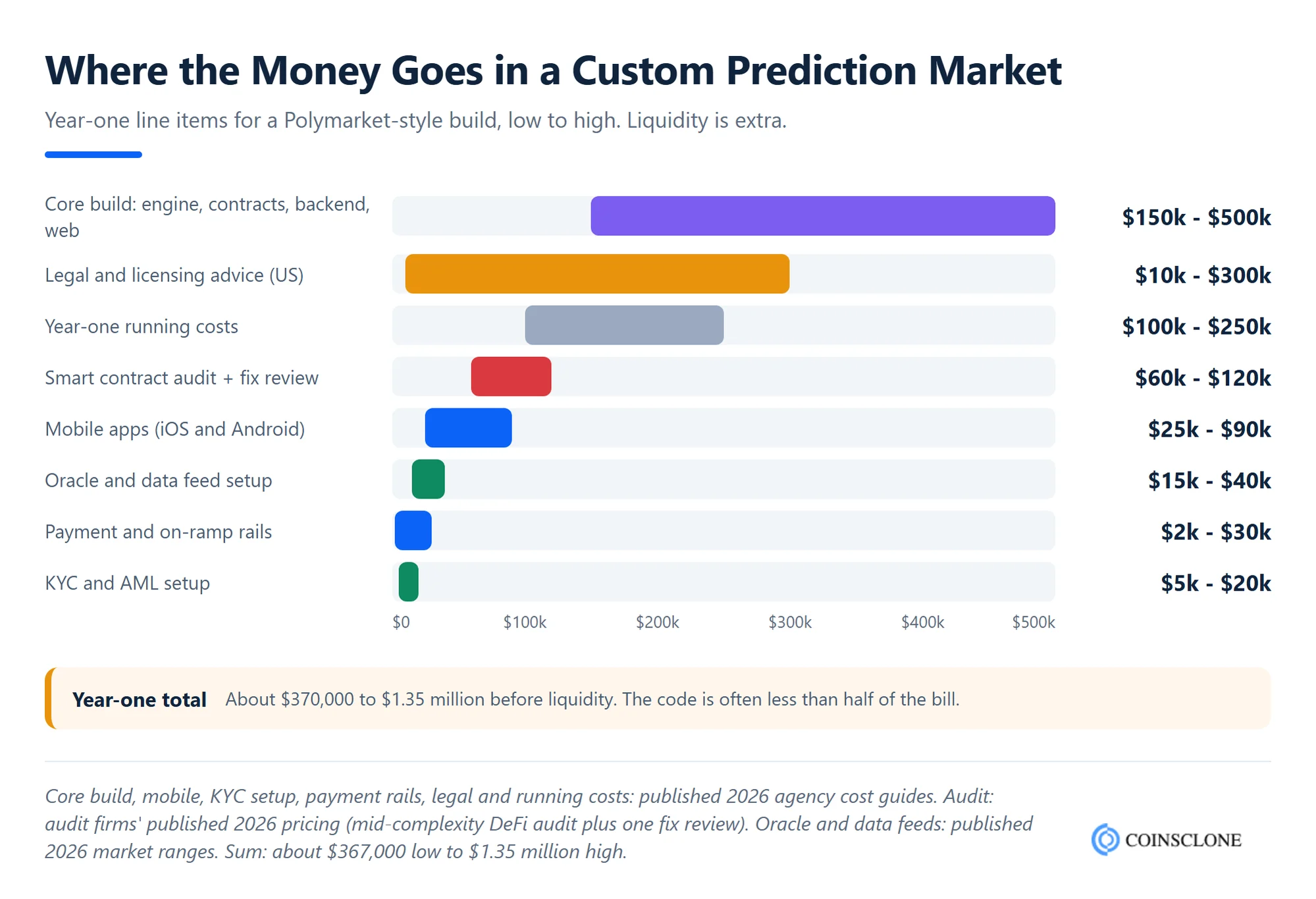
- Year one for a custom build: roughly $370,000 to $1.35 million before liquidity, once audits, apps, legal and running costs are added.
- Liquidity is a budget line: an LMSR market maker on a Yes or No market can lose at most b x ln(2), so a $1,000 depth setting caps the loss near $693 per market.
How Much Does Prediction Market Development Cost in 2026?
Prediction market development cost depends on three choices: how you build, where you operate and how you settle results. The build route sets the base price. Your legal plan and liquidity plan then add to it.
Here is the short answer. These are market ranges from published 2026 agency cost guides, not quotes.
| Build route | What you get | Market range | Time to launch | Best for |
| White label, core features | Branded script: markets, Yes and No trading, wallets, settlement, admin | $10,000 to $30,000 | 5 to 8 weeks | Testing a niche fast |
| White label plus custom work | Order book, mobile apps, compliance tools, more market types | $30,000 to $100,000 | 2 to 4 months | Operators with a brand and users |
| Custom on-chain, like Polymarket | Off-chain order matching, on-chain settlement, conditional tokens, oracle | $150,000 to $500,000 | 10 to 14 weeks for a standard scope, up to 9 months | Crypto-native founders |
| Custom regulated, like Kalshi | Own exchange, clearing, surveillance, segregated client money | $900,000 to $2.5 million or more | 7 to 12 months or more | Firms seeking a licence |
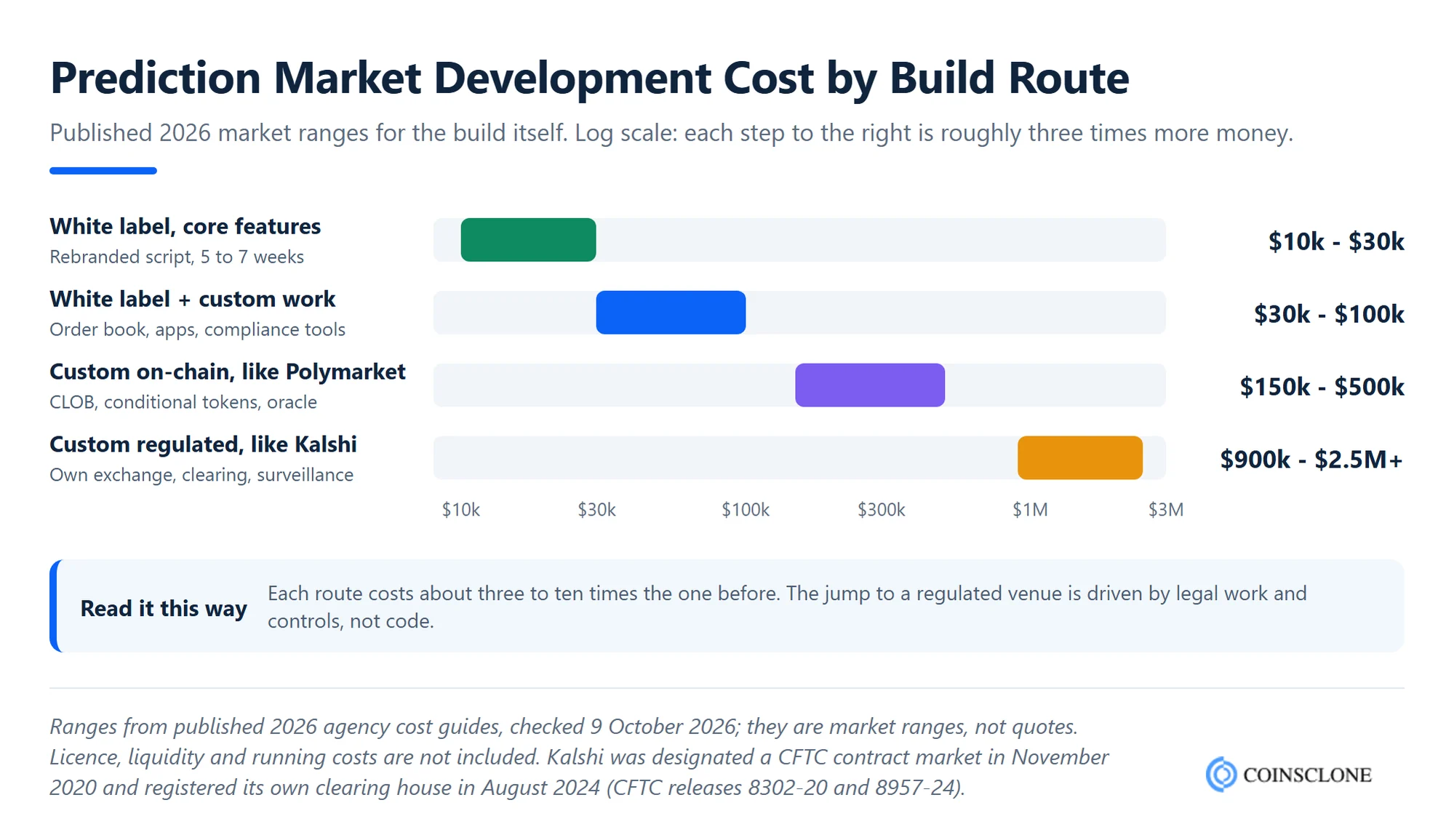
The jump to a regulated venue comes from legal work and controls, not from extra code.
Prediction Market Development Cost by Build Route
Each route buys a different mix of speed, control and legal reach. So pick the route first, then price the features.
White Label or Clone Script: $10,000 to $100,000
A white label is a ready platform that you brand and launch. The core is built and tested, so you pay for setup, design and any custom work. Some vendors charge a monthly fee of $2,000 to $10,000 instead, often with a share of revenue.
This route suits a first launch in one niche, such as one sport, one region or one community. For example, a Polymarket clone script gives you the order book, Yes and No shares, oracle hooks and wallets out of the box. As a result, your budget goes to users and liquidity instead of core code.
The trade-off is control. You depend on the vendor’s code quality, so ask who audited it and whether you get the full source.
Custom On-Chain Build Like Polymarket: $150,000 to $500,000
Polymarket runs a hybrid model. An operator matches signed orders off-chain, and trades settle on-chain. Outcome shares are conditional tokens, and the UMA oracle settles results. As a result, users keep custody while trading feels like a normal exchange.
A custom build of this stack has four big parts:
- Matching engine: a central limit order book (CLOB) that matches orders in milliseconds and survives traffic spikes on big event days.
- Smart contracts: the conditional token contracts that mint, split and redeem Yes and No shares, plus the exchange contract that settles matched orders.
- Resolution layer: oracle hooks, market rules, a dispute flow and an admin tool for edge cases.
- Wallet and funding: embedded wallets, USDC deposits, a card on-ramp and gas sponsorship so users never touch gas.
You do not have to start from zero. Polymarket’s CTF Exchange contracts are open source under the MIT licence, with an audit report in the repository. Reusing audited code cuts build time. However, any change you make still needs a fresh audit.
Custom Regulated Build Like Kalshi: $900,000 to $2.5 Million or More
Kalshi is a US exchange regulated by the CFTC. It runs as a designated contract market (DCM) and clears trades through its own clearing house. Building this way means the software is the smaller bill.
Time is the other cost. The CFTC reviews a DCM application on a 180-day timeline that starts only once the file is complete. Kalshi was designated in November 2020 and only registered its own clearing house in August 2024. Polymarket took a shortcut instead: it bought QCEX, a licensed exchange and clearing house, for $112 million in July 2025.
Many new US entrants therefore partner with a licensed venue first. They build the front end, KYC and user experience, then route trades to the exchange. A Kalshi clone script covers the exchange side for firms that plan to apply for a licence later.
Line-Item Breakdown: Where the Money Goes
Every route uses the same building blocks. Market ranges below come from published 2026 agency cost guides; unit prices come from vendors’ own pages.
| Line item | What it covers | Typical cost |
| Matching engine or AMM | Order book, or a formula-based market maker for thin markets | Part of the core build, $150,000 to $500,000 custom |
| Smart contracts and audit | Conditional tokens, exchange contract, fee logic | Audit $40,000 to $100,000 per round; $60,000 to $120,000 with a fix review |
| Oracle and resolution | Oracle hooks, rules, dispute tools, a resolution team | Setup $15,000 to $40,000; UMA bonds per market (see below) |
| Wallet and on-ramp | Embedded wallets, USDC deposits, card purchases | Payment rails $2,000 to $30,000 |
| KYC and geofencing | Identity checks, sanctions screening, location blocks | Setup $5,000 to $20,000; checks from $1.35 each |
| Admin and market creation | Market builder, rule templates, risk limits, reports | Part of the core build |
| Mobile apps | iOS and Android apps | $25,000 to $90,000 |
| Liquidity and market making | Market maker capital, rebates, AMM subsidies | Your choice; often the biggest line |
| Legal and licensing | Jurisdiction plan, terms, licence filings | $10,000 to $300,000 in the US |
| Hosting | Servers, database, monitoring | About $700 to $1,200 a month in compute |
Audits: Audit firms’ published 2026 pricing puts most DeFi audits at $25,000 to $100,000. Each fix review adds $5,000 to $20,000. Also, Rust and Solana code costs 25% to 40% more, and rush jobs add 20% to 40%. A white label with small contract changes sits at the low end.
Oracle and resolution: UMA’s minimum bond equals its final fee, which is 250 USDC. Polymarket typically sets a $750 bond with a two-hour challenge window. The bond comes back when no one disputes the result. A disputed market takes 4 to 6 days, and the losing side forfeits half its bond.
KYC: Sumsub’s published price is $1.35 per verification with a $149 monthly minimum, or $1.85 on its Compliance plan. So 5,000 sign-ups a month cost about $6,750 in checks alone.
How Much Liquidity Budget Do You Need?
Liquidity is the line item most quotes skip. Yet thin markets are the most common reason a new platform fails. Users leave when they see wide spreads and empty order books.
You have two ways to fund it.
AMM subsidy: A formula-based market maker, such as the Logarithmic Market Scoring Rule (LMSR), always quotes a price. Its worst-case loss is b x ln(n), where b sets the market’s depth and n is the number of outcomes. For a Yes or No market with b set to 1,000, the most you can lose is about $693. Fifty such markets cap your exposure near $34,650.
Order book with maker rebates: Here you pay market makers to post prices. Polymarket charges takers a fee of shares x rate x price x (1 – price) and pays makers 15% to 25% of it back, per its fee page. For instance, $1 million of sports trades at 50 cents is 2 million shares. At the 0.05 rate, that earns $25,000 in fees, and $3,750 of it goes back to makers. Our breakdown of how Polymarket makes money covers this model in full.
In practice, most platforms use both. An AMM covers long-tail markets, and paid makers cover busy ones. Either way, set this budget before launch, not after.
Monthly Running Costs After Launch
Launch is not the end of spending. Published 2026 agency cost guides put upkeep at 15% to 25% of the build cost per year. On a $200,000 build, that is $2,500 to $4,200 a month. A modest platform costs $100,000 to $250,000 a year to run in total.
| Monthly cost | What drives it | Example |
| Hosting | Servers, database, bandwidth, monitoring | An AWS m7g.xlarge costs $0.1632 an hour on demand, about $119 a month; 6 to 10 servers run $700 to $1,200 |
| Identity checks | New sign-ups | $1.35 per check, $149 minimum |
| White label licence | SaaS plans, if you rent | $2,000 to $10,000 a month |
| Maintenance | Bug fixes, updates, security patches | 15% to 25% of build cost a year |
| Market operations | Creating markets, writing rules, resolving results | One or more full-time staff |
| Liquidity | Maker rebates, AMM subsidies | Scales with volume |
| Legal and compliance | Counsel, filings, surveillance reviews | Retainer, varies by country |
Price Your Prediction Market Before You Build It
Prediction Market Development — done right.
- Polymarket Clone Script: Order book, Yes and No shares, conditional tokens and oracle hooks, ready to brand.
- Kalshi Clone Script: Event exchange with surveillance, segregated funds and audit trails for a regulated launch.
- Fee and Liquidity Engine: Category taker fees, maker rebates and market maker tools from day one.
- Compliance Built In: KYC tiers, geofencing and market rules set to your counsel’s plan.
Get a free branded demo of your prediction market in 48 hours, before you spend on a build.
Book a Free Demo to scope your platform and see how a white label can go live in 5 to 7 weeks.
Hidden Costs Most Quotes Leave Out
The build quote is the number founders see first. The costs below are the ones that surprise them later.
- State legal fights: On 1 September 2026, a Michigan court ordered Kalshi to keep blocking sports contracts in the state and to use a state-licensed geolocation provider, with a $500,000-a-day fine for breaches. Precise geofencing is now a cost of doing business.
- EU authorisation: ESMA said in September 2026 that selling event contracts in the EU generally requires an authorisation the largest platforms lack. Budget for local legal advice before you list a single EU market.
- Disputed results: One bad resolution can cost more than many clean ones earn. You pay for clear rule templates, named data sources and a team that handles disputes.
- Re-audits: Every contract upgrade needs a new review. Plan $5,000 to $20,000 per pass.
- Gas sponsorship: Gasless trading means the platform pays network fees for users. It is small per trade but grows with volume.
- Data feeds: Official sports and financial data is licensed, and prices are quote-based.
- Team location: Published 2026 agency cost guides show build rates of about $20 to $30 an hour in India and $80 to $200 in North America. The same scope can cost three times more onshore.
Together, these can add two to three times the base build cost before launch, per published 2026 agency cost guides.
How to Choose the Right Route for Your Budget
The decision tree below sorts most projects in three questions. Start at the top and stop at the first yes.
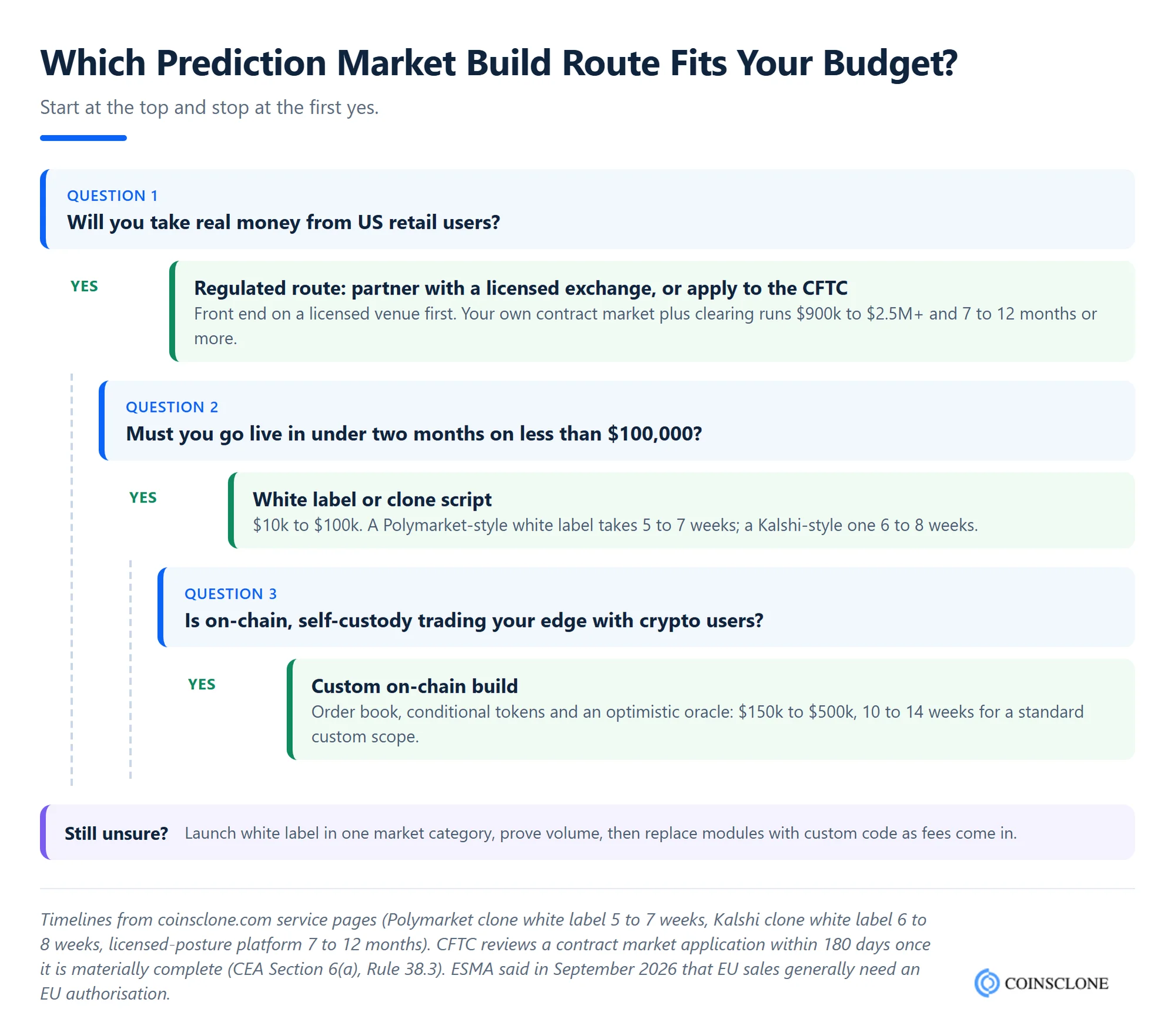
US retail users: You need a licensed path. Partner with a licensed exchange first, or plan for the full regulated route and its long timeline. Our crypto license guide compares costs by country.
Speed and a tight budget: A white label wins. On Coinsclone’s own timelines, a Polymarket-style white label goes live in 5 to 7 weeks, and a Kalshi-style one in 6 to 8 weeks.
On-chain edge: Build custom if self-custody, a token or a specific chain is your product. Otherwise, start white label in one category, prove volume, and replace modules with custom code as fees come in. For a side-by-side look at ready scripts, see our guide to the prediction market platform script.
How to Cut Prediction Market Development Cost Without Cutting Corners
Lower cost should never mean weaker security or vague rules. These moves save money safely:
- Launch one category first. Sports, crypto prices or local politics each need different data and rules. One category keeps the first build small.
- Reuse audited code. Open-source conditional token and exchange contracts cut build and audit time.
- Use an AMM for long-tail markets. It avoids paying makers to quote markets that few people trade.
- Ship web first. Responsive web can come before native apps and saves $25,000 to $90,000 at launch.
- Pick your countries before your features. Geofencing and KYC rules shape the whole build. Adding them later costs far more.
Our guide on how to build a prediction market platform like Polymarket walks through these steps in order.
What to Prepare Before a Scoping Call
A clear brief turns a vague estimate into a firm quote. Before you talk to any build partner, write down:
- Target countries and whether you will serve US users
- Market categories for the first six months
- Engine choice: order book, AMM or both
- Settlement asset and chain, such as USDC on a low-fee network
- Resolution policy: oracle, in-house team or both
- KYC tiers and deposit limits
- Liquidity plan and its budget
- Budget band and launch date
Then ask each partner the same questions. Who audited the code, and can you read the report? Do you get full source ownership? How does the system handle a disputed result? What load did the matching engine handle in testing?
Coinsclone has delivered 350+ platforms for 200+ clients across 20 industries since 2018. Our prediction market platform development team can scope your build after a short call and give you a firm figure for your route.
Frequently Asked Questions
How much does it cost to build a prediction market platform from scratch?
Published 2026 agency cost guides put a production-grade custom build at about $150,000 to $500,000. A licensed, regulated venue costs $900,000 to $2.5 million or more. Audits, legal work, apps and liquidity come on top of these figures.
How much does it cost to build an app like Polymarket?
A custom on-chain platform with an order book, conditional tokens and oracle settlement costs about $150,000 to $500,000. A Polymarket clone script lowers the entry point to roughly $10,000 to $100,000, depending on custom work. Either way, plan a separate budget for liquidity.
Is a white label prediction market cheaper than a custom build?
Yes, by a wide margin at launch. A white label costs about $10,000 to $100,000 and goes live in weeks, while custom builds start near $150,000. Some white labels charge $2,000 to $10,000 a month or a revenue share, so compare the cost over two to three years.
How much does a smart contract audit cost for a prediction market?
Audit firms’ published 2026 pricing puts most DeFi audits at $25,000 to $100,000. A realistic budget with one fix review is $60,000 to $120,000 for a mid-complexity protocol. Rust or Solana code adds 25% to 40%.
What is the minimum realistic budget to launch a prediction market platform?
A white label with core features starts around $10,000 to $30,000. A realistic launch budget also covers KYC, legal advice, hosting and starting liquidity. So most serious launches plan for $50,000 or more in year one, even on the cheapest route.
What is the biggest hidden cost of building a prediction market?
Liquidity. Users leave markets with wide spreads, so you must pay makers or fund an AMM. Legal costs come close behind, especially in the US and EU, where courts and regulators are active in 2026.
What are the biggest ongoing costs after launch?
Maintenance runs 15% to 25% of the build cost a year, and a modest platform costs $100,000 to $250,000 a year to run. The biggest monthly lines are liquidity, staff for market operations, identity checks and legal work. Hosting is usually small next to these.
Does an AMM make a prediction market cheaper to build?
An AMM is simpler than a high-speed order book, so it can lower build cost. However, the platform funds the AMM’s losses, which LMSR caps at b x ln(n) per market. Many platforms use an AMM for thin markets and an order book for busy ones.
How long does it take to build a prediction market platform?
A white label takes 5 to 8 weeks. A standard custom on-chain platform takes 10 to 14 weeks, and full compliance stretches that to 4 to 6 months. A licensed exchange takes 7 to 12 months or more, mostly because of the regulator’s timeline.