
For its first five years, Polymarket charged traders almost nothing. No trading fee, no deposit fee, no withdrawal fee. People kept asking the same question: if it is free, how does Polymarket make money?
For most of that time, the honest answer was that it did not. Venture money paid the bills while the platform chased volume. That changed in 2026. Polymarket rolled out taker fees across nearly every market in March. By August, Bloomberg reported annualized revenue of more than $1.2 billion.
This guide breaks down the full revenue model: what each trade costs, who gets paid back, where data deals fit, and why the US arm runs on its own fees. It also covers where Polymarket is legal. If you plan to launch your own prediction market, the last sections show which parts of this model you can copy.
How Does Polymarket Make Money?
Polymarket makes money mainly from taker fees. A taker is a trader who fills an order that is already on the order book. Makers, the traders who post those resting orders, pay nothing.
The fee is not a flat percentage. It follows one rule from the Polymarket fee page:
Fee = shares x fee rate x price x (1 – price)
Price is the share price between $0 and $1. The fee is highest when a share costs 50 cents, the point of most doubt. It shrinks as the price moves toward 0 or $1. A trader betting on a near-certain result pays very little.
Here is the full money picture in 2026:
- Taker fees: the main engine, charged in most market categories since 30 March 2026.
- The US exchange: Polymarket US runs under CFTC rules with its own fee schedule.
- Data deals: partners such as ICE and Dow Jones carry Polymarket odds to their users.
- Costs that come back out: maker rebates and holding rewards, both paid to users.
Data from DefiLlama’s Polymarket page, the platform collected about $82 million in fees in the 30 days to 28 September 2026. That is close to $1 billion a year at the current pace.
What Does a Polymarket Trade Cost?
Each market category has its own fee rate. The rates below come from the fee page, checked on 28 September 2026:
| Category | Fee rate | Peak fee (at 50 cents) | Maker rebate share |
| Crypto | 0.07 | 1.75% | 20% |
| Sports | 0.05 | 1.25% | 15% |
| Economics, culture, weather, other | 0.05 | 1.25% | 25% |
| Finance, politics, tech, mentions | 0.04 | 1.00% | 25% |
| Geopolitics and world events | 0 | Free | None |
A worked example makes this clear. Say you buy 100 “Yes” shares on a crypto market at 50 cents. The fee is 100 x 0.07 x 0.5 x 0.5, which is $1.75. Buy the same 100 shares at 90 cents and the fee drops to $0.63.
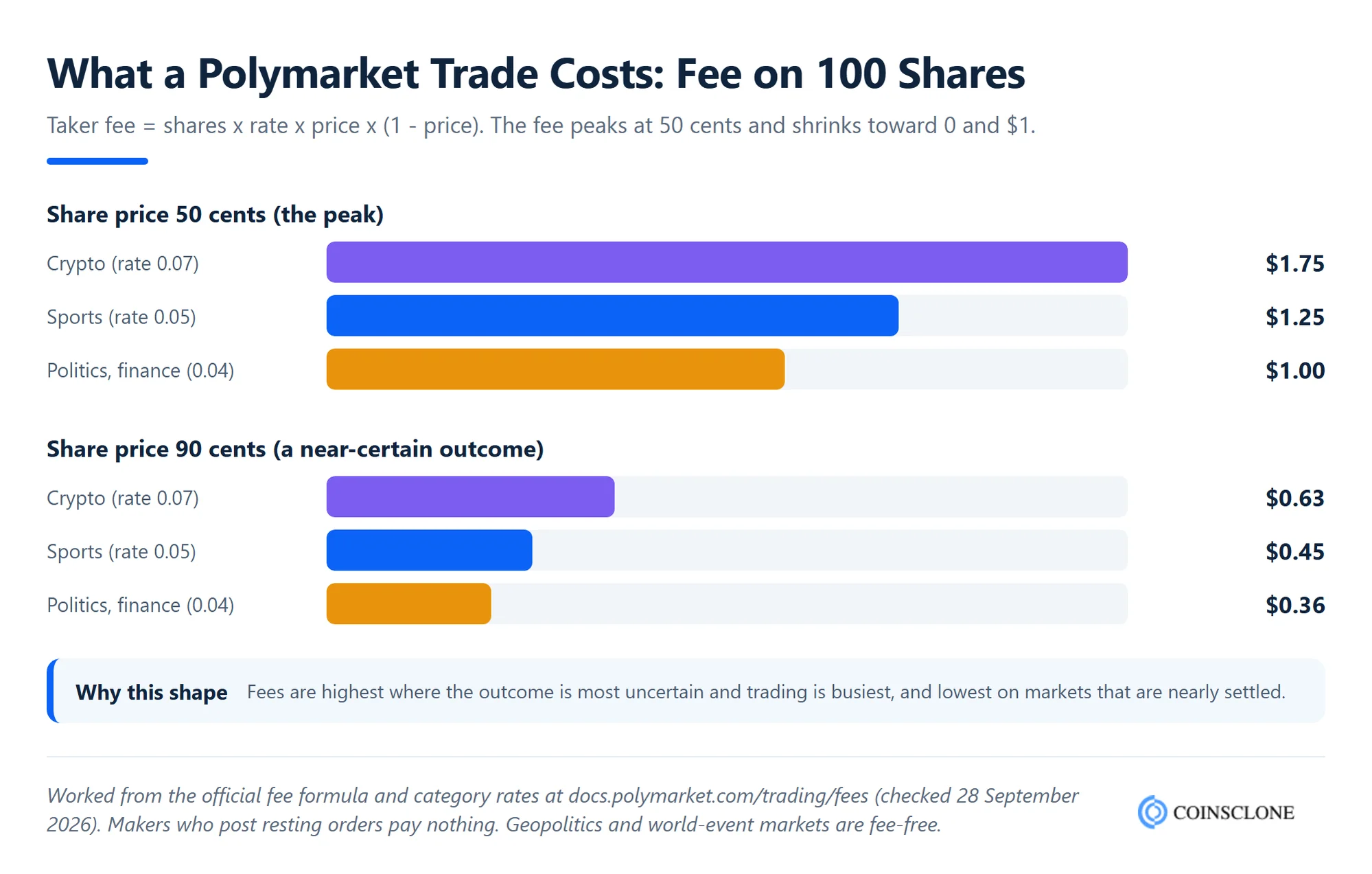
The minimum fee is 0.00001 USDC. It is still free to add or take out money. Some older guides say the crypto peak fee is 1.80%. The fee page math gives 1.75%, so trust the math.
Why Did Polymarket Start Charging Fees in 2026?
Polymarket did not switch fees on in one day. It tested them market by market:
- January 2026: taker fees on 15-minute crypto markets, used to fund a new maker rebate program (The Block covered the launch).
- February 2026: fees on sports markets.
- March 2026: fees on all crypto time frames, then on nearly all categories from 30 March.
- 31 March 2026: a quick fix. The first version charged fees on the dollar value of a trade, which hit cheap shares too hard. Within a day Polymarket moved to the per-share formula used today.
The reason was simple. Volume had grown far past what free trading could support. Fees turn that volume into revenue, and the rebates keep market makers quoting tight prices. Daily fees passed $1 million for the first time on 1 April 2026, days after the full rollout.
Who Gets Paid Back? Maker Rebates and Holding Rewards
Not all fee money stays with Polymarket. Two programs send money back to users.
Maker rebates. Each day, Polymarket pays makers a share of the taker fees their orders earned. The share is 20% in crypto markets, 15% in sports and 25% in the other paid categories. Rebates are paid in USDC. This is how the platform keeps its order books deep without acting as a market maker itself.
Holding rewards. On some long-dated political markets, Polymarket pays holders about 4% a year on their positions. This comes from the treasury, so it is a cost, not revenue. It keeps money parked in slow markets that would otherwise sit idle.
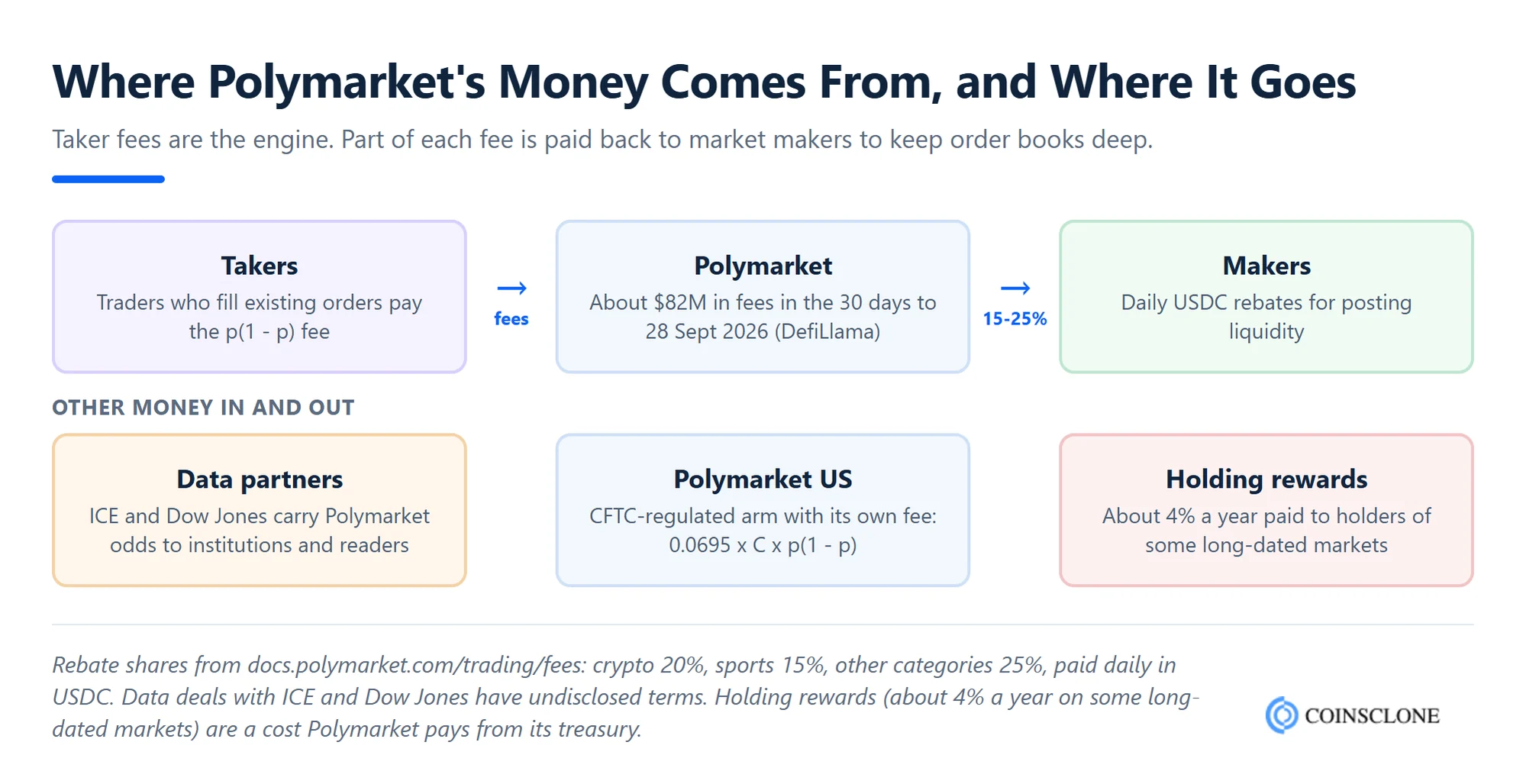
This design is worth studying if you build a platform of your own. Fees on takers, rebates to makers: that one loop funds both revenue and liquidity. You can see the same idea in the revenue models of crypto exchanges.
Does Polymarket Make Money From Data Deals?
Polymarket odds are now news. Media and finance firms want them on their screens, and that creates a second line of business.
- ICE, the owner of the New York Stock Exchange, agreed in October 2025 to invest up to $2 billion and to share Polymarket data with its big clients.
- Dow Jones signed an exclusive deal in January 2026 to show Polymarket data across The Wall Street Journal, Barron’s and MarketWatch.
- X named Polymarket its main betting-odds partner in June 2025.
None of these deals has public payment terms. So data is best seen as a growth and trust channel with some revenue attached, not the main engine. A deal with Yahoo Finance started in late 2025 and ended in April 2026, which shows these deals can come and go.
One thing Polymarket does not seem to do: earn interest on user funds. Trades settle in Polymarket USD, which is backed one to one by USDC. No public source says the platform keeps yield on those reserves.
How Does Polymarket US Make Money?
Polymarket has two businesses under one brand. The main platform serves most of the world. Polymarket US is a separate exchange for American users, and it runs under US rules.
The path back to the US took three steps:
- In July 2025, Polymarket bought QCEX, a CFTC-licensed exchange and clearing house, for $112 million.
- In September 2025, CFTC staff issued a no-action letter giving the exchange relief on some reporting rules.
- In November 2025, the CFTC approved an amended order that let brokers route US customers to the exchange. The app opened by invite in December 2025 and dropped its waitlist in May 2026.
The US fee started at a tiny 0.01% of premium. From 25 September 2026 it follows the same shape as the global fee: 0.0695 x contracts x price x (1 – price), with maker rebates and volume tiers. At 50 cents, that is at most $1.74 per 100 contracts.
The US arm is growing fast. It was 4% of Polymarket’s volume in January 2026 and 39% by July, according to Pew Research.
How Much Money Does Polymarket Make?
Polymarket is private and does not publish accounts. Here is what the public record shows:
| Figure | Amount | Source and date |
| Revenue in 2025 | About $0 | Trading was fee-free (Sacra) |
| Fees, last 30 days | About $82.2 million | DefiLlama, 28 Sept 2026 |
| Fees, last 12 months | About $399 million | DefiLlama, 28 Sept 2026 |
| Annualized revenue | More than $1.2 billion | Bloomberg, August 2026 |
| Valuation | $15 billion; talks at more than $20 billion | Bloomberg, April 2026; CoinDesk, August 2026 |
The 12-month fee total looks low next to the annualized figure because fees only covered all markets from late March. The run rate since then is the better guide.
Volume sets the ceiling. In July 2026, Polymarket traded about $12.9 billion, against $37.7 billion on Kalshi, its main US rival. Kalshi uses the same p(1 – p) fee shape with a 0.07 rate, according to its fee schedule. Sports drive most of Kalshi’s trades (about 80%), while sports are about 39% of Polymarket volume. Polymarket leans more on politics, crypto and world events.
Launch Your Own Prediction Market Like Polymarket
Prediction Market Development — done right.
- Polymarket Clone Script: Order book, Yes/No shares, oracle hooks and wallets, ready to brand.
- Fee Engine: Set taker fees by category and pay maker rebates, the model Polymarket uses.
- Compliance Ready: Geo-blocking, KYC and market rules built in from day one.
- Revenue Engine: Earn from trading fees, market creation fees and data feeds.
Get a free branded demo of your prediction market in just 48 hours — before spending a single dollar.
Book a Free Demo to see how our Polymarket Clone Script can take you from idea to live platform in as little as 5 – 7 weeks.
Is Polymarket Legal? Where It Works and Where It Is Blocked
This is the most searched question after fees. The short answer: it depends on the country, and in the US, on the state.
In the US. The CFTC fined Polymarket $1.4 million in January 2022 for offering event contracts without registration, and the main site then blocked US users. In July 2025 the Justice Department and the CFTC closed their probes with no charges. Today, US users trade on Polymarket US, a CFTC-licensed app of its own, not the main site.
States are still fighting over sports contracts. Nevada sued Polymarket in January 2026 and won a court order that bars sports, election and entertainment contracts in the state. In April 2026, the CFTC sued Arizona, Connecticut and Illinois, saying US law beats state gambling rules. The courts have not settled this yet.
Outside the US. Polymarket keeps an official list of restricted places. It has three levels:
- Fully blocked: Iran, Syria, Cuba, North Korea and occupied parts of Ukraine.
- Close only (users can close positions but not open new ones): among others the UK, France, Germany, Italy, Belgium, Poland, Australia, Singapore, Taiwan, Thailand, Brazil, parts of Canada, and the US on the international app.
- Website only restricted: Ireland, Japan, the Netherlands and South Korea.
Europe is the hardest region. France’s gaming watchdog ordered web providers to block Polymarket in July 2026. Portugal, Hungary and Spain have also acted against it. Most regulators treat prediction markets as gambling, not as trading.
These rules change often, so check the official list before you trade or build.
How Do Polymarket Markets Settle?
Settlement is part of the business, because trust in outcomes is what keeps traders coming back.
Polymarket settles markets with the UMA oracle, a tool that checks real-world results. Anyone can propose an outcome by posting a bond. If no one disputes it within two hours, it stands. If it is disputed twice, UMA token holders vote on the result.
Trading runs on a hybrid order book. An operator matches signed orders off-chain, and trades settle on-chain on Polygon. The operator cannot move funds without the user’s signature. This mix gives the speed of a normal exchange with the custody model of a crypto app.
What Can Founders Learn From Polymarket’s Revenue Model?
Polymarket’s path offers five clear lessons for anyone building a prediction market platform:
- Grow first, charge later. Five fee-free years built the volume that fees now turn into revenue. A new platform needs a funded plan for its free period.
- Charge takers, pay makers. The p(1 – p) fee plus rebates keeps spreads tight without the platform taking the other side of trades. Regulators and users trust that more than a house that profits from the spread.
- Price by category. Crypto markets carry the highest rate, world events carry none. Set fees by how busy and how price-sensitive each market is.
- Plan for licences early. Polymarket paid $112 million for a US licence path. Pick your target markets and their rules before you pick your features. Our crypto license guide compares costs and timelines by country.
- Treat your odds as a product. Data deals turn market prices into brand reach, and sometimes into revenue.
Competing head-on with Polymarket and Kalshi is hard. New platforms win with a niche: one region, one sport, one community or one chain. A Polymarket clone script gives you the order book, oracle hooks, wallets and admin tools out of the box, so your budget goes to liquidity and users instead. Our team has delivered 350+ platforms, and a white label prediction market can go live in about 5 to 7 weeks. If you want the full build path, read our guide on how to build a prediction market like Polymarket, or compare options in our list of prediction market clone scripts.
Frequently Asked Questions
How does Polymarket make money if trading was free?
Until 2026 it mostly did not. Venture funding covered costs while volume grew. Since 30 March 2026, Polymarket charges taker fees on nearly all market categories, and that is now its main income.
What fee does Polymarket charge per trade?
The fee is shares x rate x price x (1 – price). Rates are 0.07 for crypto, 0.05 for sports and most other categories, 0.04 for politics and finance, and 0 for world events. The peak fee at 50 cents runs from 1% to 1.75%.
Do Polymarket makers pay fees?
No. Makers who post resting orders pay nothing. They also earn a daily USDC rebate of 15% to 25% of the taker fees their orders generate.
How much revenue does Polymarket make?
Bloomberg reported annualized revenue of more than $1.2 billion in August 2026. DefiLlama tracked about $82 million in fees in the 30 days to 28 September 2026.
Is Polymarket legal in the US?
Yes, through Polymarket US, a separate CFTC-regulated exchange that opened to the public in 2026. The international site still restricts US users, and some states, such as Nevada, have won court orders that limit certain contracts.
Is Polymarket legal in the UK?
The UK is on Polymarket’s close-only list. UK users can close existing positions but cannot open new ones on the international platform.
Is Polymarket profitable?
Polymarket does not publish profit figures. Fees now bring in close to $1 billion a year and the firm is worth $15 billion or more. But its costs, rebates and legal bills are not public.
How do prediction markets like Kalshi make money?
Kalshi also charges a p(1 – p) fee, with a 0.07 rate. It is a US-regulated exchange that settles in dollars, and it reported annualized revenue above $1.5 billion in May 2026.