

Decentralized finance (DeFi) lets people trade, lend, borrow and earn without a bank in the middle. Smart contracts on a blockchain do the work instead. This guide covers the top DeFi trends of 2026 with live data, so you can see which parts of DeFi are growing, which have cooled off, and where a new business still has room.
The picture is mixed, and that is useful to know. Total value locked in DeFi fell from $155.3 billion to $95.3 billion over the past year as token prices dropped, per DefiLlama. Yet stablecoins, tokenized assets, perp DEXs and prediction markets all kept growing. For each trend below, you will get the latest numbers, why it matters, and how a startup can earn from it.
In this guide:
- The 10 DeFi trends that matter in 2026, chosen by real money and real users
- Live figures for stablecoins, RWAs, perp DEXs, lending, staking and prediction markets
- Three trends that cooled off, and why
- The rules and the hacks that shape what you can safely build
- A simple decision tree to pick the right trend for your business
See How Our MVP System Can Help You Stay Ahead of Top DeFi Trends
Top DeFi Trends — shaping the future of decentralized innovation.
- MVP System : Build trend-driven DeFi products 90% faster.
- DeFi-Ready Modules : LSDfi, RWA, cross-chain, AI-driven yields.
- Brand & Customization : Adapt fast to market shifts and token strategies.
- Revenue Engine : Turn DeFi trends into scalable, profitable platforms.
Get a free trend-based DeFi strategy demo in just 48 hours — before making a move.
Book a Free Demo to stay ahead of top DeFi trends and launch future-ready products in 8–12 weeks.
Top 10 DeFi Trends in 2026
DeFi in 2026 looks very different from the yield farming boom of 2021. Money now flows to products with real income: interest from bonds, fees from traders, and payments in stablecoins. Here is a quick look at the market before we go through the trends one by one.
| DeFi in numbers | October 2026 | A year earlier | Source |
| Total value locked (TVL) | $95.3 billion | $155.3 billion | DefiLlama |
| Stablecoin supply | $310.7 billion | $297.5 billion | DefiLlama |
| DEX trading volume | $3.65 trillion in the past 12 months | n/a | DefiLlama |
| Tokenized real-world assets | $38.55 billion | n/a | RWA.xyz |
| ETH price | $2,692 | $4,145 | DefiLlama prices |
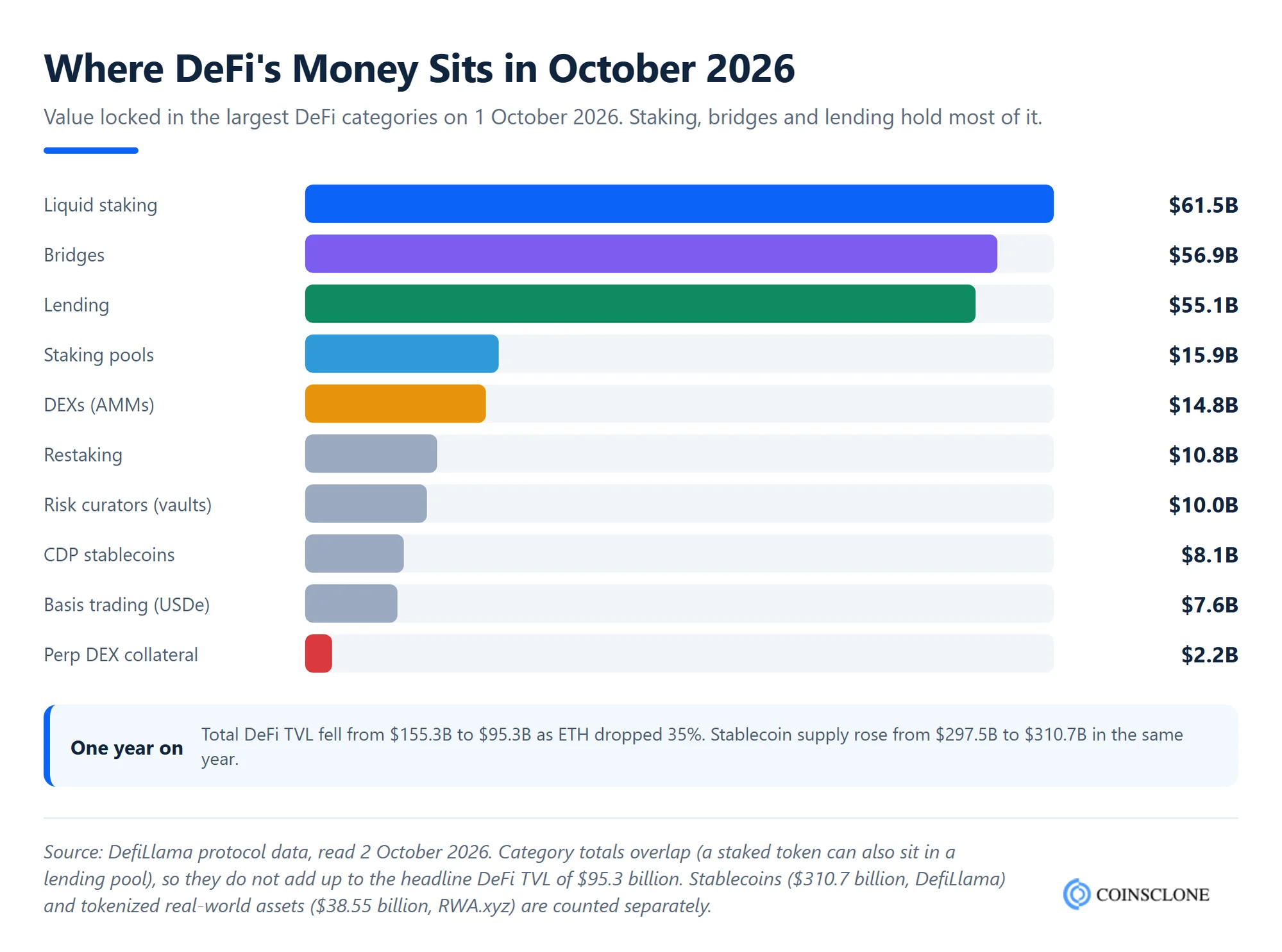
Now, here are the top 10 DeFi trends for 2026. Each one is a market you can study, invest in or build for. For more ways to turn them into a company, see our list of DeFi business ideas.
- Real-World Asset (RWA) Tokenization
- Stablecoins as DeFi’s Base Layer
- Perp DEXs and DeFi Futures
- DEX with AMM Development
- DeFi Lending and Borrowing
- Liquid Staking and Restaking
- On-Chain Prediction Markets
- AI-Powered DeFi Solutions
- Crypto Bridges and Cross-Chain DeFi
- DeFi Wallet Development and Smart Accounts
1. Real-World Asset (RWA) Tokenization
RWA tokenization turns things like US Treasury bills, private loans, gold and shares into tokens on a blockchain. As a result, a bond fund can now be held in a wallet, used as collateral, and moved at any hour. The World Economic Forum calls tokenization a leading trend for 2026.
The numbers back it up. According to RWA.xyz, $38.55 billion of real-world assets were held on public blockchains on 1 October 2026, owned by more than 5 million holders. Funds that hold US Treasury bills are the biggest slice. Meanwhile, DeFi apps are starting to accept these tokens. For example, Aave now lets non-US users borrow USDC against tokenized US stocks on Base.
Why it matters for a startup: issuers earn fees for creating, managing and transferring tokens. However, you need KYC, a legal structure and a custodian, so plan for rules from day one. Our guide to real world asset tokenization explains the full setup.
2. Stablecoins as DeFi’s Base Layer
Stablecoins are tokens pegged to a currency such as the US dollar. They are now the cash of DeFi: traders price in them, lenders lend them, and businesses pay with them. Even as most token prices fell this year, stablecoin supply grew to $310.7 billion, per DefiLlama’s stablecoin tracker.
Two coins lead the market. USDT holds about 59% of supply and USDC about 24%. Next come newer coins, such as Sky’s USDS and Ethena’s USDe, which pays holders from a trading plan. In addition, rules are now clear in the US. The GENIUS Act was signed on 18 July 2025, and regulators are now writing the detailed rules. Full licensing applies from January 2027 at the latest.
Why it matters for a startup: you can issue your own stablecoin, or build payments, savings and lending around existing ones. Clear rules make banks and fintechs far more willing to partner. Learn more in our guide to stablecoin development.
3. Perp DEXs and DeFi Futures
Perpetual futures, or perps, let traders bet on prices with borrowed money and no end date. In the past, only big central exchanges offered them. In 2026, however, on-chain perp exchanges handle billions of dollars a day.
Hyperliquid leads this trend. On 2 October 2026, its public API showed $5.78 billion in daily volume and $12.45 billion in open positions across 234 markets. Over the past year, it earned about $909 million in fees, per DefiLlama. Rivals such as Aster and Lighter are also growing fast, which shows the demand is real.
Why it matters for a startup: a perp DEX earns a small fee on every trade, and trading volume is high even in a weak market. Still, it needs a fast matching engine, reliable price oracles and strong risk controls. Our Hyperliquid clone script gives you a proven starting point.
4. DEX with AMM Development
A decentralized exchange (DEX) lets users swap tokens straight from their wallets. Most DEXs use an automated market maker (AMM), where users trade against a pool of tokens instead of an order book. This keeps trading open even for small, new tokens.
DEXs remain one of DeFi’s busiest products. They handled $3.65 trillion in trades over the past 12 months, with $317 billion in the last 30 days alone, per DefiLlama’s DEX dashboard. Uniswap alone processed $758 billion. In late 2025, Uniswap holders also voted to turn on protocol fees and burn 100 million UNI. That move made “real yield” from fees, not token rewards, the new standard.
Why it matters for a startup: a DEX earns a share of every swap and can add staking, launchpads and token listings. Coinsclone offers decentralized exchange development, with a white label DEX ready in 5 to 7 weeks and a standard build in 10 to 14 weeks.
5. DeFi Lending and Borrowing
DeFi lending and borrowing platforms let users borrow crypto against collateral, with no credit check. Smart contracts set the rates and close risky loans automatically. Lenders earn interest, and borrowers get cash without selling their tokens.
Lending is now one of DeFi’s three biggest sectors, with $55.1 billion locked, per DefiLlama. Aave V3 alone holds about $18.2 billion, and Morpho about $11.2 billion. In addition, Aave launched V4 on Ethereum on 30 March 2026. Its “hub and spoke” design lets one pool of cash feed many separate markets, each with its own risk rules. This makes it easier to lend against new kinds of collateral, including real-world assets.
Why it matters for a startup: lending platforms earn the gap between borrower and lender rates, plus liquidation fees. Careful risk settings matter more than flashy features.
6. Liquid Staking and Restaking
Staking locks tokens to help secure a proof-of-stake network in return for rewards. Liquid staking gives the user a receipt token, such as Lido’s stETH, which they can still trade or lend. In other words, users earn staking rewards and keep their money working.
This is now the largest category in DeFi, with $61.5 billion locked, per DefiLlama. Lido alone holds about $26.6 billion. Restaking goes one step further. It reuses staked ETH to secure other services. Restaking holds another $10.8 billion. EigenCloud, once called EigenLayer, is the leader.
Why it matters for a startup: staking platforms earn a share of rewards. They also pair well with wallets and lending apps. Explore our DeFi staking platform development to launch one.
7. On-Chain Prediction Markets
Prediction markets let people trade on the outcome of real events, such as elections, sports and the news. Prices show what the crowd thinks will happen. Polymarket runs on-chain with stablecoins, while Kalshi is a US exchange under CFTC rules.
Growth this year has been huge. Combined monthly volume on Kalshi and Polymarket rose from $4.5 billion in September 2025 to $53 billion in July 2026, per Pew Research Center. Sports, led by the FIFA World Cup, drove most of the jump.
Why it matters for a startup: prediction markets earn trading fees and attract users who may never have touched DeFi before. To launch one, start with our Polymarket clone script.
8. AI-Powered DeFi Solutions
AI is moving from chatbots into DeFi itself. AI agents can now hold a wallet, watch prices, move funds between pools and pay for services on their own. Coinbase’s x402 standard, launched in May 2025, gives these agents a simple way to pay each other in stablecoins.
So far, most real use is plain rather than flashy. Common uses include trading bots, yield tools, risk alerts and fraud checks. There is no reliable public count of how much DeFi volume comes from AI agents yet, so treat bold claims with care.
Why it matters for a startup: adding AI to a wallet or trading app can be a strong selling point. But an agent that can move funds is also a new risk, so set limits and sign-offs.
9. Crypto Bridges and Cross-Chain DeFi
Crypto bridges move tokens from one chain to another, such as from Ethereum to Solana. Without them, money stays stuck on one chain. As a result, bridges hold $56.9 billion in DeFi, per DefiLlama, and newer tools hide the bridge step completely so users just pick a token and a chain.
Bridges are also DeFi’s weakest link. In 2026 so far, attackers took about $700 million through bridge and cross-chain flaws. This includes $293 million from Kelp in April and $320 million from Liquid Network in September, per the DefiLlama hacks list.
Why it matters for a startup: cross-chain swaps and transfers are in high demand. Use well-audited messaging layers and add limits on how much can move at once. A cross-chain DEX is one way to offer this to users.
10. DeFi Wallet Development and Smart Accounts
DeFi wallets let users hold their own keys and use DeFi apps directly. In 2026, the wallet is also becoming the main home for every other trend. Users swap, stake, bridge and borrow without leaving it.
Wallets are also getting smarter. Ethereum’s Pectra upgrade in May 2025 added EIP-7702, which lets a normal wallet act like a smart account. That means users can pay gas in stablecoins, bundle steps into one click and set spending limits. As a result, DeFi finally feels closer to a banking app.
Why it matters for a startup: DeFi wallet development lets you earn swap, bridge and staking fees while owning the user relationship. A white label wallet can go live in 3 to 5 weeks, and a custom wallet in 8 to 12 weeks.
DeFi Trends That Cooled Off in 2026
Not every trend from past years kept its promise. These three still have a place, but the hype has faded, so plan around real demand.
Blockchain Gaming (GameFi)
Play-to-earn games mixed gaming with token rewards. Most failed because players wanted fun, not jobs. More than 90% of Web3 games have failed, per Caladan research cited by CoinDesk in April 2026. Even DappRadar, a well-known tracker of these games, shut down in late 2025. Today, the games that survive put gameplay first and keep tokens in the background. If you still want to enter this space, our GameFi clone script helps you test an idea fast and at low cost.
DeFi-Integrated NFT Marketplaces
NFT markets with built-in lending, staking and shared ownership looked like the next big thing. But NFT sales fell 37% in 2025 to $5.63 billion, per CryptoSlam. A DeFi integrated white label NFT marketplace still works for clear uses, such as tickets, game items or art, where buyers want real use.
Central Bank Digital Currencies (CBDCs)
CBDCs are digital cash issued by a central bank. They are not DeFi, since a central bank controls them. Their path also differs by region. In the US, a White House order in 2025 bans a US CBDC. In Europe, Parliament backed the digital euro law in June 2026, and the ECB aims for a pilot in 2027. For most startups, stablecoins are the better bet.
What Is Driving the Future of Decentralized Finance
Three forces explain why DeFi trends look the way they do in 2026. Together, they point to slower but steadier growth.
- Clearer rules: the GENIUS Act gives US stablecoins a legal home, and the EU’s MiCA rules apply in full after the transition period ended on 1 July 2026. In contrast, the US market structure bill (the CLARITY Act) stalled after a 49 to 50 Senate vote on 15 September 2026, per Congress.gov records and press reports.
- Big money moving on-chain: fund managers issue tokenized funds, and banks now pay with stablecoins. This brings large, patient money into DeFi.
- Real yield over hype: protocols now pay users from fees and interest, not freshly printed tokens. Uniswap’s fee switch and Hyperliquid’s fee income show this shift.
Risks to Watch Before You Build
Every trend above carries risk, and 2026 has been a costly year. DefiLlama logged 285 hacks worth $2.24 billion between 1 January and 1 October. Most losses came from stolen keys, admin rights and bridges, not from clever code bugs.
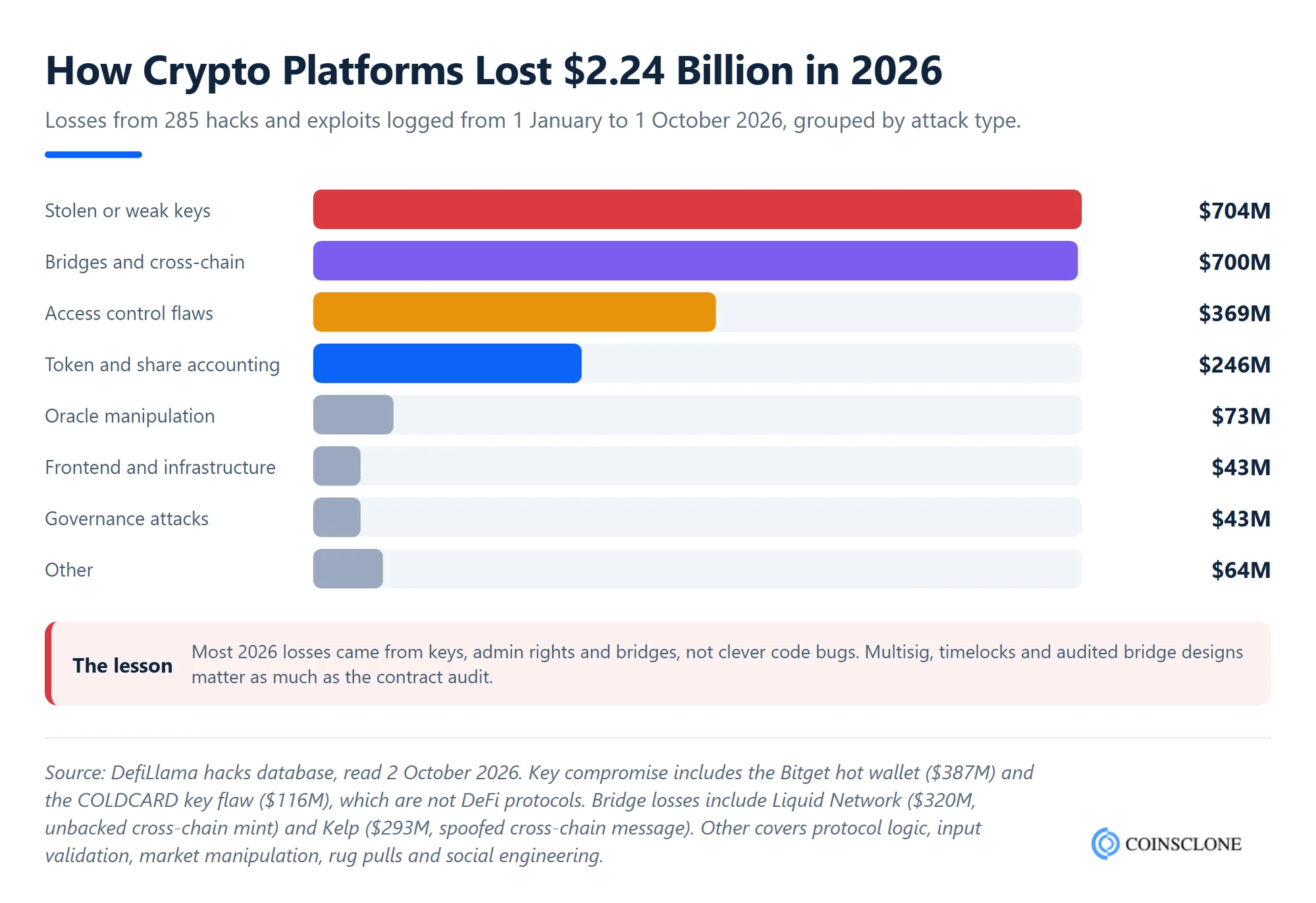
The main risks to plan for are:
- Key and admin risk: use multisig wallets, time delays and hardware keys for any key that can move funds or upgrade contracts.
- Smart contract risk: get at least one independent audit, and run a bug bounty after launch.
- Oracle risk: use more than one price source so attackers cannot fake a price.
- Bridge risk: cap how much value can cross a bridge at once.
- Legal risk: check local laws on KYC, stablecoins and securities before launch, most of all for RWAs.
Benefits of Building a DeFi Platform
From a business view, building a secure DeFi platform is more than chasing a trend. It is a path to trust, steady income and new ideas. Here are the main benefits for startups and firms.
Improved Security
DeFi platforms run on blockchain and smart contracts, so trades, loans and staking are open and easy to check. With strong encryption, audits and safe key handling, you give users a reliable place to manage their money. That trust supports every trend on this list.
Rules Built In and Global Reach
DeFi runs on open networks, but planning for the rules still pays off. A platform built with KYC options, clear terms and local licences can enter more markets and work with banks. In short, compliance turns into a growth tool.
User-Centric Experience
One goal of decentralized finance is to make financial services simple and open to all. A clean design helps both new users and expert traders use the platform with ease. As a result, more users stay and come back.
Data-Driven Market Response
DeFi platforms can use real-time on-chain data to spot market shifts early. This lets you adjust fees, add assets or change risk settings before rivals do. Over time, that speed builds a name for reliability.
Technical Strength and Scale
Modern DeFi platforms use proven tech stacks to support deep liquidity, high traffic and cross-chain features. With a forward-looking design, your platform can grow with demand and add new protocols without a rebuild.
These benefits make a DeFi build a smart move today. Still, it takes skill, planning and a good partner to get them. A skilled DeFi partner helps you build fast and keep up as the market shifts.
How to Start with Your Dream DeFi Trend
Successful DeFi businesses start with one clear choice: which trend fits your skills, your users and your budget. For example, a DEX gains a lot from having its own DeFi wallet, because the wallet brings users straight to the exchange. Use the decision tree below to find your best fit.
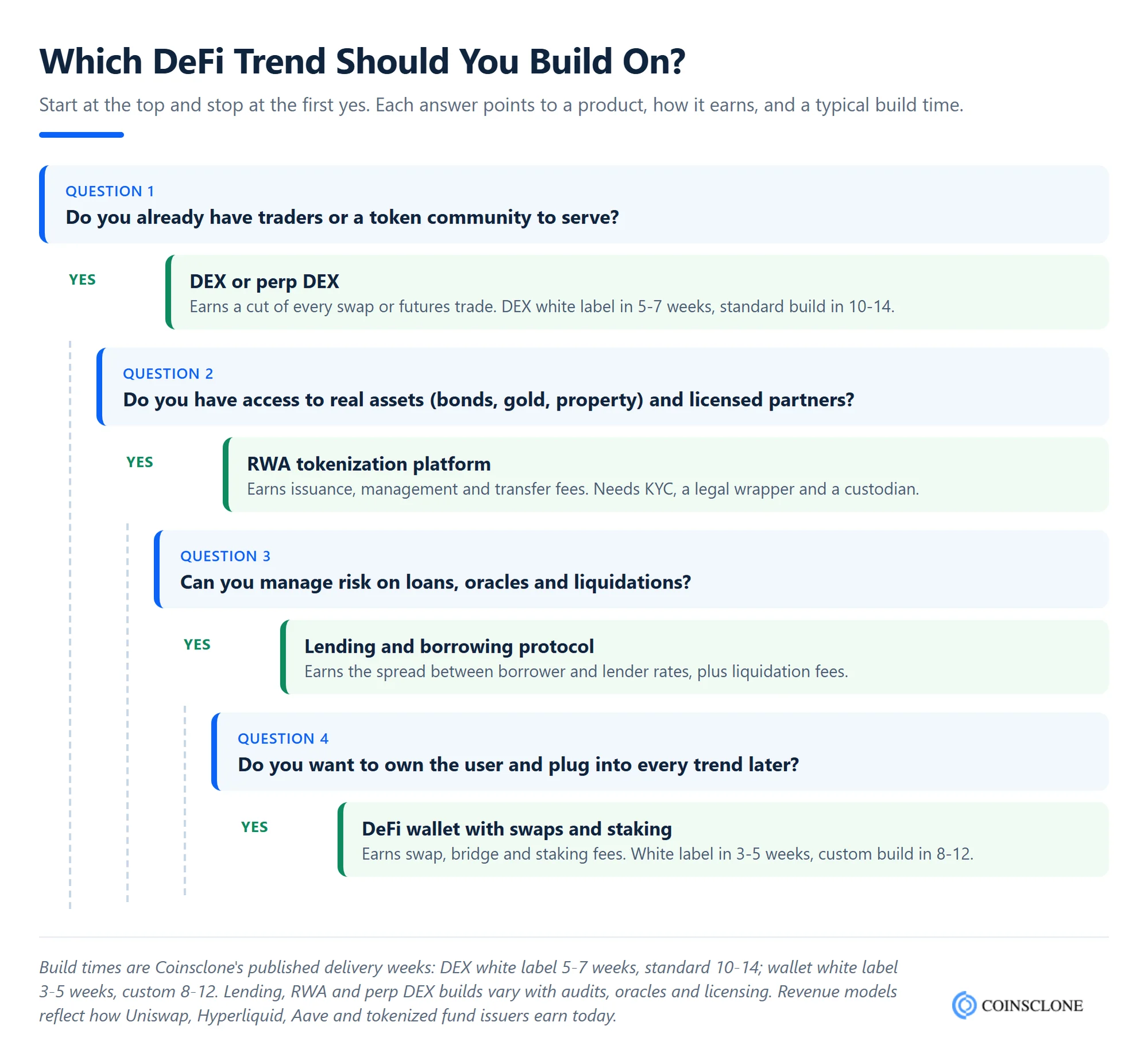
Once you pick a trend, follow these steps:
- Check demand: look at live data on DefiLlama or RWA.xyz to confirm users and money are there.
- Pick your chain: Ethereum still holds about 56% of DeFi TVL, while Solana, Base and BNB Chain offer lower fees.
- Choose your build route: a white label product launches in weeks, while a custom build takes a few months but gives you full control.
- Plan security and rules: budget for audits, key management and legal advice before launch.
- Launch and grow liquidity: seed pools, partner with market makers and reward early users.
Coinsclone is a trusted DeFi development company. Since 2018, our team has built 350+ platforms for 200+ clients across 20 industries. We build DEXs, perp DEXs, lending platforms, staking apps, RWA platforms and DeFi wallets, so you can launch on the trend that fits your goals.
Frequently Asked Questions
Does DeFi have a future?
Yes. DeFi is moving from hype to real use. TVL fell over the past year because token prices dropped, but stablecoin supply hit $310.7 billion and tokenized real-world assets reached $38.55 billion in October 2026. Clearer rules in the US and EU are also drawing banks and asset managers in.
What are the biggest DeFi trends in 2026?
The two biggest DeFi trends in 2026 are RWA tokenization and stablecoins. They are followed by perp DEXs, AMM DEXs, lending, staking, prediction markets, AI agents, bridges and smart wallets. RWAs and stablecoins are growing fastest in real money.
What are the top 10 DeFi tokens?
By market value on CoinGecko in October 2026, the largest DeFi tokens include Lido Staked Ether (stETH), Hyperliquid (HYPE), Chainlink (LINK), Uniswap (UNI), Dai (DAI), Pump.fun (PUMP), Aave (AAVE), Ethena (ENA), Ondo (ONDO) and Aster (ASTER). Rankings change often, and this is not investment advice, so always do your own research.
Is XRP considered DeFi?
XRP itself is mainly a payments token, not a DeFi protocol. However, the XRP Ledger has a built-in exchange and AMM pools, so some DeFi runs on it. Its DeFi use is still small: about $45 million in TVL per DefiLlama, versus $53.7 billion on Ethereum.
See How Our MVP System Can Help You Stay Ahead of Top DeFi Trends
Top DeFi Trends — shaping the future of decentralized innovation.
- MVP System : Build trend-driven DeFi products 90% faster.
- DeFi-Ready Modules : LSDfi, RWA, cross-chain, AI-driven yields.
- Brand & Customization : Adapt fast to market shifts and token strategies.
- Revenue Engine : Turn DeFi trends into scalable, profitable platforms.
Get a free trend-based DeFi strategy demo in just 48 hours — before making a move.
Book a Free Demo to stay ahead of top DeFi trends and launch future-ready products in 8–12 weeks.