
A peer-to-peer crypto exchange lets two people trade crypto with each other directly. One person posts an ad, the other accepts it, and the money moves straight between their bank or wallet apps. The platform does not set the price or take the other side of the trade. Instead, it locks the seller’s coins in escrow until the buyer’s payment arrives. That simple design is why P2P markets thrive where banks block exchanges, and why Binance alone supports more than 1,000 payment methods on its P2P desk.
This guide explains how a P2P trade works from the first ad to the final release, how escrow keeps both sides honest, and what it really costs on the big platforms in 2026. You will also see the risks most guides skip, the rules that now apply to P2P operators, and how the people who run these platforms make money.
In this guide:
- A step-by-step view of one P2P trade, including what happens in a dispute.
- The three escrow designs, and who can move the locked coins in each.
- Real 2026 fees on Binance, OKX, Bybit, KuCoin, RoboSats, Bisq and Hodl Hodl.
- The scams and bank freezes P2P traders face, and how to avoid them.
- How a P2P exchange earns revenue, and what launching one involves.
Launch Your Peer-to-Peer Crypto Exchange — Faster Than Ever!
Build a secure, scalable P2P Crypto Exchange that connects traders directly — no middlemen.
- Lightning-Fast MVP : Go live 90% faster than building from scratch
- Plug-and-Play Liquidity & Wallets : Built-in crypto escrow and multi-wallet system.
- Global Trading Freedom : Enable crypto-to-crypto and fiat-to-crypto swaps worldwide.
- Monetize Seamlessly: Earn from trading fees, listings, and staking from day one
See Your Branded Demo in 48 Hours — risk-free, no investment upfront.
Book Your Free Demo Now and turn your P2P crypto exchange idea into reality in 8 – 12 weeks.
What Is a Peer-to-Peer Crypto Exchange and How Does It Work?
A peer-to-peer (P2P) crypto exchange is a marketplace where users buy and sell crypto directly with each other. Sellers create ads that list their price, the coin, the payment methods they accept and their trade limits. Buyers browse the ads and pick one that suits them. Because ads drive every trade, these platforms are often called ad-based exchanges.
The platform’s main job is trust. It checks users, holds the seller’s crypto in escrow during the trade, runs a chat between the two sides, and steps in when something goes wrong. Payment itself happens outside the platform, by bank transfer, UPI, mobile money, PayPal or even cash.
Paxful was the best-known example of this model for a decade. It served 14 million users in more than 140 countries before it wound down on 1 November 2025, citing past misconduct by its founders and the cost of fixing its compliance. The model itself lives on: Binance, OKX, Bybit and KuCoin all run large P2P desks, and many startups still launch with a Paxful clone script built with the compliance tools Paxful lacked.
How a P2P Trade Works, Step by Step
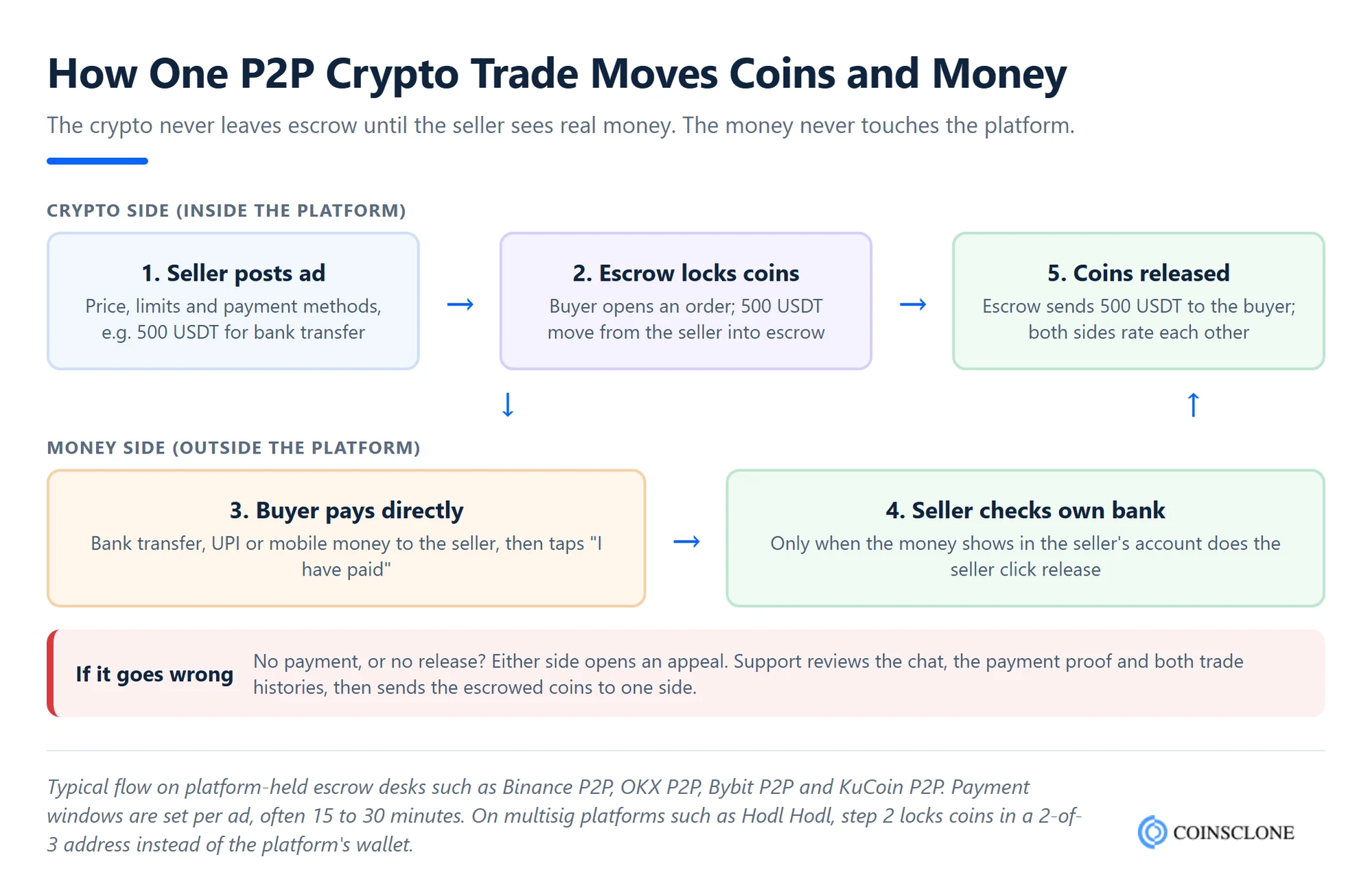
Here is what happens when someone buys USDT on a typical P2P desk:
- Seller posts an ad: The seller sets a price, a minimum and maximum order size, and the payment methods they accept.
- Buyer opens an order: The buyer picks the ad and enters an amount. At once, the platform moves that amount of the seller’s crypto into escrow.
- Buyer pays off-platform: The buyer sends money to the seller’s bank or wallet app within a set time window, then taps “I have paid”.
- Seller confirms and releases: The seller checks that the money has truly arrived in their own account, then releases the crypto.
- Escrow pays out: The coins move from escrow to the buyer’s wallet, and both users rate each other.
If the seller does not release, or the buyer never pays, either side can open an appeal. A support agent then reviews the chat, the payment proof and both users’ history before deciding who gets the coins.
How Escrow Works on a P2P Exchange
Escrow is the heart of every P2P platform. It solves the oldest problem in trading with strangers: who goes first? In a P2P trade, the seller’s coins are locked before the buyer pays, so the seller cannot take the money and vanish. Likewise, the buyer cannot get the coins without paying, because only the seller (or a judge) can release them.
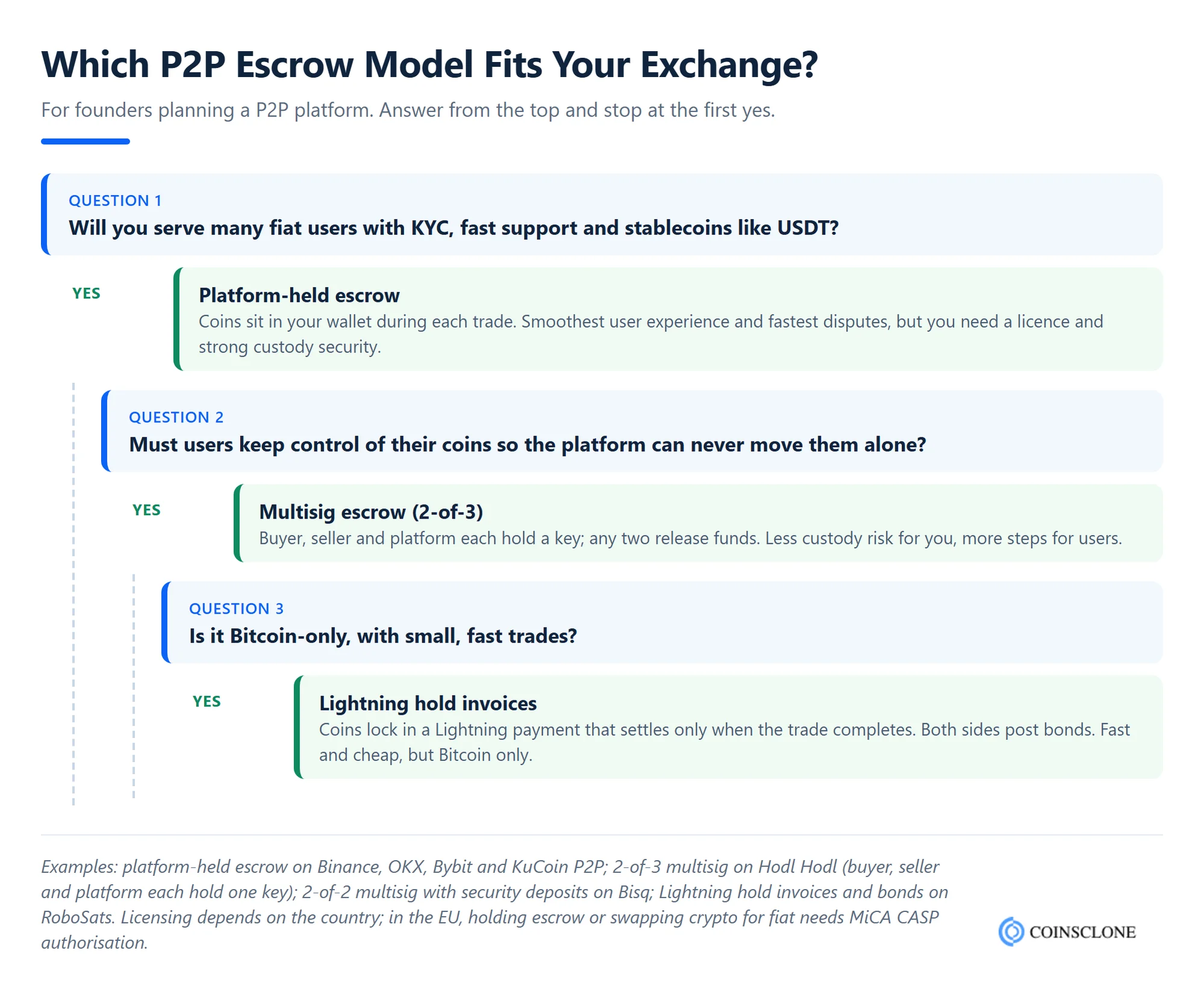
Platforms build this lock in three main ways:
- Platform-held escrow: The exchange moves the seller’s coins into its own wallet for the length of the trade. Binance, OKX, Bybit and KuCoin work this way. It is fast and easy to use, but users must trust the platform with their coins.
- Multisig escrow: The coins sit in a shared address that needs two of three keys to move. Hodl Hodl gives one key each to the buyer, the seller and itself, so the platform can never move funds on its own. Bisq uses a 2-of-2 design, and both traders put down a deposit.
- Lightning hold invoices: RoboSats locks the seller’s bitcoin in a Lightning payment that only settles when the trade completes. Both sides also post a small bond, which they lose if they cheat.
For a founder, this choice shapes everything else: licensing, user experience and how disputes get settled. If you are weighing it up, our guide to crypto escrow explains each design in more depth.
P2P Exchange vs Order-Book Exchange vs DEX
Knowing how a P2P exchange differs from other types of exchange helps both traders and founders choose the right one. Here is a quick comparison.
| P2P exchange | Order-book exchange (CEX) | DEX | |
| Who sets the price | The two traders | The order book and matching engine | A formula or on-chain order book |
| Fiat money | Paid directly between users | Deposited into the exchange | Not supported; crypto only |
| Who holds funds | Escrow, only during the trade | The exchange, all the time | The user’s own wallet |
| Speed | Minutes, set by the payment | Instant | One block |
| Fees | Often zero for takers | Maker and taker fees | Swap fee plus gas |
| Main risk | Payment fraud | Exchange hack or failure | Smart contract bugs |
Third-party role: On an order-book exchange, the platform sits in the middle of every trade. It holds your deposit and matches your order with someone else’s. On a P2P exchange, users deal with each other, and the platform only provides escrow, chat and dispute handling.
Fee structure: Order-book exchanges charge a fee on every trade. By contrast, many P2P desks charge takers nothing and earn a small fee from the advertisers who post ads.
Trading method: Order-book exchanges use a matching engine with limit, market and stop orders, plus live price charts. P2P exchanges have no matching engine. Users pick an ad, and in some cases agree on terms in chat.
A DEX is a third model again. It swaps one token for another through smart contracts, but it cannot move dollars or rupees. That is why P2P desks remain the main way to turn local cash into crypto in many countries.
Advantages of a Peer-to-Peer Crypto Exchange
P2P crypto exchanges offer clear benefits for users. Let’s look at the main ones.
Lower Trading Charges
On most big P2P desks, the person who accepts an ad pays no platform fee. OKX and KuCoin charge no P2P fees at all. Binance charges only the advertiser, and only in some currencies. Bybit is free in most currencies and charges small fees in a few. The fees section below shows the exact numbers.
Safer Than Trading With Strangers Directly
Escrow, identity checks and seller ratings turn a risky deal with a stranger into a protected trade. Funds sit with the platform only for the few minutes a trade takes, not for months. Non-custodial P2P platforms go further, because they never hold user coins at all.
Wider Access Where Banks Block Exchanges
Because money moves between users’ own bank or wallet apps, P2P works even where banks refuse to deal with crypto exchanges. As a result, P2P desks are a key on-ramp in parts of Africa, Latin America and Asia. Note that this is not the same as being outside the law. P2P operators must follow anti-money-laundering rules like any other exchange, as the rules section explains.
Many Payment Methods
P2P desks support far more ways to pay than any order-book exchange. Binance P2P lists over 1,000 payment methods and 100+ fiat currencies, and OKX lists more than 900 methods. Buyers can pay with the app they already use every day.
Freedom to Choose Coins and Prices
Users are not limited to Bitcoin. Most desks support USDT, USDC, BTC, ETH and other major coins, and stablecoins now make up much of the volume. Sellers also set their own prices, so a buyer can shop around for the best rate.
Local Liquidity
P2P markets pool demand from thousands of local buyers and sellers. On a popular desk, you can usually find an ad for common amounts in your own currency within seconds. That said, liquidity is thinner for large trades and smaller currencies, which leads to the risks below.
Risks and Drawbacks of P2P Crypto Trading
P2P trading has real downsides that many guides leave out. Knowing them is the best way to avoid them.
- Fake payment proofs: Scammers send edited screenshots of a bank transfer and push the seller to release fast. The fix is simple: only release after the money shows up in your own account.
- Chargebacks: Some payment methods, such as PayPal or card-linked apps, let the payer reverse a payment days later. The seller then loses both the coins and the money.
- Bank account freezes: A scammer can trick a fraud victim into paying a P2P seller directly. The seller releases the coins in good faith, and then the victim’s complaint gets the seller’s bank account frozen. In India, police can order such freezes under Section 106 of the BNSS, and banks often freeze the whole account, not just the disputed sum.
- Slower trades: A P2P trade waits on a bank transfer and a human click. It can take 5 to 30 minutes, while an order-book trade fills at once.
- Price premium: Sellers set their own prices, and P2P rates often sit above the market price, most of all in small or volatile currencies. So a zero-fee trade can still cost more than a normal exchange.
- Thin liquidity for big trades: Large orders may need several ads from several sellers, each with its own limits.
How to Trade Safely on a P2P Exchange
A few habits prevent most problems:
- Trade only with verified advertisers who have many completed trades and high ratings.
- Never release crypto until the payment shows in your own bank or wallet app.
- Keep every message inside the platform’s chat, because support cannot see outside messages.
- Check that the payer’s name matches the name on the buyer’s account.
- Avoid payment methods that allow chargebacks unless you know the buyer.
- Keep records of every trade for tax and for any bank questions later.
P2P Crypto Exchange Fees Compared (2026)
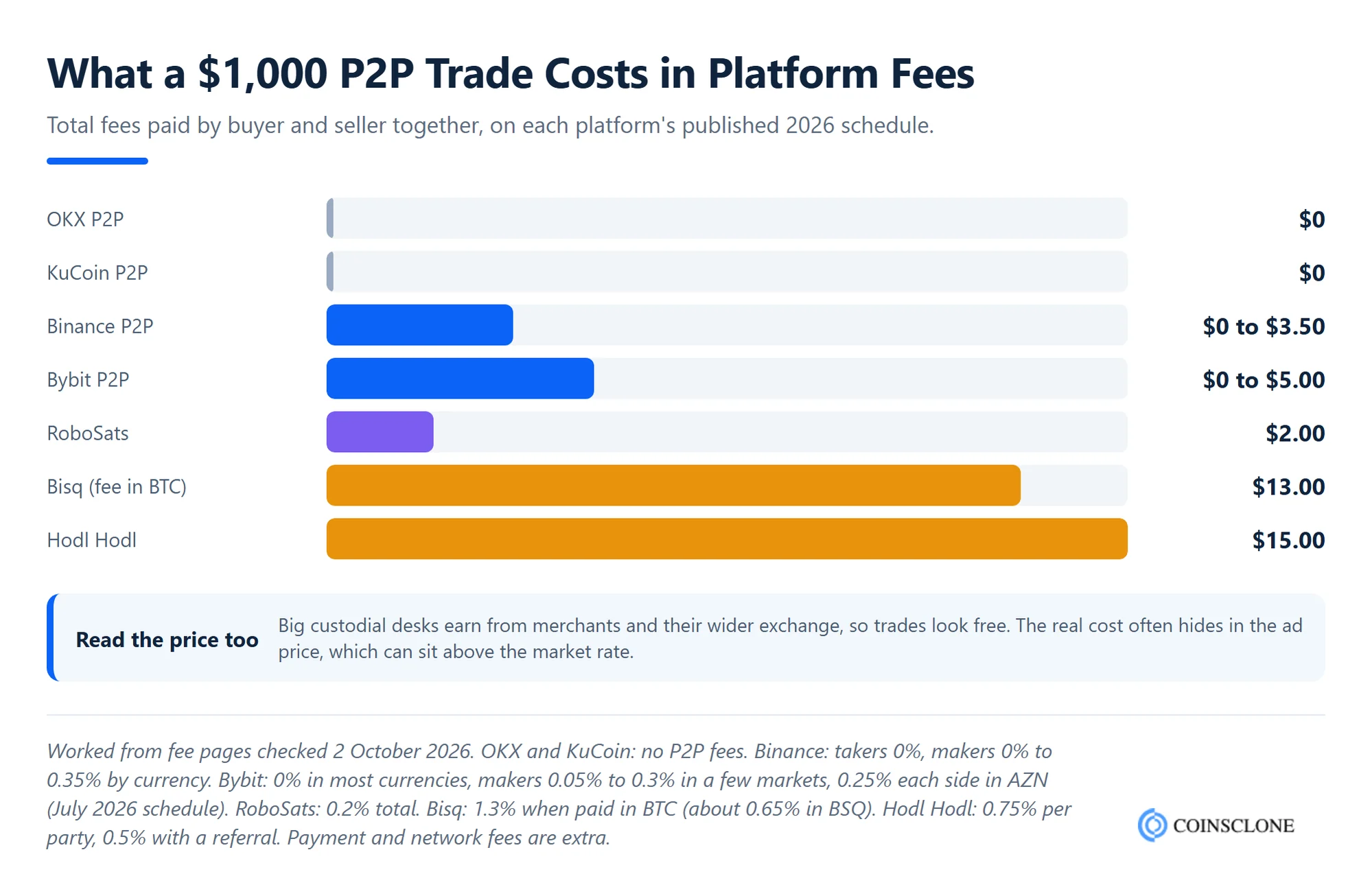
Fees vary a lot between platforms, and the headline “zero fee” often applies only to one side. Here are the published rates as of October 2026.
| Platform | Escrow type | Taker fee | Maker (advertiser) fee |
| Binance P2P | Platform-held | 0% | 0% to 0.35%, by currency |
| OKX P2P | Platform-held | 0% | 0% |
| Bybit P2P | Platform-held | 0% in most currencies; 0.25% in AZN | 0% in most; 0.05% to 0.3% in a few markets |
| KuCoin P2P | Platform-held | 0% | 0% |
| RoboSats | Lightning hold invoice | 0.175% | 0.025% |
| Bisq (fee paid in BTC) | 2-of-2 multisig | 1.15% | 0.15% |
| Hodl Hodl | 2-of-3 multisig | 0.75% per party | 0.75% per party |
Sources: Binance P2P maker fee notice, OKX P2P markets, Bybit P2P fee schedule (updated July 2026), KuCoin P2P support, RoboSats docs, Bisq wiki and the Hodl Hodl FAQ. Payment providers and blockchains may add their own charges.
The pattern is clear. Large custodial desks keep fees near zero to win users, and they earn from merchant programs and their wider exchange. Non-custodial platforms charge more per trade, because the fee is their main income and they skip identity checks.
Features of a Peer-to-Peer Crypto Exchange
When users explore a crypto exchange, its features are often the first thing they judge. A well-built P2P exchange includes these features:
- Escrow service: Locks the seller’s crypto until the buyer’s payment is confirmed.
- Ad listings: Let users post and filter buy and sell offers for Bitcoin, USDT and other coins.
- Multi-language support: Serves users in their own language, which matters for local markets.
- Dispute management: Gives support staff the chat logs, payment proofs and tools to settle appeals.
- Multiple payment methods: Bank transfer, UPI, mobile money, PayPal and cash options per country.
- API access: Lets large merchants manage ads and orders with their own software.
- User dashboard: Shows open orders, trade history, ratings and limits in one place.
- Automatic KYC/AML checks: Confirms who each user is and screens them against sanctions lists.
- Built-in wallets: Hold users’ coins between trades, with hot and cold storage.
- Clear pricing: Shows fees and the final amount before a user confirms a trade.
- Referral program: Rewards users who invite new traders.
- Merchant program: Gives high-volume advertisers badges, higher limits and lower fees.
Having covered the features, let’s look at the platforms that lead P2P trading in 2026.
Top P2P Crypto Exchanges To Know in 2026
There are several P2P exchanges in the industry, but only a few have earned a strong name. Here are the popular ones in 2026:
- Binance P2P: The largest P2P desk, launched in 2019, with 1,000+ payment methods, 100+ fiat currencies and zero taker fees.
- OKX P2P: Zero fees for both sides, 900+ local payment methods and 100+ currencies.
- Bybit P2P: Popular with traders worldwide; zero fees in most currencies, with small fees in a few markets.
- KuCoin P2P: Zero transaction fees and many local payment methods, built into its “Buy Crypto” flow.
- Hodl Hodl, Bisq and RoboSats: Bitcoin-focused, non-custodial P2P platforms for users who want to keep control of their own coins.
Two once-famous names are gone. LocalBitcoins closed in 2023, and Paxful shut down in November 2025.
Choosing the right platform requires proper comparison. Explore our detailed breakdown of the Top 10 P2P Crypto Exchanges for 2026.
Is P2P Crypto Trading Legal? The Rules in 2026
P2P trading is legal in most countries, but P2P platforms are not above the law. Older articles, including an earlier version of this one, claimed P2P exchanges sit outside government rules. That is not true, and the Paxful case shows why.
- United States: In February 2026, a US court ordered Paxful to pay a $4 million fine. It had run an unlicensed money business and lacked proper anti-money-laundering checks. The Justice Department said the right penalty was $112.5 million but cut it based on Paxful’s ability to pay. A P2P platform that serves US users must register with FinCEN and run full KYC and AML checks.
- European Union: Under MiCA, a platform that holds escrow or swaps crypto for money needs a crypto-asset service provider (CASP) licence. The grace period for older firms ended on 1 July 2026, so every EU state now enforces it. Our guide to a MiCA-compliant crypto exchange covers the steps.
- India: Exchanges that serve Indian users, including P2P desks, must register with FIU-IND. In addition, a 1% TDS applies to crypto transfers, and in a P2P trade the buyer is usually the one who must deduct it.
In short, users can trade P2P legally, but operators need the right licence, ID checks and trade monitoring from day one.
How Peer-to-Peer Crypto Exchanges Generate Revenue
Peer-to-peer crypto exchanges have several ways to make money, and many founders do not know them all. The more users join the platform, the higher the liquidity, which in turn lifts revenue. Once users trust the platform, the owner can earn in the following ways.
Trading Fees
This is the main income for most P2P exchanges. Users, usually the advertisers, pay a small share of each completed trade. Rates on the big desks run from 0% to about 0.35% per trade, as the fee table shows.
Withdrawal Fees
Startups can charge a fee when users withdraw crypto to an outside wallet. Most platforms set it close to the network fee plus a small margin.
Listing Fees
Advertisers who want their sell or buy ads featured at the top of the list can pay a listing fee. The admin can also use this to make sure only trusted sellers get top spots.
Merchant and Premium Plans
High-volume merchants often pay for verified badges, higher limits, lower fees and faster support. Users can also subscribe to premium features such as advanced security tools and plugins.
Margin Trading Fees
If the P2P desk sits inside a wider exchange, users can also buy and sell cryptocurrencies with margin. Users borrow funds to trade bigger positions, and the platform earns interest and fees on those loans.
Token Launch (IEO) Fees
Startups that want to sell their tokens through the exchange can pay for an Initial Exchange Offering. The platform charges for listing, promotion and project checks.
Trading Bots
Some P2P exchanges offer automatic trading bots that help beginners manage risk. Users pay a small fee to use them.
All these fees are direct income. Beyond them, a P2P exchange with a strong name can add new products, such as a spot market or a card, and earn from those too. This is why P2P crypto exchange development remains one of the smarter business ideas in crypto.
Coinsclone builds P2P exchanges with escrow, dispute tools, KYC/AML and local payment rails built in. A white label P2P platform launches in 4 to 8 weeks, a standard build takes 8 to 12 weeks, and a fully custom build takes 12 to 16 weeks.
Final Insights
On the whole, peer-to-peer crypto exchanges remain one of the most used ways to turn local money into crypto, especially where banks and card networks fall short. For users, the key is to trade with verified sellers and never release coins before the money lands. For founders, the lesson of 2025 and 2026 is just as clear: fees and features win users, but compliance keeps the doors open.
If you’re an entrepreneur planning to start a P2P crypto exchange on a limited budget, a ready-made P2P crypto exchange script is the fastest route. It’s pre-built software for peer-to-peer trading that you can brand, set up for your market and launch quickly.
Frequently Asked Questions
Is a peer-to-peer crypto exchange safe?
Yes, P2P exchanges are generally safe when you use a well-known platform with escrow, identity checks and seller ratings. Most losses come from payment fraud, such as fake payment screenshots or chargebacks. So, only release crypto once the money is in your own account, and keep all chats on the platform.
How does P2P crypto trading work?
A seller posts an ad with a price and payment methods. A buyer opens an order, and the platform locks the seller’s crypto in escrow. The buyer then pays the seller directly, the seller confirms the payment, and the platform releases the crypto to the buyer.
What types of cryptocurrencies can be traded on a P2P platform?
Most P2P desks support USDT, USDC, Bitcoin, Ethereum and other major coins, along with local fiat currencies. Stablecoins such as USDT are the most traded. Non-custodial platforms such as Bisq, Hodl Hodl and RoboSats focus mainly on Bitcoin.
Is P2P crypto trading legal?
P2P trading is legal for users in most countries, but the platforms that run it must follow money-laundering rules. In the US they register with FinCEN, in the EU they need a MiCA CASP licence, and in India they register with FIU-IND. Always check the rules in your own country, including tax.
How do you make money from P2P crypto?
Traders earn by buying at one price and selling at a slightly higher one, often as verified merchants who post ads. Platform owners earn from trading fees, withdrawal fees, featured listings, merchant plans and extra services such as margin trading.
How much does it cost to build a peer-to-peer crypto exchange?
The cost depends on the route you choose, the features you need and the markets you serve. A white label script costs far less than a custom build, while licensing, KYC services and security audits add to the budget. For a full breakdown of features, steps and budget, see our guide on how to start a P2P crypto exchange.
How to start a P2P crypto exchange?
Launching a P2P crypto exchange takes a clear plan that covers research, legal rules, the build, liquidity and security.
- Research the market: Decide your target users, supported coins, payment methods and revenue model.
- Handle legal needs: Get the right licence for your market and set up strong KYC/AML checks.
- Choose a build method: Build from scratch, or use a ready-made P2P exchange script to launch faster.
- Add core features: Include escrow, wallets, payments, dispute handling and admin controls.
- Test and launch: Test security, tune performance, and launch with a clear marketing plan.
What security measures do peer-to-peer crypto exchanges use?
The key safety tools are escrow, multisig wallets, encryption, two-factor login, KYC checks and fraud alerts. Good platforms also use cold storage for most user funds and trade limits for new accounts.
What are the risks of running a P2P crypto exchange?
The main risks for an operator are payment fraud, user disputes, regulatory action and cyber attacks. Paxful’s 2025 shutdown and 2026 criminal penalty show that weak AML controls can end a business, so compliance belongs in the plan from day one.
How long does it take to launch a peer-to-peer exchange?
With Coinsclone, a white label P2P exchange takes 4 to 8 weeks, a standard build 8 to 12 weeks, and a custom build 12 to 16 weeks. Mobile apps, extra payment rails and licensing can add time.
Launch Your Peer-to-Peer Crypto Exchange — Faster Than Ever!
Build a secure, scalable P2P Crypto Exchange that connects traders directly — no middlemen.
- Lightning-Fast MVP : Go live 90% faster than building from scratch
- Plug-and-Play Liquidity & Wallets : Built-in crypto escrow and multi-wallet system.
- Global Trading Freedom : Enable crypto-to-crypto and fiat-to-crypto swaps worldwide.
- Monetize Seamlessly: Earn from trading fees, listings, and staking from day one
See Your Branded Demo in 48 Hours — risk-free, no investment upfront.
Book Your Free Demo Now and turn your P2P crypto exchange idea into reality in 8 – 12 weeks.