
Two strangers want to trade. One has Bitcoin. The other has cash in a bank account. Neither wants to go first, because whoever sends first can be robbed.
Crypto escrow solves that problem. A neutral party, or a piece of code, holds the coins until both sides keep their promise. It is the reason millions of people can buy crypto from someone they have never met.
Scams make the need clear. The FBI’s 2025 Internet Crime Report logged $11.4 billion in crypto losses across 181,565 complaints, up 22% in a year. Many of those losses began with a trade where one side paid first.
This guide explains how crypto escrow works, the four ways to build it, what escrow services charge, the licence rules, and how to start an escrow business of your own.
What Is Crypto Escrow?
Crypto escrow is a setup where coins are locked until a deal is done. The seller’s crypto goes into a locked wallet. The buyer pays. Once the payment is confirmed, the coins go to the buyer. If the deal falls apart, the coins go back to the seller.
The holder of the coins can be one of three things:
- A platform: an exchange such as Binance P2P holds the coins in its own wallet.
- Shared keys: a multisig wallet where no single person can move the coins.
- Code: a smart contract that releases funds when set rules are met.
Escrow is not new. Banks and law firms have used it for property deals for a century. What is new is that crypto escrow can run with no bank at all, and sometimes with no company holding the funds.
How Does Crypto Escrow Work on a P2P Exchange?
Most people meet crypto escrow on a P2P exchange. The steps are much the same on every big platform:
- The order opens. A buyer picks a seller’s ad. The seller’s crypto moves into escrow at once.
- The buyer pays. The buyer sends cash by bank transfer, mobile money or another method outside the platform.
- The seller checks. The seller confirms the money has reached their account.
- The coins are released. The seller clicks release and escrow sends the crypto to the buyer.
- Or the deal fails. If the buyer does not pay before the timer runs out, the coins go back to the seller.
Disputes are where the platforms differ. Each one runs an appeal desk:
- Binance P2P: if a buyer paid by instant transfer and the seller has not released within 15 minutes, Binance can release the coins by hand. For slower payments the window is two working days.
- Bybit P2P: users can appeal for five days after an order opens. A normal appeal is judged within 48 hours, and a fast-track option for USDT takes about 15 minutes.
- OKX P2P: users file an appeal with proof, and the coins stay frozen until it is settled.
This model is simple for users, which is why it dominates. But it asks you to trust the platform, because the platform holds the coins. If you want to build this kind of platform, our guide on how to start a P2P crypto exchange covers the full setup.
The Four Ways to Build Crypto Escrow
There is more than one way to lock coins. Each model trades off ease, trust and legal load.
| Model | Who holds the coins | Real example | Good for | Main risk |
| Platform escrow | The exchange | Binance P2P, Bybit P2P | Mass-market P2P apps | Users must trust the platform |
| 2-of-3 multisig | Nobody alone | Hodl Hodl | Bitcoin trades with less trust | Harder for new users |
| 2-of-2 multisig + deposits | Both traders jointly | Bisq | Private, peer-run trading | Slow disputes |
| Smart contract | Code on a blockchain | Custom EVM or Solana escrow | Token and NFT deals | Bugs in the code |
A fifth option is growing on Bitcoin’s Lightning Network. We cover it below.
How Does 2-of-3 Multisig Escrow Work?
Multisig means “many signatures”. A 2-of-3 wallet has three keys: one for the buyer, one for the seller and one for an arbiter. Any two keys can move the coins. No single key can.
The Bitcoin wiki describes this pattern, and BIP-11 made multisig a standard Bitcoin feature in 2011, with escrow named as a key use.
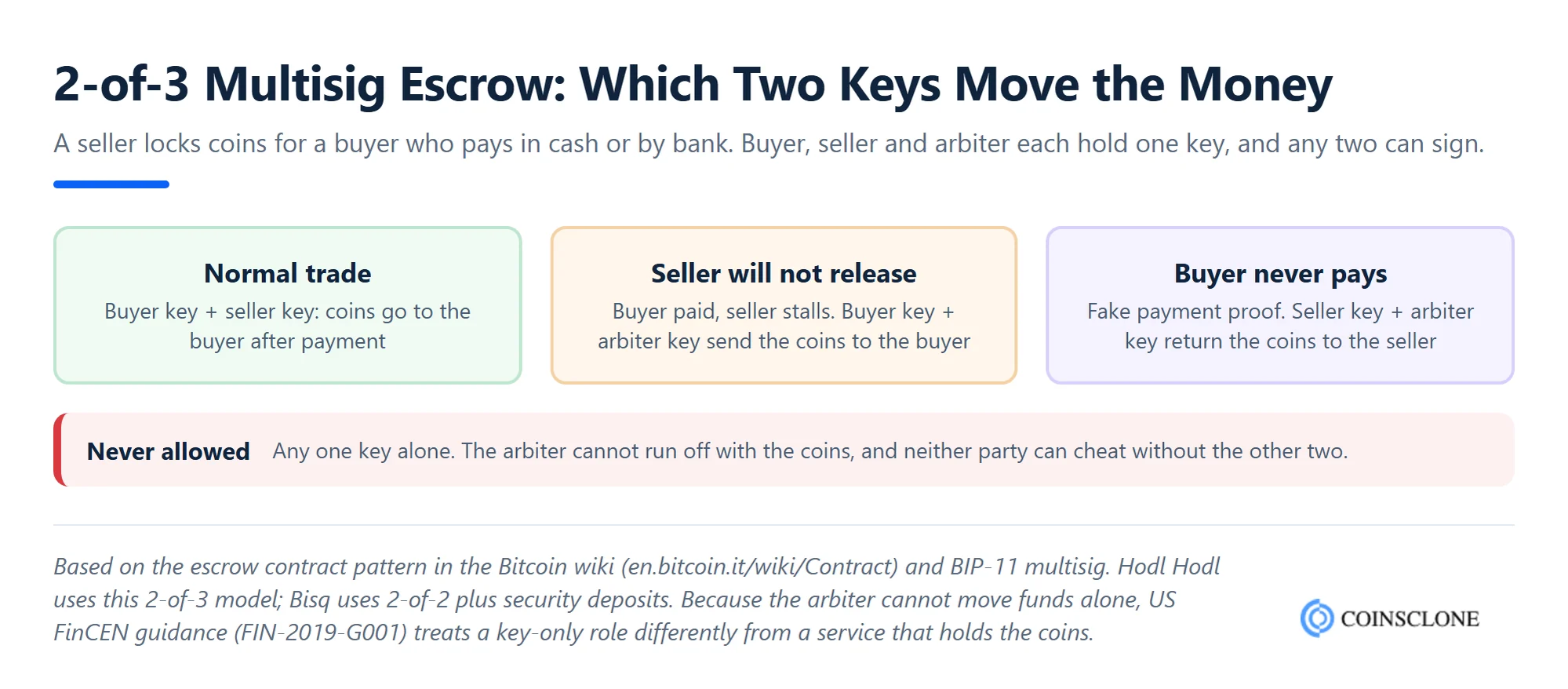
The beauty of this model is that the arbiter cannot steal. It can only break a tie. Hodl Hodl runs Bitcoin P2P trades this way and says plainly that it does not hold users’ funds.
How Does Bisq Handle Escrow?
Bisq uses a 2-of-2 multisig held only by the two traders. To stop either side from walking away, both post a security deposit of 15% to 50% of the trade. Cheaters lose their deposit.
When traders cannot agree, Bisq moves from chat to mediation to arbitration. It is slower than a big exchange, but no company ever touches the coins.
How Does Smart Contract Escrow Work?
On Ethereum and other smart contract chains, escrow can be pure code. The buyer’s or seller’s tokens go into a contract. The contract pays out when a condition is met, such as both parties signing, a deadline passing or an oracle reporting a result.
Builders should know one detail. OpenZeppelin, the most used library of contract templates, removed its Escrow and RefundEscrow contracts in version 5.0 in October 2023. Modern escrow contracts are custom code, so an audit matters. Our guide to smart contract development explains the build and test steps.
How Do Lightning Hold Invoices Work as Escrow?
A Lightning hold invoice locks a payment in flight. The receiver can settle it or cancel it, but the sender cannot pull it back. RoboSats uses this as trade escrow, with a default escrow timer of three hours.
It is fast and cheap. The limit is time: Lightning payments expire, so hold invoices suit short trades, not deals that take weeks.
How Much Does Crypto Escrow Cost?
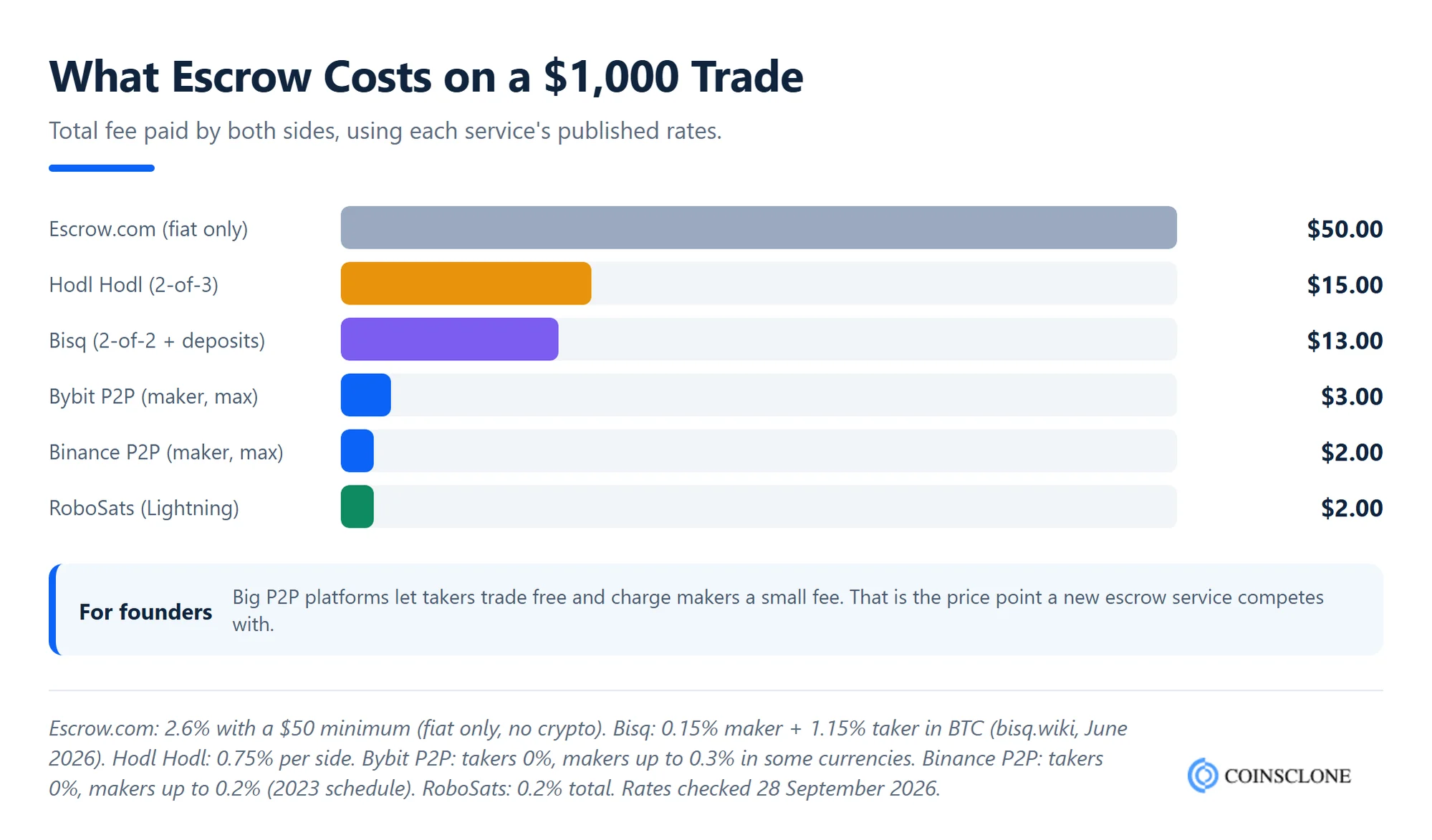
Escrow fees vary widely by model. Here is what a $1,000 trade costs on well-known services, using their published rates:
A few notes on these numbers:
- Escrow.com does not handle crypto. Its currency page lists only USD, EUR, AUD, GBP and CAD. Its fees run from 2.6% on small deals down to 0.7% above $10 million, with a $50 minimum.
- Hodl Hodl charges 0.75% to each side, only when a deal completes.
- Bisq charges about 1.3% in total when fees are paid in BTC.
- Big exchanges charge takers nothing. Bybit’s fee page lists maker fees of up to 0.3% in some currencies, and Binance set maker fees of 0.1% to 0.2% in many markets in 2023.
The lesson for users: escrow on a large P2P exchange is almost free. The lesson for founders: you cannot win on price alone.
How Do Crypto Escrow Services Make Money?
Every escrow business makes money from some mix of these seven models, all seen on the services above:
- A percentage of each trade. Hodl Hodl, Bisq, RoboSats and Escrow.com all do this.
- Maker fees with free takers. Binance and Bybit charge the traders who post ads, and let buyers trade free.
- Paid convenience modes. Binance charges a small taker fee in its simple “Express” and “Lite” buy flows.
- Minimum fees. Escrow.com charges at least $50, which protects margin on small deals.
- Premium service tiers. Escrow.com’s Concierge tier costs twice the standard rate.
- Forfeited bonds and deposits. Bisq and RoboSats keep deposits from users who break the rules.
- A platform token. Bisq offers lower fees when paid in its own BSQ token.
The strongest businesses combine two or three. A common mix for a new P2P platform is free trading for buyers, a small maker fee, and paid features such as featured ads or faster payouts. For a wider view, see how crypto exchanges make money.
Launch Your Own Escrow-Powered P2P Exchange
Crypto Escrow Development — done right.
- Bitcoin Escrow Script: Escrow wallets, release rules and time-outs, ready to brand.
- Dispute Desk: Appeals, evidence upload and admin release tools built in.
- Multisig or Smart Contract: Custodial, 2-of-3 multisig or on-chain escrow, your choice.
- Revenue Engine: Earn from maker fees, trade fees and premium listings.
Get a free branded demo of your P2P escrow platform in just 48 hours — before spending a single dollar.
Book a Free Demo to see how our Bitcoin Escrow Script can take you from idea to live platform in as little as 4 – 8 weeks.
Do You Need a Licence to Run a Crypto Escrow Service?
In most places, yes, if you hold other people’s coins. The rules turn on one question: who controls the funds?
United States. FinCEN’s 2019 guidance on virtual currency says a service that holds users’ coins is a money transmitter and must register as a money services business. A multisig service that only adds a second key, and cannot move coins alone, can fall outside that rule. The guidance also says a transfer that waits on a condition is still money transmission once the condition is met. States add their own money transmitter licences on top.
European Union. Under MiCA, holding crypto for clients and moving it for them are services that need authorisation as a crypto-asset service provider (CASP). ESMA confirmed that from 1 July 2026 only authorised CASPs may offer these services.
India. Since March 2023, businesses that exchange, transfer or safeguard crypto must register with FIU-IND, even if they are based abroad.
The practical upshot: a custodial escrow needs a licence plan from day one. A non-custodial 2-of-3 design can lower your legal load, but get local legal advice before you launch. For fees, capital and timelines by country, see our crypto license guide.
How Common Are Crypto Escrow Scams?
Escrow protects traders only if they use it well. Three scams show up again and again:
- Fake payment proof. A buyer sends an edited bank screenshot and pushes the seller to release fast. Binance’s advice is blunt: release crypto only after the money is in your account, never on a screenshot.
- Fake bank text messages. A scammer sends an SMS that looks like a bank alert. Check your bank app, not your messages.
- Fake escrow sites. The other side insists on “their” escrow service, which turns out to be a copy of a real one. Only use escrow built into a platform you chose yourself.
Moving the chat off the platform is a warning sign in every case, because the platform can no longer see the deal or help with an appeal.
How to Start a Crypto Escrow Service in 7 Steps
Demand is strongest in markets where banks and card rails are weak. Chainalysis ranks Nigeria first in the world for domestic P2P crypto use in its 2026 Global Crypto Adoption Index, and India, Brazil and Thailand also rank in the top ten. Here is how to enter that market:
- Pick your niche. A country, a payment method, a coin such as USDT, or a type of deal such as freelance work or OTC trades.
- Choose the escrow model. Platform escrow is easiest for users. 2-of-3 multisig lowers your custody risk. Smart contracts suit token and NFT deals.
- Plan your licences. Map the rules in each target country before you build. Custody changes everything.
- Build the core. You need escrow wallets, order matching, timers, chat, KYC, an appeal desk and an admin panel. A Bitcoin escrow script gives you these parts ready to brand.
- Design the dispute process. Set clear rules on proof, time limits and who decides. Your dispute desk is your reputation.
- Set your fee model. Most new platforms start with free takers and a small maker fee, then add paid features.
- Solve cold start. Recruit trusted sellers first, offer fee-free months and seed ads in your main payment methods.
Our team has delivered 350+ crypto platforms. A white label P2P exchange with escrow can launch in about 4 to 8 weeks, and a custom multi-market build in 12 to 16 weeks. To compare ready-made options, see our P2P crypto exchange script or the LocalBitcoins clone script.
Frequently Asked Questions
How does crypto escrow work?
The seller’s coins are locked in a wallet or contract when a trade opens. The buyer pays. Once the seller confirms payment, the coins go to the buyer. If the buyer never pays, the coins go back to the seller.
Is crypto escrow safe?
Escrow built into a well-known platform is much safer than paying a stranger first. The risks are fake payment proof, fake escrow sites, and, for custodial escrow, the platform itself. Always confirm money in your own account before you release coins.
How much does a crypto escrow service charge?
On big P2P exchanges, buyers usually pay nothing and sellers pay 0% to 0.3%. Peer-run services such as Hodl Hodl charge about 0.75% per side. Escrow.com charges 0.7% to 2.6%, but it does not handle crypto.
Does Escrow.com accept Bitcoin?
No. Escrow.com processes only USD, EUR, AUD, GBP and CAD. For crypto deals you need a crypto-native escrow such as a P2P exchange, a multisig service or a smart contract.
What is 2-of-3 multisig escrow?
It is a wallet with three keys, held by the buyer, the seller and an arbiter. Any two keys can move the coins, so the arbiter can settle a dispute but cannot take the funds alone.
How do escrow companies make money?
Mostly from a percentage of each deal. Crypto platforms also use maker fees, minimum fees, premium tiers, forfeited deposits and discounts paid in their own token.
Do I need a licence to start a crypto escrow company?
Usually, if you hold users’ coins. In the US that means FinCEN registration and state licences, in the EU a MiCA CASP licence, and in India FIU-IND registration. Non-custodial designs can reduce the load. Take local legal advice.
How do I create a Telegram escrow bot?
A Telegram escrow bot is a front end. The escrow itself still needs a wallet or contract behind it, plus a way to settle disputes. Build the escrow engine first, then connect the bot to it as one more way for users to trade.