
NFT smart contract development is the work of writing, testing and launching the code that creates NFTs and runs them on a blockchain. That code decides who owns each token, how it moves, what it costs to mint and whether the creator earns on resales. Get it right, and your collection, game or marketplace runs on its own. Get it wrong, and a bug can sit on-chain for good.
This guide walks you through the whole job in plain words. You will see how these contracts work, which token standard to pick, how to build and test one with today’s tools, what can go wrong, and what the work costs in 2026. If you plan to hire a team, you will also know what to ask for.
In this guide:
- How an NFT smart contract works, with a simple example
- How to choose between ERC-721, ERC-721A, ERC-1155 and ERC-721C
- A five-step build process using current tools such as Foundry and Hardhat
- The real state of creator royalties, and how to enforce them
- What the work costs and how long it takes, plus the safety checks to insist on
Build Secure NFT Smart Contracts for Your Marketplace
NFT Smart Contract Development — designed for creators, traders, and marketplaces.
- Custom NFT Logic: Minting, ownership transfer, royalties, and programmable NFTs.
- Multi-Chain Support: Deploy contracts on Ethereum, BSC, Polygon, and more.
- Optimized & Audited: Gas-efficient and fully secure smart contracts.
- Scalable & Maintainable: Future-proof contracts with continuous updates and support.
See a free branded demo of your NFT marketplace in 48 hours — before you invest a cent.
Book a Free Demo to discover how our NFT Smart Contract Development can help you launch secure, scalable NFT solutions in just 8–12 weeks.
What Is NFT Smart Contract Development?
An NFT smart contract is a program stored on a blockchain. It works like a digital agreement written in code. It mints tokens, tracks who owns them and moves them between wallets, all without a middleman. NFT smart contract development covers every stage of that program: design, code, tests, audit, launch and upkeep.
Most NFT contracts follow a shared rule set called a token standard, such as ERC-721 or ERC-1155. Because the rules are shared, any wallet or marketplace can read your tokens. Once a token is minted, the contract also sets how it can be traded, who owns it and how royalties are paid.
How Does It Work?
- Minting: The contract creates a token with a unique ID and links it to the creator’s wallet address.
- Metadata: Each token points to a file that describes it, such as an image, a name and its traits.
- Transfers: When the token is sold or sent, the contract updates the owner and records the change on-chain.
- Rules: The contract can add extra rules, such as a royalty for the creator on each resale.
To make it simple:
Think of an NFT smart contract like a vending machine. You put money in (you buy an NFT), and the machine (the smart contract) hands over the product (the NFT). There is no shopkeeper and no trusted third party. Every action is out in the open, and once a sale is recorded it cannot be changed. That is what makes the system secure and easy to trust.
All of this happens behind the scenes. Now, let’s look at the key roles the contract plays in making NFTs work.
Key Role of NFT Smart Contract
NFTs now cover art, music, games, tickets, loyalty passes and real-world assets. In every case, the smart contract is the backbone. It makes these assets work, gives buyers a reason to trust them and lets people trade them.
1. Minting Logic: Creating NFTs with Rules Built-In
Minting means creating a new token on the blockchain, and it is the base of any NFT. The smart contract gives each NFT its own ID and links it to metadata, such as a game item or a piece of art. As a result, each token is unique and easy to trace.
The contract also sets the mint rules. For example, it can cap the total supply, set a price, limit each wallet to a few mints or open an early mint to an allowlist.
2. Ownership and Transfer Control: Keeping Track of Who Owns What
Once a token is minted, the contract keeps the record of who owns it. It logs each transfer, so anyone can check the history and settle a dispute. Because this runs on-chain, no middleman has to approve a sale.
3. Royalty Logic: Paying Creators on Resales
A contract can tell marketplaces that the creator should get a share of every resale, often 2% to 10%. This is one of the biggest draws for artists, musicians and game studios. But as we explain below, asking a marketplace to pay a royalty is not the same as making it pay.
4. Security: Proving What’s Real
A smart contract stops anyone from faking a token from your collection. Buyers can check the contract address and see that the NFT is genuine. That proof of origin is what gives digital art its value.
5. Utility: Going Beyond a Picture
NFT contracts are not limited to ownership. They can unlock game features, event entry or member perks. With newer standards, such as ERC-6551, an NFT can even own its own wallet and hold other tokens. This turns a picture into a working product.
Now that you know what the contract does, let’s look at where it is used today.
Real-World Use Cases of NFT Smart Contracts
Some of the most useful apps in Web3 today run on NFT smart contracts.
- NFT art platforms: Marketplaces such as SuperRare use smart contracts to mint, verify and sell art, and to pay artists on resales.
- Gaming assets: Games such as Axie Infinity turn creatures, skins and items into NFTs that players own and trade.
- Real estate and real-world assets: A property or other asset can be split into NFTs for shared ownership and easy transfer.
- Music and content: Artists mint limited music, video or fan content and earn from sales.
- Tickets and memberships: An NFT can act as an event ticket or a members-only pass that cannot be faked.
With this much value riding on one piece of code, a well-built contract is a must for any serious project.
Why NFT Smart Contract Development Is the Backbone of Digital Ownership
Smart contract development is not just a technical step. It is the base on which every NFT idea is built. That is why teams put so much effort into a strong, safe contract.
Proof of Ownership
Smart contracts record ownership on-chain in a way that cannot be changed. They prove that one wallet owns one unique item, whether that is a piece of art, a song or a game item.
Decentralization and Interoperability
The contract runs on a public blockchain, so no single company controls the asset. Because it follows a shared standard, the NFT can move freely across marketplaces, wallets and apps.
Empowering Creators and Artists
Smart contracts let creators sell straight to fans and set royalty terms in code. This puts artists back in control of their work and their income, wherever their buyers live.
Efficiency and Transparency
Smart contracts run on rules agreed in advance and trigger on their own. This cuts manual steps and human error. Every action is public, so anyone can audit it.
New Ideas for Collectibles
From a profile picture to a game hero, smart contracts turn collectibles into items that can do things. Features such as reveals, rarity logic and cross-chain transfers can help your project stand out.
Now that we know the “why,” it’s time to look at the “how.”
How to Develop an NFT Smart Contract (Step-by-Step Guide)
Behind every NFT sits a smart contract doing the heavy lifting. So, if you plan to launch your own project, you need a contract that is secure, cheap to use and ready for the future. Let’s go through the process step by step. For a broader look at the craft, see our guide on how to develop a smart contract.
Step 1: Choose a Blockchain
Before you write a single line of code, pick the blockchain your NFTs will live on. Each chain has trade-offs in cost, speed and audience.
- Ethereum: The most trusted home for top art and big-name projects. Fees are much lower than in the 2021 boom, but they still rise when the network is busy.
- Layer 2 networks: Base, Arbitrum and Optimism settle to Ethereum but cost far less per mint, which suits large drops and games.
- Polygon, BNB Chain and Avalanche: Low-fee EVM chains, so the same Solidity code works with small changes.
- Solana: Fast and cheap. It uses its own NFT standards, such as Metaplex Core, and programs written in Rust rather than Solidity.
Learn more: Top Blockchains to Launch NFT Marketplace.
Step 2: Choose the Right Token Standard
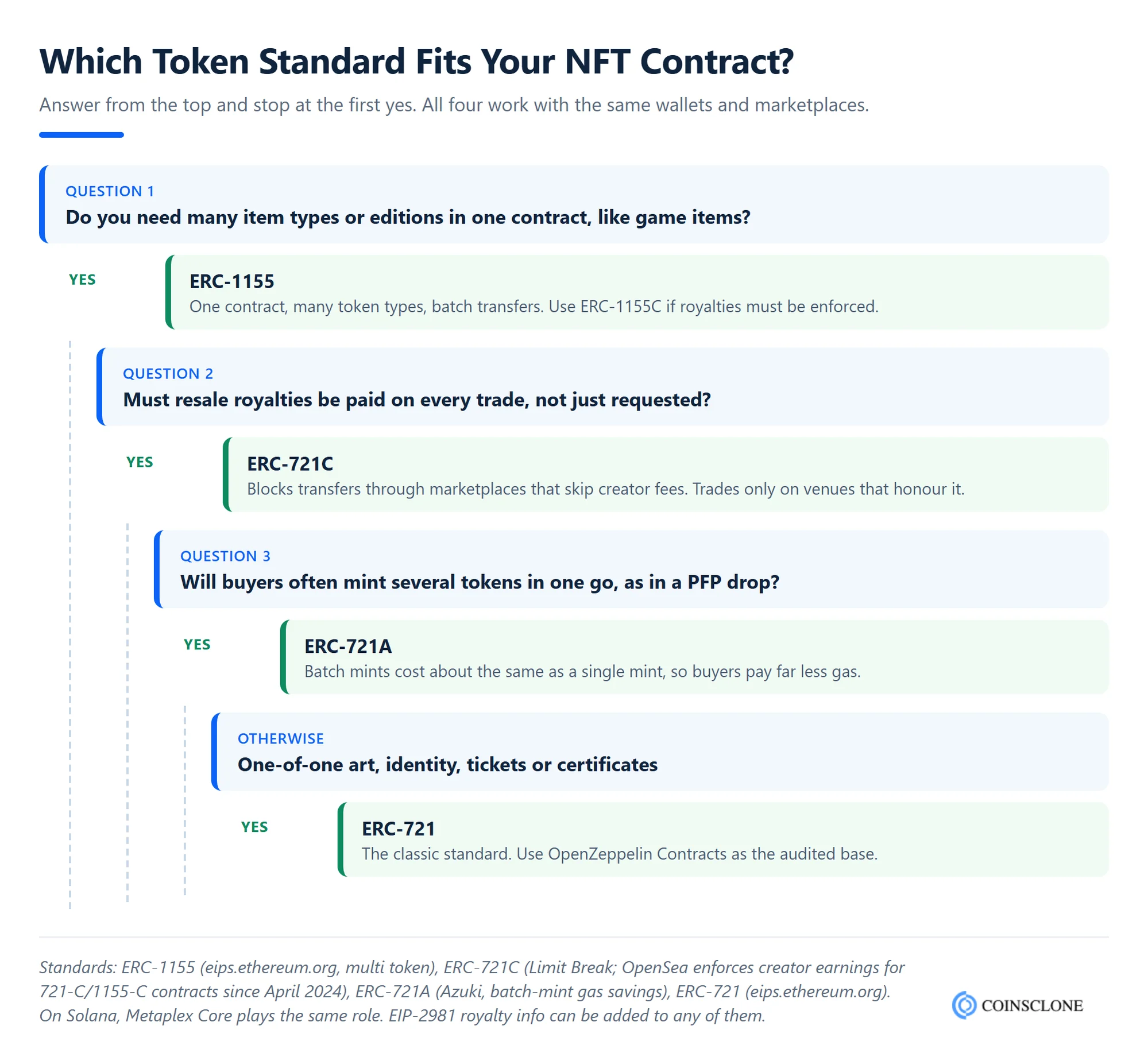
Token standards describe how your NFTs behave on the blockchain. The right choice depends on your use case.
- ERC-721: The classic standard for one-of-one items, such as art or identity tokens. See our ERC-721 token development service.
- ERC-721A: A gas-saving version of ERC-721, built by the Azuki team, for collections where buyers mint a few tokens at once.
- ERC-1155: One contract can hold many token types, both unique and in editions, and send them in batches. It suits games and multi-item drops. See ERC-1155 token development.
- ERC-721C: An ERC-721 version from Limit Break that lets the creator block transfers on marketplaces that skip royalties.
- Add-ons: EIP-2981 adds royalty info, ERC-4907 adds rentals, and ERC-6551 gives each NFT its own wallet.
For a full list, read our guide to popular NFT token standards. If you are unsure, the decision tree below gives a quick answer.
Step 3: Plan the Contract Features and Metadata
Next, list what the contract must do before anyone writes code. A clear plan saves money, because every change after launch is hard or impossible.
- Supply and price: Set the max supply, mint price, wallet limits and any free mints.
- Mint phases: Many drops open first to an allowlist, checked with a Merkle proof, and then to the public.
- Metadata storage: Choose where the token files live. IPFS is common and cheap. Arweave stores files for good with a one-time fee. Fully on-chain metadata is the most durable but costs the most gas.
- Reveal and freeze: Decide whether art is revealed after the mint, and when the metadata is locked so it cannot change.
- Admin controls: Set who can pause the mint, change the price or withdraw funds. Use a multisig wallet for these roles rather than one private key.
- Upgrades: A proxy pattern lets you fix bugs later, but buyers must then trust the team that holds the upgrade key. Many art projects lock their code on purpose.
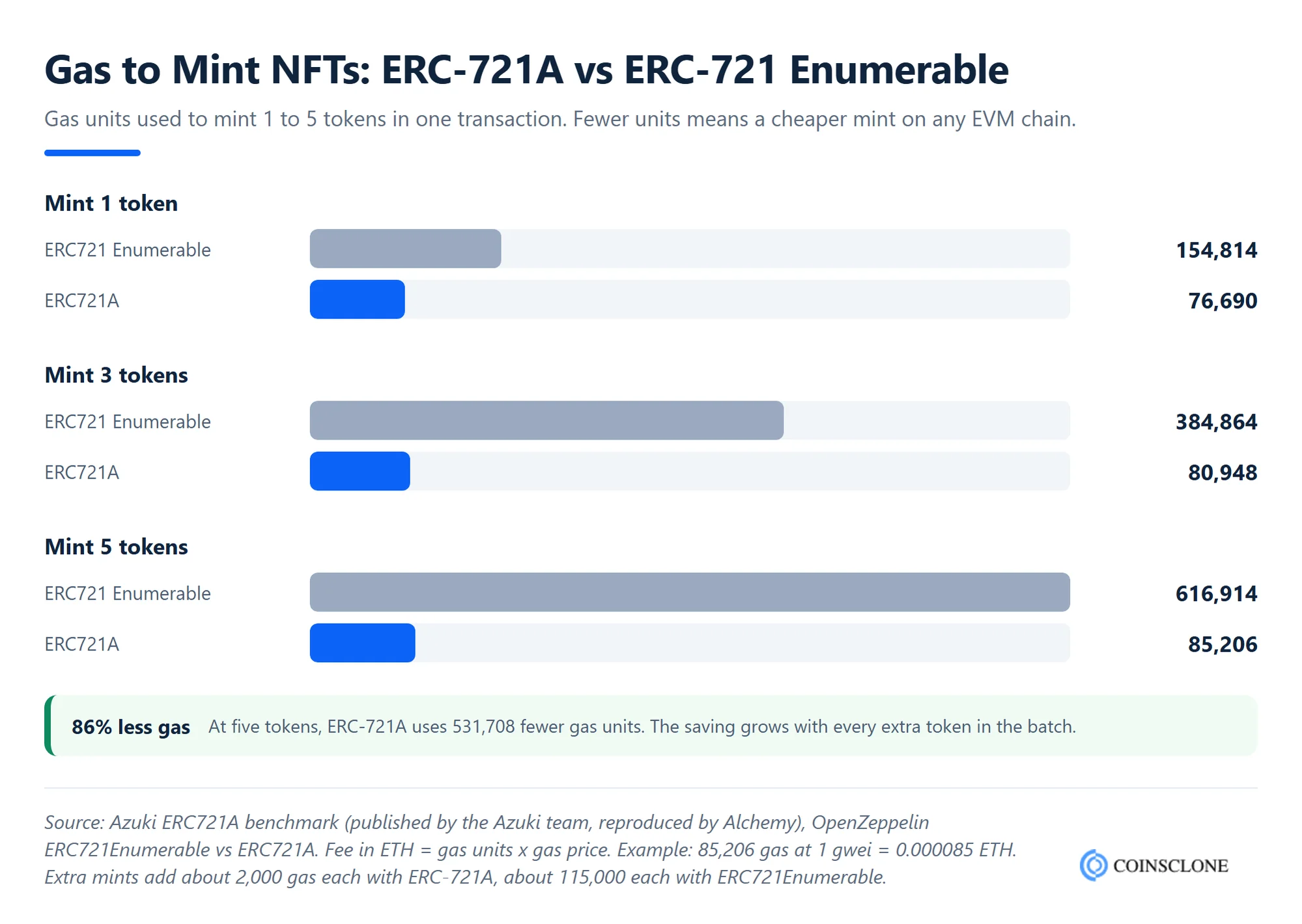
Gas is part of this plan, too. In batch mints, your choice of base contract can cut costs by more than half, as the chart below shows.
Step 4: Write the Smart Contract in Solidity
On Ethereum and other EVM chains, Solidity is the main language for NFT contracts. Start simple and add features only when you need them.
- Remix IDE: Good for quick tests in the browser.
- Foundry or Hardhat: The two main frameworks for real projects. Truffle was retired by Consensys in 2023, so new projects should not use it.
- OpenZeppelin Contracts: Use these audited ERC-721 and ERC-1155 templates, now at version 5.7, instead of writing the security-critical parts yourself.
- Clean code: Keep functions small, add comments and emit events for each key action, so wallets and indexers can follow along.
Step 5: Test, Audit and Deploy
Once a contract is live, its code cannot be changed. So test every way a user might touch it before launch.
- Unit and fuzz tests: Use Foundry or Hardhat to test minting, transfers, sales, royalties and admin actions with random inputs.
- Static analysis: Run tools such as Slither and Mythril to catch common bugs early.
- Testnet run: Deploy to a test network, such as Sepolia for Ethereum, and run a full mock mint with real wallets.
- Outside audit: For any paid mint, hire an outside firm to review the code.
- Mainnet launch: Deploy from a hardware wallet or multisig. Then publish the source code on Etherscan or a similar site, so buyers can read it.
Once the contract is live, keep watching it. Track mints, admin actions and odd transfers, and have a plan ready if something goes wrong.
Before you launch, one topic needs more attention than any other: security. Let’s look at the main risks.
Security Risks and Audit Essentials for NFT Smart Contracts
A single bug can drain a mint or let strangers create free tokens. Here are the risks auditors look for most in NFT contracts.
Common Security Risks
- Reentrancy attacks: An outside contract calls back into yours before the first call ends. NFT “safe” transfers trigger these callbacks, so mint and sale logic needs guards.
- Unauthorized minting: Weak access checks let attackers mint tokens without permission or past the supply cap.
- Signature and allowlist abuse: Badly checked signatures or Merkle proofs can be reused to mint more than allowed.
- Metadata tampering: If the metadata link can be changed after launch, the art behind a token can be swapped.
- Owner key risk: If one private key controls the mint, funds and upgrades, losing that key loses the project.
- Old code: Solidity 0.8 and later blocks number overflow by default. Older code, or code in “unchecked” blocks, still needs care.
Recommended Audit Tools and Firms
The tool list has changed fast. MythX shut down in March 2026, and OpenZeppelin Defender closed in July 2026. Today, teams usually combine:
- Slither: Free static analysis that flags common Solidity bugs.
- Mythril: A free code checker, and the open-source engine that once powered MythX.
- Foundry fuzzing and Echidna: Throw random inputs at your contract to find edge cases.
- Manual audit firms: Firms such as ConsenSys Diligence, OpenZeppelin and Trail of Bits review the code line by line.
If you want a second pair of eyes on your code, our developers can run a full smart contract audit. Next, let’s look at a question many teams get wrong: royalties.
How NFT Royalties Work Now (and How to Enforce Them)
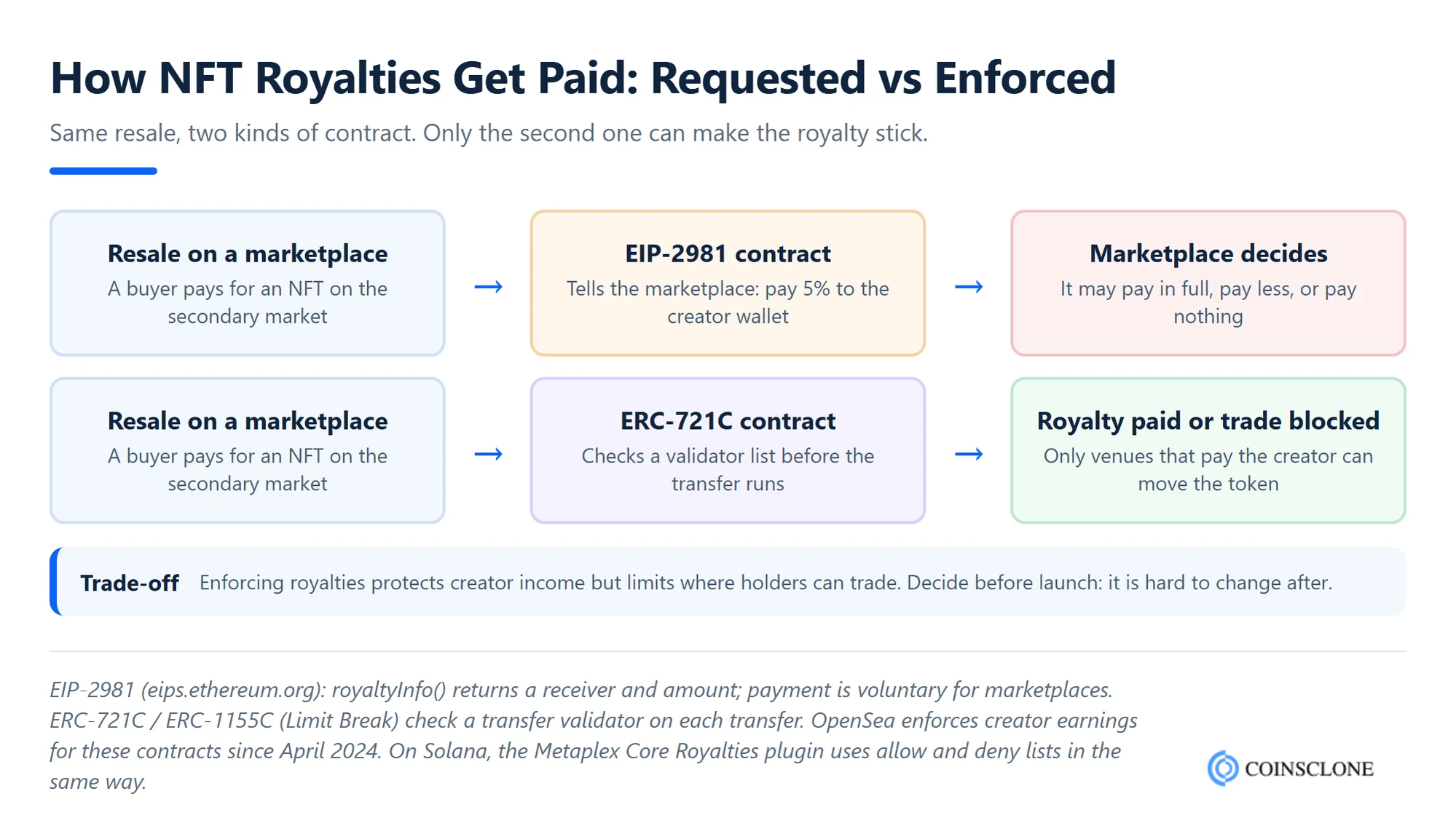
Many guides still say royalties are “automatic.” That is no longer true for most contracts. The common royalty standard, EIP-2981, only tells a marketplace the royalty rate and who should get it. Paying it is up to the marketplace. Since 2023, most big marketplaces have made creator fees optional on standard contracts.
To make royalties stick, you have to enforce them in the contract itself. On Ethereum and other EVM chains, ERC-721C and ERC-1155C do this. They block transfers through marketplaces that do not pay the creator. OpenSea has enforced creator earnings for these contracts since April 2024. On Solana, the Metaplex Core royalties plugin works the same way, with allow and deny lists of programs.
There is a trade-off. Enforced royalties protect income, but they limit where buyers can trade. As a result, some collections choose open trading and lower royalties instead. The diagram below shows the two paths side by side.
NFT Smart Contract Development Services We Do
NFT smart contract development services cover the whole job of designing, building and securing the contracts behind an NFT platform. These services make sure the platform runs correctly, on its own and for the long term.
NFT Consulting
Before any code is written, we look at your goals and plan the contract design. This means checking the use case, listing what the contract must do, designing the mint flow and royalty terms, and planning for growth from day one. With clear technical direction, your project moves forward with less risk and a clear roadmap.
Custom Smart Contract Development
We build contracts around the needs of your platform. This covers mint rules, owner records, access controls, token files, royalties and links to wallets and marketplaces. When a contract is designed with care and tuned for gas, it runs safely, costs users less and works smoothly with the rest of the NFT world.
NFT Smart Contract Audit
An audit looks for bugs, logic errors and gas waste in the code. We read the code, test it under many scenarios and check how it behaves under attack. A well-reviewed contract keeps the platform stable and earns the trust of users and backers.
With these services in mind, you might be wondering about the cost. Let’s take a closer look.
Cost to Develop an NFT Smart Contract
The cost depends on the chain, the features, the audit and the team you hire. Here are the main factors:
- Blockchain: Ethereum mainnet costs more to deploy and mint on than a layer 2, Polygon or BNB Chain.
- Contract scope: A standard mint costs far less than one with staking, reveals, rentals or cross-chain transfers.
- Audit depth: One auditor for a few days costs much less than a multi-firm review.
- Team: A freelancer, an agency or your own in-house team will each price the work very differently.
As a rough guide, market prices in 2026 look like this. These are typical public ranges, not fixed quotes.
| Route | Typical cost | Best for |
| No-code contract generator | Platform fee plus gas | Simple art drops with no custom logic |
| Freelancer using audited templates | About $500 to $3,000 | Standard ERC-721 or ERC-1155 collections |
| Agency custom build | From about $10,000; some agencies list $25,000 and up | Games, staking, reveals, marketplaces |
| Independent security audit | About $5,000 to $15,000 for a simple NFT contract | Any paid public mint |
Gas comes on top. Deploy cost equals gas units times the gas price times the price of the coin. A one-token mint uses about 77,000 to 155,000 gas, depending on the base contract. On a layer 2, that is often a few cents.
On timing, a standard audited collection contract often takes 2 to 4 weeks. Custom logic, such as staking or cross-chain features, can take 6 to 12 weeks, plus time in an auditor’s queue. If your contract is part of a full platform, see the cost to build an NFT marketplace.
Now that you know the cost factors, let’s see why the right team matters.
Why Choose Coinsclone for NFT Smart Contract Development?
Coinsclone is a leading NFT marketplace development company, and NFT smart contracts are a core part of that work. Since 2018, we have delivered 350+ platforms for 200+ clients across 20 industries. Whether you are starting with a first mint or need to review a contract you already have, our team can build custom contracts that fit your business model and audit them before launch.
Here’s what we offer:
- Custom contracts: NFT smart contracts built around your project’s goals.
- All major standards: ERC-721, ERC-721A, ERC-1155, ERC-721C and royalty add-ons such as EIP-2981.
- Full audits: Code review and testing to find bugs before they reach mainnet.
- Multi-chain launch: Deploy on Ethereum, layer 2 networks, Polygon, BNB Chain and more.
- Ongoing support: Monitoring, upgrades and help after launch.
Planning a drop, game or marketplace? Our NFT development company team can scope your contract and give you a clear plan.
Let’s build your NFT success story together!
Launch a fully audited smart contract that’s ready for the future of Web3.
Frequently Asked Questions
How much does it cost to create an NFT smart contract?
A simple contract built from audited templates often costs about $500 to $3,000 from a freelancer. A custom agency build usually starts around $10,000, and an independent audit for a simple NFT contract adds about $5,000 to $15,000. Gas for deploying and minting comes on top.
Can an NFT exist without a smart contract?
No. On Ethereum and other EVM chains, every NFT is a token recorded inside a smart contract. The contract is what mints the token, tracks the owner and handles transfers. Solana NFTs work in a similar way through on-chain programs such as Metaplex Core.
What is the best blockchain for NFT smart contracts?
Ethereum is the most trusted choice for top art and big-name projects. Layer 2 networks such as Base and Arbitrum, and chains such as Polygon and BNB Chain, cost far less per mint, so they suit games and large drops. Solana is fast and cheap but uses its own standards and Rust programs.
Can I create an NFT smart contract without coding?
Yes. No-code tools let you launch a basic ERC-721 or ERC-1155 collection with a form. However, they limit custom logic, and you depend on the tool’s code. For games, staking, custom royalties or a marketplace, a custom contract is the safer choice.
How long does it take to develop an NFT smart contract?
A standard, audited collection contract often takes 2 to 4 weeks. Contracts with custom logic, such as staking, reveals or cross-chain transfers, can take 6 to 12 weeks, plus time waiting for an audit slot.
Can I add royalties to my NFT smart contract?
Yes. EIP-2981 adds royalty info that marketplaces can read, but paying it is up to them. To enforce royalties, use ERC-721C or ERC-1155C on EVM chains, or the Metaplex Core royalties plugin on Solana.
What programming language is used for NFT smart contracts?
Solidity is the main language for Ethereum and other EVM chains, such as Polygon, BNB Chain and Base. Solana programs are written in Rust, often with the Anchor framework.
Build Secure NFT Smart Contracts for Your Marketplace
NFT Smart Contract Development — designed for creators, traders, and marketplaces.
- Custom NFT Logic: Minting, ownership transfer, royalties, and programmable NFTs.
- Multi-Chain Support: Deploy contracts on Ethereum, BSC, Polygon, and more.
- Optimized & Audited: Gas-efficient and fully secure smart contracts.
- Scalable & Maintainable: Future-proof contracts with continuous updates and support.
See a free branded demo of your NFT marketplace in 48 hours — before you invest a cent.
Book a Free Demo to discover how our NFT Smart Contract Development can help you launch secure, scalable NFT solutions in just 8–12 weeks.