

Buying smart contract development services is not like buying ordinary software. The usual signals of a good vendor, speed and price, tell you almost nothing here.
Why not? Because the expensive failure is never a late delivery. It is a deployed contract with a vulnerability in it, and in most cases nobody can patch it afterwards.
That single fact changes what you should ask for, what you should pay for, and how long you should expect the work to take.
This guide covers what a proper engagement includes, what genuinely drives the cost, what audits cost and how long they take at current market rates, and the eight questions that separate audited engineering from fast prototyping.
Key Takeaways
Smart contract development services span specification, architecture, build, testing, independent audit and deployment.
Audit scope drives cost, not line count. A short contract holding value costs more to secure than a long one holding nothing.
Published 2026 audit rates run $5,000 to $15,000 for an ERC-20 and $40,000 to $100,000 for a mid-complexity DeFi protocol.
Most audits take two to four weeks, and remediation is a separate phase that teams routinely forget to schedule.
Expect roughly twelve weeks for a production contract, and never deploy before remediation completes.
What Does a Smart Contract Engagement Cover?
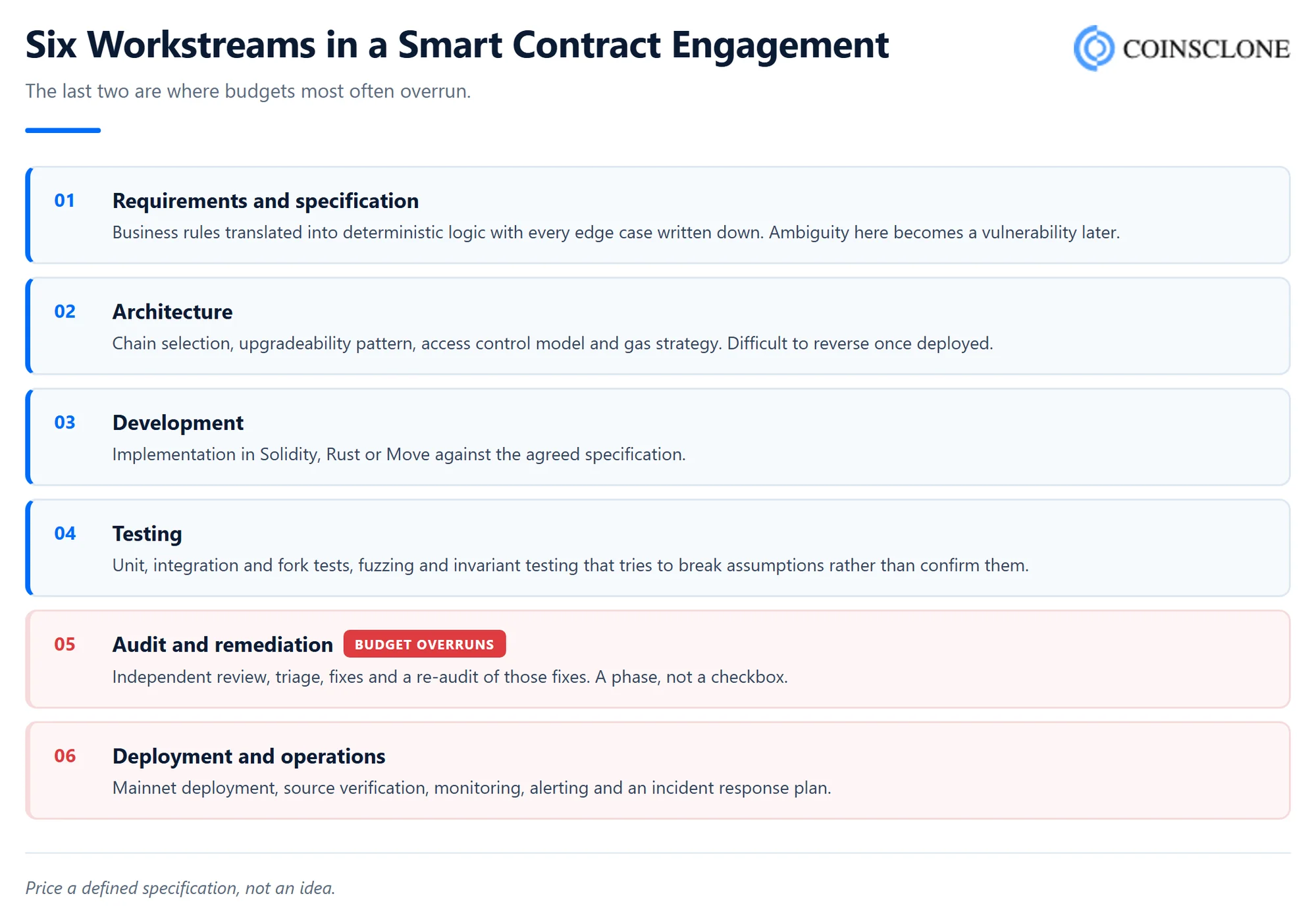
Six workstreams, and the last two are where budgets most often overrun.
Requirements and specification. Translating business rules into deterministic logic with every edge case written down. Ambiguity here becomes a vulnerability later.
Architecture. Chain selection, upgradeability pattern, access control model and gas strategy. These decisions are difficult to reverse once deployed.
Development. Implementation in Solidity, Rust or Move against the agreed specification.
Testing. Unit and integration tests, fork tests against real mainnet state, fuzzing and invariant testing that tries to break assumptions rather than confirm them.
Audit and remediation. Independent external review, triage of findings, fixes and a re-audit of those fixes. This is a phase rather than a checkbox.
Deployment and operations. Mainnet deployment, source verification, monitoring, alerting and an incident response plan.
How Much Does a Smart Contract Audit Cost?
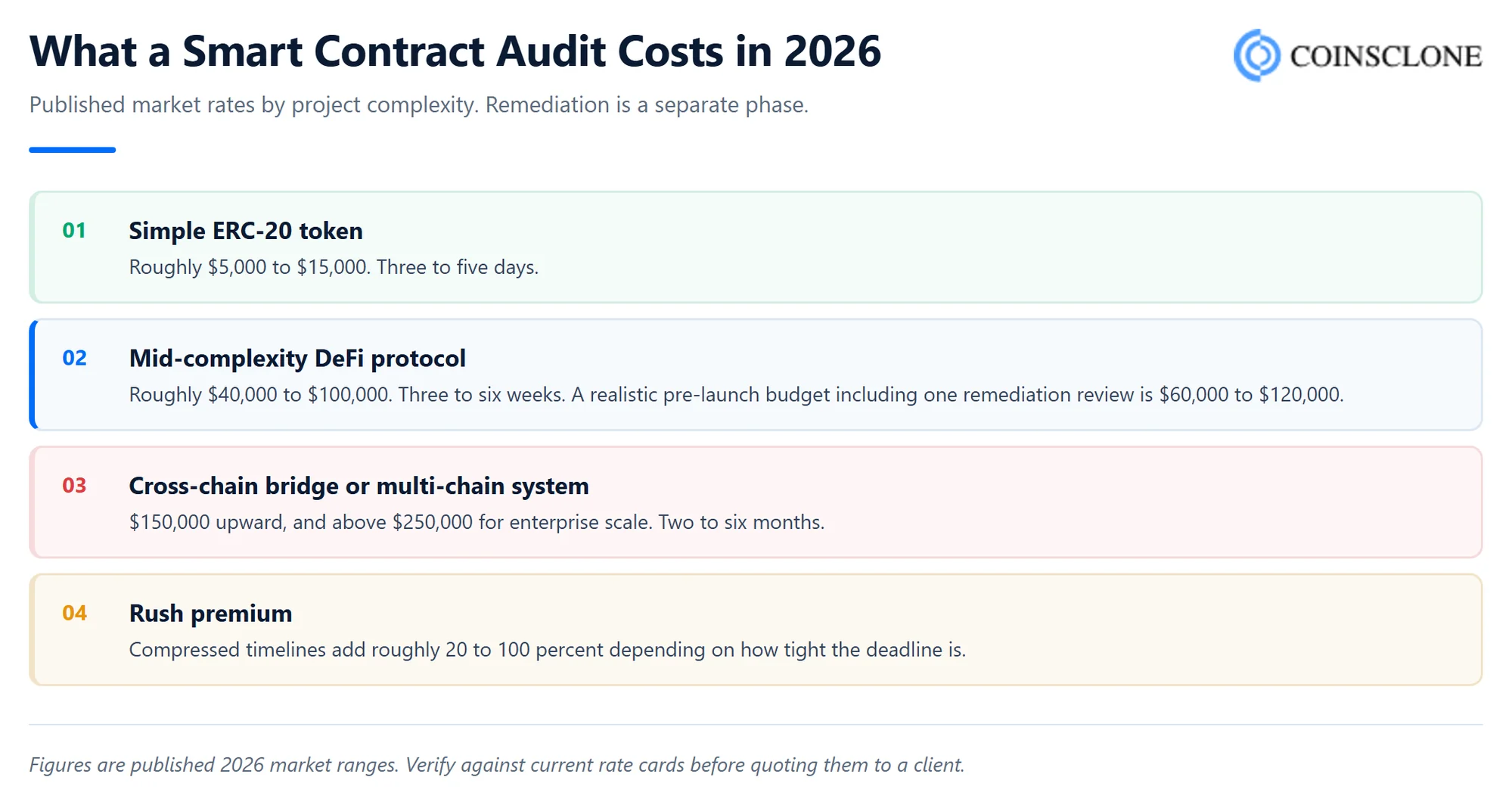
Published market rates in 2026 run from roughly $5,000 for a simple token contract to $250,000 and above for enterprise multi-chain systems.
A simple ERC-20 token audit sits in the $5,000 to $15,000 range. Mid-complexity DeFi protocols run roughly $40,000 to $100,000. At the top end, cross-chain bridges and large multi-chain systems start around $150,000.
A realistic pre-launch budget for a mid-complexity DeFi protocol is $60,000 to $120,000 including the initial audit and at least one remediation review. Rush engagements carry a premium of roughly 20 to 100 percent depending on how compressed the timeline is.
How Long Does a Smart Contract Audit Take?
Most audits complete in two to four weeks. However, the range is wide, running from a few days for a simple token to several months for a bridge or Layer 1.
Simple token contracts take roughly three to five days. Standard DeFi protocols take three to six weeks. Complex systems such as bridges, rollups and Layer 1s take two to six months.
Remediation follows the report as a separate phase, and teams routinely leave it out of the plan. That omission is where launch dates slip. Booking lead time matters as much as audit duration, since reputable firms are often scheduled weeks ahead.
What Actually Drives the Cost?
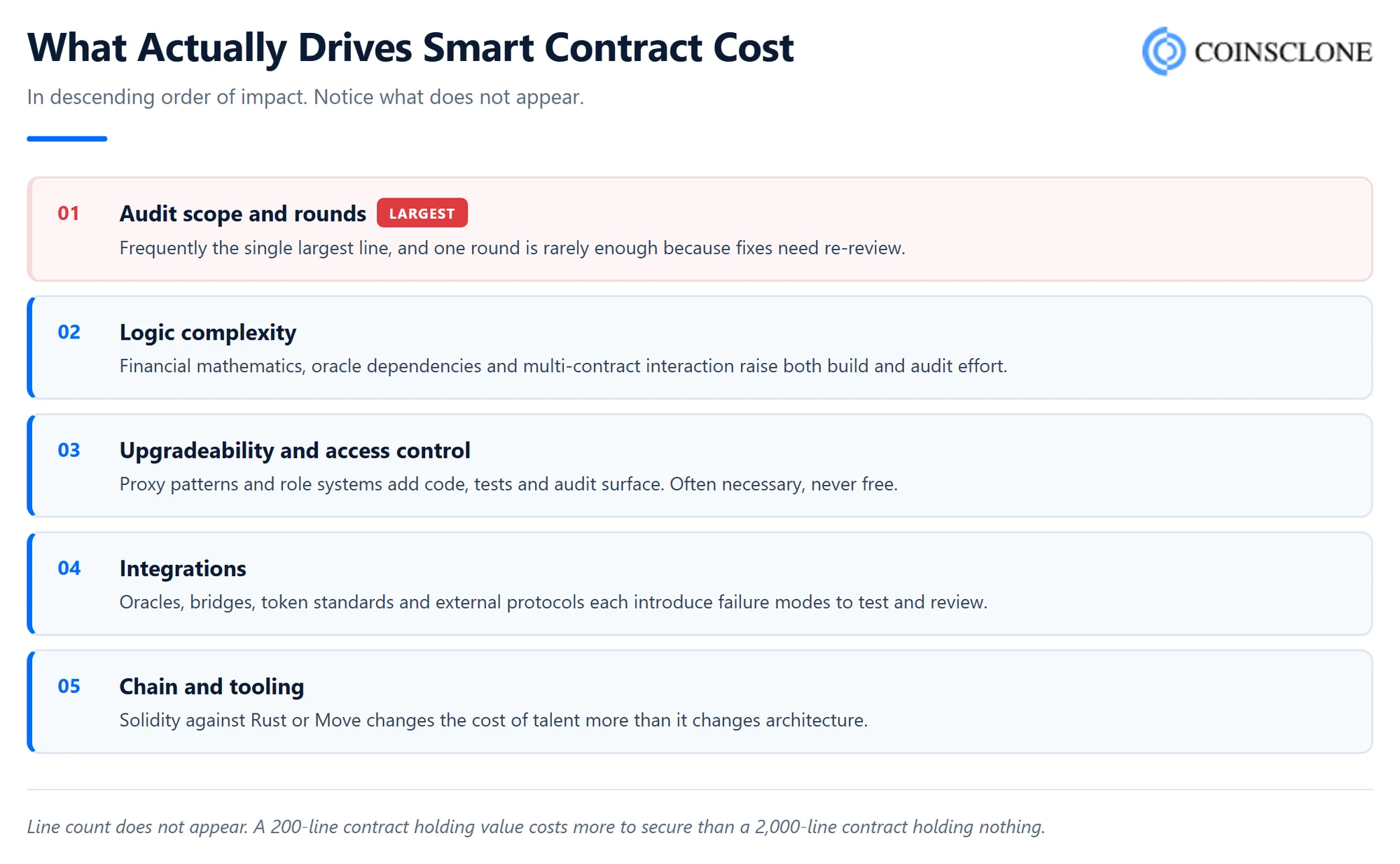
In descending order of impact.
Audit scope and number of rounds. Independent review is frequently the single largest line, and one round is rarely enough because fixes need re-review.
Logic complexity. Financial mathematics, oracle dependencies and multi-contract interaction raise both build effort and audit effort, because each interaction is a place where assumptions can break.
Upgradeability and access control. Proxy patterns and role systems add code, tests and audit surface. They are often necessary, but they are never free.
Integrations. Oracles, bridges, token standards and external protocols each introduce failure modes that must be tested and reviewed.
Chain and tooling. Solidity versus Rust or Move changes the cost of talent more than it changes architecture.
Notice, however, that line count does not appear anywhere on that list. A two-hundred-line contract holding significant value costs more to secure than a two-thousand-line contract that does not.
What Language Are Smart Contracts Written In?
Solidity for Ethereum and EVM-compatible chains, Rust for Solana and Polkadot, and Move for Aptos and Sui.
Because Solidity has the largest talent pool, tooling ecosystem and audit market, it stays the default unless a target chain dictates otherwise. Rust brings stronger memory safety guarantees and a steeper learning curve, and the audit market for it is smaller and more expensive.
Language choice follows chain choice, not preference, so settle the target chain before hiring.
Do Smart Contracts Need to Be Audited?
Any contract holding user funds or executing irreversible value transfers should be audited before deployment. Contracts that hold nothing of value do not warrant the cost.
Deployed contracts usually cannot be patched, so a defect is permanent unless an upgrade path was designed in, which itself introduces centralization risk. Most institutional partners, exchanges and launchpads require an audit report from a recognized firm before listing or integrating.
One audit is a floor rather than a guarantee. Contracts audited by reputable firms have still been exploited, which is why continuous testing, monitoring and an incident plan sit alongside it.
What Does a Realistic Timeline Look Like?
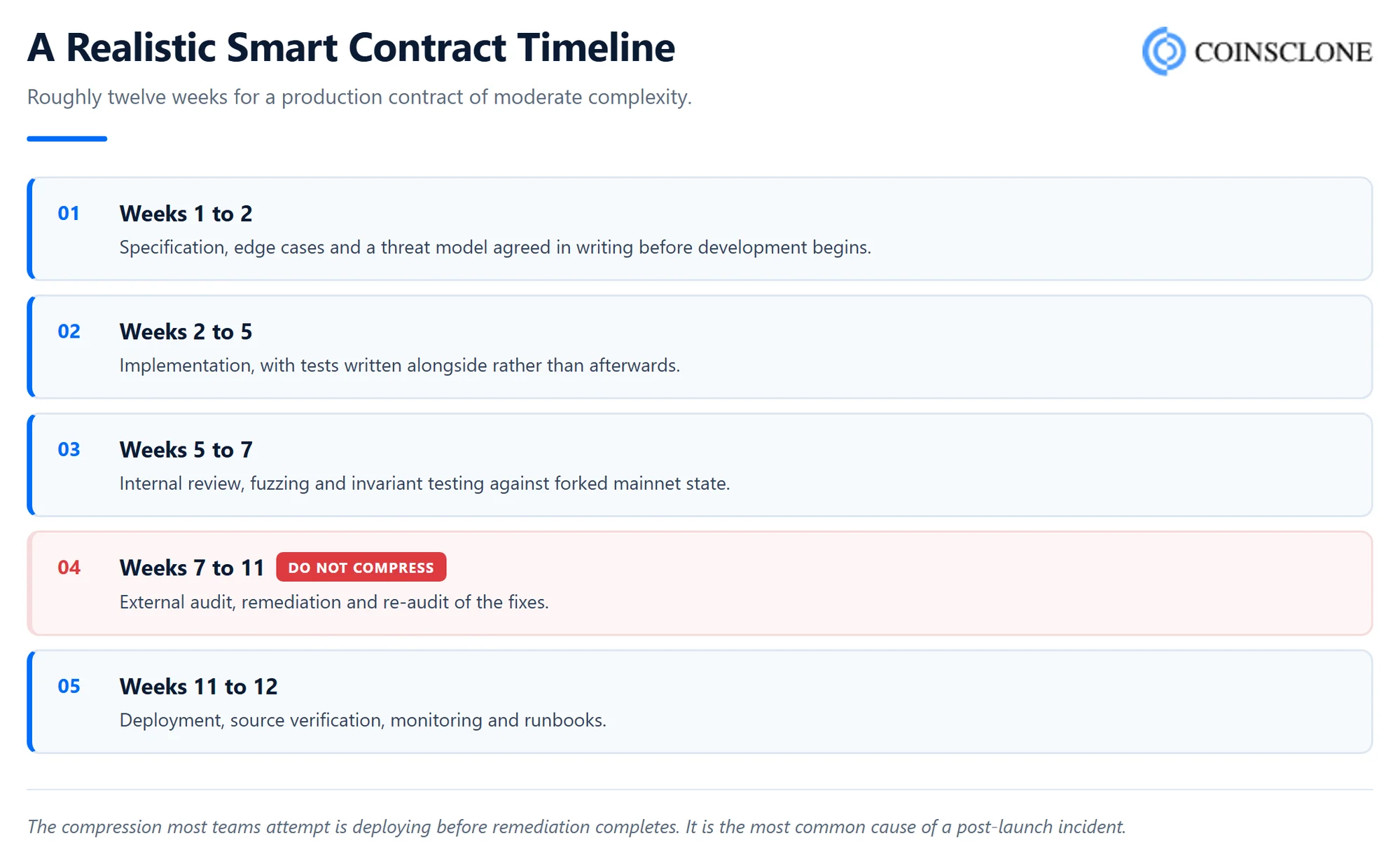
Roughly twelve weeks for a production contract of moderate complexity, assuming the specification is settled before development begins.
Weeks one and two: specification, edge cases and a threat model agreed in writing.
Weeks two to five: implementation with tests written alongside rather than afterwards.
Weeks five to seven: internal review, fuzzing and invariant testing against forked mainnet state.
Weeks seven to eleven: external audit, remediation and re-audit of the fixes.
Weeks eleven and twelve: deployment, verification, monitoring and runbooks.
The compression most teams attempt is deploying before remediation completes. It is also the most common cause of a post-launch incident.
What Eight Questions Should You Ask Before Appointing a Partner?
Who audits this, and do we see the report before mainnet? What is your test coverage, and do you run fuzzing and invariant tests? Which upgradeability pattern do you propose, and what are the trade-offs? How are admin keys held, and what is the multisig or timelock design? What happens if a vulnerability is found after deployment? Can you show verified mainnet contracts you wrote? What is the gas cost per core user action at expected volume? And who owns the code, tests and deployment scripts afterwards?
Question six is the fastest filter available. Verified contracts are public, and checking one takes two minutes.
Conclusion
Smart contract development is bought badly when it is bought on price and speed, because the failure that matters is not a missed deadline. It is permanent, public and expensive.
Price a written specification rather than an idea. Budget audit and remediation as a phase rather than a line item, using the published ranges above as a sanity check on any quote. Expect roughly twelve weeks for a moderate contract done properly. And ask for verified mainnet addresses, because that single question separates firms that ship audited contracts from firms that ship prototypes. Buy smart contract development services on that basis, and the price stops being the risk.
Coinsclone builds enterprise-grade Web3 platforms including smart contract development, testing and audit coordination, DeFi protocols, token development, crypto exchanges, wallets, NFT marketplaces and payment gateways, using customizable white-label solutions. Talk to our blockchain experts for a free consultation and a live demo.
FAQ
Q: How much does a smart contract audit cost?
Published 2026 rates run from roughly $5,000 for a simple ERC-20 token to $40,000 to $100,000 for a mid-complexity DeFi protocol, and $150,000 upwards for cross-chain bridges and enterprise multi-chain systems. A realistic pre-launch budget for a DeFi protocol including one remediation review is $60,000 to $120,000.
Q: How long does a smart contract audit take?
Most complete in two to four weeks. A simple token takes three to five days, a standard DeFi protocol three to six weeks, and complex systems such as bridges or rollups two to six months. Remediation is a separate phase and booking lead time can add weeks.
Q: How long does smart contract development take overall?
Roughly twelve weeks for a production contract of moderate complexity: two weeks specification, three weeks implementation with tests, two weeks internal review and fuzzing, four weeks external audit and remediation, then deployment and runbooks.
Q: What language are smart contracts written in?
Solidity for Ethereum and EVM-compatible chains, Rust for Solana and Polkadot, and Move for Aptos and Sui. Solidity has the largest talent pool and audit market, so language choice should follow chain choice rather than preference.
Q: Do smart contracts need to be audited?
Any contract holding user funds or executing irreversible transfers should be. Deployed contracts usually cannot be patched, and most exchanges, launchpads and institutional partners require an audit report before listing or integrating.
Q: What drives smart contract development cost?
Audit scope and number of rounds first, then logic complexity, upgradeability and access control patterns, external integrations, and chain and tooling choice. Line count does not drive cost. A short contract holding significant value costs more to secure than a long one holding nothing.
Q: What happens if a smart contract has a bug after deployment?
If no upgrade path was designed in, the contract cannot be fixed and funds may be permanently at risk. Options are limited to pausing if a pause function exists, migrating users to a new contract, or negotiating with an exploiter. This is why remediation before deployment matters.
Q: Is one audit enough?
It is a floor, not a guarantee. Contracts audited by reputable firms have still been exploited. Continuous testing, production monitoring, invariant checks against live state and a rehearsed incident runbook sit alongside the audit rather than after it.
Q: What should I ask a smart contract development partner?
Who audits it and do you see the report before mainnet, what the test coverage is, which upgradeability pattern is proposed, how admin keys are held, what happens if a vulnerability appears post-deployment, and for verified mainnet contract addresses they have written.
Q: What is an upgradeability pattern and do I need one?
A proxy design that lets contract logic be replaced after deployment. It solves the inability to patch and introduces centralization risk, since whoever controls the upgrade key controls the contract. It adds code, tests and audit surface, so it should be a deliberate decision rather than a default.