
On 16 September 2026, Kraken’s parent company Payward announced a plan to offer US clients perpetual futures that trade on Hyperliquid. Its regulated exchange, Bitnomial, would deploy the markets under HIP-3. The plan still needs approval, but the shift is clear: big brokers want to plug into Hyperliquid, not build a matching engine.
There are two ways in. Hyperliquid builder codes let a wallet, broker or trading app send orders to Hyperliquid and add its own fee to each fill. HIP-3 goes further and lets a team list its own perp markets on Hyperliquid’s engine, run the price feed and keep part of the trading fees.
This guide covers the rules, the fees on one trade, today’s stake and auction costs, and how to choose your route.
In this guide:
- Builder codes: you need just 100 USDC in a perps account, and you can charge up to 0.1% on perps and 1% on spot. Users approve your fee once, from their main wallet.
- Builder income is top heavy: Hyperliquid front ends earned about $8.8 million in the 30 days to 9 October 2026, per DefiLlama, and four apps took more than 60% of it.
- HIP-3: you must stake 500,000 HYPE, about $43 million at $86 on 9 October 2026, for at least 183 days. You can keep up to half of the trading fees on your markets.
- More markets: your first 3 markets skip the auction. Each extra ticker goes through a 31-hour Dutch auction, which stood near 1,014 HYPE on 9 October 2026.
- Owning the venue: a white label DEX takes 5 to 7 weeks at Coinsclone and a standard custom DEX 10 to 14 weeks, but you must bring your own liquidity.
What Are Hyperliquid Builder Codes?
Hyperliquid builder codes are a way for apps to earn a fee on the trades they send to Hyperliquid. The app owns the screens, the wallet flow and the users. Hyperliquid matches the order on its own order book. The fee is charged and paid onchain, as part of Hyperliquid’s normal fee logic.
“Builder” here means the team behind a trading app, not a block builder. Wallets such as Phantom, MetaMask and Trust Wallet use builder codes to offer perp trading inside their apps. So do trading bots and pro terminals.
How a Builder Code Works, Step by Step
The builder code docs set out a short flow:
- Fund the builder address: it must hold at least 100 USDC in perps account value and use the standard account mode.
- User approves a maximum fee: each user signs an `ApproveBuilderFee` action once for your address. It must come from the user’s main wallet, not an agent or API wallet.
- Attach the code to orders: each order carries your address and a fee in tenths of a basis point. A value of 10 means 0.01%.
- Earn on each fill: the fee is taken on every fill, up to the cap the user approved.
- Claim the fees: you collect them through the usual referral reward claim. Daily fill files are also published for each builder address.
Users can revoke an approval at any time.
Builder Code Rules at a Glance
| Rule | What the docs say |
| Maximum fee on perps | 0.1% of the fill |
| Maximum fee on spot | 1% of the fill |
| Which side pays | Both sides of perp trades; on spot, not the buying side |
| Builder minimum | 100 USDC in perps account value |
| Who approves | The user’s main wallet, once per builder |
| Limit per user | 10 active builder approvals |
| How you get paid | Referral reward claim, onchain |
Who Earns From Builder Codes Today
Builder codes are a real business, but the money sits with a few big apps. DefiLlama tracks fees for more than 230 Hyperliquid front ends. Together they earned about $8.8 million in the 30 days to 9 October 2026, and about $79 million over the past year.
| Front end | Fees, 30 days to 9 Oct 2026 | Fees, past 12 months |
| Trust Wallet Perps | $1.53M | $2.98M |
| MetaMask Perps | $1.51M | $11.57M |
| Phantom Perps | $1.21M | $19.50M |
| fomo Perps | $1.16M | $2.22M |
| Rabby Perps | $0.39M | $2.15M |
Source: DefiLlama fees data, pulled 9 October 2026.
The lesson: a builder code earns in line with the users you already have. A new app with no audience earns very little.
HIP-3 Explained: How Builder-Deployed Perps Work
HIP-3 lets an outside team run its own perp exchange on top of Hyperliquid’s engine. Under the HIP-3 spec, each deployer gets one perp DEX with its own order books, margin and settings. Matching and settlement still run on HyperCore, the same engine as Hyperliquid’s own markets. Our guide to Hyperliquid architecture explains that engine.
HIP-3 took off for assets Hyperliquid does not list itself, such as stocks, oil, metals and pre-IPO names. Its share of Hyperliquid’s perp volume grew from about 2% at the start of 2026 to nearly half earlier this summer, The Block reported.
What a HIP-3 Deployer Controls
The deployer has two jobs: define the market and run it. The deployer actions docs list what that covers:
- Oracle: you pick the price source and push prices onchain, about every 3 seconds, with at least 2.5 seconds between updates.
- Leverage: margin tables with up to 3 tiers and a max of 50x.
- Funding: multipliers, interest rates and clamps that shape the funding rate.
- Open interest caps: limits per market and across the whole DEX.
- Settlement: the `haltTrading` action cancels all orders and settles positions at the mark price. You can reuse the ticker later, which suits dated contracts.
HIP-3 Stake, Auction and Slashing Rules
| Rule | What it means for you |
| Stake | 500,000 HYPE, expected to fall over time. About $43M at $86 on 9 October 2026 |
| Lock period | At least 183 days after the DEX goes live |
| Markets per deployer | One perp DEX per deployer today |
| First markets | The first 3 assets skip the auction |
| Extra markets | A 31-hour Dutch auction shared by all HIP-3 DEXs, falling to a 500 HYPE floor. Near 1,014 HYPE on 9 October 2026 |
| Fee share | 0% to 300% of the base fee on top (0% to 100% in growth mode), changed at most once per 30 days |
| Slashing | By validator vote: up to 100% for inputs that break state or stall the chain, up to 50% for brief downtime, up to 20% for slow performance |
| Unstaking | A 7-day queue, and the stake can still be slashed during it |
Note that slashing does not ask why something went wrong: a bad spec, a careless operator and a hacked key are treated the same. Slashed HYPE is burned, not paid to traders.
HIP-3 Fees and Growth Mode
On a HIP-3 market, the trader pays the normal protocol fee plus your deployer fee. With a fee scale of 1, the trader pays twice the base fee and you keep half. The fees page sums it up: HIP-3 deployers can keep up to 50% of the trading fees their markets create.
Growth mode is a launch tool for new kinds of markets. It cuts all-in fees, rebates and volume credit by 90% or more, so the base taker rate falls to between 0.0045% and 0.009%. It only applies to markets that do not overlap with Hyperliquid’s own perps, so crypto perps, crypto baskets and gold are out.
Who Uses HIP-3 in 2026
One deployer leads by far. On 9 October 2026, Hyperliquid’s API listed 10 HIP-3 DEXs. The largest, XYZ from the trade.xyz team, carried about $3.1 billion of 24-hour volume and $3.6 billion of open interest. Most of the others traded close to nothing that day.
HIP-3 open interest hit a record above $4.44 billion in August 2026, though its share of Hyperliquid’s open interest eased from 34% to 25% by early September, per The Block.
Regulated firms are lining up too. Coinbase won CFTC approval for its own clearinghouse on 28 September 2026. The Block noted this may later let it support a restricted HIP-3 market, though Coinbase has not said it plans to.
Where the Money Goes on One Trade
Here is one $10,000 taker trade at the base fee tier, sent through an app that charges a 0.05% builder fee.
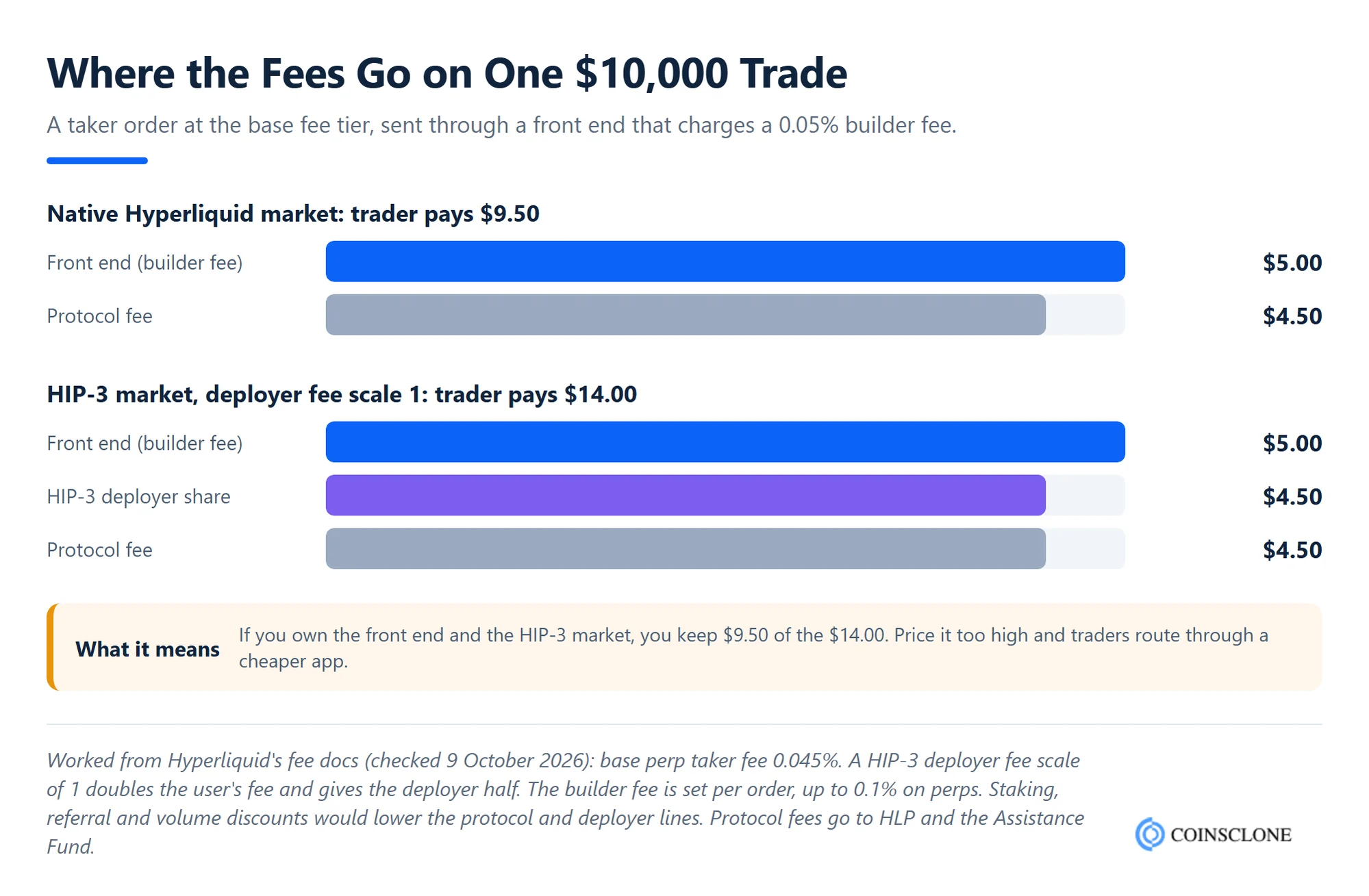
On a native market, the trader pays $9.50: the app keeps $5.00 and the protocol $4.50. On a HIP-3 market with a fee scale of 1, the trader pays $14.00, and the deployer takes $4.50 of it. If you own both the app and the HIP-3 market, you keep $9.50 of every $14.00.
But traders compare costs. If your app and market cost 0.14% while a rival costs 0.07%, active traders will move. So price for the volume you want, not for the cap the rules allow.
Builder Code vs HIP-3 vs Your Own Perp DEX
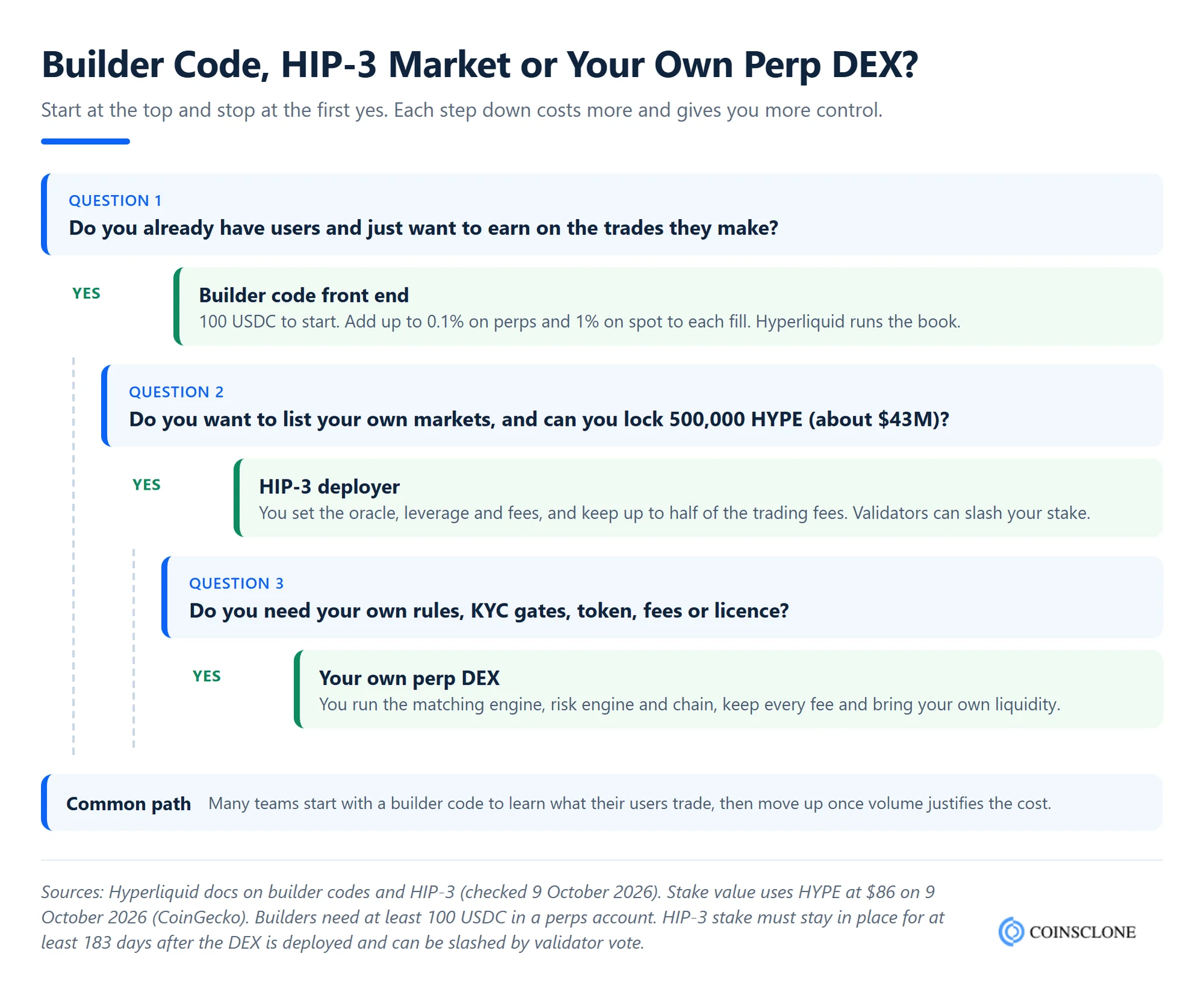
Each route gives you more control and asks for more money and work.
| Factor | Builder code front end | HIP-3 deployer | Own perp DEX |
| Upfront need | 100 USDC plus an app | 500,000 HYPE stake plus an app and oracle | Build budget plus liquidity |
| What you earn | Up to 0.1% per perp fill | Up to half the trading fees, plus builder fees if you run the app | Every fee you set |
| What you control | The app and your fee | Markets, oracle, leverage, fee share | Everything: chain, rules, token, KYC |
| Liquidity | Shared Hyperliquid books | Your markets must attract makers | You bring it all |
| Main risk | Users switch apps | Slashing and oracle failures | Empty order books |
| Best for | Wallets, brokers, bots, apps with users | Funded teams with a market Hyperliquid lacks | Exchanges and brands that need full ownership |
Pick a builder code if you have users today and want income this quarter. Pick HIP-3 if you have a market nobody lists yet, such as a regional stock index, and the capital to stake. Build your own perp DEX if you need your own rules, such as a KYC allow-list, a home-market licence or your own token. For that route, our Hyperliquid clone script gives you the order book, risk engine and admin tools to start from.
How to Launch Your Own Perp Market on Hyperliquid With HIP-3
The onchain steps are short. The hard part is the price feed, the risk settings and the app traders will use.
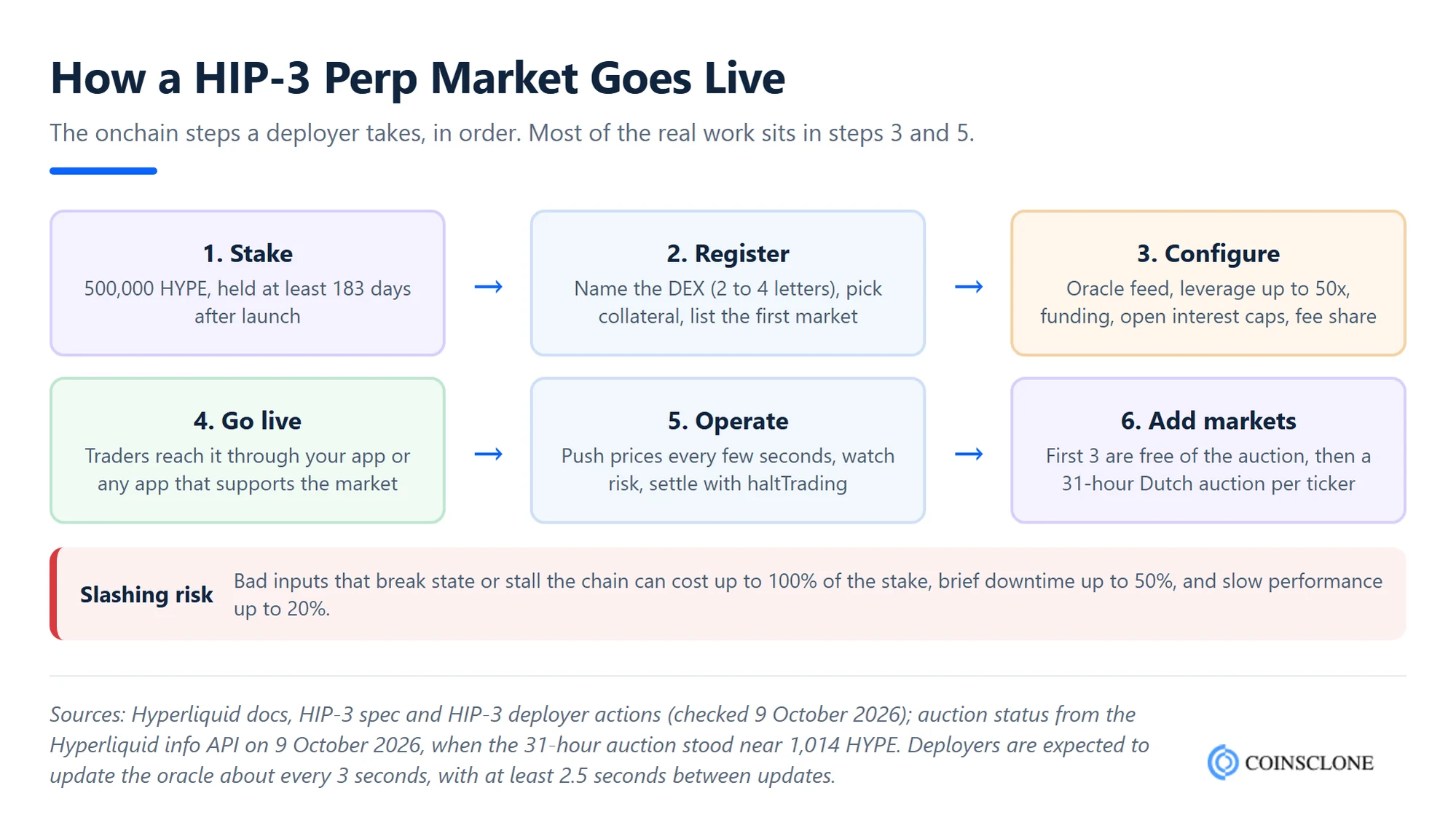
- Stake the HYPE. Lock 500,000 HYPE for at least 183 days. Its dollar value moves with the HYPE price every day.
- Test on testnet. Run the full deploy there first. Some choices, like turning on cross margin, cannot be undone.
- Register the DEX. One action names the DEX (2 to 4 letters), sets the collateral token and lists your first asset.
- Build the oracle. Use a source that is hard to move and tied to a real asset. The spec warns that most price indexes make poor perp sources.
- Set risk and fees. Choose leverage tiers, funding settings, open interest caps and your fee share. Start low and raise limits as the book deepens.
- Line up market makers. Thin books will not hold traders, so agree quotes and spreads before launch day.
- Ship and run it. Launch your own app with a builder code, ask other apps to list your markets, and watch the oracle around the clock.
What Each Route Needs You to Build
Even a “plug in” route needs real software.
- Builder code front end: wallet connect, a clear fee approval screen, trading screens, an agent wallet for fast signing, a private data feed and revenue reports.
- HIP-3 market: all of that, plus a backup-ready oracle service, a deployer console that needs two sign-offs, and price alerts. On cross margin assets, a move of more than 50% in a day triggers a slashing review.
- Own perp DEX: all of that, plus a matching engine, a risk and liquidation engine, a chain or rollup, and a vault. Our guide to create a perpetual DEX like Hyperliquid covers that build step by step.
Trade on Hyperliquid or Own Your Perp DEX
Perp DEX Development — done right.
- Trading App: Web and mobile perp trading with wallet login, live order books, funding data and advanced order types.
- Admin and Fee Controls: Add markets, set leverage limits and adjust every fee from one dashboard.
- Risk Engine: Liquidations, a backstop vault and auto-deleveraging to protect the venue in fast markets.
- Compliance Ready: KYC rules, market watch and reports for venues that need them.
Get a free branded demo of your Hyperliquid-like perp DEX in 48 hours.
Book a Free Demo to see which route fits your users, budget and markets.
Rules and Regulation That Apply
Perps are derivatives in most countries, even when you run only the app or the market.
- United States: perps for US clients need a CFTC-registered exchange, a clearinghouse and a futures broker. So Payward’s plan lists the contracts on Bitnomial, with client accounts at its broker. It would not open Hyperliquid’s own markets to US users.
- European Union: MiCA does not cover crypto derivatives; they fall under the MiFID II rules for financial instruments. Our guide to a MiCA-compliant perpetual DEX explains the licence path.
- Market abuse checks: on 29 September 2026, the chair of the US House Oversight Committee asked Hyperliquid how it checks who its users are and reports suspect trades. Anyone serving real clients should plan for identity checks and trade surveillance.
- Stock markets: a perp on a listed stock may raise securities law questions where you operate, so get local legal advice first.
One tool to watch: the docs describe HIP-3\*, a testnet-only version with an allow-list that lets the deployer set users to reduce-only. It could suit regulated venues that need KYC gates, but it is not live on mainnet.
Timeline and Cost Drivers
Timelines. A builder code is the quickest route. HIP-3 adds staking, oracle work, testnet runs and market maker deals. Owning the venue takes longest: at Coinsclone, a white label DEX launches in 5 to 7 weeks and a standard custom DEX takes 10 to 14 weeks.
Costs. The big cost lines differ by route:
- Builder code: app build, data feeds, support and marketing.
- HIP-3: the 500,000 HYPE stake (capital at risk, not a fee), auction fees for extra tickers, oracle running costs and market maker deals.
- Own DEX: published 2026 agency price lists for Hyperliquid-style DEXs start at about $35,000 for a basic build and pass $120,000 for a premium one, before liquidity, audits, nodes and oracle feeds.
Risks to Weigh Before You Commit
- Platform risk: Hyperliquid can change fee shares, stake size and growth mode terms.
- Concentration: one HIP-3 DEX holds most of the volume.
- Token price: a 30% drop in HYPE cuts the value of your locked stake by 30%.
- Oracle failure: stale or wrong prices cause bad liquidations and can lead to slashing.
- App switching: your users can trade the same books through any other app.
How to Choose a Partner and What to Prepare
A good partner will talk you out of the wrong route. Ask to see:
- Live perp work: a running perp trading app or DEX you can test.
- Risk know-how: how they handle liquidations, funding and oracle failures.
- Hyperliquid API depth: builder codes, agent wallets and HIP-3 deployer actions.
- Compliance support: KYC, surveillance and reports for your target markets.
Before a scoping call, prepare your target users and regions, the markets you want to list, your expected monthly volume, your liquidity budget, and whether you need to own the venue or just the app.
Coinsclone has been building since 2018 and has delivered 350+ platforms for 200+ clients across 20 industries. To own the venue, start with our Hyperliquid clone script and we will map the launch plan with you.
Frequently Asked Questions
What are Hyperliquid builder codes?
Builder codes are an onchain fee system that lets apps earn a fee on the trades they send to Hyperliquid. The user approves a maximum fee once, and the app adds its address and fee to each order. The fee is charged on each fill.
How much can a builder charge on Hyperliquid?
A builder can charge up to 0.1% on perps and up to 1% on spot. On perps the fee applies to both sides of a trade. On spot it does not apply to the buying side.
How do users approve a builder fee?
The user signs an `ApproveBuilderFee` action that sets the highest fee a builder may charge. It must be signed by the user’s main wallet, not an agent or API wallet. Users can revoke it at any time and can hold up to 10 active builder approvals.
How do builders claim builder code revenue?
Builders claim their fees through Hyperliquid’s usual referral reward claim. The total shows in the referral info request for the builder address, and daily fill files for each builder are published too.
What is HIP-3 on Hyperliquid?
HIP-3 is the upgrade that lets outside teams deploy their own perp markets on Hyperliquid’s engine. Each deployer runs one perp DEX with its own order books, margin, oracle and settings, while matching and settlement stay on HyperCore.
Who can deploy a market under HIP-3?
Anyone who meets the staking rule can deploy one perp DEX. On mainnet that means staking 500,000 HYPE, about $43 million on 9 October 2026, for at least 183 days. The first 3 markets skip the auction, and later ones go through a shared Dutch auction.
What is HIP-3 growth mode?
Growth mode is a low-fee setting that HIP-3 deployers can turn on for new kinds of markets. It cuts fees, rebates and volume credit by 90% or more, so the base taker rate falls to 0.0045% to 0.009%. It cannot be used for crypto perps or gold, and each asset can change it once per 30 days.
Is HIP-3 risky?
Yes. Deployers can lose up to 100% of their stake if their inputs break or stall the network, and slashing does not tell mistakes apart from bad intent. Traders depend on each deployer’s oracle and settings, which vary in quality.