Every few months a proposal appears for putting IoT devices on a blockchain, and most of them founder on the same four constraints. A full chain is orders of magnitude larger than the flash on a typical microcontroller, consensus participation exceeds what a low-power processor can sustain, battery devices cannot afford continuous networking, and constrained networks are metered and intermittent. None of this makes the idea unworkable, but it does mean the device never runs a node. This guide sets out the architecture that does work, explains the Merkle mechanism that makes the economics viable, states precisely what it protects against, and covers the decisions that determine whether a deployment is feasible.
What Is Lightweight Blockchain Security?
Lightweight blockchain security is an architecture where constrained devices contribute cryptographically signed data to a system whose integrity is anchored on a blockchain, without any device participating in the chain itself.
The distinction matters because the phrase is used loosely. It does not mean a smaller blockchain, a private chain with fewer validators, or a device running a trimmed-down client. It means moving every expensive operation away from the device and leaving it with exactly one job: signing a short message.
What you get is a tamper-evident record of what a fleet of devices reported and when, verifiable by anyone, without trusting the operator who collected it. What you do not get is any assurance that the devices told the truth. Holding those two statements apart is the whole discipline of designing these systems well.
Why Can’t Constrained Devices Run Blockchain Nodes?
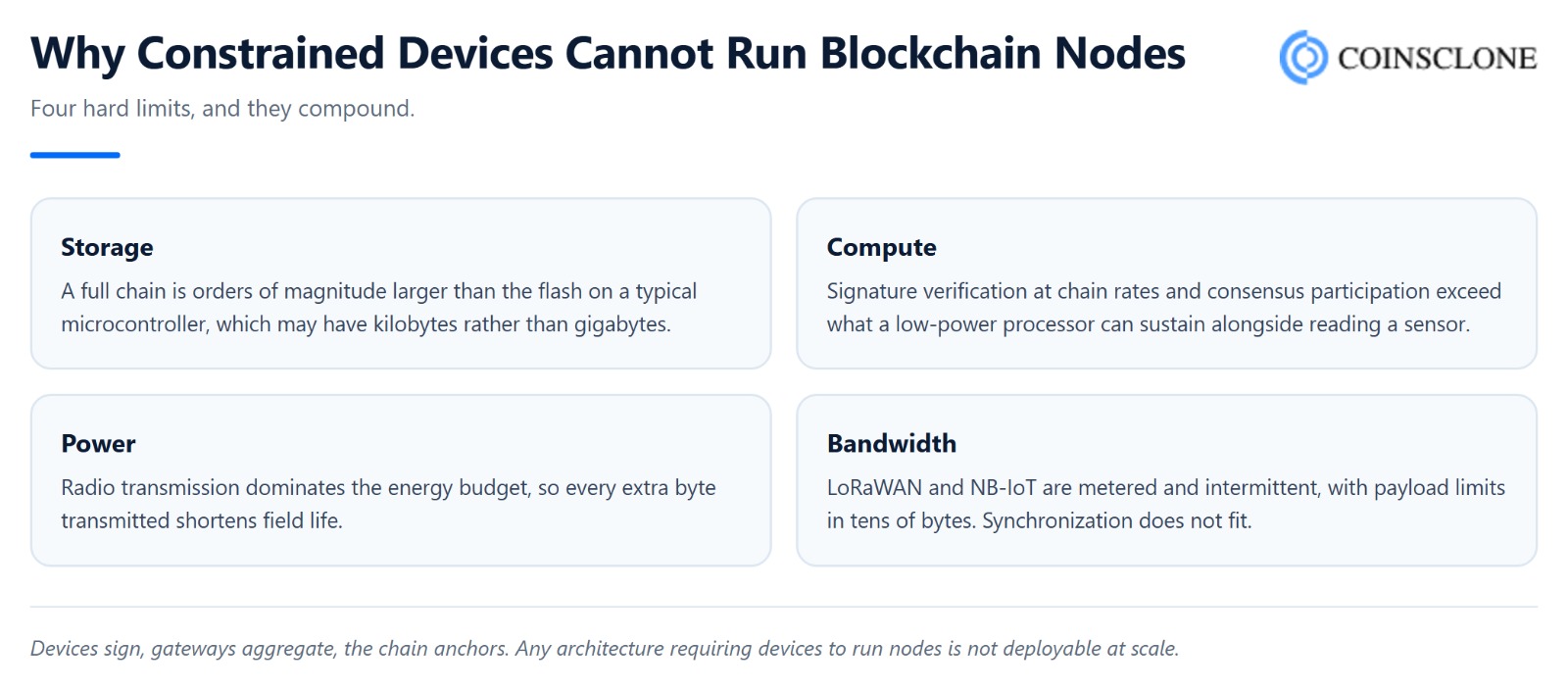
Four hard limits rule it out, and they compound.
Storage. A full chain is orders of magnitude larger than the flash memory available on a typical microcontroller, which may have kilobytes rather than gigabytes. Even light client state is often too large.
Compute. Signature verification at chain rates and consensus participation exceed what a low-power processor can sustain alongside its actual job, which is usually reading a sensor.
Power. Battery-operated devices cannot afford continuous networking and cryptographic work. Radio transmission typically dominates the energy budget, so every extra byte transmitted shortens field life.
Bandwidth. Constrained networks such as LoRaWAN and NB-IoT are metered, intermittent and often very low rate, with payload limits measured in tens of bytes. Chain synchronization is not merely slow, it is architecturally impossible within those frames.
The design answer follows directly. Devices sign, gateways aggregate, the chain anchors. Any architecture requiring devices to run nodes is not deployable at scale, and a vendor proposing one has not costed the radio budget.
What Does a Workable Architecture Look Like?
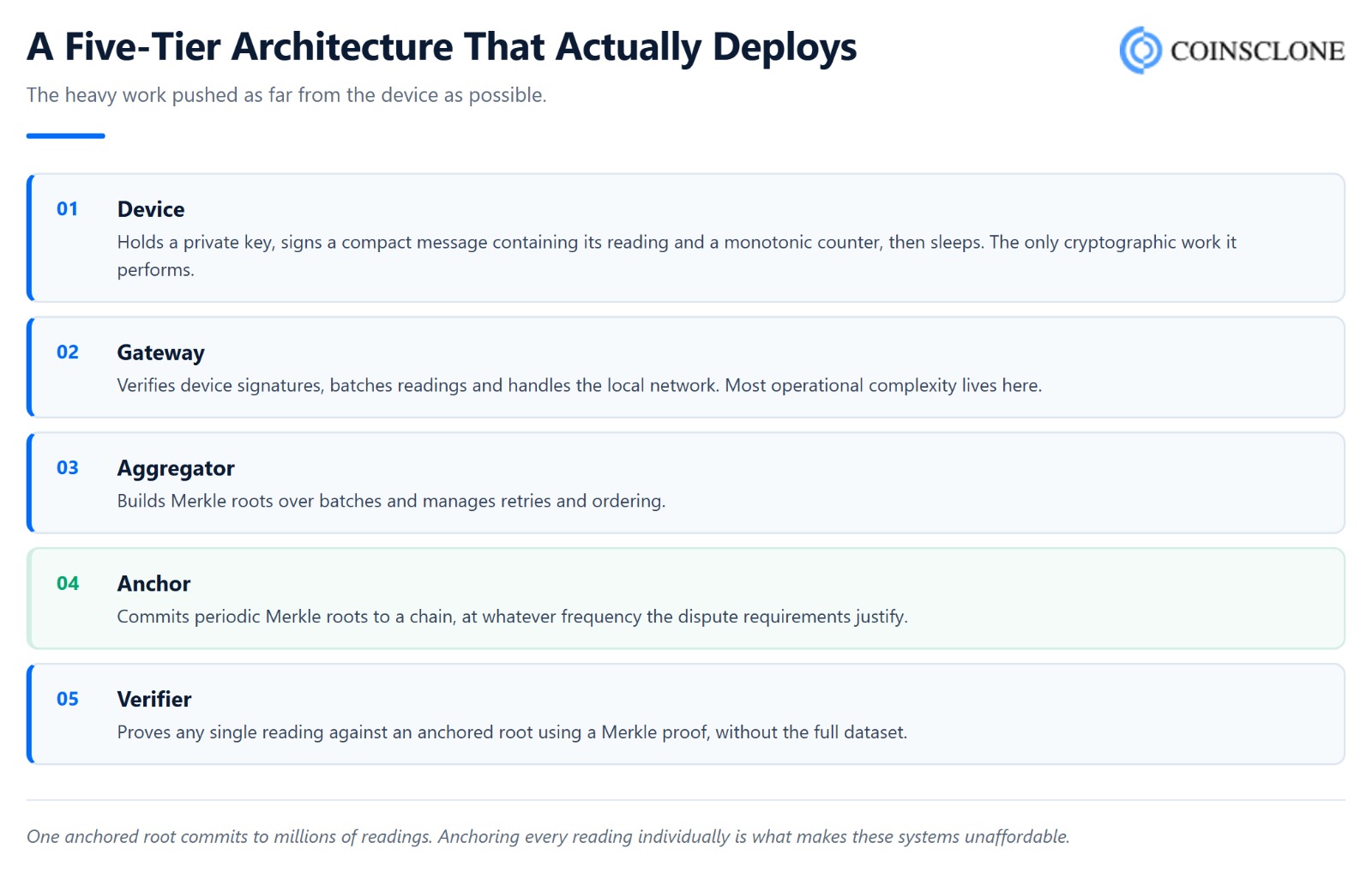
Five tiers, with the heavy work pushed as far from the device as possible.
Device. Holds a private key, signs a compact message containing its reading and a monotonic counter, then returns to sleep. This is the only cryptographic work it performs. The counter matters more than it looks: without it, a replayed message is indistinguishable from a fresh one.
Gateway. Verifies device signatures, batches readings and handles the local network. Most of the operational complexity lives here.
Aggregator. Builds Merkle roots over batches and manages retries and ordering.
Anchor. Commits periodic Merkle roots to a chain, at whatever frequency the dispute requirements justify.
Verifier. Proves any single reading against an anchored root using a Merkle proof, without needing the full dataset or the cooperation of whoever collected it.
Why Does Merkle Anchoring Make the Economics Work?
This is the mechanism that turns an unaffordable idea into a cheap one, and it is worth understanding rather than taking on faith.
Readings are hashed in pairs, those hashes are hashed in pairs, and the process repeats until a single root value remains. That one root commits to every reading beneath it. Change any single reading anywhere in the set and the root changes, which is the same avalanche property that makes hashing secure for a blockchain in the first place.
The consequence is a cost structure that barely grows. Proving a reading belongs to a set of one million requires roughly twenty hashes, because each level of the tree halves the remaining candidates. Doubling the dataset adds one hash to the proof, not one to the cost of anchoring.
So a single on-chain write can commit to millions of readings, and the per-reading anchoring cost falls toward zero as the batch grows. Anchoring every reading individually is the mistake that makes these systems unaffordable, and it is the most common error in first designs.
What Does This Actually Protect Against?
Precision matters here, because security claims in this area are frequently overstated by people selling them.
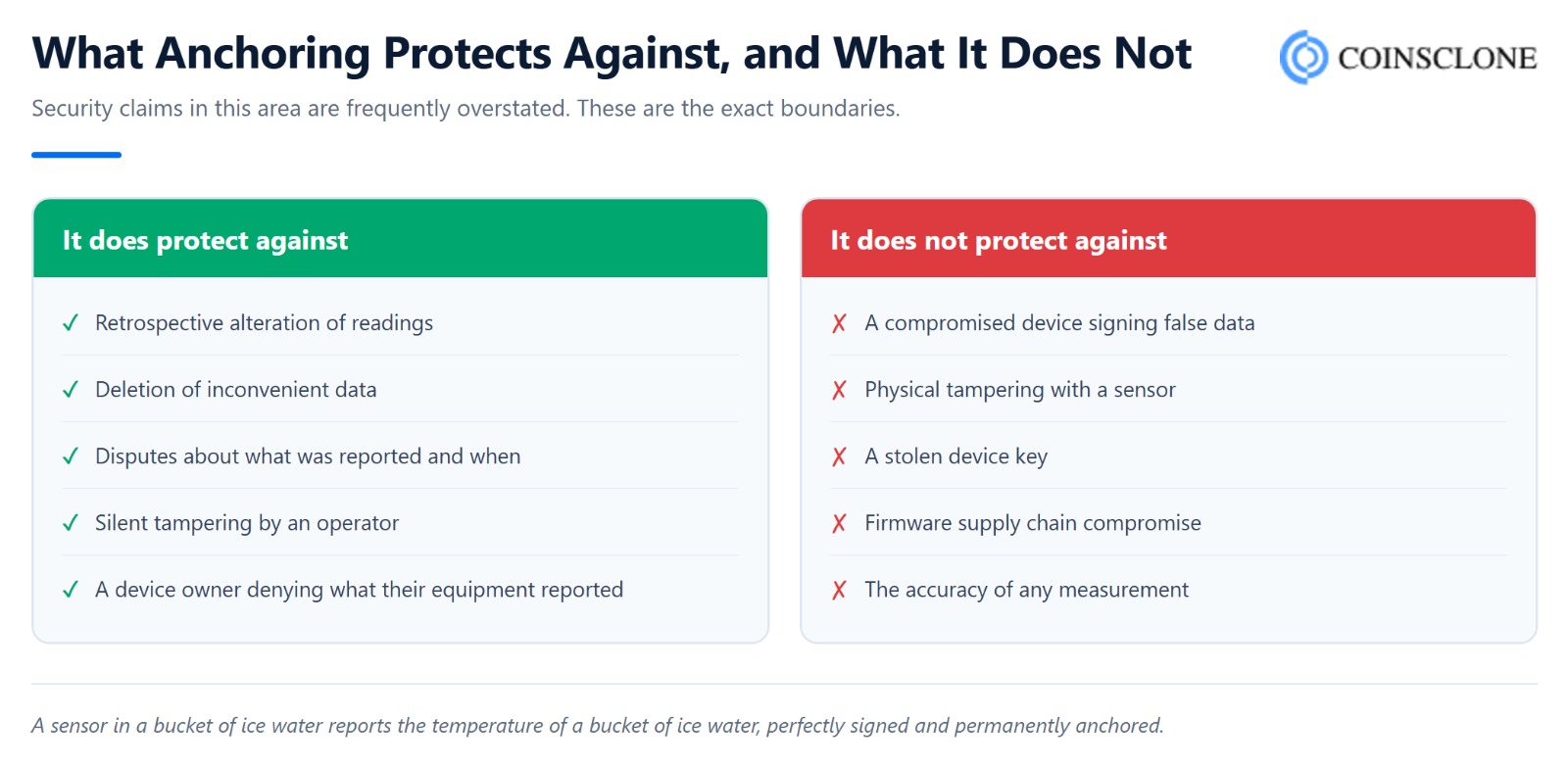
It does protect against retrospective alteration of readings, deletion of inconvenient data, disputes about what was reported and when, silent tampering by an operator, and repudiation by a device owner who later denies what their equipment reported.
It does not protect against a compromised device signing false data, physical tampering with a sensor, a stolen device key, firmware supply chain compromise, or anything at all about the accuracy of a measurement.
This is the oracle problem in a different setting. The system provides strong guarantees about the record after signing and no guarantees about what happened before it. A sensor sitting in a bucket of ice water reports the temperature of a bucket of ice water, perfectly signed and permanently anchored.
Key storage on the device is the weakest link in the chain, which is why secure elements cost more and are usually worth it.
Which Signature Scheme and Key Storage Should You Use?
These two choices constrain everything else, and they are firmware decisions before they are security preferences.
On signatures, Ed25519 is the common default for constrained hardware. Signatures are 64 bytes, keys are 32, verification is fast, and the scheme is deterministic, which removes an entire class of failure caused by weak random number generation on devices that have very little entropy available. ECDSA over secp256k1 is the alternative where native chain compatibility matters, at the cost of needing good randomness or careful deterministic implementation.
On key storage, there are three tiers and they define your threat model completely.
Plain flash is cheapest and offers essentially no resistance to an attacker with physical access. A dedicated secure element such as the Microchip ATECC608 family generates and holds the key so it never leaves the chip, adding a small per-unit cost. A trusted execution environment such as ARM TrustZone on a more capable processor isolates key material in software with hardware backing.
If devices will be physically accessible to anyone with an interest in falsifying data, and in most deployments they will be, plain flash storage means the entire system inherits the security of a device someone can put in their pocket.
How Much Does Anchoring Cost?
Less than teams expect, because the cost driver is the number of anchoring transactions rather than the volume of data.
Three variables set the bill. Anchoring frequency determines how many on-chain writes you make, and it is the only one you control freely. Chain selection sets the price of each write, which is why cost per commit matters far more here than throughput. Batch size is effectively free scaling, since one root commits to whatever you put under it.
The useful way to scope this is to work backwards from the dispute requirement. If a contested reading must be provable within twenty-four hours, daily anchoring is sufficient and the annual cost is 365 transactions. If it must be provable within an hour, that becomes 8,760. Neither is a large number, and the difference between them is a business decision about dispute latency rather than an engineering one.
Open timestamping services that batch across many users and anchor to Bitcoin push the marginal cost lower still, at the price of accepting their aggregation schedule rather than setting your own.
Which Design Decisions Decide Feasibility?
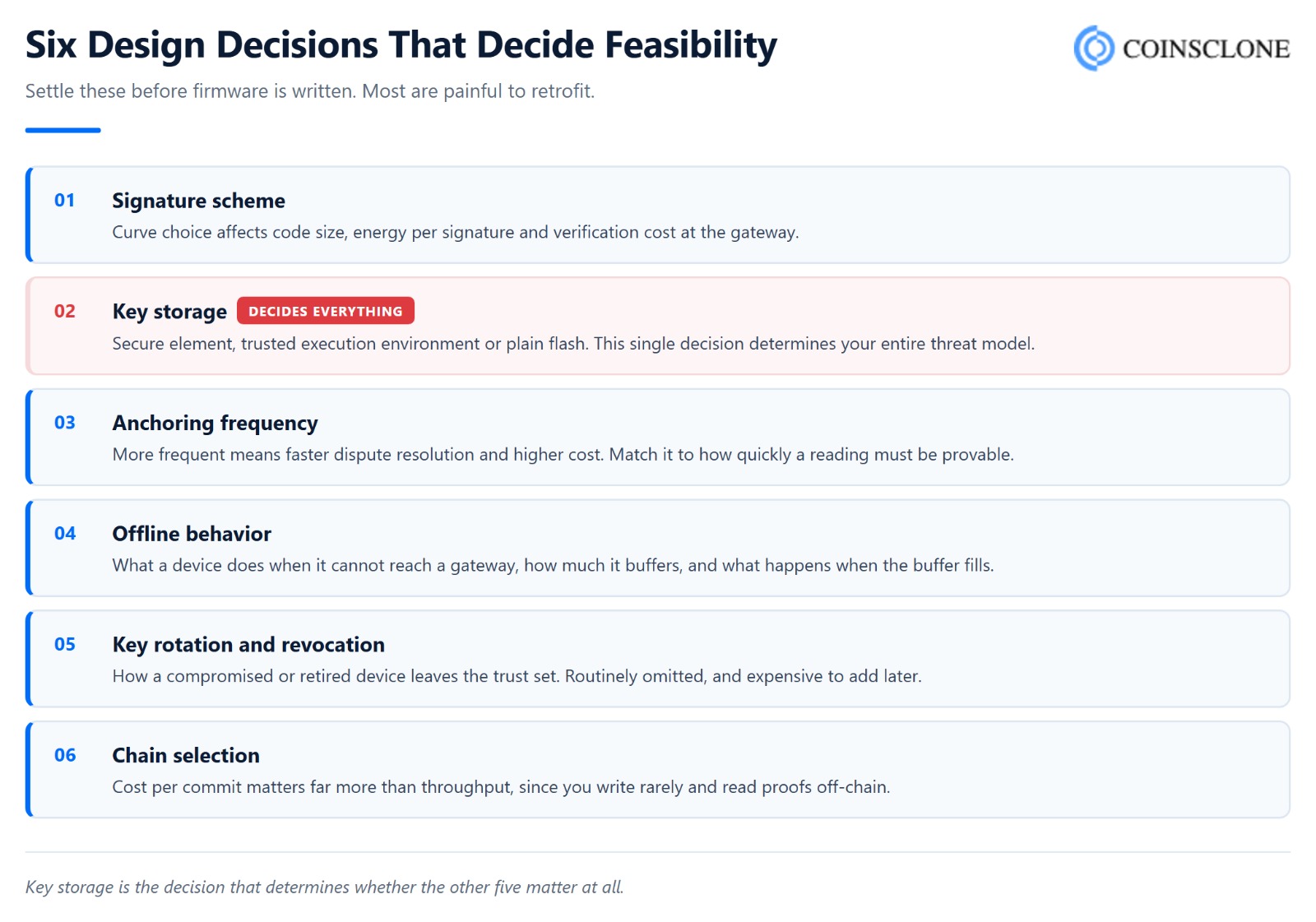
Six, and they are best settled before firmware is written because most are painful to retrofit.
Signature scheme. Curve choice affects code size, energy per signature and verification cost at the gateway.
Key storage. Secure element, trusted execution environment or plain flash. This single decision determines your entire threat model.
Anchoring frequency. More frequent anchoring means faster dispute resolution and higher cost. Match it to how quickly a disputed reading actually needs to be provable.
Offline behavior. What a device does when it cannot reach a gateway, how much it buffers, and what happens when the buffer fills. Silent data loss during outages undermines the record you are building.
Key rotation and revocation. How a compromised or retired device is removed from the trust set. Routinely omitted from designs, and expensive to add later.
Chain selection. Anchoring cost per commit matters far more than throughput, since you write rarely and read proofs off-chain.
Key storage is the decision that determines whether the other five matter at all.
Conclusion
Lightweight blockchain security for constrained devices works when the chain does the smallest possible job: anchoring periodic Merkle roots that make a body of device data tamper-evident. Devices sign and sleep, gateways carry the operational load, and one anchor commits to enormous numbers of readings.
Be precise with stakeholders about what this guarantees. It protects the record after signing and says nothing about whether the device told the truth. Get key storage right and the rest of the design follows. Get it wrong and every other control is decoration.
Coinsclone builds enterprise-grade Web3 platforms including IoT data anchoring and device attestation systems, enterprise consortium networks, crypto exchanges, wallets, payment gateways and RWA tokenization, using customizable white-label solutions. Talk to our blockchain experts for a free consultation and a live demo.
FAQ
Q: Can IoT devices run blockchain nodes?
No, not practically. A full chain exceeds the flash memory of a typical microcontroller, consensus participation exceeds low-power compute budgets, continuous networking drains batteries, and constrained networks such as LoRaWAN and NB-IoT lack the bandwidth and payload size for synchronization. Devices should sign messages while gateways and aggregators handle everything else.
Q: How does lightweight blockchain security work?
Devices sign compact messages containing readings and return to sleep. Gateways verify signatures and batch readings. An aggregator builds Merkle roots over batches. Only periodic roots are anchored on-chain. Any single reading can later be proved against an anchored root using a Merkle proof.
Q: What does anchoring actually prove?
That a specific body of data existed in a specific form at the time of anchoring and has not been altered since. It does not prove the readings were accurate, that the device was not compromised, or that the sensor was not physically tampered with before signing.
Q: What is a Merkle proof and why does it matter here?
A short chain of hashes proving one reading belongs to an anchored set. Proving membership in a set of a million takes roughly twenty hashes, because each tree level halves the candidates. This is what lets a single on-chain write commit to millions of readings and keeps the per-reading cost near zero.
Q: What is the weakest point in this architecture?
Key storage on the device. If a private key can be extracted from flash memory, an attacker can sign arbitrary false readings that the entire system will accept as genuine. A secure element that generates and holds the key on-chip, or a trusted execution environment, is usually justified.
Q: Which signature scheme is best for constrained devices?
Ed25519 is the common default: compact keys and signatures, fast verification, and deterministic signing that removes the risk of weak randomness on devices with little entropy. ECDSA over secp256k1 is the alternative where native chain compatibility matters more than firmware simplicity.
Q: How often should data be anchored?
As often as your dispute requirements justify and no more. Work backwards from how quickly a contested reading must be provable. A twenty-four hour requirement means 365 anchoring transactions a year, which is a negligible cost. Anchoring every reading individually is almost never economically sensible.
Q: Which blockchain suits device anchoring?
One where cost per commit is low and predictable, since you write rarely and read proofs off-chain. Throughput matters far less than for transactional applications, because a single anchored Merkle root can commit to millions of individual readings.
Q: How do you handle a compromised device?
Through key rotation and revocation designed in from the start: a registry of valid device keys, a documented process for removing one from the trust set, and a clear position on how readings signed before revocation are treated. Retrofitting this is painful, which is why it belongs in the first design rather than the second.
Q: Does this make IoT data trustworthy?
It makes IoT data tamper-evident, which is different. The record cannot be quietly altered after signing, and that is genuinely valuable in disputes. Whether the reading was correct at the moment of signing depends on device integrity, sensor calibration and physical security, none of which a ledger can observe.