
Hashing is the single mechanism that makes blockchain history tamper-evident, and it is also the most commonly misunderstood part of the stack. It is not encryption, it does not hide anything, and it does not prove who wrote a record. What it does is more specific and more useful: it produces a fingerprint that changes completely if a single character of the input changes, which turns a chain of blocks into a structure where old history cannot be quietly rewritten. This guide shows that mechanism with real values, covers where hashing appears across a blockchain, explains how it differs from encryption and signatures, and sets out what it deliberately does not protect against.
What Is a Cryptographic Hash?
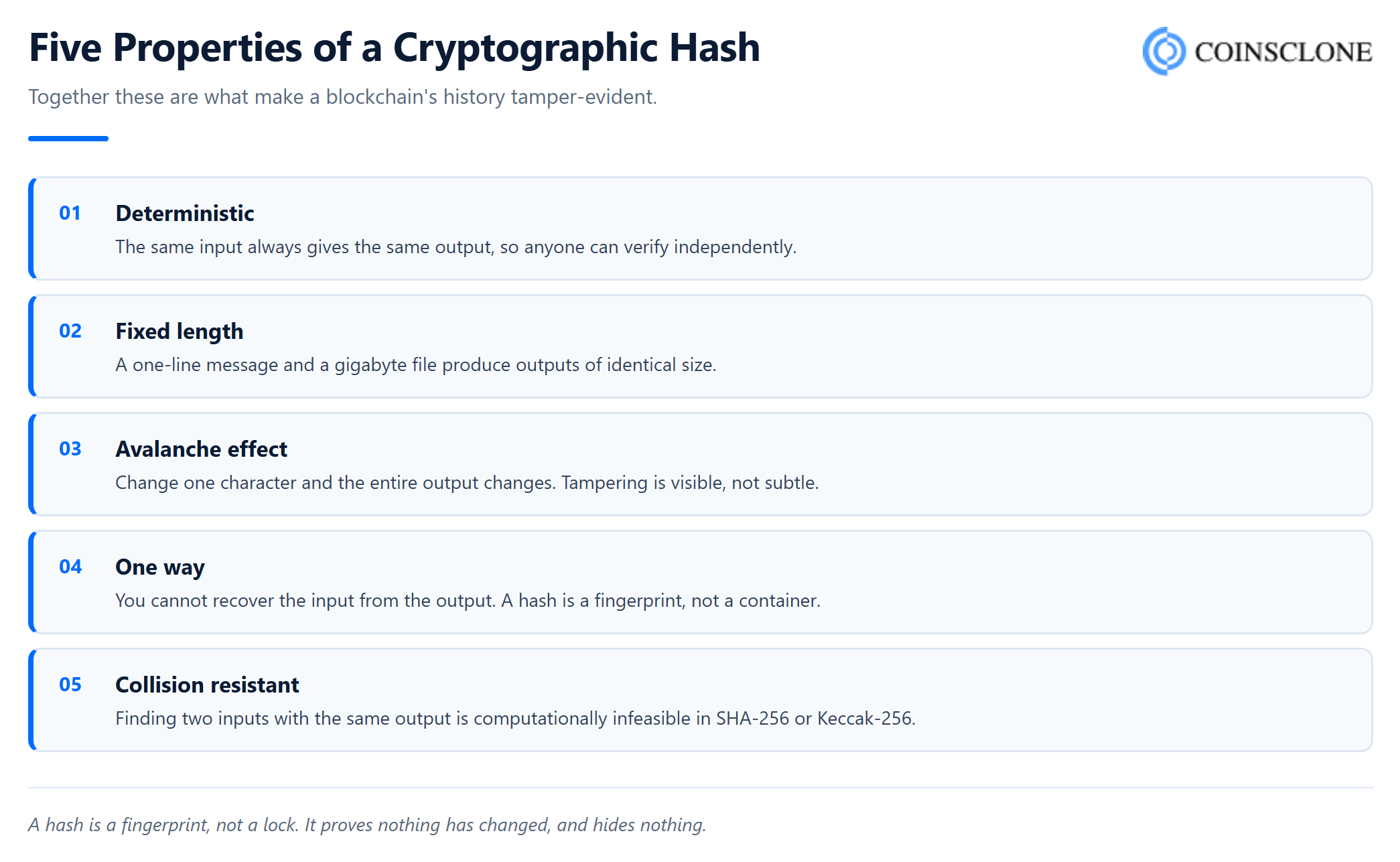
A cryptographic hash function takes any input and produces a fixed-length output. Five properties make it useful for security.
Deterministic. The same input always produces the same output, so any party can verify a result independently without coordinating with anyone.
Fixed length. A one-line message and a gigabyte file produce outputs of identical size, which makes storage and comparison cheap.
Avalanche effect. Changing one character changes the entire output, so tampering is immediately visible rather than subtle.
One way. You cannot recover the input from the output. This is why a hash is a fingerprint rather than a container.
Collision resistant. Finding two different inputs that produce the same output is computationally infeasible with modern functions such as SHA-256 or Keccak-256.
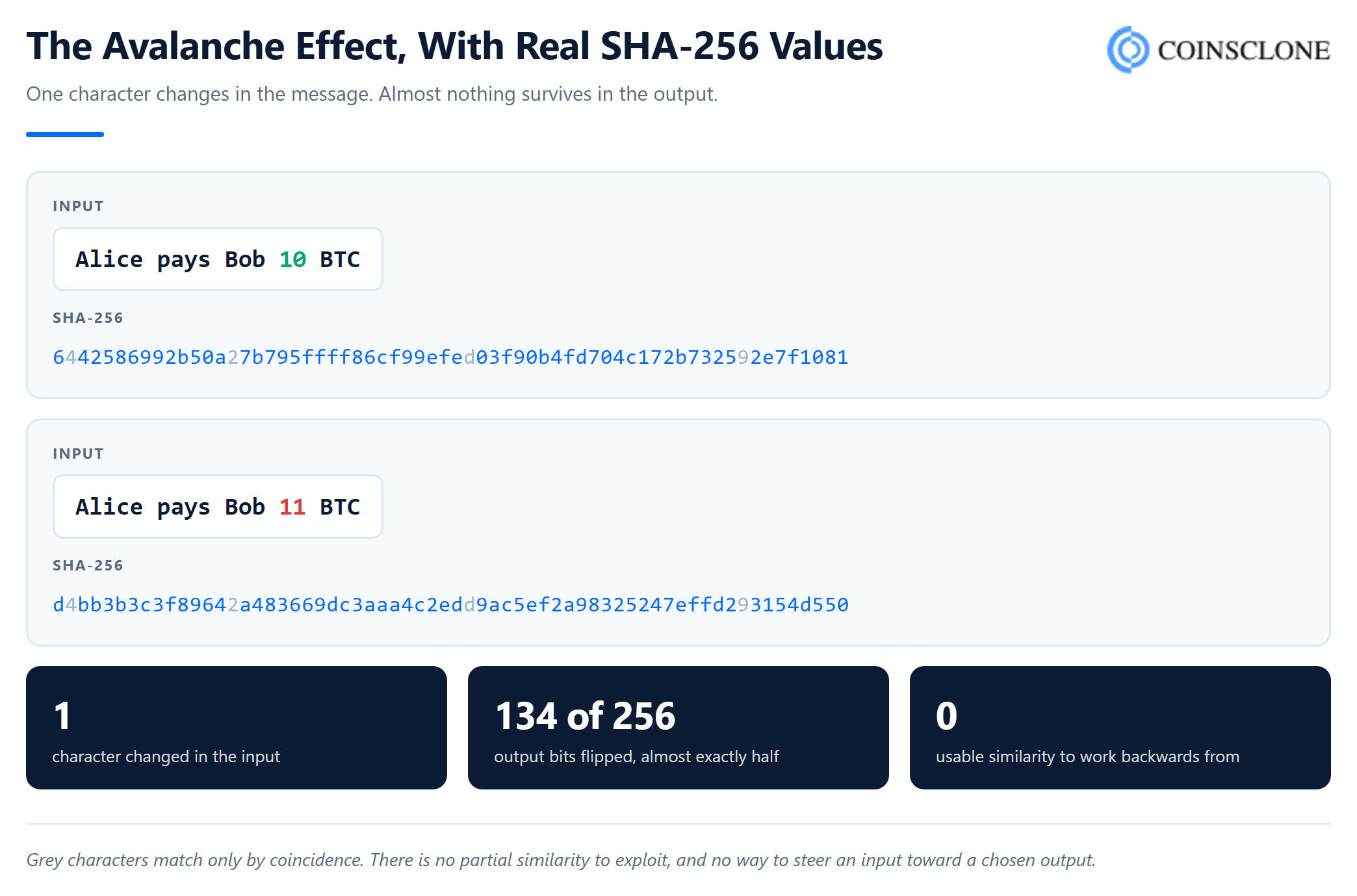
The avalanche property is the one worth seeing rather than reading about. Here are two nearly identical statements and their real SHA-256 hashes:
Alice pays Bob 10 BTC
6442586992b50a27b795ffff86cf99efed03f90b4fd704c172b732592e7f1081
Alice pays Bob 11 BTC
d4bb3b3c3f89642a483669dc3aaa4c2edd9ac5ef2a98325247effd293154d550
One character changed. The outputs share nothing recognizable: 134 of the 256 bits differ, which is almost exactly the half you would expect from a well-designed function. There is no partial similarity to work backwards from, and no way to nudge the input toward a desired output. That is what makes tampering detectable rather than negotiable.
How Do Hashes Chain Blocks Together?
This is the mechanism that gives a blockchain its name and its central security property.
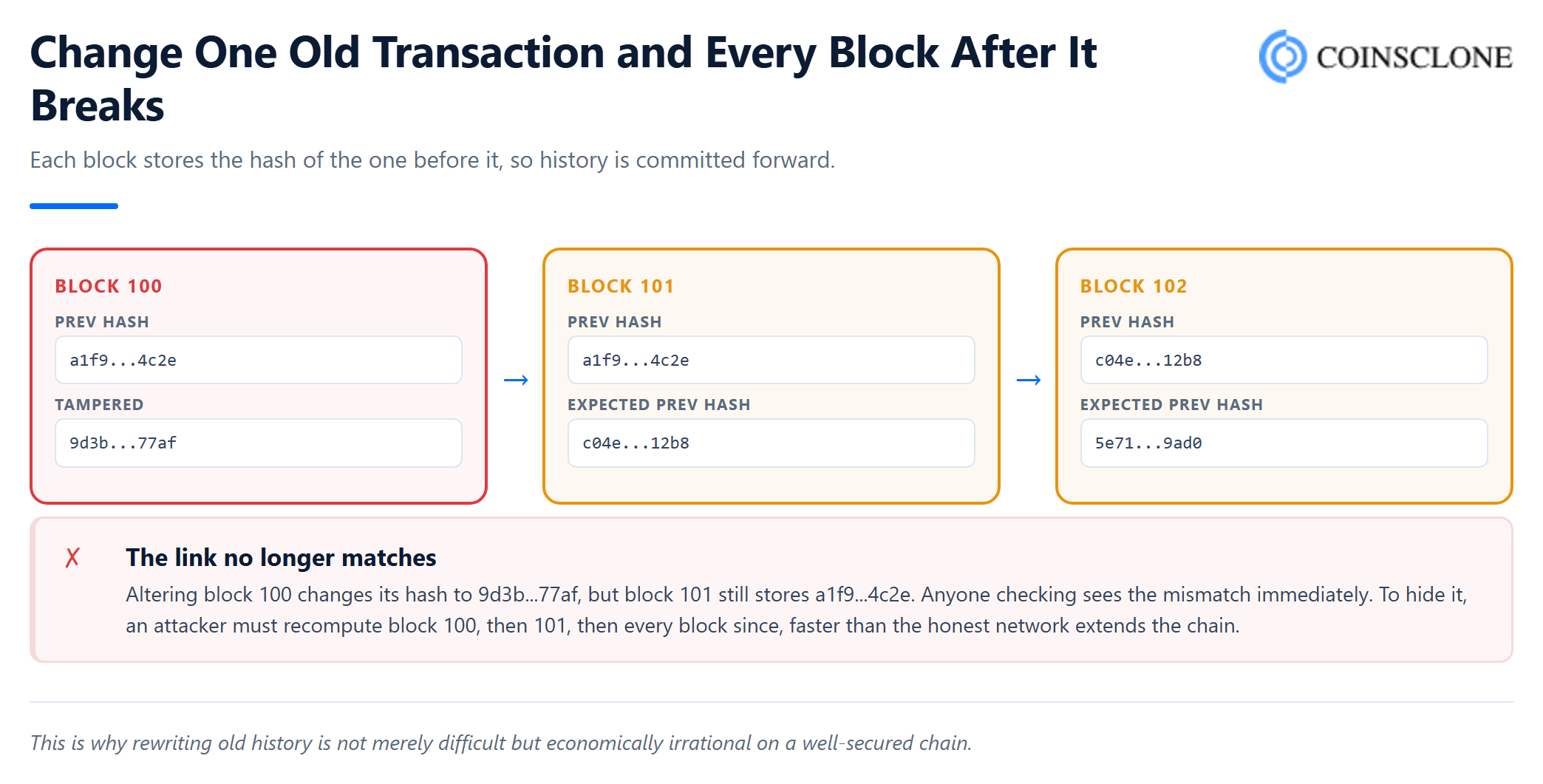
Each block contains a set of transactions and a field holding the hash of the previous block. Block 101 stores block 100’s hash. Block 102 stores block 101’s hash. The chain runs back to the first block, the genesis block, which is the only one with no predecessor to point at.
Now suppose someone alters a single transaction in block 100. That block’s contents change, so its hash changes completely, as the example above showed. But block 101 still stores the old hash, so the link no longer matches and the tampering is detectable by anyone checking. To make the change stick, an attacker would have to recompute block 100’s hash, then block 101’s, then every block after it, and do so faster than the honest network extends the chain.
That is why altering old history is not merely difficult but economically irrational on a well-secured chain. The cost is not one recomputation. It is every recomputation since, performed against a network that is still moving.
What Is SHA-256, and Which Blockchains Use It?
SHA-256 is a member of the SHA-2 family of hash functions, standardized by NIST, producing a 256-bit output usually written as 64 hexadecimal characters. It is the most widely deployed hash function in blockchain and the one behind every example above.
Different chains made different choices, and the differences are worth knowing.
Bitcoin uses SHA-256, applied twice for block hashing and for Merkle tree construction, a construction usually written as SHA-256d. Addresses combine SHA-256 with RIPEMD-160 to produce a shorter value.
Ethereum uses Keccak-256, which is closely related to but not identical with the final SHA-3 standard. Ethereum adopted Keccak before NIST finalized the padding scheme, so code that calls Ethereum’s function “SHA-3” is a common and confusing mislabel.
The practical implication is that hash choice is a protocol-level decision with long consequences. A chain cannot swap its hash function without a hard fork, because every historical block commits to the previous one under the original algorithm.
Where Is Hashing Used in a Blockchain?
Hashing does five distinct jobs, and confusing them causes most of the misunderstanding around this topic.
Block linking. Each block stores the previous block’s hash, creating the ordered, tamper-evident chain described above.
Merkle trees. Transactions are hashed in pairs, then those hashes are hashed in pairs, repeatedly, until a single root remains. That one value commits to thousands of transactions, which is what lets a light client verify that a specific transaction is included without downloading the entire chain. Verification takes a number of hashes proportional to the depth of the tree rather than the number of transactions in it.
Addresses. Public keys are hashed to produce shorter addresses, which also means the full public key is not revealed until funds are spent.
Proof of work. Miners search for an input that produces a hash below a target value. There is no shortcut, which is precisely what makes the work costly and the security real.
Data integrity for off-chain files. Storing a document’s hash on-chain lets anyone later prove that a file has not been altered, without putting the file itself on a public ledger.

Hashing vs Encryption vs Digital Signatures: What Is the Difference?
These three get used interchangeably in casual writing and they solve three entirely different problems. Conflating them is the source of most security mistakes in this area.
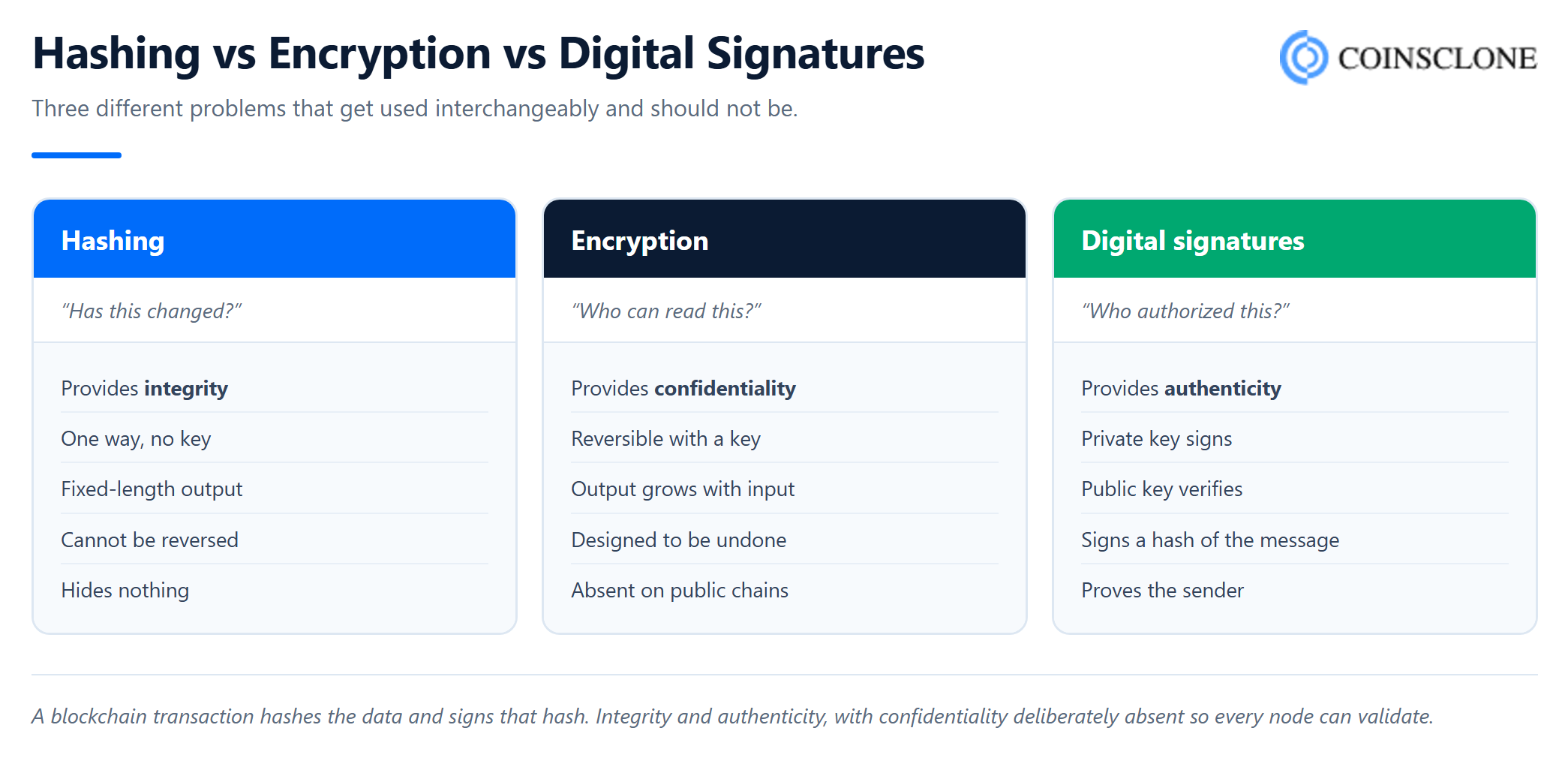
Hashing provides integrity. It answers “has this changed?” It is one way, takes no key, and produces a fixed-length fingerprint. You cannot reverse it and you cannot use it to hide anything.
Encryption provides confidentiality. It answers “who can read this?” It is reversible with the correct key, and the output length grows with the input. Nothing on a public blockchain is encrypted by default.
Digital signatures provide authenticity. They answer “who authorized this?” A signature is produced with a private key over a hash of the message, and anyone holding the public key can verify it. This is the piece that proves a transaction came from the account holder.
A blockchain transaction uses two of the three together. The transaction data is hashed, and that hash is signed with the sender’s private key. Integrity comes from the hash, authorization comes from the signature, and confidentiality is absent by design because the network needs every participant to be able to validate the transaction.
Has a Cryptographic Hash Function Ever Been Broken?
Yes, which is exactly why algorithm choice matters and why “collision resistant” is a claim with a shelf life rather than a permanent guarantee.
MD5 was widely deployed through the 1990s and practical collisions were demonstrated in the mid 2000s. It is now unsuitable for any security purpose, though it survives as a checksum for detecting accidental corruption.
SHA-1 was the successor and lasted longer. In 2017, researchers from Google and CWI Amsterdam published the first practical collision, producing two different PDF files with the same SHA-1 hash. Later work reduced the cost further and produced chosen-prefix collisions, which are considerably more dangerous.
SHA-256 and Keccak-256 have no known practical attacks. They are built differently from their predecessors, and Keccak in particular uses a sponge construction rather than the Merkle-Damgard design that MD5 and SHA-1 share.
The lesson is not that hashing is fragile. It is that a hash function’s security is a claim about the current state of cryptanalysis, and the transition away from a weakened function takes years. For a blockchain, where the algorithm is baked into every historical block, that transition is a hard fork rather than a configuration change.
Are Blockchain Hashes Safe From Quantum Computers?
Hashing is the part of blockchain cryptography least threatened by quantum computing, and the distinction from signatures is the whole point.
Grover’s algorithm offers a quadratic speedup for searching, which effectively halves the security level of a hash function. SHA-256 would drop from 256-bit to roughly 128-bit security against a sufficiently large quantum computer. That is still comfortably beyond reach, and the practical response is to use longer outputs rather than to abandon hashing.
Shor’s algorithm is the real problem, and it does not touch hashes at all. It breaks the elliptic curve cryptography behind digital signatures, which is what secures ownership of funds. A sufficiently capable quantum computer would let an attacker derive a private key from a published public key.
This produces a conclusion most coverage gets backwards. The hash-linked history of a blockchain is comparatively robust. The signatures that prove who owns what are the exposure. NIST published its first post-quantum cryptography standards in 2024, and notably one of them is a hash-based signature scheme, which uses the quantum resistance of hashing to shore up the part that is actually vulnerable.
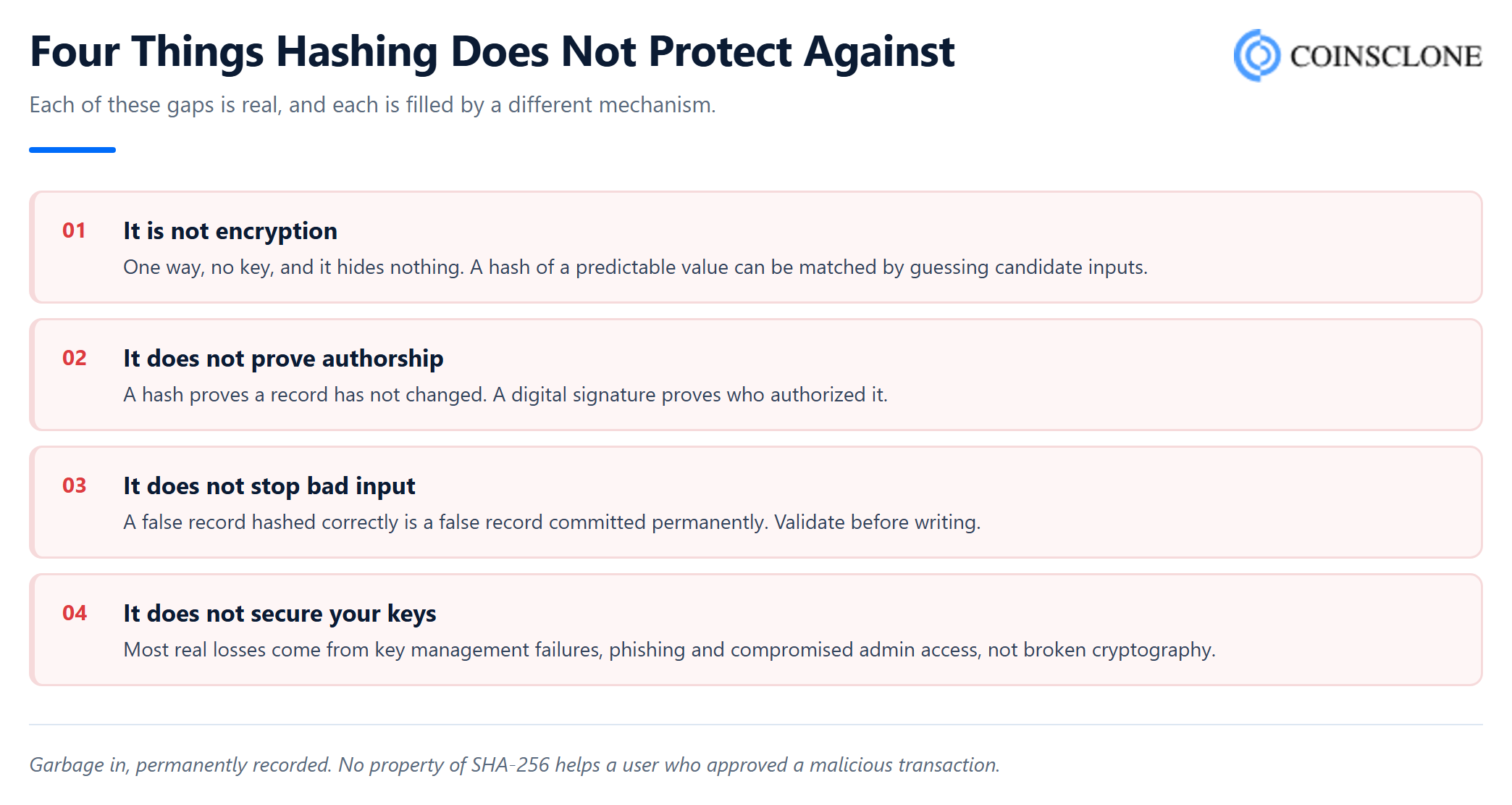
What Does Hashing Not Protect Against?
Four misconceptions that create genuine security gaps.
Hashing is not encryption. It is one way and there is no key to reverse it. Data written to a public chain remains readable to everyone, so hashing a record does not make it private. If the underlying values are predictable, an attacker can simply hash candidate values until one matches, which is why personal data should generally not go on-chain at all.
It does not prove authorship. That is the job of digital signatures. A hash proves a record has not changed; a signature proves who authorized it.
It does not stop bad input. A false record hashed correctly is a false record permanently committed to an immutable ledger. Validate data before it reaches the chain, because you cannot quietly correct it afterwards.
It does not secure your keys. The overwhelming majority of real-world losses come from key management failures, phishing and compromised admin access rather than from broken cryptography. No property of SHA-256 helps a user who approved a malicious transaction.
Conclusion
Hashing is what converts a list of records into a structure where the past cannot be quietly edited. It works because the function is deterministic, one way and exquisitely sensitive to change, and because each block commits to the one before it. Change one character in an old transaction and 134 of 256 bits move, breaking every link that follows.
Understanding the limits matters just as much. Hashing proves integrity, signatures prove authorship, encryption provides confidentiality, and none of the three substitutes for disciplined key management. The systems that hold up in production are the ones that treat those as separate concerns and solve each of them deliberately.
Coinsclone builds enterprise-grade Web3 platforms including crypto exchanges, wallets, DEXs, NFT marketplaces, payment gateways and RWA tokenization, using customizable white-label solutions. Talk to our blockchain experts for a free consultation and a live demo.
FAQ
Q: How does a hash help secure blockchain technology?
A hash produces a fixed-length fingerprint of data that changes entirely if the data changes. Each block stores the previous block’s hash, so altering any earlier transaction changes that block’s hash and breaks the link to every block after it. Detecting tampering therefore requires only comparing hashes, and rewriting history requires redoing all subsequent work faster than the network moves.
Q: What is a cryptographic hash function?
A function that takes any input and returns a fixed-length output with five useful properties: it is deterministic, produces fixed-length results, changes completely when the input changes, cannot be reversed to recover the input, and makes finding two inputs with the same output computationally infeasible. SHA-256 and Keccak-256 are common examples.
Q: What is SHA-256 and which blockchains use it?
SHA-256 is a hash function from the SHA-2 family standardized by NIST, producing a 256-bit output written as 64 hexadecimal characters. Bitcoin uses it, applied twice for block hashing and Merkle trees. Ethereum uses Keccak-256 instead, which is closely related to but not identical with the final SHA-3 standard.
Q: Is hashing the same as encryption?
No. Encryption is reversible with a key and provides confidentiality. Hashing is one way with no key and provides integrity. Digital signatures are a third thing again and provide authenticity. Hashing data does not hide it, which is why personal data should generally not be written to a public blockchain even in hashed form if the underlying values could be guessed.
Q: What is a Merkle tree and why does it matter?
A Merkle tree hashes transactions in pairs, then hashes those results in pairs repeatedly until one root hash remains. That single value commits to every transaction beneath it, which allows a light client to prove a specific transaction is included in a block without downloading the entire blockchain.
Q: How does hashing relate to proof of work?
In proof of work, miners repeatedly change an input value searching for a hash below a target threshold. Because hash functions have no shortcut, the only method is trial and error, which makes the work genuinely costly. That cost is what secures the chain against rewriting.
Q: Can a blockchain hash be reversed or cracked?
Not practically with modern hash functions. MD5 and SHA-1 have both been broken by collision attacks, but SHA-256 and Keccak-256 have no known practical attacks. In real terms, blockchain losses come from compromised private keys, flawed smart contracts and social engineering rather than broken hashing.
Q: Are blockchain hashes safe from quantum computers?
Comparatively, yes. Grover’s algorithm would effectively halve a hash function’s security, taking SHA-256 to roughly 128-bit strength, which remains secure. The real quantum exposure is Shor’s algorithm breaking the elliptic curve signatures that prove ownership, not the hashes that link blocks together.
Q: Does hashing make data on a blockchain private?
No. Hashing provides integrity, not confidentiality. Data written to a public chain is visible to everyone, and a hash of a predictable value can often be matched by guessing candidate inputs. Sensitive information should be kept off-chain, with only a hash stored on-chain to prove the off-chain record has not been altered.
Q: What is the avalanche effect?
The property that a small change to the input produces a completely different output. Changing one character in “Alice pays Bob 10 BTC” to “11 BTC” changes 134 of the 256 output bits, roughly half, with no recognizable similarity between the two hashes. This is what makes tampering immediately visible.