

Flash loan arbitrage bot development is the work of building software that borrows crypto with no collateral, trades it on two or more exchanges where the price differs, and pays the loan back in the same step. If the trade cannot repay the loan, the whole thing is undone. That one rule is what makes the model so attractive to startups and traders who do not have large capital.
This guide explains how these bots work, where they borrow from and what each source charges, how to build one step by step, and which features and tech stack you need. It also shows the real profit math with a worked example, the risks most guides skip, and what a build costs in 2026, so you can decide whether to build and what to ask your team.
In this guide:
- How one flash loan arbitrage trade works, from scan to repay
- Where bots borrow in 2026 and what Aave, Uniswap and Sky charge
- A 7-step build plan, the tech stack and the features that matter
- Worked numbers that show where a price gap goes before you keep any profit
- Market cost ranges for basic, mid-level and multi-chain bots
See How Our Flash Loan Arbitrage Bot Can Multiply Your Profits — Fast!
DeFi automation — done smarter.
- Plug & Play Bot: Deploy on major DEXs in minutes.
- AI-Powered Scans: Finds real-time arbitrage opportunities 24/7.
- Zero Capital Risk: Leverage flash loans, no upfront funds required.
- Custom Strategy: Tune parameters, tokens, and gas limits easily.
Get a free live demo of your arbitrage bot — fully branded and running within 48 hours.
Book a Free Demo and see how our Flash Loan Arbitrage Bot can start generating profits in 8-12 weeks, not months.
What Is Flash Loan Arbitrage Bot Development?
Flash loan arbitrage bot development means building a bot that spots price gaps for the same asset and profits from them with loans that need no collateral, called flash loans. A flash loan has to be borrowed and repaid inside one blockchain transaction. Because of that, the lender takes no risk, and the borrower needs no collateral.
The bot itself has two parts. An off-chain program watches prices, sizes each trade and tests it before sending. An on-chain smart contract borrows the funds, makes the swaps and repays the loan. Both parts must be fast, cheap to run and secure, because thousands of other bots are chasing the same gaps.
That is why new startups and established trading firms both invest in flash loan arbitrage bot development. With a skilled team, you can build one of the best crypto arbitrage bots on the market and tune it for your own strategy. First, though, it helps to see what happens inside a single trade.
How Does a Flash Loan Arbitrage Bot Work?
Every flash loan arbitrage bot follows the same loop. The off-chain side finds and checks a trade. Then the on-chain side runs it as one atomic transaction: every step works together, or nothing happens at all.
- Scan: The bot reads prices from DEX pools and the mempool on every new block.
- Size and simulate: It picks the most profitable trade size and runs the trade on a copy of the live chain (a mainnet fork) first.
- Send privately: It sends the trade as a bundle or private transaction, so other bots cannot copy it.
- Borrow: The smart contract takes a flash loan from a lending pool or DEX.
- Buy low, sell high: It buys the asset on the cheaper pool and sells it on the dearer one.
- Repay: It returns the loan plus the fee and keeps what is left.
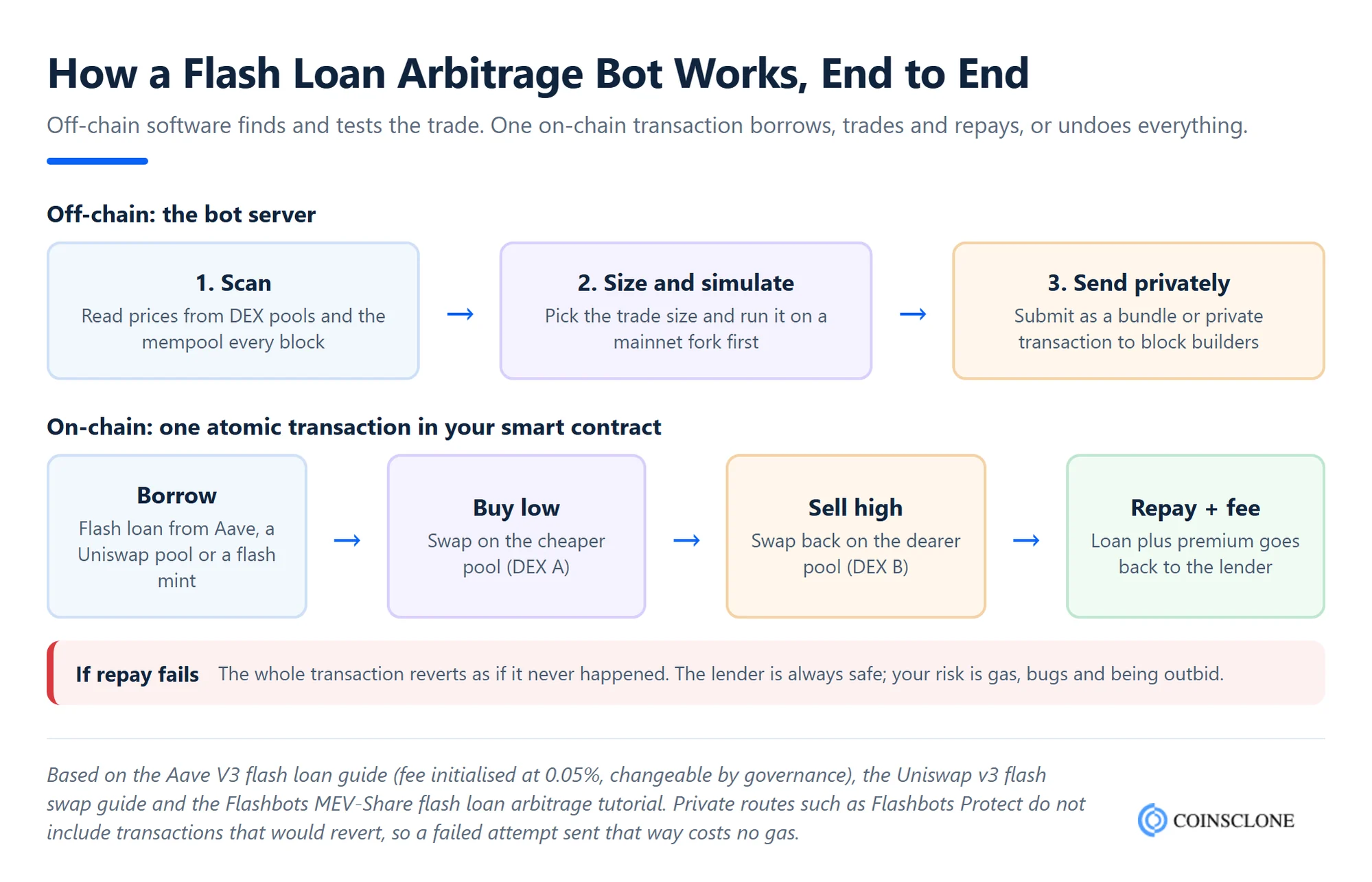
If the repayment fails at step 6, the blockchain reverts the whole transaction as if it never happened. The lender is always safe. Your real risks are gas fees, bugs in your contract and being outbid by faster bots.
Where Can a Flash Loan Bot Borrow in 2026?
The loan source sets your fee and how much you can borrow. Here are the main options and what they charge today.
| Flash loan source | Fee | What to know |
| Aave V3 | 0.05% by default | The Aave flash loan guide says the fee starts at 0.05% and governance can change it, so read the live value from the pool contract |
| Uniswap v3 pools | The pool’s swap fee tier | The Uniswap v3 flash swap guide says you repay the amount plus the pool fee by the end of the transaction |
| Uniswap v4 | Settled through flash accounting | v4 tracks balances as deltas and only moves tokens at the end, which cuts gas on routes across many pools |
| Sky (formerly MakerDAO) flash mint | Set by governance | The flash mint module mints stablecoins up to a ceiling and charges a fee set by votes |
| Balancer | Being wound down | The wind-down was approved on 29 Sept 2026 and pools become withdrawal-only from 30 Oct 2026, so do not build new strategies on it |
Many bots support more than one source. That way, the contract can pick the cheapest loan for each trade and keep working if one source pauses.
How to Develop a Flash Loan Arbitrage Bot?
You can develop a flash loan arbitrage bot in 7 clear steps. Each step reduces risk before real money moves.
Step 1: Get Expert Advice
Start with a call with your build team. Together, you check the market, the strategy, the chains you will target and the likely cost. Market research and competitor analysis also happen in this phase, so you know which gaps are still open.
Step 2: Prepare the Roadmap
Next, turn the research into a plan. Decide which DEXs, tokens and loan sources the bot will use, what the dashboards should show, and how you will measure success. Set clear milestones so the build does not drift.
Step 3: Gather Resources
In this phase, you finalise the tools and services the bot needs. These include node or RPC providers, mempool data feeds, cloud servers and any paid tools. Buying them early avoids delays later in the build.
Step 4: Inclusion of Features
After that, the team adds the admin and user dashboard features. These include bot controls, profit tracking, alerts, support and account settings. Security controls such as role-based access and a kill switch are added here too.
Step 5: Build the Bot
Now the developers build the smart contract, the bot engine and the dashboards. Most teams today write and test contracts with Foundry or Hardhat, and use Remix for quick checks. The contract must only accept calls from the loan provider it expects and only start loans that it started itself. These two checks block the most common flash loan callback attacks.
Step 6: Testing
Testing comes next. The team runs the bot against a mainnet fork, so it trades on real prices without real money. Peer reviews and a smart contract audit find bugs, gas waste and security holes early. Beta tests then confirm that the bot spots real gaps and works out profit correctly after every fee.
Step 7: Deployment
Finally, the contract is deployed on the target chains and linked to an operating wallet that pays gas. The bot engine runs on a reliable server close to your nodes, because speed decides who wins each trade. Live monitoring and alerts stay on from day one.
This is how a flash loan arbitrage bot is built in 7 steps. Following this process helps you launch a secure, efficient bot that protects profit and limits risk. Next, let us look at the tools behind it.
Tech Stack for Flash Loan Arbitrage Bot Development
The tech stack decides how fast your bot reacts and how safe it is. Here is a typical 2026 setup.
| Layer | Common choices | Why it matters |
| Smart contract | Solidity, Foundry or Hardhat, OpenZeppelin libraries | Runs the loan, swaps and repayment in one transaction |
| Bot engine | Rust or Go for speed; TypeScript (ethers.js, viem) or Python (web3.py) for faster builds | Finds gaps, sizes trades and builds transactions |
| Market data | Your own node or a premium RPC, plus mempool streams | Fresh prices every block; slow data means missed trades |
| Execution | Private bundles through block builders, such as Flashbots and MEV-Share | Keeps trades out of the public mempool, so they are not copied |
| Testing | Mainnet fork simulation, unit and fuzz tests | Proves profit after fees before any live trade |
| Monitoring | Dashboards, logs and alerts | Shows profit, failed trades and gas spend in real time |
It also helps to see how DEX aggregators guard against MEV, since the same ideas apply to your bot.
Which Blockchain Should Your Bot Run On?
Each chain changes your costs and your odds of winning a trade.
- Ethereum: It has the deepest liquidity and the largest loan pools. However, it also has the most skilled bots, so you compete on speed, gas and private order flow.
- Layer 2s such as Arbitrum and Base: Gas is far cheaper, so smaller gaps can still pay. One sequencer puts trades in order, so a fast link matters more than gas bids.
- BNB Chain and Polygon: Lower fees and many DEX forks create frequent small gaps. Check that the loan sources you need have enough liquidity there.
- Solana: It is built for speed and uses a different model from Ethereum. Bots there rely on Solana-native lending protocols and bundle services, so most code must be written fresh.
Many teams start on one Layer 2 to prove the strategy, then add Ethereum or other chains once the bot is profitable.
Features of Flash Loan Arbitrage Bot Development
Features are the backbone of a flash loan arbitrage bot. Startups need a strong bot engine plus clear admin and user dashboards. We have listed the important features below.
Core Bot Engine Features
- Multi-DEX price scanning: Reads prices from many pools on every block.
- Trade sizing: Finds the trade size with the best profit after slippage, instead of always using the largest loan.
- Profit simulation: Tests each trade on a fork and drops any trade that would not cover fees and gas.
- Multi-source flash loans: Chooses the cheapest loan source for each trade.
- Gas and tip strategy: Sets gas and builder tips so the bot wins trades without paying away all its profit.
- Kill switch: Lets the team pause the bot at once if something looks wrong.
Admin Dashboard Features
- Bot Management: The admin dashboard lets you control and tune the flash loan arbitrage bot’s functions and operations.
- Live Stats: Profits, trades and income are shown as they happen.
- User Management: The admin can see what users do and track new sign-ups.
- Custom Settings: The admin can adjust the bot to match user trends and needs.
- CMS Management: The admin can update site content at any time.
- Security Feature Integration: Extra security features can be added to the bot over time.
- System Integration: The admin can connect third-party tools, data feeds and services.
User Dashboard Features
- Account Overview: Users see their balances, active strategies and past performance in one place.
- Trade History: Each trade the bot makes is saved so users can check it later.
- Alerts & Notifications: Users get alerts when prices move or a trade runs.
- Customer Support: Users can raise tickets about trades, payments and other problems.
- Account Settings: Users can change the display, theme and shortcuts to suit them.
- Arbitrage Tracking: Users can track live prices, assets and open gaps in their interface.
- Resources: Guides on how the bot works and how profit is worked out help users learn.
These are the key features to build into the bot engine and the dashboards. On top of these, you can add more security rules and extra modules. Together, they help startups win and keep user attention.
Is Flash Loan Arbitrage Still Profitable in 2026?
Yes, but only for well-built bots, and margins are thin. The flash loan removes the need for capital. It does not remove the costs. Swap fees, price impact, the loan fee, gas and builder tips all come out of the price gap before you keep anything.
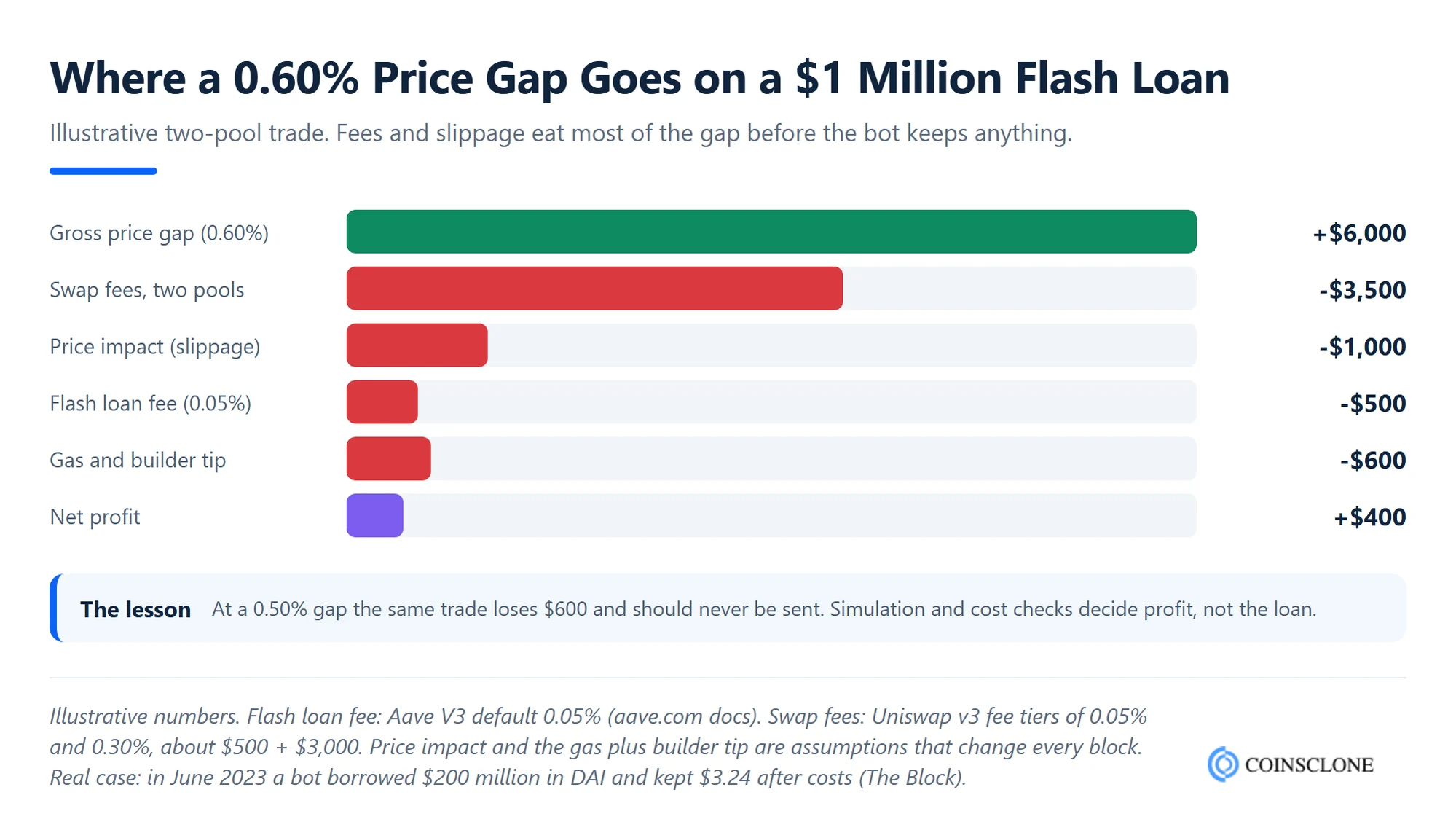
In the worked example above, a 0.60% gap on a $1 million loan leaves about $400 after costs. At a 0.50% gap, the same trade would lose money and should never be sent. Real trades can be even tighter. In June 2023, one bot borrowed $200 million in DAI and kept just $3.24 after transaction costs and a builder fee.
So what makes a bot profitable? In short, it comes down to speed, exact tests, private order flow, smart gas bids and finding niches that bigger bots ignore. A bot copied from a public template seldom beats the big players.
Risks of Flash Loan Arbitrage Bots
A flash loan protects the lender, not you. Before launch, plan for these risks.
- Front-running: Trades sent to the public mempool can be copied by faster bots. Private bundles reduce this risk.
- Failed trade costs: A reverted public transaction still pays gas. Private routes such as Flashbots Protect skip transactions that would revert.
- Smart contract bugs: A weak contract can be drained. Callback checks, audits and small limits at launch all help.
- Price oracle attacks: Flash loans have been used to exploit weak DeFi protocols. For example, Euler Finance lost about $197 million in a flash loan attack in March 2023. Your bot should never depend on prices that one trade can move.
- Legal and tax rules: Pure arbitrage between pools is generally treated as trading. But using a trade to move prices on purpose, or to drain a buggy app, has led to criminal charges. Get legal and tax advice where you operate.
Business Benefits of a Flash Loan Arbitrage Bot
A flash loan arbitrage bot gives startups clear business gains. Here are the main ones.
Improved Trading
A flash loan arbitrage bot helps users, traders and investors trade with more speed and accuracy. It builds trust and makes trading more efficient. As a result, new startups can launch their crypto business with a flexible trading product.
Increased Revenue Streams
Flash loan bots give startups several revenue streams. You can charge fees per trade, pay or earn referral fees, and sell monthly plans. The bot can also chase many arbitrage gaps at once or one after another, which raises earning potential.
Speed Over Manual Traders
Automated bots are faster than manual traders, so the business can capture gaps before rivals do. A strong bot helps startups rise in the DeFi market and hold their place as it changes.
Scalable Software
Flash loan bots can grow with your business. You can add new chains, DEXs, loan sources, features and security rules over the years without starting again.
These are the main gains of building your own bot. Because of them, many people expect the cost to be very high. However, with the right team and a clear scope, a bot can be built within a startup’s budget.
How Much Does It Cost to Develop a Flash Loan Arbitrage Bot?
The cost depends on how many chains, DEXs and loan sources the bot supports, and how advanced its engine is. A published 2026 agency cost guide gives these market ranges:
| Bot type | Typical build cost | What you get |
| Basic | About $8,000 to $15,000 | One chain, a few DEXs, one loan source, simple dashboard |
| Mid-level | About $15,000 to $35,000 | Several DEXs and loan sources, simulation, private bundles, full dashboards |
| Advanced multi-chain | From about $40,000 | Many chains, fast engine in Rust or Go, custom routing, admin and user panels |
Then there are running costs. The same guide puts premium node access at about $200 to $2,000 a month and smart contract audits at about $5,000 to $30,000. You also pay gas and builder tips on every trade, which change by the block.
Your build method matters too. A custom bot is built from scratch, so it costs more and takes longer. A white-label bot starts from ready-made, tested software, so it is usually the faster and cheaper choice for startups. You can buy white-label software from a trusted arbitrage bot developer such as Coinsclone.
Why Choose Coinsclone for Flash Loan Arbitrage Bot Development?
Coinsclone has been building crypto and blockchain products since 2018, with 350+ platforms delivered for 200+ clients across 20 industries. We offer crypto arbitrage bot development at a fair cost, with no cut corners. Our team shapes each bot to your trading plan and uses current tools to keep it fast and protect profit.
We also help startups add stronger security rules and extra features to their flash loan arbitrage bot. Our smart contract development team writes and tests the loan and swap contracts. Our DeFi development team can also grow the bot into a wider platform, such as a lending protocol built with an Aave clone script. We give end-to-end support, from idea to launch and beyond.
Talk to our sales team to get a cost quote for your flash loan arbitrage bot!
See How Our Flash Loan Arbitrage Bot Can Multiply Your Profits — Fast!
DeFi automation — done smarter.
- Plug & Play Bot: Deploy on major DEXs in minutes.
- AI-Powered Scans: Finds real-time arbitrage opportunities 24/7.
- Zero Capital Risk: Leverage flash loans, no upfront funds required.
- Custom Strategy: Tune parameters, tokens, and gas limits easily.
Get a free live demo of your arbitrage bot — fully branded and running within 48 hours.
Book a Free Demo and see how our Flash Loan Arbitrage Bot can start generating profits in 8-12 weeks, not months.
Frequently Asked Questions
How does a flash loan arbitrage bot work?
The bot scans DEX prices, finds a gap and tests the trade on a copy of the chain. Its smart contract then borrows a flash loan, buys the asset where it is cheaper, sells it where it is dearer and repays the loan plus the fee, all in one transaction. If the loan cannot be repaid, the whole transaction is undone.
Are flash loan arbitrage bots still profitable in 2026?
They can be, but margins are thin and the field is crowded. Swap fees, price impact, the loan fee, gas and builder tips must all be covered before any profit is left. Bots that win use fast data, accurate simulation, private bundles and niche markets.
Is flash loan arbitrage legal?
Arbitrage between DEX pools is generally treated as normal trading. But using flash loans to move prices on purpose or drain buggy apps has led to criminal charges. Rules and taxes differ by country, so get local legal advice before launch.
Which blockchain is best for a flash loan arbitrage bot?
Ethereum has the most liquidity but also the toughest rivals. Layer 2s such as Arbitrum and Base have far cheaper gas, so smaller gaps can still pay. Many teams start on one Layer 2 and add more chains later.
Do I need capital or coding skills to run a flash loan arbitrage bot?
You do not need capital for the loan itself, but you do need funds for gas, servers, data and audits. You can run a ready-made bot without coding, but building your own needs Solidity and bot engine skills.
How much does it cost to build a flash loan arbitrage bot?
Published 2026 market ranges put a basic bot at about $8,000 to $15,000, a mid-level bot at $15,000 to $35,000 and an advanced multi-chain bot from about $40,000. Audits and premium nodes add to that, and a white-label bot usually costs less than a custom build.