

A crypto arbitrage bot buys a coin where it is cheap and sells it where it costs more, faster than any person can click. That sounds like free money. In practice the gaps are small, fees eat most of them, and several bots that still show up in “best of” lists no longer offer arbitrage at all.
So we checked. Every tool below has a live arbitrage feature in 2026, confirmed on the vendor’s own site or help pages. You will see what each one does, what it costs where the price is public, and the maths that decides whether a trade pays. If you want to build a bot of your own, the last part shows how.
Know the Smart Arbitrage Bots To Maximize Your Crypto Profits!
Crypto Arbitrage — automated, fast, and profitable.
- AI-Driven Precision: Instantly spot and execute cross-exchange opportunities.
- Plug & Play Setup: No coding, no API chaos — just connect and earn.
- Multi-Exchange Coverage: Trade across Binance, KuCoin, OKX & more.
- Smart Risk Control: Built-in safeguards to protect every trade.
Get a free demo in 48 hours — see your personalized arbitrage dashboard in action.
Book a Free Demo and discover how our Best Crypto Arbitrage Bots can grow your returns 24/7.
10 Best Crypto Arbitrage Bots in 2026
The best crypto arbitrage bots fall into three groups. Exchange bots run funding-rate arbitrage inside one exchange. Standalone platforms connect to your exchange accounts by API. Scanners find the gaps and leave the trade to you.
| Bot | Arbitrage type | Where it runs | Cost |
| Binance Smart Arbitrage | Funding rate (spot vs perpetual) | Inside Binance | No extra bot fee, normal trading fees |
| OKX Arbitrage Bot | Funding rate and spread | Inside OKX | Normal trading fees |
| Bitget Funding Rate Arbitrage | Funding rate | Inside Bitget | Normal trading fees |
| Crypto.com Arbitrage Bot | Funding rate, both directions | Inside Crypto.com Exchange | Normal trading fees |
| Pionex Spot-Futures Arbitrage | Funding rate | Inside Pionex | Share of bot profit |
| Hummingbot | Cross-exchange, CEX to DEX | Your own server | Free, open source |
| Cryptohopper | Exchange and market arbitrage | Cloud | Higher paid plans |
| HaasOnline | Custom arbitrage scripts | Cloud or self-hosted | Monthly plan, 7-day trial |
| ArbitrageScanner | Cross-exchange alerts, CEX and DEX | Web and Telegram | From $195 a month |
| WunderTrading | Statistical (pairs) arbitrage | Cloud | Premium plan |
1. Binance Smart Arbitrage
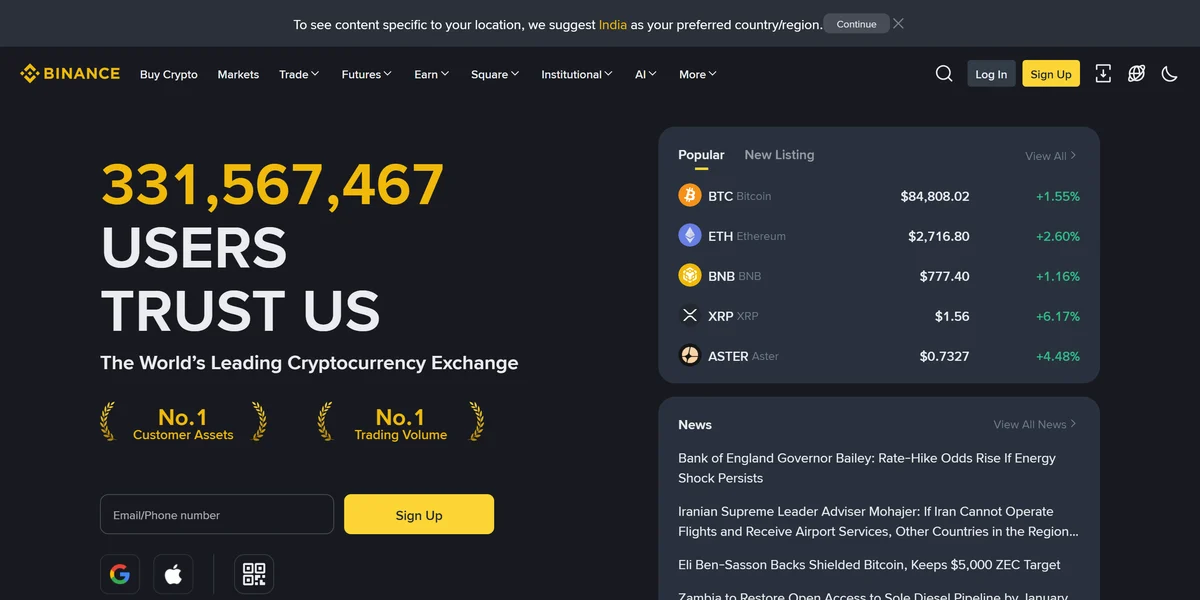
Binance is the largest crypto exchange by trading volume, and it runs two arbitrage tools. Smart Arbitrage lets you put USDT in and have Binance run the trades for you. The Funding Rate Arbitrage bot lets you set the trade up yourself.
Both use the same idea. The bot buys a coin on the spot market and opens a short of the same size on the perpetual futures market. Price moves cancel out, and you collect the funding fee that long traders pay to short traders. Binance says it charges no extra fee for its trading bots, only the normal trading fees.
- Best for: Binance users who want hands-off funding-rate income.
- Watch out for: funding rates can turn negative, and then you pay instead of earn.
2. OKX Arbitrage Bot
OKX is a global exchange with a strong derivatives market, and its bot covers two arbitrage types. Funding-rate arbitrage pairs a spot trade with a perpetual swap, as Binance does. Spread arbitrage trades the price gap between two contracts, such as spot bitcoin and a dated future.
You choose the order type for each leg: queuing, surpassed, best bid or offer, or market. That control helps you avoid paying away the gap in slippage.
- Best for: traders who want to manage both legs themselves.
- Watch out for: OKX is not available in every country, so check your region first.
3. Bitget Funding Rate Arbitrage
Bitget is a derivatives-focused exchange, and its funding rate arbitrage bot opens the spot and futures legs in one step. You set the batch size, how orders are placed and a sell-at-end rule. Bitget settles funding every 8 hours, and some contracts settle every 2 or 4 hours, which means more frequent payouts.
- Best for: Bitget users who want fine control over order size.
- Watch out for: Bitget’s marketing mentions 25% to 50% a year, but that depends on rates staying high, and they rarely do for long.
4. Crypto.com Exchange Arbitrage Bot
Crypto.com Exchange is the trading venue of the Crypto.com app, and its arbitrage bot works in both directions. Positive carry buys spot and shorts the perpetual. Reverse carry does the opposite, which earns when the funding rate is negative.
- Best for: traders who want to earn in both positive and negative funding markets.
- Watch out for: you must live in a place approved for derivatives trading on Crypto.com.
5. Pionex Spot-Futures Arbitrage Bot

Pionex is an exchange built around free trading bots, and the Spot-Futures Arbitrage bot is one of them. It buys the coin on spot, shorts it on futures, and collects the funding fee every 8 hours. Pionex’s own guide shows returns between 15% and 50% a year in past markets, and it takes a share of the bot’s profit.
- Best for: beginners who want an arbitrage bot with a few taps.
- Watch out for: higher leverage lifts returns but moves you closer to liquidation in a fast rally.
6. Hummingbot
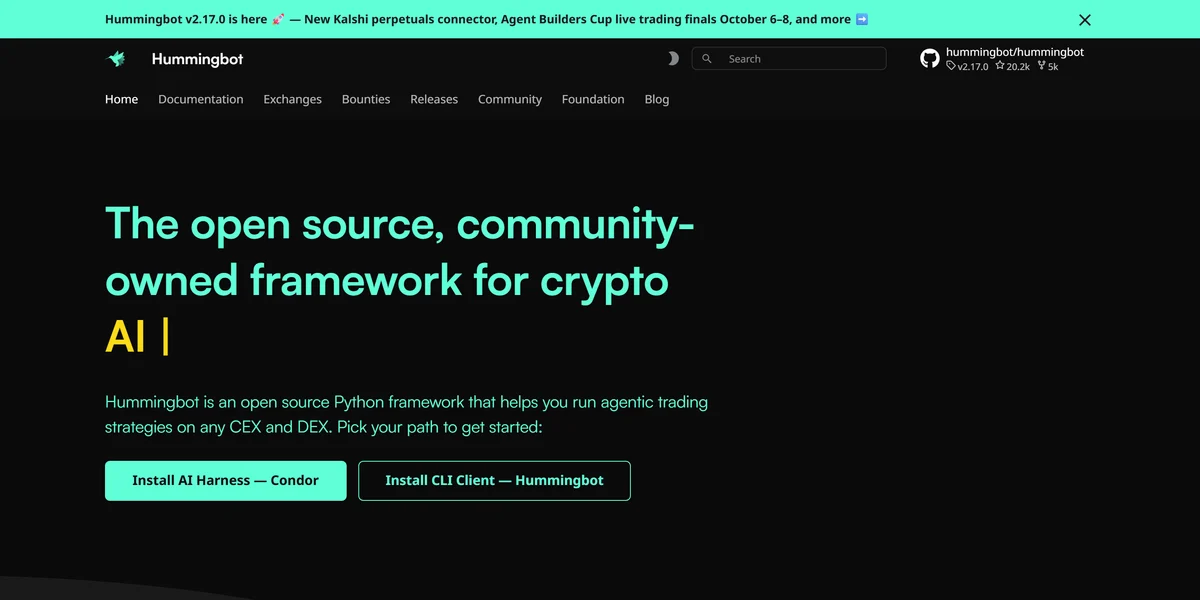
Hummingbot is free, open-source software for running trading bots on your own computer or server. It ships with an AMM arbitrage strategy, which trades the gap between a decentralized exchange like Uniswap and a centralized one like Binance. It also offers cross-exchange market making.
Because you host it, your API keys never leave your machine. The trade-off is setup: you need to be at ease with Docker or Python.
- Best for: technical traders and teams who want full control at no licence cost.
- Watch out for: you run the servers, so uptime and security are yours.
7. Cryptohopper
Cryptohopper is a cloud trading bot that connects to your exchange accounts by API. Its arbitrage tools cover exchange arbitrage (buy on one exchange, sell on another) and market arbitrage (triangular trades inside one exchange). They sit on the higher paid plans, next to market making and the AI strategy designer.
- Best for: traders who already use Cryptohopper for other strategies.
- Watch out for: cross-exchange arbitrage needs money waiting on both exchanges before the bot can act.
8. HaasOnline
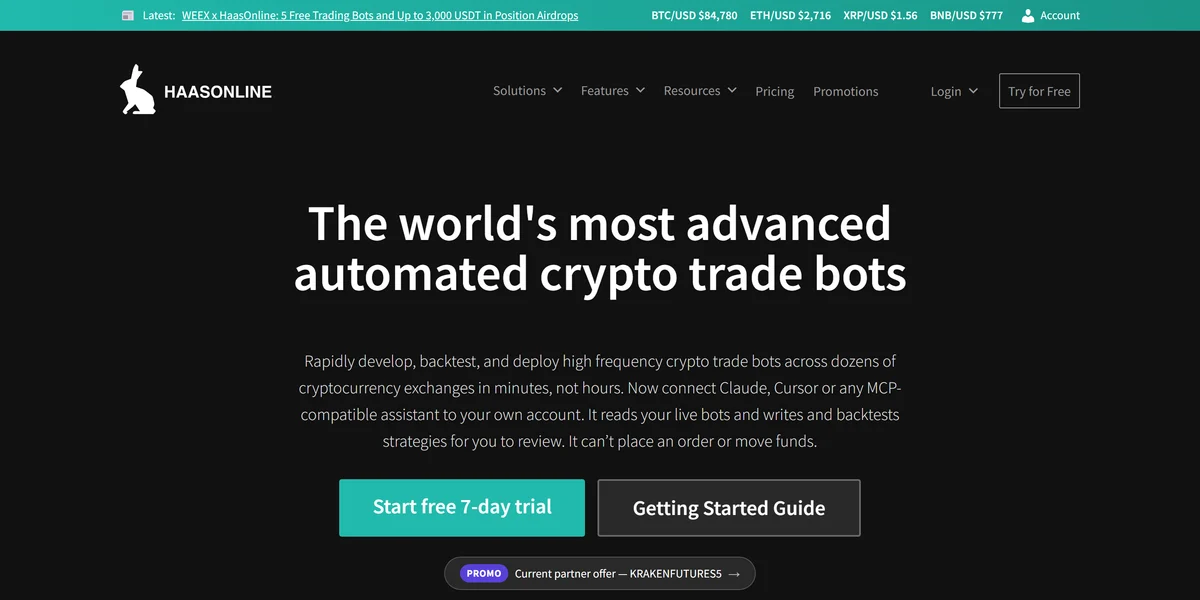
HaasOnline is a trading bot platform for advanced users. Instead of a fixed arbitrage button, you write the logic in its HaasScript language and backtest it on real market data before going live. You can run it in the cloud or host TradeServer yourself.
HaasOnline charges a fixed monthly subscription with no trade fees, and it offers a 7-day free trial.
- Best for: quant traders who want to design and test their own arbitrage rules.
- Watch out for: there is a learning curve, and a badly tested script can lose money fast.
9. ArbitrageScanner
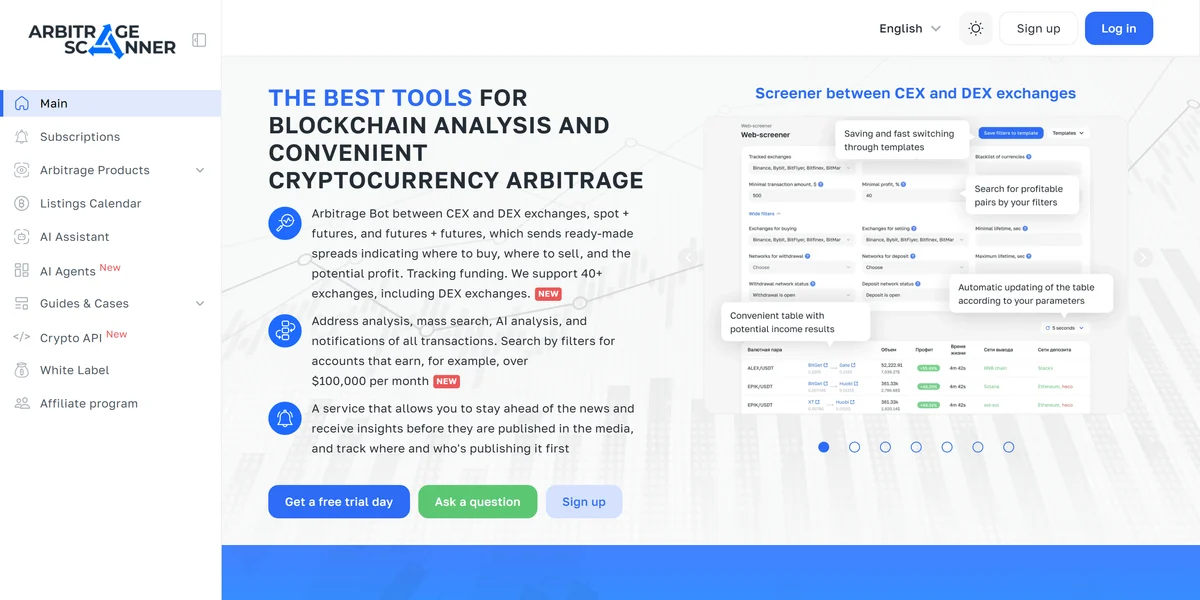
ArbitrageScanner is a scanner, not an auto-trader. It watches centralized and decentralized exchanges and alerts you to price gaps by web dashboard or Telegram. You then decide whether to trade.
Plans start at $195 a month for Business, with DEX coverage of about 200 exchanges on the higher plans. A 24-hour trial is available. Some older reviews still quote a $69 plan, which is no longer listed.
- Best for: manual traders who want to see gaps across many venues at once.
- Watch out for: alerts are not profits; fees and transfer time still apply.
10. WunderTrading
WunderTrading is a cloud bot platform with a free plan and paid tiers. Its Market Neutral bots run statistical arbitrage: they trade two related coins against each other when their usual price link breaks, and profit when it returns. These bots come with the Premium plan.
- Best for: traders who want arbitrage that does not depend on exchange price gaps.
- Watch out for: statistical links can break for good, so stop-loss rules matter.
Bots Often Listed for Arbitrage That No Longer Offer It
Many “best arbitrage bot” lists are copied from year to year. These three names still appear, but they are not arbitrage tools in 2026:
- 3Commas: its own arbitrage page now says it does not offer an arbitrage bot. It focuses on DCA, grid and signal bots.
- Shrimpy: the consumer trading app shut down in 2024.
- Bitsgap: its homepage and plans now centre on grid, DCA and futures bots, with no arbitrage bot on sale.
If a review still lists them for arbitrage, treat the rest of that review with care too. For bots built for other strategies, see our list of the best crypto trading bots.
What Is a Crypto Arbitrage Bot?
A crypto arbitrage bot is software that watches prices and trades a gap the moment it appears. It connects to exchanges through API keys, checks prices many times a second, and places both sides of the trade at once.
A person can spot a gap too. But by the time you log in, buy and sell, the gap is often gone. Bots win on speed, and they never get tired or scared.
Types of Crypto Arbitrage Bots
Each type of bot chases a different kind of gap:
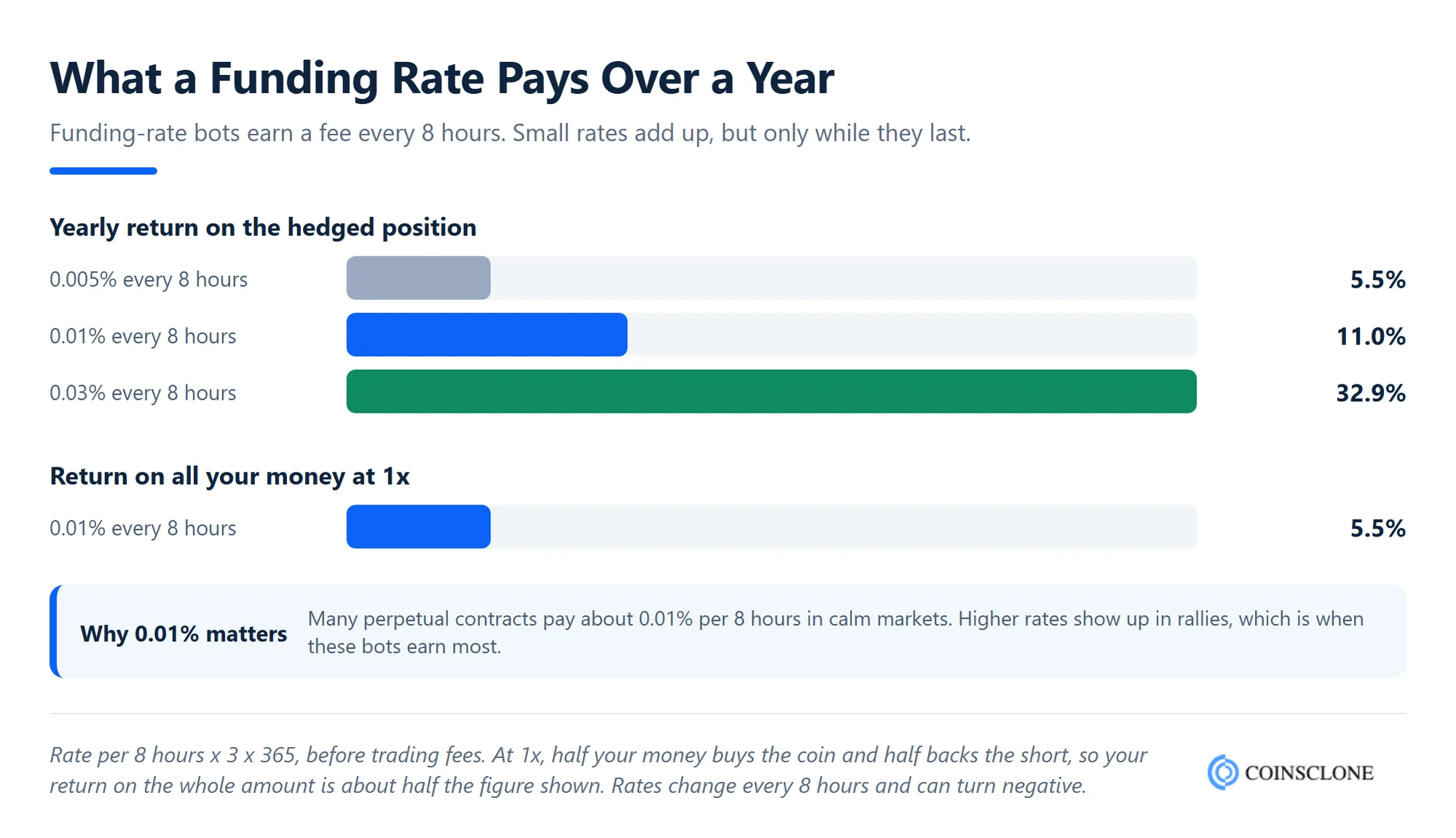
- Funding-rate bots: buy spot and short the perpetual future, then collect the funding fee. This is the most common type in 2026, and it is what the big exchanges build into their apps.
- Spatial (cross-exchange) bots: buy on the exchange where a coin is cheap and sell where it is dear. You need money waiting on both exchanges.
- Triangular bots: trade three pairs inside one exchange, such as BTC to ETH to USDT and back to BTC, to catch a pricing mismatch. No transfers are needed.
- Statistical bots: use maths to trade two coins that usually move together when they drift apart.
- Cross-border bots: use regional price gaps, such as when a coin trades higher against one local currency than another.
- DeFi bots: trade gaps between decentralized exchanges, often inside one blockchain transaction. Some use flash loans for arbitrage, which borrow and repay within the same transaction.
Does Crypto Arbitrage Still Pay After Fees?
It can, but the margins are thin. Here is a simple test: add up every cost of the trade, then compare that to the gap. The bot only earns what is left.
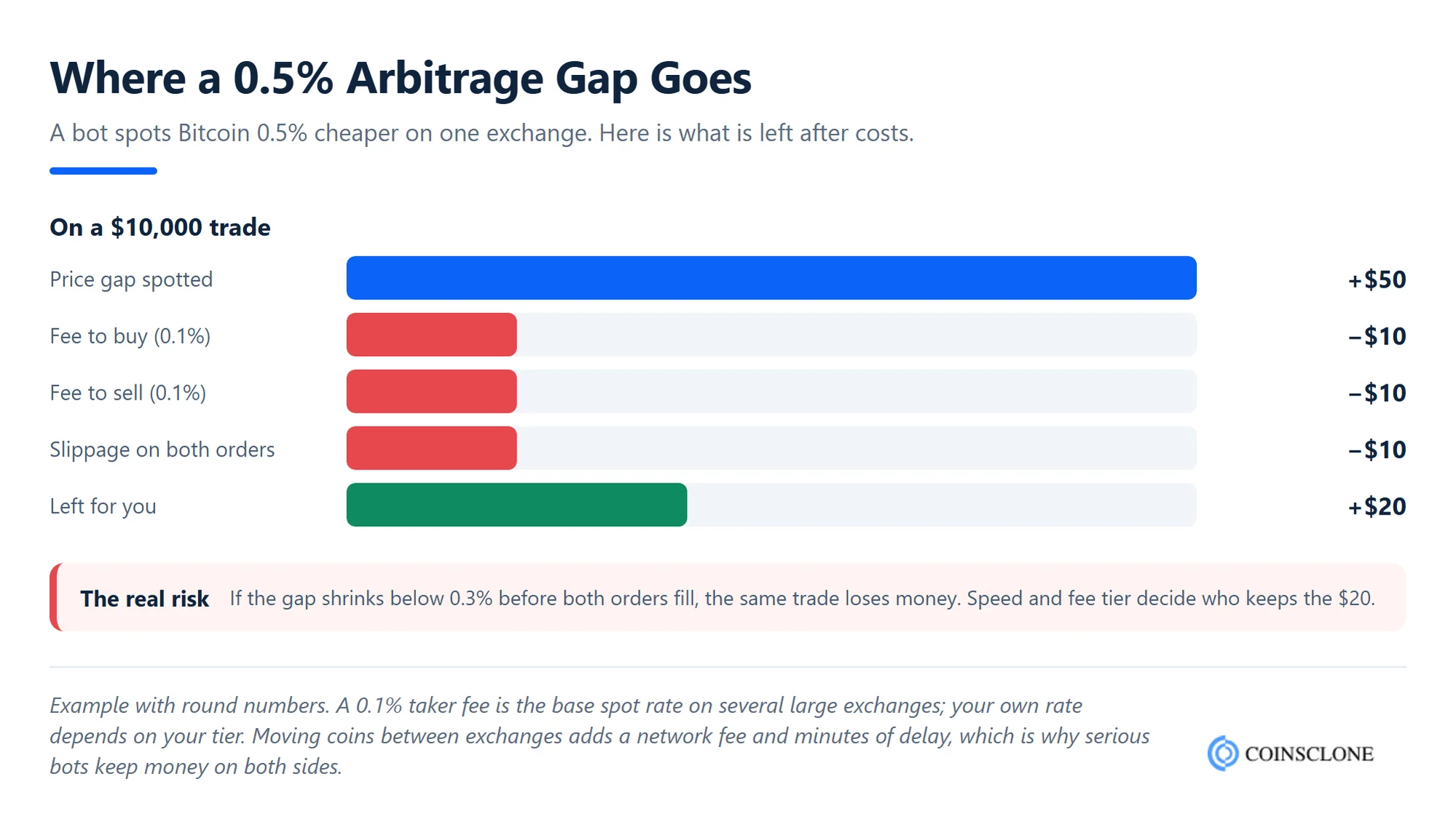
That is why cross-exchange gaps are hard to profit from for small traders. Large firms pay lower fees, keep money on every exchange, and run servers close to the exchange. Funding-rate bots are more forgiving, because they earn a steady fee rather than racing for a gap.
How to Choose the Best Crypto Arbitrage Bot
Match the bot to the gap you want to trade, then check these points:
- Arbitrage type: funding-rate bots suit most people. Cross-exchange bots need capital on several exchanges.
- Real cost: add the subscription, the bot’s profit share and your trading fees. Compare that total to the returns you expect.
- Exchange support: the bot must work with exchanges you can legally use in your country.
- Key safety: use API keys with trading on and withdrawals off, and limit them to fixed IP addresses where the exchange allows it.
- Backtesting and paper trading: test on past data or fake money before you commit real funds.
- Track record: prefer tools that still ship updates in 2026, not ones kept alive only in old reviews.
Risks of Crypto Arbitrage Bots
Arbitrage is lower risk than betting on price, but it is not risk free:
- Fees and slippage: they can turn a winning gap into a loss, as the example above shows.
- Funding flips: a positive funding rate can turn negative, and then your short pays the longs.
- Liquidation: in a sharp rally, a leveraged short can be closed before the spot side catches up.
- Exchange risk: if an exchange freezes withdrawals or fails, money parked there is stuck.
- Scams: “AI arbitrage” schemes that promise a fixed daily return are a red flag. Real arbitrage returns change every day.
How to Build Your Own Crypto Arbitrage Bot
Off-the-shelf bots suit individual traders. Exchanges, trading desks and fintech startups often need their own, so they can control the logic, the fees and the user experience. A custom build usually covers:
- Market data feeds: live prices and order books from each exchange, through WebSocket connections.
- Strategy engine: rules that spot a gap, check that it beats the costs, and size the trade.
- Order execution: placing both legs at once, with retries and limits for partial fills.
- Risk controls: caps on position size, loss limits and a kill switch.
- Dashboard and reports: profit and loss, open positions, and alerts for the team.
Coinsclone has a full guide to crypto arbitrage bot development, and a broader one on cryptocurrency trading bot development if you want grid, DCA or market-making strategies too.
Join Hands With Coinsclone For Crypto Arbitrage Bot Development!
Coinsclone is a crypto arbitrage bot development company that has built trading software for startups and exchanges for over seven years. We build bots around your strategy, whether that is funding-rate, cross-exchange, triangular or DeFi arbitrage, and we support them after launch.
Beyond bots, we also offer cryptocurrency exchange development, wallet creation, token development and crypto payment gateways. Talk to our team to plan your arbitrage bot and see a live demo.
Know the Smart Arbitrage Bots To Maximize Your Crypto Profits!
Crypto Arbitrage — automated, fast, and profitable.
- AI-Driven Precision: Instantly spot and execute cross-exchange opportunities.
- Plug & Play Setup: No coding, no API chaos — just connect and earn.
- Multi-Exchange Coverage: Trade across Binance, KuCoin, OKX & more.
- Smart Risk Control: Built-in safeguards to protect every trade.
Get a free demo in 48 hours — see your personalized arbitrage dashboard in action.
Book a Free Demo and discover how our Best Crypto Arbitrage Bots can grow your returns 24/7.
Frequently Asked Questions
What is the best crypto arbitrage bot?
For most traders, an exchange’s built-in funding-rate bot, such as Binance Smart Arbitrage, is the simplest and cheapest place to start. Technical traders who want cross-exchange or DEX arbitrage often choose Hummingbot, because it is free and runs on their own servers.
Are crypto arbitrage bots profitable?
They can be, but profits are small and depend on fees. A 0.5% price gap can shrink to about 0.2% after trading fees and slippage. Funding-rate bots have earned steadier returns, but only while funding rates stay positive.
Is crypto arbitrage legal?
Yes. Buying on one market and selling on another is legal in most countries. You still need to use exchanges that are allowed where you live, and you must report the profits for tax.
Is there a free crypto arbitrage bot?
Yes. Hummingbot is free and open source. Binance, OKX, Bitget and Crypto.com also offer arbitrage bots with no extra bot fee, although normal trading fees still apply.
How do trading bots execute arbitrage strategies?
The bot connects to exchanges through API keys and watches prices in real time. When a gap is bigger than the total cost of the trade, it places the buy and sell orders at the same moment, so the price has no time to move.
Is AI arbitrage a scam?
Not always, but many “AI arbitrage” offers are. If a platform asks you to deposit funds with it and promises a fixed daily profit, treat it as a warning sign. Real arbitrage returns go up and down with the market, and good bots let you keep funds in your own exchange account.