
Crypto trading is no longer just about swapping tokens. In 2026, traders want perpetual futures, leverage, deep order books, fast fills and full control of their own funds. dYdX was one of the first exchanges to offer all of that without a middleman. A dYdX clone script lets you launch your own decentralized exchange like dYdX, under your brand, in weeks instead of a year.
This guide explains what the script is, how dYdX really works today and how a clone copies it. You will also see where perp DEX trading has moved in 2026, how such an exchange earns money, and what a launch costs in time and money. We checked every number against dYdX’s own docs, its code on GitHub and DefiLlama data in October 2026, so you can plan with facts.
In this guide:
- What a dYdX clone script includes, for traders and for the admin
- How dYdX matches orders on its own blockchain, step by step
- Why dYdX now does about $1.2 billion a month while Hyperliquid does over $200 billion, and what that means for your launch
- Whether to buy a clone script, fork dYdX’s open code or build from scratch
- The build steps, market cost ranges and timeline
See How Our MVP System Can Launch Your dYdX-like Exchange Faster
Decentralized Exchange Development — done right.
- MVP System : Launch your dYdX-style perpetual DEX 90% faster with advanced trading features.
- On-Chain Trading Engine : Supports perpetual futures, margin trading & real-time order books — no coding needed.
- Brand & Customization : Your UI, your tokens, your markets — fully white-labeled for your brand.
- Revenue Engine : Earn from trading fees, funding rates & governance tokens.
See a free branded DEX demo in 48 hours — before you invest a cent.
Book a Free Demo to discover how our dYdX-like Exchange Development System can take you from concept to a live perpetual DEX in 8–12 weeks.
What Is a dYdX Clone Script?
A dYdX clone script is ready-made software that lets you build a decentralized exchange similar to dYdX. It comes with smart contracts or chain modules, wallet links, an order book, a margin and liquidation engine, risk tools and an admin panel. You can then change the design, markets, fees and features to suit your business.
It lets startups enter the DeFi derivatives market fast. Traders keep control of their funds, every trade settles on-chain and orders fill in under a second. Because the core parts arrive tested, your team spends its time on branding, liquidity and growth, not on rebuilding a trading engine.
What Is dYdX? Key Facts in 2026
Before you copy a platform, it helps to know what makes it work. dYdX is a decentralized exchange for perpetual futures, or “perps”. These are futures contracts with no end date, so traders can hold a long or short position for as long as their margin allows. Antonio Juliano founded dYdX in 2017.
The exchange has changed its design twice. Version 3 ran on StarkEx, a layer 2 network on Ethereum. In late 2023, dYdX moved to dYdX Chain (v4), its own blockchain built with the Cosmos SDK. Today, v3 shows no trading at all, so a modern clone should copy the v4 model.
Here is what dYdX looks like in October 2026:
- Markets: 99 markets, per the dYdX homepage, with instant market listings, spot trading on Solana and trading inside Telegram.
- Collateral: Traders post USDC as margin. They can deposit from Ethereum, Base, Arbitrum, Polygon, Avalanche and Optimism.
- Fees: The base tier charges 0.05% to takers and 0.01% to makers. Large traders pay as little as 0.025%, and top makers earn a 0.011% rebate, per the dYdX fee schedule.
- Who earns the fees: DefiLlama counts all trading fees as income for people who stake the DYDX token, not for a company.
- Size: dYdX says it has handled $1.6 trillion in lifetime volume across all versions. On v4 alone, DefiLlama shows $69.6 billion over the past year and about $69.5 million in deposits.
- Access: dYdX states that it is not available in the US or to other restricted persons.
So dYdX gives you a proven blueprint. However, its own numbers also hold a warning, as the next section shows.
Where Perp DEX Trading Happens in 2026
Perp DEXs are now big business. Over the 30 days to 1 October 2026, all perp DEXs together traded $624.5 billion, according to DefiLlama’s perps tracker. Yet dYdX, once the leader, traded only about $1.2 billion in that time. That puts it around 34th.
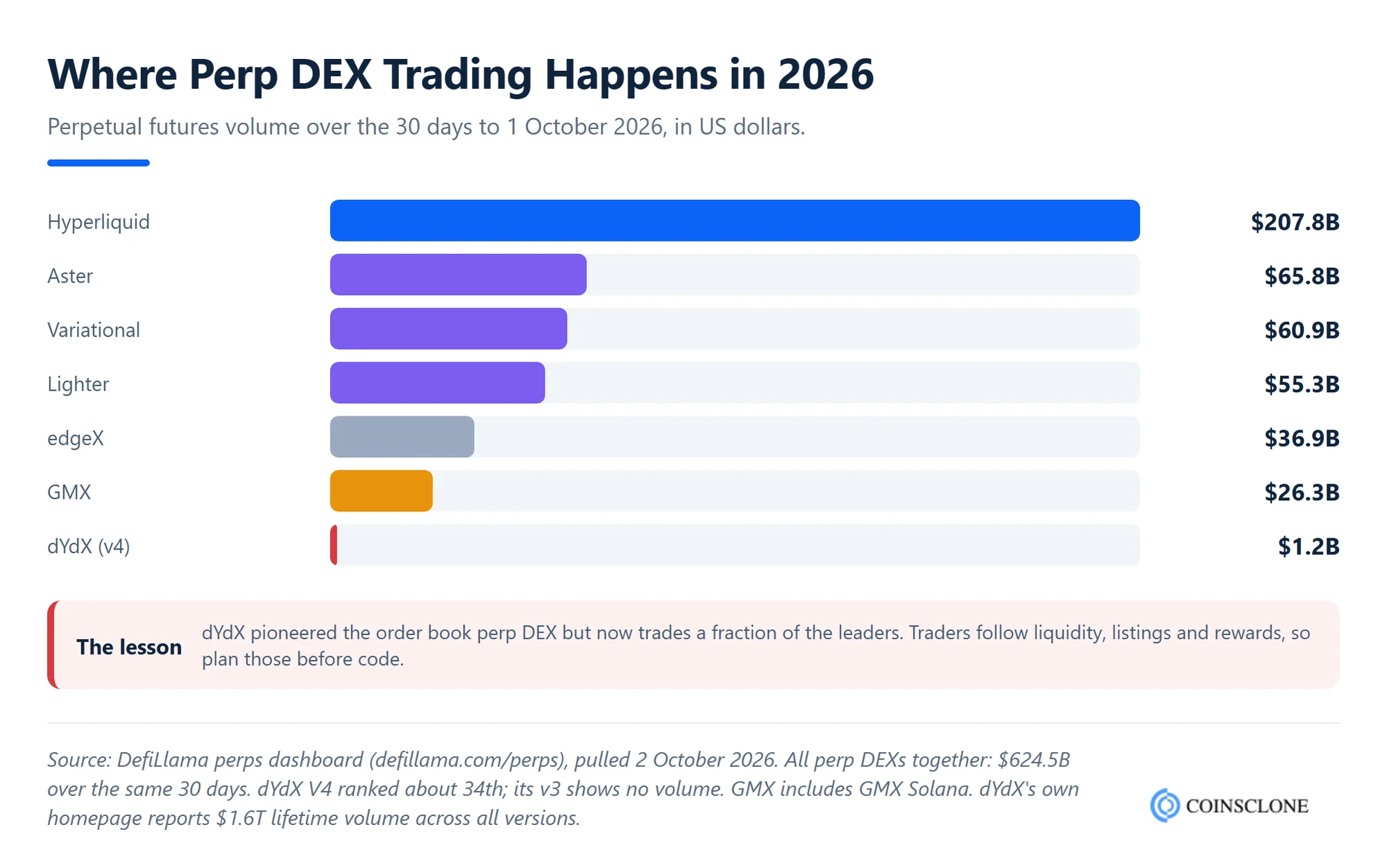
What changed? Faster venues with more markets, bigger rewards and deeper liquidity pulled traders away. Hyperliquid alone now does over $200 billion a month. The lesson for your exchange is simple: good code is not enough. Traders follow liquidity, low fees, fast fills and markets they cannot find elsewhere.
So a modern dYdX clone should copy dYdX’s strongest ideas, such as its fair order book and self-custody. Then it should add what the leaders do well: a liquidity vault, quick listings, rewards and new asset types. If you want the market leader’s model instead, read our Hyperliquid clone script guide.
How Does dYdX Match Orders on Its Own Chain?
Most DEXs match trades with a pool and a formula. dYdX works more like a pro exchange. It runs a full order book, but no single company owns it.
Every validator on dYdX Chain keeps its own copy of the order book in memory. Placing or cancelling an order costs no gas, because it happens off-chain. Then, in each block, the validator that proposes the block matches orders. The other validators check the result, and the matched trades are written on-chain for good. A module called `x/clob` runs the order book, and `x/perpetuals` tracks each position and its margin.
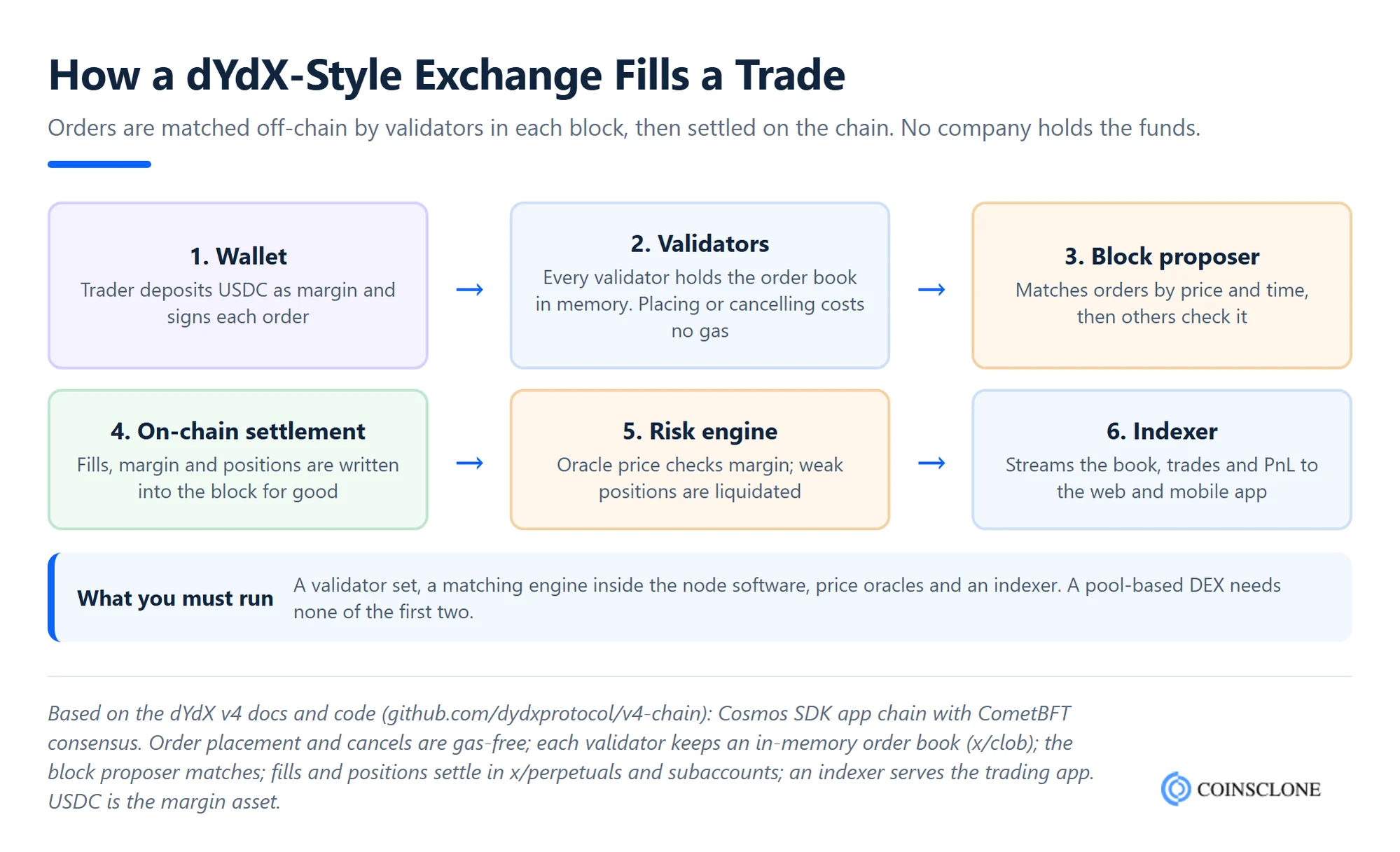
This design gives traders the speed of a central exchange and the trust of a blockchain. For you, it means a dYdX-style build needs three things that a simple DEX does not: a validator network, a matching engine inside the node software and an indexer that feeds the trading screen.
How Does a dYdX Clone Script Work?
Our dYdX clone script follows the same simple flow, so traders can start within minutes. Safety and fast fills are built into each step.
1. Connect Wallet (User Onboarding)
Users first link the self-custody wallet they prefer, such as MetaMask or Keplr. They never share private keys or personal data with the platform.
2. Deposit Margin and Approve Trading
Next, the user moves USDC into a trading account on the exchange. The wallet signs this step, so only the user can move those funds out again.
3. Select Trading Market & View Live Price Feeds
Users then browse the markets and check live charts, the order book and recent trades. A price oracle sets a fair mark price for each market, so one big trade cannot push traders into liquidation.
4. Place Orders (Spot, Margin, or Perpetual)
Once a market is chosen, traders pick a spot, margin or perpetual trade. They set the size, leverage and order type, then confirm in one click.
5. Fast Matching & Live PnL
The matching engine fills the order in under a second. Profit and loss (PnL) update live on the dashboard. Every hour, a funding payment flows between longs and shorts to keep the perp price close to the spot price.
6. Trade Settlement & Wallet Update
When the trade is matched, the system settles it on-chain and updates the user’s balance. Anyone can check every trade on the blockchain.
Core Features Of Our dYdX Clone Script
The right features turn a basic script into a rich trading platform. Here are the key ones to include.
User Features of dYdX Clone
- Self-Custody Wallet Link: Users connect their own wallets and keep full control of their funds. No third party holds their assets.
- Perpetual Trading Dashboard: A clean screen to manage positions, watch PnL, change leverage and follow the market live.
- On-Chain Settlement: Every trade is recorded on the blockchain, so no one can quietly change the results.
- Advanced Charts & Indicators: Detailed charts and technical tools help traders make better choices.
- Limit, Market & Stop-Loss Orders: Traders pick the order type that fits their plan, including take-profit and stop-loss.
- Cross and Isolated Margin: Traders can share margin across positions or ring-fence it for one risky trade.
- Low-Slippage Trading: Deep order books and market makers keep prices close to what traders expect.
- Liquidity Vault Access: Users can deposit USDC into a shared vault that provides liquidity and earns a share of the profits, like dYdX’s MegaVault.
- Spot, Margin & Perpetual Trading: Users choose simple spot trades or leveraged trades in one app.
- Many Languages: The platform speaks your users’ language, so you can reach traders worldwide.
- Trade History: A full log of trades, orders, deposits and funding payments, ready to check at any time.
Admin Features of dYdX Clone Script
- Admin Dashboard: One control panel to watch activity, track performance and run daily operations.
- User and Wallet Management: Review accounts, handle wallet links and solve user issues from the back end.
- Liquidity Management: Watch the vault and market makers, change settings and keep order books deep.
- Fee Settings: Set or change maker, taker, withdrawal and listing fees to match your business plan.
- Market Management: Add, edit or pause markets, and set leverage limits and margin rules for each one.
- Risk Engine Controls: Set margin levels, liquidation rules and insurance fund limits, and pause a market in an emergency.
- Security Monitoring: Track threats, odd activity and weak spots around the clock.
- CMS Management: Update banners, news, FAQs and other front-end content with ease.
- Analytics & Reports: See user activity, trading volume, open interest and growth at a glance.
- Revenue Tracking: A clear breakdown of income from fees, listings and other sources, in real time.
Security Features Of Our dYdX Clone Script
Security is a top concern for any decentralized exchange. Our dYdX clone software uses many layers of protection to keep trading safe and tamper-proof.
- Self-custody design, so the platform never holds users’ keys
- Audited smart contracts and chain modules
- Multi-signature admin wallet
- Price oracles that use many data sources
- Insurance fund for losses that liquidations cannot cover
- Anti-DDoS protection
- Rate limits and anti-bot checks
- Two-factor sign-in for admin accounts
- Fraud and wash-trade detection
- Secure transaction signing
Together, these layers protect user funds from unwanted access. They also keep the exchange running smoothly, even when markets swing hard.
dYdX vs Hyperliquid vs GMX: Which Model Should You Copy?
Not every perp DEX works the same way. Before you pick a script, decide which model fits your traders. Here is how the three best-known designs compare.
| Factor | dYdX | Hyperliquid | GMX |
| How trades match | Order book run by validators on its own Cosmos chain | Order book on its own layer 1 chain | No order book; traders trade against a pool at the oracle price |
| Where liquidity comes from | Market makers plus the MegaVault | Market makers plus the HLP vault | Liquidity providers in GM pools |
| 30-day volume (to 1 Oct 2026) | About $1.2 billion | About $207.8 billion | About $26.3 billion |
| Main strength | Fair order book, gas-free orders, open code | Speed, deep liquidity, huge market list | Simple to run, no market makers needed on day one |
| Main challenge | You must run a validator set | Hard to copy at the same speed | Liquidity providers take the other side of every trade |
In short, the dYdX model suits founders who want a true order book and their own chain. The pool model suits a smaller launch on an existing chain. For a deeper look at the leader, see our Hyperliquid architecture guide.
Why Create a Decentralized Exchange Like dYdX?
The rise of decentralized exchanges has opened real chances for crypto businesses. Here are the main reasons founders choose this path.
Profit Potential
Your own perp DEX can become a strong source of income. Trading fees, listing fees and vault income can bring steady revenue while you serve traders well.
Transparency and Security
A decentralized exchange runs on the blockchain, so everyone can check every trade. Smart contracts guard the funds automatically. This builds trust and draws more traders to your platform.
Multi-Device Access
A web app plus mobile apps let users trade whenever and wherever they want. As a result, you reach a larger audience with a smooth experience on every device.
Faster Market Entry
A dYdX clone lets you launch much sooner than a DEX built from zero. It saves months of work and helps you reach the market at the right moment.
Reduced Development Risk
A tested clone skips the trial-and-error phase of a custom build. Since the core parts already work, you face fewer technical surprises during launch.
Why Invest In Coinsclone’s dYdX Clone Script?
Here are the main business perks of building on our script.
Lower Running Costs: A ready-made base cuts build and upkeep costs. You save on a large in-house team, repeat audits and extra servers, yet still get a full exchange.
Many Ways to Earn: The script comes ready for trading fees, listing fees, vault income, staking rewards and premium plans.
Deeper Liquidity: Like dYdX, the script pairs an order book with a liquidity vault and hooks for outside market makers. This keeps spreads tight, which is what draws traders and keeps them.
Global Reach: A decentralized exchange can serve traders in many countries. You still decide which regions to block, so you stay on the right side of local rules.
These perks show why building on a proven dYdX-style base is a smart move for your DEX business.
How a dYdX-Style Exchange Makes Money
A perp DEX earns from many small streams. Plan them before launch, because they shape your fee table and your token design.
- Trading Fees: The main income. dYdX charges 0.01% to 0.05% per trade on its base tier. On $1 billion of monthly volume, an average fee of 0.03% brings in $300,000.
- Listing Fees: Projects can pay to list a new market, or fund its first liquidity.
- Liquidation Fees: When a position is closed for low margin, a small fee is charged. Most of it usually goes to the insurance fund.
- Vault Income: A house liquidity vault earns from market making. You can keep a share of its profit as a fee.
- Native Token and Staking: Many perp DEXs share fees with token stakers, as dYdX does. This builds loyalty, though it lowers your own share.
- Premium API and Data: Pro traders and bots pay for faster data and higher rate limits.
Keep in mind that funding payments pass between traders. They are not income for the exchange.
Clone Script, Open-Source Fork or Custom Build?
dYdX’s v4 code is public on GitHub. So some founders ask: why not just copy it for free? You can, but read the licence first. dYdX grants rights under the GNU Affero General Public License (AGPL), and only while you follow the law and dYdX’s terms of use. Under the AGPL, if you run a changed version for users online, you must share your changes as open source too.
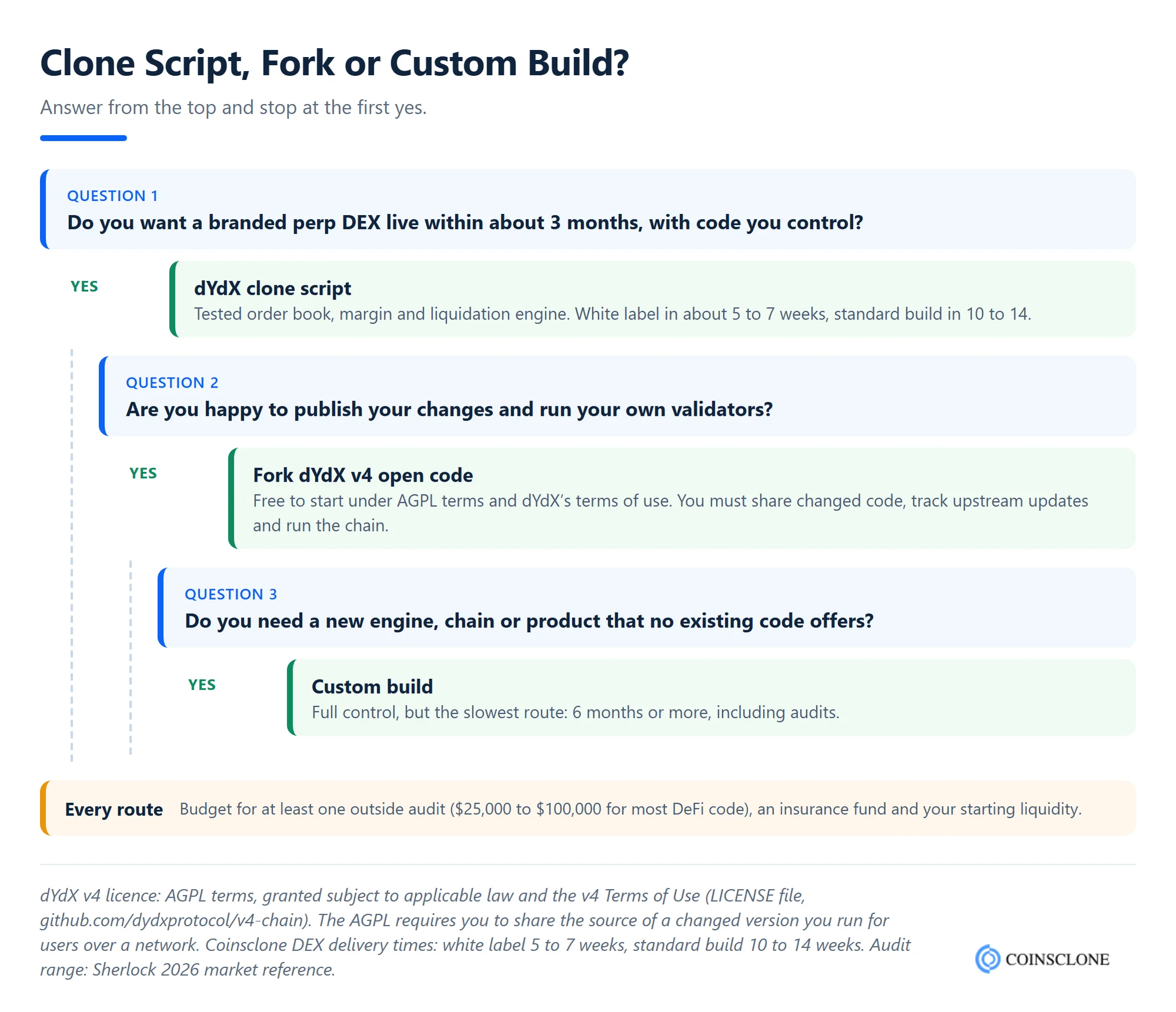
As a result, there are three real routes:
- Clone script: Tested, branded code you own, ready in weeks. Best for most startups.
- Fork the open code: Free to start, but you must run validators, keep up with dYdX updates and publish your changes.
- Custom build: Full control and new features, but the slowest and most costly route.
How to Create a Decentralized Exchange Like dYdX
Once you decide to build, the journey needs careful planning, a clear view of the rules and a strong technical base. Here are the key steps.
Step 1: Define Your Business Model & Market Positioning
First, decide whether you will focus on perps, margin, spot or a mix. Pick your target users: everyday traders, pros or institutions. Then choose your markets, leverage limits, fees and token plan. A clear revenue model is vital for long-term success.
Step 2: Choose the Blockchain & Technical Architecture
Next, pick the chain. You can launch your own app chain, as dYdX did, or deploy on a fast layer 2. Then choose how orders match: a fully on-chain book, off-chain matching with on-chain settlement, or a pool. This choice shapes speed and user experience more than any other.
Step 3: Build Smart Contracts & Risk Management
Contracts and chain modules run trading, margin, liquidations and settlement. They must be secure, audited and efficient. Add a risk engine that watches collateral, stops bad debt and keeps the platform solvent. Security audits are a must at this stage.
Step 4: Build the Trading Engine & Liquidity Plan
A fast matching engine fills orders with little slippage. Add a liquidity vault, outside market makers and rewards to keep order books deep. Funding rates keep perp prices close to the spot market.
Step 5: Add Wallets & Self-Custody
Let users connect Web3 wallets so they always hold their own assets. Deposits, withdrawals and margin moves should work smoothly, with no central control.
Step 6: Design an Easy Trading Screen
A good screen wins traders. Your front end needs live charts, order books, a portfolio view, PnL and advanced order types. It must be clean, fast and work well on desktop and mobile.
Step 7: Plan for Rules, Security & Growth
Even a decentralized exchange must respect local rules. Perps count as derivatives in most countries. In the EU they fall under MiFID II, not MiCA, and in the US they fall under the CFTC. That is why dYdX blocks US users. Add region blocks where needed, and keep watching security and server load as you grow. Our crypto derivatives exchange guide covers the licence paths in more detail.
Step 8: Launch, Reward & Grow
After launch, kick-start liquidity with trading contests, token rewards, partners and market maker deals. Build a strong community and market smartly. Regular upgrades, governance and new markets will help you grow for the long term.
With the right design and plan, a decentralized exchange like dYdX can become a strong DeFi business in 2026.
dYdX Clone Script Vs Custom Development: Comparison
A perp DEX needs a trading engine, contracts, margin rules, liquidity and strong risk controls. Building all of it from zero is slow and costly. A dYdX clone script offers a faster, cheaper path.
| Key Factors | Development From Scratch | dYdX Clone Script (Faster Option) |
| Development Work | Build the trading engine, order book, contracts, margin and liquidation systems from zero. | Start with a tested trading engine, margin logic and contracts. |
| Time to Launch | 6 months or more, including audits. | About 5 to 7 weeks for white label, 10 to 14 weeks for a standard build. |
| Cost | Higher, because of the long build and several audits. | Lower, since the core trading features already exist. |
| Security | Depends on new code and extra audits. | Built on a tested, audit-friendly code base. |
| Scale | You must plan and tune for high volume yourself. | Designed for high trading volume from day one. |
| Best For | Firms that need a fully unique exchange. | Startups that want a fast launch on a proven base. |
How Much Does It Cost to Build a Decentralized Exchange Like dYdX?
The cost depends on your build route, features, security needs, chain choice and how many audits you run. Published 2026 agency cost guides fall in these broad market ranges:
| Build route | Typical market cost | What you get |
| Basic dYdX clone (white label) | About $25,000 to $40,000 | Perps, wallet link, margin, liquidations, admin panel, basic liquidity tools |
| Customized dYdX clone | About $40,000 to $75,000 | Your design, advanced orders, cross margin, a liquidity vault, deeper analytics |
| Enterprise dYdX clone | $75,000 to $150,000+ | Multi-chain deposits, mobile apps, your own token, governance |
| Fully custom build from scratch | $100,000 to $300,000+ | Your own chain or engine, custom risk system, built from zero |
| Security audit (each) | $25,000 to $100,000 | An outside review of contracts and chain modules |
Running costs matter too. Budget for validator or node hosting, price oracles, an indexer, market makers, an insurance fund, bug bounties and legal advice. Your starting liquidity is your own capital, not a fee, but you need it on day one.
Treat all of these numbers as a rough guide. Time to market, audits and a clear liquidity plan matter just as much as the build price.
How Long Does It Take to Build a Decentralized Exchange Like dYdX?
The timeline depends on how much you customize, how complex the contracts are, your chain and the audits you need before launch. At Coinsclone, our DEX builds follow these timelines.
1. White Label DEX with Core Features
This is the fastest way in. A white label DEX with core trading, wallet links and an admin panel goes live in about 5 to 7 weeks.
2. Standard Build with Custom Features
If you need your own design, advanced orders, cross margin, a liquidity vault and analytics, a standard build takes about 10 to 14 weeks. Leverage, liquidations and price oracles add testing, so most perp builds fall in this range.
3. Fully Custom Development from Scratch
A perp DEX built from zero, with a custom chain or matching engine, new risk systems and full security testing, can take 6 months or more, including audits.
Knowing these timelines early helps you plan liquidity, marketing and any token launch. That way, your exchange is ready for traders on day one.
Launch Your Decentralized Exchange Like DyDx And Reshape The Future Of Finance
Cost-effective | White-Label Solution | Premium Features | Customizable | Live Demo Available
Why Choose Coinsclone For Developing a Decentralized Exchange like dYdX?
Coinsclone is a trusted Decentralized Exchange Development Company for businesses that want a fast, safe trading platform like dYdX. Since 2018, we have delivered 350+ platforms for 200+ clients across 20 industries. Our team builds exchanges that are fast, secure and ready for real trading demand.
If you want to start a decentralized exchange like dYdX, we will guide you from the first plan to launch. You can begin with our white label decentralized exchange and add perps, a liquidity vault and your own token as you grow. With Coinsclone, you gain a partner who knows both the tech and the business side of running a trading platform.
Frequently Asked Questions
What is a dYdX clone script?
A dYdX clone script is ready-made software with the core features of the dYdX exchange. These include perpetual and margin trading, an order book, on-chain settlement and self-custody wallets. Teams use it to launch a dYdX-style decentralized exchange quickly and with fewer technical hurdles.
How does a dYdX clone work?
Users connect a wallet and deposit USDC as margin. They open long or short positions, and the matching engine fills orders in under a second. The system then settles trades on-chain, tracks margin and charges funding, and no company holds user funds.
What blockchain is dYdX built on?
dYdX runs on dYdX Chain, its own blockchain built with the Cosmos SDK. It moved there in late 2023 from StarkEx, a layer 2 network on Ethereum. Validators run the order book, and trades settle on the chain.
How does dYdX make money?
dYdX earns trading fees of 0.01% to 0.05% per trade on its base tier, with lower fees for large traders. DefiLlama counts all of these fees as income for DYDX stakers. A clone can also earn from listings, liquidations and a liquidity vault.
Is dYdX available in the US?
No. dYdX states that it is not available in the US or to other restricted persons. Perps are derivatives under US law, so a US launch needs CFTC approval. Most dYdX-style exchanges block US users for this reason.
Is a dYdX clone script secure?
Yes, when it is built well. A good clone uses audited contracts, self-custody, price oracles, an insurance fund, rate limits and many layers of checks. Since users control their own wallets, there is no central pool of funds for hackers to target.
What technology is used to build a decentralized exchange like dYdX?
A dYdX-style exchange uses a Cosmos SDK app chain or a fast layer 2, smart contracts or chain modules, Web3 wallet tools, price oracles, an indexer and a fast matching engine. Together, they give quick fills, low fees and secure on-chain settlement.
How much does a dYdX clone script cost?
Published 2026 agency cost guides put a basic dYdX clone at about $25,000 to $40,000. Customized versions cost about $40,000 to $75,000, and enterprise builds $75,000 or more. A fully custom build from scratch often passes $100,000. Audits cost extra.
Can a dYdX clone be customized?
Yes. You can change markets, fees, leverage limits, the design, trading tools, chains and token features. Both the contracts and the front end can be changed to fit your business.
Does a dYdX clone support leverage trading?
Yes. Most dYdX clone scripts support leverage through margin rules. Users open long and short positions, and the admin sets the leverage limit for each market based on risk and liquidity.
What APIs are available in a dYdX clone script?
Typical APIs cover market data, order placement, trade history, account balances, positions and price feeds. They help traders connect bots, dashboards and outside trading tools.
See How Our MVP System Can Launch Your dYdX-like Exchange Faster
Decentralized Exchange Development — done right.
- MVP System : Launch your dYdX-style perpetual DEX 90% faster with advanced trading features.
- On-Chain Trading Engine : Supports perpetual futures, margin trading & real-time order books — no coding needed.
- Brand & Customization : Your UI, your tokens, your markets — fully white-labeled for your brand.
- Revenue Engine : Earn from trading fees, funding rates & governance tokens.
See a free branded DEX demo in 48 hours — before you invest a cent.
Book a Free Demo to discover how our dYdX-like Exchange Development System can take you from concept to a live perpetual DEX in 8–12 weeks.