
Decentralization, immutability and transparency are quoted so routinely that they have stopped carrying information. Every chain claims all three, few define what they mean by them, and almost none mention what each one costs. Treated properly these are three independent spectrums that a network can sit anywhere along, and the position it occupies is a design decision with commercial consequences. This guide defines each pillar precisely, sets out what each one costs, separates the pillars from the blockchain trilemma they are routinely confused with, gives you five concrete ways to check whether a chain genuinely has these properties, and helps you identify which pillar your project actually depends on.
What Are the Three Pillars of Blockchain?
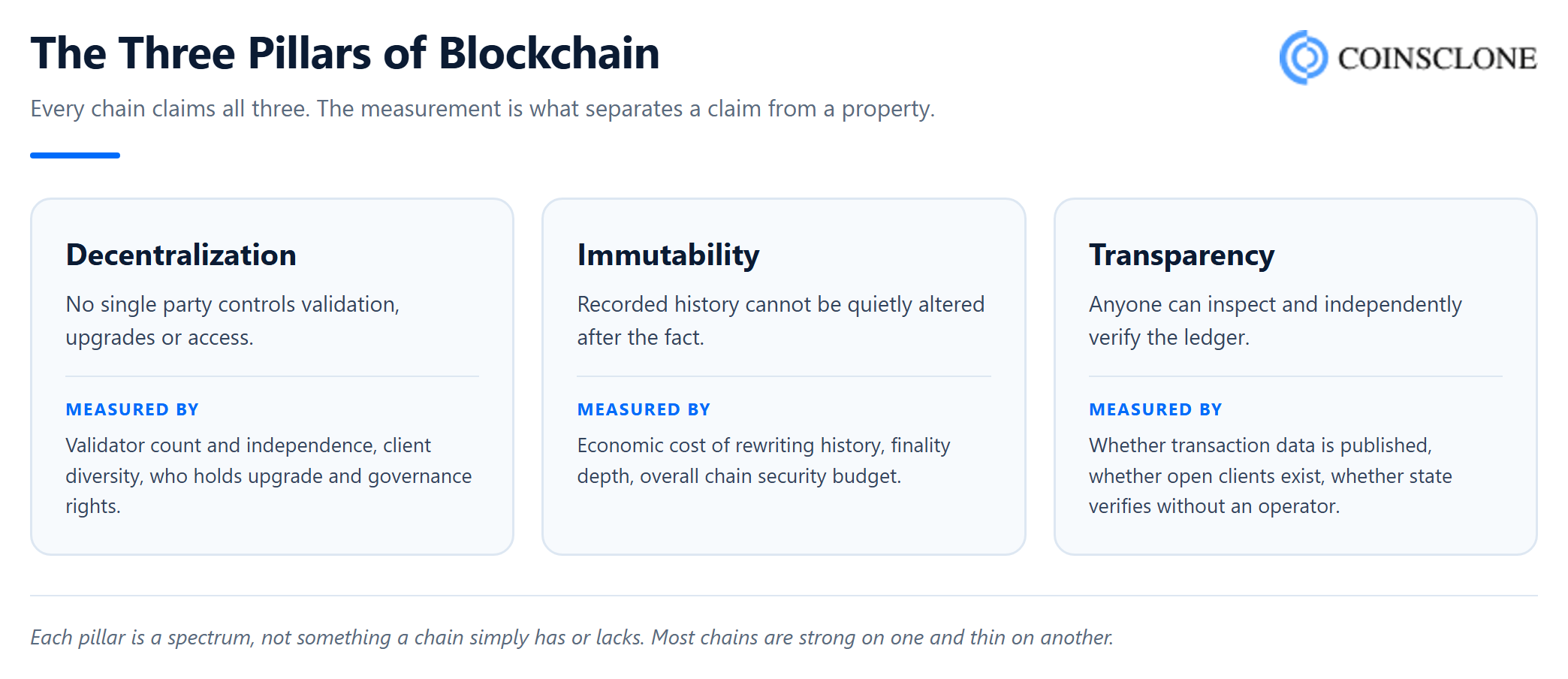
Three properties, each with a specific meaning and a specific way of being measured. The measurement matters more than the definition, because every chain claims the definition.
Decentralization means no single party controls validation, upgrades or access. Measure it by validator count and independence, by client diversity, and by who holds governance and upgrade rights. Do not measure it by how the project describes itself.
Immutability means recorded history cannot be quietly altered after the fact. Measure it by the economic cost of rewriting history, by finality depth, and by overall chain security. It is not absolute. It is expensive.
Transparency means anyone can inspect and independently verify the ledger. Measure it by whether transaction data is actually published, whether open clients exist, and whether state can be verified without trusting an operator.
A chain can be strong on one pillar and weak on another, and most are. A high-throughput network with forty validators run by a dozen firms has real immutability and thin decentralization. A permissioned consortium ledger can be genuinely immutable within its membership while being opaque to everyone outside it. Marketing rarely specifies which pillar is being claimed.
t8-02-pillars.png | Alt: The three pillars of blockchain defined with how each is measured
What Does Each Pillar Cost?
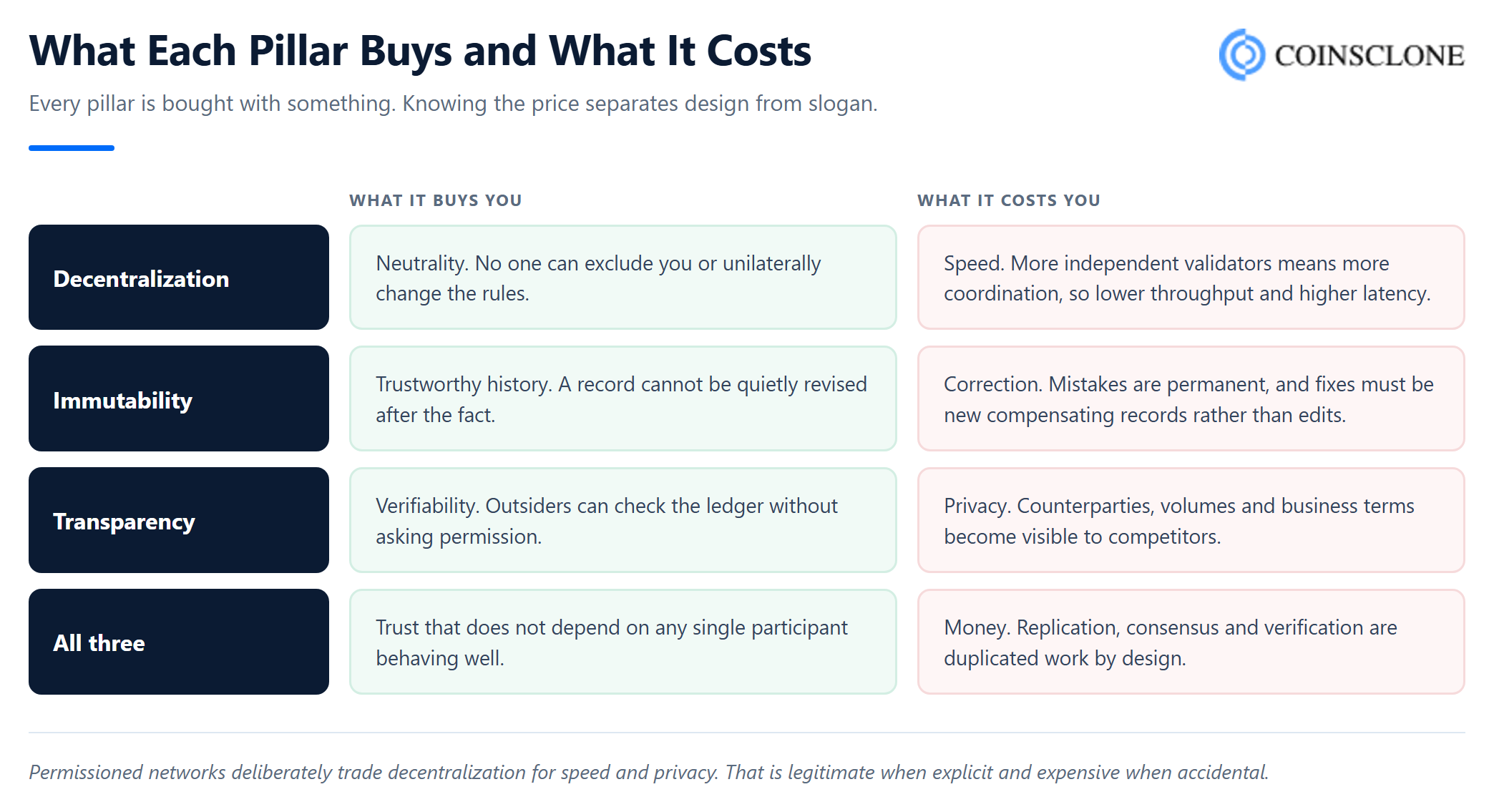
Every pillar is bought with something. Knowing the price is what separates a design decision from a slogan.
Decentralization costs speed. More independent validators means more coordination, which means lower throughput and higher latency. This is not an inefficiency waiting to be optimized away. It is the mechanism working as intended.
Immutability costs correction. Mistakes are permanent. A wrong record stays on the ledger and fixes must be new compensating records rather than edits, which changes how you design data models, reconciliation and reporting.
Transparency costs privacy. A public ledger is public. Counterparties, volumes and business terms become visible to competitors, which is why most commercial applications keep sensitive detail off-chain and commit only a hash.
All three cost money. Replication, consensus and verification are duplicated work by design. You are paying many parties to do the same computation so that no single one has to be trusted.
And they can be traded. Permissioned networks deliberately reduce decentralization to gain speed and privacy. That is a legitimate engineering choice when it is made explicitly and an expensive accident when it is not.
Are the Three Pillars the Same as the Blockchain Trilemma?
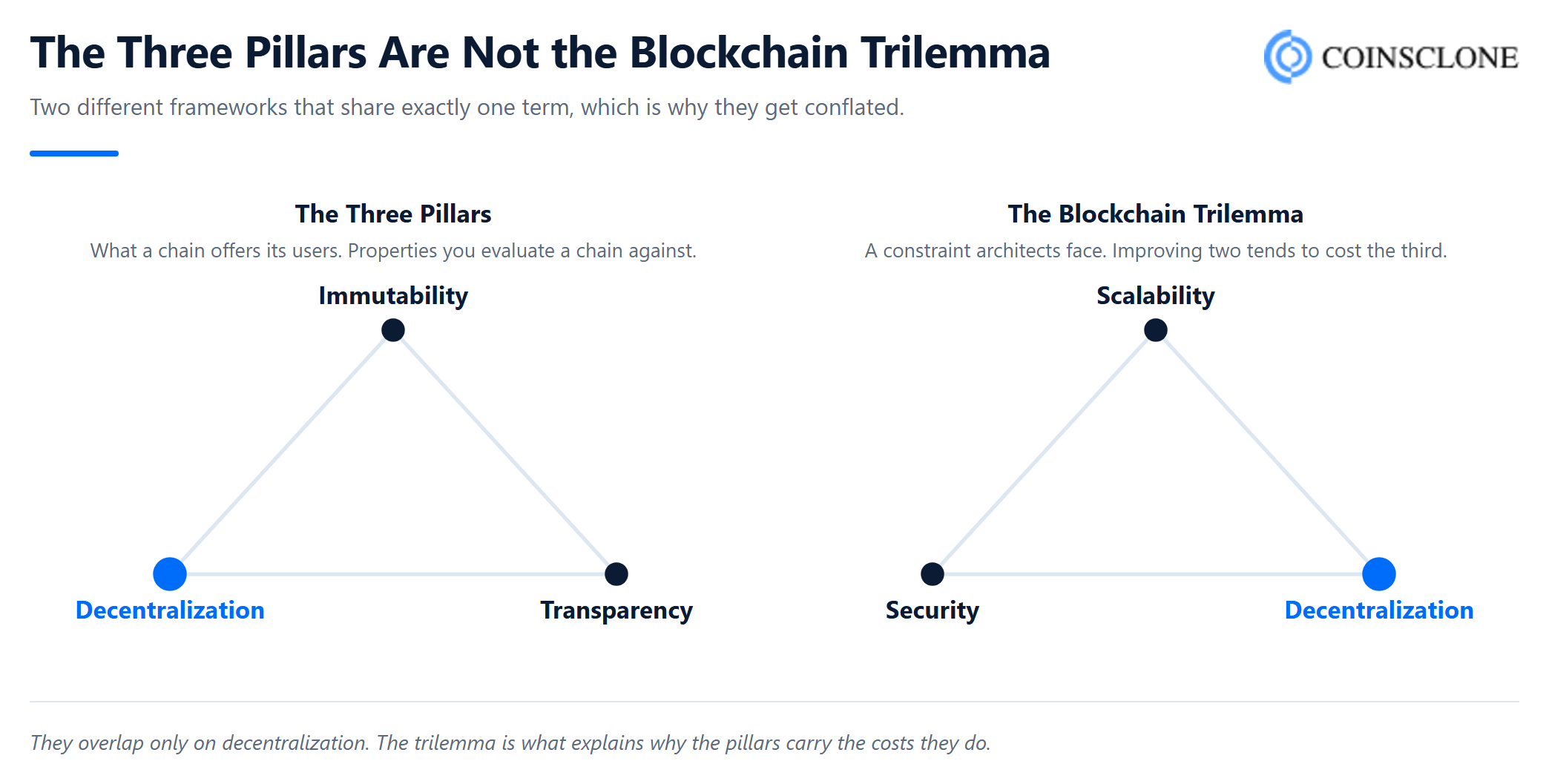
No, and the two get conflated constantly. They are different frameworks answering different questions.
The three pillars describe what a blockchain offers its users: decentralization, immutability and transparency. They are properties you evaluate a chain against when deciding whether it fits your use case.
The blockchain trilemma, popularized by Vitalik Buterin, describes a constraint that chain architects face: scalability, security and decentralization, where improving any two tends to come at the expense of the third. It is a statement about engineering limits, not about user-facing features.
The two frameworks overlap on exactly one term, decentralization, which is why they get muddled. The useful distinction is that the trilemma explains why the pillars cost what they do. A chain cannot maximize decentralization without surrendering scalability, and that surrendered scalability is precisely the speed you pay for the decentralization pillar.
If someone tells you a network solves the trilemma, ask which of the three they redefined. Usually it is decentralization, and usually the redefinition involves a validator set small enough to coordinate quickly.
t8-04-trilemma.png | Alt: The three pillars of blockchain compared with the blockchain trilemma
Is Blockchain Really Immutable?
Practically rather than absolutely, and the distinction has real consequences.
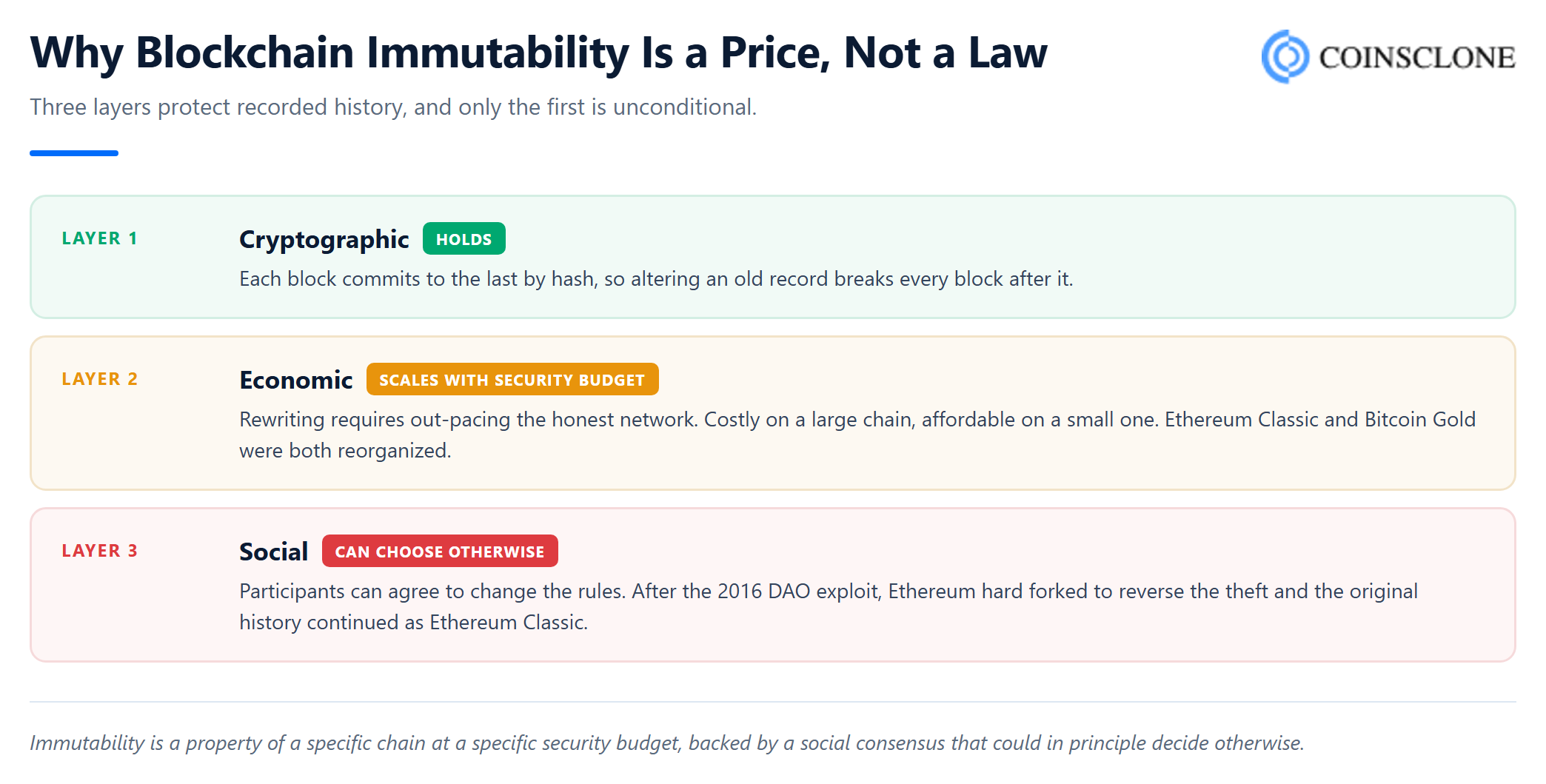
Altering an old record changes its hash, which breaks every block after it. Rewriting history therefore means redoing all subsequent work faster than the honest network extends the chain. On a well-secured network that is economically irrational rather than physically impossible, which makes immutability a matter of cost.
That cost is not uniform. Smaller proof-of-work chains have been successfully attacked and their history rewritten, with Ethereum Classic and Bitcoin Gold both suffering deep reorganizations that enabled double spends. The same attack against Bitcoin would require a hash rate nobody has assembled. Immutability scales with the security budget of the specific chain, not with the word blockchain.
There is also a social layer that no consensus mechanism covers. In 2016, following the DAO exploit, the Ethereum community executed a hard fork that effectively reversed the theft. The chain’s rules were changed by agreement among the people who ran it, and the original history survived as Ethereum Classic. Nothing was broken cryptographically. The participants simply decided to move the ledger somewhere else.
The honest formulation is that immutability is a property of a specific chain at a specific security budget, backed by a social consensus that could in principle choose otherwise. That is still enormously useful. It is not the physical law it is often sold as, and any design that depends on absolute permanence should account for both failure modes.
t8-05-immutability.png | Alt: Why blockchain immutability is economic rather than absolute
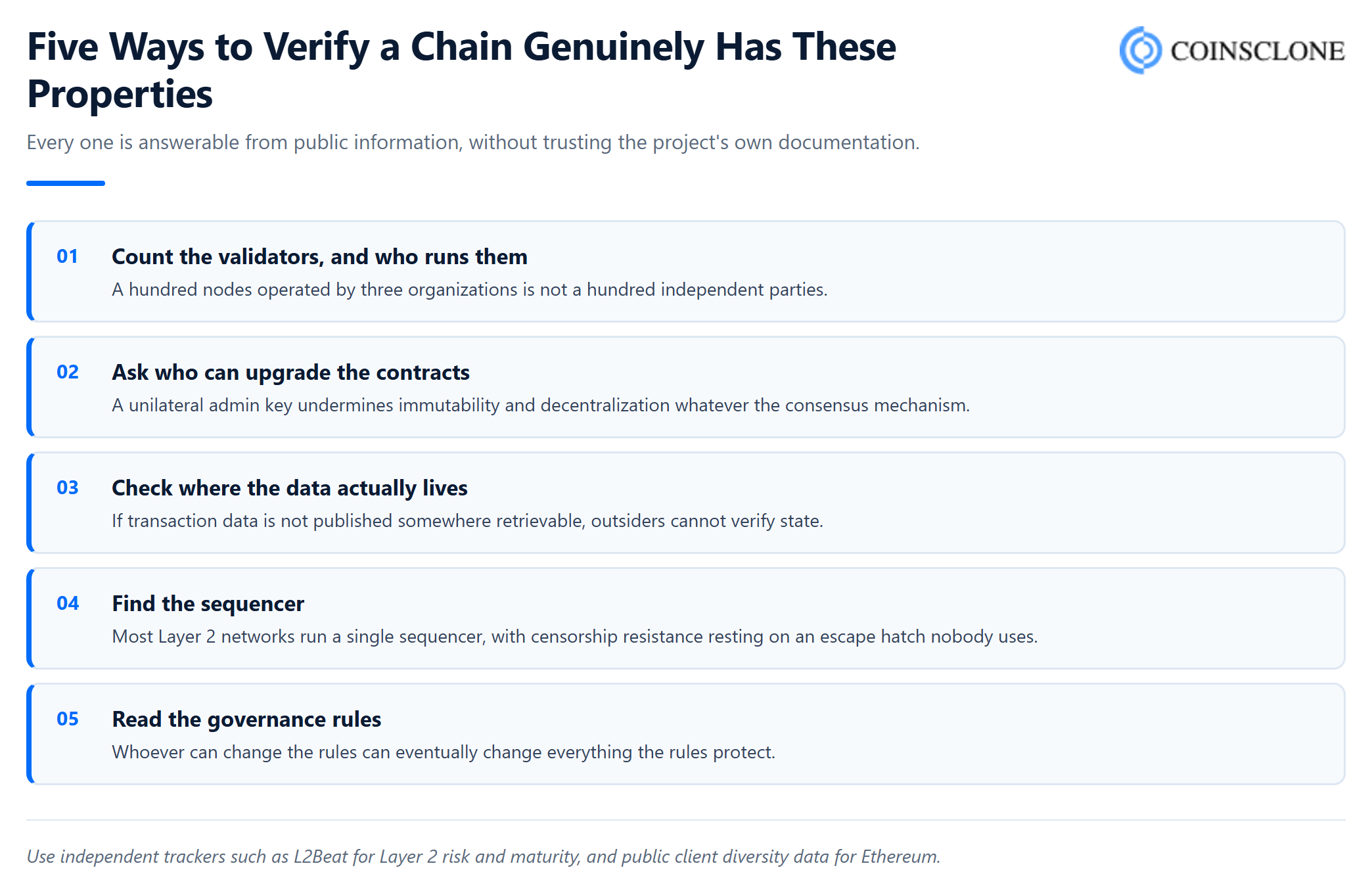
How Do You Verify a Chain Genuinely Has These Properties?
Five checks that cut through marketing language. Every one is answerable from public information.
Count the validators, and find out who runs them. A hundred nodes operated by three organizations is not a hundred independent parties. Concentration of operators matters more than the raw node count.
Ask who can upgrade the contracts. An admin key with unilateral upgrade rights undermines both immutability and decentralization regardless of the consensus mechanism underneath. A multisig held by one team is not meaningfully better.
Check where the data actually lives. If transaction data is not published somewhere retrievable, outsiders cannot reconstruct or verify state no matter what the chain claims about openness.
Find the sequencer. Most Layer 2 networks still run a single sequencer, with censorship resistance resting on an escape hatch that almost no user will ever exercise. Ask whether forced inclusion actually works and who has tested it.
Read the governance rules. Whoever can change the rules can eventually change everything the rules protect.
Use independent trackers rather than project documentation. L2Beat publishes risk assessments, upgrade key arrangements and maturity stages for Layer 2 networks, and client diversity for Ethereum is tracked publicly and has repeatedly shown a single execution client holding a majority share, which is a real decentralization risk that no marketing page mentions.
What Is the Nakamoto Coefficient?
A single number for how decentralized a network actually is: the minimum number of independent entities that would have to collude to compromise a given subsystem.
If the top four validators control more than a third of the stake on a chain where a third is enough to halt finality, the Nakamoto coefficient for that subsystem is four. It does not matter that ten thousand nodes exist. Four parties in a room can stop the network.
Two things make it more useful than a node count. It is computed per subsystem, so a chain can score well on consensus and badly on client software, mining pools or governance. And it is adversarial by construction, asking what an attacker needs rather than what the network advertises.
It is not a complete measure. It says nothing about whether those entities are genuinely independent, jurisdictionally diverse, or resistant to being pressured by the same regulator. Treat a low coefficient as a reliable warning and a high one as a starting point rather than a clean bill of health.
Public, Private or Consortium: Which Model Fits?
The three pillars land very differently across the three deployment models, and choosing the model is usually a bigger decision than choosing the chain.
Public networks maximize decentralization and transparency. Anyone can validate, anyone can read, and nobody can exclude you. You pay in throughput, in transaction cost, and in the privacy you surrender by publishing.
Private networks are run by a single organization. They are fast, cheap and confidential, and they deliver essentially none of the decentralization pillar. If one party controls all validators, the ledger’s integrity guarantee reduces to trusting that party, which a well-audited conventional database also provides at lower cost.
Consortium networks sit between the two, with validation shared among a known group of organizations that do not fully trust each other but do have a reason to cooperate. This is where most enterprise deployments genuinely belong: supply chains, trade finance, interbank reconciliation. Decentralization is bounded and real, transparency is scoped to members, and immutability holds as long as the members do not collectively agree to rewrite.
The question that settles it is simple. If a single organization can be trusted to hold the record, you do not need a blockchain. If several mutually suspicious organizations need one shared record, a consortium chain is the honest answer. If the participants are unknown, unbounded and potentially adversarial, only a public network works.
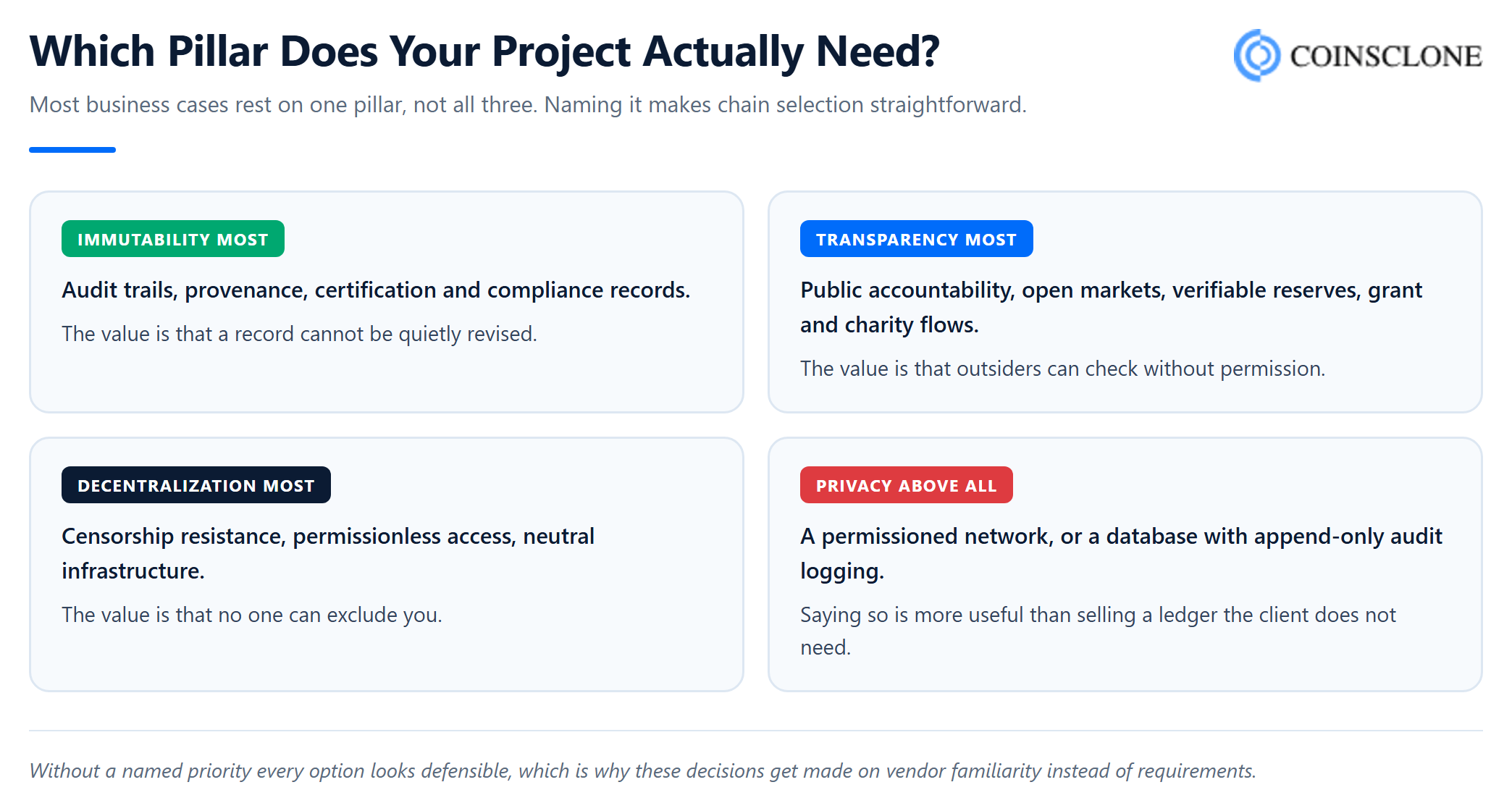
Which Pillar Does Your Project Actually Need?
Most business cases rest on one pillar rather than all three, and naming it early makes chain selection straightforward instead of arbitrary.
Immutability most: audit trails, provenance, certification and compliance records, where the entire value is that a record cannot be quietly revised.
Transparency most: public accountability, open markets, verifiable reserves, and grant or charity flows, where the value is that outsiders can check without permission.
Decentralization most: censorship resistance, permissionless access and neutral infrastructure, where the value is that no one can exclude you.
Privacy more than any of them: then a permissioned network, or a conventional database with strong append-only audit logging, is likely the honest answer, and saying so is more useful to a client than selling them a ledger they do not need.
Skipping this step is what makes chain selection feel arbitrary. Without a named priority every option looks defensible, which is exactly why these decisions tend to get made on vendor familiarity instead of requirements.
Conclusion
The three pillars become useful precisely when they stop being slogans and start being measurable properties with prices attached. Decentralization buys neutrality and costs speed. Immutability buys trustworthy history and costs the ability to correct. Transparency buys verifiability and costs privacy.
Work out which one your business case actually rests on. Verify that a candidate chain delivers it rather than claims it, using validator concentration, upgrade rights, data availability and independent trackers rather than documentation. Then be explicit about which of the other two you are trading away.
A network that claims all three, maximally and cheaply, has redefined at least one of them. Finding out which is usually a five minute exercise.
Coinsclone builds enterprise-grade Web3 platforms including public, private and consortium blockchain networks, crypto exchanges, wallets, DEXs, NFT marketplaces, payment gateways and RWA tokenization, using customizable white-label solutions. Talk to our blockchain experts for a free consultation and a live demo.
FAQ
Q: What are the three pillars of blockchain?
Decentralization, meaning no single party controls validation, upgrades or access; immutability, meaning recorded history cannot be quietly altered; and transparency, meaning anyone can inspect and independently verify the ledger. Each is a spectrum rather than a property a network either has or lacks.
Q: Is blockchain data really immutable?
Practically rather than absolutely. Altering an old record changes its hash and breaks every block after it, so rewriting history requires redoing all subsequent work faster than the honest network extends the chain. On a well-secured chain that is economically irrational, but smaller chains have been successfully reorganized, and Ethereum’s 2016 DAO fork showed that participants can also change the rules by agreement.
Q: Are the three pillars the same as the blockchain trilemma?
No. The pillars are decentralization, immutability and transparency, and describe what a chain offers users. The trilemma is scalability, security and decentralization, and describes a constraint architects face where improving two tends to cost the third. They share only decentralization, and the trilemma explains why the pillars carry the costs they do.
Q: What is the trade-off of decentralization?
Speed and cost. More independent validators means more coordination, which lowers throughput and raises latency. Replication and consensus are duplicated work by design, so a decentralized network will always be slower and more expensive per transaction than a centralized database performing the same task.
Q: Does transparency mean everything is public?
On a public chain, effectively yes. Transaction data, counterparties and amounts are visible to anyone, which is why commercial applications typically keep sensitive detail off-chain and commit only a hash. Hashing does not provide privacy if the underlying values can be guessed.
Q: What is the Nakamoto coefficient?
The minimum number of independent entities that would have to collude to compromise a subsystem of a network. It is computed per subsystem, so a chain can score well on consensus and poorly on client software or governance. A low coefficient is a reliable warning; a high one is a starting point rather than proof of decentralization.
Q: How can I tell if a blockchain is genuinely decentralized?
Count validators and check who operates them, since many nodes controlled by few organizations is not decentralization. Ask who holds contract upgrade rights, check whether transaction data is published, identify who runs the sequencer on Layer 2 networks, and read the governance rules covering who can change what. Use independent trackers rather than project documentation.
Q: What is the difference between public, private and consortium blockchains?
Public networks let anyone validate and read, maximizing decentralization and transparency at the cost of speed and privacy. Private networks are run by one organization and deliver almost none of the decentralization pillar. Consortium networks share validation among a known group of mutually suspicious organizations, which is where most enterprise use cases genuinely belong.
Q: Which pillar matters most for my project?
Immutability for audit trails, provenance and compliance records. Transparency for public accountability, open markets and verifiable reserves. Decentralization for censorship resistance and permissionless access. If privacy matters more than all three, a permissioned network or a database is likely the better answer.
Q: Can a blockchain have all three pillars at once?
Not maximally and not cheaply. Strengthening decentralization reduces speed, strengthening immutability removes the ability to correct errors, and strengthening transparency reduces privacy. Every real network sits at a chosen point along all three spectrums, and the useful question is whether that point matches your requirements.