
Every few weeks a new wallet hack makes the news. In September 2026 alone, attackers took $387.5 million from one exchange’s hot wallets. Yet most losses are smaller and closer to home: a fake site, a bad browser add-on, or a seed phrase saved in the cloud. Crypto wallet security is how you stop all of these. It covers the keys, the device, the app and the habits that keep your coins where they belong.
This guide sums up what you need to know in one place. You will see the threats that drain wallets today, with real 2025 and 2026 loss figures. You will also get a set of best practices you can apply in an hour. Then we look at what a wallet team must build in, and how Coinsclone builds secure wallets for businesses.
In this guide:
- What crypto wallet security means and why a lost key cannot be undone.
- The 10 threats that empty wallets in 2026, from drainers to “wrench” attacks.
- 12 best practices, including how to split funds across wallets.
- Real hacks from 2025 and 2026, and the lesson each one teaches.
- The security layers a wallet business must build, step by step.
See How Our MVP System Can Build a Highly Secure Crypto Wallet Faster
Crypto Wallet Development — done right.
- MVP System : Launch your secure crypto wallet 90% faster.
- Advanced Security : Multi-layer encryption, MPC, 2FA, and biometric protection—no coding needed.
- Brand & Customization : Your design, your blockchain, your control.
- Revenue Engine : Earn from transaction fees, swaps, and staking while keeping assets safe.
Get a free branded demo of your secure crypto wallet in 48 hours — before you invest a cent.
Book a Free Demo to discover how our system ensures enterprise-grade crypto wallet security and takes you from idea to live wallet in just 8–12 weeks.
What Is Crypto Wallet Security?
Crypto wallet security is the set of tools and habits that keep your private keys, and the coins they control, out of other people’s hands. A crypto wallet does not hold coins. It holds the keys that sign transfers on the blockchain. Whoever has the key, or can trick you into signing, can move the funds.
That is why wallet safety matters more than bank safety. A bank can reverse a bad card payment. A blockchain cannot. Once a transfer is signed and confirmed, it is final. There is no help desk to call and, in most cases, no way to get the money back.
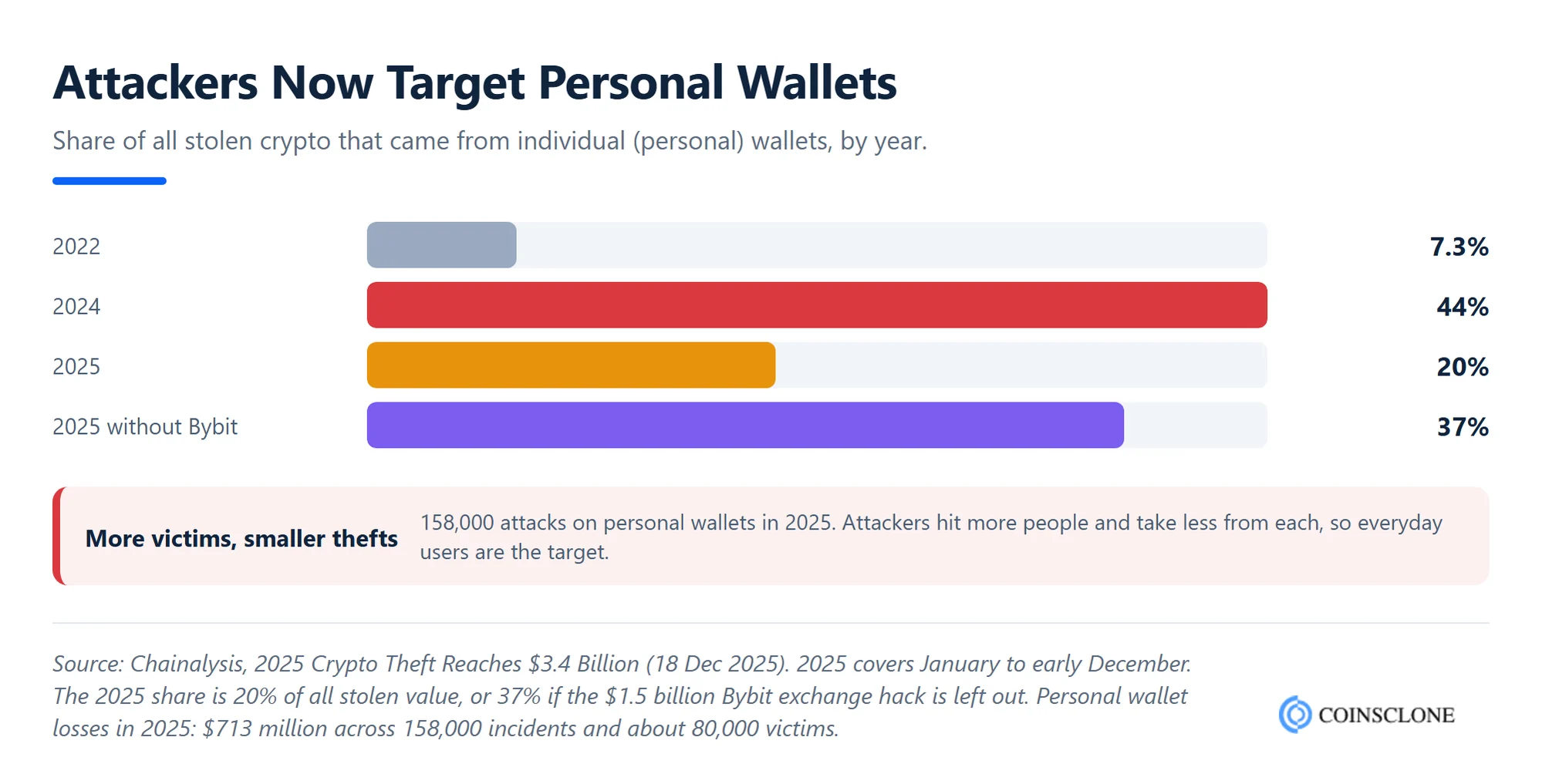
The numbers show how real the risk is. Chainalysis counted $3.4 billion stolen in 2025. Of that, $713 million came from 158,000 attacks on personal wallets, hitting about 80,000 people. In short, attackers now go after many small wallets, not just a few big ones.
Good wallet security works in layers. If one layer fails, the next one still holds. A strong password, a hardware device, a careful signing habit and a tested backup each block a different kind of attack.
Potential Threats Against Crypto Wallet Security
Crypto wallet security is at risk when any one of the following threats reaches you. Most of them target the person, not the code.
Phishing Attacks
Phishing means hackers build fake websites or apps that look like the real wallet, then steal your login details. They want your private key, your seed phrase or a signature. The links arrive by email, text, social media posts, search ads and even fake support chats. In early 2026, CertiK found phishing was the top source of losses in the first quarter.
Wallet Drainers and Token Approvals
A drainer is a phishing kit that asks you to sign one “harmless” approval. That approval lets the attacker’s contract spend your tokens later, with no further clicks from you. Scam Sniffer’s 2025 report counted $83.85 million lost to drainers from 106,000 victims. That is down 83% from 2024, but the average loss was still $790 per person.
Malware and Clipboard Hijackers
Malware gets onto your phone or computer through cracked software, fake games, bad browser add-ons or email files. It can log your keystrokes, copy your wallet files or swap a copied address for the attacker’s own. You paste what you think is your friend’s address, and the coins go to the thief.
Address Poisoning
Here the attacker sends you a tiny transfer from an address that looks like one you use. The first and last few characters match. Later, you copy the wrong address from your history and send real funds to the fake one. In December 2025, one trader lost almost $50 million in USDT this way, minutes after sending a small test amount to the right address.
SIM Swap Attacks
In a SIM swap, a criminal convinces your mobile carrier to move your number to their SIM card. They then receive your SMS codes and can reset your exchange or email logins. That is why SMS codes are the weakest form of two-factor login for crypto.
Supply Chain Attacks
Sometimes the wallet itself is poisoned. On 24 December 2025, a hacked update of the Trust Wallet Chrome extension (version 2.68) sent users’ seed phrases to the attacker. Trust Wallet later confirmed about $8.5 million drained from 2,520 wallets before a clean version 2.69 replaced it.
Social Engineering and AI Scams
Social engineering means tricking people into giving up access. Scammers pose as support staff, recruiters or friends and build trust before they ask for a key or a “test” transfer. In 2026, they also use AI voice clones and deepfake video calls, so a familiar face on screen is no longer proof.
Physical Theft and Wrench Attacks
A thief can steal a hardware wallet or the paper with your seed phrase on it. Worse, some criminals now use force. Chainalysis tracked 46 violent “wrench” attacks and about $30 million taken in the first half of 2026. The best defence is to keep your holdings private.
Attacks Through External Platforms
This threat hits custodial wallets, where a platform such as an exchange holds the keys for you. If the platform is hacked, your balance is at risk too. On 24 September 2026, Bitget lost $387.5 million from its hot and warm wallets. The Hacker News reported that attackers broke in through a flaw in a third-party security tool. Bitget said its cold wallets were not touched.
Smart Contract and Delegation Exploits
Smart wallets and DeFi apps run on code, and code can have bugs. Ethereum’s EIP-7702 upgrade (May 2025) also lets a normal wallet hand control to a contract. Within weeks, phishers used it to get victims to sign over their whole wallet in one step.
So what does all this mean? It means a secure crypto wallet needs more than a password. A trusted crypto wallet development company builds defences for each of these threats into the product itself.
Essential Components of Cryptocurrency Wallet Security
Crypto wallet security comes from several parts working together. Here is an overview of each one, and what it protects you from. For the wider feature set, see our guide to the features of a crypto wallet.
Private Key Management
Private keys are long secret numbers made with cryptography. They prove you own an address and let you sign transfers. In custodial wallets, the provider stores the keys. In non-custodial wallets, you store them, which gives you full control. MPC wallets split signing power into key shares held in different places, so no full key ever sits on one device. Understand what your users expect and pick the right model. Our guide on custodial vs non-custodial wallets explains the trade-offs.
Authentication Methods
Crypto wallet apps run on mobile, desktop and browser add-ons. Each uses a mix of these login and approval checks:
- PIN or password: Locks the app on your device.
- Two-factor or multi-factor login (2FA/MFA): An authenticator app or hardware security key adds a second check.
- Biometric login: Fingerprint or face scan on phones and laptops.
- Multi-signature approval: Two or more keys must sign before a transfer goes through.
- Physical device check: A hardware wallet asks you to press a button to confirm.
The first three protect wallet access. The last two protect transfers. You can combine two or more of them as you need.
Secure Wallet Communication
Secure communication is about how data moves between the wallet, the blockchain and the user. Wallets talk to the chain through nodes and APIs. Strong encryption and TLS keep that data safe as it travels. As a result, there is little risk of someone reading or changing the data in the middle.
Backup and Recovery Options
Backup and recovery options help you get back into your wallet after a lost phone or a broken device. Most wallets create a 12 to 24-word seed phrase when you first set them up. With it, you can restore the wallet on any compatible app. This seed phrase is the master key of cryptocurrency wallet security, so it must stay offline and private.
Storage Type
Based on storage, crypto wallets are hot or cold. Hot wallets stay online, so they are easy to use but more exposed to hacks. Cold wallets keep keys offline and only connect when you sign. That makes them safer for savings. Many apps now pair a hot wallet for daily use with cold storage for the bulk of funds. For a full list of options, see our guide to the types of crypto wallets.
| Wallet type | Where the key lives | Main risks | Best for |
| Hot (mobile, desktop, browser) | On an online device | Phishing, malware, drainers | Daily spending and DeFi |
| Cold (hardware, air-gapped) | On an offline chip | Theft, lost seed phrase | Long-term savings |
| Custodial (exchange account) | With the provider | Platform hack, freeze, failure | Active trading |
| MPC | Split across devices or servers | Weak share backup, provider lock-in | Teams, apps, firms |
These parts protect the wallet against the threats above. But in daily use, both users and wallet providers must follow a few rules to get the most from them.
Crypto Wallet Security Best Practices: 12 Ways to Protect Your Assets
Here are the habits that keep your crypto wallet secure. Start with the first five; they stop most attacks. For more storage tips, see the best ways to keep your cryptocurrency safe.
1. Never Share Your Seed Phrase or Private Key
- No real support team will ever ask for your seed phrase. Anyone who asks is a scammer.
- Never type it into a website, a form or a chat. You only enter it in your own wallet app, and only to restore it.
2. Store Your Seed Phrase Offline
- Write it on paper or stamp it on a metal plate. Keep it in a safe place, away from fire and water.
- Do not store it in screenshots, email, cloud notes or photos. Malware and cloud leaks find these first.
3. Protect Your Wallet With a Strong Password
- Use a long, unique password with letters, numbers and symbols.
- Never reuse it anywhere else.
- Keep it in a trusted password manager.
4. Use an Authenticator App or Security Key, Not SMS
- Turn on 2FA for your wallet, exchange and the email linked to them.
- Use an authenticator app or a hardware security key. SMS codes can be stolen through a SIM swap.
- On mobile wallets, turn on biometric login as well.
5. Keep Most Funds in Cold Storage
- Use a hardware wallet for savings you do not touch often. It keeps the key offline and makes you confirm each transfer on the device.
- Entry hardware wallets cost well under $100, which is cheap insurance for any real sum.
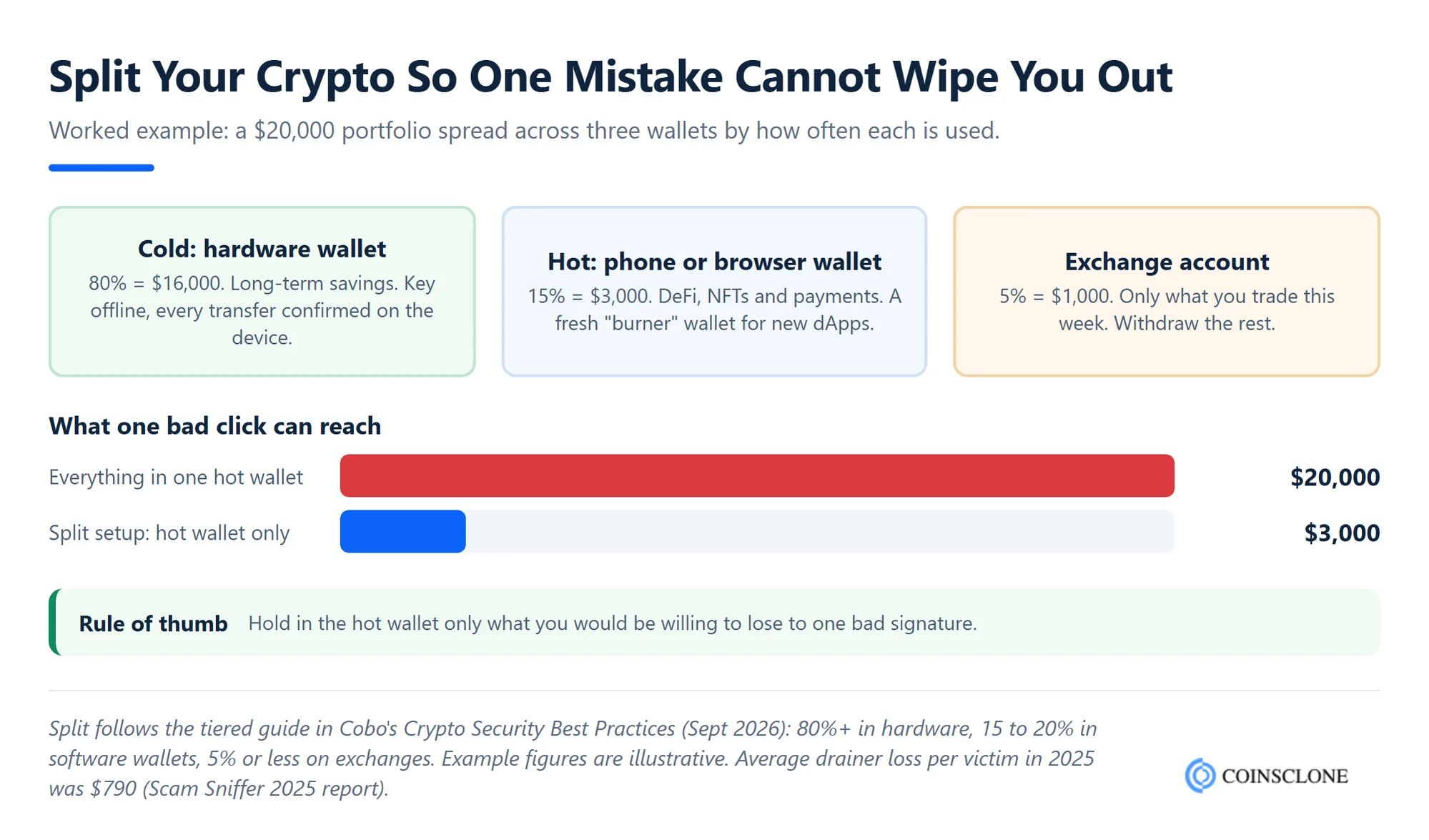
6. Split Funds Across Wallets
- Keep savings, daily funds and risky DeFi tests in separate wallets.
- If a dApp or link turns out to be bad, only the small “test” wallet is at risk.
7. Read Every Signing Request
- Check what you are signing, not just the amount. A request that grants “unlimited” spending or a “SetApprovalForAll” is a red flag.
- Use a wallet that shows a clear preview of each transaction and warns about risky contracts.
8. Review and Revoke Token Approvals
- Check active approvals and dApp links every month.
- Remove the ones you no longer use with a tool such as Revoke.cash or the Etherscan token approval checker.
9. Check Every Address Before You Send
- Compare the full address, not just the first and last few characters. Address poisoning relies on that shortcut.
- Save trusted addresses in your wallet’s address book, and send a small test amount first for large transfers. For the main transfer, copy the address from the address book again, never from your history.
10. Download Only From Official Sources
- Install wallet apps and add-ons only from the official site or app store link.
- Do not click unknown links in texts or emails. Type the website address yourself or use a bookmark.
11. Use a Secure Network and Device
- Avoid public Wi-Fi and unknown VPNs when you use your wallet.
- Keep your phone and computer clean of cracked software, and use trusted anti-malware tools.
12. Keep Your Wallet Updated and Test Your Backup
- Update the wallet app and device firmware when the official team releases a fix. Turn on auto-updates for mobile apps.
- Test your seed phrase backup once by restoring it on a spare device with a small balance. A backup you have never tested is only a hope.
Finally, keep quiet about your holdings. Posting big wins online makes you a target, both online and in person. With these steps, your cryptocurrency wallet becomes far harder to break into.
Common Crypto Wallet Security Mistakes to Avoid
Most wallet losses come from a handful of repeat mistakes. Avoid these and you are ahead of most users.
- Seed phrase in the cloud: A photo or note synced to the cloud is one leaked login away from theft.
- SMS as your only second factor: A SIM swap gives the attacker your codes.
- Blind signing: Approving pop-ups without reading them is how drainers win.
- Leaving large sums on an exchange: You carry the platform’s risk as well as your own.
- Copying addresses from history: That is where poisoned look-alike addresses wait.
- Never testing recovery: People often find a wrong word in their backup only after the phone is gone.
- Trusting “support” in your DMs: Real support teams do not message you first.
Real Crypto Wallet Hacks and What They Teach
Big hacks show where security breaks in practice. Each one points to a layer that failed.
| Incident | What happened | Loss | Lesson |
| Bybit, Feb 2025 | Attackers tricked signers into approving a bad transfer from a cold wallet | About $1.5 billion | Check what you sign on a trusted screen, even with multisig |
| Trust Wallet extension, Dec 2025 | A hacked add-on update stole seed phrases | About $8.5 million | Supply chains need code signing and release checks |
| Bitget, Sept 2026 | A third-party tool flaw let attackers forge hot wallet withdrawals | $387.5 million | Keep most funds cold and limit hot wallet balances |
| Address poisoning, Dec 2025 | A victim copied a look-alike address from their history, right after a test transfer | About $50 million | Check the full address every time and use an address book |
Notice the pattern. None of these attacks broke the blockchain or its cryptography. Each one went around it, through people, tools or habits. That is why crypto wallet security has to cover all layers, not only the code.
Future Innovations in Crypto Wallet Protection
Wallet security keeps moving as threats change. Here are the upgrades that are shaping the next few years of cryptocurrency wallet security.
Decentralized Identity Solutions
Decentralized identity lets users prove who they are, or that they own a wallet, by sharing only what is needed. This cuts the amount of personal data stored in one place. As a result, there is less to leak and fewer chances for identity-based phishing.
Passkeys and Smart Accounts
Smart accounts, built on standards such as ERC-4337 and EIP-7702, let a wallet follow rules. It can set daily spending limits, block unknown contracts, or use trusted contacts to recover access. Paired with passkeys, which use your phone’s secure chip and face or fingerprint scan, users can skip the seed phrase without losing control.
Post-Quantum Cryptography (PQC)
Most wallets today sign with elliptic curve schemes (ECDSA or EdDSA). A large quantum computer could one day break these. To prepare, the US standards body NIST published its first post-quantum standards (FIPS 203, 204 and 205) in August 2024. Blockchains and wallets are now testing how to move to these new signature types.
Multi-Party Computation (MPC)
MPC splits signing power into key shares held by different devices or parties. The shares work together to sign, but the full private key never exists in one place. So a thief who steals one device gets nothing useful. MPC is already common in firms and consumer apps, and better share backup and refresh methods keep improving it.
Threshold Signature Schemes (TSS)
TSS is the signing method behind most MPC wallets. Several key shares sign together and produce one normal signature. To the blockchain, it looks like any other transfer. Compared with on-chain multisig, TSS costs less in fees, works on more chains and keeps the approval setup private.
| Feature | On-chain multisig | MPC with TSS |
| Where approval happens | On the blockchain | Off-chain, between key shares |
| Network fees | Higher (extra signatures on chain) | Same as a normal transfer |
| Chain support | Only chains with multisig support | Most chains |
| Privacy | Signer setup is public | Signer setup stays private |
These are the leading innovations in cryptocurrency wallet security. However, you need a well-built wallet platform to use them well. Coinsclone, a leading Crypto Wallet Development Company, builds wallets with these features ready to switch on. Here is how we do it.
How Does Coinsclone Help You Achieve Crypto Wallet Security?
At Coinsclone, we first understand your needs and plan a clear roadmap. Here is our working process, with crypto wallet security built into each stage.
Understanding Your Requirements
We start by learning your wallet business idea, your users and your markets. Our experts then map the security goals and the risks that matter most for your model.
Choosing the Type of Wallet
Next, our team suggests the right wallet type: custodial, non-custodial, MPC or hybrid. That choice shapes the rest of the plan, from key storage to login methods.
Defining Secure Key Management
This step sets up how keys are created, stored and backed up. Keys are made with secure random number generators and encrypted at rest with AES-256. For custodial and business wallets, we use hardware security modules (HSMs) or MPC so no single person or server can move funds.
Employing Robust Authentication
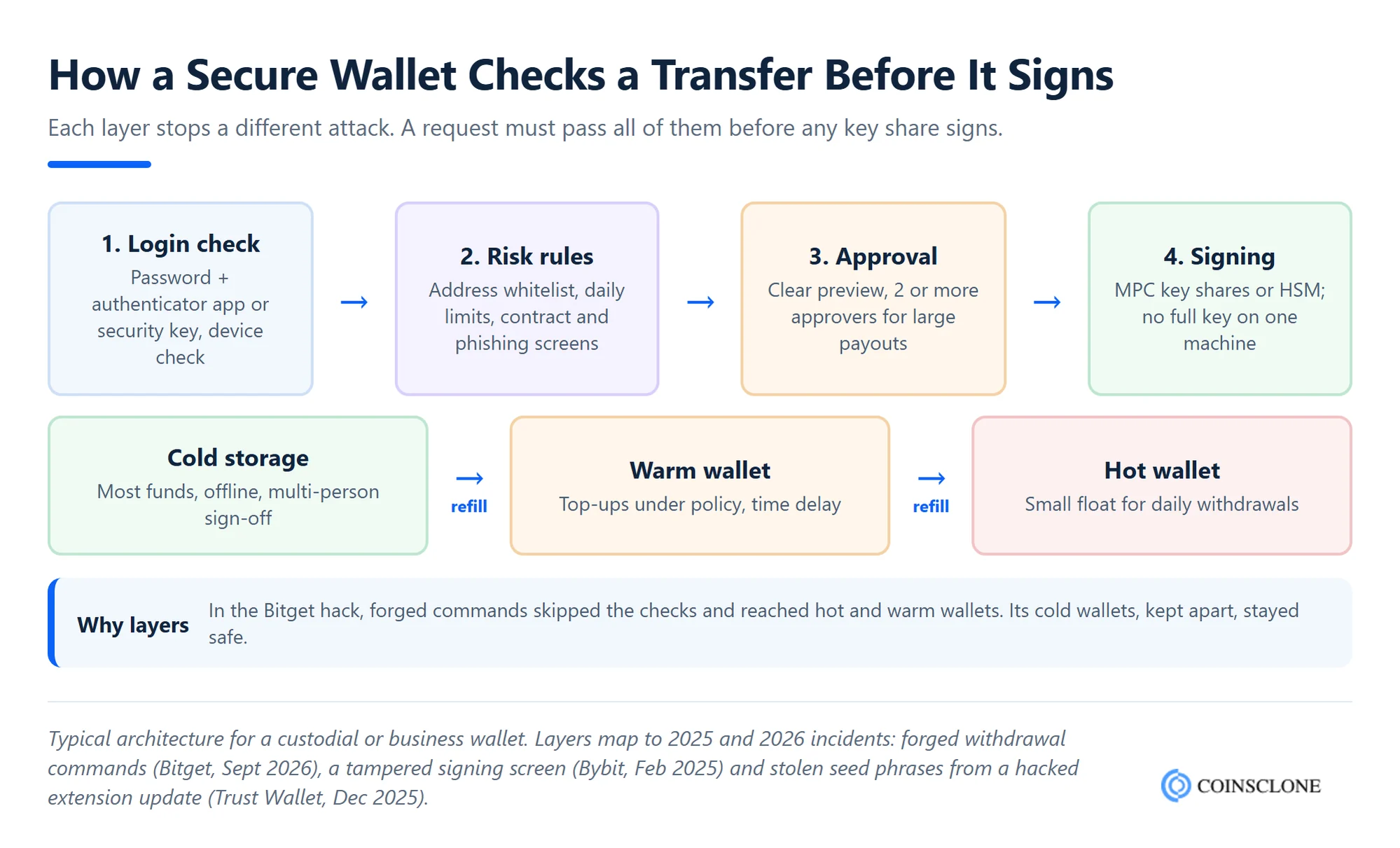
We build in 2FA and MFA with authenticator apps, security keys and biometric login. For transfers, we add multi-signature or MPC approval rules, so large payouts need more than one sign-off.
Following Secure Coding Practices
Our developers follow secure coding rules, peer review each change and test error handling. Smart contracts and wallet logic are checked for known flaws before release. Signed builds and locked release keys protect against supply chain attacks like the Trust Wallet extension hack.
Integrating Modern Security Features
We add anti-phishing domain checks, transaction previews, risky contract warnings, address books and approval managers. Our wallets also support device checks, withdrawal limits, address whitelists and alerts. You can add more security measures to suit your needs.
Implementing Data Encryption and Storage
Wallet data, including user details, addresses and transaction records, is encrypted with AES. Data in transit uses TLS. For custodial setups, most assets sit in cold storage, with only a small float in hot wallets for daily withdrawals.
Completing the Wallet Build
This is where the front end and back end come together. Our testing team runs functional tests, penetration tests and a smart contract audit before launch.
Meeting Regulatory and Legal Norms
We build to support the rules of your market. That can include GDPR data handling, KYC and AML checks, Travel Rule data sharing and, in the EU, MiCA custody needs. The wallet stays flexible, so you can add features as rules change.
Conducting Periodic Security Audits
Security does not stop at launch. Our wallets come with regular audit and upgrade plans. You can also add real-time monitoring to spot odd activity early.
A white label crypto wallet from Coinsclone can go live in about 3 to 5 weeks, while a fully custom wallet takes about 8 to 12 weeks. Either way, we never cut corners on cryptocurrency wallet security. For the steps from idea to launch, read our guide on how to create a crypto wallet.
Why Should You Choose Coinsclone for Secure Crypto Wallet Development?
Coinsclone is a leading crypto wallet development company that builds security-first wallets to each client’s needs. We have been building blockchain products since 2018, with 350+ platforms delivered for 200+ clients across 20 industries. Our team follows secure coding practices and a proven process that keeps quality high.
Our wallets are built to handle real-world threats, from phishing and drainers to hot wallet attacks, while staying fast and easy to use. That helps you grow a wallet business that users trust. Ready to start? Book your free consultation today.
Frequently Asked Questions
Can a crypto wallet be hacked?
Yes, but attackers rarely break the blockchain itself. In most cases, they steal the seed phrase or private key, infect the device, or trick the user into signing a bad transfer. A hardware wallet, a private seed phrase and careful signing block most of these attacks.
What is the most secure type of crypto wallet?
For most people, a hardware (cold) wallet is the most secure way to hold savings. It keeps the private key offline and asks you to confirm each transfer on the device. For teams and firms, MPC or multi-signature wallets add more safety, because no single person or device can move funds alone.
How do crypto wallets get hacked?
The most common routes are phishing sites, drainer approvals, malware on the device, address poisoning, SIM swaps and fake support staff. Hacks of exchanges and wallet software updates also put users at risk. Chainalysis counted 158,000 personal wallet attacks in 2025 alone.
Is it safe to keep crypto on an exchange?
It is fine for small amounts you trade often, but it adds the platform’s own risk. If the exchange is hacked, frozen or fails, your balance may be stuck or lost. Keep long-term savings in a wallet where you control the keys.
Should I store my seed phrase on my phone or in the cloud?
No. Screenshots, notes and cloud files are top targets for malware and account takeovers. Write the seed phrase on paper or a metal plate and store it somewhere safe and private.
Is SMS 2FA safe for crypto accounts?
SMS is better than nothing, but it is the weakest option. A SIM swap lets a criminal receive your codes. Use an authenticator app or a hardware security key instead.
See How Our MVP System Can Build a Highly Secure Crypto Wallet Faster
Crypto Wallet Development — done right.
- MVP System : Launch your secure crypto wallet 90% faster.
- Advanced Security : Multi-layer encryption, MPC, 2FA, and biometric protection—no coding needed.
- Brand & Customization : Your design, your blockchain, your control.
- Revenue Engine : Earn from transaction fees, swaps, and staking while keeping assets safe.
Get a free branded demo of your secure crypto wallet in 48 hours — before you invest a cent.
Book a Free Demo to discover how our system ensures enterprise-grade crypto wallet security and takes you from idea to live wallet in just 8–12 weeks.