
In June 2026, the Curaçao Gaming Authority gave its licensees their first crypto rules. Operators that take coins must now keep player money, business cash and treasury in separate wallets, screen every wallet, and be fully set up by June 2027. So a crypto payment gateway for online casinos is no longer a plug-in you add and forget. It is part of your licence.
Card payments for gambling keep getting harder, too. Since 1 April 2026, Visa’s monitoring program flags merchants in the US, EU, Canada and Asia Pacific once fraud and disputes pass 1.5% of card payments. As one operator thread put it, getting approved is hard, but staying live is harder.
This guide is for licensed operators, not players. It covers how crypto payments move, the licence rules, the costs next to cards, and when to build your own.
In this guide:
- Licences: Curaçao allows crypto under the standard licence with strict wallet rules. Malta needs prior MGA approval. The UK has no route yet.
- Costs: in our worked example, a $2 million month costs about $125,000 on high-risk cards, $30,000 on a 1% crypto gateway and about $21,000 on your own.
- Break-even: owning a gateway starts to pay off at about $1.25 million a month in crypto deposits.
- Build cost: published 2026 agency cost guides put a white label gateway at $20,000 to $60,000 and a custom one at $40,000 to $100,000.
- Rules: screen wallets on every deposit and payout, send Travel Rule data, and pay out to the wallet the player paid from.
What Is a Crypto Payment Gateway for Online Casinos?
A crypto payment gateway for online casinos is the system that takes player deposits in coins, credits the player’s balance and sends payouts back on-chain. It sits between your casino and the blockchains, the way a card processor sits between you and Visa.
A full gateway does six jobs:
- Addresses: a fixed deposit address for each player on each chain.
- Chain watching: credits the balance once a payment is final.
- Screening: checks each wallet against sanctions lists and risk scores.
- Ledger: logs every deposit, bet, win and payout in one currency.
- Payouts: checks, signs and sends each withdrawal.
- Treasury: sweeps funds to safe storage and swaps coins through a licensed partner.
Why do operators want one? Crypto payments can’t be charged back, they settle in minutes, and no acquirer can hold back a reserve. The catch is that you now carry the checks a card processor used to carry.
How Crypto Casino Payments Move
The flow below shows a deposit and a payout, with the check a regulator now expects at each step.
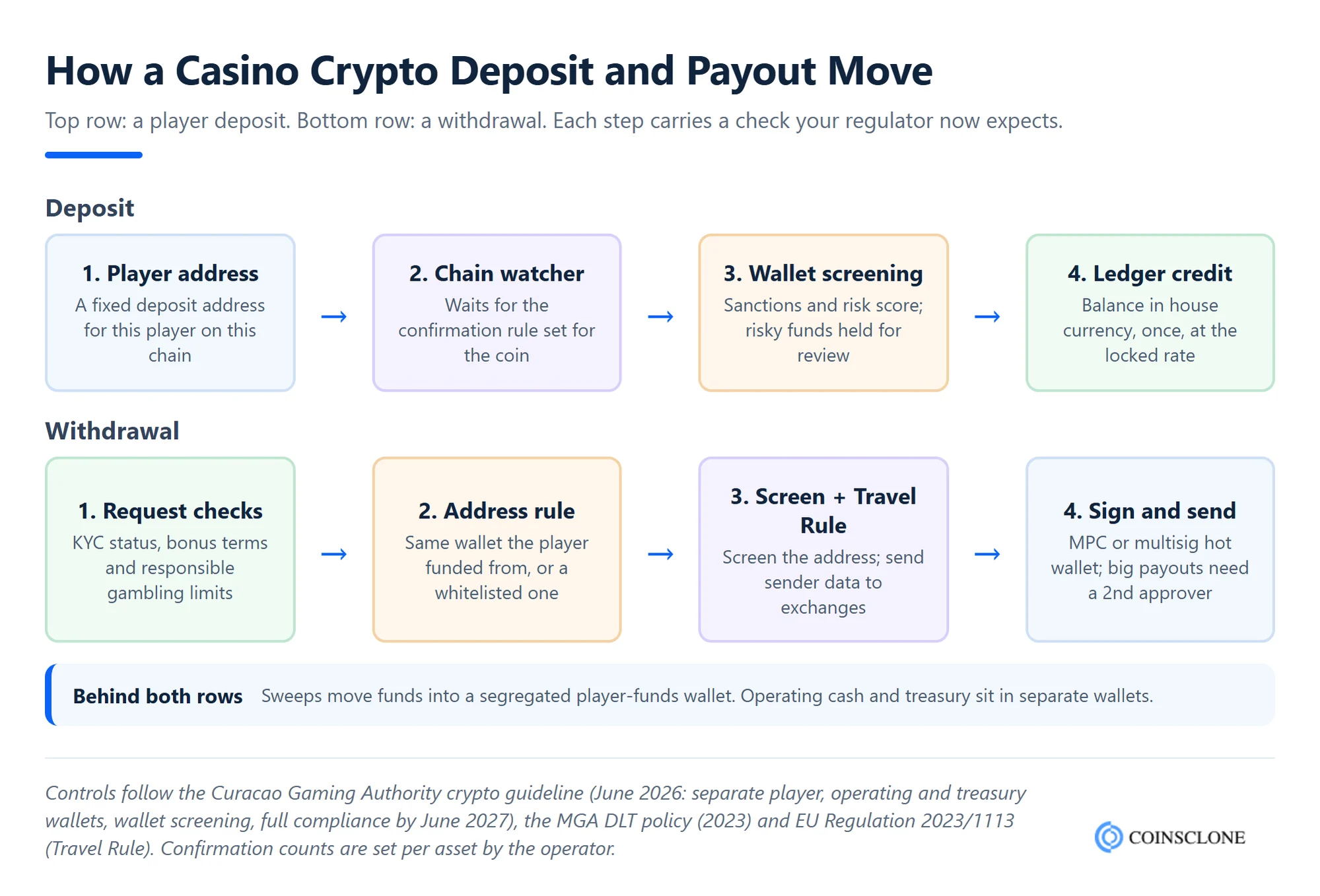
A deposit, step by step:
- The player picks a coin and network, such as USDT on Tron or USDC on Ethereum.
- The gateway shows that player’s own address, with a QR code and the minimum amount.
- The chain watcher sees the payment and waits for your confirmation rule for that coin.
- Analytics scores the sending wallet. Risky funds are held for review, not credited.
- The ledger credits the player in your house currency, at the rate locked on arrival.
- A sweep later moves the funds into your player-money wallet.
A payout, step by step:
- The player asks to withdraw. Your platform checks KYC, bonus terms and safer gambling limits.
- The gateway checks the address. Is it the wallet the player paid from, or one you have cleared?
- Analytics screens the address, and Travel Rule data goes out if the receiver is an exchange.
- The hot wallet signs with MPC or multisig keys. Large payouts wait for a second approver.
Plan for the edge cases operators complain about: the wrong network, less than the minimum, or a missing XRP tag. Also, make each credit run once only, so a webhook that fires twice never pays a player twice.
Licence Rules That Allow Crypto Payments in 2026
Your gaming licence decides whether you can take crypto at all, and on what terms. Here is where the main licences stand in October 2026:
| Licence | Crypto allowed? | Key 2026 rules |
| Curaçao (CGA, under the LOK) | Yes, inside the standard B2C licence | Crypto policy on the CGA portal first, risk work within 6 months, full wallet and analytics controls by June 2027 |
| Malta (MGA) | Yes, with prior approval | Asset-by-asset review, wallet standards, only authorised service providers |
| Anjouan | No crypto rule published | Licence terms tightened after the FATF report in September 2026, details not shared |
| UK (Gambling Commission) | No route yet | Commission is looking at one; it would need FCA-authorised crypto firms, and that regime starts 25 October 2027 |
Checked 16 October 2026 against the regulators’ own papers and trade press. Rules change fast, so confirm with your licence lawyer.
Curaçao: crypto is allowed, with strict wallet rules
Curaçao’s new gaming law, the LOK, took effect on 24 December 2024 and made the Curaçao Gaming Authority (CGA) the direct regulator. In June 2026 the CGA issued its first crypto guideline for licensees. It covers deposits, play, payouts and treasury, and it reaches group firms that support the licence:
- Gambling only: you may take crypto for gambling, but you may not act as an exchange, custodian or crypto service firm yourself.
- Coins: fiat-backed stablecoins are preferred. Privacy coins, meme coins and wrapped tokens of unclear origin need extra review or a ban.
- Wallets: player, business and treasury wallets must be separate. Sanctioned wallets, mixers, and personal or owner-linked wallets are banned now.
- Deadlines: a crypto policy within about three months, risk and partner checks within six, and full controls by June 2027.
Note this: handing payments to a gateway does not hand off the duty. If your provider fails a CGA check, it is still your licence at risk.
Malta: prior approval, then a review of each coin
The Malta Gaming Authority’s policy on the use of DLT has been in force since 30 January 2023. You need MGA approval before you take any crypto, and you must list each coin and how Maltese law classes it. Any firm that holds wallets or takes coins for you must be authorised under the VFA Act or other Maltese rules. The policy also sets wallet standards.
Anjouan: popular, but check before you rely on it
Anjouan Gaming said in July 2026 that it had issued more than 1,650 licences. After the FATF report in September, it said it had tightened its licence terms but did not say how, and it has no published crypto rules. Authorities have also warned about sellers offering licences in Anjouan’s name with no legal basis. So check any licence on the regulator’s own register.
UK: no crypto route yet
In February 2026 the UK Gambling Commission asked its industry forum to look at a route for crypto payments, with no timetable. Any route would rely on FCA-authorised crypto firms, and the FCA’s crypto regime only starts on 25 October 2027. Until then, plan UK brands without crypto.
If you plan to sell the gateway to other operators, you will likely need a crypto licence too. Our crypto license guide covers the options.
KYC, AML and the Travel Rule for Casino Crypto Payments
Crypto does not shrink your KYC duty. Regulators expect the same checks as for cards, plus checks on wallets. In September 2026, the FATF’s report on gaming and gambling risks listed crypto among the payment methods open to money laundering.
What your gateway must support:
- Player KYC: verify the player before the first payout, or sooner if your licence says so.
- Wallet screening: on every deposit and every payout, not once at sign-up.
- Source of funds: flag large or fast deposits and ask for proof.
- Same-wallet payouts: pay out to the wallet the player paid from. This blocks the “pay in, play a bit, cash out elsewhere” trick.
- Limits in cash terms: set safer gambling limits in your house currency, so a price move can’t break them.
The Travel Rule: when funds move between your provider and an exchange, sender and receiver details must go with them. In the EU, Regulation 2023/1113 has applied to every such transfer since 30 December 2024. Above EUR 1,000, a personal wallet also needs proof that the customer controls it. In the US the line is $3,000. Our crypto Travel Rule guide covers the message formats and networks.
Chargebacks, Price Swings and Settlement
A confirmed on-chain payment can’t be pulled back by a bank or card network. That ends friendly fraud, where a player loses, then disputes the card payment. For gambling merchants, those disputes count toward Visa’s 1.5% line. Cross it, and fees of up to $8 a case can be passed on to you, or the account can be shut.
But “no chargebacks” does not mean “no disputes”. Players can still complain to your regulator, so build a refund path into the gateway from day one.
Price swings are the other risk. If a player pays in Bitcoin and you hold it, a price drop cuts your funds while the player’s balance stays fixed in dollars. Most operators handle this in one of three ways:
- Stablecoins first: use USDT and USDC as the main rails.
- Swap on arrival: convert other coins at once through a licensed partner.
- Keep a payout float: hold a day or two of payouts in the hot wallet and sweep the rest to cold storage.
For more on the stablecoin side, read our guide to a stablecoin payment gateway.
Crypto Gateway Fees vs Card Fees: A Worked Example
Headline rates hide most of the cost. So here is one full month for a mid-sized operator. The card terms are the kind high-risk acquirers quote, not a real price list:
- Volume: $2,000,000 in deposits a month, from 20,000 deposits of $100.
- Cards: 5% to process, 1% of deposits disputed at $100 lost plus a $25 fee each, and 10% held back for 180 days.
- Rented crypto gateway: NOWPayments lists a 1% fee and CoinPayments lists 3% (both checked October 2026), plus an assumed 0.5% to convert.
- Own gateway: $12,000 a month to run, 0.3% to convert through a licensed OTC desk, and a $70,000 build spread over 24 months.
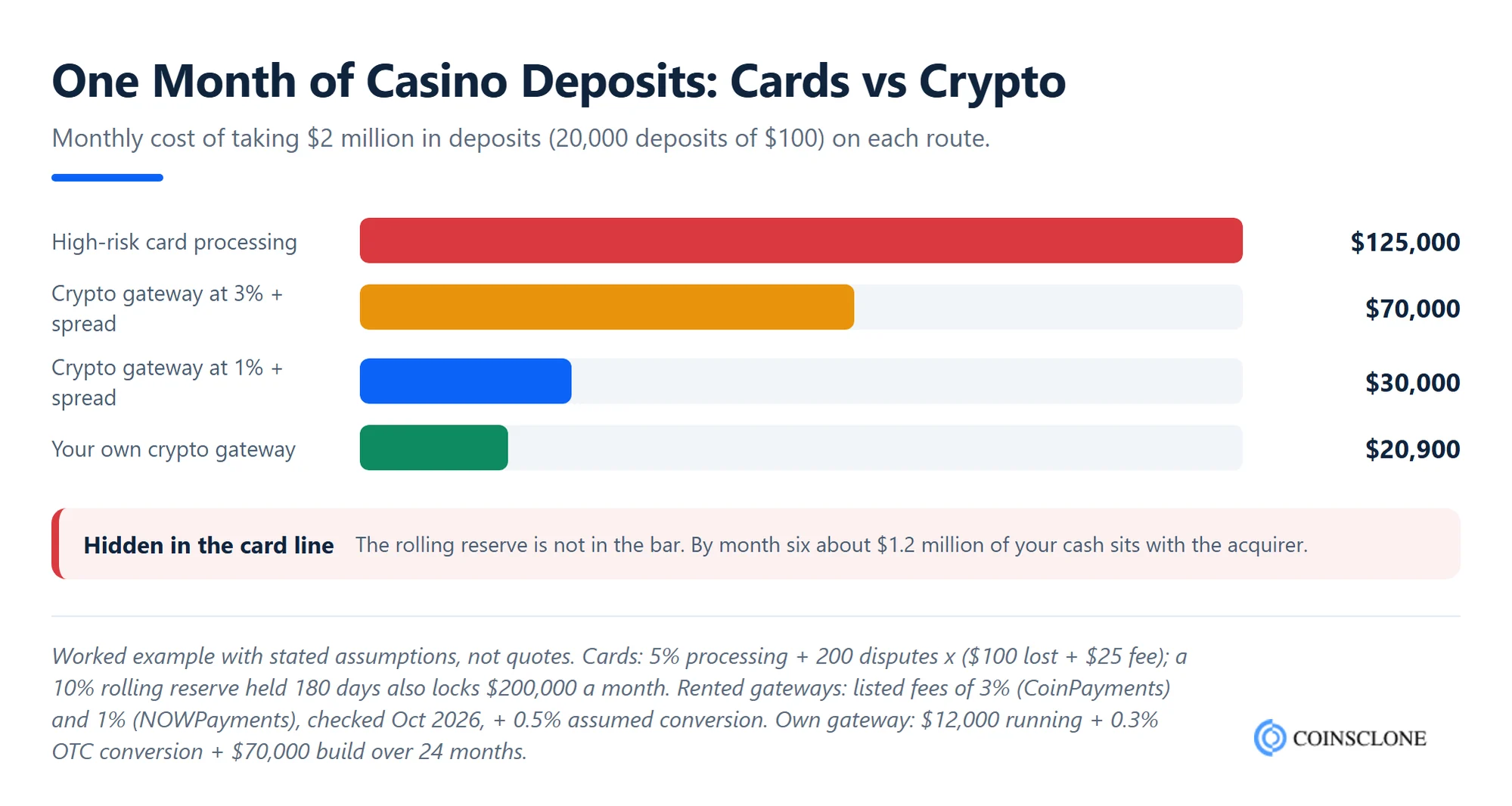
Cards cost about $125,000 a month, or 6.25% of deposits. They also lock up $200,000 in reserve each month, so by month six about $1.2 million of your cash sits with the acquirer. A 1% crypto gateway costs about $30,000. Your own gateway costs about $20,900, with the build cost included.
So the big win is moving off cards. The smaller, later win is moving from a rented gateway to your own.
Launch Your Own Crypto Payment Gateway for Your Casino
Crypto Payment Gateway Development — done right.
- Per-player deposits: a fixed address for each player on every chain, with idempotent credits and webhooks
- Segregated wallets: separate player, operating and treasury wallets with hot and cold tiers and MPC or multisig keys
- Compliance hooks: wallet screening on every deposit and payout, Travel Rule messages and audit-ready reports
- Cashier integration: connects to your casino platform, bonus engine, KYC flow and responsible gambling limits
Stablecoin-first payouts, full source code ownership and support after launch.
Book a Free Demo to see a working gateway with your casino’s coins, chains and payout rules.
Build vs Buy: Which Gateway Model Fits Your Casino?
You have three real choices. Each one shifts cost, control and rule work in a different way:
| Option | Upfront cost | Monthly cost | Time to live | Best for |
| Rent a third-party gateway | Little or none | 1% to 3% of volume, plus conversion | Days, after onboarding | New casinos and low volume |
| White label gateway you own | $20,000 to $60,000 | $5,000 to $15,000 to run | About 4 to 6 weeks | Operators past about $1 million a month |
| Custom gateway | $40,000 to $100,000, or $100,000 to $300,000+ from scratch | $5,000 to $15,000+ to run | 6 to 9 weeks standard, 10 to 14 with settlement | Groups with many brands, licences or a B2B plan |
Cost ranges reflect published 2026 agency cost guides and are planning figures, not quotes. Timelines are the delivery times Coinsclone lists for its gateway builds. Licences, audits and partner fees are extra.
The chart below runs the same example at three volumes. It shows where owning starts to beat renting.
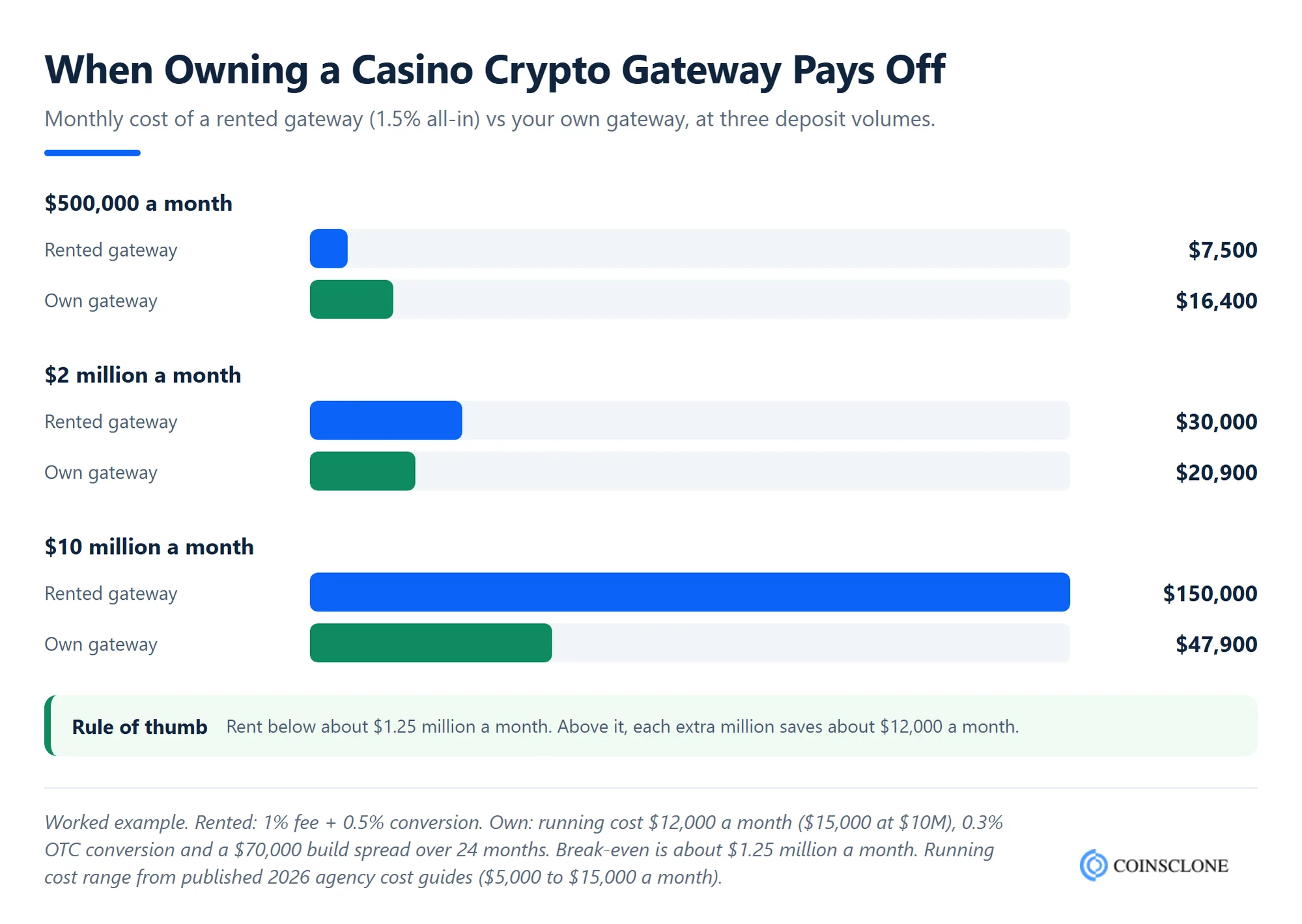
On these numbers, the line sits at about $1.25 million a month in crypto deposits. Below it, renting is cheaper and simpler. Above it, each extra million saves you about $12,000 a month. At $10 million a month, the gap is about $100,000.
Cost is not the only reason to own. You also get control, since no provider can drop you or raise fees, and data on every wallet for audits and bonus abuse checks. Still, rent if you are pre-launch, your licence is under review or your volume is small. Many operators start on a rented gateway and switch later. If you are also choosing the casino itself, our crypto casino clone script comes with wallet and payment modules built in.
How to Launch Your Own Casino Payment Gateway
If the numbers favour owning, this order keeps you inside your licence:
- Map your licence rules. Every crypto clause in your licence becomes part of the build spec.
- Pick coins and chains. Start with USDT and USDC on two or three cheap networks, plus Bitcoin and Ethereum.
- Choose your partners. You need wallet analytics, a Travel Rule tool and a licensed partner to hold or swap coins. Under Curaçao’s rules you can’t do the swaps yourself.
- Design the wallets. Keep player, business and treasury funds apart, with hot and cold tiers and MPC or multisig keys.
- Build the core. Player addresses, chain watchers, a confirmation rule per coin, run-once webhooks, the ledger and the payout engine.
- Connect your platform. Wire it into your cashier, bonus engine, KYC flow and safer gambling limits.
- Test and audit. Published 2026 agency cost guides put an outside audit and pen test at $15,000 to $50,000.
- Launch in stages. Start with a small group of players, check the books daily, then roll out.
For a cost breakdown by module, read our guide to the cost of a crypto payment gateway.
Mistakes Operators Make With Crypto Payments
These traps come up again and again in operator threads and regulator notes:
- A gateway that bans gambling: some crypto processors exclude it in their terms, so get written approval first.
- “No KYC” gateways: easy to join, but a risk to your licence.
- Mixed funds: player money next to business cash breaks the new Curaçao rules.
- A treasury of volatile coins: one bad week can wipe out a month’s profit.
- No exit plan: if you rent, make sure you can export player wallet data and move.
How to Choose a Partner and Prepare for the Scoping Call
Whether you rent or build, ask any partner these questions:
- Gambling approval: will you serve my licence and target markets, in writing?
- Custody: who holds the keys, and how are player, business and treasury wallets kept apart?
- Checks: which analytics and Travel Rule tools do you use, and can I see the reports?
- Real cost: what are the fee, swap spread, network fees and minimums at my volume?
- Code: if you build it, do I own the code and run it on my own servers?
Before the call, bring your licence terms, your monthly volume, the coins you want and the name of your casino platform.
Coinsclone has been building crypto products since 2018 and has delivered 350+ platforms for 200+ clients across 20 industries. We build crypto payment gateways for casinos with player addresses, split wallets, analytics hooks and full code ownership. To compare rented options first, see our list of the top crypto payment gateways.
Frequently Asked Questions
What is the best crypto payment gateway for an online casino?
The best one accepts your licence and markets in writing, screens wallets and supports stablecoins. Once crypto deposits pass about $1.25 million a month, compare its cost with running your own gateway.
Can an online casino accept crypto with a Curaçao licence?
Yes. Crypto sits inside the standard Curaçao B2C licence. Since June 2026 the CGA requires separate wallets, wallet screening and a crypto policy, with full compliance by June 2027.
Do crypto casino deposits have chargebacks?
No. A confirmed on-chain payment can’t be reversed by a bank or card network. Players can still complain to your regulator, so you still need a refund process.
Should a casino use a custodial or non-custodial gateway?
A custodial gateway holds the coins and pays you later, which is simpler but leaves your money with someone else. A non-custodial one sends funds straight to wallets you control, which means more control and more security work.
Which cryptocurrencies should an online casino accept?
Start with USDT and USDC on a few low-fee networks, plus Bitcoin and Ethereum. Curaçao’s rules favour fiat-backed stablecoins and want extra review of privacy coins, meme coins and wrapped tokens.
How much does it cost to build a crypto payment gateway for a casino?
Published 2026 agency cost guides put a white label gateway at $20,000 to $60,000 and a custom one at $40,000 to $100,000. A full platform from scratch with fiat settlement runs $100,000 to $300,000 or more. Plan for $5,000 to $15,000 a month to run it, plus audits and partner fees.
Can UK-licensed casinos accept crypto?
Not yet. The Gambling Commission began looking at a route in February 2026 but set no timetable. Any route would rely on FCA-authorised crypto firms, and the FCA’s crypto regime only starts on 25 October 2027.
How long does it take to build a crypto payment gateway for a casino?
Coinsclone lists 6 to 9 weeks for a standard gateway, and 10 to 14 weeks with swaps, batched payouts and settlement. Licence approvals can take longer than the build, so start them early.