
A crypto exchange API is the set of doors that lets software trade on your exchange without a person clicking buttons. Bots, market makers, funds, tax tools and price sites all come in through it. That makes the API a core product, not an add-on.
This guide is for teams building an exchange, not for traders using one. It covers what your API must offer, how Binance, Coinbase, Kraken and Bybit design theirs, and the rules for keys, limits and order IDs that keep it safe. It ends with a build plan, real timelines and cost ranges.
In this guide:
- The five parts every crypto exchange API needs, from public prices to FIX sessions
- A side-by-side look at how four big exchanges sign requests and set limits, checked 2 November 2026
- A worked example showing why polling eats a whole rate limit while streams cost nothing
- How client order IDs stop a network retry from buying twice
- A step-by-step build plan with timelines and 2026 cost ranges
What Is a Crypto Exchange API?
A crypto exchange API is a published set of endpoints that lets outside code read prices, place orders and manage an account on an exchange. It speaks three “languages”:
- REST: simple request and reply over HTTPS. Good for balances, order history and withdrawals.
- WebSocket: a live connection that pushes prices, trades and fills the moment they happen.
- FIX: the old standard of stock and FX markets. Funds and trading firms plug their own systems into it.
Who uses it? Retail traders running bots. Market makers who quote all day. Funds that need a clean order trail. And aggregators: the open-source CCXT library alone connects to 104 exchanges in eight languages, as of 2 November 2026. If your API is hard to use, those tools skip you, and their users never find you.
What Should a Crypto Exchange API Offer?
A complete API has five parts. Most new exchanges ship the first three and add the rest once pros show up.
| Part | What it does | Example calls | Needs a key? |
| Public market data | Prices, order book, trades, candles, symbol rules | ticker, depth, klines, exchange info | No |
| Private trading | Place, cancel and amend orders | new order, cancel, cancel all, open orders | Yes, trade right |
| Account and wallet | Balances, deposits, withdrawals, transfers | balances, deposit address, withdraw | Yes, read or transfer right |
| WebSocket streams | Live data and private updates | book diffs, trades, order fills | Public: no. Private: yes |
| FIX sessions | Order entry, market data and drop copy for firms | New Order Single, Execution Report | Yes, plus onboarding |
Public market data endpoints
These are open to anyone and get the most traffic. Give every symbol’s rules in one call: tick size, lot size, minimum order value and status. Binance’s exchange info call does this, and it also lists the live rate limits. Clients read it at startup, so they never guess.
Private trading endpoints
This is where money moves, so every call must be signed. Support limit, market and stop orders, plus “cancel all” for a symbol. Market makers need a cancel-and-replace call, so they can move a quote in one step instead of two.
Account and wallet endpoints
Balances, deposit addresses and withdrawals sit here. Withdrawal calls need the tightest controls of all, which we cover in the security section below.
WebSocket streams
Streams push data instead of making clients ask again and again. Binance offers its order book diff stream at 1,000 ms or 100 ms. A private user stream sends fills and balance changes. Without good streams, every bot polls, and your servers carry the load.
FIX API for institutions
FIX is what funds and prime brokers expect. It runs as long-lived sessions with sequence numbers, so no message is lost. Binance runs FIX 4.4 with separate hosts for order entry, drop copy and market data. Coinbase Exchange runs FIX 5.0 SP2 with the same three-way split, per its FIX connectivity docs.
REST vs WebSocket vs FIX: Which Does Each Client Need?
Each protocol serves a different kind of client. A good crypto exchange API offers all three over the same back end.
| Protocol | Best for | Strength | Weak spot |
| REST | Funding, reports, one-off orders | Easy to sign, test and cache | Polling is slow and burns rate limits |
| WebSocket | Live prices, fills, fast bots | Push updates, no polling | Must handle drops, gaps and reconnects |
| FIX | Funds, brokers, high-frequency firms | Sequence numbers, drop copy, cancel on disconnect | Hard to build, needs onboarding |
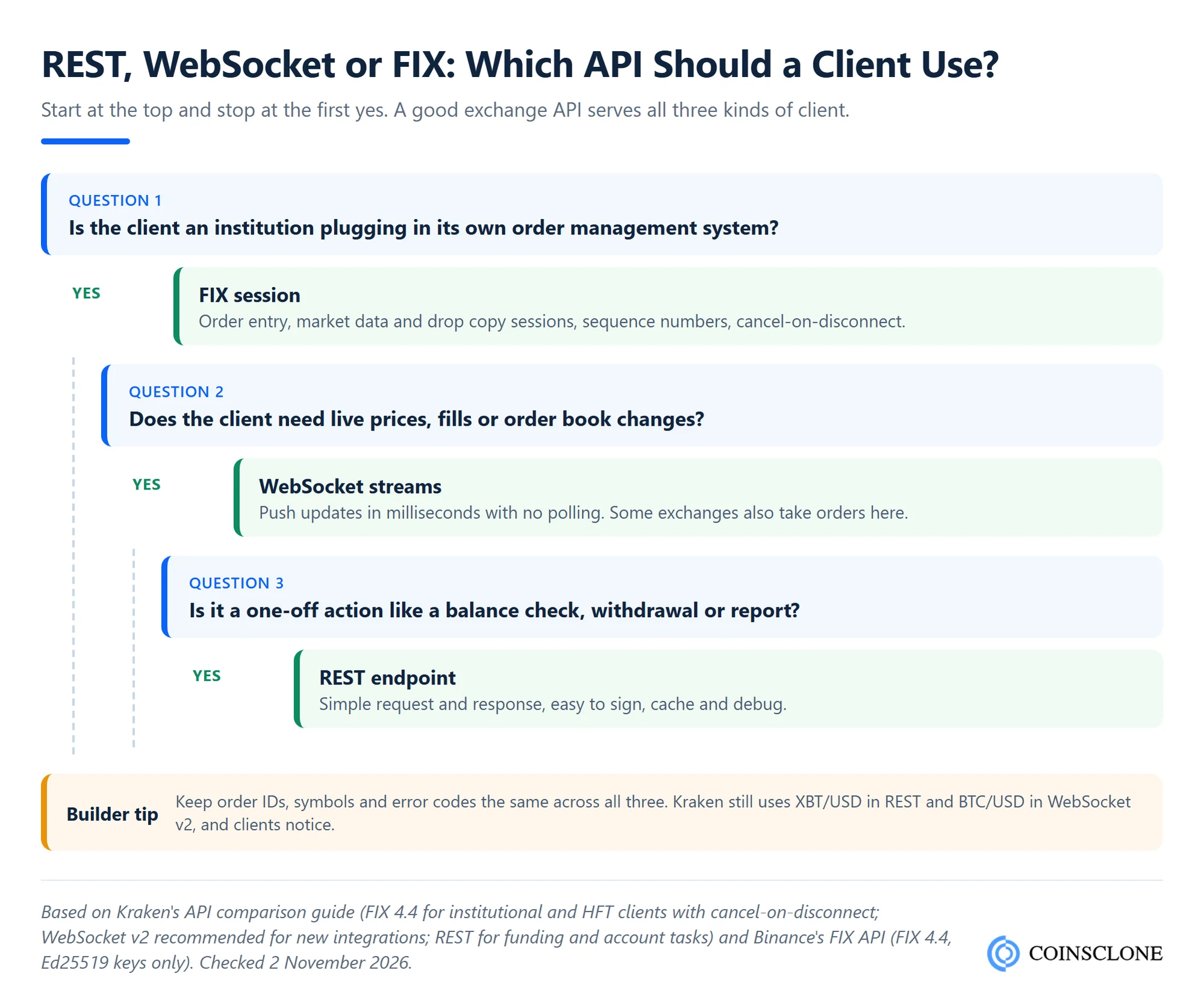
Kraken’s API comparison guide is a good model. It tells clients plainly that REST is for funding and account tasks, WebSocket v2 is the default for new builds, and FIX is for firms that need the lowest latency. Write a page like that for your own API. It saves your support team hours.
How Do Major Exchanges Design Their APIs?
Public docs show how the leaders solve the same problems. Here is what four of them publish, as of 2 November 2026.
| Exchange | How requests are signed | How replays are blocked | Published REST limit | FIX |
| Binance spot | HMAC, RSA or Ed25519 keys; Ed25519 advised | Timestamp plus recvWindow, 5,000 ms default, 60,000 max | 6,000 weight per minute per IP; 100 orders per 10 s; 200,000 orders a day | FIX 4.4, Ed25519 keys only |
| Coinbase | Advanced Trade: a fresh JWT per request, ES256 keys | JWT lasts 2 minutes, with a random nonce | Exchange: private 15 per second (burst 30) per profile | Exchange: FIX 5.0 SP2 |
| Kraken spot | HMAC-SHA512 in API-Key and API-Sign headers | A nonce that must always rise | One account counter shared by REST, WebSocket and FIX | FIX 4.4 |
| Bybit v5 | HMAC-SHA256 or RSA-SHA256 | Timestamp plus recv_window, 5,000 ms default | 600 requests per 5 s per IP, then a 10 minute block | Not reviewed |
Sources: Binance request security and live exchange info; Coinbase key auth and Exchange limits; Kraken REST auth; Bybit signing guide.
Three lessons stand out for builders:
- Offer a modern key type: Binance now advises Ed25519 keys and requires them for FIX. It says they give the best speed and safety of its key types.
- Count weight, not just calls: a heavy call should cost more. On Binance a 5,000-level order book snapshot costs 250 weight, while a new order costs 1.
- Pick one limit model and say it clearly: Kraken shares one counter across all three protocols. That is fair, but clients must know a FIX burst eats into their REST budget.
How Does Crypto Exchange API Authentication Work?
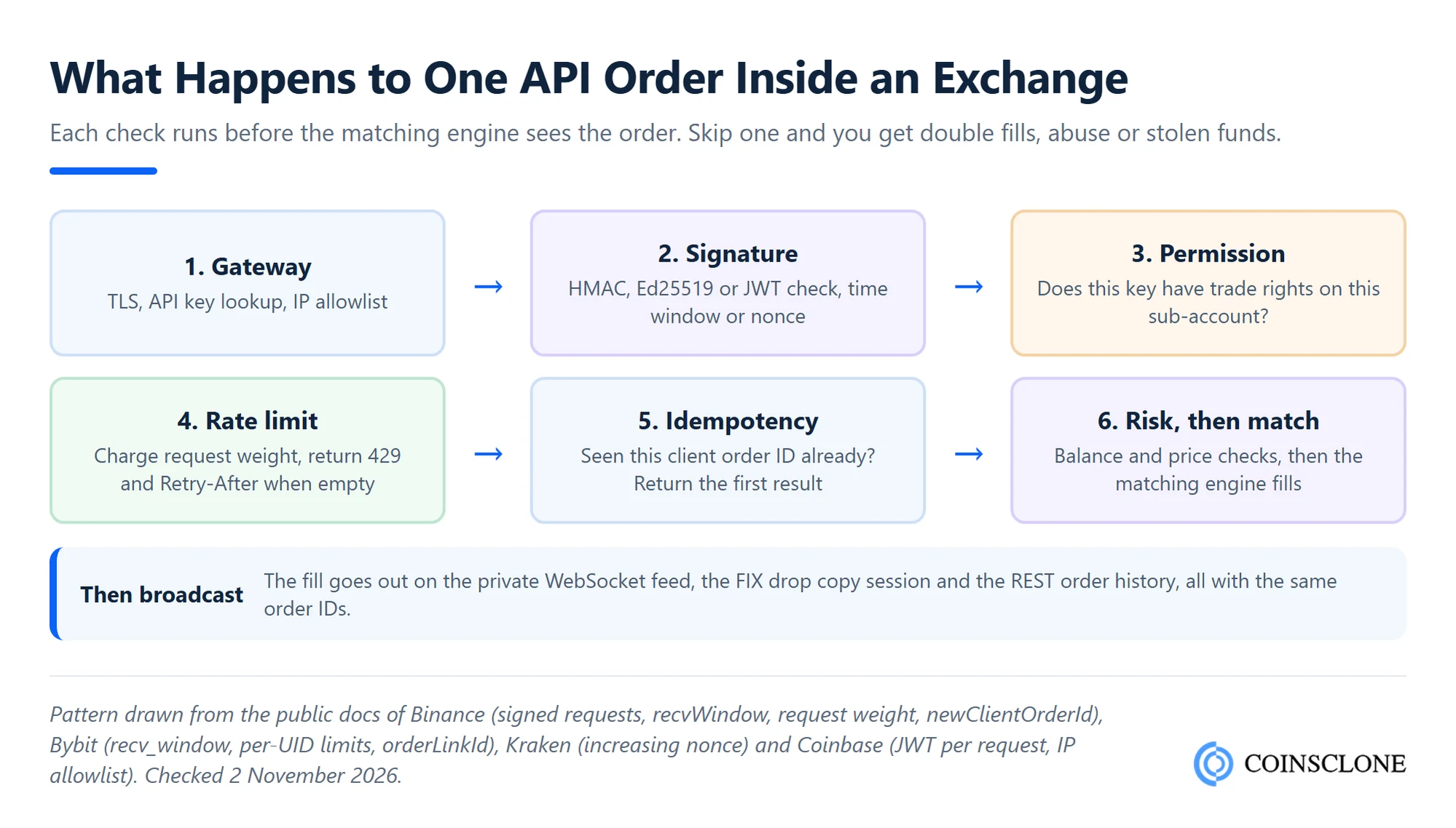
Every private call has to prove two things: who sent it, and that nobody changed or replayed it. Most exchanges use the same pattern.
- Create a key pair. The user makes an API key in their account. They get a public key ID and a secret, shown once. With Ed25519 or RSA, the user makes the key pair and uploads only the public half.
- Build the message. The client joins the request parts in a fixed order: method, path, query or body, and a timestamp.
- Sign it. The client signs that string with HMAC-SHA256 or a private key, then sends the key ID and signature in headers.
- Check it on the server. Your gateway rebuilds the same string, checks the signature, and rejects it if the timestamp is outside the allowed window.
Binance rejects a request if its timestamp is more than one second ahead of server time, or older than the recvWindow. Kraken uses a different guard: a nonce that must rise with every call and can never be reset to a lower value. Coinbase skips shared secrets for Advanced Trade and asks for a new signed JWT on each call.
The most common support ticket is “invalid signature”. The cause is nearly always clock drift, parts joined in the wrong order, or a body with extra spaces. Publish a server time endpoint, a signing example in each SDK, and test values that show the exact expected signature.
Key permissions and IP allowlists
A key should only do what its owner needs. Coinbase splits rights into view, trade and transfer, and recommends an IP allowlist on each key. Use the same model:
- Read only by default: new keys can view data but not trade.
- Trade as an opt-in: turned on per key, ideally per sub-account.
- Withdraw as a rare extra: only with an IP allowlist, a second factor and a withdrawal address list.
How Should an Exchange Set API Rate Limits?
Rate limits protect your matching engine from overload and from abuse. The best designs have three layers:
- Per IP: caps raw traffic. Bybit allows 600 requests per 5 seconds per IP.
- Per account or key: caps what one user can do from many IPs. Coinbase Exchange counts private calls per profile.
- Order count: caps orders, not requests. Binance allows 100 orders per 10 seconds and 200,000 a day.
Tell clients where they stand on every reply. Binance returns used weight in an X-MBX-USED-WEIGHT header, and Bybit returns the remaining count in X-Bapi-Limit-Status. When a client goes over, send HTTP 429 with a Retry-After header. Binance then bans IPs that keep hammering, from 2 minutes up to 3 days, per its limits page.
Worked example: polling vs streaming
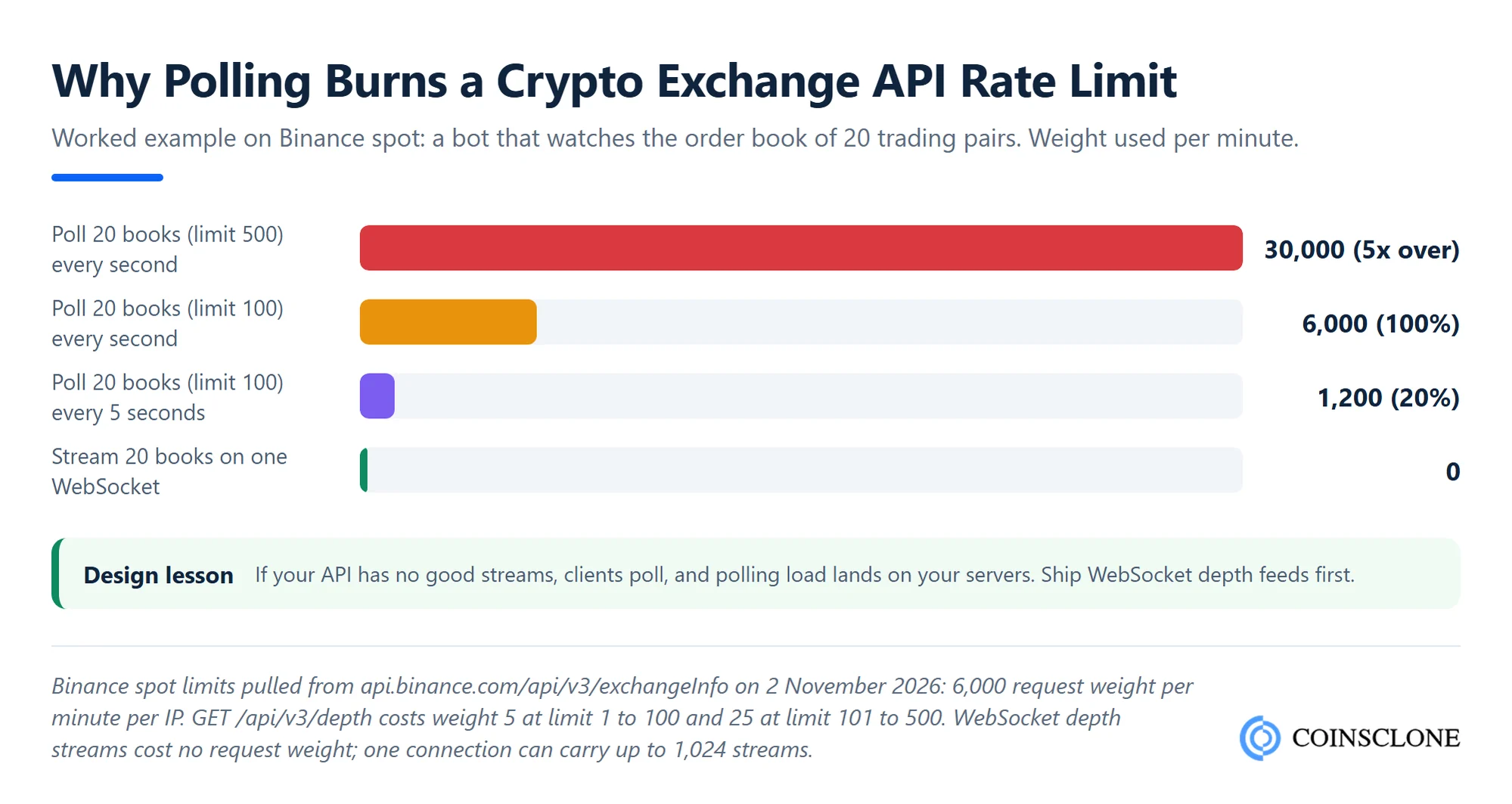
Picture a bot that tracks the order book on 20 pairs. On Binance, an order book snapshot with up to 100 levels costs weight 5. Polling 20 books every second costs 20 x 5 x 60 = 6,000 weight a minute. That is the entire budget, with nothing left to trade.
Ask for 500 levels instead (weight 25) and the bot needs 30,000 a minute, five times the cap. The same bot on one WebSocket connection uses no REST weight at all. One Binance connection can carry up to 1,024 streams.
WebSocket rules to publish
Streams need rules too. Binance publishes clear ones in its WebSocket stream docs:
- A connection lasts at most 24 hours, so clients must reconnect.
- The server pings every 20 seconds and drops clients that do not reply within a minute.
- Clients may send 5 messages per second and open 300 connections per 5 minutes per IP.
- Order book users get a step-by-step method: buffer the diff stream, fetch a snapshot, then match update IDs so no change is lost.
Why Do Sub-Accounts and Client Order IDs Matter?
These two features decide whether pros can run real money through your API.
Sub-accounts
Funds and market makers split strategies, desks and clients into sub-accounts. Each one needs its own balances, its own keys and, ideally, its own rate limit. Add an API call to move funds between them. Kraken, for example, offers sub-account transfers through its REST API.
Client order IDs and idempotency
Networks fail. A client sends “buy 1 BTC”, the reply times out, and the client sends it again. If your API cannot tell those apart, the user buys 2 BTC.
The fix is a client order ID that the client sets. Binance calls it newClientOrderId. It must be unique among open orders, and a repeat is rejected while the first is still open. Bybit calls it orderLinkId, allows up to 36 characters and asks that it always be unique, per its order docs.
Build it this way:
- Store each client order ID with the order, per account.
- If the same ID arrives again, return the first order’s status. Do not create a new one.
- Echo the client order ID in every fill on REST, WebSocket and FIX.
What Makes Good API Docs and SDKs?
The API is only as good as its docs. Traders judge an exchange by how fast they can place a first test order. Ship these from day one:
- A testnet: a sandbox with fake funds. Binance runs one with its own stream host.
- An OpenAPI file: so clients can generate code in any language.
- Official SDKs: at least Python and JavaScript, with signing built in.
- A full error code list: with what each code means and what to do next.
- A changelog and version plan: Binance stamps its limits page with a last-changed date. Do the same, and give notice before you remove anything.
- CCXT support: get listed in the library so existing bots work with you on day one.
How Do You Secure a Crypto Exchange API?
A leaked key with trade or withdraw rights can be used against its owner’s account. Your design should limit the damage when, not if, a key leaks.
- Hash secrets at rest: store HMAC secrets encrypted, and show them only once.
- Prefer key pairs: with Ed25519 or RSA, your server never holds the private key.
- Turn off withdraw by default: and require an IP allowlist before it can be turned on.
- Expire idle keys: delete or freeze keys that have not been used for months.
- Cancel on disconnect: let FIX and WebSocket users ask you to cancel their orders if the link drops. Kraken offers this on FIX.
- Log and alert: flag new IPs, sudden order bursts and changes to withdrawal lists.
For the wider picture, see our guide on how to build a non-hackable crypto exchange.
Crypto Exchange API Development: The Build Plan
The API sits on top of your matching engine, wallets and risk checks. Plan it as part of the crypto exchange architecture, not as a late add-on.
- Define the spec. List endpoints, streams, error codes, limits and key rights. Write it as an OpenAPI file first.
- Build the gateway. TLS, key lookup, signature checks, time windows, IP allowlists and rate limits in one layer.
- Wire up REST. Market data, orders and accounts, with client order IDs from the start.
- Add WebSocket streams. Public book and trade feeds first, then private order and balance feeds.
- Add FIX when pros ask. Order entry and drop copy sessions for funds and market makers.
- Test hard. Load tests at several times your expected peak, replay attacks, clock drift cases and reconnect storms.
- Launch the docs and testnet. Then list on CCXT and invite trading bot and market maker partners.
How long does it take?
Coinsclone’s own timelines: a white label exchange takes 4 to 6 weeks. Add fiat rails and it is 7 to 10 weeks. Add mobile apps and it is 9 to 13 weeks. A custom FIX gateway adds time on top, depending on how many order types and sessions you need.
What does it cost?
Published 2026 agency cost guides put a white label exchange at $15,000 to $60,000. A custom MVP runs $100,000 to $200,000, and a full custom exchange $250,000 to $500,000 or more. The API is part of that cost. What moves the number most is FIX, the number of order types, sub-account depth and how much load you must prove in testing.
What does crypto exchange API integration involve?
Integration runs both ways. Inbound, you plug outside services into your exchange: liquidity providers, KYC checks, custody, fiat rails and price feeds. Outbound, you make your API easy for others to plug in: bots, tax tools and market making software that keeps your books deep. A crypto trading bot built on your own API is also a good way to test it before launch.
Launch a Crypto Exchange API That Traders and Funds Trust
Crypto exchange API development, done right.
- REST and WebSocket APIs: Market data, trading and account endpoints with live order book and fill streams
- Secure key management: HMAC or key-pair signing, key rights, IP allowlists and withdrawal controls
- Fair rate limits: Weight based limits per IP, account and order count, with clear limit headers
- Pro trading features: Sub-accounts, client order IDs, testnet, SDKs and clear docs for bot builders
See a live demo of an exchange with a full trading API.
Book a Free Demo to plan your crypto exchange API.
How Coinsclone Helps With Crypto Exchange API Development
Coinsclone builds exchange back ends with REST and WebSocket APIs, with signing, rate limits, sub-accounts and client order IDs built in from the start, and can scope a FIX gateway with you if institutions are part of your plan. Coinsclone has built crypto products since 2018 and delivered 350+ platforms for 200+ clients across 20 industries. Start fast with our white label crypto exchange script, or plan a custom build with our cryptocurrency exchange development company team.
Frequently Asked Questions
What is API in a crypto exchange?
An API in a crypto exchange is a set of endpoints that lets software read market data, place orders and manage an account without the website. Traders use it for bots, and firms use it to connect their own trading systems. Most exchanges offer REST and WebSocket, and larger ones add FIX.
Is a crypto exchange API free?
Exchange APIs are usually free for account holders. You pay the normal trading fees on orders placed through it, and you must stay within the rate limits. Paid plans are mostly found at data firms that combine prices from many exchanges.
What is a crypto exchange API key?
An API key is an ID plus a secret, or a key pair, that proves a request comes from your account. You create it in the exchange’s settings and choose its rights, such as read, trade or transfer. Keep withdraw rights off unless you truly need them, and lock the key to your IP address.
Which crypto exchange is best for API trading?
It depends on what you trade and where you live. Look for clear docs, a testnet, high rate limits, WebSocket order entry and, for firms, FIX. Binance, Coinbase, Kraken and Bybit all publish full docs, and the right pick is the one with the pairs, fees and licences that fit you.
What is a crypto exchange API aggregator?
An aggregator gives one interface to many exchanges, so a bot can trade on several without new code for each. The best known is the open-source CCXT library, which supports 104 exchanges as of November 2026. For an exchange, being listed in CCXT means many existing bots can connect on day one.
What is the difference between REST and WebSocket APIs?
REST works by request and reply: the client asks, the server answers once. WebSocket keeps a live link open, and the server pushes new data the moment it changes. Use REST for one-off tasks like withdrawals and WebSocket for live prices and fills.
What is FIX API in crypto?
FIX is a messaging standard from traditional markets that funds and brokers use to send orders and get fills. Crypto exchanges such as Binance, Coinbase Exchange and Kraken offer it for institutional clients. It uses long-lived sessions with sequence numbers, so no message is lost.