If you are interested in NFTs, you’re likely aware of the rapid growth in this space. Because of this surge, a new question started to arise among NFT enthusiasts: “ How can we do smoother and more accessible NFT trading across multiple blockchains?” In response to this question, a new platform has emerged: Cross-Chain NFT Marketplaces.
These marketplaces make the minting, buying, selling, and transferring of NFTs across multiple blockchain networks. Also, such a platform gives revenue generation possibilities through increased user retention.
In this guide, we will take a closer look at the process of cross-chain NFT Marketplace Development and its most significant challenges and benefits. Once you understand how to build a platform that bridges blockchain networks, you can create a more profitable NFT Marketplace. So that it will attract a wider user base and stand out in the competitive Web3 ecosystem.
Build a Powerful Cross-Chain NFT Marketplace Fast
Cross-Chain NFT Marketplace Development — launch your interoperable NFT platform effortlessly.
- Seamless Interoperability: Connect Ethereum, BSC, and more for smooth NFT transfers.
- Cost-Efficient Transactions: Reduce gas fees with optimized multi-chain architecture.
- Liquidity Boost: Expand your audience reach across multiple blockchain ecosystems.
- Smart Integration: Enable multi-wallet access, analytics, and DAO participation.
See a free branded demo of your NFT marketplace in 48 hours — before you invest a cent.
Book a Free Demo to discover how Cross-Chain NFT Marketplace Development can help you launch in just 8–12 weeks.
What is Cross-Chain NFT Marketplace Development?
Developing an NFT marketplace is the process of creating an NFT platform where users can mint, purchase, buy, and transfer NFTs across two or more blockchain networks through one marketplace. A cross-chain NFT marketplace is not confined to a single blockchain and is an interoperability system of interconnected networks, such as Ethereum, BNB Chain, Polygon, Solana, and others, where interoperability protocols and smart contracts are connected. This will enhance liquidity, lower gas, and provide users with the liberty to trade NFTs on their blockchain of choice without friction.
With a clear idea of cross-chain NFT development, let’s look at the key differences between cross-chain and multi-chain marketplaces.
Difference Between Cross-Chain & Multi-Chain NFT Marketplace
If you’re diving into the world of NFTs, it’s important to understand the difference between cross-chain and multi-chain NFT Marketplaces. While they might sound similar, they’re actually pretty different when it comes to how they work, their architecture, and how they affect your user experience.
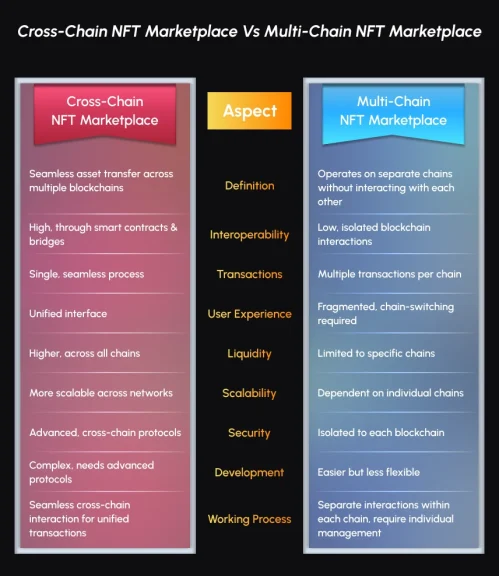
While both have their advantages, cross-chain marketplaces stand out by offering a more dynamic, interconnected solution. With the ability to seamlessly trade and transfer NFTs between networks, cross-chain platforms are a forward-thinking way to handle Web3 development.
Let’s move on to the common development approaches for creating a cross-chain NFT marketplace.
Development Methods to Build a Cross-Chain NFT Marketplace
The type of development technique you select will be important in deciding the amount of scalability, interoperability, cost, and the time of the launch of your platform. Also, depending on your business objectives and technical needs, one of the following best practices can be used to develop a cross-chain NFT marketplace.
1. Developing from Scratch
A completely customized cross-chain NFT marketplace is the best solution for a business that requires full control and ownership of the architecture. So, the strategy here is the creation of smart contracts, interoperability interfaces, and user interfaces that match your specific cross-chain needs.
2. White-Label Cross-Chain NFT Marketplace Solution
The most cost-effective and efficient method to launch a cross-chain NFT marketplace is a white-label NFT marketplace software. Because, it includes in-built essential core features, cross-chain integrations, and administration controls that are customizable to your brand and business model.
3. Hiring an NFT Marketplace Developer
The approach to employing seasoned NFT marketplace developers will be appropriate in case you already have a roadmap or an internal team, but need cross-chain skills. Also, depending on your needs, developers have the opportunity to work on their individual modules, including interoperability, smart contracts, or performance optimization.
With the development strategy finalized, let’s take a closer look at how a cross-chain NFT marketplace works in practice.
How does the Cross-Chain NFT Marketplace work?
It is all about making it easy to trade, mine, and sell NFTs on various blockchain networks to your users. So, a cross-chain marketplace, in turn, overcomes the restriction of a single-chain platform, offering the desired liquidity, enhanced accessibility, and easier interoperability.
- Wallet Connection – First, you will connect your multi-chain wallet, such as MetaMask or WalletConnect. This allows you to store NFTs from various blockchains in one place.
- Network Detection – The platform identifies the blockchain networks that you have connected to and displays to you the NFT collections supported on those networks.
- Cross-Chain Asset Discovery – Using APIs and smart contracts, the marketplace fetches NFTs from different blockchains and displays them for you to discover.
- Listing NFTs – If you’re an artist or collector, you might list your NFTs for sale. The marketplace will display those NFTs after storing all the metadata and setting your price through smart contracts.
- NFT Minting – While minting an NFT, the metadata can be stored on-chain or off-chain, and then the NFT is minted using smart contracts.
- Transaction Signing – Regardless of whether you are buying, selling, or transferring an NFT, you will sign each transaction with your wallet signature.
- Cross-Chain Interoperability – Protocols like Wormhole, Axelar, or LayerZero do the heavy lifting, allowing NFTs to move seamlessly across blockchains.
- Cross-Chain Order Processing – The platform matches buyers and sellers, manages token wrapping (ensuring NFTs are compatible with different blockchains), and ensures everything exchanges securely and trustlessly.
- Transaction Finalization – After the execution of the transaction, smart contracts finalize it and change ownership, making everything legit across the chains.
- Post-Transaction Updates – Finally, users get real-time updates, NFT metadata syncs, and you can track your portfolio and transaction history with cross-chain analytics.
In short, this seamless process unlocks a whole new world of NFTs across different blockchain ecosystems.
Features we Integrate in our Cross-Chain NFT Marketplace
When creating a cross-chain NFT Marketplace, it is important to incorporate the appropriate features to ensure that the project is successful. Not only do these features enhance the user experience, but they also make the platform more efficient, secure, and smoother to trade NFTs. So, let’s dive into some of the must-have features you should consider.
Interoperability Protocols – Enable seamless communication between different blockchain networks through cross-chain bridges. So, digital assets remain compatible across multiple blockchain ecosystems.
Multi-Wallet Integration – Support different crypto wallets to make it easier to manage assets and conduct transactions across different chains, making it more convenient for users.
Cross-Chain Minting – Allow creators to mint NFTs on their preferred blockchain and enable automatic listing across connected networks, to increase asset exposure.
User-Friendly Interface – Provide an easy-to-use and streamlined dashboard that makes the complicated process of cross-chain interactions easier for users, both beginner and advanced.
Advanced Search and Filtering – Implement robust search functionalities with filters for blockchain types, asset categories, price ranges, and rarity levels to improve discoverability.
Secure Payment Gateways – Integrate multi-currency payment gateways that support cryptocurrencies from different chains, ensuring safe and flexible transactions.
Smart Contract Auditing – Incorporate automated auditing tools to verify the security and accuracy of cross-chain smart contracts, minimizing vulnerabilities.
Cross-Chain Royalty Distribution – Enable creators to receive royalties seamlessly across different chains when their NFTs are resold, ensuring proper compensation.
Analytics and Performance Insights – Provide detailed insights on user activities, transaction volumes, and trends across multiple chains. So, users make informed decisions.
Governance and DAO Integration – Allow community-driven governance through decentralized autonomous organizations (DAOs), where users can vote on platform updates and changes.
By integrating these features, the platform’s functionality is enhanced to a more secure and enjoyable experience for everyone involved in the NFT ecosystem. Up next, we’ll dive into the…
Our Various Cross-Chain NFT Marketplace Development Services
Cross-chain NFT marketplaces are not limited to a single niche. So, depending on the use case, the same interoperable framework can be adapted to support NFTs across various industries, enabling wider accessibility, liquidity, and multi-blockchain asset trading.
NFT Art Marketplace Development Services
With cross-chain capabilities, NFT Art Marketplace Development enables artists and collectors to mint, trade, and transfer digital artwork across multiple blockchains, improving exposure, buyer reach, and long-term asset portability.
NFT Fashion Marketplace Development Services
A cross-chain approach in NFT Fashion Marketplace Development allows brands to showcase digital wearables across ecosystems, supporting broader audience engagement, flexible ownership transfers, and interoperability with metaverse platforms.
NFT Sports Marketplace Development Services
By leveraging cross-chain infrastructure, NFT Sports Marketplace Development supports seamless trading of sports collectibles, moments, and fan tokens across different blockchains, ensuring liquidity and uninterrupted fan participation.
NFT Real Estate Marketplace Development Services
In NFT Real Estate Marketplace Development, cross-chain marketplaces enable tokenized property assets to move across networks, enhancing investment accessibility, fractional ownership options, and global participation without blockchain restrictions.
NFT Ticketing Marketplace Development Services
A cross-chain framework strengthens NFT Ticketing Marketplace Development by enabling secure ticket minting, resale, and verification across blockchains, reducing fraud while improving interoperability with multiple wallet ecosystems.
NFT Music Marketplace Development Services
With cross-chain support, NFT music marketplace development empowers musicians to distribute music NFTs across blockchains. Also, it enables licensing and monetization across multiple networks. So, musicians can reach diverse global audiences effectively. And, the platform maintains transparent and reliable royalty tracking.
Next, let’s explore why building a cross-chain NFT marketplace makes strong business sense.
Why Create a Cross-Chain NFT Marketplace?
The cross-chain NFT Marketplace is an important step to unlock new opportunities in the world of digital assets. Here’s why it is becoming very important:
Enhanced Liquidity and Audience Reach
Cross-chain platforms are giving NFTs the ability to be traded on different blockchains, which greatly enhances their liquidity and exposes the assets to a wider group of people to NFTs. Also, to creators, it would imply increased exposure, allowing them to access various blockchain ecosystems. This assists in reaching collectors in every corner of the world.
Reduced Gas Fees and Transaction Bottlenecks
Another important benefit of cross-chain NFT platforms is the possibility to utilize blockchains with reduced gas costs and faster transactions. This not only reduces trading costs but also minimizes bottlenecks that can slow down transactions on networks facing heavy traffic.
Flexibility for Creators and Collectors
A cross-chain NFT marketplace provides creators and collectors with the ability to choose the most suitable blockchain. Also, users can select networks based on their specific requirements. For example, some may prefer a faster blockchain for transactions. And others may choose a network that better supports metadata. So, a cross-chain NFT marketplace effectively fulfills these diverse needs.
Increased Security and Reliability
Integrating advanced interoperability protocols within cross-chain NFT platforms ensures the secure transfer of assets between networks. Thus, it prevents single points of failure and thereby provides a more stable environment. In which all users involved can trade more securely.
Various Revenue Streams
A cross-chain NFT marketplace offers multiple monetization opportunities by enabling NFT transactions across different blockchain networks. So, entrepreneurs can generate consistent revenue through platform usage, asset movement, and value-added services built into the marketplace ecosystem.
- Transaction Fees: Earn fees from every NFT sale across supported blockchains.
- Cross-Chain Transfer Fees: Charge users for transferring NFTs between different blockchain networks
- NFT Minting Fees: Collect fees when creators mint NFTs on multiple blockchains.
- Listing and Promotion Fees: Monetize featured listings and promoted NFT collections within the marketplace.
- Creator Royalty Commissions: Earn a share from automated royalties on secondary NFT sales.
- Premium Features and Subscriptions: Offer paid access to advanced tools and marketplace features.
Established Regulation and Compliance Standards
Regulations play an important role in cross-chain NFT marketplace development by ensuring transparency, legal compliance, and user trust. Since NFTs can represent digital or real-world assets across multiple blockchains, platforms must follow applicable laws related to ownership, taxation, and digital transactions.
Equally important is having a clear complaint and dispute-handling process, which helps to:
- Enable users to report fraud or suspicious activities
- Address transaction errors across different blockchains
- Resolve ownership or asset transfer conflicts
- Protect users and maintain platform credibility
- Support long-term marketplace sustainability
With the profitable benefits in mind, let’s examine the technologies and protocols that power cross-chain NFT marketplaces.
Key Technologies & Protocols We Use to Launch the Cross-Chain NFT Marketplace
To enable seamless interactions and transactions across multiple blockchain networks, cross-chain development relies on several advanced technologies and protocols. Also, these tools help different blockchain networks talk to each other, ensuring that assets can move around securely and seamlessly.
1. Blockchain Networks – Each blockchain has unique benefits. Ethereum offers a vast ecosystem, Binance Smart Chain is fast with lower fees, and Polygon provides scalability. So, integrating these gives you the best of each network.
Also Read: Top Blockchains To Create NFT Marketplace Platform
2. Cross-Chain Bridges and Protocols – These technologies enable secure communication and asset transfers between different blockchains, unlocking the potential of multi-chain ecosystems for seamless NFT exchanges.
3. Smart Contracts and Token Standards – Smart contracts manage NFT operations, while token standards ensure compatibility and consistency across blockchains.
For More Insights Read: NFT Smart Contract Development
4. Oracles and Decentralized Storage – Oracles bring off-chain data onto the blockchain, enabling accurate cross-chain transactions, while decentralized storage (like IPFS) secures and ensures easy access to NFT data.
With the right protocols in place to support seamless user experiences, it becomes clear why many turn to Coinsclone for their cross-chain NFT development needs.
Why Choose Coinsclone for Cross-Chain NFT Marketplace Development Services?
Coinsclone is a leading NFT Marketplace Development Company, extending our expertise in creating robust and secure cross-chain NFT Marketplaces. We offer expertise in creating robust and secure cross-chain NFT Marketplaces. Also, our team of experienced developers specializes in building platforms that enable seamless interoperability between multiple blockchain networks. This ensures that your NFT Marketplace can cater to a global audience and accommodate various digital assets.
Also, Coinsclone utilizes advanced cross-chain protocols and technologies like Polkadot, Cosmos, and LayerZero to ensure smooth asset transfers and interactions. By partnering with Coinsclone, you can be confident that your cross-chain NFT Marketplace will be built with industry-leading tools and best practices.
FAQ
1. What is cross-chain NFT marketplace development?
Cross-chain NFT marketplace development refers to creating an NFT platform that supports multiple blockchains and allows NFTs to move between them. Also, it uses smart contracts, blockchain bridges, and interoperability protocols to enable seamless NFT trading across different networks without needing separate marketplaces.
2. How does a cross-chain NFT marketplace work?
A cross-chain NFT marketplace works by connecting multiple blockchains through interoperability layers. When an NFT is transferred from one chain to another, the original NFT is either locked or burned, and a corresponding NFT is minted on the destination blockchain. Smart contracts ensure ownership, metadata, and royalties remain intact during the transfer.
3. Why is cross-chain support important for NFT marketplaces?
Cross-chain support is important because it removes blockchain limitations. Users can trade NFTs across networks with lower fees, better speed, and higher liquidity. It also helps marketplaces attract users from different blockchain ecosystems instead of depending on a single network.
4. How much does it cost to build a cross-chain NFT marketplace?
The cost to build a cross-chain NFT marketplace depends on factors such as the number of blockchains supported, smart contract complexity, bridge integration, security audits, and user features. A basic cross-chain marketplace with limited networks and standard NFT functions costs less, while advanced platforms with multiple chains, custom bridges, high security, and scalability require a higher investment.
5. Which blockchains can be integrated into a cross-chain NFT marketplace?
Most cross-chain NFT marketplaces support popular blockchains such as Ethereum, Polygon, BNB Chain, Avalanche, Solana, Arbitrum, and Optimism. The choice of blockchains depends on transaction costs, speed, NFT standards, and user demand.
6. Is cross-chain NFT marketplace development secure?
Yes, cross-chain NFT marketplace development can be secure when built correctly. Security depends on audited smart contracts, reliable bridge protocols, proper validation mechanisms, and secure wallet integrations. Poorly designed bridges are the most common security risk, so architecture matters.
Build a Powerful Cross-Chain NFT Marketplace Fast
Cross-Chain NFT Marketplace Development — launch your interoperable NFT platform effortlessly.
- Seamless Interoperability: Connect Ethereum, BSC, and more for smooth NFT transfers.
- Cost-Efficient Transactions: Reduce gas fees with optimized multi-chain architecture.
- Liquidity Boost: Expand your audience reach across multiple blockchain ecosystems.
- Smart Integration: Enable multi-wallet access, analytics, and DAO participation.
See a free branded demo of your NFT marketplace in 48 hours — before you invest a cent.
Book a Free Demo to discover how Cross-Chain NFT Marketplace Development can help you launch in just 8–12 weeks.