
This guide breaks down the cost to build a DEX like PancakeSwap in 2026, from the first plan to launch day and beyond. PancakeSwap is the second-largest decentralized exchange in the world, so many founders use it as the model for their own DEX. The good news is that a PancakeSwap-style DEX is one of the lowest-cost crypto businesses to start, if you pick the right build route.
You will see real price ranges for each route, the factors that push the cost up or down, and the costs that most guides leave out, such as audits, liquidity and upkeep. We also show which PancakeSwap version you are really copying, how long each route takes, and how fast swap fees can pay the build back. By the end, you will know what budget to plan and which questions to ask a team.
In this guide:
- Cost ranges for a white label, custom and advanced DEX like PancakeSwap
- Which PancakeSwap version (v2, v3 or Infinity) to copy, and what each one costs
- The full launch budget: audits, liquidity, servers, legal and marketing
- A worked example of how swap fees pay back your build
- Timelines, ongoing costs and ways to cut the bill safely
See How Our MVP System Can Help You Cut the Cost to Build Your DEX
Cost to Build a DEX — reduced with performance-focused development.
- MVP System : Save up to 70% in time and cost using pre-built modules.
- DeFi-Ready Modules : Liquidity pools, trading pairs, staking rewards.
- Brand & Customization : Customize UI, tokens, and trading logic.
- Revenue Engine : Earn from swaps, governance, and liquidity incentives.
Get a free DEX cost breakdown and demo in just 48 hours — before spending a cent.
Book a Free Demo to get a transparent breakdown of DEX development costs and delivery within 8–12 weeks.
Cost to Build a DEX Like PancakeSwap
The cost to build a DEX like PancakeSwap in 2026 ranges from about $10,000 to $50,000 for a white label build, about $40,000 to $100,000 or more for a custom build on one chain, and $100,000 to $250,000 or more for an advanced multi-chain DEX. These are broad market ranges from published 2026 cost guides. On top of the build, plan for a smart contract audit and your own starting liquidity.
Here is how the main build routes compare:
| Build route | Typical market cost | Typical time | Best for |
| White label PancakeSwap clone | About $10,000 to $50,000 | 1 to 2 months | Startups that want to launch fast |
| Custom single-chain AMM DEX | About $40,000 to $100,000+ | 3 to 5 months | Teams with their own design and features |
| Custom multi-chain or advanced DEX | $100,000 to $250,000+ | 6 to 12 months | Funded teams adding hooks, perps or cross-chain swaps |
| Smart contract audit (each) | $25,000 to $100,000 | 2 to 8 weeks | Every route, before mainnet |
The audit line comes from a 2026 audit pricing reference by audit firm Sherlock, which puts most DeFi audits at $25,000 to $100,000 and each re-audit at $5,000 to $20,000. A white label base that is already audited can shrink this line, since only your changes need a fresh review.
So why is a DEX cheaper than a centralized exchange? Smart contracts do the jobs that cost the most on a centralized exchange. There is no order matching engine to run, no hot wallet to guard and no user funds to hold. That is why the cost to develop a cryptocurrency exchange with central custody often runs higher.
Also Read: How does PancakeSwap Make Money? Profitable Revenue Streams
What You Are Really Copying: PancakeSwap in 2026
Before you price anything, be clear about what “a DEX like PancakeSwap” means today. PancakeSwap began in 2020 as a simple swap app on BNB Chain. It has since grown into a large multi-product platform.
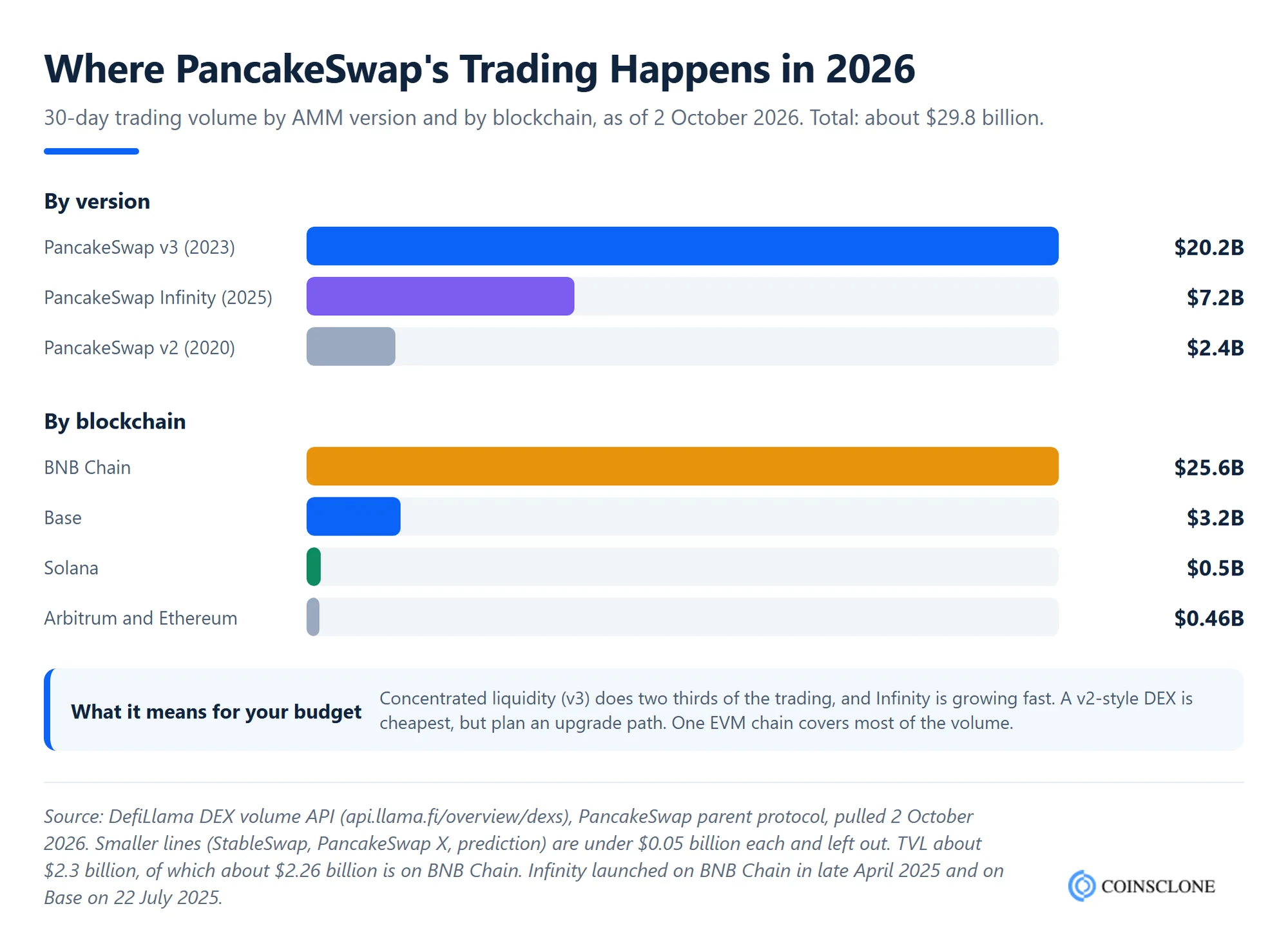
In the 30 days to 2 October 2026, PancakeSwap handled about $29.8 billion in trades, DefiLlama data shows. Only Uniswap traded more. Its pools hold about $2.3 billion in tokens, and about 86% of its volume still runs on BNB Chain. It now also runs on Base, Ethereum, Arbitrum, Solana and more.
PancakeSwap runs three AMM versions side by side, and each one costs a different amount to copy:
- PancakeSwap v2: The classic model. Each pool spreads funds across all prices, and every swap pays a fixed 0.25% fee. It is the simplest and cheapest version to build and audit.
- PancakeSwap v3: Adds concentrated liquidity, so liquidity providers (LPs) choose a price range for their funds. It offers four fee tiers: 0.01%, 0.05%, 0.25% and 1%. It needs more complex contracts and more audit time.
- PancakeSwap Infinity: The newest version, live on BNB Chain since the end of April 2025 and on Base since July 2025. It puts every pool in one contract (a “singleton”), which PancakeSwap says cuts pool creation gas by up to 99%. It also adds hooks: small add-on contracts for dynamic fees, limit orders and custom pricing curves.
The chart below shows where PancakeSwap’s trading happens today, by version and by chain.
Beyond swaps, PancakeSwap also offers farms, perps, a prediction game, a lottery and token sales (CAKE.PAD). You do not need all of them on day one. Each extra product adds contracts, testing and audit scope, so it adds cost.
Can You Legally Copy PancakeSwap’s Code?
Yes. Unlike Uniswap v4, every PancakeSwap version is open source today. The v2 core is under GPL-3.0, while the v3 contracts and the Infinity core use GPL-2.0-or-later. So you can fork them, as long as you follow the GPL terms and keep your changes to that code open.
However, you cannot copy the PancakeSwap name, logo, bunny artwork or CAKE token. Your DEX needs its own brand. Also, a fork is only as safe as your changes to it, so every line you edit needs its own audit. If you also want a Uniswap-style design, our guide on how to create a DEX like Uniswap explains which Uniswap code is open to fork.
Factors That Influence the Cost to Build a DEX Like PancakeSwap
The main factors that change the cost to build a DEX like PancakeSwap are listed below.
Project Complexity
Even though you want to build a DEX like PancakeSwap, your business and marketing goals will shape the final feature list. The more features you add, the higher the cost.
PancakeSwap offers swaps, pools, farms, perps and a lottery. A basic v2-style swap with pools is the cheapest start. Price-range pools, hooks, perps or a lottery each add their own contracts. In 2026 cost guides, a v2-style AMM runs about $15,000 to $60,000, while a v3-style concentrated liquidity AMM runs about $60,000 to $140,000.
Other choices also move the cost: wallet links, smart contract work, your blockchain and whether you launch your own token.
Blockchain Choice
PancakeSwap’s home is BNB Chain, where gas fees are low and most of its volume still lives. BNB Chain, Ethereum, Base and Arbitrum all run the same Solidity code, so one set of code can cover many of them. Each extra chain still adds testing, deployment and upkeep.
Solana is different. It needs its own build in Rust, and fewer coders know it, so a Solana version often costs more. Many teams start on one EVM chain and add more later.
Security Features
A DEX must be well protected against hacks and scams. Attackers stole more than $3.4 billion in crypto in 2025, Chainalysis reported, and DeFi contracts are a common target.
To protect your platform, plan for audited smart contracts, time locks on admin actions, a pause switch, price feed checks and SSL between the app and your servers. A bug bounty is also worth the money. The more security layers you add, the higher the cost, but this is the one area where cutting corners costs far more later.
Technology Stack
The tech stack is the base of your DEX project. It covers platform support, UI/UX design, API links and tools. Your choices here depend on how much you need to scale.
- Platform support: This is how users reach your DEX. You can launch a web app first, then add iOS and Android apps, which adds cost.
- API links: These connect your DEX to price feeds, wallets, indexers and analytics tools, so it runs smoothly.
- Front-end and back-end tools: A DEX like PancakeSwap uses a front-end app, smart contracts and an indexer (such as a subgraph) that reads on-chain events for charts and history.
- UI/UX design: A clear, easy dashboard wins users. Give enough time and budget to the swap screen, the pool pages and the mobile view.
Team Size and Location
To build a DEX like PancakeSwap, you need a skilled team with real DeFi work behind it.
The size of the team and where it is based both shape the cost. Published 2026 guides put blockchain developer rates at about $80 to $200 an hour in the US and Western Europe, $50 to $100 in Eastern Europe and $25 to $60 in India and Southeast Asia. A team that has built DEXs before also wastes fewer hours.
Testing and Ongoing Maintenance
Once the build ends, testing begins. Your team tests the DEX on a testnet to find and fix bugs before launch. A large share of the effort goes into testing and quality checks, so the platform runs smoothly and safely.
After launch, ongoing support covers bug fixes, server updates, third-party upgrades and code tuning. Published 2026 guides put yearly upkeep at about 15% to 25% of the first build cost. These services add to the total cost to build a DEX like PancakeSwap.
Development Method
The biggest cost factor is the build method. There are two main ways to launch a DEX platform.
Building From Scratch
When you build from scratch, your team creates every part of the DEX from the start. You decide the UI/UX design, the tech stack and every contract. This route gives you the most control, but it is slow. A custom DEX usually takes 3 to 6 months or more, and an advanced multi-chain DEX can take a year.
It also costs the most. A custom single-chain DEX runs about $40,000 to $100,000 or more, and an advanced one $100,000 to $250,000 or more, before audits. That is too much for most startups. So it is often better to choose a white label decentralized exchange software for your first launch.
Adopting a White Label Software
That is why many founders adopt white label software modeled on the PancakeSwap DEX. White label software is a ready-made, tested product that copies the features of PancakeSwap. You add your own brand, chain and fee settings.
With a PancakeSwap clone app, you can launch a DEX that works like PancakeSwap at a fraction of the scratch cost. Market prices for a white label DEX sit at about $10,000 to $50,000, depending on your features and chains.
Here, you will have a question…
Why White Label Is the Best Way to Build a DEX Like PancakeSwap for Startups
White label software helps you and your crypto business in several ways. By the end of this section, you will see why it suits most first launches.
Lower Investment, Faster Returns
Compared to building from scratch, a clone app costs far less. A white label DEX with PancakeSwap’s features costs about $10,000 to $50,000 in the 2026 market, against $40,000 or more for a custom build. By spending less up front, you can put more money into liquidity and marketing, which are what bring traders in.
Faster Launch
Because experts have already built the white label product, you do not lose months on the base code. At Coinsclone, a white label DEX goes live in about 5 to 7 weeks, and a standard build with custom design and features takes about 10 to 14 weeks. This frees you to focus on launch and marketing.
Lower Risk
Skilled teams have built and tested the white label clone app many times. So the risk of launching a DEX like PancakeSwap is far lower than with brand-new code. No software is risk free, though. Still get an audit of any changes you make.
Easy to Customize
The main benefit of clone software is that you can tailor it to your needs. You can change the logo, design and admin and user dashboards.
Here you may ask, can I add features beyond PancakeSwap’s? Of course. Your clone software comes with PancakeSwap’s core features by default. You can also add your own features and security layers to fit your business.
Familiar to Users
When you adopt clone software of a well-known DEX, users already know the UI and UX. This helps users trust your DEX faster, which paves the way for more trading and revenue.
These are the reasons white label software is the ideal, cost-effective choice for startups launching a DEX. That is why many new founders choose a PancakeSwap clone app to launch a DEX like PancakeSwap.
Which PancakeSwap Model Fits Your Budget?
Since the version you copy shapes your cost the most, decide it early. The tree below walks through the choice, from the cheapest route to the most advanced.
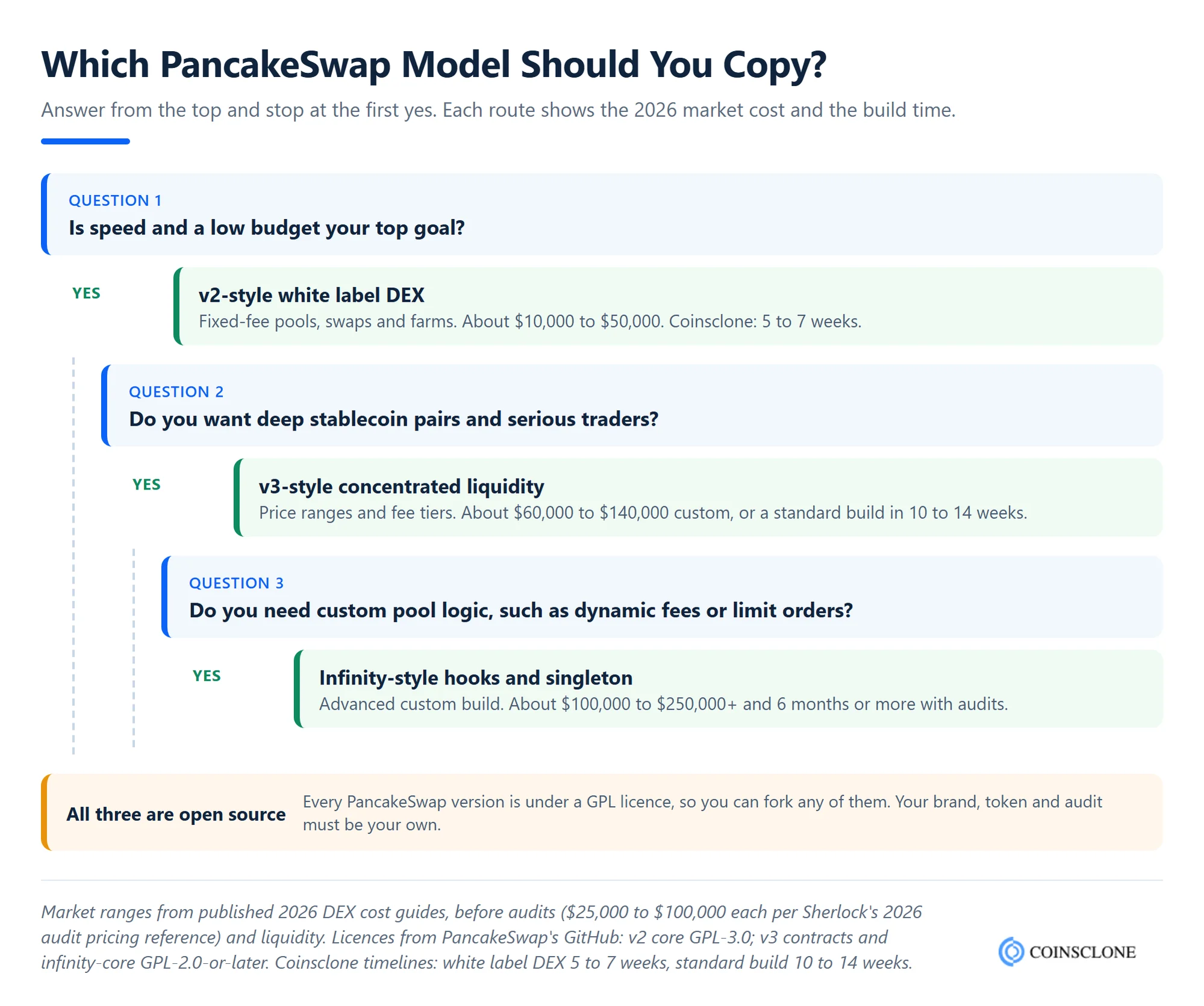
For most first-time founders, a v2-style white label DEX with the option to add v3-style pools later is the safest start. Infinity-style hooks make sense once you have users and a clear feature that no one else offers.
Costs Beyond the Build: Your Full Launch Budget
The build price is only part of what you need. A new DEX rarely struggles because of its code alone; it struggles when it lacks liquidity or users. Plan for these costs as well:
- Smart contract audits: About $25,000 to $100,000 per audit, plus $5,000 to $20,000 for each re-audit after code changes.
- Starting liquidity: Your own funds in the first pools, so trades get fair prices from day one. This is capital, not a fee, but you need it before launch. Published 2026 guides often budget $50,000 to $150,000 for early liquidity and LP rewards.
- Servers and data: Hosting, RPC nodes, indexers and alerts often cost a few hundred to a few thousand dollars a month, based on traffic and chains.
- Legal advice: Rules for DeFi differ by country. In the EU, the MiCA rules leave fully decentralized services out of scope, but a company that runs the front end may still be covered. Get local advice before launch.
- Marketing and community: Launch campaigns, listings on DEX aggregators and user rewards can cost as much as the build itself.
- Upkeep: About 15% to 25% of the build cost each year for updates, fixes and new features.
In short, a lean white label launch with one audit and modest liquidity can start below $150,000 in total. A custom multi-chain DEX with a few audits and deep liquidity can pass $500,000.
How Swap Fees Pay Back the Cost of Your DEX
Founders often ask how long it takes to earn the cost back. The answer depends on your trading volume and the share of each fee your DEX keeps.
PancakeSwap’s v2 pools charge a fixed 0.25% on every swap. Per its liquidity pool docs, 0.17% goes to LPs, 0.0225% to the treasury and 0.0575% to buy back and burn CAKE. So the platform side keeps 0.08% of each trade. Your own DEX can use the same split or set its own.
The worked example below uses that 0.08% platform share at three levels of daily volume.
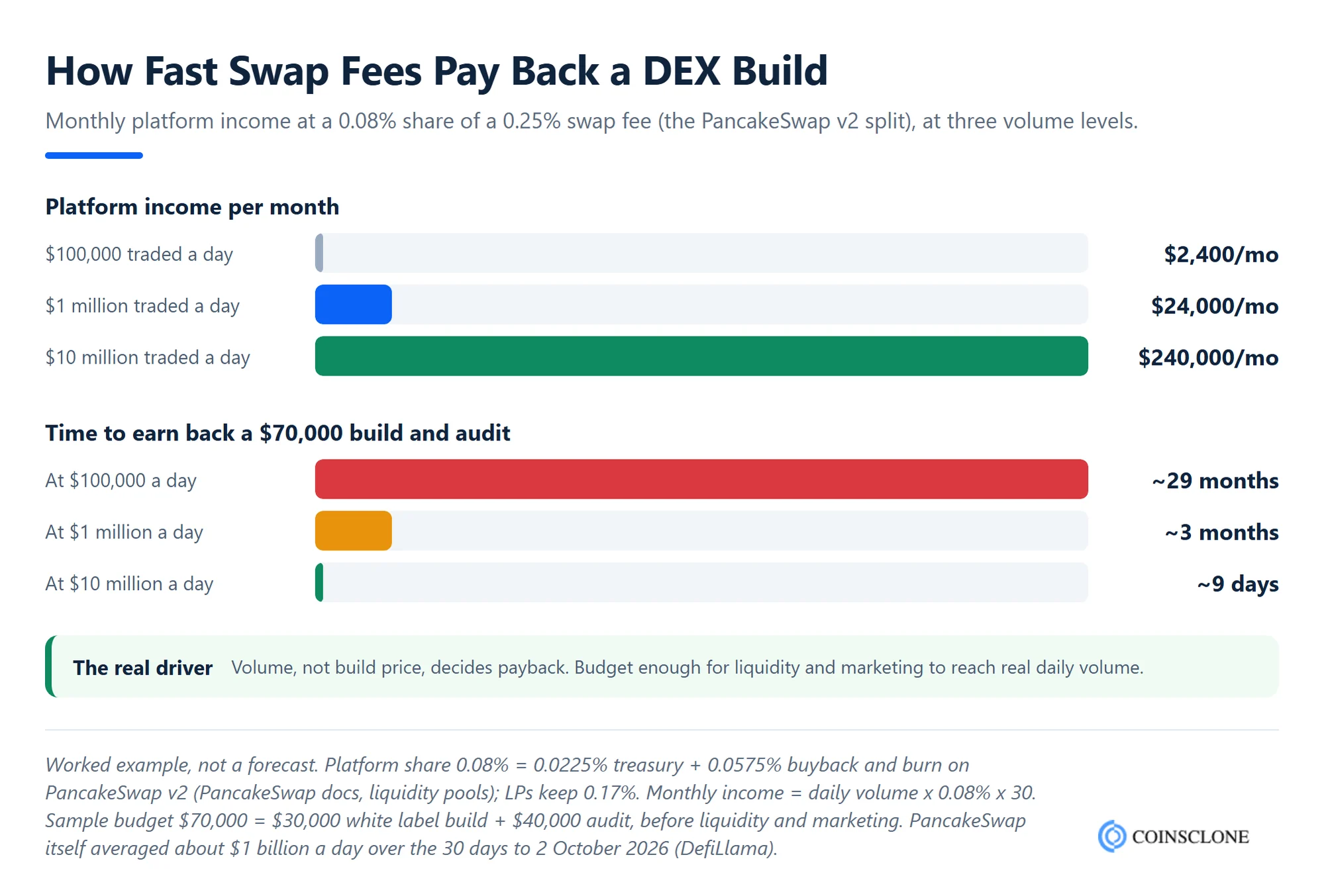
The lesson is clear: volume matters far more than the build price. A DEX with $1 million in daily trades can earn back a $70,000 build and audit in about three months. At $100,000 a day, the same budget takes more than two years. So keep enough budget for liquidity and marketing, since they drive the volume that pays for everything else.
Besides swap fees, a DEX like PancakeSwap can earn from token listings, farm and staking fees, launchpad sales, perpetual trading and a native token. Our post on how PancakeSwap makes money covers each stream in detail.
How Long Does It Take to Build a DEX Like PancakeSwap?
The timeline depends on your build route:
- White label DEX: About 5 to 7 weeks at Coinsclone, including branding and setup.
- Standard build with custom design and features: About 10 to 14 weeks.
- Fully custom or multi-chain DEX: Often 6 months or more, including audits.
Leave extra time for the audit. A thorough audit can take 2 to 8 weeks, and fixes may need a second pass. Many teams also run a short testnet beta with real users before mainnet.
How to Reduce the Cost to Build a DEX Like PancakeSwap
You can cut the cost without cutting safety. Here are the moves that save the most:
- Start with a white label base: A tested, audited base saves months of build time and shrinks the audit to your changes only.
- Launch an MVP first: Begin with swaps, pools and farms. Add perps, lotteries or a launchpad once you have users.
- Pick one chain to start: Launch on one low-fee EVM chain such as BNB Chain or Base, then expand.
- Copy the simplest model that fits: A v2-style AMM is cheaper to build and audit than v3 or Infinity-style pools.
- Never skip the audit: An audit costs far less than a hack. Treat it as part of the build, not an extra.
For a step-by-step view of the full build, see our guide on how to create a decentralized exchange.
If you too want to build a DEX like PancakeSwap, then without any hesitation…
Choose Coinsclone to Launch a DEX Like PancakeSwap
Coinsclone is a leading Decentralized Exchange Development company. We offer a PancakeSwap clone app that is ready to launch, with rich features. While there are many clone app providers, we bring a skilled team of blockchain developers and DeFi experts. Since 2018, we have delivered 350+ platforms for 200+ clients across 20 industries.
Our PancakeSwap clone script combines AMM swaps, yield farms, staking pools, perpetuals, a lottery and prediction rounds under one native token, ready for your brand and chain. A white label launch takes about 5 to 7 weeks, and a standard build with custom features takes about 10 to 14 weeks. Along with the clone app, we provide 24/7 support and upkeep for your crypto project. So keep your worries aside and join hands with our team to launch a DEX that stands out.
See How Our MVP System Can Help You Cut the Cost to Build Your DEX
Cost to Build a DEX — reduced with performance-focused development.
- MVP System : Save up to 70% in time and cost using pre-built modules.
- DeFi-Ready Modules : Liquidity pools, trading pairs, staking rewards.
- Brand & Customization : Customize UI, tokens, and trading logic.
- Revenue Engine : Earn from swaps, governance, and liquidity incentives.
Get a free DEX cost breakdown and demo in just 48 hours — before spending a cent.
Book a Free Demo to get a transparent breakdown of DEX development costs and delivery within 8–12 weeks.
Frequently Asked Questions
How much does it cost to build a DEX like PancakeSwap?
Published 2026 market estimates put a white label PancakeSwap clone at about $10,000 to $50,000. A custom DEX on one chain costs about $40,000 to $100,000 or more, and an advanced multi-chain DEX $100,000 to $250,000 or more. Add $25,000 to $100,000 for each smart contract audit, plus your own starting liquidity.
How long does it take to build a DEX like PancakeSwap?
A white label DEX can go live in about 5 to 7 weeks. A standard build with custom design and features takes about 10 to 14 weeks. A fully custom or multi-chain DEX often takes 6 months or more, including audits.
Is a PancakeSwap clone legal?
Yes. PancakeSwap’s code is open source: v2 under GPL-3.0, and v3 and Infinity under GPL-2.0-or-later. You can fork it if you follow the GPL terms. You cannot use the PancakeSwap name, logo or CAKE token, and you must follow the rules in each country where you offer your DEX.
What ongoing costs should I expect after launch?
Plan for upkeep of about 15% to 25% of the build cost each year. On top of that come servers, RPC nodes and indexers, re-audits after each code change, LP rewards and marketing. Liquidity rewards and marketing are often the largest ongoing costs.
What is the cheapest way to launch a DEX?
The cheapest safe route is an audited white label DEX on one low-fee chain, with a small first feature set such as swaps, pools and farms. Avoid cheap unaudited scripts, since one bug can drain every pool.
Is a DEX cheaper to build than a centralized exchange?
Usually, yes. A DEX uses smart contracts instead of a matching engine, custody wallets and a large back office. You also skip most custody costs. However, a DEX still needs audits, liquidity and legal advice, so budget for those.
Is a DEX clone safe?
A clone is as safe as its code and its audit. A white label base that has been audited and used in live projects is far safer than new code. Still, get every change audited, add timelocks and an emergency pause, and run a bug bounty.
How does a DEX like PancakeSwap make money?
Mainly from swap fees. PancakeSwap v2 charges 0.25% per swap, of which 0.08% goes to the platform and the rest to LPs. A DEX can also earn from listings, farms, staking, launchpad sales, perpetual trading and its own token.