

This guide ranks the 11 best crypto payment gateway clone scripts in 2026, from BitPay to a Stripe-style stablecoin checkout. For each one, you see the business you would copy: what the original charges, who holds the money and who it is built for. We checked every fee and status against each platform’s own site on 2 October 2026.
A clone script saves you from building a gateway line by line. But the model you pick shapes your fees, your licences and your launch date. So after the list, we explain what sits inside a clone script, how a gateway makes money, which rules apply and what a launch costs in time and money.
In this guide:
- The 11 best crypto payment gateway clone scripts, with a side by side table of the originals
- Which gateway model fits your market, as a simple decision tree
- What is inside a clone script, and how your gateway earns from day one
- The licences you need, with real 2025 and 2026 fines as a warning
- Cost and launch time, from a 4 week white label to a 9 month fiat platform
See How Our MVP System Can Launch Your Crypto Payment Gateway Faster
Crypto Payment Gateway Development — done right.
- MVP System: Launch your BitPay-like crypto payment gateway 90% faster.
- Crypto & Fiat Payments: Accept Bitcoin, Ethereum, stablecoins, and fiat with pre-integrated APIs.
- Brand & Customization: Your logo, supported coins, and payment flow — fully customizable.
- Revenue Engine: Earn through merchant fees, transaction charges, and settlement spreads.
Explore the Top Crypto Payment Gateway Clone Scripts with a free branded demo.
Book a Free Demo and discover how our crypto payment gateway clone script can help you launch your own gateway platform in just a few weeks.
11 Best Crypto Payment Gateway Clone Scripts in 2026
The 11 best crypto payment gateway clone scripts in 2026 copy BitPay, CoinPayments, Coinbase Commerce, NOWPayments, CoinGate, CoinsPaid, Binance Pay, Cryptomus, Stripe’s stablecoin checkout, CoinRemitter and BVNK. Each one copies a different business, so the right pick depends on who your merchants are and how they want to be paid.
- BitPay clone: an enterprise processor that pays merchants in fiat
- CoinPayments clone: a gateway with one of the longest coin lists
- Coinbase Commerce clone: a clean, simple checkout for online brands
- NOWPayments clone: an API-first gateway that sends funds straight to the merchant
- CoinGate clone: a plugin-led gateway for European stores
- CoinsPaid clone: a high volume processor for gaming and fintech
- Binance Pay clone: a wallet-to-wallet payment network inside one app
- Cryptomus clone: a hosted checkout that handles conversion for the merchant
- Stripe-style crypto gateway: stablecoin payments next to cards
- CoinRemitter clone: a low fee gateway for small merchants
- BVNK clone: stablecoin and fiat accounts for businesses
The Original Platforms Compared
The table shows the business behind each clone. The fee is what the original charges its merchants today, so it tells you where your own pricing can sit. Fees come from each platform’s own pricing pages or help centre, checked on 2 October 2026.
| Clone of | Model | Who holds funds | Original’s fee | Best for |
| BitPay | Enterprise processor | Platform, then pays out | 2% + $0.25, down to 1% + $0.25 | Large merchants who need fiat |
| CoinPayments | Multi-coin gateway | Platform | About 0.5% | Long tail coins |
| Coinbase Commerce | Simple checkout (now Coinbase Business) | Platform | 1% | Online brands |
| NOWPayments | API-first gateway | Merchant wallet by default | 1% | SaaS and apps |
| CoinGate | Plugin gateway, EU | Platform | 1% | Online stores in Europe |
| CoinsPaid | High volume processor | Platform | Quote based | Gaming, fintech |
| Binance Pay | In-app payment network | User and merchant accounts | 1% for Mini Program merchants | Super apps, exchanges |
| Cryptomus | Hosted checkout with conversion | Platform | Varies by plan | Small online sellers |
| Stripe crypto | Stablecoins next to cards | Stripe balance | 1.5% | Existing card merchants |
| CoinRemitter | Low fee gateway | Platform until withdrawal | 0.23% on withdrawal | Small merchants |
| BVNK | Stablecoin and fiat accounts | Platform | Enterprise pricing | Payment firms, payouts |
1. BitPay Clone Script
A BitPay clone script copies the model of BitPay, the processor that has served merchants since 2011. A shopper pays in crypto, and the merchant gets dollars, euros or stablecoins in its account. BitPay’s published pricing starts at 2% plus $0.25 per payment and falls to 1% plus $0.25 once a merchant passes $1 million a month. That tiered fee is the revenue model your clone copies.
Enterprise payments
- Scale: built for large merchants with high payment volume.
- Steady checkout: handles high value payments without slowing down.
- Safe wallets: keeps each merchant’s funds tracked and apart.
Fiat settlement: the system can turn incoming crypto into fiat or stablecoins, based on each merchant’s choice. This cuts the risk of price swings and keeps the books simple, while shoppers still pay in crypto.
Compliance tools: the platform links to KYC and AML checks, watches payments for risk and builds reports for audits. That matters, because a processor that pays out in fiat needs a bank partner, and banks ask for these controls first.
Best suited for: large merchants, fintech firms and payment companies that need fiat payouts, audit trails and high value payments.
If you plan a platform like BitPay, read our breakdown of the cost to create a crypto payment gateway like BitPay, including build, hosting and hidden costs.
2. CoinPayments Clone Script
A CoinPayments clone script copies one of the oldest gateways for many coins. CoinPayments accepts a very long list of coins and tokens, and its fee starts at about 0.5% per payment. Its homepage also stresses fixed-rate invoices and batched payouts, two features worth copying.
Multi-coin payments
- Wide coin list: merchants accept Bitcoin, Ether, stablecoins and many smaller coins through one setup.
- Global reach: more coins mean fewer shoppers turned away.
- Shopper choice: buyers pay with the coin they already hold.
Merchant invoices: merchants create invoices with a locked rate, a timer, a QR code and live status updates. The rate lock protects the merchant if the price moves before the shopper pays.
Wallets and payouts: the system tracks every payment on chain, updates merchant balances and pays out to the merchant’s wallet. Batched withdrawals group many payouts into one transfer, which cuts network fees when chains are busy.
Best suited for: payment startups, crypto-friendly stores, marketplaces and SaaS tools that want to accept a wide range of coins.
3. Coinbase Commerce Clone Script
A Coinbase Commerce clone script copies the clean, simple checkout Coinbase made popular. One 2026 change matters here. Coinbase closed the Commerce portal for all merchants on 31 March 2026. Its successor, Coinbase Business, charges 1% but serves only firms in the US and Singapore. That left many merchants elsewhere looking for a new home, which is a real gap for a new gateway to fill.
Simple user experience
- Familiar design: the checkout looks like the card checkouts shoppers already know.
- Short checkout: shoppers pick a coin and pay in a few taps.
- Clear dashboard: merchants see live payments, invoices and history in one place.
Direct payments: payments move from the shopper’s wallet to the merchant’s account with no extra middlemen, and every payment can be checked on chain.
Clean records: clear payment logs and reports make audits easier for firms in regulated markets.
Best suited for: SaaS platforms, digital service sellers, online stores and subscription brands that want a simple, trusted checkout.
4. NOWPayments Clone Script
A NOWPayments clone script copies an API-first gateway that, by default, sends funds straight to the merchant’s own wallet. NOWPayments lists 350+ currencies, a 1% service fee and an average payment time of about 5 minutes on its pricing page. Because the gateway never holds the money in its default mode, your licence load can be lighter.
API-first design
- Easy to embed: APIs and webhooks put crypto payments inside websites, apps and SaaS dashboards.
- Fast builds: developers ship and test new payment flows quickly.
- Flexible flows: each platform can shape the payment steps to fit its own backend.
SaaS and platform use: the system handles payments on its own, bills users each month and keeps a report for each merchant. That suits marketplaces and apps sold by plan.
Auto conversion: merchants can accept one coin and receive another, such as USDT. This shields them from price swings.
Best suited for: teams that want strong dev tools, hands-off payment flows and easy links across many apps.
5. CoinGate Clone Script
A CoinGate clone script copies a gateway built around store plugins. CoinGate charges 1% per payment, says it is MiCA-compliant and lists plugins for WooCommerce, PrestaShop, OpenCart, WHMCS and Wix. It also turns on Bitcoin Lightning by default, so small payments stay cheap.
Merchant plugins
- Ready for stores: plugins drop into the shopping carts merchants already use.
- Quick setup: merchants can take crypto without writing code.
- Easy onboarding: fewer setup steps mean more merchants finish signing up.
Store links: the system connects to online stores, checkouts and marketplaces, and it sends invoices and live payment updates.
Regional payouts: merchants can choose which coins to accept and how to get paid, including bank payouts in euros. That flexibility matters most in Europe, where EUR payouts often decide the choice.
Best suited for: online stores and sellers, especially in Europe, that want plugins, Lightning and simple payouts.
6. CoinsPaid Clone Script
A CoinsPaid clone script copies a processor built for high volume, such as gaming sites, exchanges and fintech apps. CoinsPaid sells mostly on custom quotes. Its history also carries a lesson: in July 2023, attackers stole $37.3 million from its hot wallets through a social engineering attack, as CoinsPaid itself reported. So a clone of this model needs strong key security, not just speed.
High volume payments
- Throughput: handles many payments at once for busy platforms.
- Peak ready: stays stable when traffic spikes.
- Scale: keeps the same speed as payment flows grow.
Exchange and payment in one: the platform mixes gateway tools with exchange tools, such as wallets inside the app, swaps and fund routing.
Reports: full payment logs, payout totals and income tracking help with the books and with audits.
Best suited for: large platforms, exchanges and fast-growing firms that need high volume payments and deep reporting.
7. Binance Pay Clone Script
A Binance Pay clone script copies a payment network that runs inside one app. Payments move between user and merchant accounts on the same platform, so they settle in seconds with no on-chain wait. It is no longer free, though. Binance’s fee page, updated in January 2026, charges users $0.50 or $1 per send, Mini Program merchants 1%, and payouts 0.80% capped at $5.
Instant payments
- Fast settlement: transfers inside the app clear in seconds.
- Low delay: the payment feels as quick as a card tap.
- Retail use: speed makes it useful in shops, marketplaces and online services.
Built-in wallet: users store, send and spend crypto from one screen.
Merchant tools: merchants create payment links, QR codes and checkout links for websites, apps and in-store sales.
Works everywhere: the same flow runs on mobile, web and partner apps.
Best suited for: exchanges, super apps and fintech startups that already have users holding balances and want to turn them into a payment network.
8. Cryptomus Clone Script
A Cryptomus clone script copies a hosted checkout that takes the payment, converts it and pays the merchant. The merchant never handles conversion or price risk. Cryptomus also shows why rules matter. In October 2025, Canada’s FINTRAC fined the firm behind it C$176.96 million, the largest fine it has ever set. The firm had failed to file 1,068 reports on suspect payments, as FINTRAC announced. The firm has appealed. Copy the product, not the compliance gaps.
Hosted checkout
- Ready pages: merchants share a payment page or link, with no build work.
- Built-in swaps: coins that come in can be swapped to USDT or USDC as they land.
- Simple setup: small sellers go live in a day.
Payouts and mass payments: merchants pay suppliers, staff or affiliates in bulk from the same balance.
Plugins and links: plugins and payment links let merchants add crypto to stores and invoices.
Best suited for: small and mid-sized online sellers who want the gateway to handle conversion for them.
9. Stripe-Style Crypto Gateway Script
A Stripe-style crypto gateway script copies the way Stripe added stablecoins next to cards. Stripe’s stablecoin payments accept USDC on Ethereum, Solana, Polygon, Base and Tempo, settle to the merchant’s Stripe balance and cap each payment at $10,000. The widely reported fee is 1.5%, well under the 2.9% plus 30 cents Stripe charges for US cards. Stripe built this on Bridge, the stablecoin firm it bought for $1.1 billion in 2025.
Developer-friendly APIs
- Easy setup: APIs and webhooks add crypto to websites, apps and SaaS tools.
- One stack: crypto sits next to cards, so merchants keep one checkout.
- Deep links: the tools cover the full payment flow, from checkout to refunds.
Mixed payments: merchants accept stablecoins next to cards and bank transfers, with no change to their current setup.
Repeat billing: the system bills users each month and sends invoices on its own, for SaaS and member sites.
Merchant tools: onboarding, payment tracking, routing and reports grow with each merchant’s volume.
Best suited for: SaaS tools, firms that bill by plan and payment firms that want stablecoins in a card-style checkout.
10. CoinRemitter Clone Script
A CoinRemitter clone script copies a light, low fee gateway for small merchants. CoinRemitter’s homepage lists a 0.23% fee, taken when the merchant withdraws. It also offers free plugins for WordPress, Magento and other stores. A low fee like this works best when your costs are lean, so plan your running costs before you copy the price.
Easy onboarding
- Quick signup: merchants open an account and create wallet addresses in minutes.
- No deep tech: plugins and simple settings mean no developer is needed.
- Smooth start: merchants begin taking crypto without changing how they work.
Low fees: the fee sits well under card fees, so merchants keep more of each sale.
Wallet tracking: the system tracks each payment on chain and updates its status live for merchants and shoppers.
APIs for sites and apps: developers can add crypto to checkouts, subscriptions and service apps.
Best suited for: small and mid-sized merchants, online sellers and crypto-friendly services that want a simple, low cost gateway.
11. BVNK Clone Script
A BVNK clone script copies a platform that runs stablecoin and fiat accounts side by side. Businesses use it to take payments, hold balances, convert and pay out across borders. Its value is clear from one deal: Mastercard agreed to buy BVNK for up to $1.8 billion in March 2026 and closed the deal on 3 August 2026, as its completion release confirms. BVNK serves 130+ countries.
Crypto and fiat in one place
- Both rails: the platform handles stablecoins and bank money together.
- Bank links: businesses take crypto while keeping their normal bank flows.
- One system: funds move between crypto and fiat without switching tools.
Multi-currency accounts: one dashboard shows crypto, stablecoin and fiat balances. That makes cash planning and payouts abroad simpler.
Automatic payouts: incoming funds can go to internal wallets, outside addresses or bank accounts with no manual steps.
APIs: fintech apps, exchanges and marketplaces can add these payments through clean APIs.
Best suited for: fintech firms, payment startups and businesses that pay out across borders in both stablecoins and fiat.
What Is a Crypto Payment Gateway Clone Script?
A crypto payment gateway clone script is ready-made software that copies the features and payment flow of a proven gateway. It lets you launch your own branded gateway faster, because the core parts already exist: coin support, merchant dashboards, wallets and payouts.
These scripts copy how top gateways create invoices, generate addresses, wait for confirmations and pay merchants. You can still change the design, coins, fees and features to fit your own business. For live examples of the brands people copy, see our list of the best crypto payment gateways.
What Is Inside a Crypto Payment Gateway Clone Script
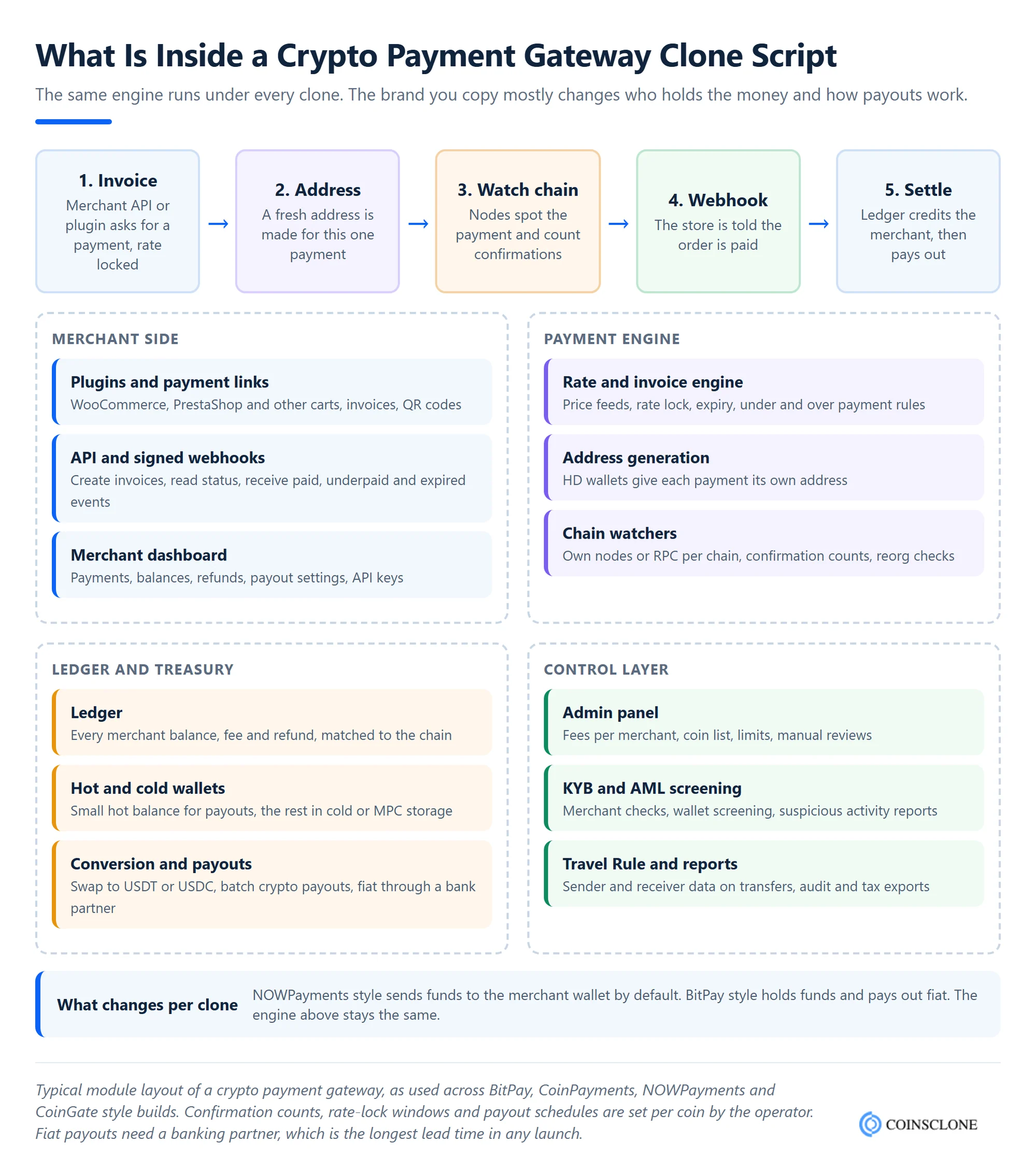
Every clone in the list runs on the same core parts. The brand you copy changes the defaults, such as who holds the funds or how payouts work. The engine stays much the same.
- Merchant side: plugins, payment links, APIs and webhooks that create invoices and report status.
- Payment engine: a rate lock for each invoice, a fresh address per payment and nodes that watch each chain.
- Ledger: a record of every merchant balance, fee and refund, kept in step with the chain.
- Treasury: hot and cold wallets, swaps to stablecoins or fiat, and batched payouts.
- Control layer: admin panel, KYB checks for merchants, AML screening and reports.
Why Choose a Crypto Payment Gateway Clone Script Over Custom Development?
For most founders, the choice comes down to speed, cost and risk. Payments move fast, and a clone script lets you launch quickly without rebuilding parts that are already proven.
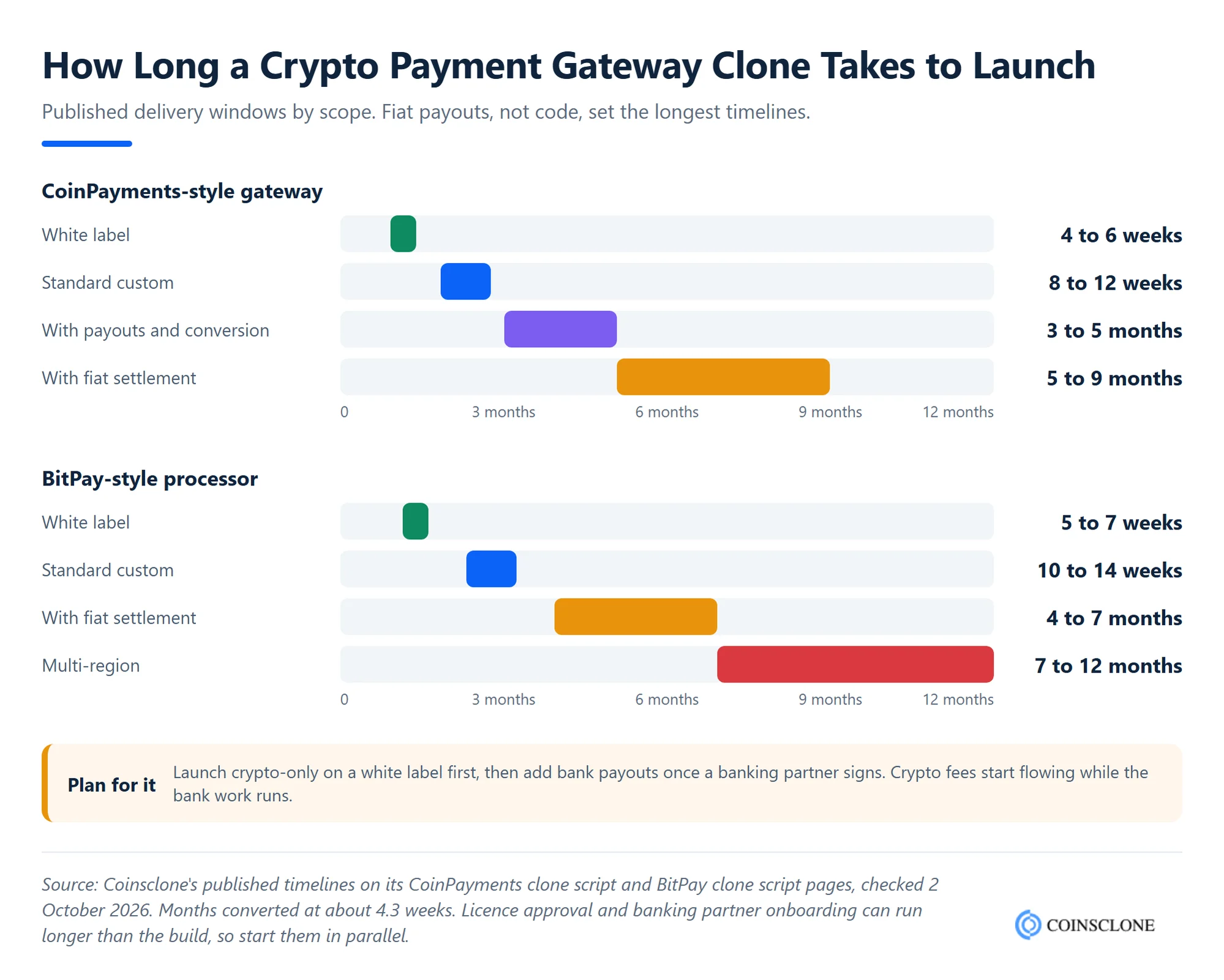
- Faster launch: payment flows, wallets and dashboards are ready, so a white label clone can go live in 4 to 7 weeks instead of 4 to 9 months.
- Lower cost: the core is already built and tested, so you skip most design, testing and bug fixing work.
- Proven logic: confirmations, fee math and payouts follow models that already work at scale.
- Easier merchant onboarding: ready APIs, admin panels and merchant screens help you sign merchants faster.
- Room to grow: you can still add coins, compliance tools, fiat payouts and new features later.
In short, a clone script cuts technical risk and launch time. It gives startups and growing firms a base they can build on, rather than a blank page. If you want your own brand on a ready product, a white label crypto payment gateway is the closest option.
How a Crypto Payment Gateway Makes Money
A clone script is not just software. It is a payment business, and the original brands show how that kind of firm earns. Most gateways mix four income lines.
- Processing fee: a share of each payment, from 0.23% (CoinRemitter) to 2% plus $0.25 (BitPay’s entry tier).
- Conversion spread: a small margin when a merchant takes BTC but wants USDT or fiat.
- Payout fees: a flat or capped fee on withdrawals, such as Binance Pay’s 0.80% capped at $5.
- Plans and add-ons: monthly plans, white label checkouts, mass payouts or priority support.
Here is a simple worked example. Say 40 merchants send $3 million a month through your gateway, and you charge 1%. That is $30,000 a month in fees. If half of that volume also converts to stablecoins at a 0.5% spread, you add $7,500. Against that, a lean white label gateway costs about $5,000 to $15,000 a month to run in its first year. These are round numbers for planning, not a forecast.
How to Choose the Best Crypto Payment Gateway Clone Script for Your Business?
The right pick depends on more than a feature list. Match the clone to your merchants, your markets and your growth plans. Check these points first:
- Target merchants: small sellers want plugins and low fees, while large firms need high volume and strong controls.
- Supported chains: make sure the script supports the coins and networks your market uses, with room to add more.
- Fiat needs: decide early if merchants need bank payouts, since banking partners take the longest to set up.
- Rules where you operate: pick a model you can license in your target countries.
- Custom scope: check how easily you can change features, flows, branding and links.
- Room to scale: the best scripts handle more volume, coins and merchants without a rebuild.
The decision tree below turns these points into a quick answer. Start at the top and stop at the first yes.

Licences and Rules Before You Launch
Your licence decides where you can work, and that often matters more than your features. Rules got stricter in 2025 and 2026, and fines are now large.
- United States: a gateway that holds or moves client funds must usually register with FinCEN as a money services business. There is no federal fee, but many states also ask for a money transmitter licence. The GENIUS Act of July 2025 now sets rules for payment stablecoins.
- European Union: under MiCA, firms that hold or transfer crypto for clients need CASP approval. The grace period ended on 1 July 2026, so EU gateways without a licence must stop serving EU clients.
- Canada: FINTRAC’s C$176.96 million fine on the firm behind Cryptomus shows the cost of weak reporting.
- Travel Rule: most markets now require sender and receiver details on transfers above set limits, and the EU applies it to every transfer.
A non-custodial model, where funds go straight to the merchant’s wallet, can lower your licence load in some markets. But it does not remove it everywhere, so take local legal advice before launch.
Cost of Developing a Crypto Payment Gateway Using Clone Scripts
The cost depends on how far you take the platform beyond its core. Published 2026 agency cost guides put a white label gateway with core features at about $20,000 to $60,000. A custom white label gateway costs about $40,000 to $100,000, and a gateway built from scratch costs $100,000 to $300,000 or more. Our full guide on the cost to develop a crypto payment gateway breaks down each part.
- Base clone setup: coin support, merchant dashboards, wallets and admin controls needed for launch.
- Custom features: auto conversion, custom payout logic, multi-vendor support or deeper reports add cost.
- Compliance and links: KYC and AML tools, banking partners and fiat payouts raise the budget most.
- Upkeep: security updates, chain upgrades and support, often 15% to 25% of the build cost each year.
Time follows the same pattern. Coinsclone’s published timelines show a white label CoinPayments-style clone in 4 to 6 weeks, a custom build in 8 to 12 weeks, and a platform with fiat payouts in 5 to 9 months. Bank onboarding, not code, is the slowest step.
Why Coinsclone Is a Trusted Provider of Crypto Payment Gateway Clone Scripts?
Choosing the right crypto payment gateway development company matters as much as choosing the right model. A good partner gives you a gateway that works at launch and still holds up as you grow. Coinsclone has built for crypto businesses since 2018, with 350+ platforms delivered for 200+ clients across 20 industries.
- Payment know-how: we know how real crypto payments work, from wallets and confirmations to payouts and reports.
- Modular build: you can add or change payment APIs, wallets, reports or dashboards without a rebuild.
- Long-term support: chains change, threats change and new tokens arrive, so we keep your gateway updated and secure.
- Ready to customise: change payment flows, add chains or add merchant tools as your platform grows.
- For startups and large firms: the same base serves a new payment startup or a high volume global processor.
Our standard gateway goes live in 6 to 9 weeks, or 10 to 14 weeks with built-in conversion and payouts. Book a free demo to see a clone of the model you have in mind running before you commit.
Frequently Asked Questions
What is a crypto payment gateway clone script?
It is ready-made software that copies the features and payment flow of a known gateway, such as BitPay or NOWPayments. You add your brand, coins and fees, then launch your own gateway in weeks instead of months.
How much does a crypto payment gateway clone script cost?
Published 2026 agency cost guides put a white label gateway at about $20,000 to $60,000 and a custom white label build at $40,000 to $100,000. A gateway built from scratch costs $100,000 to $300,000 or more. Plan for running costs on top.
How long does it take to launch a crypto payment gateway?
A white label clone takes about 4 to 7 weeks. A custom gateway takes 8 to 14 weeks. Adding fiat payouts through banking partners stretches the launch to 4 to 9 months.
How does a crypto payment gateway make money?
Mostly through a fee on each payment, usually 0.5% to 2%. Many also earn from conversion spreads, payout fees and monthly plans.
Do I need a licence to run a crypto payment gateway?
In most markets, yes, if you hold or move customer funds. The US uses FinCEN and state licences. The EU needs MiCA CASP approval, and Canada asks firms to register with FINTRAC.
Is Coinbase Commerce still available?
No. Coinbase closed the Commerce portal on 31 March 2026. Its successor, Coinbase Business, serves only the US and Singapore. A Coinbase Commerce clone lets you offer a similar checkout in the markets it left.
What is the difference between a clone script and a white label gateway?
A clone script copies the features and flow of a named platform. A white label gateway is a ready product you rebrand. In practice, most providers build both on the same base, so the real choice is how much you want to customise.
See How Our MVP System Can Launch Your Crypto Payment Gateway Faster
Crypto Payment Gateway Development — done right.
- MVP System: Launch your BitPay-like crypto payment gateway 90% faster.
- Crypto & Fiat Payments: Accept Bitcoin, Ethereum, stablecoins, and fiat with pre-integrated APIs.
- Brand & Customization: Your logo, supported coins, and payment flow — fully customizable.
- Revenue Engine: Earn through merchant fees, transaction charges, and settlement spreads.
💬 Explore the Top Crypto Payment Gateway Clone Scripts with a free branded demo.
👉 Book a Free Demo and discover how our crypto payment gateway clone script can help you launch your own gateway platform in just a few weeks.