Blockchain voting is a topic where the honest position matters more than the enthusiastic one, because getting it wrong in a public election is not recoverable.
The technology solves one part of the problem genuinely well: it makes a recorded tally tamper-evident and independently verifiable. It does nothing about the parts election security researchers consider most dangerous, which are the voter’s own device, coercion outside a private booth, and the absence of anything independent to recount.
This guide states that position plainly, then covers how these systems are actually built, what happened when governments tried them, where the trade-offs genuinely work, and the questions any serious design has to answer.
What Is a Blockchain Voting System?
A blockchain voting system records encrypted ballots on a distributed ledger so that the tally is publicly verifiable and cannot be altered after the fact. Each vote becomes a transaction. Once confirmed, changing it would mean rewriting the ledger’s history, which on a well-distributed network is impractical.
The appeal is straightforward. Traditional electronic voting asks you to trust the organization running the count. A blockchain replaces some of that trust with arithmetic anyone can check. Observers can confirm the published result matches the recorded ballots without being granted special access and without trusting the operator.
The limitation is equally straightforward, and it is the single most important thing to understand about this category. A ledger protects a vote from the moment it is recorded onwards. Everything before that moment, how the voter was authenticated, whether their device was honest, whether anyone was standing behind them, sits entirely outside its protection.
A blockchain voting system is a recording mechanism, not an election system. Most failed projects in this space come from confusing the two.
How Does a Blockchain Voting System Work?
Five layers, each with a hard problem attached. The blockchain itself only addresses the third.
Voter identity and eligibility. Proving someone is entitled to vote without linking that person to their ballot. This is the central tension in every voting system ever designed, electronic or paper, and blockchain does not create it or resolve it.
Ballot secrecy. Encryption, blind signatures or similar techniques so that votes are countable but not attributable to individuals.
Vote recording. Committing an encrypted ballot so it cannot be altered or quietly removed afterwards. This is the layer blockchain genuinely improves, and it is one layer out of five.
Tallying. Homomorphic counting or mixnets, which total the votes without ever decrypting individual ballots.
Verifiability. Letting a voter confirm their vote was included and counted, without letting them prove to anyone else how they voted.
Election researchers describe the goal for that last layer as end-to-end verifiability, usually broken into three claims: the ballot was cast as the voter intended, recorded as cast, and counted as recorded. A blockchain contributes strongly to the third, partially to the second, and not at all to the first. The first claim is where compromised devices live, and it is the one that decides whether a system is fit for a binding election. 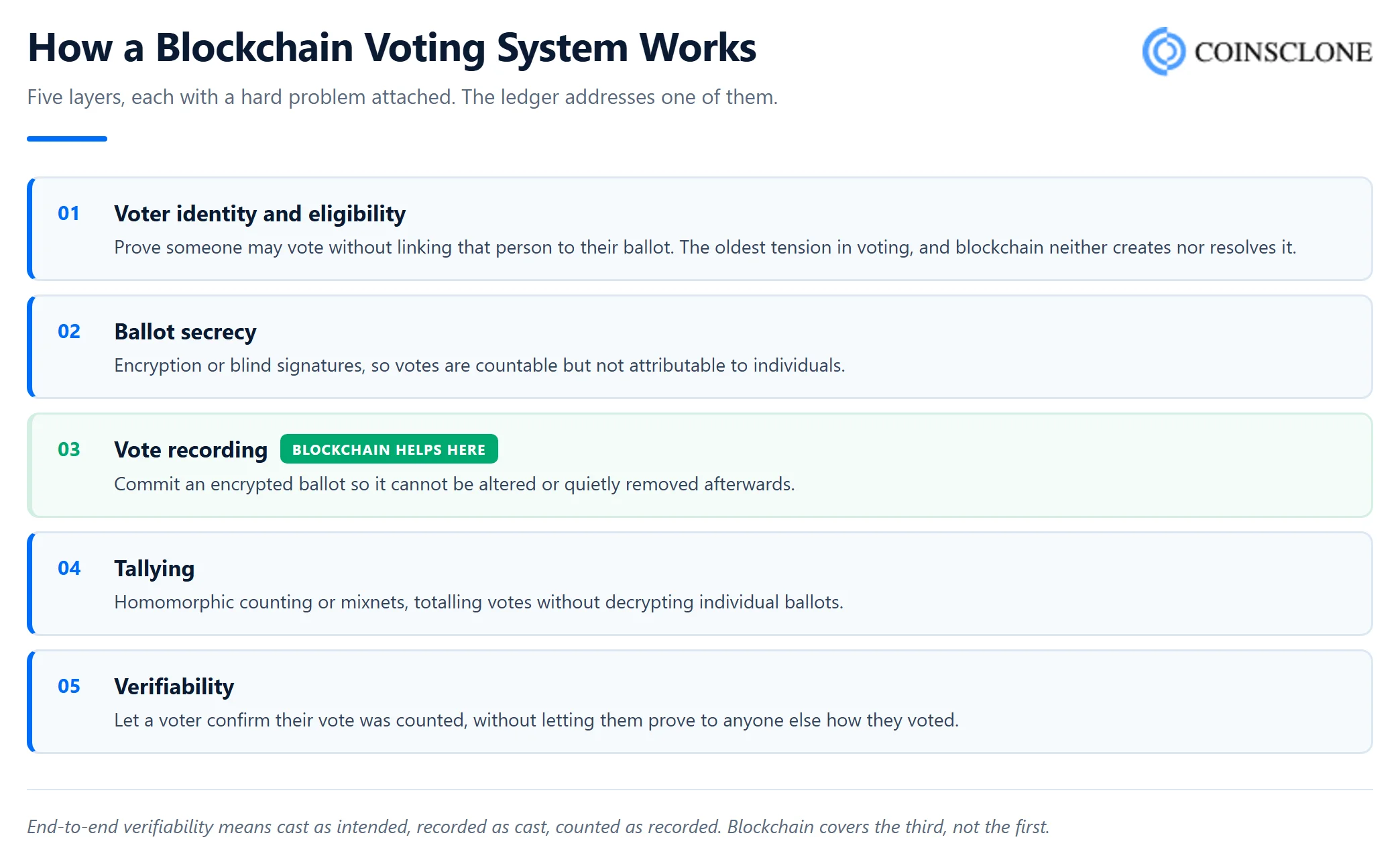
Is Blockchain Voting Secure for Public Elections?
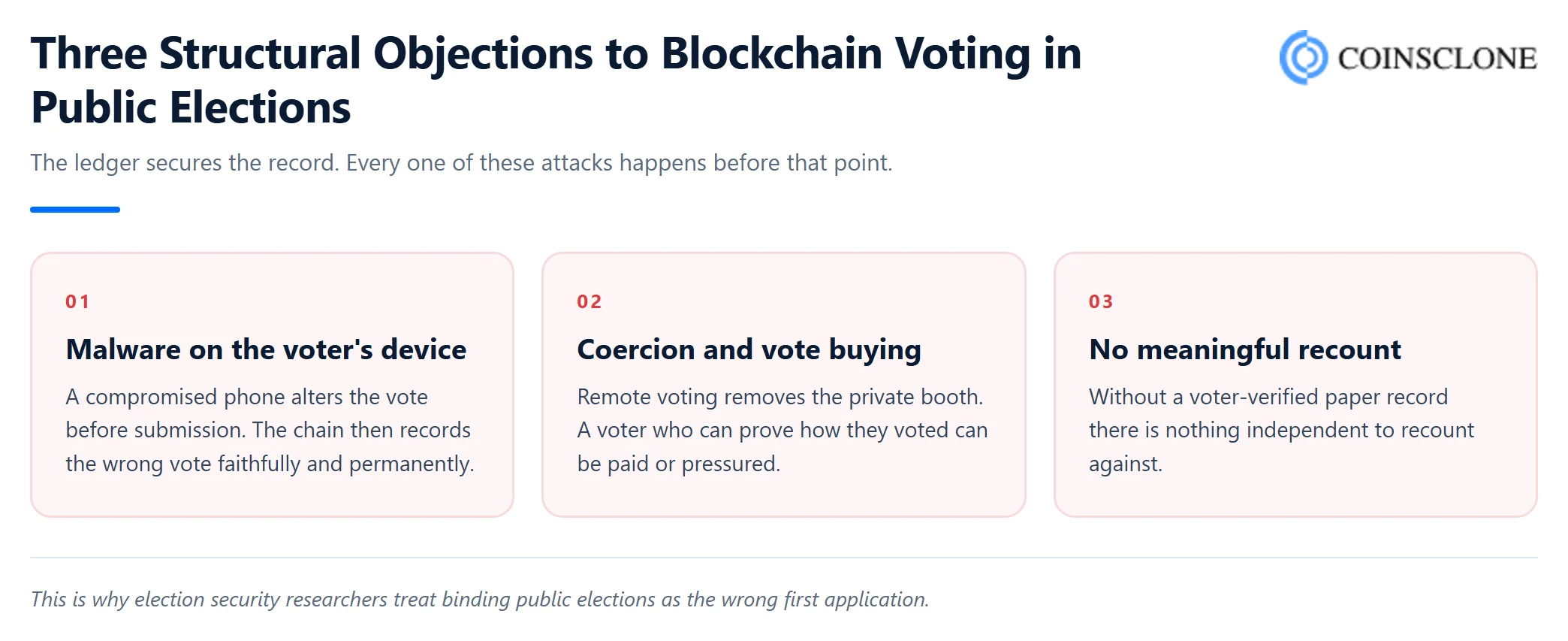
Not according to the people who study election security for a living, and the position is unusually settled for a technical field. The core objection is structural: a blockchain secures the record after a vote is cast, and the attacks that matter happen before that point.
Malware on the voter’s device. A compromised phone or laptop can alter a vote before it is ever submitted. The chain then records the altered vote faithfully and permanently, complete with a cryptographic proof that the wrong answer has not been tampered with since. Ledger integrity offers no protection against this whatsoever.
Coercion and vote buying. Remote voting removes the private booth, which is the mechanism that makes coercion difficult. A voter who can demonstrate how they voted can be paid or pressured to vote a particular way.
No meaningful recount. Without a voter-verified paper record there is nothing independent to recount against. Recounting the same digital record returns the same answer whether or not that answer was ever correct.
The 2018 National Academies of Sciences, Engineering, and Medicine report Securing the Vote recommended human-readable paper ballots and advised against internet voting for public elections given the state of available technology. Academic analysis of deployed blockchain voting systems since then has been consistently critical rather than reassuring.
None of this makes blockchain voting useless. It makes binding public elections the wrong first application, and saying so early is more useful to a client than building something that collapses under expert scrutiny later.
Has Any Country Actually Used Blockchain Voting?
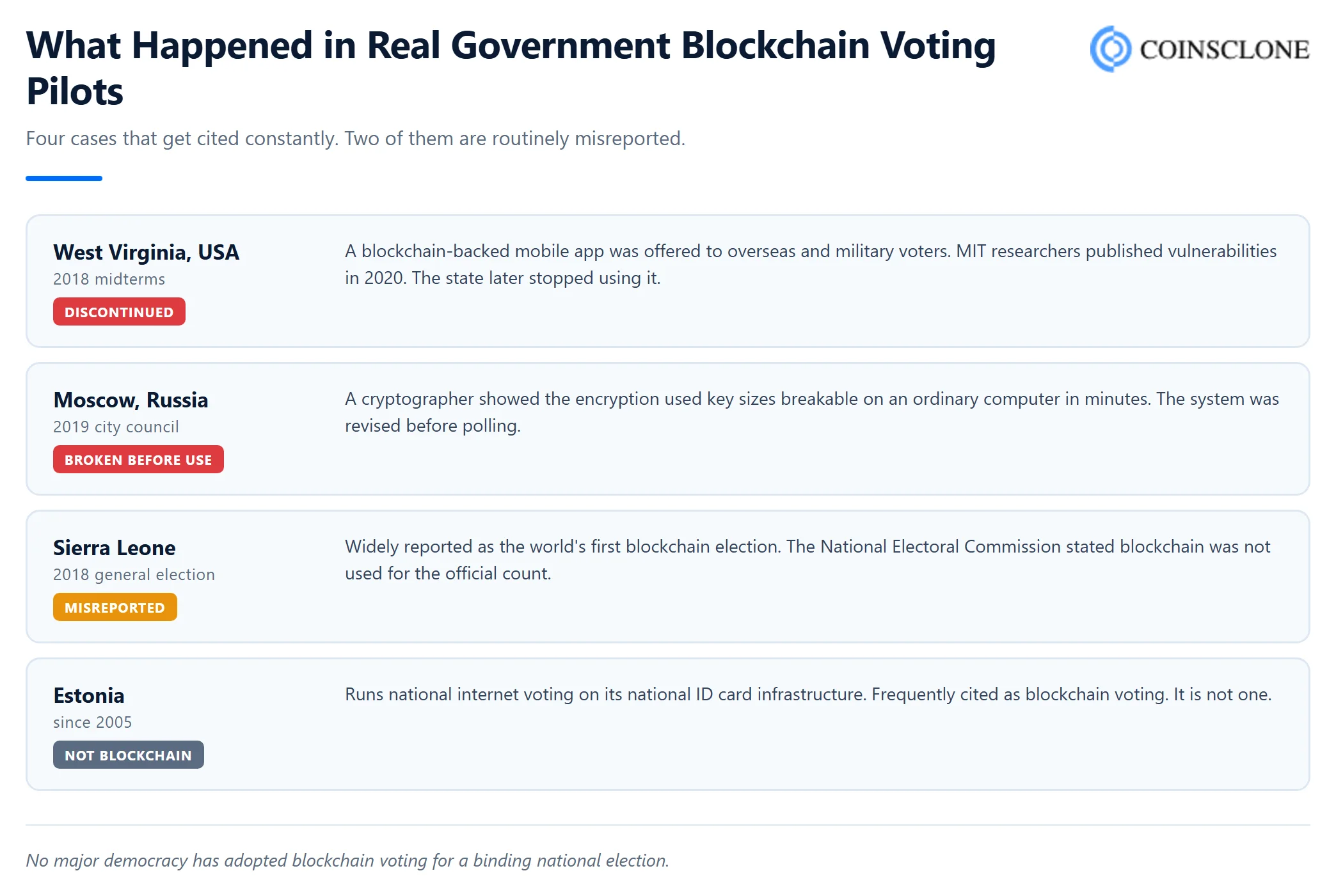
A few governments have run pilots. The results are instructive, and two of the most cited examples are widely misreported.
West Virginia, United States, 2018. A mobile blockchain-backed app was offered to overseas and military voters in the midterm elections. In 2020, researchers at MIT published a security analysis identifying vulnerabilities that could permit vote alteration and voter deanonymization. The vendor disputed the findings. The state subsequently stopped using the app.
Moscow, Russia, 2019. A blockchain-based system was used in city council elections. Before polling, a French cryptographer published work showing the encryption scheme used key sizes weak enough to be broken on an ordinary computer in minutes. The system was revised before the vote.
Sierra Leone, 2018. Widely reported at the time as the world’s first blockchain election. It was not. The country’s National Electoral Commission publicly stated that blockchain was not used to run or count the official result, and that a private company had recorded results in parallel. This claim still circulates in vendor marketing and is worth correcting whenever it appears.
Estonia is often cited in the same breath and should not be. Estonia has run national internet voting since 2005, built on its national ID card infrastructure. Whatever else that system is, it is not a blockchain voting system. Conflating the two overstates blockchain’s electoral track record considerably.
The pattern across genuine deployments is consistent. Pilots have been small, independent scrutiny has found real problems, and no major democracy has adopted blockchain voting for binding national elections.
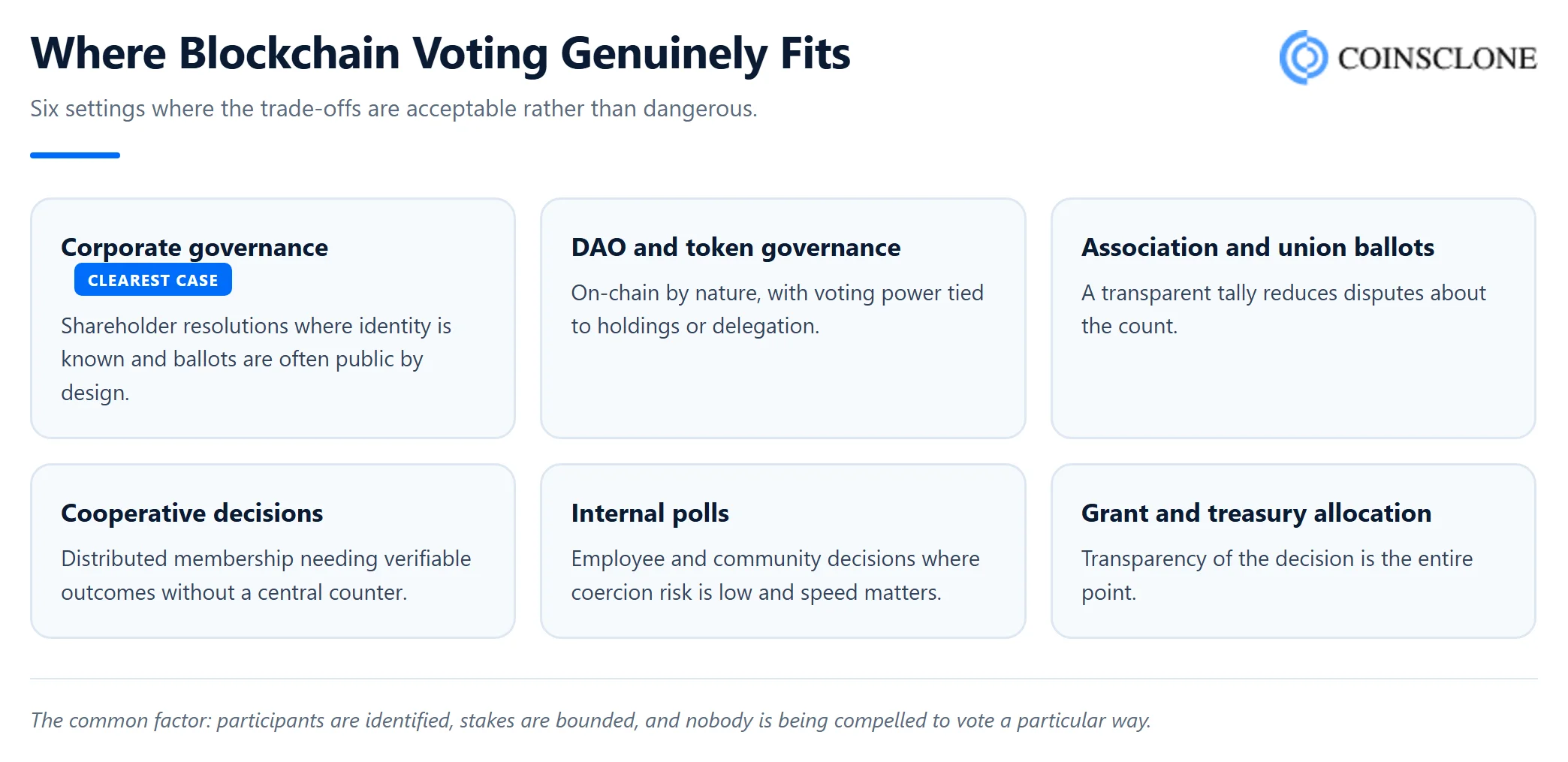
Where Does Blockchain Voting Genuinely Fit?
Six settings where the trade-offs are acceptable, because participants are known, stakes are bounded and coercion risk is manageable.
Corporate and shareholder governance, where identity is known, votes are often weighted by holding, and auditability matters more than ballot secrecy.
DAO and token governance, which is on-chain by nature, with voting power tied to holdings or delegation.
Association and union ballots, where a transparent tally reduces disputes about the count.
Cooperative decisions, where a distributed membership needs verifiable outcomes without trusting a central counter.
Internal polls for employee and community decisions, where coercion risk is low and speed matters.
Grant and treasury allocation, where transparency of the decision is the entire point.
The common factor across all six is that participants are identified, consequences are bounded, and nobody is being compelled under threat to vote a particular way. Shareholder voting is the clearest case: votes are frequently public by design, so the coercion objection that blocks political elections barely applies.
What Is the Tension Between Verifiability and Coercion Resistance?
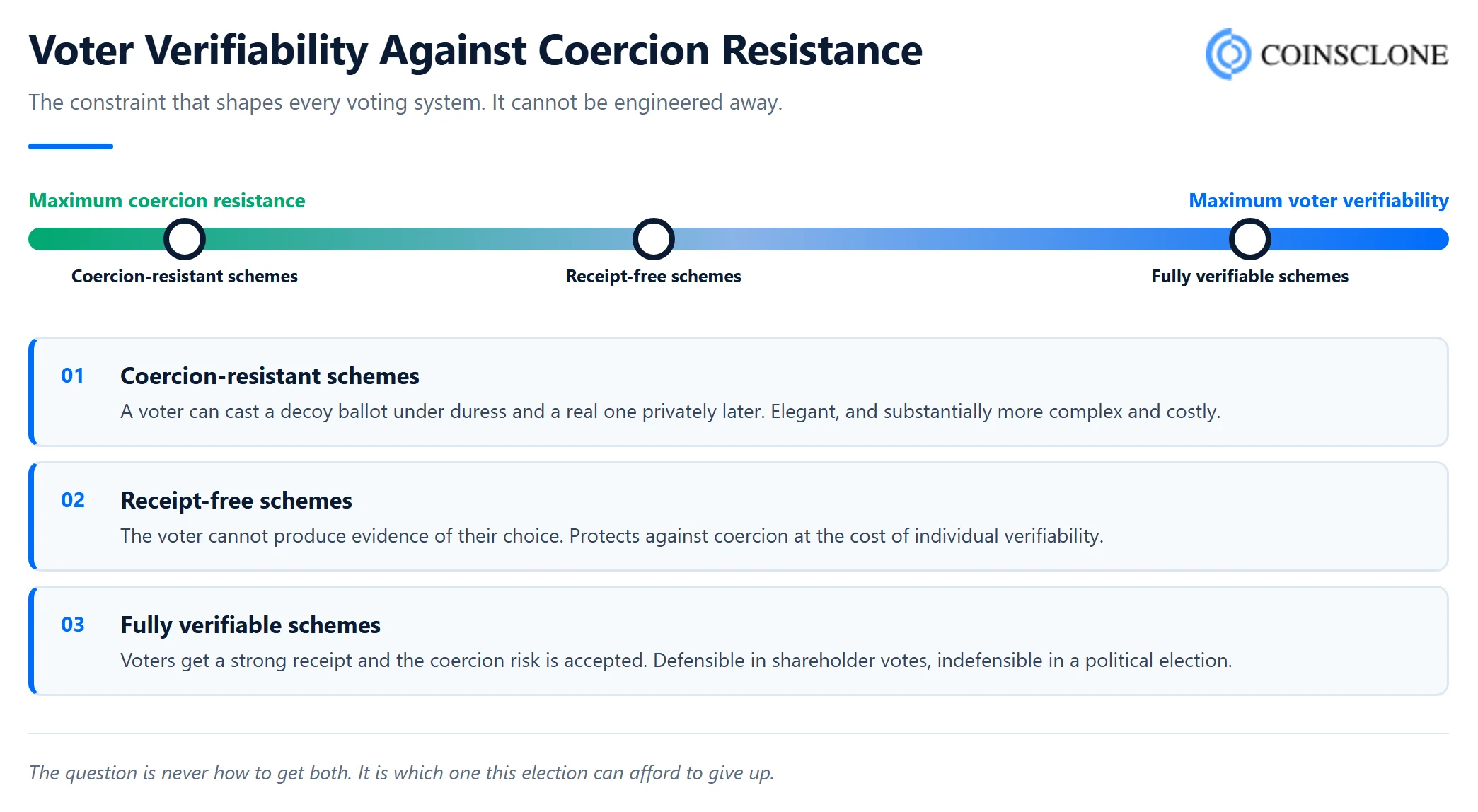
This is the constraint that shapes every voting system, and it cannot be engineered away.
If a voter can prove to a third party how they voted, they can be paid or pressured to vote a particular way. If a voter cannot prove how they voted, their ability to independently confirm their ballot was counted correctly is necessarily limited. The two properties pull directly against each other.
Real designs pick a point on that spectrum rather than escaping it.
Receipt-free schemes deliberately prevent a voter from producing evidence of their choice. This protects against coercion at the cost of individual verifiability.
Coercion-resistant schemes go further, allowing a voter to cast a decoy ballot under duress and a real one privately later. These are elegant and add substantial complexity and cost.
Fully verifiable schemes give voters a strong receipt and accept the coercion risk. Defensible in shareholder votes where ballots are public anyway, indefensible in a political election.
The right question is never how to get both. It is which property this particular election can afford to give up, and whether that decision has been written down and agreed rather than made accidentally by an engineer.
How Do Zero-Knowledge Proofs Change Blockchain Voting?
Zero-knowledge proofs are the most substantive recent development in this area, and they are frequently oversold, so it is worth being precise about what they actually move.
A zero-knowledge proof lets someone demonstrate that a statement is true without revealing why it is true. Applied to voting, a voter can prove they are eligible and have not already voted without revealing which voter they are, and can prove their encrypted ballot is well-formed without revealing its contents. Combined with on-chain nullifiers that prevent double voting, this genuinely improves the identity and secrecy layers, which earlier blockchain voting designs handled poorly.
What it does not change is the endpoint. A zero-knowledge proof generated on compromised hardware will prove, correctly and unforgeably, that a malicious ballot is well-formed. The cryptography is not lying. It is faithfully attesting to the wrong vote.
That is the honest summary. Zero-knowledge proofs move two of the five layers forward meaningfully. They leave the objection that actually blocks public elections exactly where it was.
Blockchain Voting vs Traditional E-Voting: What Is the Difference?
Blockchain is not the only way to build a verifiable election, and it is not the approach most election researchers favor.
End-to-end verifiable systems such as Helios, and toolkits such as Microsoft’s ElectionGuard, achieve public verifiability of the tally using homomorphic encryption and published cryptographic proofs, with no blockchain involved. Anyone can check the proofs and confirm the count is correct. The verifiability property that blockchain voting is usually sold on is available without a distributed ledger at all.
What a blockchain adds is decentralized custody of the record. No single operator controls the bulletin board on which ballots are posted. That is a real benefit when no participant trusts any other participant to hold the record, which describes a DAO well and describes a national electoral commission poorly, since a commission is a trusted institution by design and remains accountable through other means.
The practical distinction is worth stating plainly. Choose a blockchain when the dispute is about who holds the record. Choose established end-to-end verifiable cryptography when the dispute is about whether the count is right. A surprising number of projects reach for the first when they needed the second.
What Six Questions Should You Answer Before Building One?
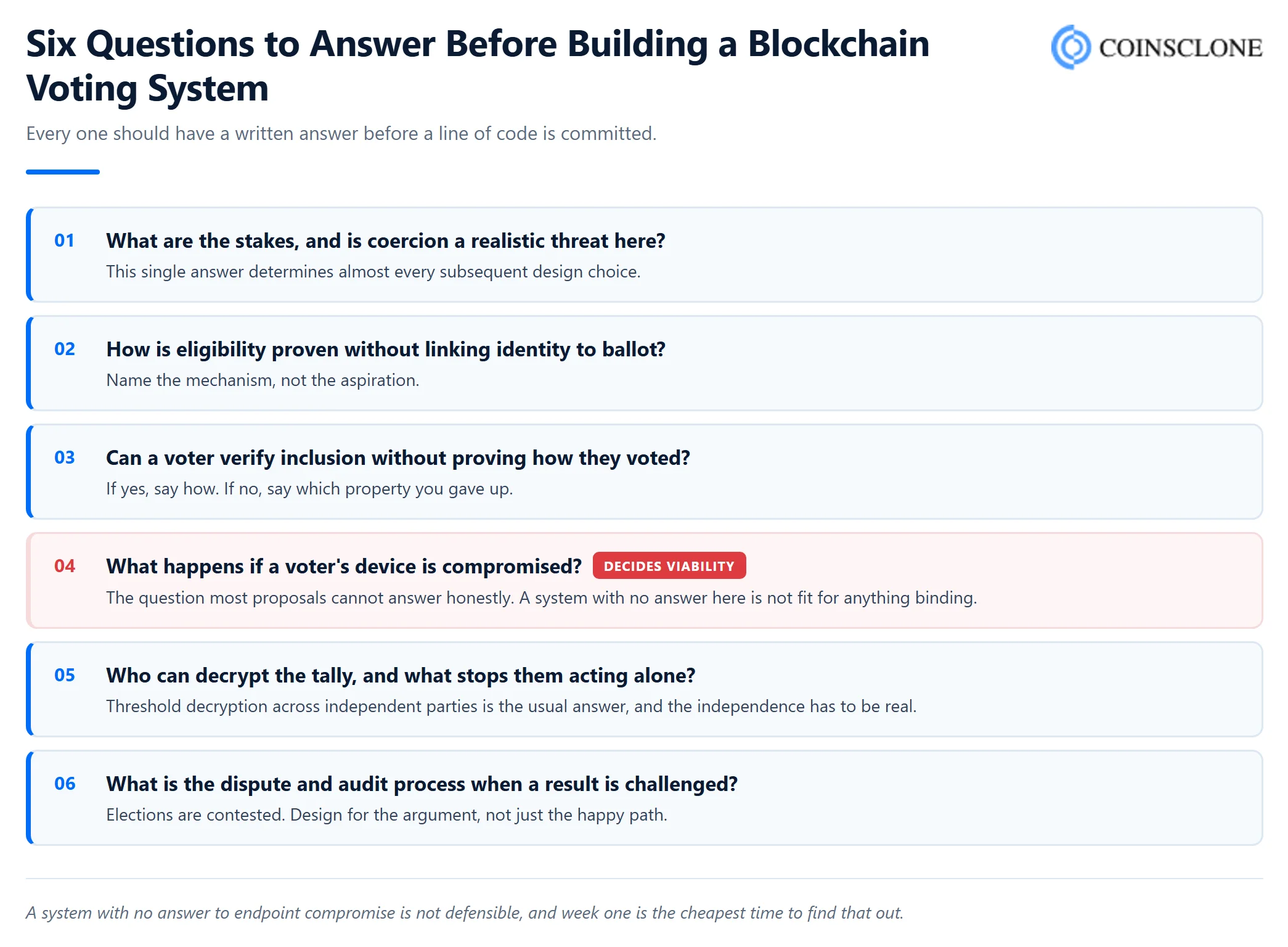
Any serious design should have a written answer to all six before a line of code is committed.
What are the stakes, and is coercion a realistic threat here? This determines almost every subsequent choice.
How is eligibility proven without linking identity to ballot? Name the mechanism, not the aspiration.
Can a voter verify inclusion without being able to prove how they voted? If yes, say how. If no, say which property you gave up.
What happens if a voter’s device is compromised? This is the question most proposals cannot answer honestly.
Who can decrypt the tally, and what stops them acting alone? Threshold decryption across independent parties is the usual answer, and the independence has to be real.
What is the dispute and audit process when a result is challenged? Elections are contested. Design for the argument, not just the happy path.
Question four decides whether the project is viable for anything binding. A system with no answer to endpoint compromise should not be used for a binding decision, and establishing that in week one saves everyone the cost of discovering it at launch.
How Much Does a Blockchain Voting System Cost to Build?
Cost is driven by which of the five layers you are actually building, and the range between a simple and a rigorous system is very wide.
Token-weighted DAO voting is the cheapest by a wide margin. Much of the stack already exists, governance contract patterns are well established, and off-chain signature voting avoids gas costs entirely.
Identity-gated organizational voting adds credential issuance, eligibility verification and access control, which is usually where integration work with an existing member or shareholder registry lands.
Ballot secrecy and verifiable tallying is the step change. Homomorphic tallying, mixnets or zero-knowledge circuits require specialist cryptographic engineering rather than standard smart contract development, and they carry an audit burden to match.
Coercion resistance and formal audit sits at the top. Independent cryptographic review, threshold key ceremonies and a documented dispute process are what regulated or high-stakes deployments require.
The honest guidance for scoping is that the first two are conventional development projects, and the third and fourth are research-adjacent engineering that should be budgeted and reviewed as such. Any vendor quoting the third at the price of the first has not understood the requirement.
Conclusion
Blockchain voting is a genuine technology with a narrow proper application. It makes tallies verifiable and tamper-evident, which is real value in corporate governance, association ballots, DAO decisions and community treasury allocation, where participants are known and stakes are bounded.
It does not address the threats that make public elections hard. Treating it as a solution there means building something that fails precisely when it matters most, in front of the people least willing to accept the failure.
Be clear about which category your project sits in before choosing an architecture, and be honest with stakeholders about what the ledger protects and what it leaves exposed. On this topic, the vendor willing to say what the technology cannot do is the one worth listening to.
Call to action block: Coinsclone builds enterprise-grade Web3 platforms including DAO and on-chain governance systems, voting and treasury tooling, NFT marketplaces, crypto exchanges, wallets and payment gateways, using customizable white-label solutions. Talk to our blockchain experts for a free consultation and a live demo.
FAQ
Q: Is blockchain voting secure for public elections?
Election security researchers broadly say no. A blockchain secures the record after a vote is cast, but does not address malware on the voter’s device, coercion outside a private polling booth, or the absence of a voter-verified paper record to recount against. Those are the threats that matter most in binding public elections.
Q: How does a blockchain voting system work?
Voters prove eligibility without linking their identity to their ballot, votes are encrypted using techniques such as blind signatures, encrypted ballots are committed to a ledger so they cannot be altered, tallying uses homomorphic counting or mixnets to total votes without decrypting individual ballots, and voters can then verify their vote was included.
Q: Has any country used blockchain voting in a real election?
Only in limited pilots. West Virginia offered a blockchain-backed app to overseas voters in 2018 and later discontinued it after security researchers published vulnerabilities. Moscow used one in 2019 city elections after a cryptographer showed its encryption was breakable. Sierra Leone was widely misreported as a blockchain election; its electoral commission stated blockchain was not used for the official count.
Q: Where does blockchain voting actually work well?
Corporate and shareholder governance, DAO and token governance, association and union ballots, cooperative decisions, internal employee polls, and community treasury allocation. The common factor is that participants are identified, stakes are bounded and coercion risk is low.
Q: What is the main design tension in voting systems?
Voter verifiability against coercion resistance. If a voter can prove how they voted, they can be paid or pressured. If they cannot prove it, their ability to independently verify their vote was counted is limited. Every design chooses a point between the two, and the choice should be deliberate.
Q: Does blockchain prevent election fraud?
It prevents one specific kind: alteration of records after they have been committed. It does nothing about votes altered on a compromised device before submission, ineligible voters who obtain credentials, coercion at the point of voting, or errors in how eligibility was determined in the first place.
Q: Can blockchain voting be anonymous?
Ballot secrecy can be achieved through encryption, blind signatures and zero-knowledge proofs, so votes are countable but not attributable. Full anonymity is harder, because eligibility must still be proven, and metadata such as timing and network origin can weaken secrecy even when ballot contents are protected.
Q: What is end-to-end verifiability?
A standard for voting systems requiring three properties: the ballot was cast as the voter intended, recorded as cast, and counted as recorded. A blockchain contributes strongly to the third, partially to the second, and not at all to the first, which is why it is not sufficient on its own.
Q: Do zero-knowledge proofs make blockchain voting safe for elections?
They meaningfully improve voter privacy and eligibility checking, and they do not address endpoint compromise. A proof generated on an infected device will correctly and unforgeably attest that a tampered ballot is well-formed, so the objection that blocks public elections remains.
Q: What should we ask a blockchain voting vendor?
What happens if a voter’s device is compromised, how eligibility is proven without linking identity to ballot, whether a voter can verify inclusion without proving how they voted, who can decrypt the tally and what prevents them acting alone, and what the dispute and audit process is when a result is challenged.