
Most blockchain explanations either stop at a metaphor about digital ledgers or drop straight into cryptography. Neither helps a business decide anything. This overview does something different: it separates the technology into five layers so you can see which ones affect your project, explains how the pieces people actually ask about fit together, sets out where blockchain is genuinely being used in 2026 rather than where it was promised, and finishes with a test for whether you need one at all. That last section matters, because the most expensive blockchain mistake is not choosing the wrong chain. It is building on a chain when a database would have done.
What Is Blockchain Technology?
A blockchain is a shared, append-only ledger maintained by many independent parties rather than a single operator. Transactions are grouped into blocks, and each block carries a cryptographic hash of the one before it, so the history is chained together in order.
That chaining is what produces the property everything else rests on. Altering an old record changes its hash, which breaks the link every later block depends on, so tampering is immediately visible to anyone holding a copy. Rewriting history means redoing all subsequent work faster than the honest network extends the chain, which on a well-secured network is economically irrational rather than impossible.
Three properties follow, and each carries a cost worth knowing before you commit: decentralization means no single party controls validation, and costs speed; immutability means history cannot be quietly revised, and costs the ability to correct mistakes; transparency means anyone can verify the ledger, and costs privacy.
The short version: a blockchain buys you trust that does not depend on any single participant behaving well, and you pay for it in throughput, cost and flexibility.
How Does a Blockchain Work?
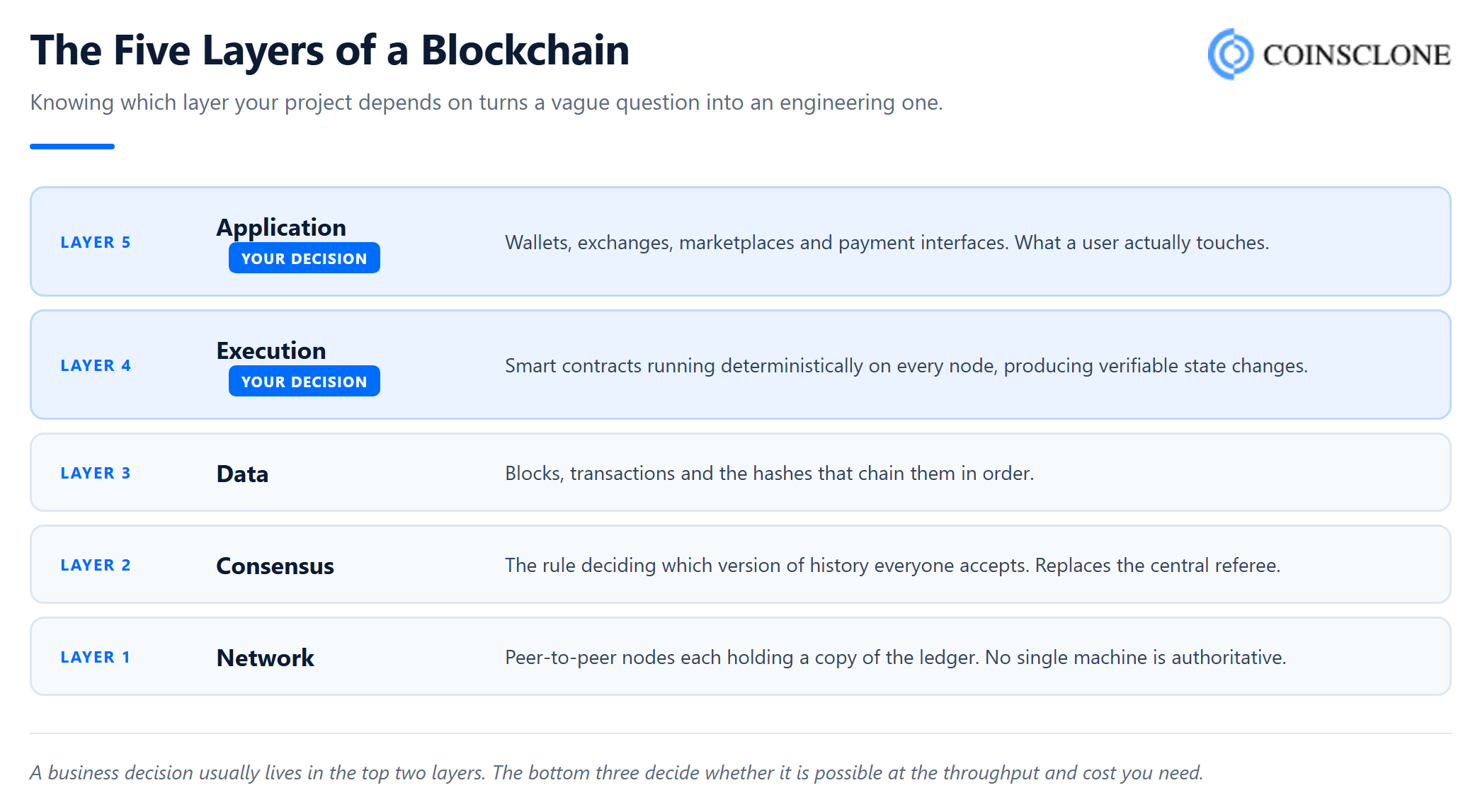
Five layers. Knowing which one your project depends on is what turns a vague technology question into a specific engineering one.
The network layer is the peer-to-peer set of nodes that each hold a copy of the ledger and relay transactions to one another. No single machine is authoritative.
The consensus layer is the rule that decides which version of history everyone accepts. It is what replaces the central referee.
The data layer holds blocks, transactions and the hashes that chain them in order. Each block stores the previous block’s hash, so altering an old record invalidates everything after it.
The execution layer runs smart contracts, which are programs that execute deterministically on every node and produce state changes everyone can verify.
The application layer is what a user actually touches: wallets, exchanges, marketplaces and payment interfaces.
A business decision usually lives in the top two layers. The bottom three decide whether that decision is technically possible at the throughput and cost you need, which is why “which chain” is an infrastructure question that should be settled before the product design hardens around it.
What Are the Main Types of Blockchain?
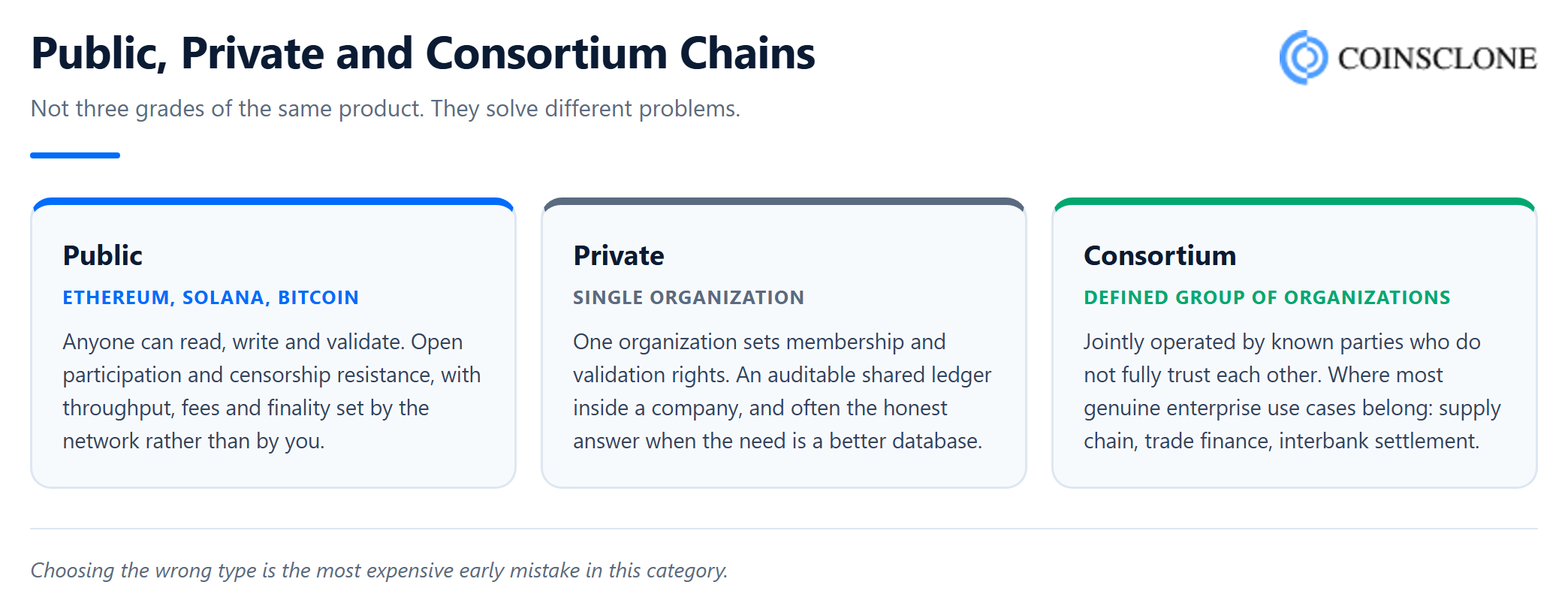
These are not three grades of the same product. They solve different problems, and choosing wrongly is the most expensive early mistake in this category.
Public chains such as Ethereum, Solana and Bitcoin let anyone read, write and validate. Use them when open participation and censorship resistance are the point, and accept that throughput, fees and finality times are set by the network rather than by you.
Private chains are controlled by one organization, which sets membership and validation rights. They give an auditable shared ledger inside a company, and they are frequently the honest answer when the real requirement is a better database with strong audit trails. Be clear-eyed about what this gives up: if one party controls every validator, the integrity guarantee reduces to trusting that party.
Consortium chains are jointly operated by a defined group of organizations. This suits situations where several known parties must share records but none of them should own the system, which describes a great deal of supply chain, trade finance and interbank settlement work. Most genuine enterprise use cases belong here rather than at either extreme.
How Do Consensus Mechanisms Differ?
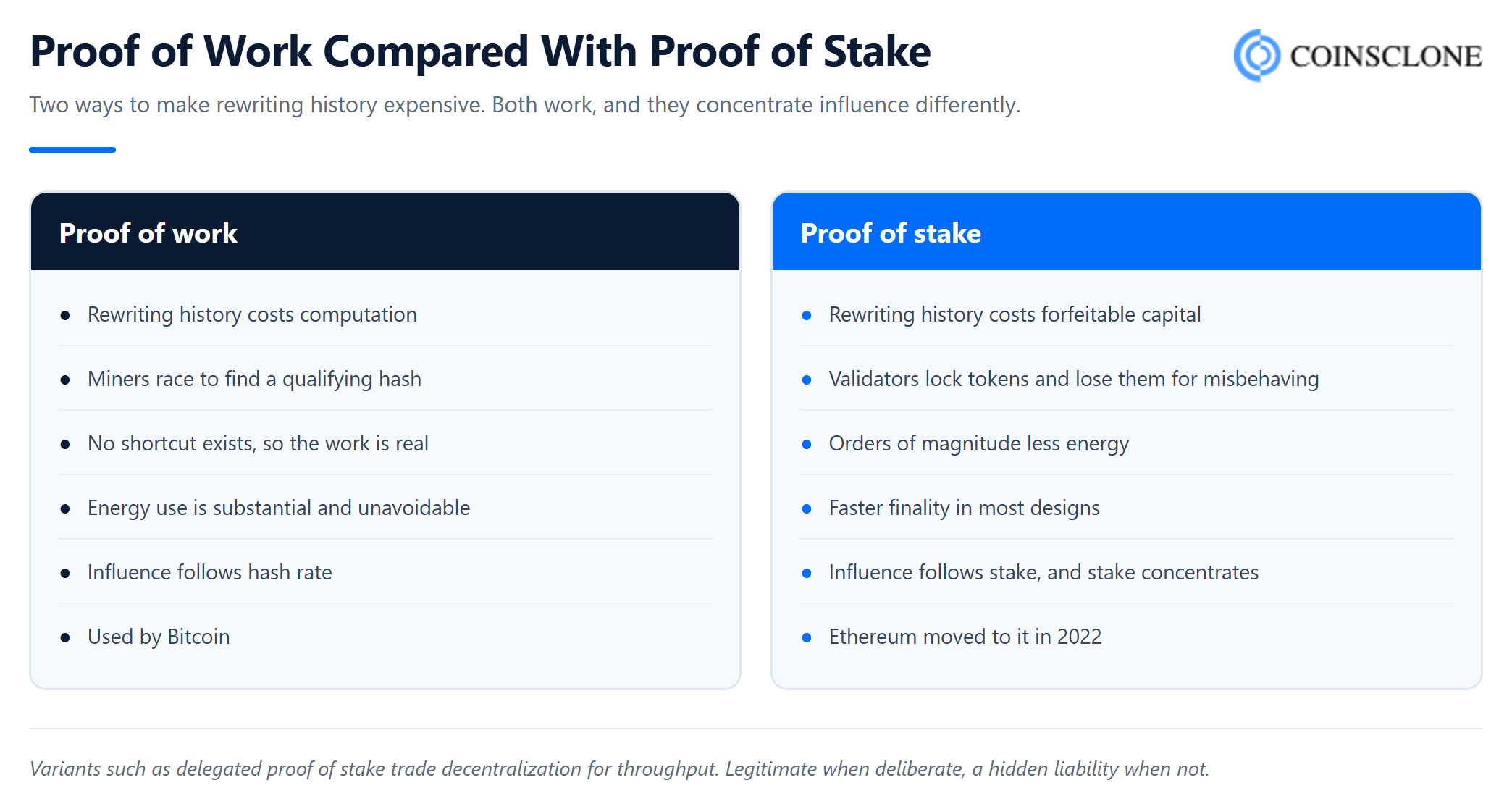
Consensus is how a network agrees on history without a central authority. Two designs dominate, and the difference has real consequences for cost, speed and who ends up holding influence.
Proof of work makes rewriting history expensive by requiring computation. Miners race to find an input that produces a hash below a target, and the only method is trial and error, which is precisely what makes the work costly. Bitcoin uses it. The security is well understood and the energy consumption is substantial and unavoidable, because the expenditure is the security.
Proof of stake makes rewriting history expensive by requiring capital that can be destroyed. Validators lock up tokens and lose them for misbehaving. Ethereum moved to proof of stake in 2022, cutting its energy use by orders of magnitude. The trade-off is a different influence model, since stake concentrates the way capital does.
Both aim at the same outcome: agreement without a central referee, made expensive enough to attack that attacking is irrational. Variants such as delegated proof of stake and proof of authority trade decentralization for throughput, which is a legitimate choice when made deliberately and a hidden liability when it is not.
What Is the Difference Between Layer 1 and Layer 2?
This distinction shapes almost every architecture decision made in 2026, and it did not meaningfully exist a few years ago.
A Layer 1 is the base chain that provides consensus and settlement: Bitcoin, Ethereum, Solana. It is where final agreement lives, and its throughput is bounded by the need for many independent nodes to validate everything.
A Layer 2 is a network that executes transactions off the base chain and posts results back to it for settlement. Rollups batch many transactions into a single Layer 1 commitment, which spreads the base chain’s cost across all of them. The result is dramatically lower fees while inheriting the settlement guarantees of the chain underneath.
Ethereum’s Dencun upgrade in 2024 introduced a dedicated cheap data format for rollups, which cut Layer 2 transaction costs substantially and pushed most new consumer-facing activity onto Layer 2 networks rather than the base chain.
The practical implication for anyone building: you are probably deploying to a Layer 2, and the questions that matter are who runs its sequencer, whether it has a working escape hatch if that sequencer censors you, and how mature its security model is. Most Layer 2 networks still run a single sequencer, which is a real centralization point sitting underneath an otherwise decentralized stack.
Where Is Blockchain Genuinely Used in 2026?
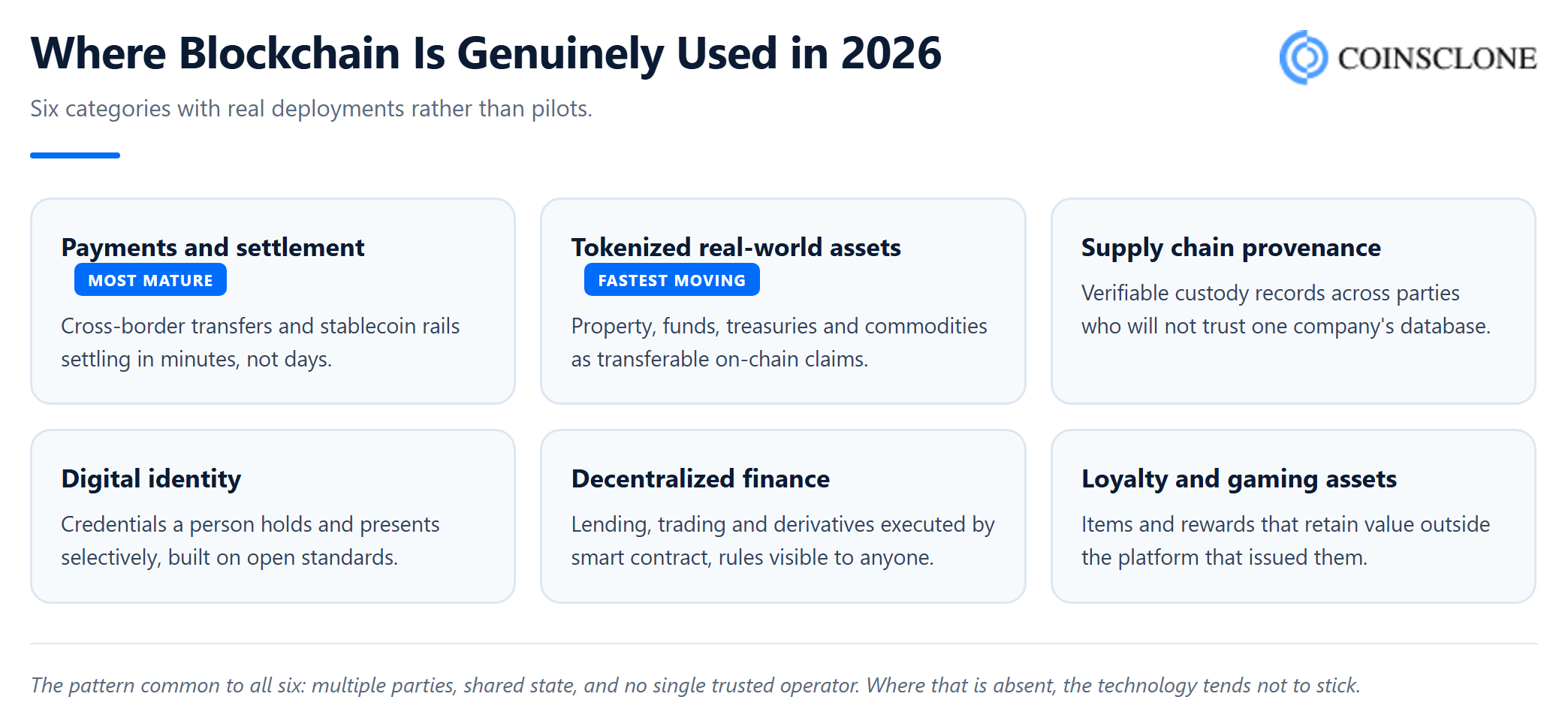
Six categories with real deployments rather than pilots.
Payments and settlement. Cross-border transfers and stablecoin rails that settle in minutes rather than days, without a chain of correspondent banks. This is the most commercially mature category by a wide margin.
Tokenized real-world assets. Property, funds, treasuries and commodities represented as transferable on-chain claims. One of the fastest-moving categories in enterprise blockchain, and the one attracting most traditional financial institutions.
Supply chain provenance. Verifiable custody records shared across parties who have no reason to trust a single company’s database.
Digital identity. Credentials a person holds and presents selectively, rather than a central issuer confirming them on request.
Decentralized finance. Lending, trading and derivatives executed by smart contract, with the rules visible to anyone.
Tokenized loyalty and gaming assets. Items and rewards that retain value outside the platform that issued them.
The pattern common to all six is multiple parties, shared state, and no single trusted operator. Where that pattern is absent, the technology tends not to stick, which is why governance and voting applications work well inside organizations and poorly for public elections
What Are the Advantages and Disadvantages of Blockchain?
Both lists are short, and honest engagement with the second one is what separates projects that ship from projects that stall.
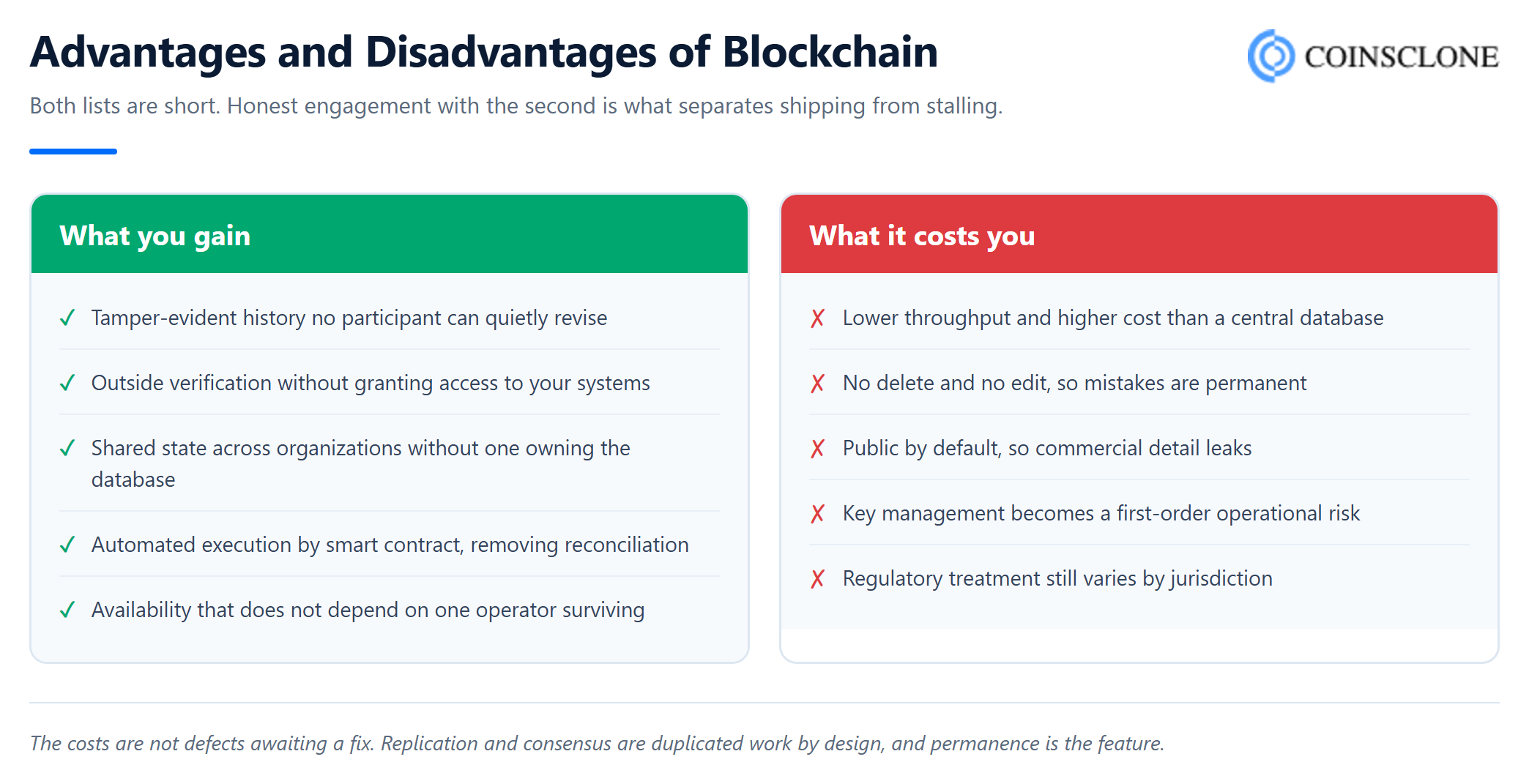
Advantages. Tamper-evident history that no participant can quietly revise. Verification by outsiders without granting them access to your systems. Shared state across organizations without one of them owning the database. Automated execution through smart contracts, removing reconciliation steps. Availability that does not depend on one operator staying in business.
Disadvantages. Lower throughput and higher per-transaction cost than a centralized database performing the same work. No delete and no edit, so mistakes are permanent and corrections must be new records. Public by default, so commercial detail leaks unless kept off-chain. Key management becomes a first-order operational risk, and it is where most real-world losses actually happen. Regulatory treatment still varies by jurisdiction and is still moving.
The disadvantages are not defects to be engineered away. Replication and consensus are duplicated work by design, and permanence is the feature. A project that needs those costs removed is a project that needed a database.
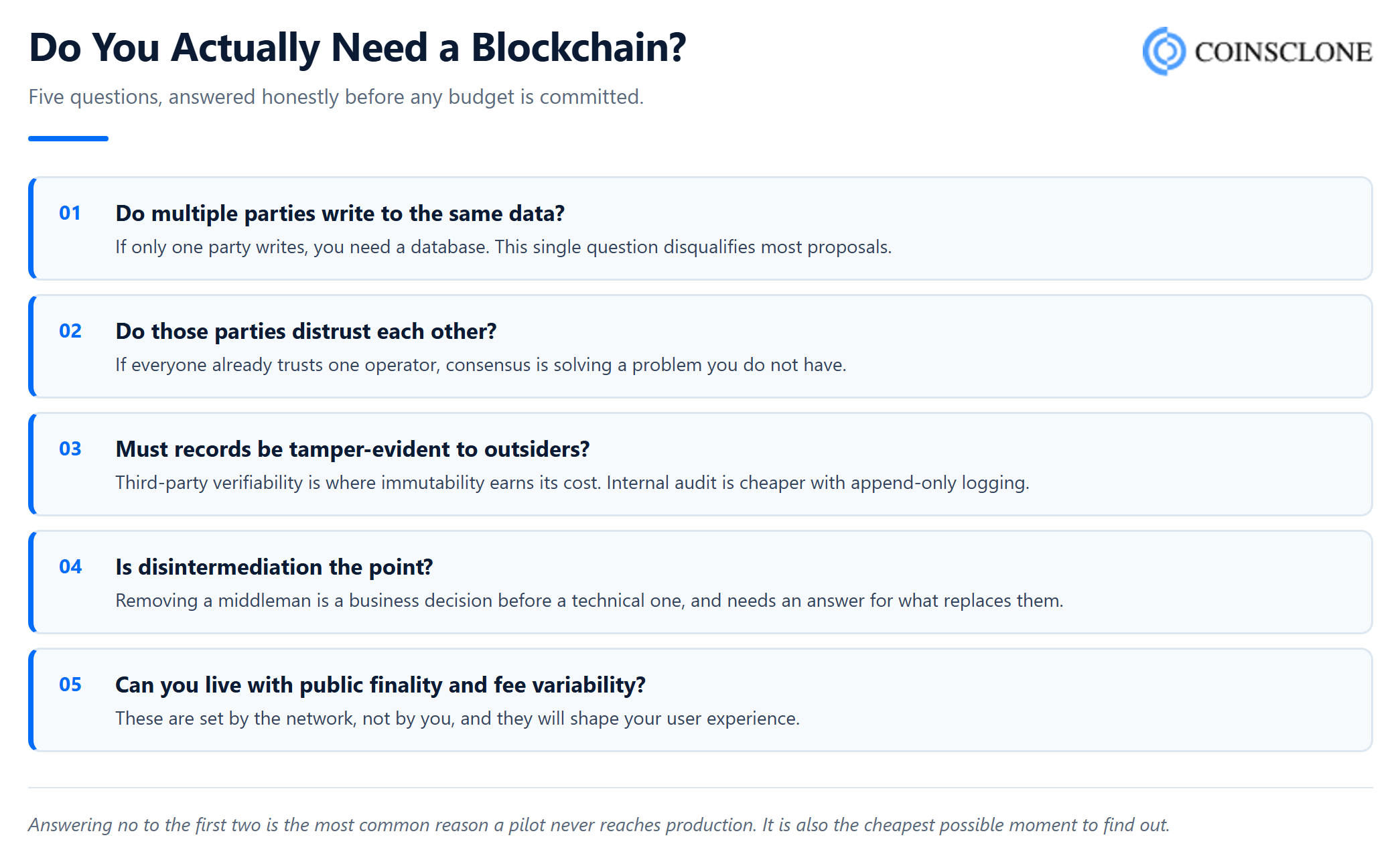
Do You Actually Need a Blockchain?
Five questions, answered honestly before any budget is committed.
Do multiple parties write to the same data? If only one party writes, you need a database. This single question disqualifies most proposals.
Do those parties distrust each other? If everyone already trusts one operator, consensus is solving a problem you do not have.
Must records be tamper-evident to outsiders? Verifiability by a third party is where immutability earns its cost. Internal audit requirements are usually met more cheaply by append-only logging.
Is disintermediation the point? Removing a middleman is a business decision before it is a technical one, and it needs a commercial answer for what replaces that middleman’s function.
Can you live with public finality times and fee variability? These are set by the network, not by you, and they will shape your user experience.
Answering no to the first two is the most common reason a blockchain pilot never reaches production. It is also the cheapest possible moment to find out.
What Changed by 2026?
Four shifts that separate the current landscape from the one most older explainers describe.
Regulation arrived. The EU’s MiCA framework brought comprehensive crypto-asset rules into force, and other major jurisdictions have moved from enforcement-by-litigation toward defined regimes. Compliance is now a design input rather than an afterthought.
Layer 2 became the default. Cheap rollup data turned Layer 2 networks into where consumer activity actually happens, with Layer 1 increasingly serving as a settlement and security layer rather than an execution environment.
Tokenized real-world assets moved from pilot to product. Traditional financial institutions issuing tokenized funds and treasuries changed the category from a crypto-native experiment into something with conventional balance sheets behind it.
Energy stopped being the headline objection. Ethereum’s move to proof of stake removed the most common criticism of blockchain from most conversations, though it remains valid for proof-of-work networks.
What has not changed is the underlying test. The technology still earns its place only where several parties need shared state that none of them controls.
Conclusion
Blockchain in 2026 is no longer an experiment looking for a use case, and it is also not a general-purpose replacement for databases. It earns its place where several parties need to share state that none of them controls, and where outside verification matters.
Work out which layer your project actually depends on. Choose the chain type that matches your trust model rather than the one with the most attention. Understand that the costs are the mechanism rather than defects awaiting a fix. And be willing to conclude that a conventional system is the better answer.
The teams that ship successful blockchain products are usually the ones that were prepared not to.
Coinsclone builds enterprise-grade Web3 platforms including crypto exchanges, wallets, DEXs, NFT marketplaces, payment gateways, RWA tokenization and enterprise consortium networks, using customizable white-label solutions. Talk to our blockchain experts for a free consultation and a live demo.
FAQ
Q: What is blockchain technology in simple terms?
A blockchain is a shared, append-only ledger maintained by many independent parties rather than one operator. Transactions are grouped into blocks, and each block carries a cryptographic hash of the previous block, which makes recorded history tamper-evident. Anyone with a copy can verify the record without trusting a central authority.
Q: How does a blockchain work?
Through five layers: a peer-to-peer network of nodes each holding a copy of the ledger, a consensus rule deciding which version of history everyone accepts, a data layer of blocks chained by hashes, an execution layer running smart contracts, and an application layer of wallets and interfaces. Most business decisions live in the top two layers.
Q: What are the main types of blockchain?
Public chains allow anyone to read, write and validate, and include Ethereum, Solana and Bitcoin. Private chains are controlled by a single organization that sets membership and validation rights. Consortium chains are jointly operated by a defined group of organizations, which suits situations where several known parties must share records without one owning the system.
Q: What is the difference between proof of work and proof of stake?
Both make rewriting history expensive, by different means. Proof of work requires computation, so an attacker must out-compute the honest network, which is why it consumes substantial energy. Proof of stake requires locked capital that can be destroyed for misbehavior. Ethereum moved from the first to the second in 2022, cutting energy use by orders of magnitude.
Q: What is the difference between Layer 1 and Layer 2?
A Layer 1 is the base chain providing consensus and settlement, such as Bitcoin or Ethereum. A Layer 2 executes transactions off that chain and posts results back for settlement, batching many transactions into a single base-chain commitment to cut costs. Most new consumer activity now happens on Layer 2 networks.
Q: What is blockchain actually used for in 2026?
The main categories are payments and settlement including stablecoin rails, tokenized real-world assets such as property and funds, supply chain provenance, digital identity, decentralized finance, and tokenized loyalty and gaming assets. The common factor is multiple parties sharing state with no single trusted operator.
Q: What are the disadvantages of blockchain?
Lower throughput and higher per-transaction cost than a centralized database, no ability to delete or edit so mistakes are permanent, public visibility by default which leaks commercial detail, key management as a first-order operational risk, and regulatory treatment that still varies by jurisdiction. These are properties of the design rather than defects awaiting a fix.
Q: How does a blockchain stay secure?
Through cryptographic hashing, consensus and replication. Each block references the previous block’s hash, so altering an old record invalidates every block after it. Consensus rules make rewriting history economically expensive, and the ledger is replicated across many independent nodes so no single machine can quietly change it.
Q: Do I need a blockchain or just a database?
You likely need a blockchain only if multiple parties write to the same data, those parties do not fully trust each other, and records must be verifiable by outsiders. If one organization controls the data and everyone trusts it, a well-designed database with strong audit logging is faster, cheaper and easier to operate.
Q: What is the difference between a blockchain and a smart contract?
The blockchain is the shared ledger and the network that maintains it. A smart contract is a program stored on that ledger which executes deterministically on every node, producing state changes anyone can verify. Not all blockchains support smart contracts, and those that do differ substantially in what they allow.
Q: How long does it take to build a blockchain application?
It depends far more on audit and integration scope than on writing code. A straightforward application built on a proven base can reach a working platform in weeks, while a custom protocol with novel on-chain logic and full independent auditing typically takes several months. Security review is usually the longest single phase.