

This guide lists 15 blockchain startup ideas you can launch in 2026, from crypto exchanges and payment gateways to supply chain, property, gaming and health apps. For each idea, you will see what it does, how it makes money, a live example we checked in October 2026, and how long it takes to build. So you get a shortlist you can act on, not just a list of buzzwords.
Think of Uber. It did not build better cars. Instead, it used the internet to fix a real problem: finding a taxi on a busy Monday morning. The best blockchain startups work the same way. They use a shared, tamper-proof ledger to fix a problem that a normal database cannot. Many startups skip that test and run into rules, weak demand or tech they did not need. This guide helps you avoid that.
In this guide:
- 15 ideas, each status-checked: what it is, how it earns, a live example and the build time.
- What the money looks like: a worked chart of what $1 million in monthly volume earns for each model.
- Does it need a blockchain? A three-question decision tree, plus lessons from startups that failed.
- How to launch: six steps, the rules to plan for, and answers to common founder questions.
Top 15 Blockchain Startup Ideas for 2026
We grouped the ideas by industry, the same way as before, but every example is now checked against its own website. Some well-known names from older lists have closed, so we replaced them with platforms that are running today. If you want a wider view that ranks business categories by budget and risk, read our guide to blockchain business ideas. This page stays focused on single products a startup team can ship.
1. White-Label Crypto Exchange
A crypto exchange lets users buy, sell and trade coins. It is still the core business of crypto, since every new user needs a place to swap money for tokens. Many founders start with a white-label exchange, which is ready-made software that you brand as your own.
- How it earns: a trading fee on every order, plus listing and withdrawal fees.
- Live example: Binance and Coinbase. Binance charges regular users 0.1% per side on spot trades.
- Startup fit: strong if you have a licence plan and a target region. The hardest part is liquidity, so plan for market makers from day one.
Coinsclone’s crypto exchange development team can launch a white-label exchange in 4 to 6 weeks, or 7 to 10 weeks with fiat rails.
2. Stablecoin Payment Gateway
A crypto payment gateway lets online shops accept crypto, often stablecoins such as USDT and USDC. Unlike card payments, a stablecoin transfer settles in seconds, even on weekends. Demand is real: stablecoin payment volume doubled to about $400 billion in 2025, and about 60% of it was business to business, per Stripe’s annual letter.
- How it earns: a percentage of each payment, plus fees for payouts and currency swaps.
- Live example: CoinGate charges from 1%, and BitPay charges 2% plus $0.25 for merchants under $500,000 a month.
- Startup fit: good for small teams with a merchant niche, such as gaming, travel or freelancers.
Coinsclone handles crypto payment gateway development in 6 to 9 weeks for a standard build, or 10 to 14 weeks with fiat settlement.
3. Crypto Wallet App
Crypto can’t be kept in a bank vault, so every user needs a wallet to store, send and trade it. Non-custodial wallets, where users hold their own keys, are now the default for Web3 apps. Newer wallets add easy logins, gas paid in stablecoins and built-in swaps.
- How it earns: swap fees inside the app, staking fees and partner deals with dApps.
- Live example: MetaMask and Trust Wallet, both earning from built-in swaps.
- Startup fit: a low-cost entry point. A wallet also gives you a user base for later products.
Coinsclone can build a crypto wallet in 3 to 5 weeks as white label, or 8 to 12 weeks as a custom build.
4. P2P Crypto Exchange
A peer-to-peer (P2P) exchange lets buyers and sellers trade crypto with each other, while the platform holds the coins in escrow until the payment clears. It works well in regions where banks block crypto or cards are rare, because users can pay through local bank transfers and mobile money.
- How it earns: a small fee per trade, often charged to the ad maker, plus paid ads.
- Live example: Binance P2P and Bybit P2P serve large markets across Asia, Africa and Latin America.
- Startup fit: strong for founders who know a local market and its payment methods.
A white-label P2P crypto exchange takes 4 to 8 weeks, or 8 to 12 weeks for a standard build.
5. Prediction Market Platform
A prediction market lets users buy shares in the outcome of real events, such as elections, sports or prices. Each share pays $1 if the outcome happens. This is one of the fastest-growing ideas in 2026. Trading on Kalshi and Polymarket doubled from $25.7 billion in May 2026 to $53.0 billion in July, according to Pew Research Center.
- How it earns: trading fees, market creation fees and data deals.
- Live example: Polymarket, which settles in USDC. In 2025 it bought QCEX, a licensed US exchange, to return to the US market.
- Startup fit: good for niche markets, such as one sport, one region or crypto-only events. Rules differ by country, so check them first.
Coinsclone offers prediction market development for both crypto-native and licensed setups.
6. Property Title and Closing Platform
Buying a home involves title checks, escrow and a lot of paperwork. A blockchain registry keeps a clear record of who owns what and every past transfer. As a result, closings get faster and title fraud gets harder.
- How it earns: closing and escrow fees per deal, plus software fees from agents.
- Live example: Propy, which runs AI-assisted title and escrow and cites more than $5 billion in deals.
- Startup fit: best for teams with real estate or legal ties. Local property law decides what you can put on-chain.
7. Blockchain Home Lending Platform
A blockchain lending platform records loans on a shared ledger. That makes loans quicker to approve, sell and fund. This idea has proved itself at scale.
- How it earns: loan fees, interest spread and fees for selling loans to investors.
- Live example: Figure, a home equity lender that runs its loans on its own blockchain. It listed on Nasdaq as FIGR on 11 September 2025, raising $787.5 million, per Renaissance Capital.
- Startup fit: needs lending licences and funding partners, so it suits fintech teams more than first-time founders.
8. Real-World Asset Tokenization Platform
Tokenization turns a real asset, such as a building, a bond or a fund share, into tokens that people can buy in small pieces. Investors get access to assets that were once out of reach, and owners raise money faster. Tokens backed by real assets, not counting stablecoins, reached $38.55 billion on 1 October 2026, per RWA.xyz. Most of that is bonds, loans and funds. Real estate is still small, at about $227 million, which leaves room for new players.
- How it earns: setup fees from asset owners, trading fees and yearly management fees.
- Live example: Securitize and Ondo Finance both issue tokenized treasury and fund products.
- Startup fit: strong for teams with a licence partner. Most of these tokens count as securities.
See how Coinsclone handles real estate tokenization for property projects.
9. Freight and Shipment Tracking
A shared ledger lets shippers, carriers, ports and customs see the same shipment record in real time. Fewer paper documents means fewer delays and less fraud. However, this idea comes with a clear warning. TradeLens, built by IBM and Maersk, had more than 300 members and still shut down in early 2023, because the wider industry would not join.
- How it earns: a monthly fee per company, plus per-document fees for things like electronic bills of lading.
- Live example: no single winner has emerged since TradeLens, which is both the risk and the gap.
- Startup fit: start small. Pick one trade lane or one type of goods, and sign your first partners before you build.
10. Cold Chain and Food Traceability
Food and medicine that must stay cold lose value fast if the temperature slips. A cold chain platform links sensor readings to a ledger, so no one can change the record later. Food traceability is a growing need too. In the US, the FDA’s Food Traceability Rule now applies from 20 July 2028, which gives startups time to sign up suppliers.
- How it earns: sensor sales plus a monthly software fee per site or shipment.
- Live example: large retailers have tested ledger-based tracking for years, but many smaller suppliers still use paper and spreadsheets.
- Startup fit: good for teams with IoT skills and a buyer in food, pharma or chemicals.
11. Pharma Supply and Settlement Network
Drug makers, wholesalers and pharmacies must trace medicines to stop fakes. In the US, the Drug Supply Chain Security Act (DSCSA) sets these rules. The FDA gave small pharmacies an exemption until 27 November 2027, so many are still choosing tools.
- How it earns: subscriptions per trading partner and fees per check or claim.
- Live example: Chronicled’s MediLedger, a blockchain network that matches contract prices and chargebacks between drug makers and buyers.
- Startup fit: strong for teams with pharma contacts. Read our guide to blockchain in pharmacy for the full rules.
12. Crypto Travel Booking Platform
A crypto travel site lets users book hotels and flights with crypto, often with rewards in tokens. It serves crypto holders who want to spend without cashing out. Older Web3 travel projects have struggled, though. Winding Tree, an early booking protocol, announced it was winding down in July 2024. The model that works today is simpler: a normal booking site that accepts crypto.
- How it earns: booking commissions, plus a margin on currency swaps.
- Live example: Travala, which lists more than 2.2 million hotels and accepts over 100 cryptocurrencies.
- Startup fit: good for travel founders who already have supplier deals. Add a crypto payment gateway rather than building a new chain.
13. Web3 Game and In-Game Marketplace
In a Web3 game, players own their items as tokens and can sell them to other players. The early play-to-earn boom faded, so the model that lasts in 2026 is “play first”: a fun game where owning items is a bonus, not the main reason to play.
- How it earns: in-game sales, plus a fee on every player-to-player trade.
- Live example: Axie Infinity, which takes a 4.25% fee on trades in its own market.
- Startup fit: good for game studios. Fun comes first, token design second.
14. NFT Marketplace
An NFT marketplace lets users create, buy and sell digital items, such as art, tickets, game items or memberships. The hype of 2021 has gone. The niche markets have stayed: ticketing, music, brand loyalty and gaming.
- How it earns: a fee on every sale, plus listing and minting fees.
- Live example: OpenSea, which has charged a 1% fee since 15 September 2025.
- Startup fit: pick a niche. A general marketplace has to compete with OpenSea on day one.
Coinsclone’s NFT marketplace development covers both niche stores and full builds.
15. Patient-Controlled Health Data Exchange
A health data exchange lets patients share their records with hospitals, labs and insurers, with consent recorded on a ledger. The data stays encrypted off-chain, and only a fingerprint (a hash) goes on the chain. This idea has a long list of failed pioneers. Medicalchain, for one, raised about $24 million in a 2018 token sale, yet its website no longer loads.
- How it earns: fees per data request from researchers, insurers or app makers.
- Live example: no clear consumer leader yet. Success here depends on hospital partners, not on a token.
- Startup fit: only with health partners and privacy experts on board. Rules such as HIPAA and GDPR shape every design choice.
The healthcare sector is also one of the most promising fintech business ideas, since health payments and insurance claims face the same trust problems.
More Blockchain Startup Ideas Worth a Look
The list above covers the strongest ideas, but a few smaller ones are worth a quick mention:
- Payment fraud protection: a B2B tool that checks payments against a shared fraud ledger. It works best as a feature for banks or gateways.
- Metaverse worlds: Decentraland still runs, but virtual land is a hard sell in 2026. Treat it as a feature inside a game, not a startup on its own.
- Digital credentials: tamper-proof certificates for schools and employers, a small but steady B2B market.
- Compliance tools: software that helps exchanges meet KYC and anti-money laundering rules. Demand grows with every new law.
Blockchain Startup Ideas Compared
The table sums up the 15 ideas side by side. Build times are Coinsclone’s own published ranges where we have them. “Licence” means you will likely need one in most major markets.
| Idea | How it earns | Licence likely? | Build time |
| Crypto exchange | Trading fees | Yes | 4-6 weeks white label |
| Payment gateway | % of each payment | Often | 6-9 weeks |
| Crypto wallet | Swap and staking fees | Not for self-custody | 3-5 weeks white label |
| P2P exchange | Fee per trade | Yes | 4-8 weeks white label |
| Prediction market | Trading fees | Yes, in most countries | Varies by scope |
| Property title | Closing fees | Yes | Varies by scope |
| Home lending | Loan fees and spread | Yes | Varies by scope |
| RWA tokenization | Setup and trading fees | Yes | Varies by scope |
| Freight tracking | SaaS fee per company | No | Varies by scope |
| Cold chain | Sensors plus SaaS | No | Varies by scope |
| Pharma network | Fee per partner | No, but DSCSA rules apply | Varies by scope |
| Crypto travel | Booking commission | Payments only | Varies by scope |
| Web3 game | Item sales and trade fees | Rarely | Varies by scope |
| NFT marketplace | Fee per sale | Rarely | Varies by scope |
| Health data | Fee per data request | Health privacy rules | Varies by scope |
How Blockchain Startups Make Money
Most blockchain startups earn in one of three ways: a fee on every trade or payment, a monthly software fee from businesses, or a fee for setting up an asset or service. The fee rate matters, but so does how often users pay it.
To show the gap, here is what $1 million of monthly volume earns at the fee rates that market leaders charge today.
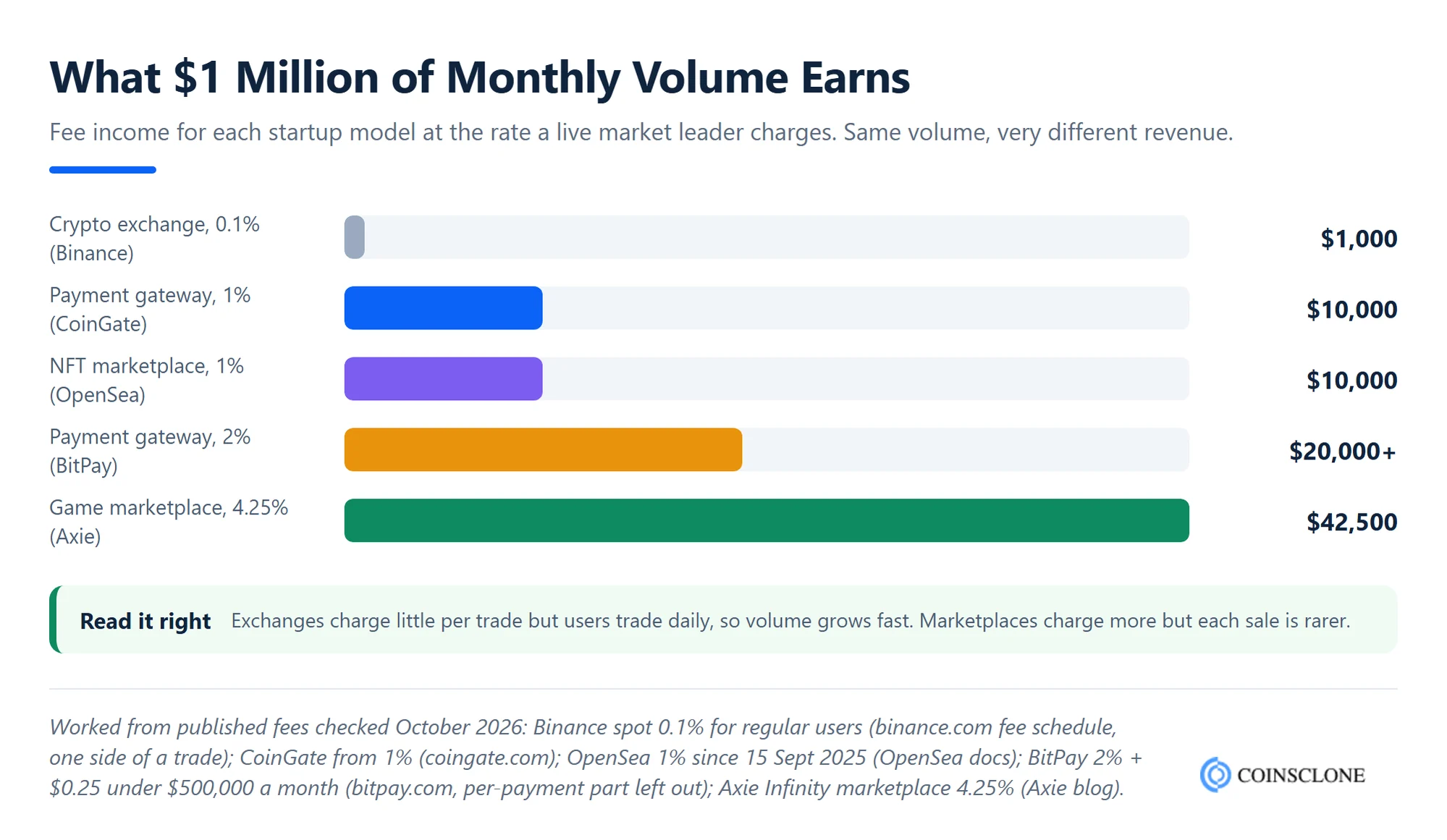
So, an exchange needs far more volume than a marketplace to earn the same amount. Then again, traders come back every day, while a buyer may visit a marketplace once a month. For B2B ideas, such as freight, cold chain or pharma, the money comes from monthly fees per company. That income is slower to win but steadier once you have it.
Why Start a Blockchain Business in 2026?
Blockchain has moved past the hype stage. These are the reasons founders still have room to grow:
- Real money is moving on-chain: stablecoins held about $311 billion on 9 October 2026, per DefiLlama. Shops, apps and banks now use them to pay each other.
- Clearer rules: the US GENIUS Act, signed on 18 July 2025, gives stablecoins a legal home. In the EU, the MiCA rules apply in full since the transition ended on 1 July 2026.
- Big firms want partners: banks, retailers and drug makers need tools that work with their systems, and they often buy from startups.
- Faster launches: white-label software cuts build times from months to weeks, so a small team can test an idea quickly.
- Global reach: a blockchain app works the same in every country, so you can reach users far beyond your home market.
Does Your Startup Idea Need a Blockchain?
Before you pick an idea, check that it really needs a blockchain. A blockchain helps when several parties who do not fully trust each other must write to the same record. If one company controls the data, a normal database is cheaper and faster. Use the decision tree below to test your idea.
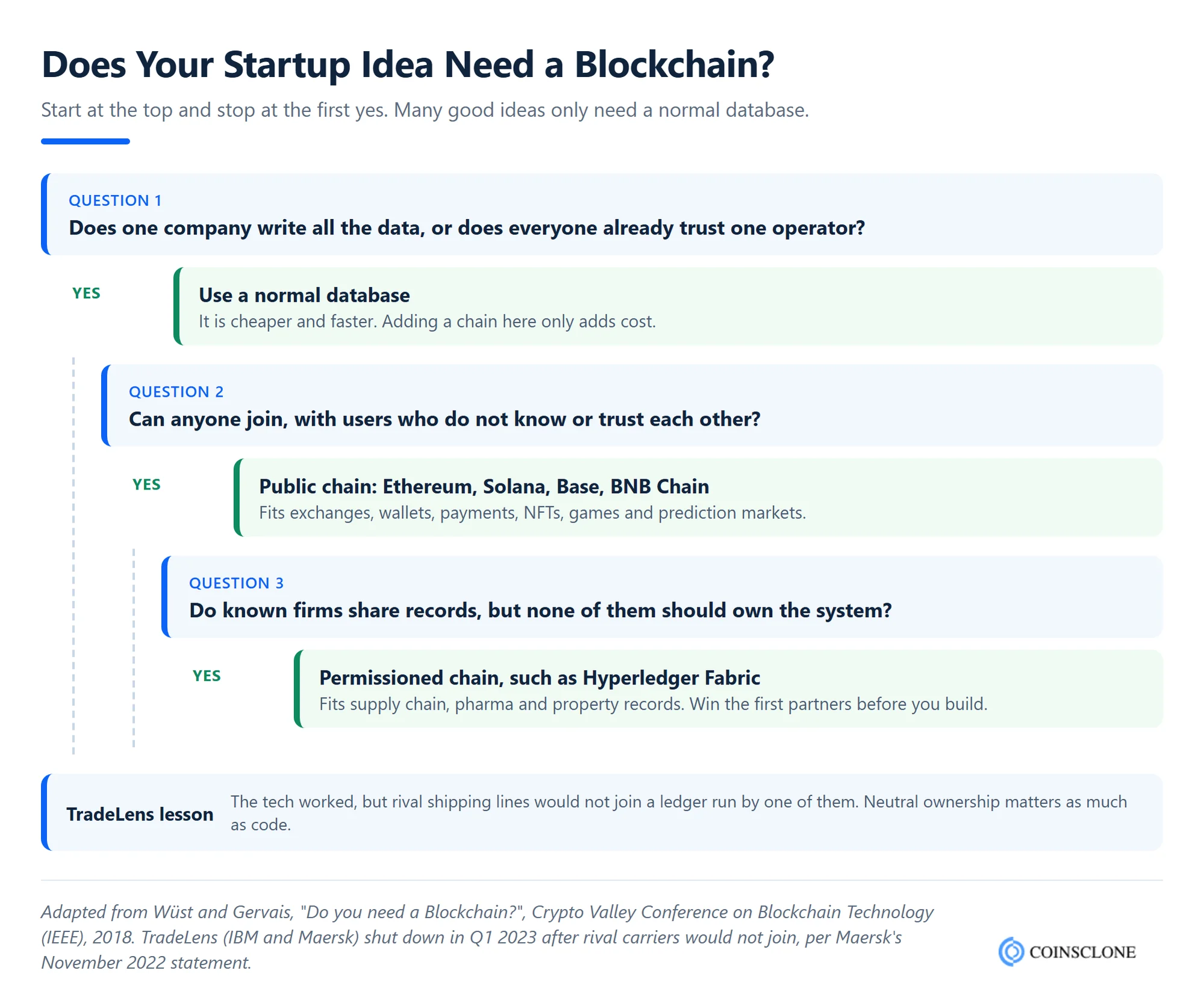
The tree is based on a well-known paper, Do you need a Blockchain? by Wüst and Gervais. In short, public chains suit open products like exchanges, wallets and games. Permissioned chains suit closed groups of known firms, like supply chain or pharma networks.
Lessons From Blockchain Startups That Failed
Failed startups teach as much as the winners. Here are three patterns that keep showing up:
- No neutral owner: TradeLens had the tech and the members, but rival carriers did not want to share data on a system run by Maersk. If your idea needs competitors to join, make the governance neutral from day one.
- A token before a product: many 2018 health and supply chain projects, Medicalchain among them, raised money through token sales before they had paying users. When the token price fell, the funding went with it.
- A model that moved on: Winding Tree tried to rebuild travel booking on a new protocol. Meanwhile, Travala simply added crypto payments to a normal booking site, and it is still running.
The lesson is simple. Solve a real problem first, then use blockchain only where it adds trust that users will pay for.
How to Launch a Blockchain Startup in 6 Steps
Once you have an idea that passes the test above, follow these steps:
- Check demand: talk to 10 to 20 likely buyers or users. Confirm they have the problem and would pay to fix it.
- Check the rules: find out early if you need a licence. Exchanges, P2P platforms, prediction markets and tokenization usually do.
- Pick your chain: use Ethereum or a layer 2 such as Base for DeFi and NFTs, Solana for fast, low-cost apps, BNB Chain for low fees with a large user base, and Hyperledger Fabric for private B2B networks.
- Build a small first version: launch one core feature with white-label software where you can, and add more later.
- Audit before launch: hire an outside firm to check your smart contracts. Hackers stole $3.4 billion in crypto in 2025, per Chainalysis.
- Find your first users: run pilots with design partners, offer low launch fees and build in public on X, Telegram and Discord.
For a deeper walkthrough of the build itself, read our guide on how to build a blockchain application.
Develop Your Own Blockchain Business With Coinsclone
Success in blockchain is not just about the idea. It also depends on the team that builds it. Coinsclone is a blockchain development company that has been building since 2018, with 350+ platforms delivered for 200+ clients across 20 industries.
Our team helps you pick the blockchain startup idea that suits your budget, market and goals. Then we build it, whether that is a white-label exchange in 4 to 6 weeks, a wallet in 3 to 5 weeks or a custom platform. Share your idea with us, and we will tell you honestly whether it needs a blockchain and what it will take to launch.
Frequently Asked Questions
What are the best blockchain startup ideas for 2026?
The strongest ideas in 2026 are stablecoin payment gateways, crypto wallets, P2P exchanges, prediction markets and real-world asset tokenization. Each one has a live market where users pay real fees today. B2B tools for supply chain and pharma tracing are slower to sell but steadier.
Do I need a token for a blockchain startup?
No. Most of the ideas in this guide work without a token of your own. Payment gateways use stablecoins, supply chain apps use permissioned ledgers, and exchanges list other projects’ tokens. Launch a token only if it has a real use inside your product.
How much does it cost to build a blockchain MVP?
Cost depends on the idea, the chain, the features and whether you start from white-label software. A white-label product costs far less than a custom build and launches in weeks. For detailed ranges, see our crypto exchange development cost guide, or ask Coinsclone for a quote based on your scope.
Which blockchain is best for startups?
There is no single best chain. Ethereum and its layer 2 networks, such as Base, suit DeFi and NFTs. Solana suits fast, low-cost consumer apps. BNB Chain offers low fees and a large user base. For private B2B networks, Hyperledger Fabric is a common choice.
What regulations should I be aware of when starting a blockchain business?
Check KYC and anti-money laundering rules, data protection laws, tax rules and licensing in each country you serve. In the US, the GENIUS Act covers stablecoins. In the EU, MiCA covers most crypto services. Get legal advice for your market before you launch.
What is the future of blockchain startups in the Web3 era?
Blockchain startups are moving from hype to real use. Stablecoin payments, tokenized assets and supply chain tracing are growing because businesses use them to save time and money. Startups that solve a clear problem, and treat the blockchain as a tool rather than the selling point, have the best odds.
What features should my blockchain platform include?
Every platform needs strong security, audited smart contracts, a simple design and clear onboarding. Beyond that, add what your users need, such as fiat on-ramps, multi-chain support or real-time tracking. Start with the core feature, then add more as users ask for them.