
Lists of blockchain business ideas are usually lists of things that could theoretically be built, which is not the same as things that could be sold. The useful version starts with a filter, because most ideas in this category fail on structural grounds before anyone considers whether they are technically feasible. This guide sets out that filter, identifies the six categories where institutional budget genuinely exists in 2026, matches opportunity types to the resources a founder actually has, and describes a launch sequence that produces evidence before it consumes capital.
25 Blockchain Business Ideas for 2026
The 25 blockchain business ideas below all sit in categories where buyers already have budget and a problem they are actively trying to solve. They are grouped by the six areas carrying real institutional spend in 2026, and each one names the customer rather than the technology.
Stablecoin and payment rails
- Cross-border B2B settlement for corridors where correspondent banking is slow or expensive.
- Stablecoin treasury management that lets finance teams hold, move and reconcile tokenized dollars alongside fiat.
- Merchant crypto payment gateway with fiat settlement, so the merchant never handles volatility.
- Programmable payroll and contractor payouts for distributed teams paid across many jurisdictions.
- Remittance platform targeting a specific corridor with a real mobile money or cash-out partner.
Real-world asset tokenization
- Tokenized treasuries and money market funds with the custody and transfer-agent plumbing institutions require.
- Private credit tokenization giving mid-market lenders a secondary market that does not currently exist.
- Fractional real estate with the legal wrapper sorted before the technology.
- Commodity and precious metal tokenization backed by audited vault custody.
- Carbon credit registry addressing double-counting, which is the actual problem in that market.
Exchange and trading infrastructure
- Regulated spot exchange in a market where licensing is achievable and incumbents are weak.
- Derivatives venue for a specific asset class rather than a general offering.
- Institutional custody with insurance, audit and segregated cold storage.
- Market making and liquidity provision as a service to new venues and token issuers.
- Compliance and transaction monitoring tooling sold to the venues themselves.
Prediction and event markets
- Sector-specific prediction market for elections, sports or commodities where local rules permit it.
- Enterprise forecasting markets run internally for demand and risk planning.
- Parametric insurance paying out automatically on an oracle-verified event.
Wallets and account abstraction
- White label wallet infrastructure sold to fintechs that want custody without building it.
- Account abstraction and gasless onboarding that hides the chain from end users entirely.
- Social and multiparty recovery solving the seed phrase problem for consumer products.
- Enterprise key management with policy controls, approvals and audit trails.
Verifiable credentials and identity
- Academic and professional credentialing for institutions drowning in verification requests.
- Reusable KYC letting a customer verified once open accounts elsewhere, where reliance rules allow.
- Supply chain attestations proving provenance, audit status or certification to buyers down the chain.
Filter any of these through the four questions in the next section before committing. An idea that fails the first one is a software business rather than a blockchain business, which may still be the better business to build.
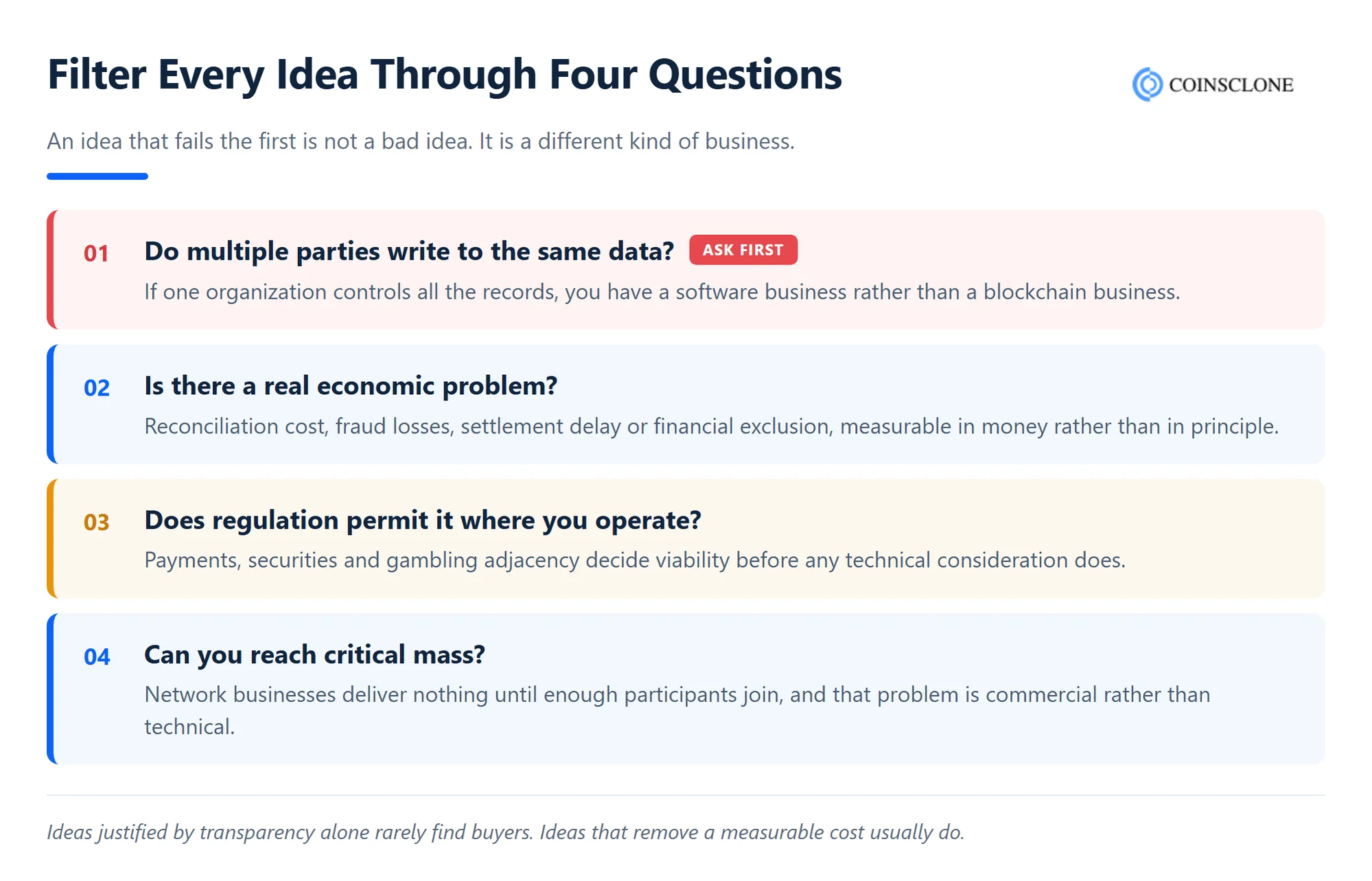
Filter Every Idea Through These Four Questions
Do multiple parties write to the same data? If a single organization controls all the records, you have a software business rather than a blockchain business. That may still be an excellent business, but the ledger adds cost without adding capability.
Is there a real economic problem? Reconciliation cost, fraud losses, settlement delay or financial exclusion, measurable in money. Ideas justified by transparency alone rarely find buyers.
Does regulation permit it where you operate? Payments, securities and gambling adjacency determine viability before any technical consideration does, and the answer varies by jurisdiction.
Can you reach critical mass? Network businesses deliver nothing until enough participants join, and the participation problem is commercial rather than technical.
An idea that fails the first question is not necessarily a bad idea. It is a different kind of business.
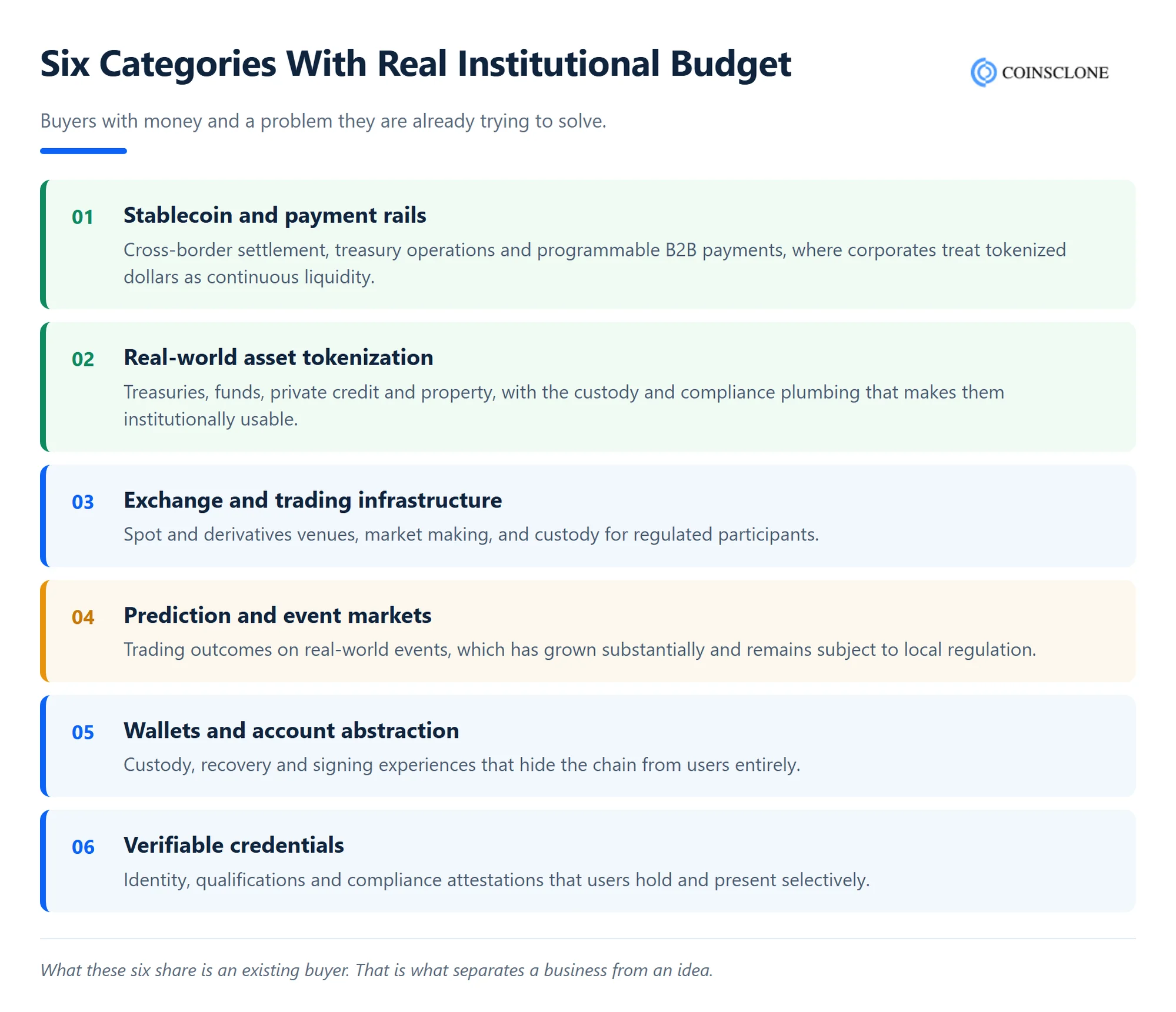
Six Categories With Real Institutional Budget
Stablecoin and payment rails. Cross-border settlement, treasury operations and programmable business-to-business payments, where corporates increasingly treat tokenized dollars as continuously available liquidity.
Real-world asset tokenization. Treasuries, funds, private credit and property, with the custody and compliance plumbing that makes them institutionally usable.
Exchange and trading infrastructure. Spot and derivatives venues, market making, and custody for regulated participants.
Prediction and event markets. Trading outcomes on real-world events, which has grown substantially and remains subject to local regulation.
Wallets and account abstraction. Custody, recovery and signing experiences that hide the chain from users entirely.
Verifiable credentials. Identity, qualifications and compliance attestations that users hold and present selectively.
What these six share is buyers with budget and a problem they are already trying to solve, which is what separates a business from an idea.
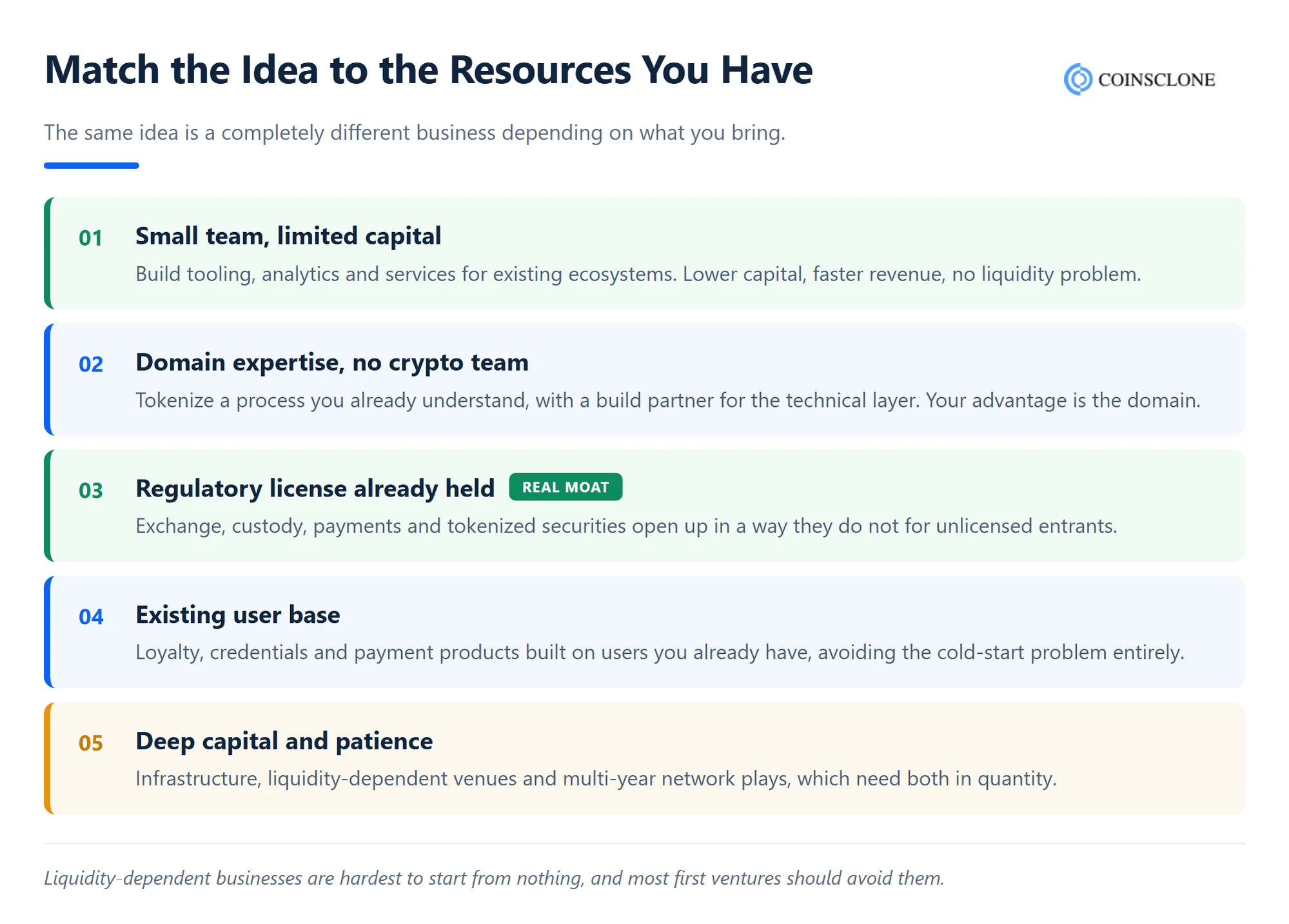
Match the Idea to the Resources You Actually Have
The same idea is a completely different business depending on what you bring to it.
Small team, limited capital. Build tooling, analytics and services for existing ecosystems rather than launching new networks. Lower capital requirement, faster revenue, no liquidity problem.
Domain expertise, no crypto team. Tokenise or streamline a process you already understand deeply, working with a build partner for the technical layer. Your advantage is the domain, not the chain.
Regulatory license already held. Exchange, custody, payments and tokenized securities become accessible in a way they are not for unlicensed entrants, and that license is a genuine moat.
Existing user base. Loyalty, credentials and payment products that leverage users you already have, avoiding the cold-start problem entirely.
Deep capital and patience. Infrastructure, liquidity-dependent venues and multi-year network plays.
Liquidity-dependent businesses are the hardest to start from nothing, and most first ventures should avoid them regardless of how attractive the economics look at scale.
Which Blockchain Business Ideas Are Most Profitable?
Profitability in this sector tracks whether someone is already paying to solve the problem, not whether the technology is interesting.
Revenue arrives soonest in tooling, infrastructure and services sold to existing ecosystems. There is no liquidity to bootstrap, the buyers have budget, and the sales cycle is ordinary B2B.
Revenue is largest but slowest in exchanges, custody and tokenized securities, where a license is a genuine moat and the capital requirement keeps competitors out.
Revenue is hardest in anything liquidity-dependent started from nothing. A venue with no order flow is worth nothing, and no amount of engineering fixes that.
For a first venture, pick something that earns fees from day one rather than something that needs a network before it earns anything. The economics of a mature marketplace look better in a spreadsheet and worse in the first eighteen months.
From Idea to Launch: What the Path Looks Like
Step one: validate the economic problem with real buyers. Not survey responses, but conversations with people who currently pay to solve this problem another way.
Step two: confirm the regulatory position in your target markets before committing to a product shape, since a legal finding can invalidate an entire design.
Step three: choose between building from scratch and starting from a proven base. Most exchange, wallet and marketplace businesses do not compete on core mechanics, so rebuilding them rarely creates advantage.
Step four: ship a narrow product with audited contracts, because anything holding value needs independent review before launch.
Step five: solve distribution before scaling the technology.
That final step is where most blockchain startups fail. Building was never the hard part, and it has become steadily easier while distribution has become harder.
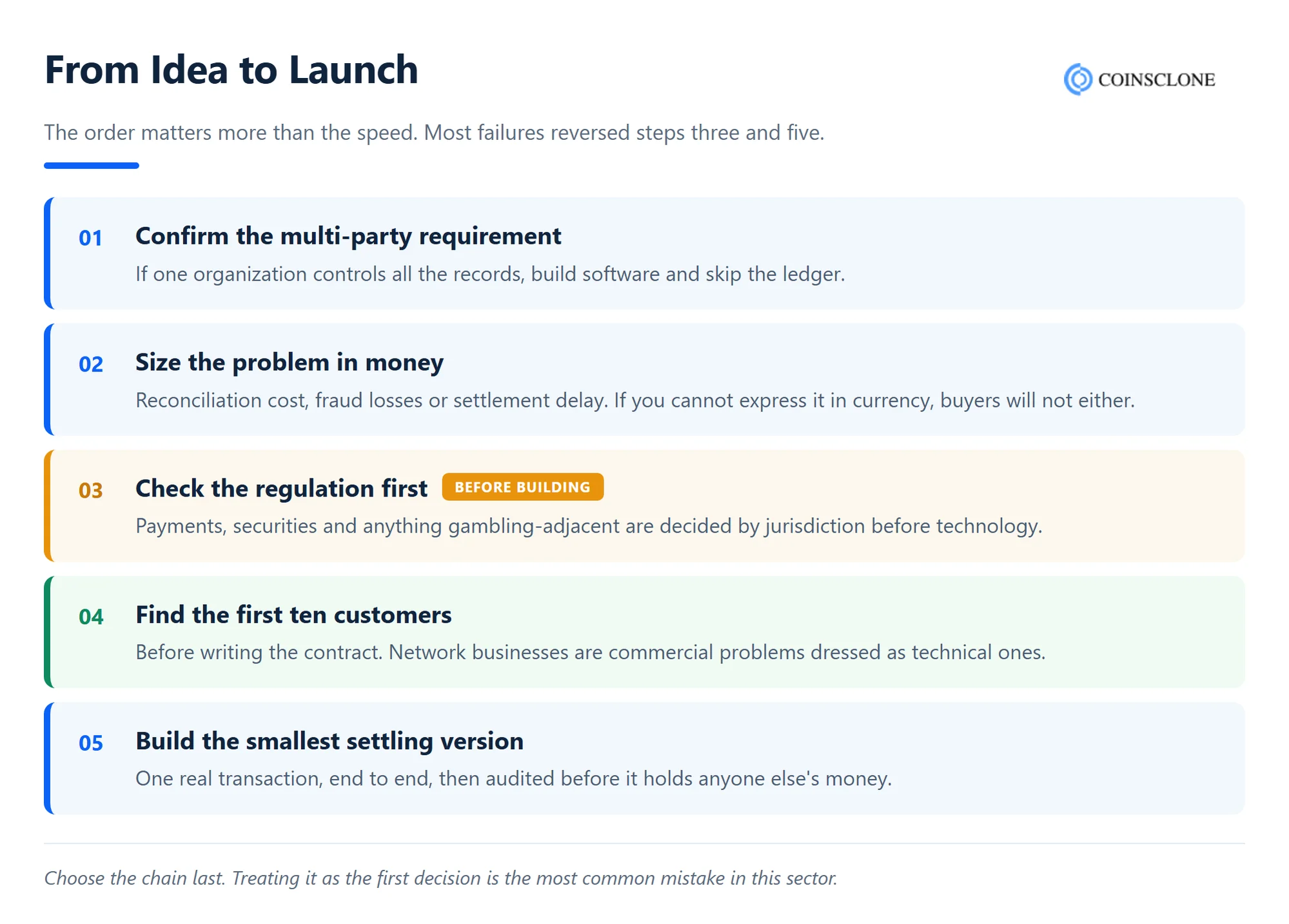
How Do You Start a Blockchain Business?
Picking the idea is the easy part. These are the steps that decide whether it becomes a business.
- Confirm the multi-party requirement. If one organization controls all the records, build software and skip the ledger.
- Size the economic problem in money. Reconciliation cost, fraud losses, settlement delay or exclusion. If you cannot express it in currency, buyers will not either.
- Check the regulation in your target market first. Payments, securities and anything gambling-adjacent are decided by jurisdiction before they are decided by technology.
- Find the first ten customers before writing the contract. Network businesses are commercial problems dressed as technical ones.
- Choose the chain last. It is an implementation detail, and treating it as the first decision is the most common mistake in this sector.
- Build the smallest version that settles one real transaction. Then get it audited before it holds anyone else’s money.
- Plan the cold start explicitly. Which side of the market do you subsidize, for how long, and out of whose budget?
The order matters. Most failed ventures in this space did step five first and step three never.
Conclusion
The blockchain business ideas that work in 2026 look different from those that worked in 2021, because the speculative layer contracted while the settlement layer kept growing. The opportunities with real buyers sit in payments, tokenization, trading infrastructure, prediction markets, wallets and credentials, and they are being bought by institutions with existing problems rather than by retail users seeking returns. Filter your idea structurally, match it honestly to your resources, and treat distribution as the main risk rather than the build.
Coinsclone builds enterprise-grade Web3 platforms including crypto exchanges, wallets, DEXs, NFT marketplaces, payment gateways and RWA tokenization, using customizable white-label clone scripts. Talk to our blockchain experts for a free consultation and live demo.
Frequently Asked Questions
What are the best blockchain business ideas for 2026?
The categories with genuine institutional demand are stablecoin and payment rails, real-world asset tokenization, exchange and trading infrastructure, prediction and event markets, wallets and account abstraction, and verifiable credentials. Each has buyers with budget and an existing problem they are trying to solve.
How do I know if my idea needs blockchain?
Test whether multiple parties write to the same data and whether those parties fully trust a single operator. If one organization controls all the records and everyone trusts it, a database is faster, cheaper and easier to run. The ledger earns its cost when no participant should own the record.
What is the biggest reason blockchain startups fail?
Distribution rather than technology. Building has become steadily easier while acquiring users and liquidity has become harder. Network businesses in particular deliver nothing until enough participants join, and that participation problem is commercial rather than technical.
Should I build from scratch or use a clone script?
Most exchange, wallet and marketplace businesses do not compete on core mechanics, so building those from scratch rarely creates advantage. Starting from a proven base and customizing is faster, cheaper and lower risk. Build from scratch when the mechanism itself is genuinely your product.
Do I need a license to run a blockchain business?
It depends entirely on what you do and where. Payments, exchange, custody, tokenized securities, prediction markets and anything gambling-adjacent typically require licensing, and the requirements vary by jurisdiction. Confirm the position before committing to a product design rather than afterwards.
What blockchain business can I start with limited capital?
Tooling, analytics, integrations and services for existing ecosystems, which avoid the liquidity and network effect problems that make consumer platforms capital-intensive. These generate revenue faster and do not require reaching critical mass before delivering value.
How much does it cost to launch a blockchain business?
It depends far more on audit scope, integrations, compliance requirements and liquidity needs than on writing code. A narrow product built on a proven base with audited contracts is achievable at a fraction of the cost of a custom protocol, and modeling twelve months of operating cost matters more than the build estimate.