There is a specific reason so many supply chain blockchain pilots produce impressive demonstrations and then stall. The ledger part is straightforward. The hard part is the oracle: something has to tell the chain the truth about physical goods, and a blockchain cannot verify that a pallet contains what the label claims. Teams that design the chain first rediscover this in month four. This guide starts with that problem, covers where blockchain genuinely helps, explains how it relates to the standards your partners already use, examines what happened to the industry’s flagship projects, and sets out what decides whether a pilot ever scales.
What Is Blockchain in Warehouse Management and Supply Chain?
A shared, tamper-evident record of custody events, maintained across organizations that have no reason to trust one another’s databases.
The distinction from your existing systems is precise. A warehouse management system records what happened inside your four walls, and you are the authority on it. A shared ledger records what happened at the handoffs between companies, where no single participant should be the authority, and where every participant needs to be able to verify the record without asking permission.
That framing settles most scoping arguments before they start. If the record only ever needs to satisfy you, you do not need a ledger. If it needs to satisfy a customer, a regulator, an insurer or a counterparty who might one day dispute it, you might.
Why Is the Oracle the Hard Problem, Not the Ledger?
Immutability guarantees that a record was not altered after it was entered. It guarantees nothing whatsoever about whether the record was true when written. That gap between physical goods and digital records is where supply chain projects succeed or fail.
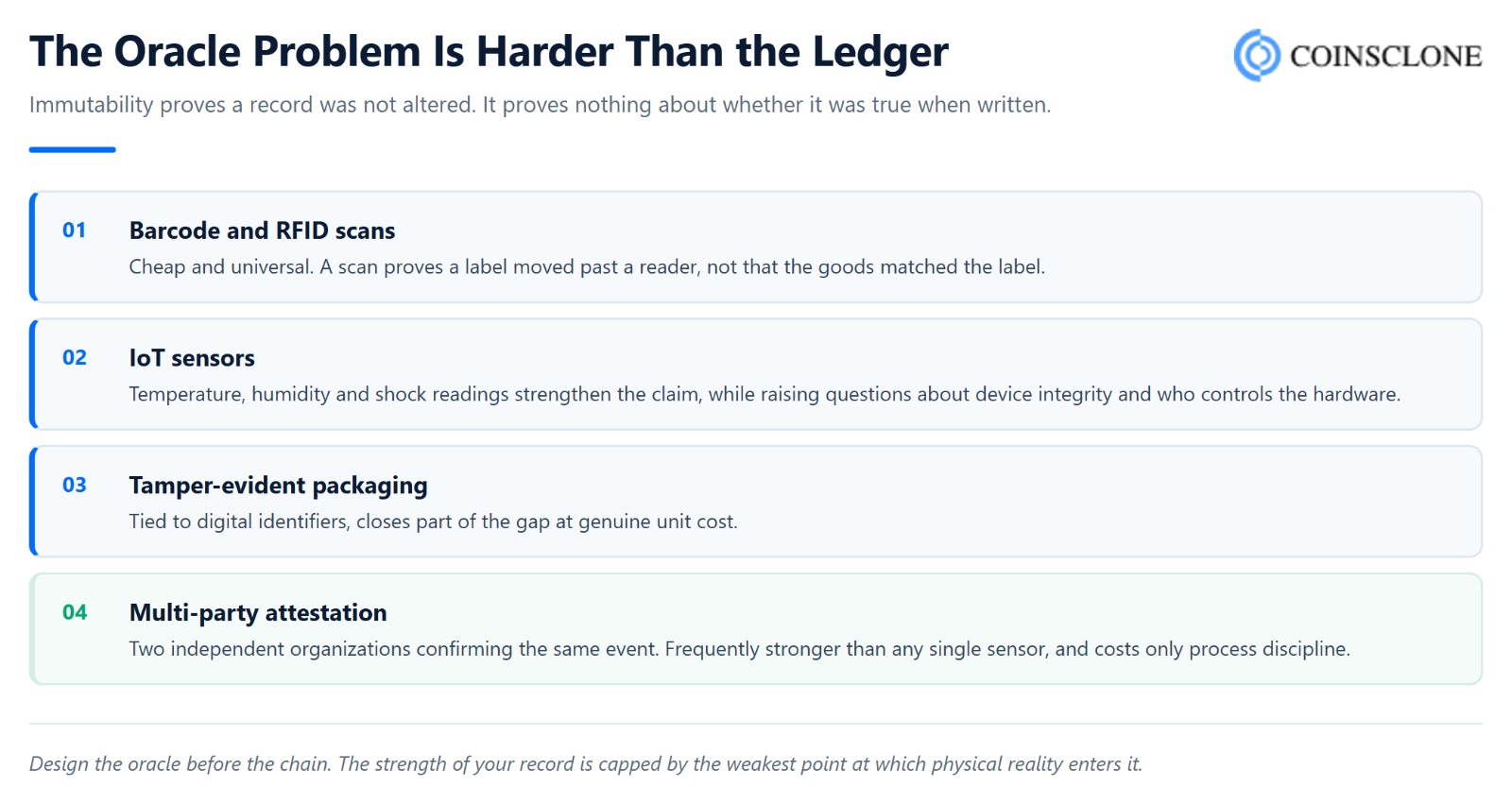
Four mechanisms close part of the gap, at increasing cost.
Barcode and RFID scans are cheap and universal, but a scan proves a label moved past a reader, not that the goods matched the label.
IoT sensors for temperature, humidity and shock strengthen the claim considerably, while introducing questions about device integrity and who controls the hardware. The same architecture and the same limits apply as in any constrained device anchoring design.
Tamper-evident packaging tied to digital identifiers closes part of the gap at genuine unit cost.
Multi-party attestation, where two independent organizations confirm the same event, is frequently stronger evidence than any single sensor reading, and it costs nothing but process discipline.
Design the oracle before the chain. The strength of your record is capped by the weakest point at which physical reality enters it, and no amount of cryptography raises that ceiling.
Where Does Blockchain Genuinely Help?
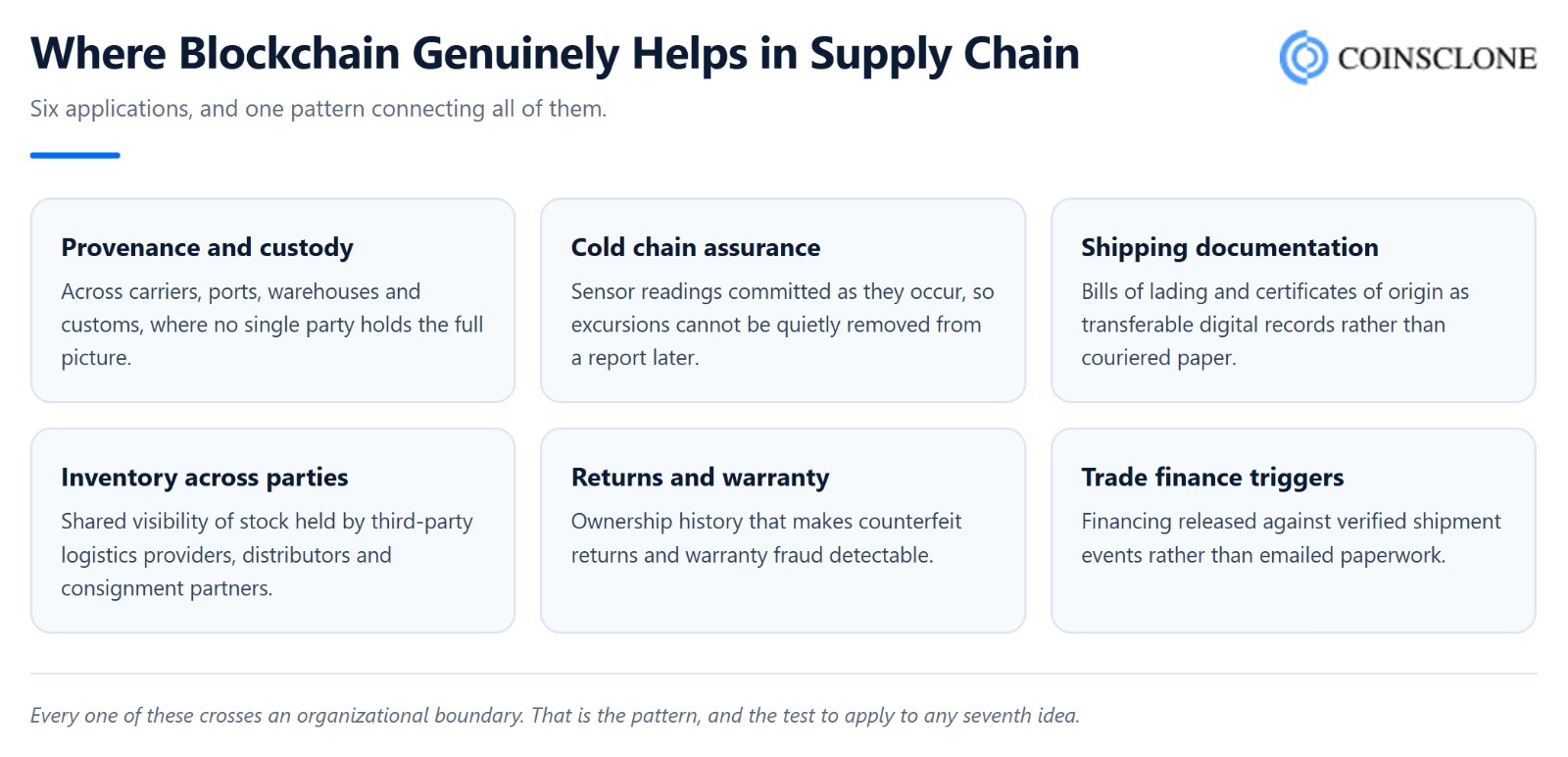
Six applications, and one pattern connecting all of them.
Provenance and chain of custody across carriers, ports, warehouses and customs, where no single party holds the full picture.
Cold chain assurance, with sensor readings committed as they occur so excursions cannot be quietly removed from a report later.
Shipping documentation, treating bills of lading and certificates of origin as transferable digital records rather than couriered paper.
Inventory across parties, giving shared visibility of stock held by third-party logistics providers, distributors and consignment partners.
Returns and warranty, where ownership history makes counterfeit returns and warranty fraud detectable.
Trade finance triggers, releasing financing against verified shipment events rather than emailed paperwork.
Every one of these crosses an organizational boundary. That is the pattern, and it is the test to apply to any seventh idea someone proposes.
How Does This Fit With GS1, EPCIS and Existing Standards?
Badly, if you ignore them. This is the most common architectural mistake after the oracle problem.
Supply chains already have identity and event standards. GS1 defines the identifiers your partners use, and EPCIS is the established standard for recording what happened, to which object, when, where and why. Your partners have already implemented them, their scanners already emit them, and their systems already speak them.
A ledger that invents its own event schema forces every participant to build an adapter purely to talk to you, which is a tax on exactly the partners whose participation determines whether the network has any value. The workable pattern is to keep standard identifiers and event structures, and use the chain to anchor and share those events rather than to replace them.
The regulatory direction reinforces this. The EU’s ecodesign framework introduces a Digital Product Passport requiring verifiable product data across categories, with textiles and batteries among the first in scope. That is a shared-data-across-parties requirement with legal force behind it, and it will do more to drive adoption than any vendor pitch.
Blockchain or Your Existing Warehouse System?
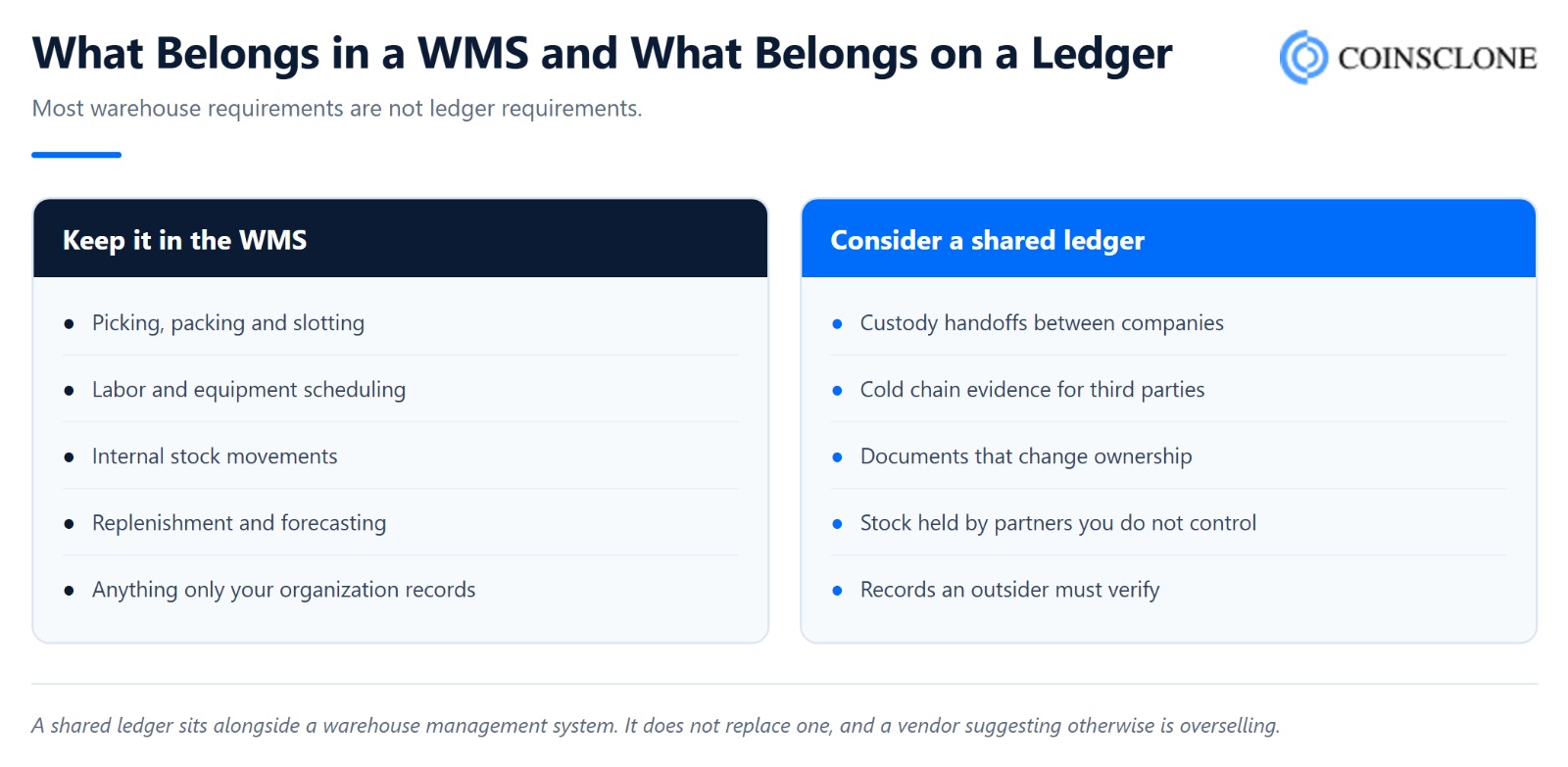
Most warehouse requirements are not ledger requirements, and being clear about that improves both systems.
Keep it in the WMS: picking, packing and slotting, labor and equipment scheduling, internal stock movements, replenishment and forecasting, and anything only your organization records.
Consider a shared ledger: custody handoffs between companies, cold chain evidence intended for third parties, documents that change ownership, stock held by partners you do not control, and records an outsider must be able to verify.
A shared ledger sits alongside a warehouse management system. It does not replace one, and a vendor suggesting otherwise is overselling.
What Happened to the Big Supply Chain Blockchain Projects?
The honest answer is instructive, and any serious evaluation should start here rather than with a vendor deck.
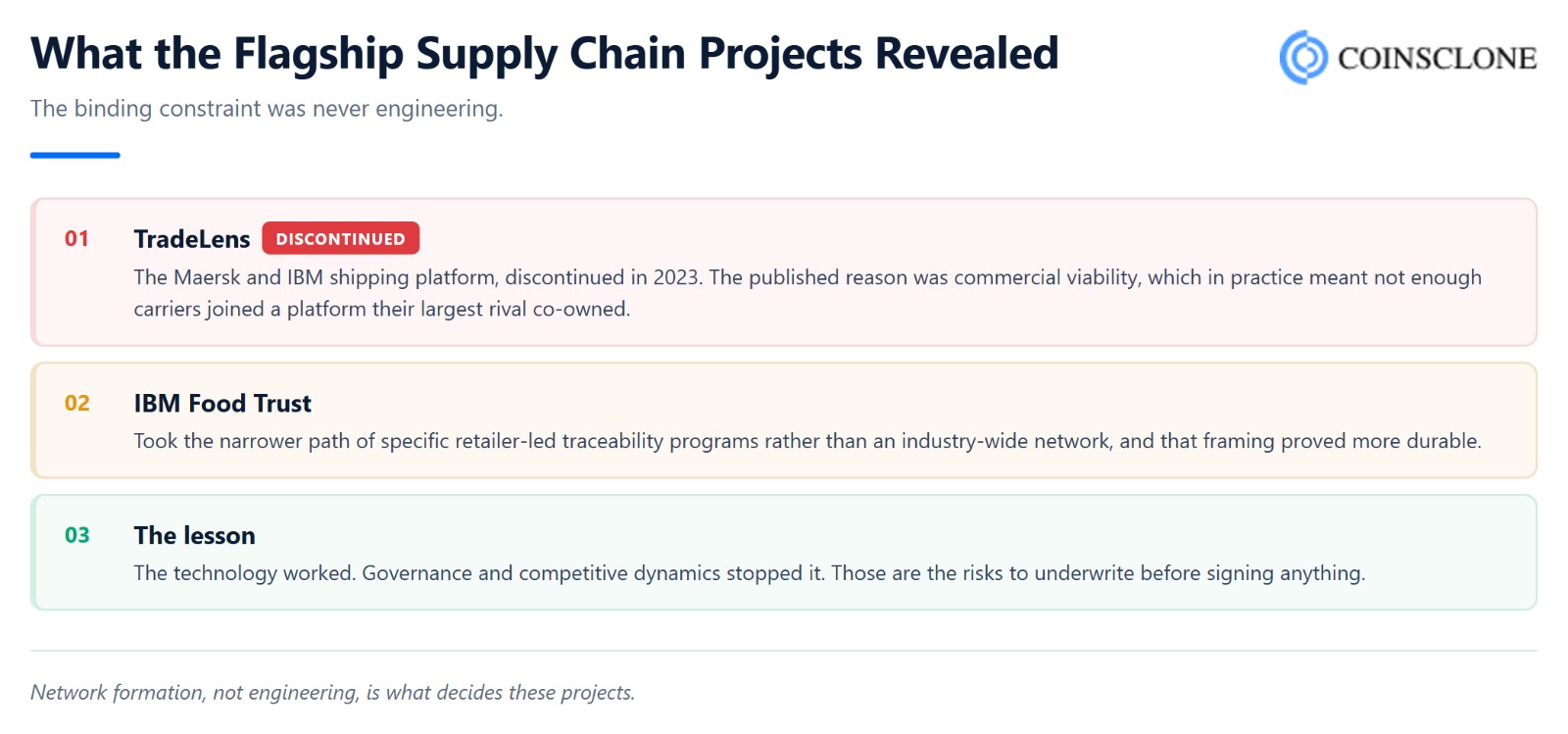
TradeLens, the shipping platform built by Maersk and IBM, was the flagship. It was discontinued in 2023. The stated reason was not that the technology failed but that it did not reach the commercial viability needed as a standalone business, which in practice meant not enough carriers joined. Maersk’s competitors were being asked to join a platform their largest rival co-owned.
IBM Food Trust took a different path, focusing on specific retailer-led traceability programs rather than an industry-wide network, and that narrower framing has proved more durable.
The lesson is not that supply chain blockchain fails. It is that the binding constraint is network formation, not engineering. TradeLens worked. It was governance and competitive dynamics that stopped it, and those are the risks to underwrite before signing anything.
What Decides Whether a Pilot Scales?
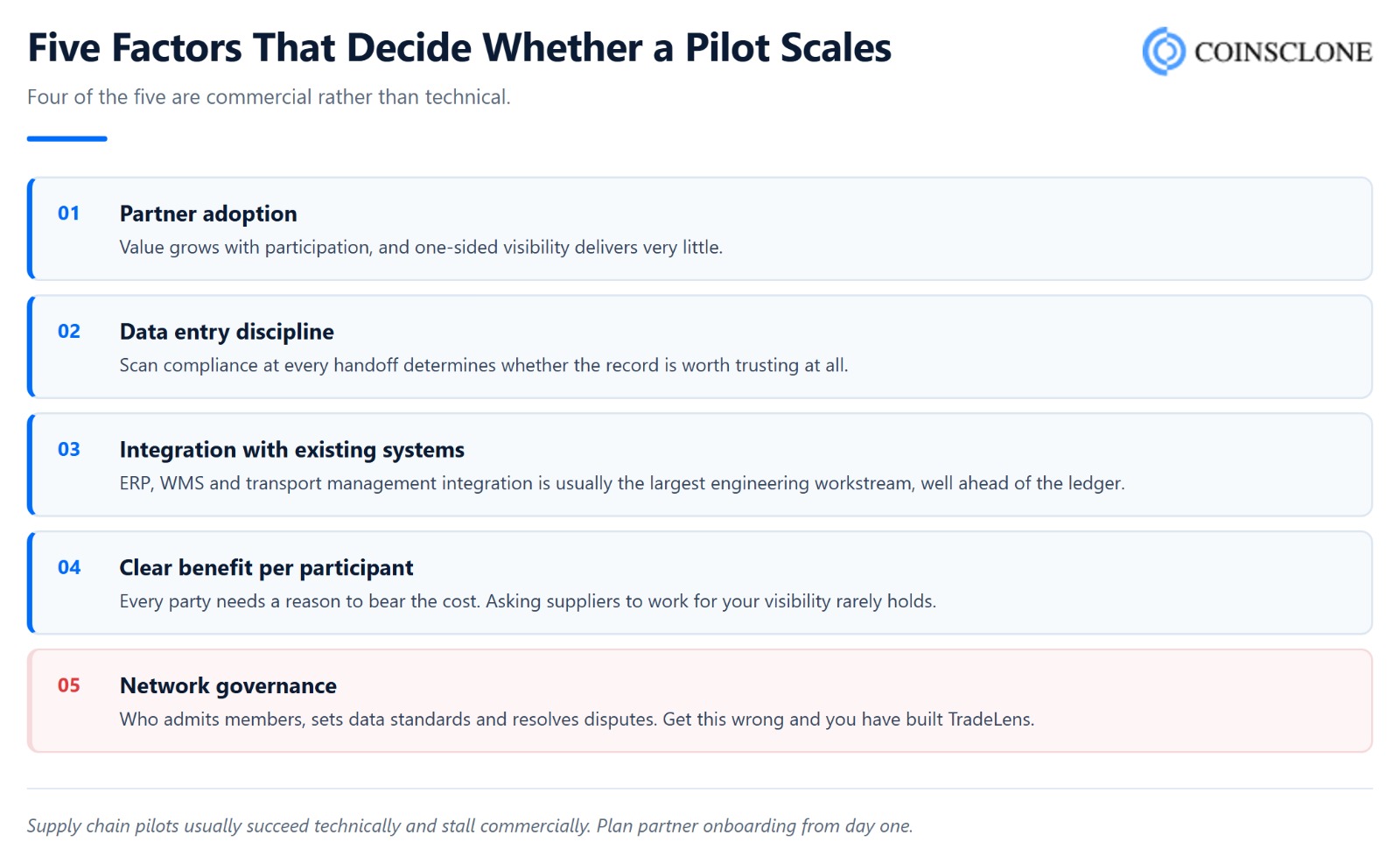
Five factors, and four of them are commercial.
Partner adoption, which is commercial rather than technical. Value grows with participation, and one-sided visibility delivers very little.
Data entry discipline. Scan compliance at every handoff determines whether the resulting record is worth trusting at all.
Integration with existing systems. ERP, WMS and transport management integration is usually the largest engineering workstream, well ahead of the ledger itself.
Clear benefit per participant. Every party needs a reason to bear the cost of participating, and asking suppliers to work for your visibility rarely holds.
Network governance. Who admits members, sets data standards and resolves disputes about contested events. Get this wrong and you have built TradeLens.
Supply chain pilots usually succeed technically and stall commercially. Plan partner onboarding from day one rather than after a successful demonstration.
Conclusion
Blockchain earns its place in supply chain where custody crosses organizational boundaries, and no participant should own the record. It earns nothing inside a single warehouse, where a good warehouse management system already does the job.
Solve the oracle problem first. Build on the identity and event standards your partners already use rather than inventing your own. Be precise about which records genuinely need to be shared. And treat governance and partner onboarding as the main commercial risk, because that is what ended the largest project this industry has attempted.
Coinsclone builds enterprise-grade Web3 platforms including supply chain traceability and consortium networks, IoT data anchoring, RWA tokenization, crypto exchanges, wallets and payment gateways, using customizable white-label solutions. Talk to our blockchain experts for a free consultation and a live demo.
FAQ
Q: How is blockchain used in supply chain management?
For provenance and chain of custody across carriers and warehouses, cold chain evidence, transferable shipping documents such as bills of lading, shared inventory visibility with third-party logistics partners, returns and warranty verification, and releasing trade finance against verified shipment events.
Q: What is the oracle problem in supply chain blockchain?
A blockchain records what it is told and cannot independently verify physical reality. Immutability proves a record was not altered after entry, not that it was true when written. Barcode scans, IoT sensors, tamper-evident packaging and multi-party attestation each close part of that gap, and the record is only as strong as the weakest of them.
Q: Does blockchain replace a warehouse management system?
No. Picking, packing, slotting, labor scheduling, internal stock movements and replenishment belong in a WMS. A shared ledger handles custody handoffs between companies, evidence intended for third parties and records that must be verifiable by outsiders. The two sit alongside each other.
Q: Why do supply chain blockchain pilots fail?
Usually for commercial rather than technical reasons. Partners do not join, each participant lacks a clear individual benefit, scan compliance at handoffs is poor, or integration with existing ERP and WMS systems is underestimated. TradeLens, the largest such project, was discontinued in 2023 despite working, because not enough carriers joined a platform co-owned by their largest competitor.
Q: What happened to TradeLens?
The Maersk and IBM shipping platform was discontinued in 2023. The published rationale was that it had not reached the commercial viability required to operate as an independent business. The technology was not the obstacle; the obstacle was persuading competing carriers to join a network their rival co-owned.
Q: How does blockchain work with GS1 and EPCIS standards?
It should anchor and share standard events rather than replace them. Your partners already use GS1 identifiers and EPCIS event structures, and a ledger with a proprietary schema forces every participant to build an adapter just to work with you, which suppresses exactly the adoption the network needs.
Q: What is the Digital Product Passport and does it need blockchain?
An EU requirement for verifiable product data across categories including textiles and batteries, arising from the ecodesign framework. It does not mandate blockchain. It does create a legal obligation to share verifiable product data across parties, which is the condition under which a shared ledger becomes worth considering.
Q: How does blockchain help with cold chain compliance?
Sensor readings can be committed to the ledger as they occur, so a temperature excursion cannot be quietly removed from a report afterwards. This matters most when the evidence is intended for a customer, regulator or insurer rather than for internal use, because it removes the need to trust the operator’s own records.
Q: What data should go on-chain in a supply chain application?
As little as possible. Commit identifiers, event hashes and custody transfers on-chain, and keep commercial detail, volumes and pricing off-chain. A shared ledger exposes what it stores, and competitors participating in the same network should not be able to infer each other’s business.
Q: Where should a supply chain blockchain pilot start?
On a single high-value lane or product category with few participants, a real dispute or fraud cost, and partners already willing to share data. Prove the custody record works and the exception rate falls before extending to a wider network.