Retail blockchain has produced more press releases than profit, which makes it worth being precise about the cases that hold up. Two consistently do: authenticating physical products in categories where counterfeits are common, and tokenizing loyalty so points stop being a wasting asset locked inside one brand. Both work because they change something a customer can feel. This guide covers the six applications worth considering, explains why tokenized loyalty changes the economics in ways finance needs to understand early, sets out what implementation genuinely requires, examines which retail programs survived and which closed, and describes how to pilot in a way that produces a number.
What Is Blockchain in Retail?
Using a shared ledger to make claims about products, ownership or loyalty value verifiable by someone other than the retailer making them.
That last clause carries the weight. A retailer already knows what it sold, to whom, and what its points are worth. It does not need a ledger for any of that. The ledger becomes useful precisely when the person who needs convincing is a customer suspicious of a counterfeit, a partner brand accepting your points, a resale platform verifying an item’s history, or a returns desk checking whether the serial number in front of them was ever legitimately sold.
Retail blockchain projects that fail almost always fail because nobody outside the company needed convincing of anything.
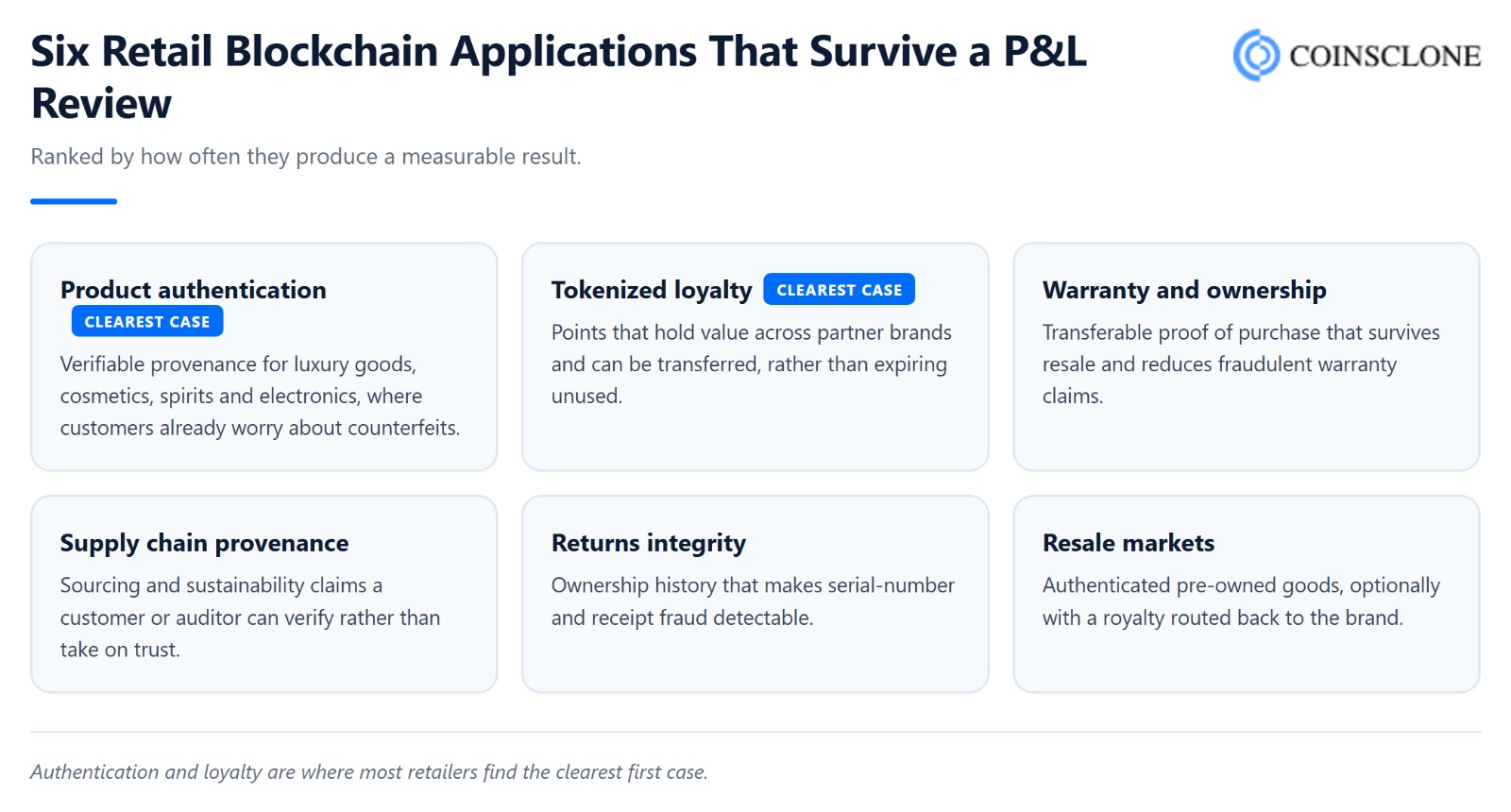
Which Six Applications Survive a P&L Review?
Product authentication. Verifiable provenance for luxury goods, cosmetics, spirits and electronics, where counterfeits are common and customers already worry about them.
Tokenized loyalty. Points that hold value across partner brands and can be transferred, rather than expiring unused.
Warranty and ownership records. Transferable proof of purchase that survives resale and reduces fraudulent warranty claims.
Supply chain provenance. Sourcing and sustainability claims a customer or auditor can verify rather than take on trust, which matters as substantiation requirements tighten.
Returns integrity. Ownership history that makes serial-number and receipt fraud detectable, in a category where losses are substantial and rarely discussed publicly.
Resale and secondary markets. Authenticated pre-owned goods, optionally with a royalty routed back to the brand.
Authentication and loyalty are where most retailers find the clearest first case.
Why Does Tokenized Loyalty Behave Differently?
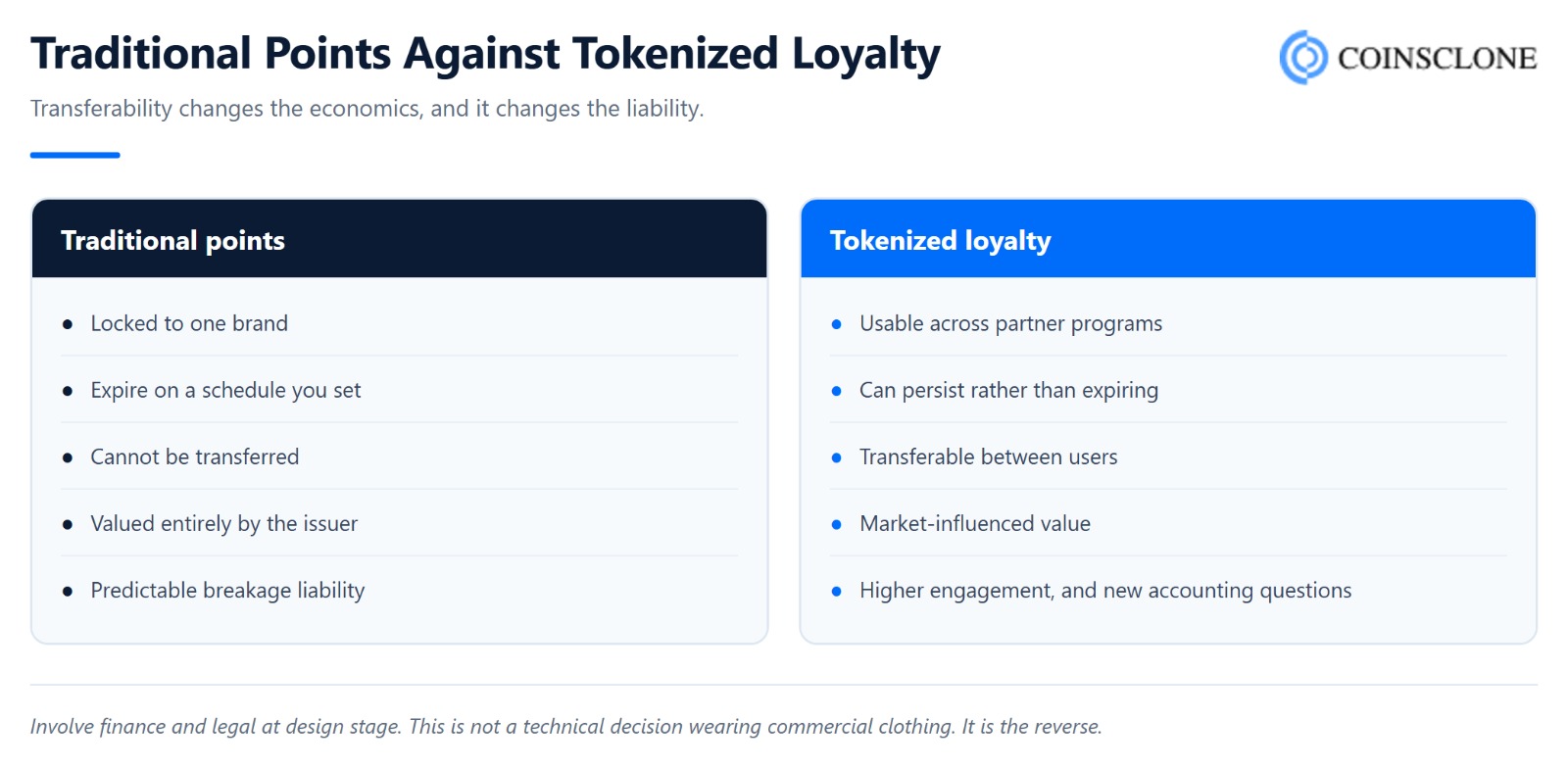
Traditional points are locked to one brand, expire, cannot be transferred, are valued entirely by the issuer, and carry redemption friction that suppresses usage. That combination produces a predictable breakage liability, which finance teams have modeled for decades.
Tokenized loyalty changes every one of those. Points become usable across partner programs, can persist rather than expiring, are transferable, acquire a market-influenced value, and typically see higher engagement.
That last set of changes is the whole point and the whole risk. Transferability raises questions about how the balance is accounted for, whether the instrument attracts regulatory attention, and what happens to your liability if a secondary market prices your points differently from you.
Involve finance and legal at design stage rather than after launch. This is not a technical decision wearing commercial clothing. It is the reverse.
Is Tokenized Loyalty a Regulated Financial Instrument?
Possibly, and the answer depends on design choices you make early and cheaply, or discover late and expensively.
The variables that attract attention are consistent across jurisdictions. Can the token be exchanged for money or crypto? Does it trade on a secondary market at a floating price? Is it marketed with any expectation of appreciation? Can it be transferred to someone who never transacted with you? Each yes moves the instrument closer to being treated as something other than a marketing liability.
In the EU, the crypto-asset framework introduced under MiCA brought a licensing regime for issuing and dealing in certain token types, with limited exemptions for tokens that cannot be exchanged for other assets. A closed-loop point that only ever buys your own goods sits in a very different position from a freely tradable token.
The practical design guidance is to decide deliberately where on that spectrum you want to sit, and to write it down. Non-transferable, non-redeemable points on a ledger capture most of the operational benefit with a fraction of the regulatory exposure. Full transferability is a genuine product differentiator and a genuine compliance project, and the mistake is arriving at the second while believing you built the first.
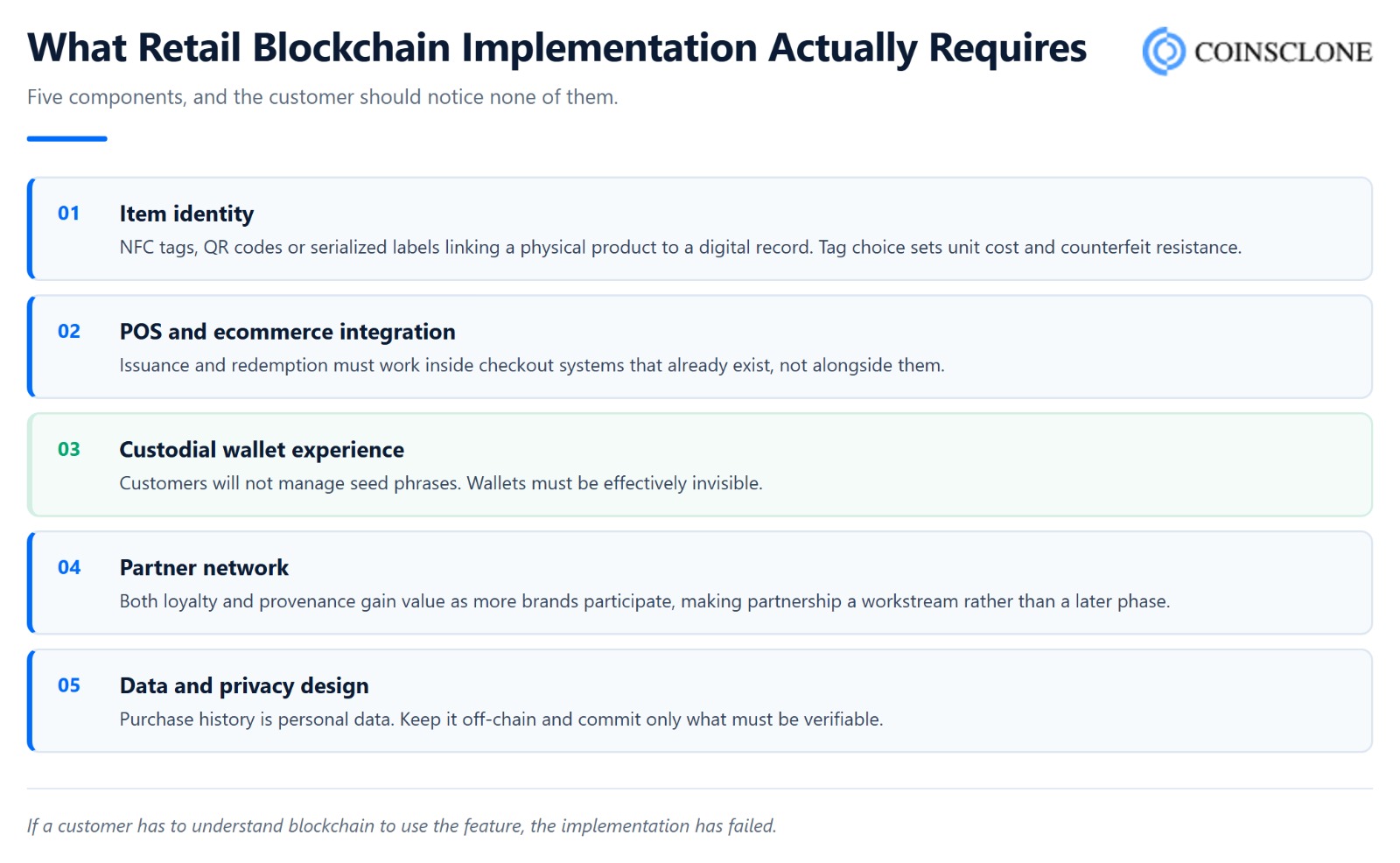
What Does Implementation Actually Require?
Item identity. NFC tags, QR codes or serialized labels linking a physical product to a digital record. Tag choice determines unit cost and how easily a counterfeiter can copy the link.
Point of sale and ecommerce integration. Issuance and redemption must work inside checkout systems that already exist, not alongside them.
Custodial wallet experience. Customers will not manage seed phrases, and asking them to is how retail pilots die. Wallets must be effectively invisible.
Partner network. Both loyalty and provenance gain value as more brands and suppliers participate, which makes partnership a workstream rather than a later phase.
Data and privacy design. Purchase history is personal data. Keep it off-chain, commit only what genuinely must be verifiable, and remember that a public ledger exposes what it stores.
If a customer has to understand blockchain to use the feature, the implementation has failed.
QR or NFC: What Does Item Identity Actually Cost?
This decision sets both your unit economics and your counterfeit resistance, and the two pull against each other.
Printed QR codes are effectively free at scale. They are also trivially copyable: a counterfeiter photographs a genuine code, prints it on a fake, and the fake now verifies against a legitimate record. QR suits categories where the goal is transparency and consumer information rather than defeating a determined counterfeiter.
Basic NFC tags cost cents rather than fractions of a cent and require the customer to tap rather than scan, which most modern phones support natively. A plain tag can still be cloned.
Cryptographic NFC tags contain a chip that signs a unique challenge, so the tag proves it holds a secret rather than merely displaying a number. This defeats copying, and it is the only option that genuinely resists a motivated counterfeiter. It carries the highest unit cost.
The rule that follows is simple. If your threat model includes someone who will invest in copying your tags, and in luxury goods it certainly does, a printed code is decoration. If you are substantiating a sourcing claim to an interested customer, a QR code is proportionate and the money is better spent elsewhere.
What Has Actually Worked in Retail Blockchain?
The record is mixed, and the pattern in the failures is more useful than the successes.
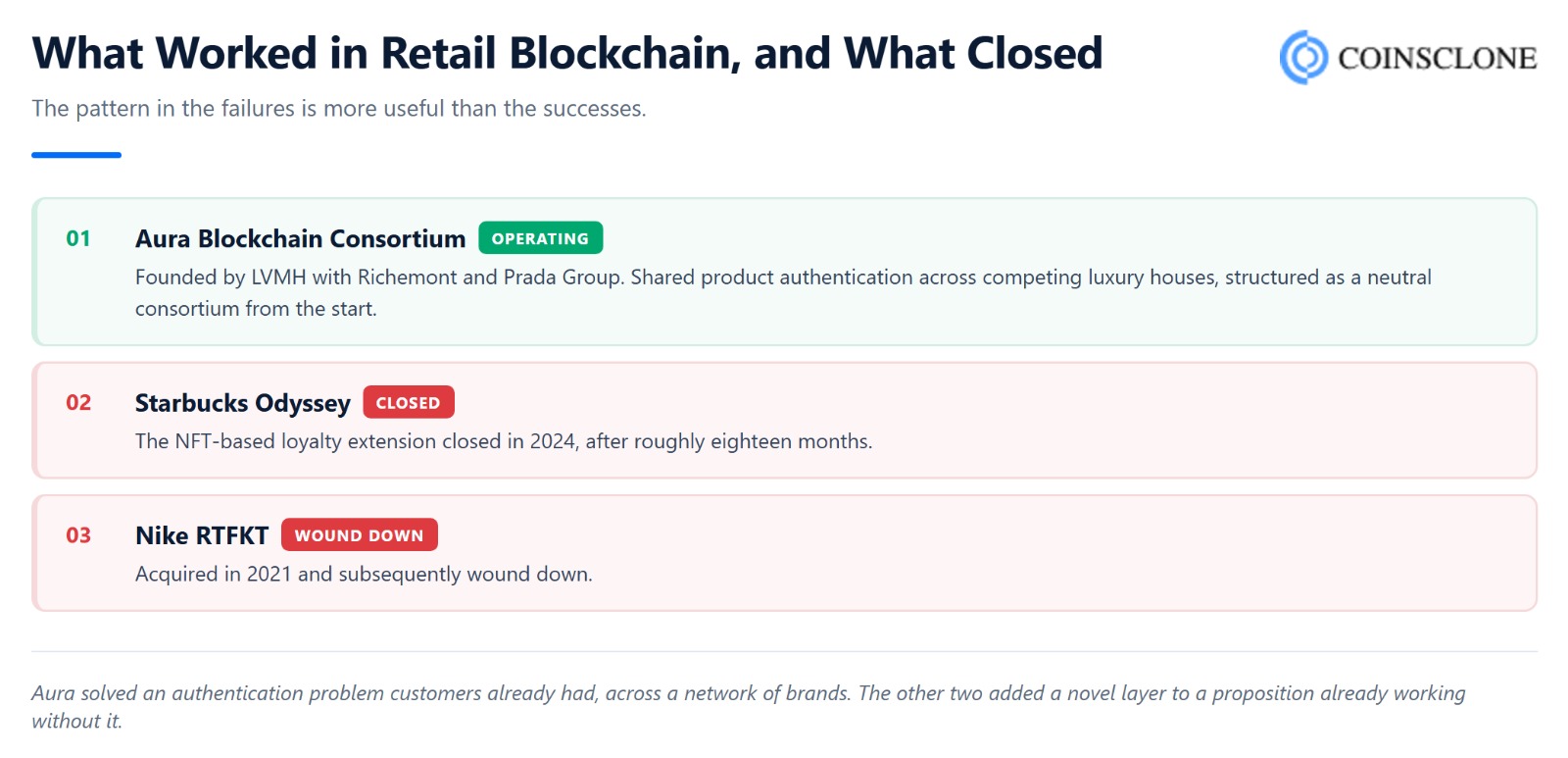
The Aura Blockchain Consortium is the clearest working example. Founded by LVMH with Prada Group and Cartier owner Richemont, later joined by others, it provides shared product authentication and digital product passports across competing luxury houses. It works for the reason TradeLens did not: it was structured as a neutral consortium from the start rather than a platform owned by one participant’s largest rival.
Starbucks Odyssey, the NFT-based extension of its loyalty program, closed in 2024 after roughly eighteen months.
Nike’s RTFKT, acquired in 2021, was wound down.
The distinction is not the technology, which was comparable across all three. Aura solves a problem the customer already has, namely knowing whether a resale handbag is genuine, and it does so across brands so the network has value. The two closed programs added a novel collectible layer to a loyalty proposition that was working adequately without it, and asked customers to learn something new for a benefit they had not requested.
Solve a problem the customer already knows they have. That is the whole lesson.
How Do You Pilot Without Betting the Estate?
Five steps, in order.
Pick one category with a real counterfeit or loyalty problem, not the category with the most enthusiastic supplier.
Define the metric before building, whether that is verification rate, redemption rate or return fraud.
Build the customer journey first, with the chain hidden entirely.
Run in a limited region or channel against a control group, so the result means something.
Extend only if the metric moved, rather than because the pilot completed on schedule.
Most retail blockchain pilots produce a case study rather than a number. Deciding the metric before building is what separates the two.
Conclusion
Retail blockchain works where it changes something the customer or the accountant can measure: a product that can be authenticated, points that stop expiring, a return that can be checked against ownership history. It fails where it becomes a feature in search of a story, which is what closed the most publicized programs of the last few years.
Choose one category with a genuine problem. Match the tag technology to your actual threat model. Decide deliberately how transferable your loyalty token is, before finance and legal decide for you. Hide the technology completely from the customer. Agree the metric before development starts, and let the pilot result rather than the pilot itself decide whether you extend.
Coinsclone builds enterprise-grade Web3 platforms including product authentication and digital product passport systems, tokenized loyalty programs, NFT marketplaces, crypto exchanges, wallets and payment gateways, using customizable white-label solutions. Talk to our blockchain experts for a free consultation and a live demo.
FAQ
Q: How is blockchain used in retail?
Mainly for product authentication in counterfeit-prone categories, tokenized loyalty programs, transferable warranty and ownership records, verifiable supply chain provenance, returns integrity checking, and authenticated resale markets with optional brand royalties.
Q: What is tokenized loyalty?
A loyalty program where points are issued as transferable digital tokens rather than entries in a closed database. They can be used across partner programs, need not expire, and can be transferred between users, which raises engagement while introducing accounting and regulatory questions that traditional points do not.
Q: Is a loyalty token a regulated financial instrument?
It depends on design. Redeemability for money, secondary market trading at a floating price, and transferability to people who never transacted with you all move a token toward regulatory scope. A closed-loop, non-transferable point sits very differently from a freely tradable token, and the choice should be deliberate and documented with counsel.
Q: Does blockchain stop counterfeit products?
It makes counterfeits detectable rather than impossible. A verifiable record proves a specific identifier has a legitimate history. Physical tag security still matters, because a copied tag linked to a genuine record defeats the system regardless of how strong the ledger is.
Q: Should we use QR codes or NFC tags?
QR is near-free and trivially copyable, which suits transparency and sourcing claims. Cryptographic NFC tags sign a challenge rather than displaying a number, which defeats copying and is the only option that resists a motivated counterfeiter. Match the choice to whether your threat model includes someone who will invest in cloning tags.
Q: Do customers need a crypto wallet?
They should not need to think about one. Retail implementations use custodial or embedded wallets so customers never manage seed phrases or pay gas. If using the feature requires understanding blockchain, adoption will be negligible regardless of the underlying design quality.
Q: Which retail blockchain projects have actually succeeded?
The Aura Blockchain Consortium, founded by LVMH with Richemont and Prada Group, provides shared authentication across competing luxury brands and continues to operate. Starbucks Odyssey and Nike’s RTFKT were both wound down. The difference is that Aura solved an authentication problem customers already had, across a network of brands.
Q: How does blockchain help with retail returns?
Ownership and purchase history recorded against a serialized item makes several common fraud patterns detectable, including returning counterfeit goods in place of genuine ones and reusing receipts across multiple returns. It works best in categories where items are already serialized.
Q: What does a retail blockchain implementation involve?
Item identity through NFC tags, QR codes or serialized labels; integration with existing point of sale and ecommerce systems; a custodial wallet experience that hides the technology; a partner network for loyalty or provenance value; and privacy design that keeps purchase history off-chain.
Q: How should a retailer pilot blockchain?
In one category with a genuine counterfeit or loyalty problem, with the success metric agreed before development starts, the customer journey built first, and the pilot run in a limited region or channel against a control group. Extend only if the metric moved.