Procurement is one of the better-fitting blockchain use cases, for a specific structural reason: buyers and suppliers each maintain their own version of the same transaction and then spend significant effort reconciling the difference. A shared record removes that reconciliation rather than automating it. But procurement is also where blockchain business cases most often overstate themselves, because the saving depends on supplier participation that nobody budgets for. This guide sets out where the technology actually fits in the source-to-pay cycle, where the return genuinely comes from, what has to be true before it works, how it interacts with the e-invoicing mandates now arriving across major markets, and how to stage a rollout that produces evidence.
What Is Blockchain in Procurement?
A shared transaction record maintained jointly by buyer and supplier, rather than two private records that periodically disagree.
That is the entire proposition, and it is worth stating plainly because procurement blockchain pitches often bury it under automation language. Automation makes an existing process faster. A shared record removes a process, namely the reconciliation work that exists only because two organizations keep separate books about the same event.
The corollary is the test. If the reconciliation cost is small, or if only one party actually records anything, there is nothing for a ledger to remove and a well-integrated ERP is the better answer.
Where Does It Fit in the Source-to-Pay Cycle?
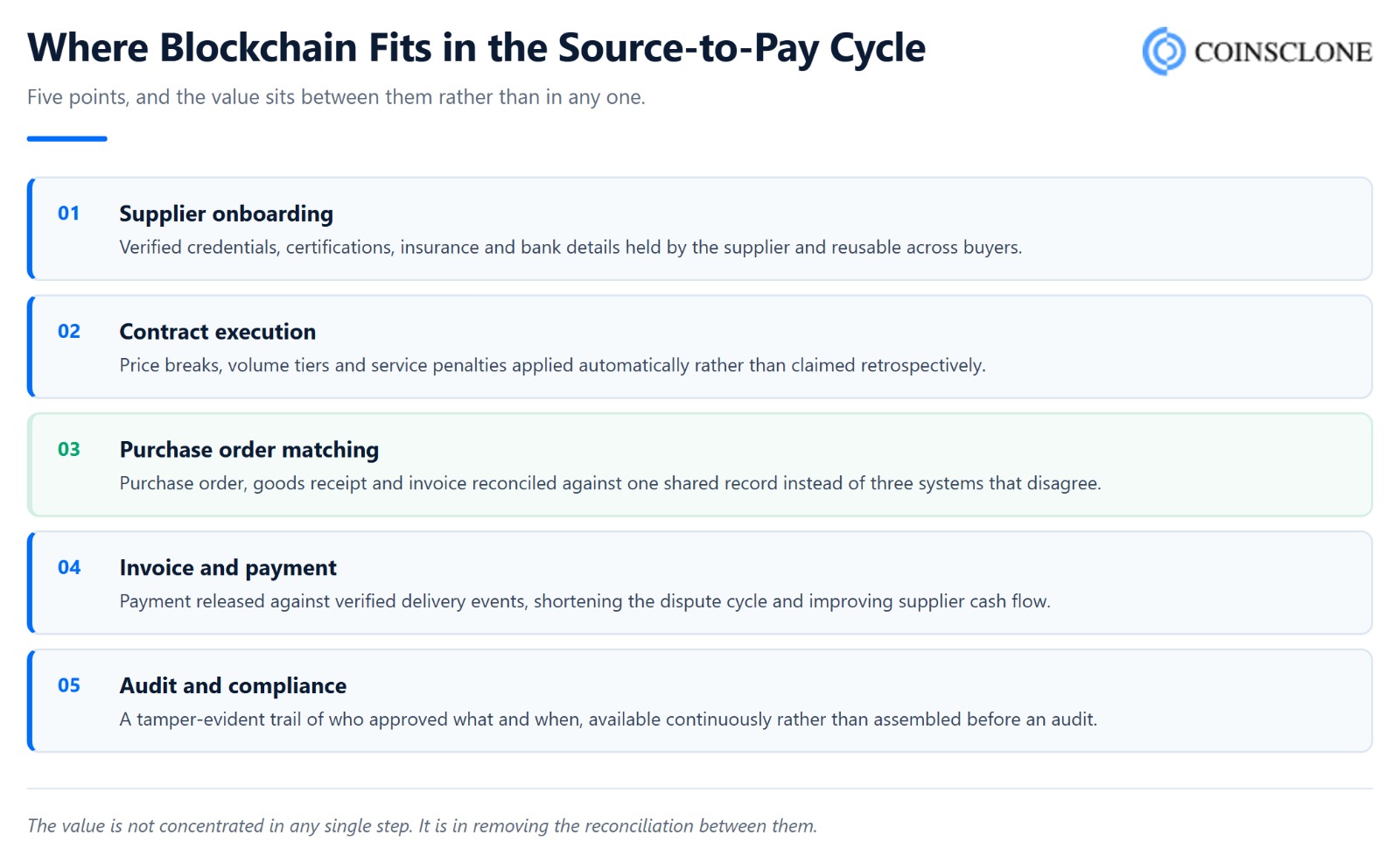
Five points, and the value sits between them rather than in any one.
Supplier onboarding. Verified credentials, certifications, insurance and bank details held by the supplier and reusable across buyers, rather than re-collected and re-verified by each one.
Contract execution. Agreed commercial terms encoded so that price breaks, volume tiers and service penalties apply automatically rather than being claimed retrospectively.
Purchase order matching. Purchase order, goods receipt and invoice reconciled against one shared record instead of three systems that disagree.
Invoice and payment. Payment released against verified delivery events, which shortens the dispute cycle and improves supplier cash flow predictability.
Audit and compliance. A tamper-evident trail of who approved what and when, available continuously rather than assembled under pressure before an audit.
The value is not concentrated in any single step. It is in removing the reconciliation between them.
Where Does the ROI Actually Come From?
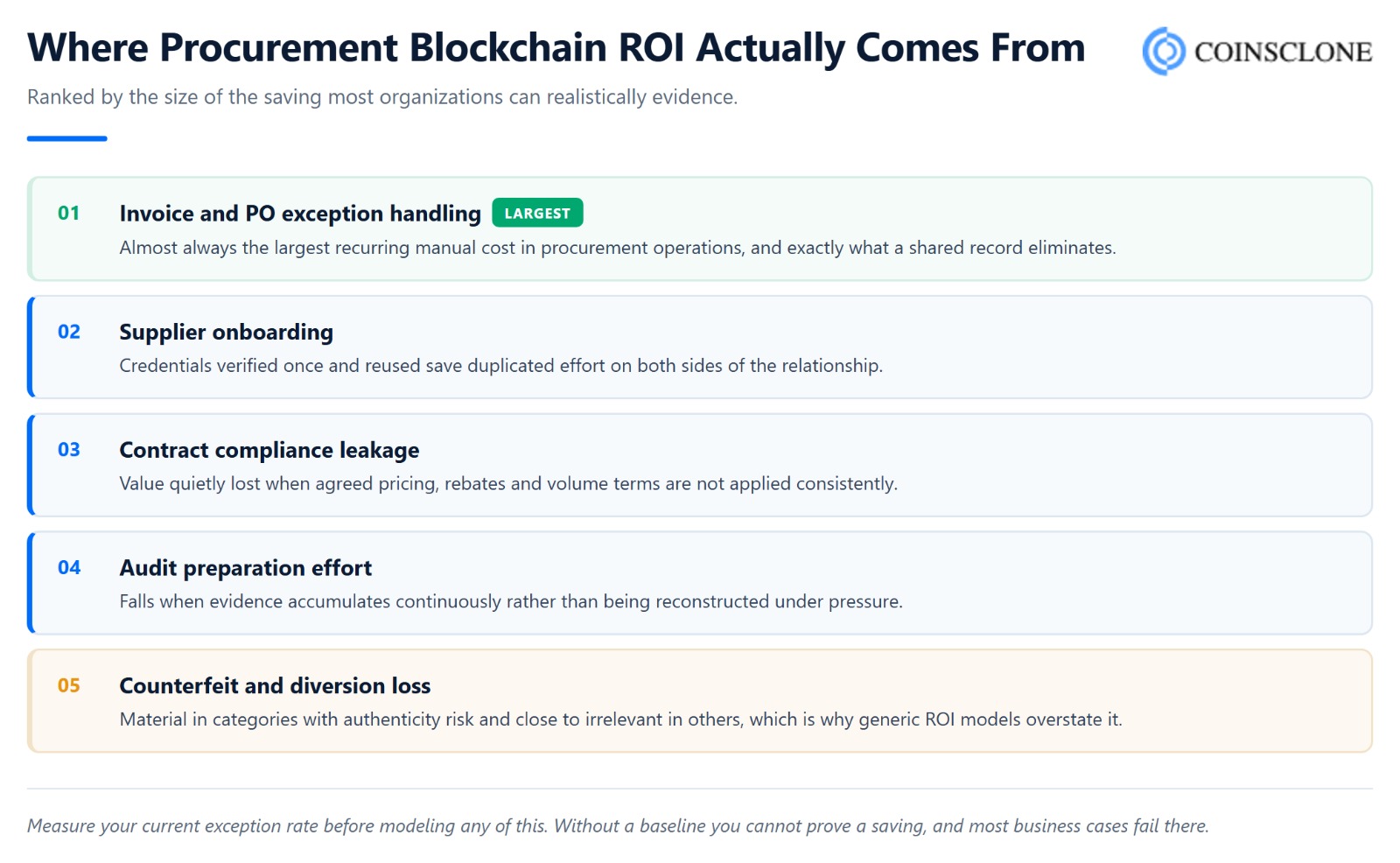
Ranked by the size of the saving most organizations can realistically evidence.
Invoice and purchase order exception handling is almost always the largest recurring manual cost in procurement operations, and mismatches between order, receipt and invoice are exactly what a shared record eliminates.
Supplier onboarding and re-verification follows, because credentials verified once and reused save duplicated effort on both sides.
Contract compliance leakage is value quietly lost when agreed pricing, rebates and volume terms are not applied consistently. Automatic enforcement recovers it.
Audit preparation effort falls when evidence accumulates continuously rather than being reconstructed.
Counterfeit and diversion loss is material in categories with authenticity risk and close to irrelevant in others, which is why generic ROI models overstate it.
Before modeling any of this, measure your current exception rate. Without a baseline you cannot prove a saving, and most business cases fail at exactly that point.
What Can a Smart Contract Actually Enforce in Procurement?
This is where expectations and reality separate most sharply, and getting it right early prevents an expensive discovery in build.
Enforceable cleanly: volume-tiered pricing, rebate thresholds, early payment discounts, automatic release against a verified goods receipt, late delivery penalties tied to a timestamp, and spend caps. Each is a deterministic rule over data the system already holds.
Not enforceable: anything requiring judgment. Whether a delivery was materially defective, whether a delay was excusable, whether substituted goods were acceptable, whether performance met a qualitative service standard. These are the terms that generate most real procurement disputes, and encoding them produces automated wrong answers rather than automated right ones.
There is also a legal distinction worth carrying into any vendor conversation. A smart contract is executable code, not a contract in the legal sense. The underlying agreement remains a legal document, and the code implements part of it. When the two diverge, and eventually they will, you need a written position on which governs and how an incorrect automatic execution gets unwound.
The practical guidance is to encode the arithmetic and leave the judgment to people. Contracts that automate pricing and payment release while routing genuine disputes to a human process work. Contracts that attempt to automate the disputes do not.
How Does This Interact With E-Invoicing Mandates?
More than most blockchain business cases acknowledge, and often in a way that reduces the case for a ledger.
Mandatory electronic invoicing is arriving across major markets. India has operated mandatory e-invoicing for businesses above a turnover threshold for several years. The EU’s VAT in the Digital Age package moves member states toward structured e-invoicing and digital reporting, with Peppol widely used as the transport network. Several other jurisdictions have made or announced comparable moves.
This matters in two directions.
It strengthens the data foundation, because mandates force structured, standardized invoice data into existence. Much of the master data quality problem that sinks procurement ledger projects gets solved by regulation rather than by you.
It weakens part of the pitch, because a compliant e-invoicing network already delivers a validated, shared, government-visible invoice record. If your business case was built mainly on invoice integrity, a mandate may deliver most of that benefit without a ledger.
The honest position is that the remaining case sits in what mandates do not cover: contract term enforcement, reusable supplier credentials, goods receipt matching against physical events, and multi-party records that no tax authority sits inside. Scope the ledger around the gap rather than around the whole cycle.
Which Five Preconditions Must Hold?
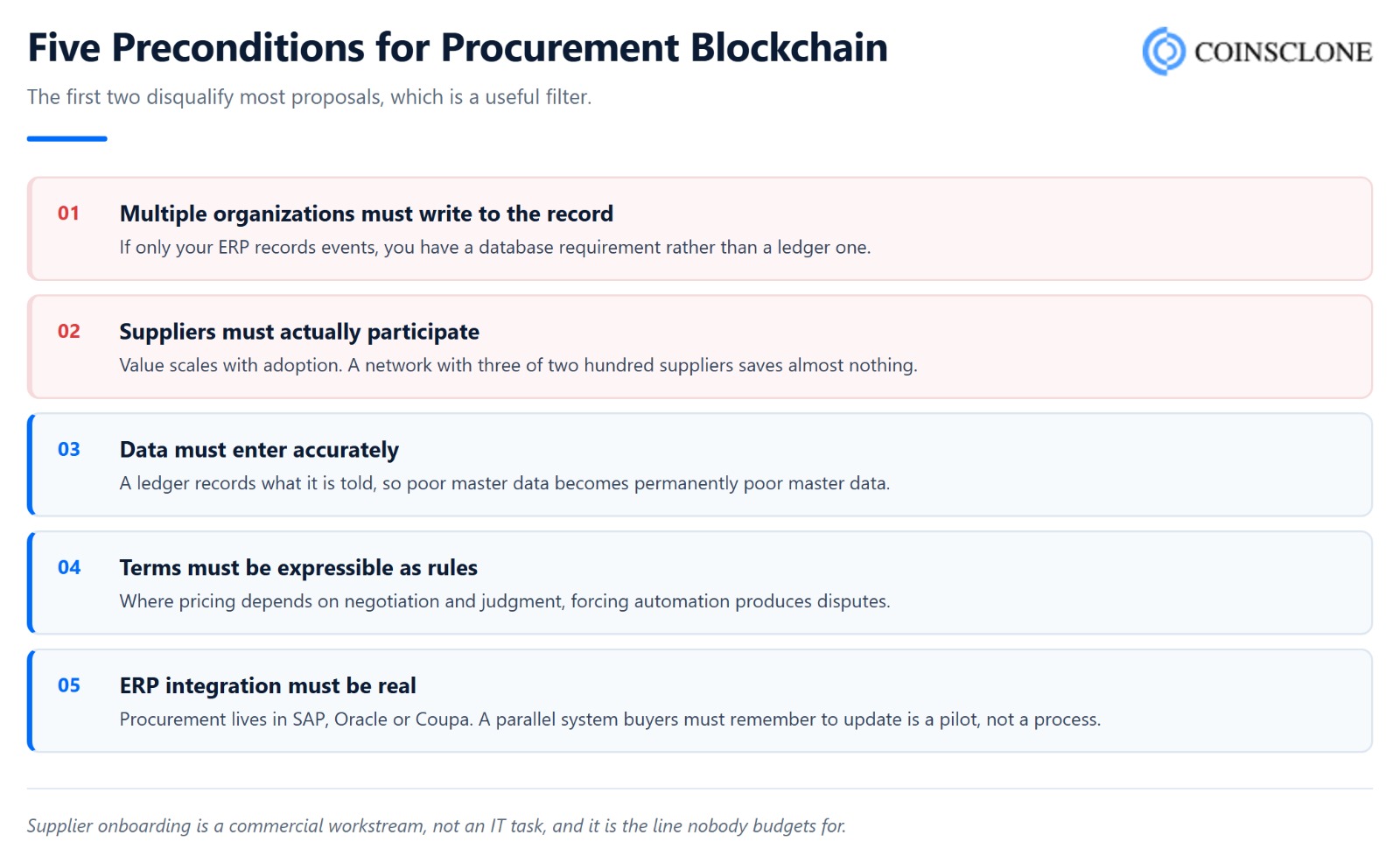
Multiple organizations must write to the record. If only your ERP records events, you have a database requirement rather than a ledger one.
Suppliers must actually participate. Value scales with adoption, and a network with three of two hundred suppliers saves almost nothing.
Data must enter accurately. A ledger records what it is told, so poor master data becomes permanently poor master data.
Terms must be expressible as rules. Where pricing depends on negotiation and judgment, it will not automate cleanly and forcing it produces disputes.
ERP integration must be real. Procurement lives in SAP, Oracle or Coupa. A parallel system that buyers must remember to update is a pilot rather than a process.
The first two eliminate most proposals, which is a useful filter rather than a disappointment.
What Does a Staged Rollout Look Like?
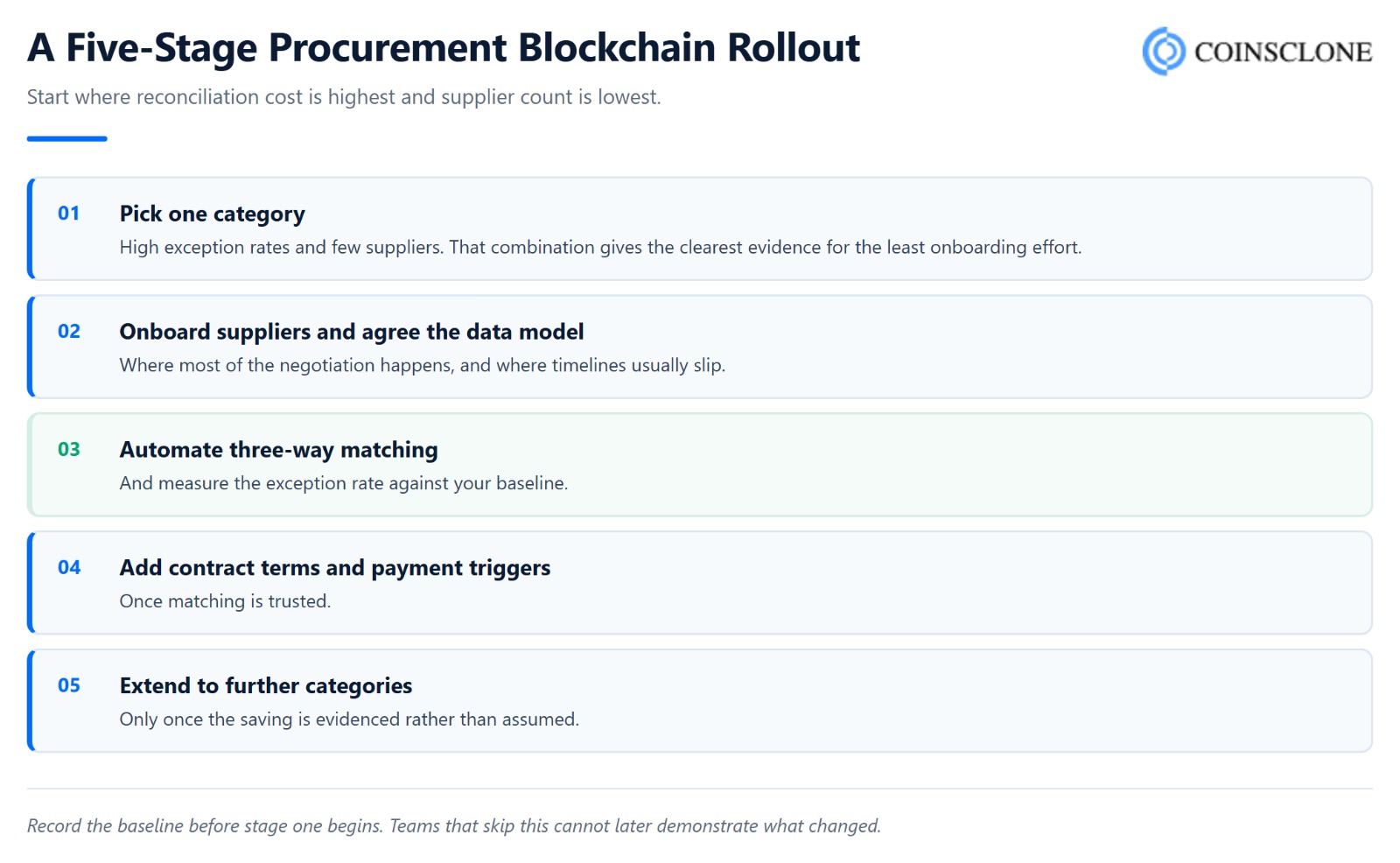
Start where reconciliation cost is highest and supplier count is lowest, because that combination gives the clearest evidence for the least onboarding effort.
Stage one: pick one category with high exception rates and few suppliers.
Stage two: onboard those suppliers and agree the shared data model, which is where most of the negotiation happens.
Stage three: automate three-way matching and measure the exception rate against your baseline.
Stage four: add contract terms and automated payment triggers once matching is trusted.
Stage five: extend to further categories, but only once the saving is evidenced rather than assumed.
Record the baseline before stage one begins. Teams that skip this cannot later demonstrate what changed, which is how successful pilots fail to win funding for stage five.
Conclusion
Blockchain in procurement works when several organizations genuinely maintain competing versions of the same transaction and the reconciliation between them is expensive. It fails when one company records everything and a supplier network never materializes.
Test the preconditions honestly. Encode the arithmetic and leave the judgment to people. Check what your jurisdiction’s e-invoicing mandate already gives you before paying to rebuild it. Choose a first category where exceptions are frequent and suppliers are few, measure the baseline before you start, and expand on evidence rather than momentum.
Coinsclone builds enterprise-grade Web3 platforms including procurement and supply chain consortium networks, smart contract development and audit, RWA tokenization, crypto exchanges, wallets and payment gateways, using customizable white-label solutions. Talk to our blockchain experts for a free consultation and a live demo.
FAQ
Q: What is blockchain in procurement?
A shared transaction record maintained jointly by buyer and supplier rather than two private records that periodically disagree. It spans supplier onboarding, contract execution, purchase order matching, invoice and payment, and audit. Its value is in removing reconciliation work rather than speeding up existing steps.
Q: Where does procurement blockchain ROI actually come from?
Mainly from reduced invoice and purchase order exception handling, which is usually the largest recurring manual cost in procurement operations. Then faster supplier onboarding through reusable verified credentials, recovered contract compliance leakage, and lower audit preparation effort. Counterfeit reduction matters only in specific categories.
Q: What can a smart contract enforce in procurement?
Deterministic terms: volume-tiered pricing, rebate thresholds, early payment discounts, payment release against verified goods receipt, and timestamp-based late delivery penalties. It cannot enforce anything requiring judgment, such as whether goods were materially defective or a delay was excusable, and those are what most real disputes concern.
Q: Is a smart contract legally binding?
The smart contract is executable code that implements part of an agreement; the legal contract remains the written agreement. Any deployment needs a documented position on which governs when the two diverge, and on how an incorrect automatic execution is unwound.
Q: Do e-invoicing mandates make procurement blockchain unnecessary?
They remove part of the case. Mandates in India, the EU and elsewhere force structured, validated invoice data into existence, which delivers much of the invoice integrity benefit without a ledger. The remaining case sits in contract term enforcement, reusable supplier credentials, goods receipt matching and multi-party records outside the tax authority’s view.
Q: What has to be true before blockchain works in procurement?
Multiple organizations must write to the record, suppliers must actually participate, master data must be accurate on entry, commercial terms must be expressible as deterministic rules, and integration with SAP, Oracle or Coupa must be real rather than parallel. The first two disqualify most proposals.
Q: How does blockchain speed up supplier onboarding?
Credentials, certifications, insurance and bank details are verified once and held by the supplier, then reused across buyers rather than re-collected and re-verified by each one. The saving accrues to both sides, which is unusual in procurement technology and makes supplier participation easier to negotiate.
Q: Does blockchain replace SAP Ariba or Coupa?
No. Procurement runs in those systems and a ledger that sits parallel to them will not be used consistently. The workable pattern is integration, where the shared record handles cross-organization events and the procurement suite remains the system of record for everything internal.
Q: How do you build a procurement blockchain business case?
Measure the current exception rate first. Without that baseline no saving can be demonstrated, and this is where most business cases fail. Then scope one category with high exceptions and few suppliers, model the reduction against the baseline, and include supplier onboarding as a commercial cost line rather than assuming participation.
Q: How long does a procurement blockchain rollout take?
The engineering is rarely the constraint. Supplier onboarding and agreeing a shared data model take the longest and are negotiation rather than development. A single-category pilot with a handful of suppliers is realistic within a few months; extending across a supplier base is a multi-year commercial program.