
Blockchain and intellectual property is a category where genuinely useful applications and badly overstated claims sit unusually close together. A blockchain timestamp is real evidence, and it is not a copyright registration. Conflating the two has produced disputes where creators believed they held protection they never had. This guide separates the three jobs blockchain actually does for IP, explains the mechanism in plain terms, states precisely what a timestamp proves and what it does not, covers where commercial traction exists today, and explains why automated royalties have consistently underperformed the promise.
What Is Blockchain in Intellectual Property?
Blockchain in intellectual property is the use of a distributed, tamper-evident ledger to record proof of creation, ownership and licensing terms for creative and inventive works. Instead of relying on a single company or registry to vouch for when a file existed and who held it, the record is written to a network that no single participant controls and that cannot be quietly rewritten.
Intellectual property covers four main rights families, and blockchain touches each of them differently.
Copyright protects original expression such as text, music, code, images and film. This is where blockchain has the most immediate use, because copyright arises automatically on creation and disputes usually turn on who had the work first.
Patents protect inventions and depend on filing and examination. Blockchain contributes only at the evidence layer here, through tamper-evident research and laboratory records that support inventorship and priority.
Trademarks protect brand identifiers. Blockchain supports anti-counterfeit verification and supply chain authenticity rather than the registration itself.
Trade secrets depend on demonstrable confidentiality. A timestamped hash lets you prove a secret existed in a specific form on a specific date without disclosing its contents to anyone.
That last point is worth holding onto, because it applies across all four families. You never publish the work itself. You publish a fingerprint of it.
How Does Blockchain Protect Intellectual Property?
The mechanism is simpler than the marketing suggests, and understanding it tells you exactly what the resulting evidence is worth.
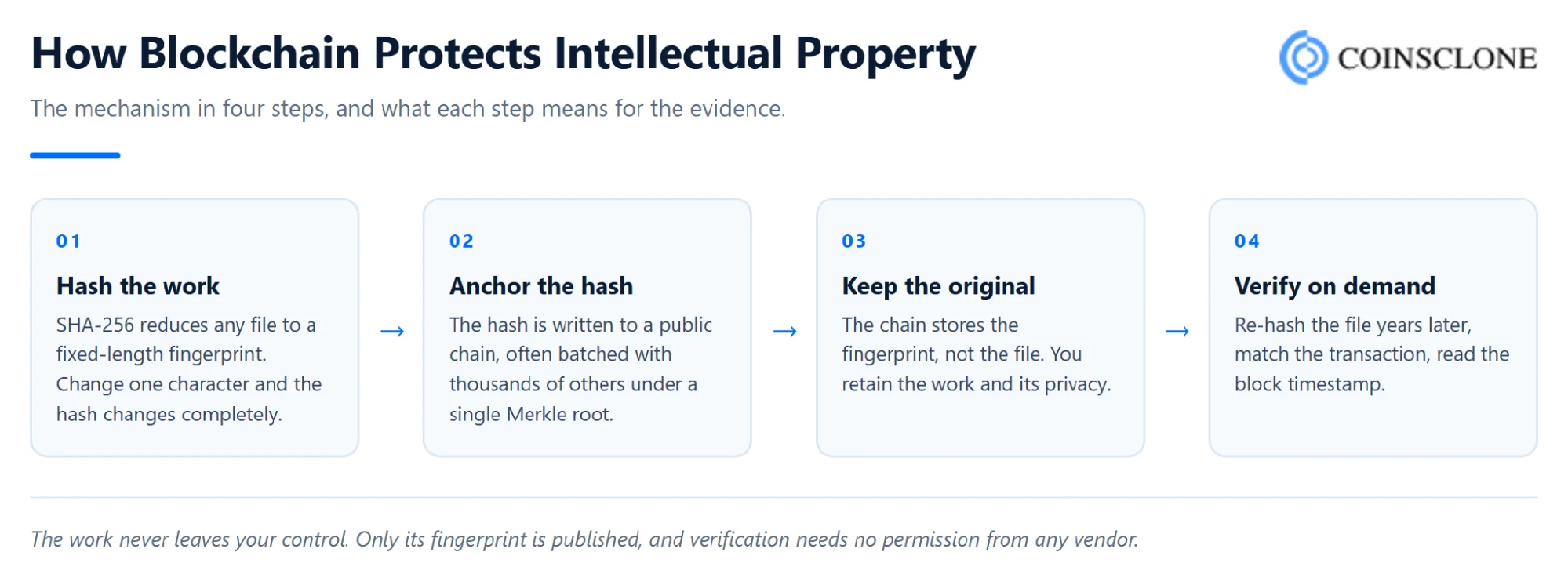
Hash the work. A cryptographic hash function such as SHA-256 reduces any file, whether a 400 page manuscript or a 4GB video master, to a fixed-length string of characters. Change a single pixel or comma and the hash changes completely. The hash reveals nothing about the content, so the work itself stays private.
Anchor the hash. That hash is written into a transaction on a public blockchain. Once the transaction is confirmed and buried under subsequent blocks, altering it would mean rewriting the chain’s history, which on a large network is economically impractical. Many services batch thousands of hashes into a single Merkle tree and anchor only the root, which is why timestamping can cost a fraction of a cent per document.
Keep the original. The chain stores the fingerprint, not the file. You retain the original work, and the evidentiary value depends on you still holding a copy that reproduces the same hash.
Verify on demand. Years later, anyone can re-hash your file, locate the matching transaction and read the block’s timestamp. Verification needs no permission from whoever created the record, and it still works if that company has gone out of business.
That final property is what separates blockchain timestamping from a notary or a private archive. The evidence does not depend on the continued existence, cooperation or honesty of a custodian. Open implementations such as OpenTimestamps anchor to Bitcoin and require no account or vendor relationship at all.
The Three Jobs Blockchain Does for IP
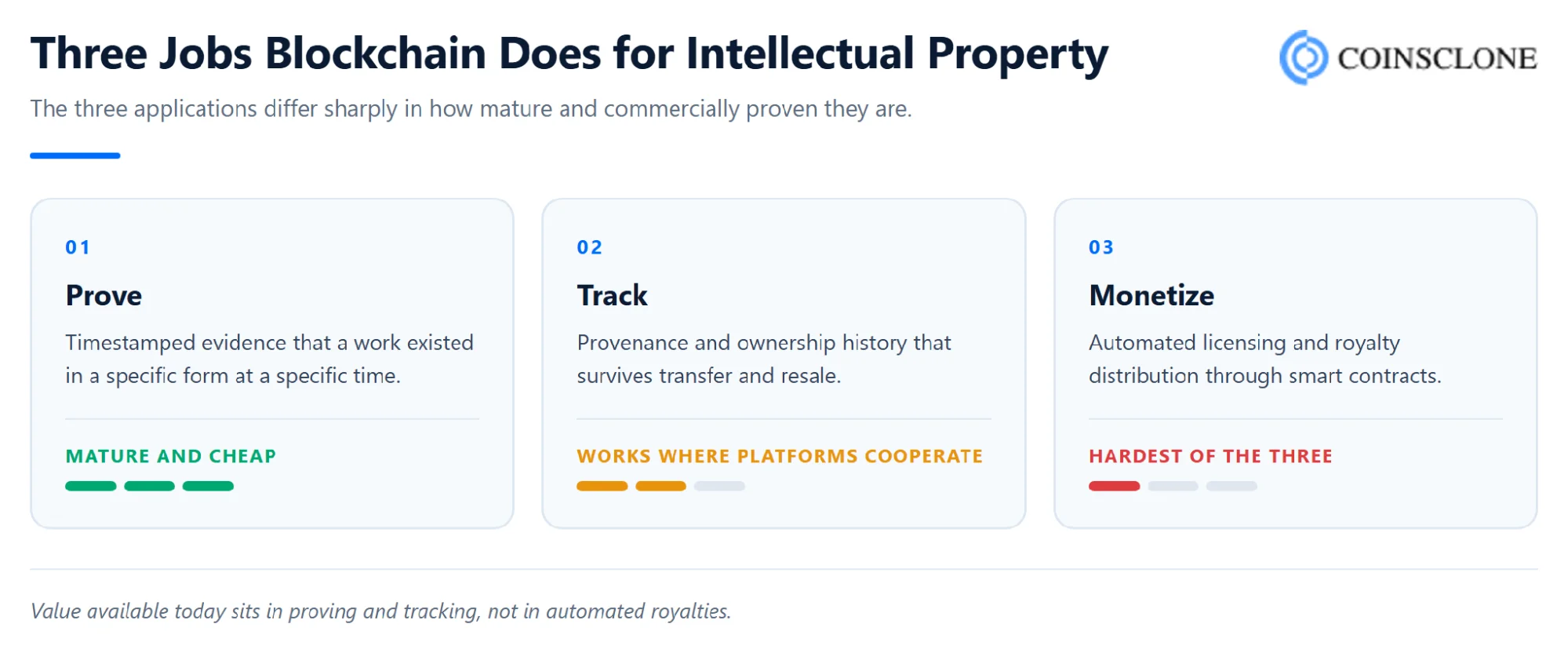
Prove. Timestamped evidence that a work existed in a specific form at a specific time. Mature, cheap and genuinely useful today.
Track. Provenance and ownership history that survives transfer and resale. Working in practice, and dependent on the platforms involved choosing to participate.
Monetize. Automated licensing and royalty distribution through smart contracts. Promising in principle and the hardest of the three to make work commercially.
Most of the value available today sits in the first two. The third depends on other parties choosing to honor terms they are not technically compelled to honor, which is a commercial problem rather than a cryptographic one.
Is a Blockchain Timestamp the Same as Copyright Registration?
No, and this is the most commonly overstated claim in the category. Getting it right protects both you and your clients.
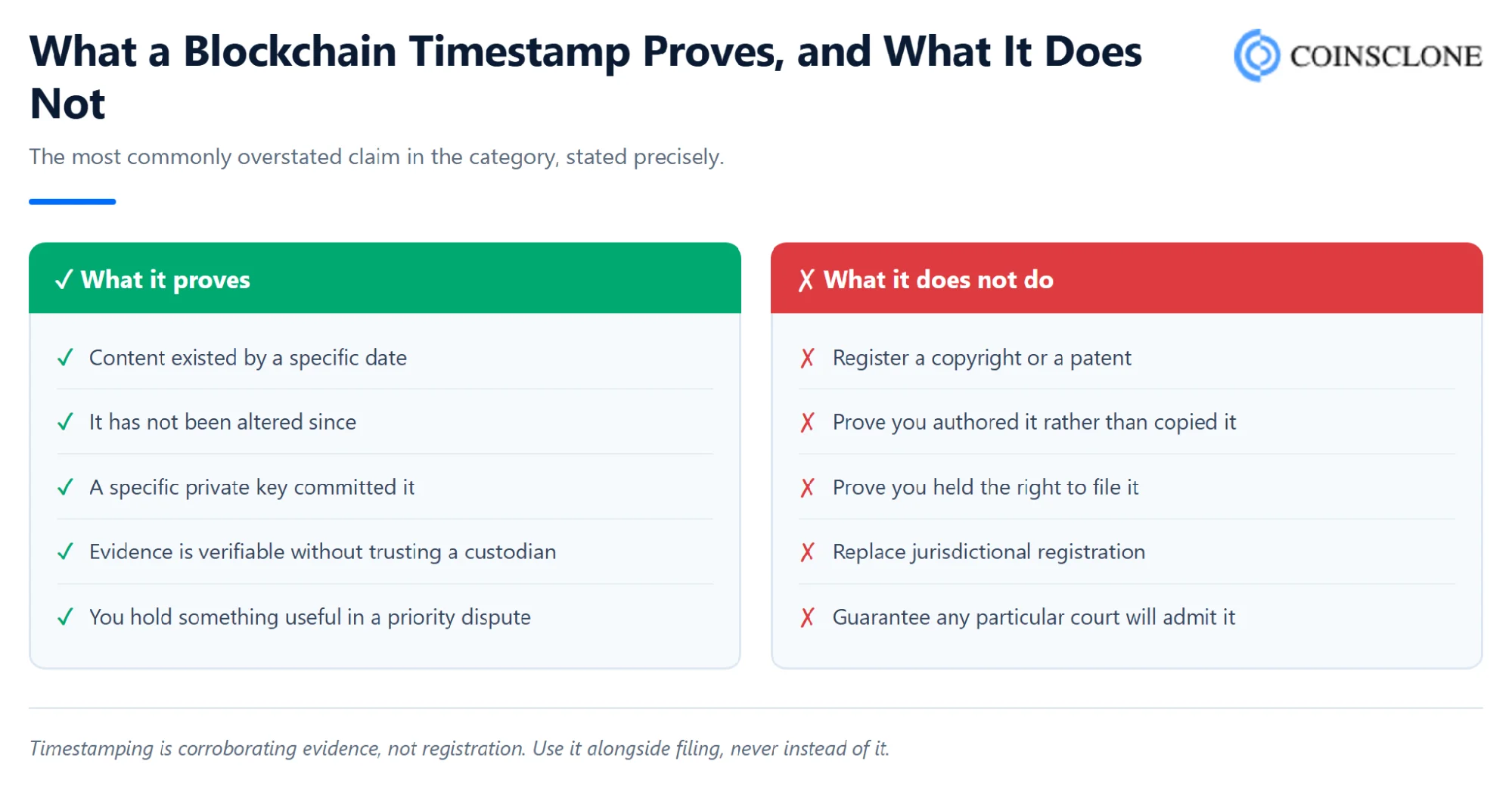
What a blockchain timestamp proves: that specific content existed by a specific date, that it has not been altered since, that a specific private key committed it, that the evidence is verifiable without trusting a custodian, and that you hold something useful in a dispute over priority.
What it does not do: register a copyright or a patent, prove you authored the work rather than copied it from someone who had not yet published, prove you held the right to file it, replace jurisdictional registration where registration confers rights or remedies, or guarantee that any particular court will admit it.
The legal backdrop matters here. Under the Berne Convention, copyright in member states arises automatically the moment a work is fixed in tangible form, with no registration required for the right to exist. That leads people to conclude registration is optional. In the United States it is not, in practice. Registration with the U.S. Copyright Office is a prerequisite for filing an infringement suit over a U.S. work, and timely registration is what unlocks statutory damages and attorney’s fees. A blockchain record does neither.
Institutional work is moving toward complement rather than replacement. WIPO’s Committee on WIPO Standards convened a Blockchain Task Force to draft a standard for applying blockchain within IP ecosystems, covering interoperability, governance and shared data models. The EUIPO has run programs applying distributed ledger technology to anti-counterfeiting and enforcement infrastructure. Neither body treats an on-chain record as a substitute for filing.
Treat timestamping as corroborating evidence. It strengthens a position, it does not create one. Register where registration matters, and timestamp alongside registration rather than instead of it.
Does Buying an NFT Give You the Copyright?
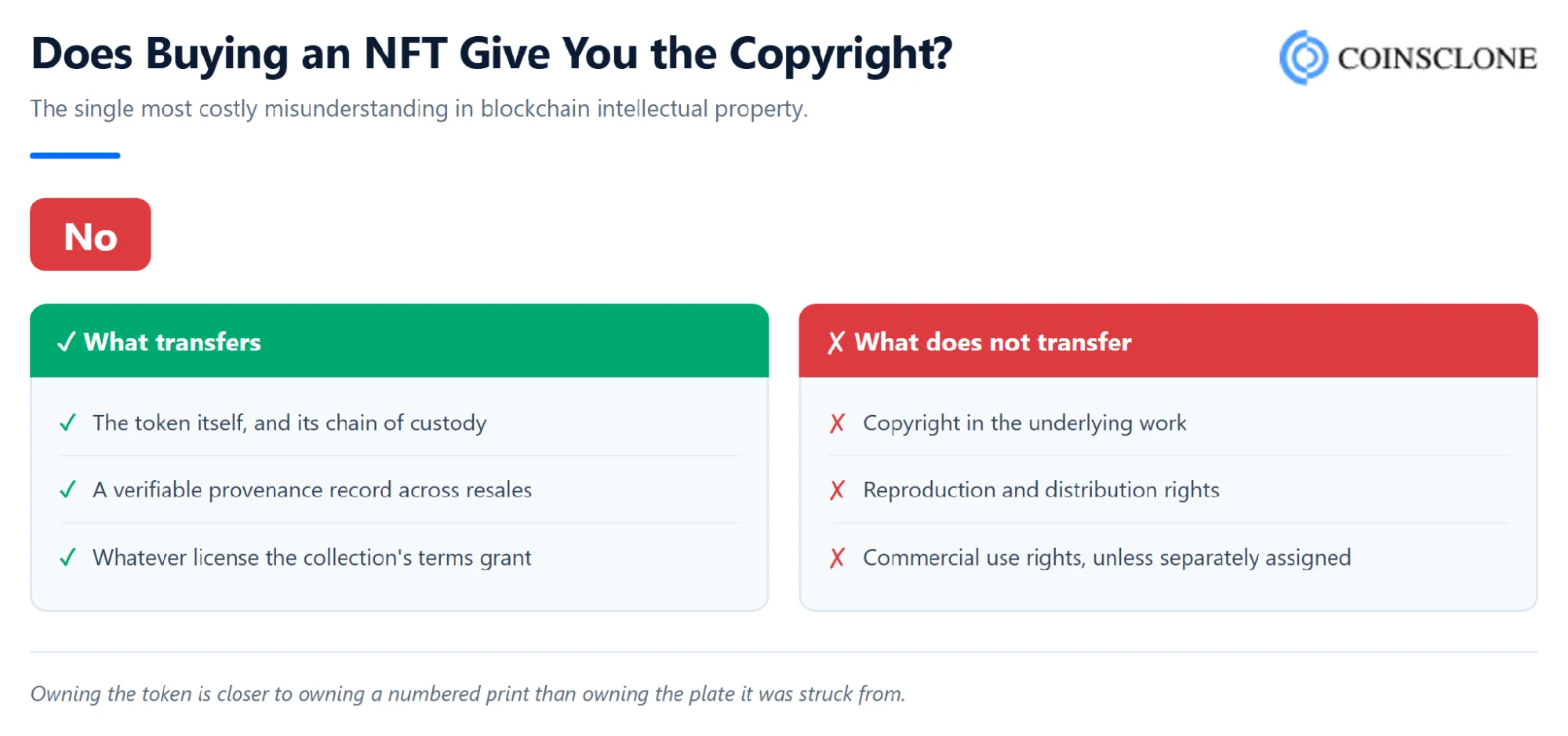
No, almost never, and this single misunderstanding has generated more disputes than anything else in the category.
An NFT is a token on a blockchain that points to a work. Buying it transfers the token. Copyright in the underlying work stays with the creator unless it is assigned in a separate written agreement that satisfies the relevant jurisdiction’s requirements for transferring copyright. Owning the token is closer to owning a numbered print than owning the plate it was struck from.
Three consequences follow.
Most NFT purchasers acquire a license at best, and its scope is whatever the collection’s terms say. That ranges from personal display only to broad commercial use, and buyers frequently never read it.
Minting an NFT of a work you do not own does not launder the infringement. Marketplaces process takedown requests for exactly this reason, and the on-chain record does nothing to defend the minter.
An NFT proves the token’s chain of custody, not the authenticity of the underlying rights. If the minter never held the copyright, the record faithfully documents a transfer that transferred nothing.
The provenance value is real and worth having. The rights transfer still has to be written down.
Where Is Blockchain IP Protection Actually Working?
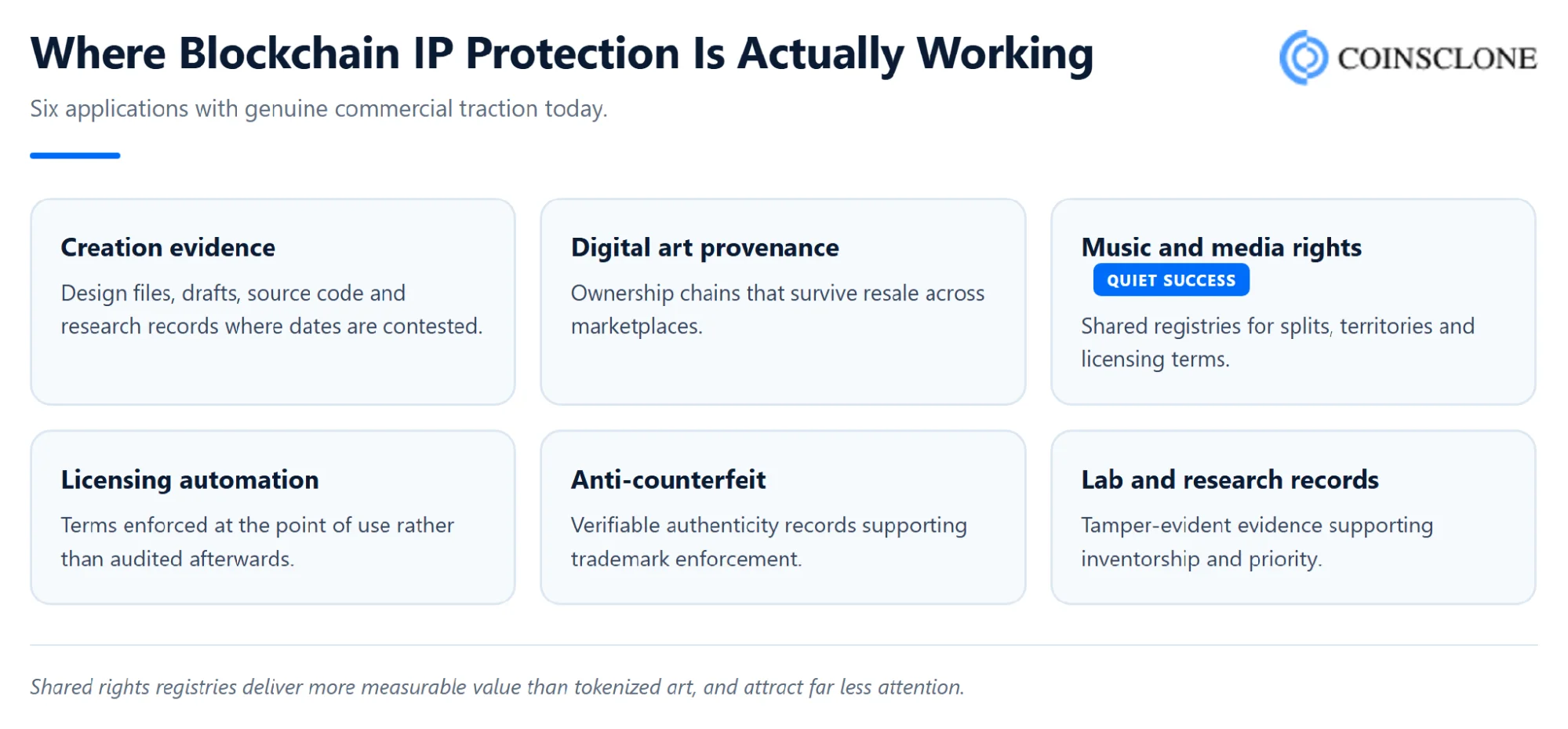
Six applications with genuine commercial traction.
Creation evidence for design files, drafts, source code and research records, in fields where establishing a date is routinely contested.
Provenance for digital art, with ownership chains that survive resale across marketplaces.
Music and media rights, where split sheets and rights registries shared between labels, publishers and platforms reduce the disputes that consume legal budgets.
Licensing automation, enforcing terms at the point of use rather than auditing compliance afterwards.
Anti-counterfeit for brands, where verifiable authenticity records support trademark enforcement across supply chains.
Research and laboratory records, providing tamper-evident evidence supporting inventorship and priority claims.
Shared rights registries are the quiet success in this list. They attract far less attention than tokenized art and they deliver more measurable value, because the money lost to unresolved rights data in music and media dwarfs anything recovered through resale royalties.
Why Do Smart Contract Royalties Fail?
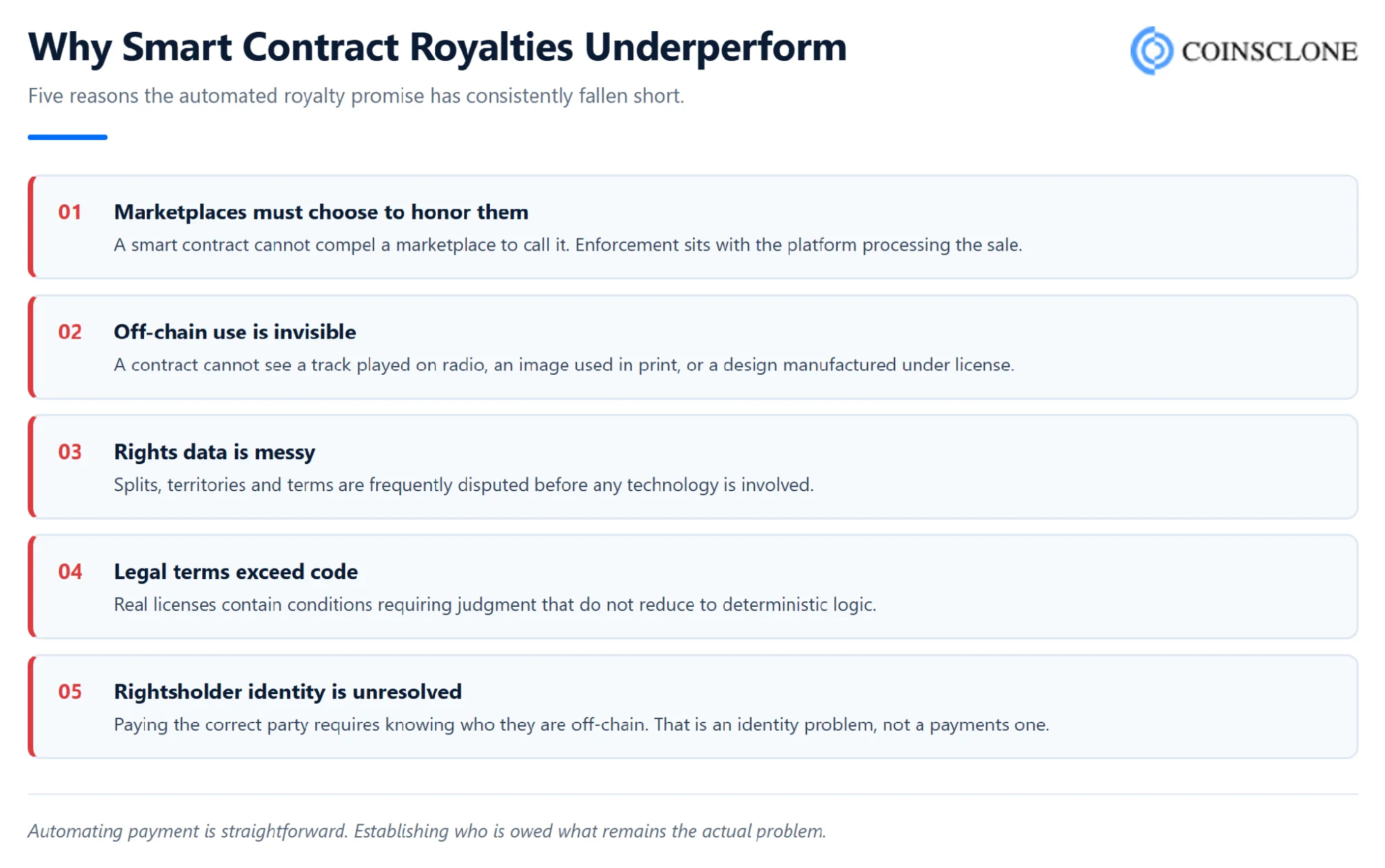
Five reasons the promise has consistently underperformed.
Marketplaces have to honor them. On-chain royalty terms are enforced by the platforms that process sales, and a smart contract cannot compel a marketplace to call it. When major NFT marketplaces moved creator royalties from mandatory to optional, creator earnings on secondary sales fell accordingly, and no amount of code on the token could prevent it.
Off-chain use is invisible. A contract cannot see a track played on radio, an image used in print, or a design manufactured under license.
Rights data is messy. Splits, territories and terms are frequently disputed before any technology is involved, and encoding a disputed split does not resolve it.
Legal terms exceed code. Real licenses contain conditions requiring judgment, such as reasonable use, materiality and good faith, that do not reduce to deterministic logic.
Rightsholder identity is unresolved. Paying the correct party requires knowing who they are off-chain, which is an identity problem rather than a payments one.
Automating payment is straightforward. Establishing who is owed what remains the actual problem, and it was the actual problem before blockchain existed.
What Are the Legal Limits of Blockchain for Intellectual Property?
Four constraints come up repeatedly, and better cryptography solves none of them.
Immutability collides with erasure rights. The GDPR right to erasure and copyright takedown regimes such as the DMCA both assume content can be removed. A public chain is designed so that it cannot be. Storing only hashes rather than works largely sidesteps this, which is a strong argument for hash-only designs over on-chain content storage.
Admissibility varies by jurisdiction. Some courts have accepted blockchain records as evidence and others have not tested the question. Treatment depends on how the evidence was created, how chain of custody was documented, and local rules on electronic evidence. Plan for the record to be one exhibit among several rather than the whole case.
Keys are a single point of failure. The record proves that a key committed a hash. If you cannot demonstrate you controlled that key, or you lose it, the evidentiary link weakens considerably. Key custody deserves the same seriousness as the IP it evidences.
Pseudonymity cuts both ways. An address proves something was committed, not who committed it. Linking an on-chain identity to a legal person is an off-chain problem, usually solved with attestations, notarization or documented corporate key management.
How Do You Use Blockchain for IP Protection Today?
A workable process for a team producing intellectual property continuously.
Hash at creation, not at dispute. Build hashing into the point where work is produced, whether that is the code repository, the digital asset manager or the lab notebook system. Evidence created routinely is worth far more than evidence created after a conflict starts.
Anchor on a schedule. Batch daily or weekly. Costs stay negligible and the granularity is sufficient for almost any priority dispute.
Keep originals under version control. The hash is only useful while you can reproduce the exact bytes that generate it.
Register where registration confers rights. File copyrights and patents on the normal timetable and use the on-chain record to support the story around those filings.
Document the process. A written, consistently followed procedure is what turns a pile of individual hashes into credible evidence of practice.
Decide storage policy up front. Hashes on chain, works off chain, with a clear position on what happens when a takedown or erasure request arrives.
What Is Next for Blockchain and Intellectual Property?
Three developments are worth watching, and one is reshaping the category faster than the others.
Provenance for AI training data is the growth area. Disputes over whether copyrighted works were used to train generative models have made verifiable content origin commercially urgent for rightsholders, publishers and model developers simultaneously. Tamper-evident records of what a work is, when it existed and what terms attach to it map directly onto that problem, and content provenance standards such as C2PA are converging on the same requirement from the media side.
Standardization is arriving. The output of WIPO’s Blockchain Task Force matters because shared data models are what allow registries operated by different labels, IP offices and platforms to interoperate. Interoperability, not novelty, is the real bottleneck in rights registries.
Tokenized IP as a financial asset is early. Treating patent portfolios, music catalogs and royalty streams as tokenized real world assets is technically feasible and commercially unproven at scale, and it inherits every valuation and enforcement problem that made IP illiquid in the first place. Worth watching, not yet worth building a business model on.
Conclusion
Blockchain gives intellectual property owners something genuinely valuable: cheap, independent, tamper-evident proof that a work existed in a given form at a given time, plus a provenance record that survives transfers. Used alongside proper registration it strengthens a position materially. Presented as a substitute for registration it creates false confidence that fails at exactly the moment it matters.
Be precise about which of the three jobs you are buying. Prove is solved and cheap. Track works where the platforms cooperate. Monetize is a commercial negotiation with marketplaces dressed up as a technical guarantee, and it should be planned as one.
Coinsclone builds enterprise-grade Web3 platforms including provenance and rights registry systems, NFT marketplaces, RWA tokenization platforms, crypto exchanges, wallets and payment gateways, using customizable white-label solutions. Talk to our blockchain experts for a free consultation and a live demo.
FAQ
Q: How does blockchain protect intellectual property?
Blockchain protects intellectual property by recording a cryptographic hash of a work on a distributed ledger, creating tamper-evident proof that the work existed in a specific form at a specific time. It also tracks provenance through ownership transfers. This is corroborating evidence that strengthens a legal position, not a form of registration that creates rights.
Q: Is a blockchain timestamp the same as copyright registration?
No. A timestamp proves content existed by a date and has not been altered since. It does not register a copyright, prove original authorship, prove you had the right to file, or replace jurisdictional registration where registration confers rights or remedies. In the United States, registration remains a prerequisite for suing over infringement of a U.S. work. Use both together.
Q: Does buying an NFT give you the copyright to the artwork?
No. Buying an NFT transfers the token, not the copyright in the underlying work. Copyright stays with the creator unless assigned in a separate written agreement. Most NFT buyers receive a license whose scope is defined by the collection’s terms, ranging from personal display only to broad commercial use.
Q: Can blockchain prove I am the author of a work?
It proves a specific key committed specific content at a specific time. It cannot prove you created that content rather than copying it from someone who had not yet published. That distinction matters in disputes, which is why timestamping supports an authorship claim rather than establishing one.
Q: How do smart contract royalties work, and why do they fail?
Terms encoded on-chain instruct a marketplace to route a share of a sale to the original creator. They fail when marketplaces choose not to enforce them, when use happens off-chain and is invisible to the contract, when the underlying rights data is disputed, and when license terms require judgment that code cannot express.
Q: How much does it cost to timestamp a work on a blockchain?
Very little. Because services batch many hashes into a single Merkle tree and anchor only the root, per-document cost typically falls to a fraction of a cent, and open implementations such as OpenTimestamps are free to use. Cost is not the barrier to adoption in this category.
Q: Will a court accept a blockchain timestamp as evidence?
It may be admitted as corroborating evidence, and treatment varies by jurisdiction and by how the evidence was created and preserved. It should not be relied on as a substitute for registration or for conventional evidentiary practice. Seek advice from qualified counsel where the position matters.
Q: Does blockchain help with patents?
Indirectly. Tamper-evident laboratory and research records can support inventorship and priority claims, and timestamping can evidence when a conception occurred. It does not replace filing, examination or the jurisdictional patent system in any way.
Q: What are the best IP uses of blockchain today?
Creation evidence for designs, drafts, code and research records; provenance for digital art that survives resale; shared rights registries in music and media; licensing enforced at point of use; anti-counterfeit support for brands; and tamper-evident laboratory records supporting priority claims.