Fantasy sports is one of the more commercially attractive blockchain applications, and also one where the sequencing of decisions matters more than in almost any other category. Whether your product is treated as a game of skill or as gambling depends on contest format, entry fees, prize structure and where the user is physically located, and that determination shapes everything downstream including which features you can offer. This guide covers the legal question first, then what blockchain genuinely adds, what the one live example at scale reveals, what actually drives cost, and a build sequence that settles the expensive unknowns before engineering starts.
Why Does the Legal Position Decide the Product?
Because it determines contest format, and contest format determines the entire product. Building first and checking later is the most expensive mistake available in this category.
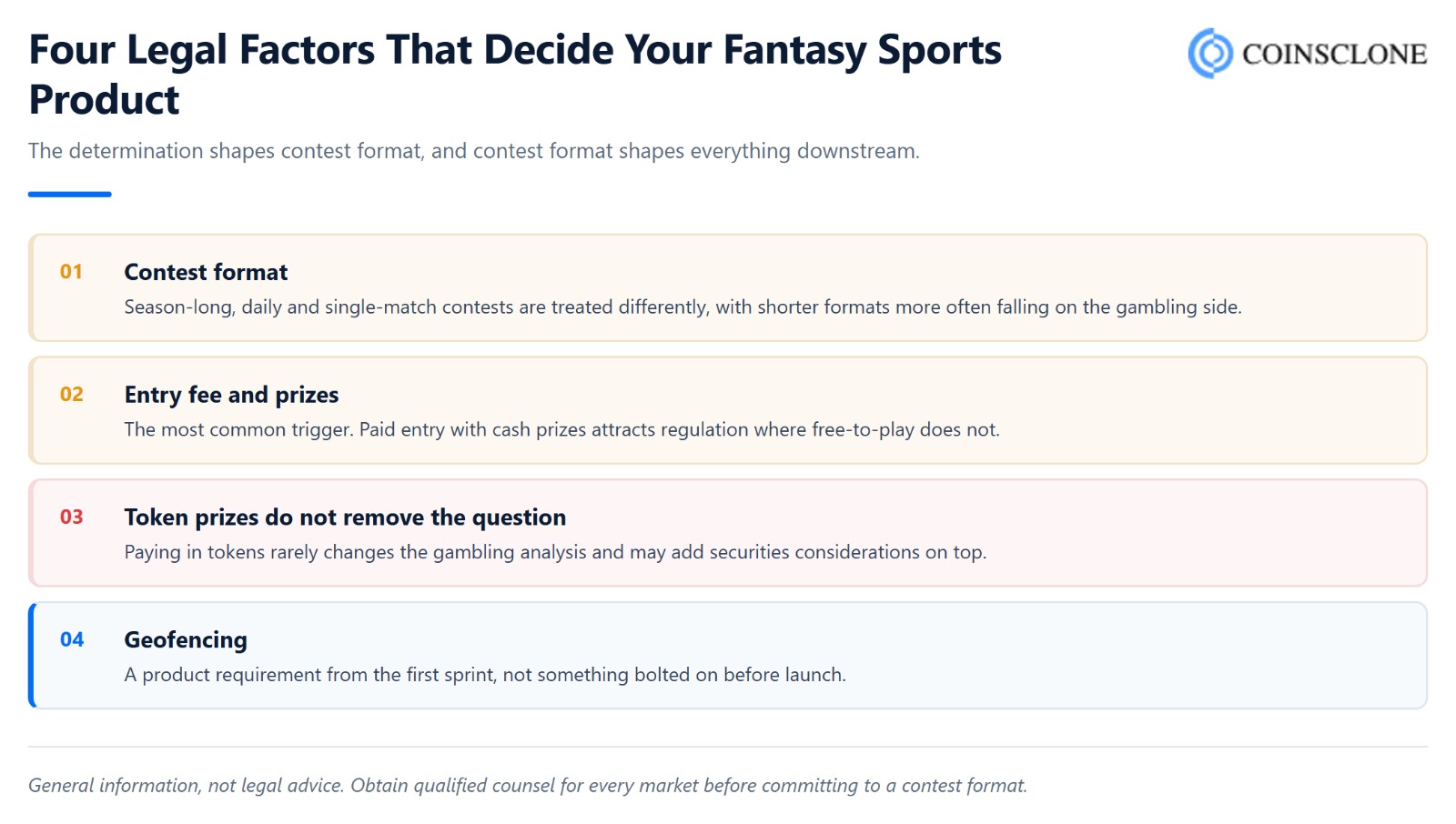
Fantasy sports regulation varies more than any other aspect of this build, and it varies by country and frequently by state or province.
Contest format matters. Season-long, daily and single-match contests are treated differently in several jurisdictions, with shorter formats more often falling on the gambling side of the line.
Entry fee and prizes are the most common trigger. Paid entry with cash prizes attracts regulation in most places where free-to-play does not.
Token prizes do not remove the question. Paying in tokens instead of cash rarely changes the gambling analysis and may add securities considerations on top.
Geofencing is therefore a product requirement from the first sprint, not something bolted on before launch.
This is general information rather than legal advice. Obtain qualified counsel for every market you intend to operate in, before committing to a contest format.
Is Fantasy Sports Gambling? How the Main Markets Differ
The answer is genuinely different in each major market, and the differences drive product decisions rather than merely legal ones.
United States. Federal law carved out fantasy contests meeting specific conditions from a 2006 prohibition on online gambling payments, which is why the daily fantasy industry exists at all. That carve-out does not preempt state law, and states have taken divergent positions, with some permitting paid contests under license, some restricting formats and some prohibiting them. Any US product is a state-by-state compliance map rather than a single determination.
India. Courts have repeatedly treated fantasy sports as a game of skill rather than chance, which permitted a large paid-entry market to develop. The commercial position changed sharply when a 28 percent GST was applied to the full deposit value for online money gaming, materially altering unit economics, and several states restrict or prohibit paid contests regardless of the skill classification.
United Kingdom and Europe. Paid fantasy contests generally fall under gambling licensing rather than a skill exemption. Where tradeable digital assets are involved, the analysis can engage both gambling and financial regulation at once.
The practical consequence is that your target market list should be settled before your feature list. A tradeable-asset model that works in one jurisdiction may be unlicensable in another, and retrofitting a compliant format onto a built product usually means rebuilding it.
What Does Blockchain Genuinely Add?
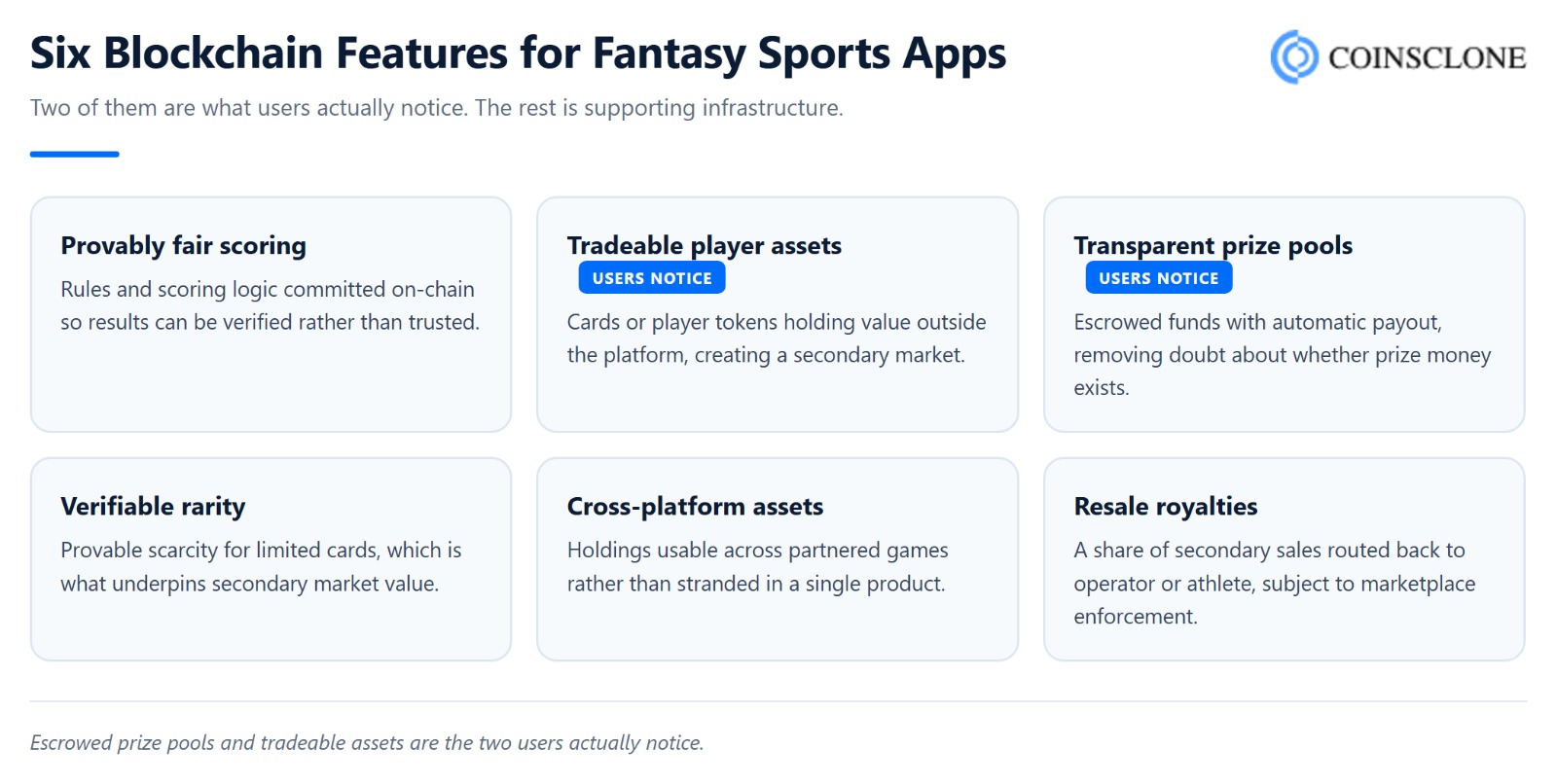
Six features, of which two are what users actually notice.
Provably fair scoring. Rules and scoring logic committed on-chain so results can be verified rather than trusted, which addresses the most common user complaint in fantasy platforms.
Tradeable player assets. Cards or player tokens holding value outside the platform, creating a secondary market and a reason to keep a collection.
Transparent prize pools. Escrowed funds with automatic payout, removing any doubt about whether prize money exists and will be paid.
Verifiable rarity. Provable scarcity for limited cards, which is what underpins secondary market value.
Cross-platform assets. Holdings usable across partnered games rather than stranded in a single product.
Resale royalties. A share of secondary sales routed back to the operator or athlete, subject to marketplace enforcement.
Escrowed prize pools and tradeable assets are the two users actually notice. The rest is infrastructure that supports them.
What Does Sorare Reveal About This Model?
Sorare is the one blockchain fantasy sports product operating at meaningful scale, and it is worth studying because it has already encountered every issue a new entrant will meet.
The model is licensed player cards as tradeable digital assets, used to enter fantasy contests, with official licensing from football, basketball and baseball competitions. Three things about it are instructive.
Official licensing is the moat and the cost. Using real player names, likenesses and club identities requires agreements with leagues and player associations. This is a larger commercial undertaking than the technology and it is what a clone script cannot supply.
Regulators engaged with it. The UK Gambling Commission examined whether the product required a gambling license, and the company has faced regulatory questions in more than one market. A tradeable-asset fantasy model sits in genuinely contested territory rather than settled ground.
Asset values are volatile. Card prices fell substantially from their peak alongside the wider market. A business model where user retention depends on collection value inherits that volatility, and a launch plan should model the downside rather than the launch-window enthusiasm.
None of this argues against building. It argues for entering with licensing and legal settled, and with a product that still works if secondary market prices fall.
What Drives the Cost?
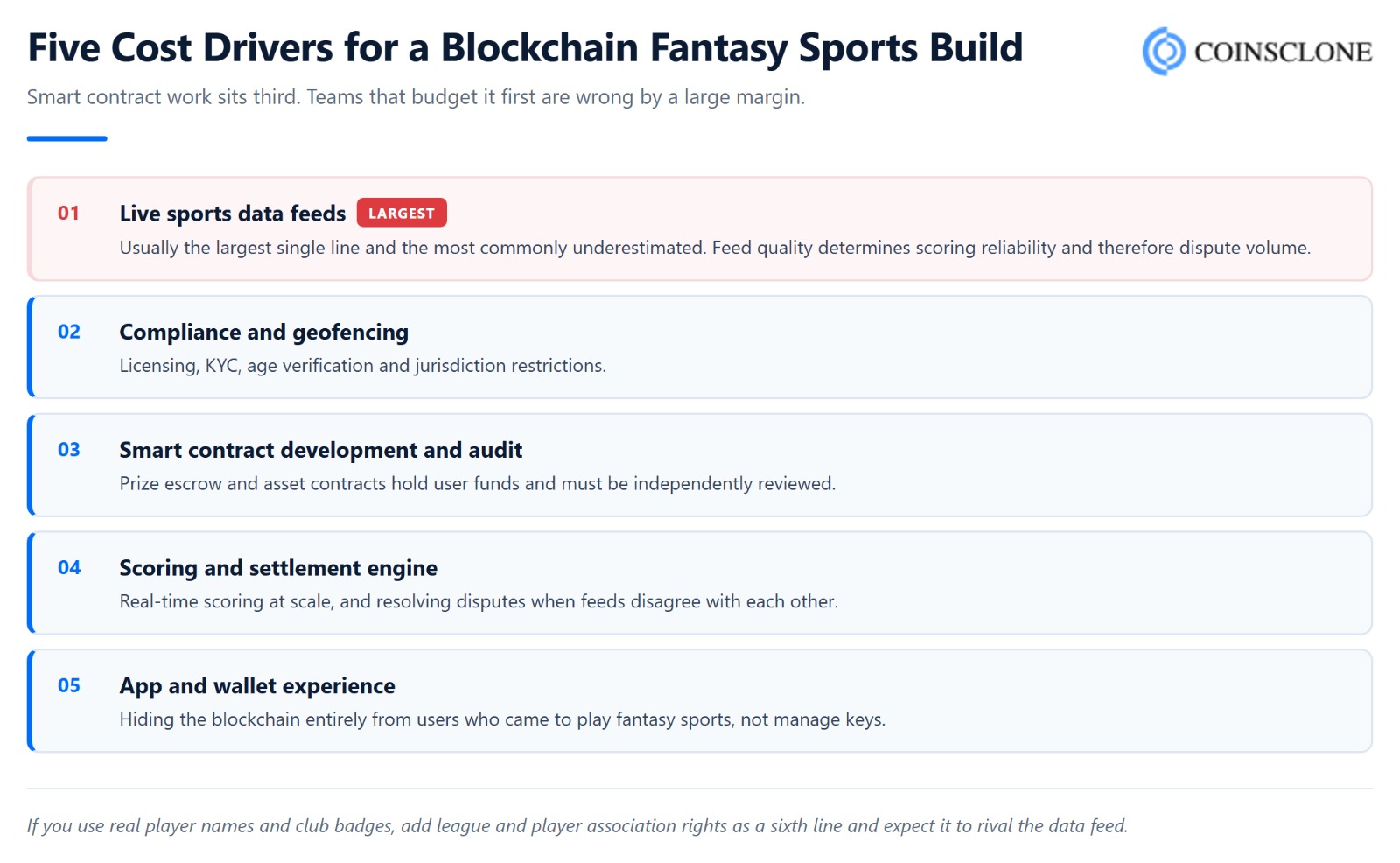
Live sports data feeds are usually the largest single line and the most commonly underestimated. Licensed real-time data is a recurring cost, and the quality of the feed determines scoring reliability and therefore dispute volume.
Compliance and geofencing follows, covering licensing, KYC, age verification and jurisdiction restrictions.
Smart contract development and audit for prize escrow and asset contracts, which hold user funds and must be independently reviewed.
Scoring and settlement engine, handling real-time scoring at scale and resolving disputes when feeds disagree with each other.
App and wallet experience, which needs to hide the blockchain entirely from users who came to play fantasy sports rather than manage keys.
Notice that smart contract work sits third. Teams that budget for contracts and treat data licensing as an afterthought produce estimates that are wrong by a large margin. If you intend to use real player names and club badges, add league and player association licensing as a sixth line and expect it to rival the data feed.
What Licensing and Compliance Do You Need?
Four separate approvals, frequently confused with each other, and each with its own timeline.
Gambling or gaming licenses where your contest format and market require one. This is jurisdiction by jurisdiction and is the long pole.
Sports data licensing, a commercial agreement with a data provider for real-time statistics, with terms covering permitted use, redistribution and latency.
Player and league rights if you use real names, likenesses, club badges or competition marks. Data licensing does not include these, and assuming it does is a common and expensive error.
Financial and payments compliance, covering KYC and anti-money-laundering obligations where real money moves, plus any securities analysis triggered by tradeable assets marketed with an expectation of value.
Sequence these in parallel with each other and ahead of engineering. The gating item is almost never the code.
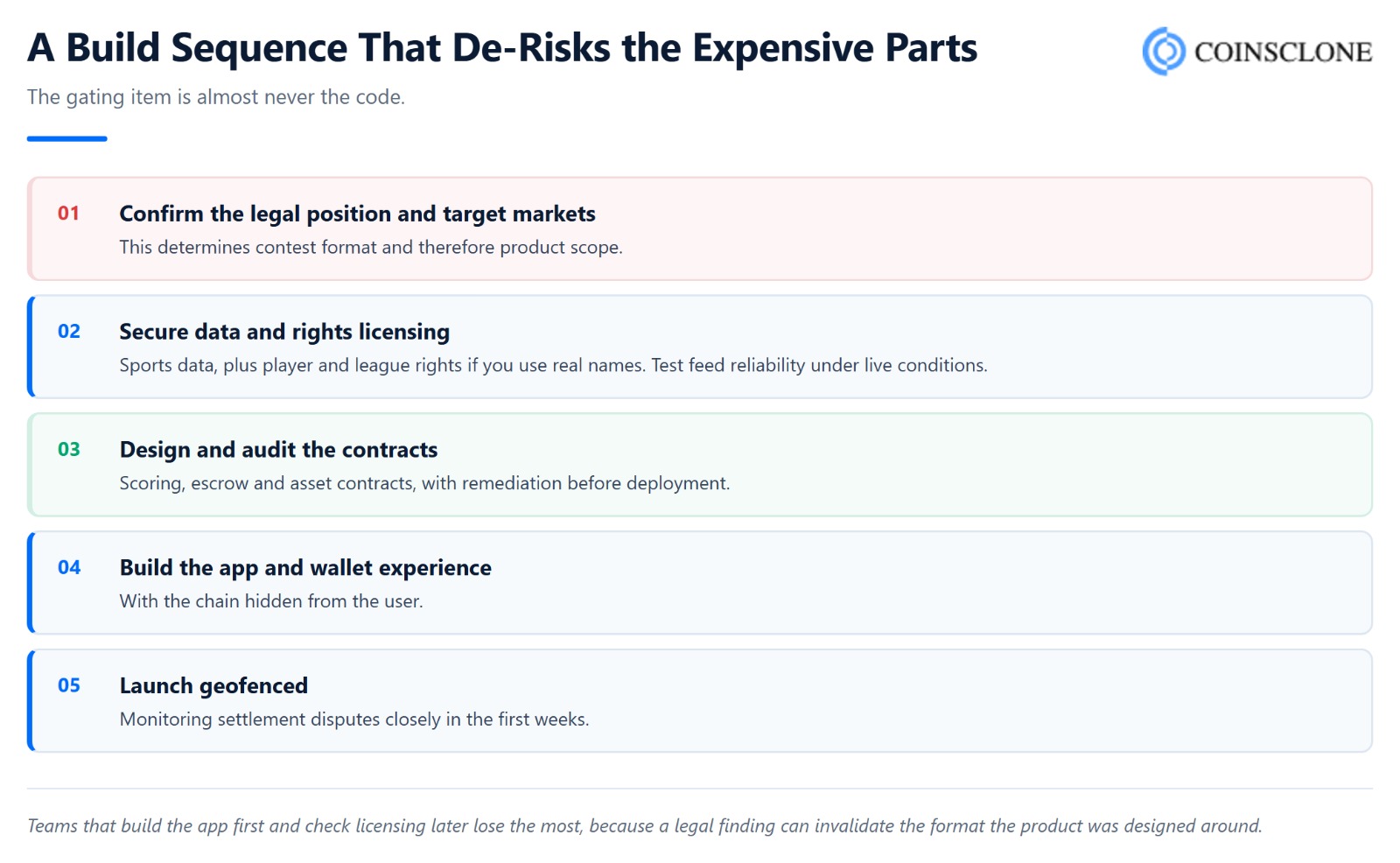
What Build Sequence De-Risks the Expensive Parts?
Stage one: confirm the legal position and the target markets, because this determines contest format and therefore product scope.
Stage two: secure sports data licensing and, if required, player and league rights. Test feed reliability under live conditions, since scoring quality depends entirely on it.
Stage three: design scoring, escrow and asset contracts, then audit them with remediation before deployment.
Stage four: build the app and wallet experience with the chain hidden from the user.
Stage five: launch geofenced, monitoring settlement disputes closely in the first weeks.
Teams that build the app first and check licensing later lose the most time and money, because a legal finding can invalidate the contest format the entire product was designed around.
Conclusion
A blockchain fantasy sports product succeeds on two things users can feel: prize pools they can verify exist, and assets that hold value beyond the platform. Everything else is supporting infrastructure.
Confirm the legal position and secure data and rights licensing before engineering begins. Budget an audit for any contract holding prize funds. Model the business assuming secondary market values fall rather than rise. And hide the blockchain completely from a user who came to pick a team. Sequencing those correctly is what separates a launched product from an expensive prototype.
Coinsclone builds enterprise-grade Web3 platforms including blockchain fantasy sports and gaming apps, NFT marketplaces, tokenized asset platforms, crypto exchanges, wallets and payment gateways, using customizable white-label solutions. Talk to our blockchain experts for a free consultation and a live demo.
FAQ
Q: Is fantasy sports gambling?
It depends on jurisdiction, contest format and prize structure. US federal law carved out qualifying fantasy contests from a 2006 online gambling payments prohibition, but states differ. Indian courts have treated fantasy sports as a game of skill, though tax and state restrictions apply. The UK and much of Europe treat paid contests under gambling licensing.
Q: What does blockchain add to a fantasy sports app?
Provably fair scoring with rules committed on-chain, tradeable player assets that hold value outside the platform, escrowed prize pools with automatic payout, verifiable rarity for limited cards, cross-platform asset use, and resale royalties. Escrowed prizes and tradeable assets are what users actually notice.
Q: What drives the cost of building a blockchain fantasy sports app?
Licensed live sports data feeds are usually the largest line and the most underestimated, followed by compliance and geofencing, then smart contract development and audit, the scoring and settlement engine, and the app and wallet experience. If you use real player names and club badges, league and player association rights are a further major cost.
Q: Do token prizes avoid gambling regulation?
Rarely. Paying in tokens instead of cash seldom changes the gambling analysis, and it can add securities considerations on top where the token is tradeable and marketed with any expectation of value. Assuming tokens sidestep the question is one of the more expensive misconceptions in this category.
Q: What licenses does a fantasy sports app need?
Potentially four separate things: gambling or gaming licenses where the format and market require them, a commercial sports data license, player and league rights if you use real names and likenesses, and financial compliance covering KYC and anti-money-laundering where real money moves. Data licensing does not include player rights.
Q: What is Sorare and what does it show?
The largest blockchain fantasy sports platform, built on licensed player cards as tradeable assets. It shows that official league and player licensing is the real moat, that regulators including the UK Gambling Commission have actively examined the model, and that a business depending on collection value inherits secondary market volatility.
Q: How does provably fair scoring work?
Scoring rules and logic are committed on-chain so any user can verify that the published result follows from the published rules and the recorded data, rather than trusting the operator’s calculation. It addresses disputes about scoring integrity, though it cannot resolve disagreements originating in the underlying sports data feed.
Q: Do users need a crypto wallet to play?
They should not need to think about one. Custodial or embedded wallets let users play without managing seed phrases or paying gas. Requiring users who came to pick a team to understand blockchain is a reliable way to lose them at signup.
Q: How long does it take to build a blockchain fantasy sports app?
The engineering is rarely the constraint. Legal determination, data licensing and any gambling license application dominate the timeline and should run in parallel ahead of build. Smart contract audit and remediation adds further time before any contract holding prize funds can be deployed.
Q: What is the biggest mistake in building one of these?
Building the app before confirming the legal position. A legal finding can invalidate the contest format the product was designed around, which means rebuilding rather than adjusting. The second biggest is budgeting for smart contracts while treating sports data licensing as a minor line item.