Anyone building a blockchain identity product should understand the patent position before settling the architecture, because claim themes in this area overlap heavily and the largest portfolios were assembled during a period of aggressive speculative filing.
The encouraging part is that the landscape has stabilized. Filing volumes peaked and then fell steeply as patent offices applied stricter scrutiny to abstract ideas and software eligibility. The more encouraging part, which most coverage of this topic omits entirely, is that the core identity standards you are most likely to build on were published under a royalty-free patent policy.
This guide covers who holds what, what those patents actually claim, why so many never granted, how the open standards change your exposure, and the practical steps to take before committing to a design.
What Are Blockchain Digital Identity Patents?
Blockchain digital identity patents are patents claiming methods and systems for issuing, holding, presenting or verifying identity credentials using a distributed ledger. They sit at the intersection of two crowded fields, cryptographic identity and blockchain infrastructure, which is why claim overlap is unusually high.
A patent grants the right to stop others from practicing a claimed invention in a specific jurisdiction for a limited term. Three consequences follow, and they are routinely misunderstood.
Patents are territorial. A United States patent restricts nothing in a country where it was never filed. Your exposure depends entirely on the markets you operate in, not on where the patent originated.
A filing is not a grant. Published applications appear in portfolio counts and confer no enforceable rights unless and until they issue, with claims that are frequently narrowed during examination.
Claims control, not titles. A patent titled broadly may carry claims that are narrow and specific. Reading the title and panicking is the most common mistake non-specialists make in this area.
That third point matters more here than almost anywhere else, because vendor marketing and press coverage in this sector describe portfolios by theme rather than by claim scope.
Who Owns the Most Blockchain Patents?
It depends entirely on whether you count applications filed or patents actually granted, and the two produce different leaders. Figures below are from Coincub’s Blockchain Patent Report 2023.
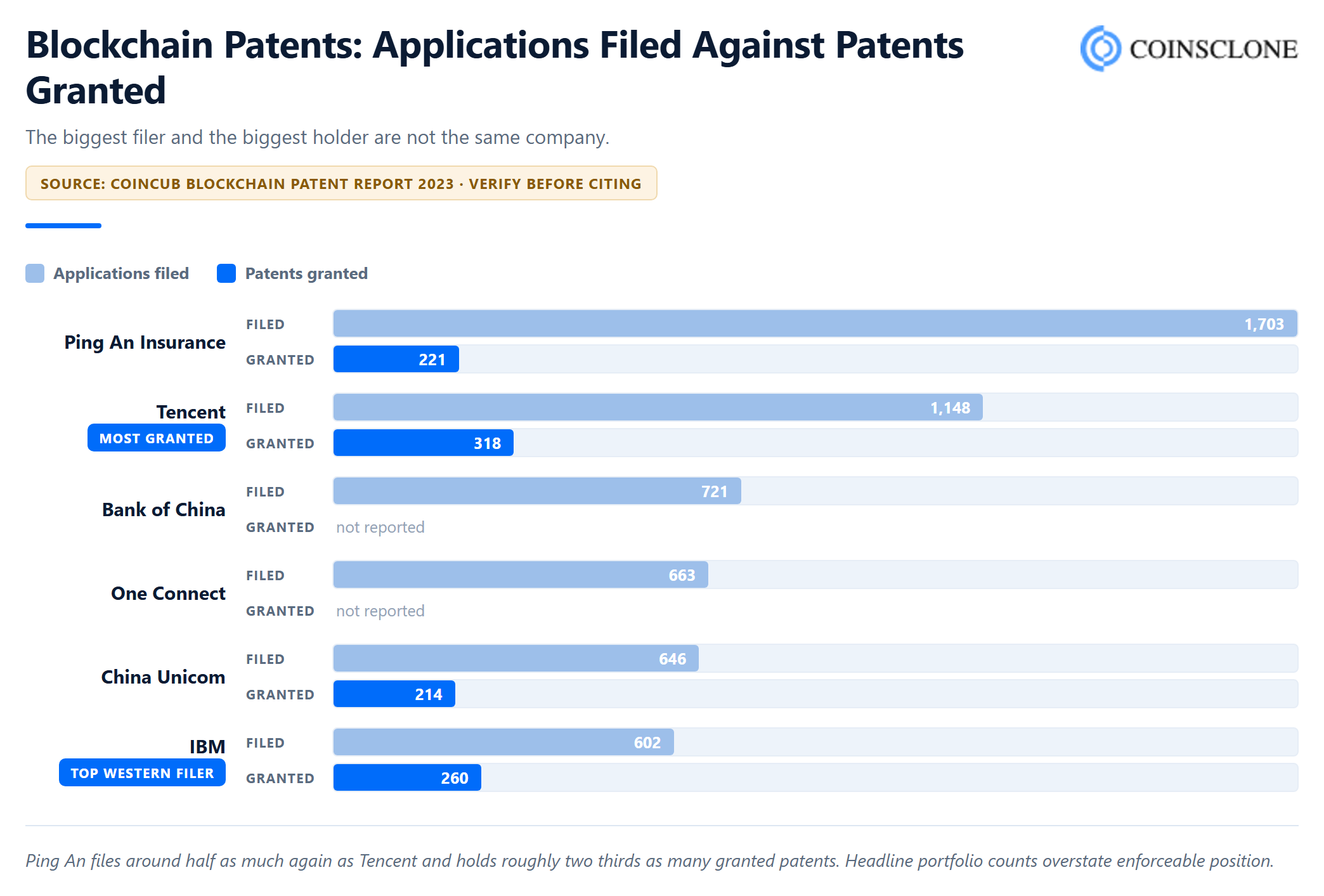
Ping An Insurance leads on filings with 1,703, of which only 221 have granted. Its portfolio concentrates on financial services and healthcare data sharing.
Tencent filed 1,148 and holds 318 granted, the largest number of granted blockchain patents globally. The portfolio spans payments, gaming and social platform integrations.
Bank of China at 721 filings and One Connect at 663 both filed more than IBM, and are routinely omitted from Western coverage of this topic.
China Unicom filed 646 with 214 granted.
IBM is the leading Western filer at 602 filings and 260 granted, focused on supply chain tracking and digital identity.
Ranked by granted patents instead of filings, the order changes materially: Tencent at 318, IBM at 260, Advanced New Technologies at 227, Ping An at 221, China Unicom at 214, Alipay at 123 and Baidu at 117.
Two conclusions follow. Ping An files around half as much again as Tencent and holds roughly two thirds as many granted patents, so headline portfolio counts substantially overstate enforceable position. And concentration by volume is not concentration by risk: one narrow granted claim that reads precisely on your architecture matters more than a thousand filings that do not.
Has Blockchain Patent Filing Peaked?
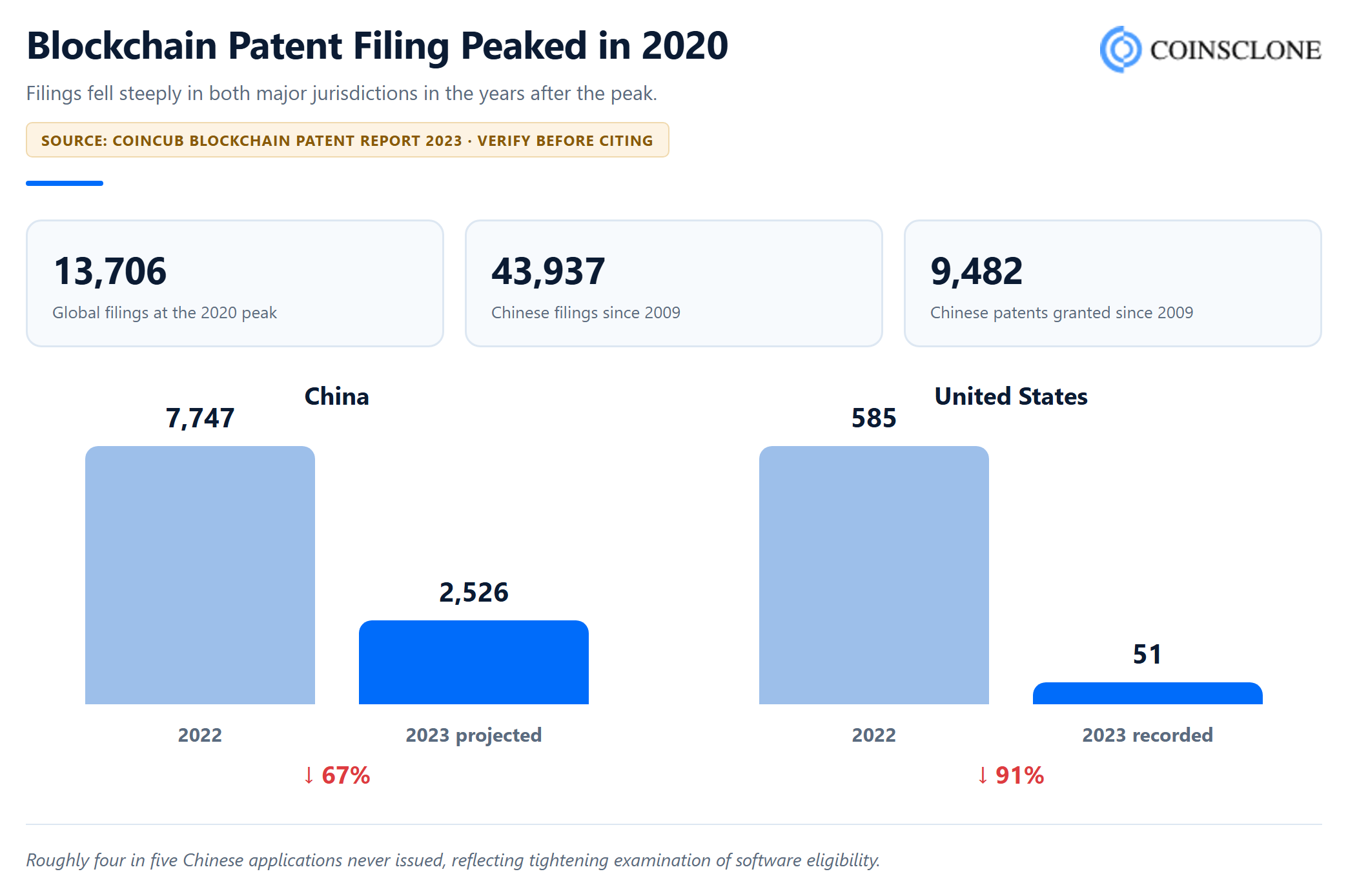
Yes, and sharply. Worldwide filings peaked at 13,706 in 2020, and the fall since has been steep in both major jurisdictions.
In China, filings dropped from 7,747 in 2022 to a projected 2,526 in 2023. In the United States the proportional fall was steeper still, from 585 in 2022 to 51 recorded in 2023.
The cumulative picture shows the same gap between activity and outcome. China has recorded 43,937 filings since 2009 against 9,482 patents granted, meaning roughly four in five applications never issued.
Three forces drove the decline, and each has a different implication for you.
Examination tightened. Offices applied stricter scrutiny to abstract ideas and software eligibility, so the marginal filing became far less likely to grant.
Speculative filing stopped paying. The 2017 to 2020 wave was partly a positioning exercise during a hype cycle. When valuations normalized, so did filing budgets.
Filings became more technical. What is filed now tends to claim specific mechanisms rather than generic ledger applications.
The practical reading is that the land grab is over. It also means a portfolio assembled in 2018 may contain claims that would not survive examination today, which directly affects how seriously to take a threat letter referencing them. Old patents are not automatically strong patents.
What Do Blockchain Identity Patents Actually Claim?
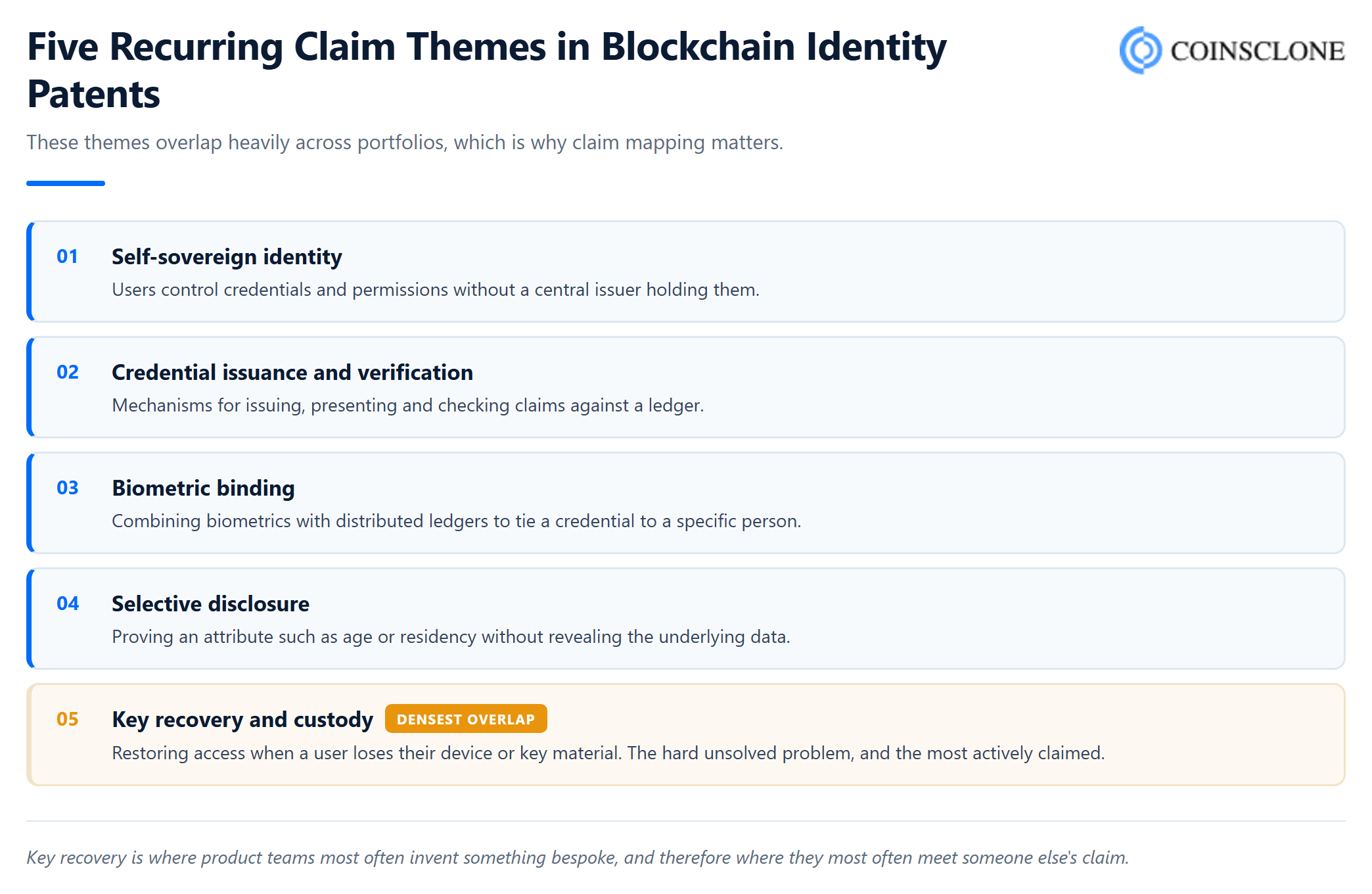
Five themes recur across identity portfolios.
Self-sovereign identity, covering users controlling credentials and permissions without a central issuer holding them.
Credential issuance and verification, describing mechanisms for issuing, presenting and checking claims against a ledger.
Biometric binding, combining biometrics with distributed ledgers to tie a credential to a specific person.
Selective disclosure, proving an attribute such as age or residency without revealing the underlying data.
Key recovery and custody, restoring access when a user loses their device or key material. This is the genuinely hard unsolved problem in the field, and unsurprisingly the most actively claimed.
These themes overlap heavily across portfolios, and because the sector matured quickly there are multiple entities claiming pioneering solutions in similar territory. That overlap is exactly why freedom-to-operate work matters more here than in less crowded fields. It is also why key recovery deserves particular attention: it is the layer where product teams most often invent something bespoke, and therefore the layer where they most often walk into someone else’s claim without noticing.
Why Do So Many Blockchain Patents Fail to Grant?
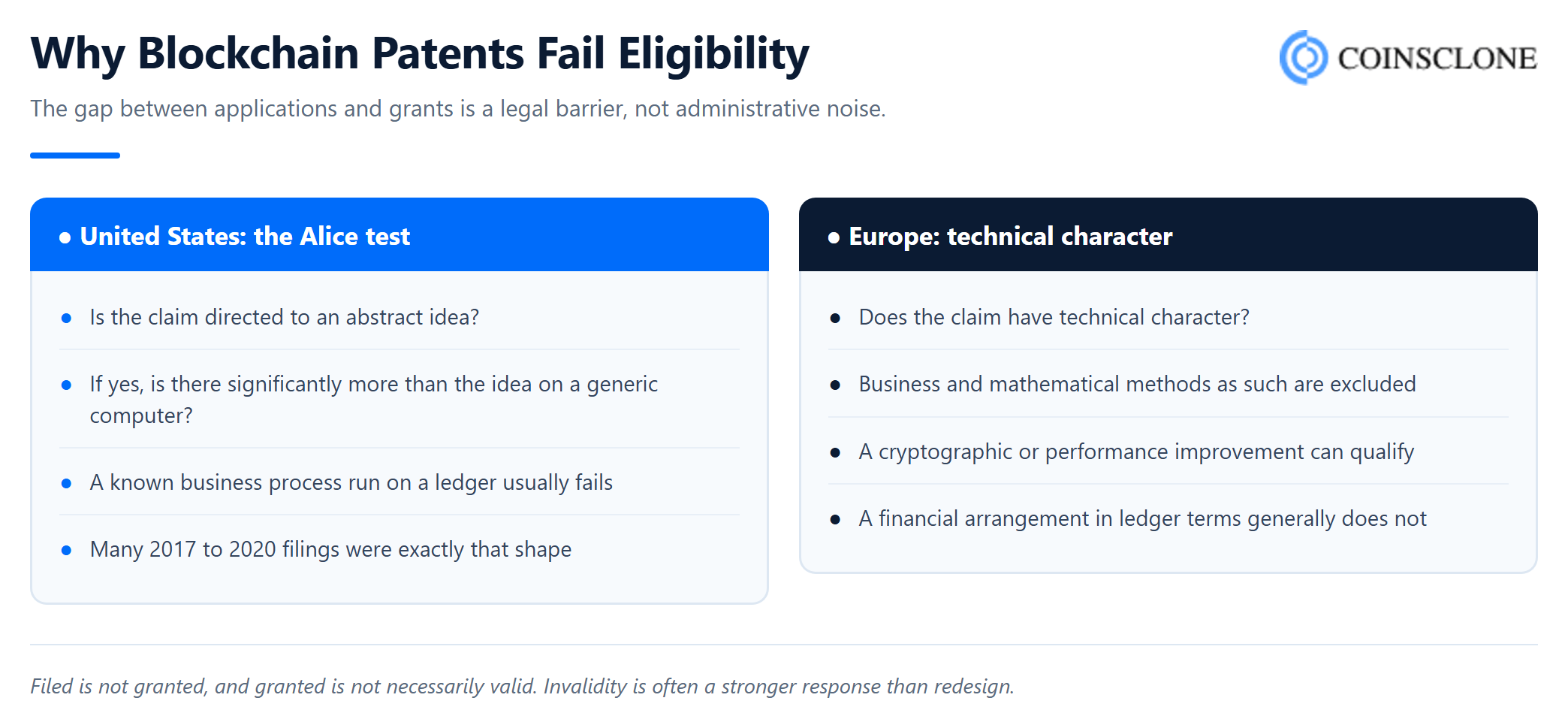
The gap between 43,937 Chinese filings and 9,482 grants is not administrative noise. It reflects a substantive legal barrier that applies differently in each major jurisdiction.
In the United States, the Supreme Court’s decision in Alice Corp v. CLS Bank established a two-step test for patent eligibility. A claim directed to an abstract idea is ineligible unless it contains something significantly more than the idea implemented on a generic computer. Many early blockchain filings were, in substance, a known business process performed on a ledger, which is close to the paradigm case the test was designed to exclude.
At the European Patent Office, the requirement is technical character. Business methods and mathematical methods as such are excluded, and a claim must solve a technical problem by technical means. A cryptographic or performance improvement can qualify. A novel financial arrangement expressed in ledger terms generally does not.
The practical consequence for a builder is worth stating plainly. A portfolio count tells you how much a company filed. It tells you very little about how much of that portfolio would survive a serious validity challenge. Where a specific claim genuinely threatens your product, invalidity is often a stronger response than redesign, and that assessment belongs with counsel rather than with an engineering team.
Who Controls the Standards Behind Self-Sovereign Identity?
This is the part most coverage of blockchain identity patents leaves out, and it changes the risk picture substantially in your favor.
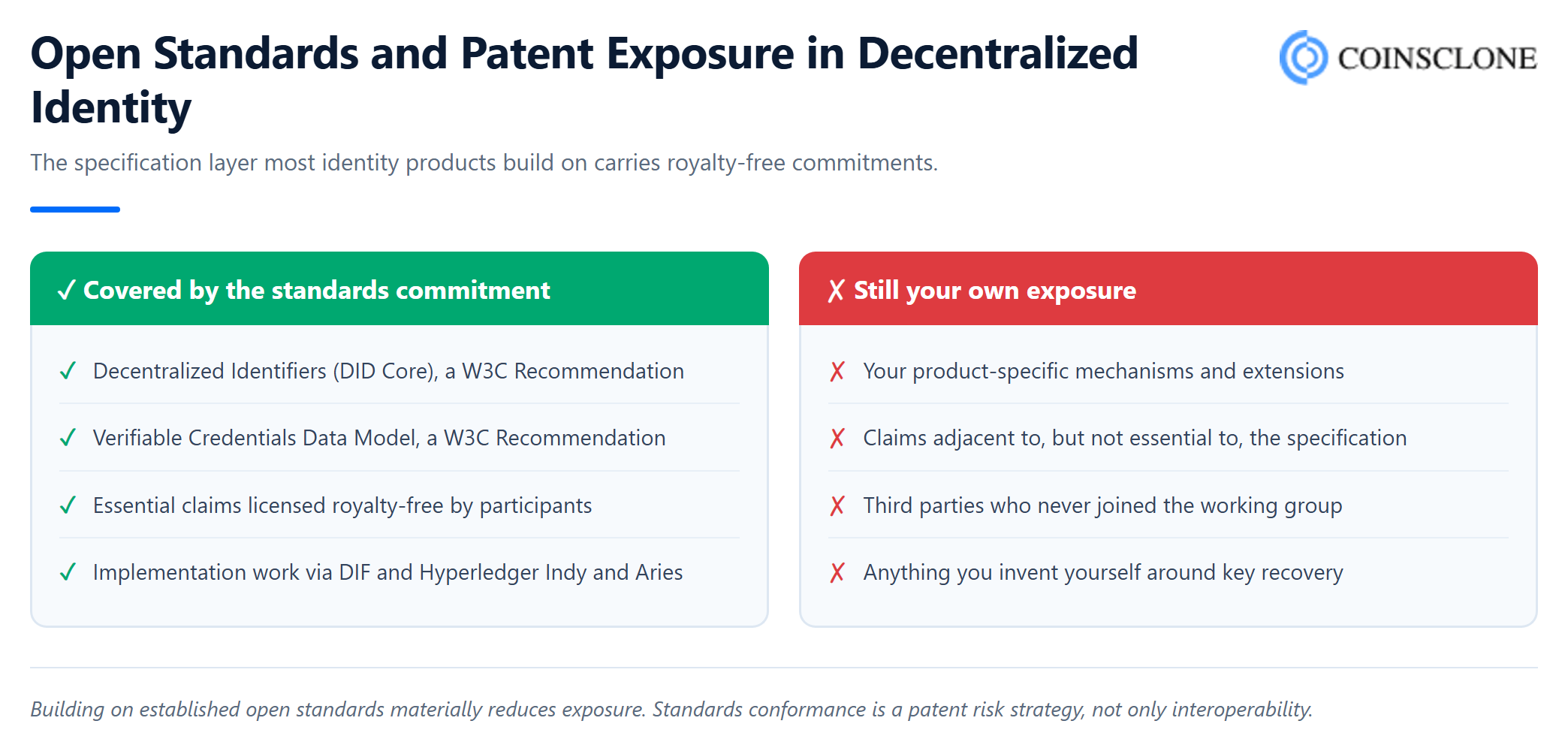
The core building blocks of decentralized identity are open standards, not proprietary technology. Decentralized Identifiers and the Verifiable Credentials Data Model are both World Wide Web Consortium Recommendations. Supporting implementation work runs through the Decentralized Identity Foundation and through Linux Foundation projects such as Hyperledger Indy and Aries.
The governance detail that matters is the W3C patent policy. Organizations participating in a working group commit to licensing essential claims on a royalty-free basis for implementations of the resulting Recommendation. In other words, the specification layer that most identity products build on was developed under an explicit royalty-free commitment from its participants.
Two qualifications keep this honest. The commitment covers claims essential to implementing the specification, not everything adjacent to it, so your product-specific mechanisms sit outside its protection. And it binds working group participants rather than the entire industry, so a third party who never joined is unaffected.
The conclusion still holds and is worth acting on. Building on established open standards materially reduces exposure compared with inventing a proprietary credential format. Standards conformance is a patent risk strategy, not only an interoperability strategy.
What Is Freedom to Operate, and How Is It Different From Patentability?
These two questions get conflated constantly, and they are entirely independent.
Freedom to operate asks whether you can commercialize your product in a given market without infringing someone else’s existing rights. It looks outward at what others hold.
Patentability asks whether your own invention is novel and non-obvious enough to be protected. It looks inward at what you have built.
All four combinations occur. A product can be unpatentable and completely free to operate, which describes most conventional software. It can be patentable and still infringing, which happens when you improve on something someone else already claimed. Being granted a patent on your own improvement gives you no right to practice it if it reads on an earlier claim.
That last point is the one that surprises product teams most often. A patent is a right to exclude others, not a permission to proceed.
What Steps Should You Take Before Building an Identity Product?
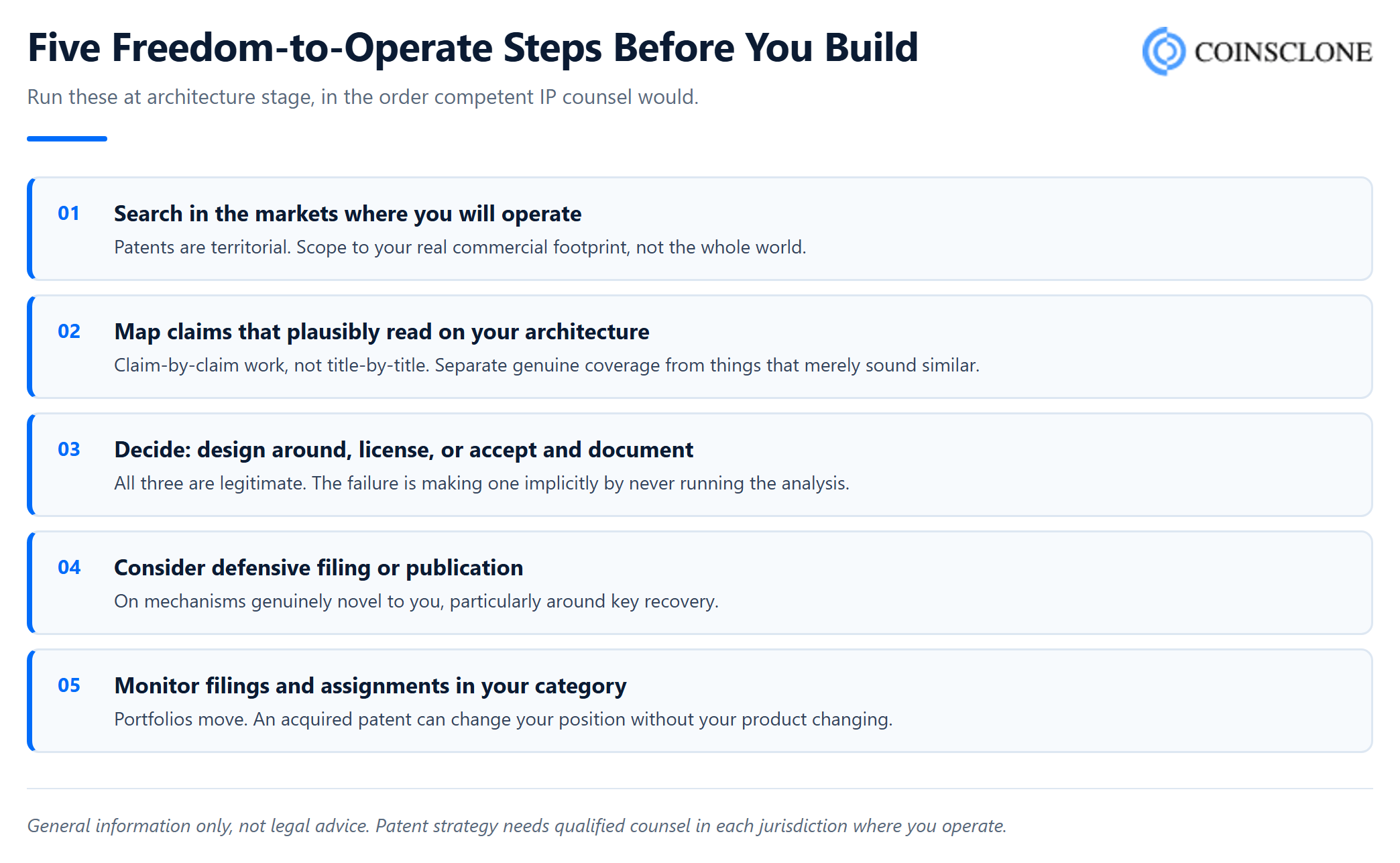
Five steps, in the order competent IP counsel would run them.
Search in the markets where you will actually operate. Patents are jurisdictional. Scope the search to your real commercial footprint rather than to the whole world, which is both cheaper and more useful.
Map claims that plausibly read on your architecture. Distinguish between claims that genuinely cover your approach and claims that merely sound similar in the abstract. This is claim-by-claim work, not title-by-title.
Decide: design around, license, or accept and document. All three are legitimate commercial decisions. The failure mode is making one implicitly by never running the analysis.
Consider defensive filing on mechanisms genuinely novel in your implementation, particularly around key recovery where the hard problems and the dense claims coincide.
Monitor filings and assignments in your category. Portfolios move, and an acquired patent in the hands of a different owner can change your position without anything about your product changing.
Run these at architecture stage. The cost of designing around a claim before you build is a design meeting. After launch it is a migration, a renegotiation with customers, and possibly a disclosure obligation.
This is general information rather than legal advice. Patent strategy requires qualified counsel in each jurisdiction where you operate.
Should You File Your Own Blockchain Patents?
It depends on whether your mechanism is genuinely novel and what a portfolio would actually do for you.
Filing has become more strategic and more technically focused across the industry. Speculative filing on generic ledger applications is now unlikely to grant, so the question is no longer whether you can file but whether the specific mechanism clears a materially higher bar than it would have in 2018.
Three purposes justify the cost. A defensive portfolio gives you something to counter-assert if a competitor comes after you. A commercial portfolio matters where investors or acquirers price it. A freedom-preserving filing stops someone else patenting a mechanism you already depend on, and a defensive publication achieves the same result far more cheaply where you only need to establish prior art.
If none of those three applies, the money is usually better spent on the freedom-to-operate work above.
Conclusion
The blockchain identity patent landscape is crowded, concentrated and past its speculative peak. That combination is manageable rather than alarming. The volume of low-quality filings has fallen, examination has tightened, and many older claims would struggle under current eligibility standards.
Two things follow for anyone building. Freedom-to-operate work belongs at architecture stage rather than after launch, particularly around self-sovereign identity, credential verification, biometric binding and key recovery where claim overlap is highest. And building on open standards developed under royalty-free patent commitments is the single most effective risk reduction available, which makes standards conformance a commercial decision as much as a technical one.
Coinsclone builds enterprise-grade Web3 platforms including decentralized identity and verifiable credential systems, self-sovereign identity wallets, KYC and compliance infrastructure, crypto exchanges, payment gateways and RWA tokenization, using customizable white-label solutions. Talk to our blockchain experts for a free consultation and a live demo.
FAQ
Q: Who owns the most blockchain patents?
It depends whether you count filings or grants. Ping An Insurance leads on applications with 1,703 filed but only 221 granted. Tencent holds the most granted blockchain patents globally at 318, from 1,148 filings. IBM is the leading Western filer with 602 filings and 260 granted. Figures from Coincub’s Blockchain Patent Report 2023.
Q: How many blockchain patents exist?
Filing peaked at 13,706 applications worldwide in 2020 and fell sharply afterwards. China, by far the largest filer, has recorded 43,937 filings since 2009 against 9,482 grants, so roughly four in five applications never issued. Figures from Coincub’s Blockchain Patent Report 2023.
Q: What do blockchain identity patents cover?
Five recurring themes: self-sovereign identity where users control their own credentials, credential issuance and verification mechanisms, biometric binding to tie a credential to a person, selective disclosure to prove an attribute without revealing underlying data, and key recovery when a user loses access.
Q: Do patents block me from building on decentralized identity standards?
Generally not at the specification layer. Decentralized Identifiers and Verifiable Credentials are W3C Recommendations, and W3C’s patent policy commits participating organizations to license essential claims royalty-free for implementations. That covers claims essential to the specification, not your product-specific mechanisms, and it binds participants rather than the whole industry.
Q: Is blockchain patentable?
In principle yes, though it has become harder. In the United States the Alice test excludes abstract ideas implemented on a generic computer, and the European Patent Office requires technical character rather than a business method expressed in ledger terms. The gap between applications filed and patents granted reflects this.
Q: What is freedom to operate?
An assessment of whether your product can be commercialized in a given market without infringing existing patents. It differs from patentability, which asks whether your own invention could be protected. A product can be unpatentable and still free to operate, or patentable and still infringing.
Q: Does a US blockchain patent stop me operating elsewhere?
No. Patents are territorial and only confer rights in the jurisdiction that granted them. A US patent restricts nothing in a country where the holder never filed, which is why a freedom-to-operate search should be scoped to your actual commercial footprint rather than globally.
Q: Is a patent application the same as a granted patent?
No, and the distinction matters when reading portfolio counts. Applications are published and confer no enforceable rights unless they issue, often with claims narrowed during examination. Large reported portfolios frequently mix the two, which overstates enforceable position.
Q: Do I need to worry about patents when building an identity product?
Assess the position rather than ignore it. Claim themes overlap heavily in this area, so a freedom-to-operate search in your target markets at architecture stage is proportionate. Patents are jurisdictional, so the answer depends on where you operate.
Q: Should we file our own blockchain patents?
It depends on whether your mechanism is genuinely novel and whether a portfolio serves a defensive, commercial or freedom-preserving purpose. Speculative filing on generic ledger applications is now unlikely to grant. Where you only need to establish prior art, a defensive publication achieves the same result far more cheaply.