
The best no-KYC crypto exchanges in 2026 are the DEXs and non-custodial P2P platforms that never open an account, led by Uniswap, Jupiter, Bisq and HodlHodl, plus two central exchanges that still allow capped unverified trading: CoinEx at $10,000 a day and BYDFi at 50,000 USDT a day. This guide ranks the 10 non-KYC crypto exchanges people use most, compares every withdrawal limit in one table, and shows which big names dropped out of this group in 2026. We checked each limit and fee against the platform’s own help pages, most recently on 23 October 2026.
Most platforms sold as “no KYC” fall into one of three groups: an unverified tier on a normal exchange, a decentralised exchange (DEX), or a peer to peer (P2P) trade with escrow. Only the last two are private by design. So the type of platform matters more than its rank, and this guide shows you how to tell them apart.
In this guide:
- The 10 best non-KYC crypto exchanges, with a side by side table of limits, fees and custody
- A withdrawal limits table for every crypto exchange without KYC that people still ask about, dated 23 October 2026
- Where ID checks still appear, even when you trade on a DEX
- Which big names now force KYC, including MEXC since February 2026
- The 2026 rules and tax reports that apply whether or not you verify
- A simple way to pick the right route for what you want to do
See How Our MVP System Can Help You Build the Best Non-KYC Crypto Exchange
Best Non-KYC Crypto Exchange — privacy-first, performance-ready.
- MVP System : Launch your non-KYC exchange 90% faster with secure smart contracts.
- DeFi-Ready Modules : Peer-to-peer trading, liquidity pools, and staking integrated.
- Brand & Customization : Your tokens, design, and brand identity — no restrictions.
- Revenue Engine : Earn from trading fees, liquidity rewards, and governance models.
Get a free non-KYC exchange demo in just 48 hours — before you invest!
Book a Free Demo to explore how our Non-KYC Exchange System helps you go live fast.
10 Best Non-KYC Crypto Exchanges in 2026
The 10 best non-KYC crypto exchanges in 2026 are Uniswap, PancakeSwap, Jupiter, dYdX, SunSwap, Bisq, HodlHodl, RoboSats, CoinEx and BYDFi. Only the first eight are non-KYC by design. The last two are normal exchanges with a capped unverified tier, and they can ask for documents at any time.
- Uniswap: the largest DEX, on Ethereum and other chains
- PancakeSwap: the main DEX on BNB Chain
- Jupiter: the main swap tool on Solana
- dYdX: a DEX for perpetual futures
- SunSwap: the main DEX on Tron
- Bisq: Bitcoin trades between people, over Tor
- HodlHodl: P2P Bitcoin trades with multisig escrow
- RoboSats: small, private Bitcoin trades over Lightning
- CoinEx: a central exchange with a $10,000 daily unverified limit
- BYDFi: a central exchange with a 50,000 USDT daily unverified limit
Non-KYC Crypto Exchanges Compared
The table below sets the 10 side by side. “Custody” shows who holds your coins while you trade, and that is the party that can ask for ID.
| Platform | Type | Who holds funds | Unverified limit | Cash or bank route | Best for |
| Uniswap | DEX | You | None, no account | No | Ethereum and L2 tokens |
| PancakeSwap | DEX | You | None, no account | No | Low-fee BNB Chain swaps |
| Jupiter | DEX aggregator | You | None, no account | No | Best price on Solana |
| dYdX | Perps DEX | You | None, no account | No | Futures without an account |
| SunSwap | DEX | You | None, no account | No | USDT on Tron |
| Bisq | P2P | Multisig escrow | None set by the platform | Yes, trader to trader | Buying BTC with bank transfer |
| HodlHodl | P2P | Multisig escrow | None set by the platform | Yes, trader to trader | Larger BTC trades |
| RoboSats | P2P (Lightning) | Lightning hold invoices | 0.04 BTC per trade | Yes, trader to trader | Small private BTC buys |
| CoinEx | Central exchange | CoinEx | $10,000 a day, $50,000 a month | No, fiat needs ID | Altcoins and futures |
| BYDFi | Central exchange | BYDFi | 50,000 USDT a day | No, fiat needs ID | Futures and copy trading |
No-KYC Withdrawal Limits Compared (23 October 2026)
This second table covers the question people search most: how much can you withdraw from a crypto exchange with no KYC? It includes the central exchanges that still have an unverified tier, the ones that closed it, and the non-custodial routes for contrast.
| Platform | Unverified withdrawal limit | After verification | Fiat without ID | Status on 23 October 2026 |
| CoinEx | $10,000 per 24 hours, $50,000 per 30 days | $1,000,000 a day (Primary), $5,000,000 (Advanced) | No | Unverified tier open; P2P and privacy coins need Primary ID |
| BYDFi | 50,000 USDT a day | 500,000 USDT a day | No | Unverified tier open; risk control can demand KYC |
| PrimeXBT | $20,000 of crypto per 24 hours, deposits capped at $2,000 | Limit removed | No | Unverified tier open; some regions must verify before depositing |
| MEXC | None, KYC required to deposit, trade or withdraw | 80 BTC a day (Primary), 200 BTC (Advanced) | No | Closed its unverified tier on 5 February 2026 |
| KuCoin | None | Set by tier | No | ID check required before trading |
| RoboSats | 0.04 BTC per trade, no account | Not applicable | Trader to trader | Open, non-custodial |
| Uniswap, PancakeSwap, Jupiter, dYdX, SunSwap | None, no account exists | Not applicable | No | Open, you hold the keys |
Sources: CoinEx help centre “How to increase withdrawal limit” (updated 11 August 2025, read 23 October 2026); BYDFi withdrawal FAQ as read on 2 October 2026 (the FAQ page has since moved); PrimeXBT help centre (3 September 2025); MEXC notice of 5 February 2026 and its KYC guide; KuCoin terms; RoboSats docs. Limits are set by each exchange and can change without notice.
1. Uniswap
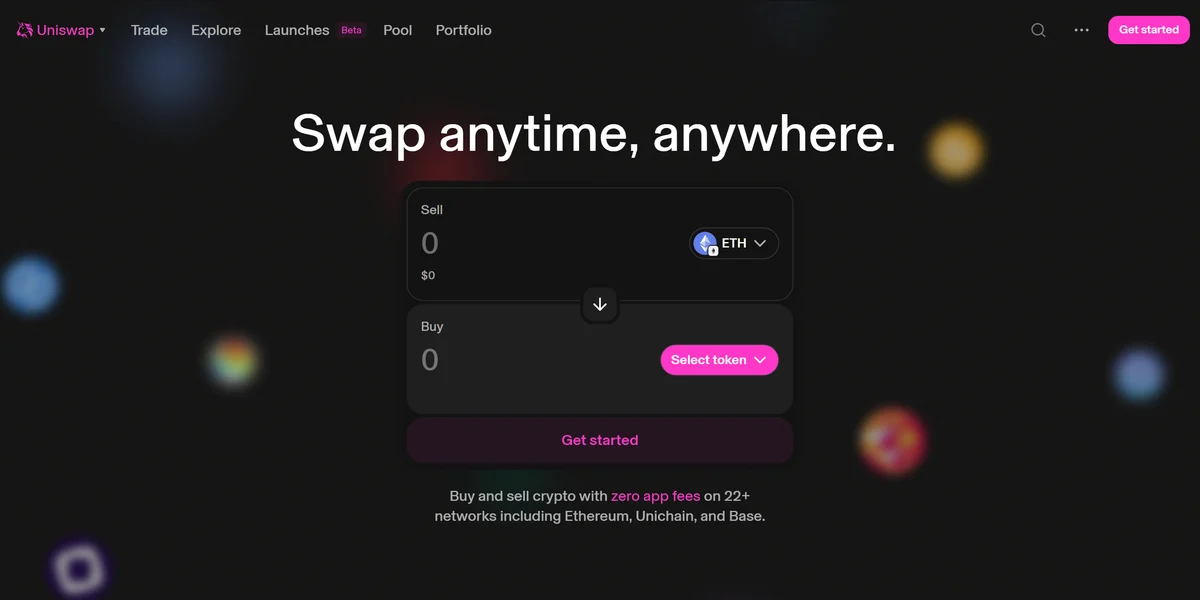
Uniswap is the largest DEX, and you only need a wallet to use it. No account exists, so there is no email, password or ID step anywhere. It handled about $93.6 billion of trades in the 30 days to 2 October 2026, per DefiLlama’s DEX volume data.
- Type: DEX on Ethereum and many other chains
- ID: none collected, because there is no account
- Note: each trade stays on a public chain for good, so this is pseudonymity, not true anonymity
2. PancakeSwap
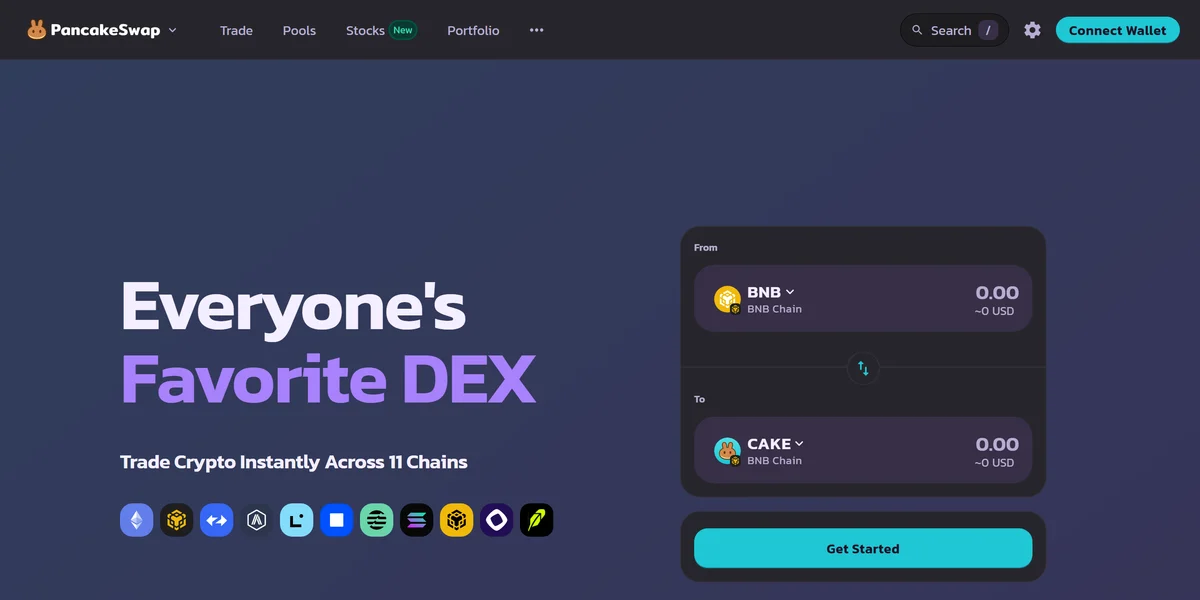
PancakeSwap is the largest DEX on BNB Chain. It works like Uniswap, with a wallet signature in place of an account. The main practical gap is cost, since network fees are much lower.
- Type: DEX on BNB Chain and several other chains
- ID: none collected
- Note: low fees make small trades worth doing where Ethereum mainnet fees would not
3. Jupiter
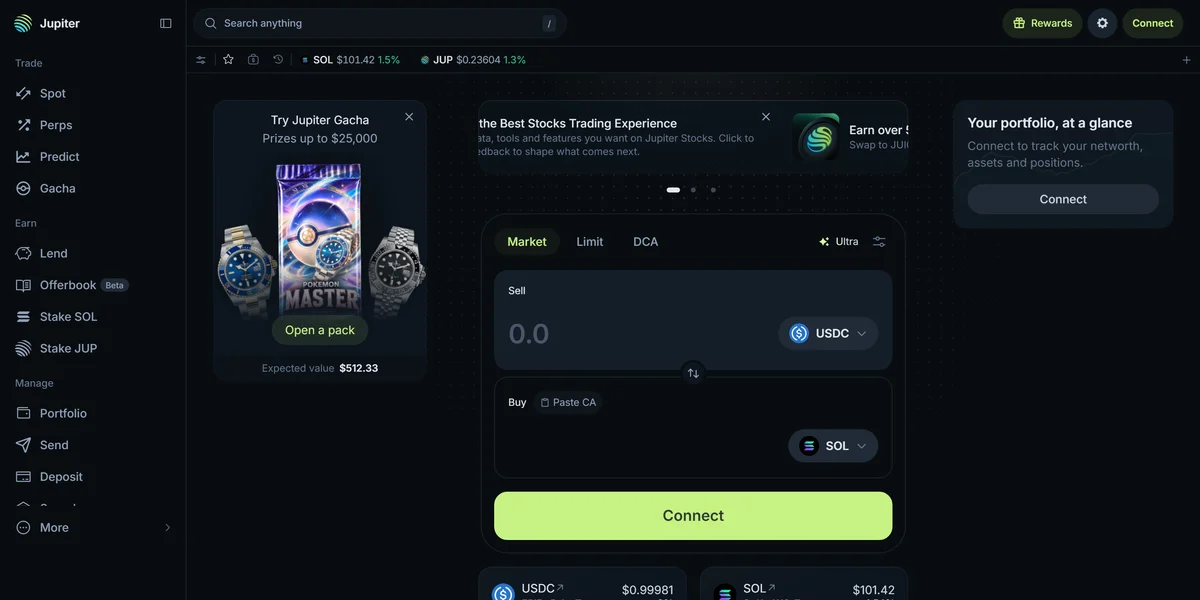
Jupiter pulls together liquidity from Solana DEXs and sends each trade to the best price. As with any DEX, a connected wallet is the only thing you need. Its swap tool routed about $15.1 billion in the 30 days to 2 October 2026.
- Type: DEX aggregator on Solana
- ID: none collected
- Note: Solana fees sit well under a cent, which suits frequent small trades
4. dYdX
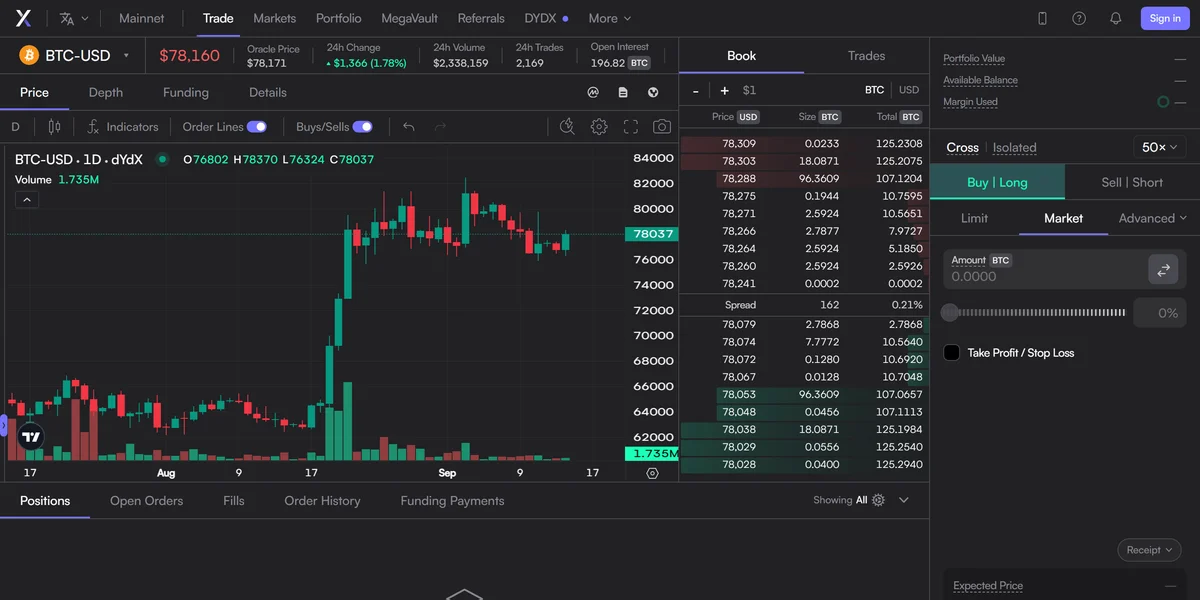
dYdX offers perpetual futures on its own chain rather than through a company account. That means you can use leverage without an ID check. It is still live and run by its community, with chain upgrades voted on through 2026. Hyperliquid is the bigger rival in this niche.
- Type: perpetual futures DEX on the dYdX Chain
- ID: none collected at protocol level
- Note: leverage magnifies losses, and no support desk can reverse a liquidation
5. SunSwap
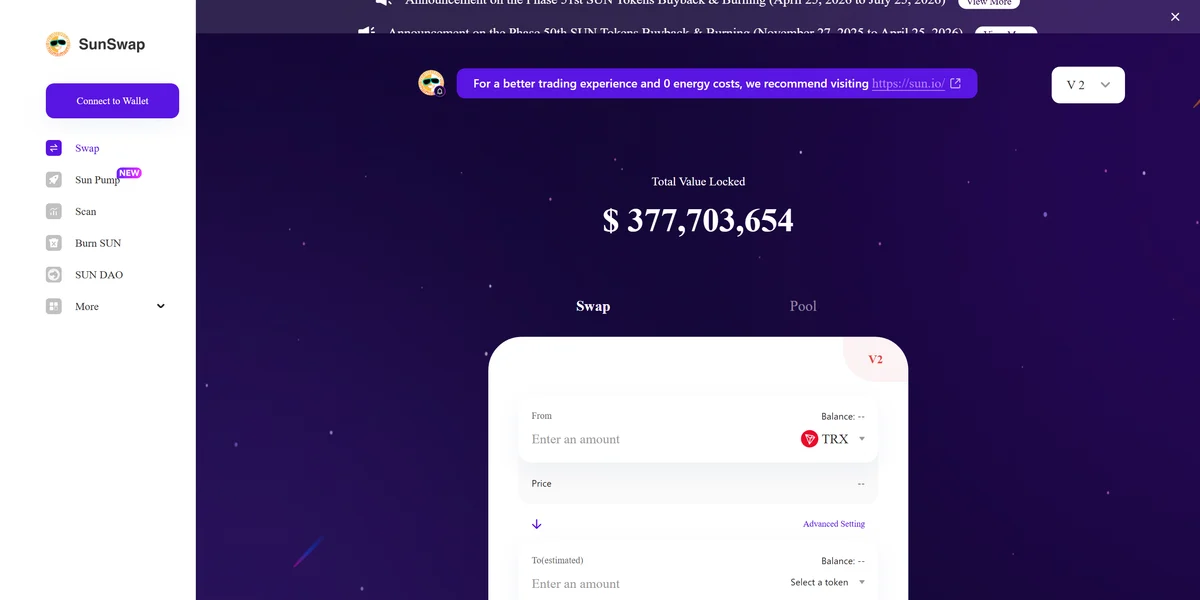
SunSwap is the go-to DEX on Tron. Low fees and heavy USDT use drive most of its trades. You connect a wallet in the same way as on the other DEXs here.
- Type: DEX on Tron
- ID: none collected
- Note: front ends run by known teams are more and more often treated as regulated activity
6. Bisq
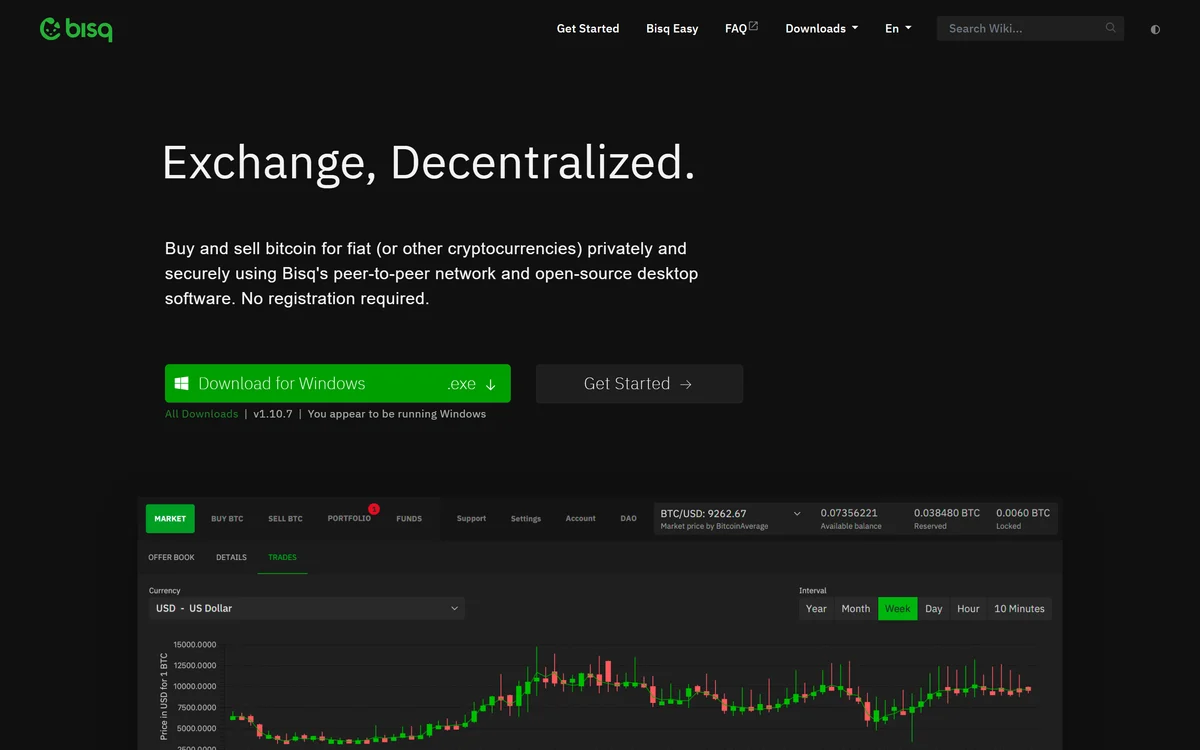
Bisq is open source software that runs over Tor, and no company runs the order book. Classic Bisq trades settle through a multisig address, with a deposit from each side. So no operator ever holds your money. The newer Bisq Easy mode skips the escrow and relies on the seller’s reputation instead, which suits small first buys.
- Type: non-custodial P2P, Bitcoin first
- ID: none collected by the platform
- Note: the Bisq team finished its mobile apps in April 2026: Bisq Easy runs a full node on Android, and Bisq Connect works on Android and iOS
7. HodlHodl
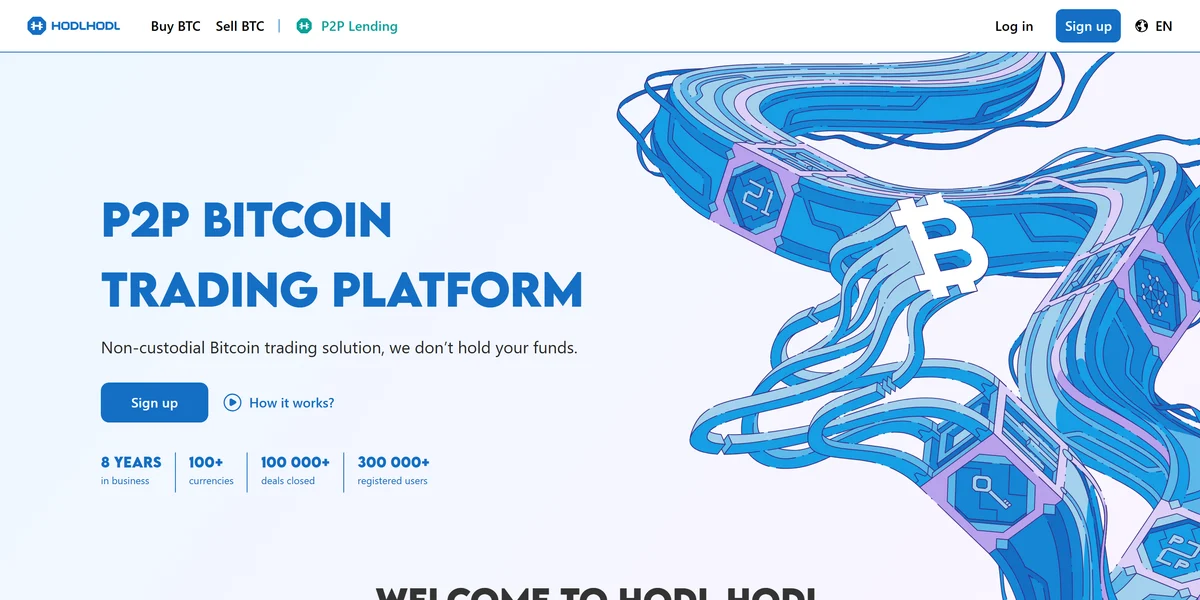
HodlHodl locks Bitcoin in a multisig address that no single party can move alone, and it asks for no ID. The escrow guards the crypto side. The two traders settle the cash side between them.
- Type: non-custodial P2P
- ID: none collected by the platform
- Fee: 0.75% per trade, or 0.5% if you sign up with a referral code, per HodlHodl’s fee page
8. RoboSats
RoboSats settles P2P Bitcoin trades over the Lightning Network without any ID. It gives you a random robot name in place of an account, and it is built for privacy rather than volume.
- Type: non-custodial P2P over Lightning
- ID: none collected
- Limits and fees: trades run from 20,000 to 4,000,000 sats (0.04 BTC), with a 0.2% total fee split between maker and taker, per the RoboSats docs
9. CoinEx
CoinEx is a central exchange, not a true non-KYC platform. Its help centre lists the unverified limits: $10,000 per 24 hours and $50,000 per 30 days. Spot, margin and futures work without ID, but fiat trading does not. Privacy coin deposits and withdrawals also need ID.
- Type: central exchange with tiered checks
- ID: an unverified tier exists, and risk checks can force KYC below the limit
- Note: the exchange holds your coins, so any ID request arrives while it already has your funds
10. BYDFi
BYDFi runs the same tiered model. Its withdrawal FAQ, as read on 2 October 2026, sets 50,000 USDT a day for unverified users and 500,000 USDT once verified. It also says risk control can demand KYC before a withdrawal. Treat the unverified tier as a temporary allowance, not a promise.
- Type: central exchange with tiered checks
- ID: limited unverified access, full KYC above the limit or after a flag
- Note: limits like these have been cut at short notice across this group, as MEXC showed in 2026
What Is a Non-KYC Crypto Exchange?
A non-KYC crypto exchange lets you trade without a full ID check. That happens either because it runs tiered checks or because it has no accounts at all. On a central exchange, this is a policy that can change. On a DEX, it is part of how the system is built.
Central exchanges usually stack their checks in four steps:
- Unverified: email only. Trading is often allowed, withdrawals are capped and fiat is closed.
- Basic check: name, date of birth and an ID document. Limits rise sharply and bank deposits open.
- Full check: proof of address and sometimes source of funds, for the highest limits.
- Check on demand: the exchange can ask for documents at any time, even after you deposit. Funds stay on hold until you pass.
Three Different Things Called Non-KYC
An unverified tier on a central exchange, a DEX and a non-custodial P2P platform share one label. Yet they behave nothing alike. Custody is what splits them, because whoever holds the funds can demand ID.
- Unverified tier on a central exchange: the company holds your funds and can ask for ID at any point, even after a deposit.
- DEX: you keep your coins the whole time. But each trade is public on-chain, and no support desk can help if you make a mistake.
- Non-custodial P2P: multisig code enforces the escrow, not a company. The cost is far less liquidity.
Non-KYC Crypto Exchanges and Where Identity Is Required
The platforms most often listed as non-KYC are the DEXs Uniswap, PancakeSwap, Jupiter and dYdX, the P2P platforms Bisq, HodlHodl and RoboSats, and tiered exchanges such as CoinEx and BYDFi. Only the first two groups skip ID by design.
Even so, a no-KYC trade rarely stays free of ID checks from start to end. The checks sit at the edges, where crypto meets a bank account. The chart below shows where they appear on a typical route.
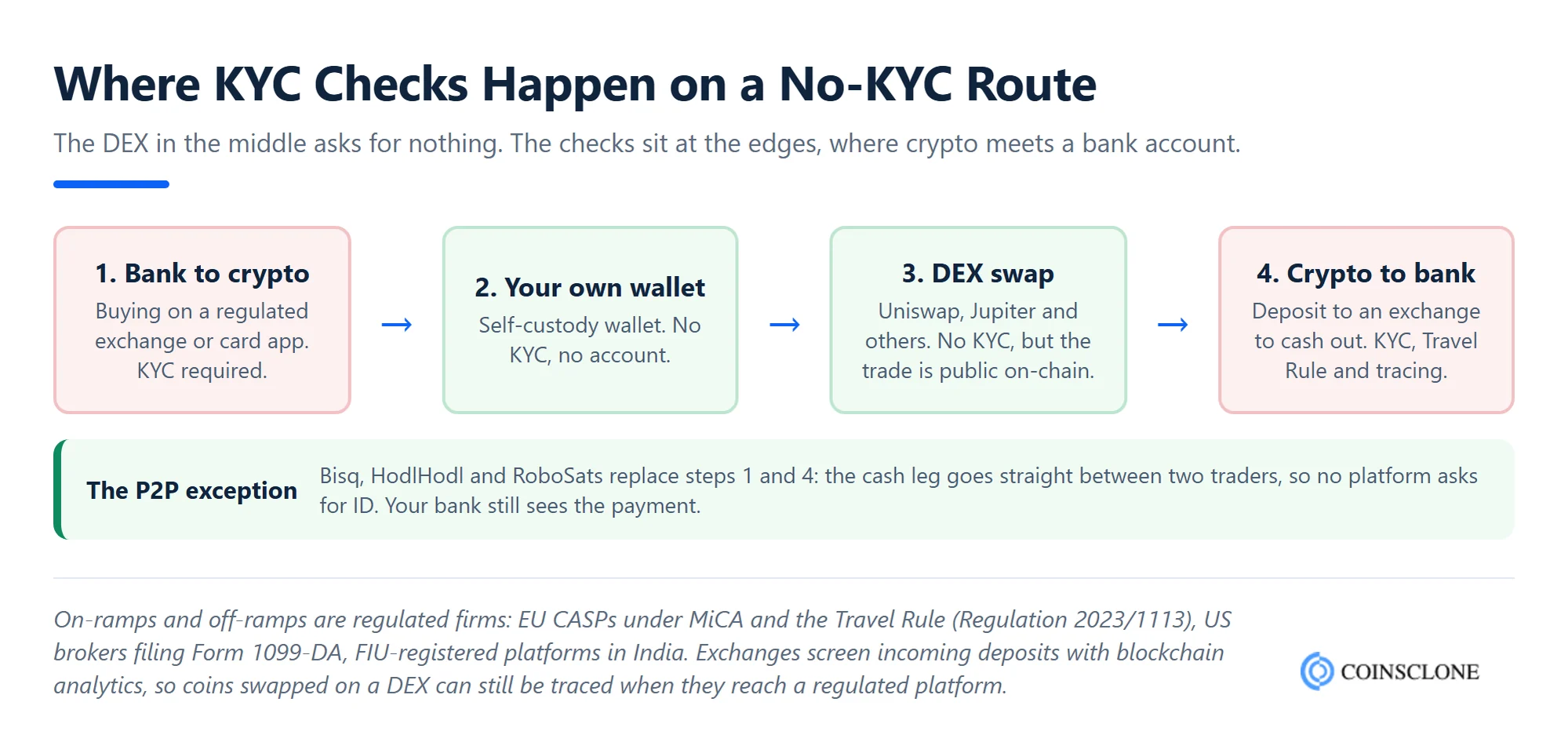
- A DEX needs a wallet link and nothing else, because no account exists to check.
- P2P platforms skip ID checks and settle through multisig escrow.
- Central exchanges post unverified limits that vary by region and change without notice.
Decentralized Exchanges Without KYC
A DEX does not check ID because no operator holds your assets. You trade from a connected wallet. Uniswap on Ethereum, PancakeSwap on BNB Chain and Jupiter on Solana are the largest, with SunSwap the main choice on Tron. Our guide to the best decentralized exchanges compares the wider field.
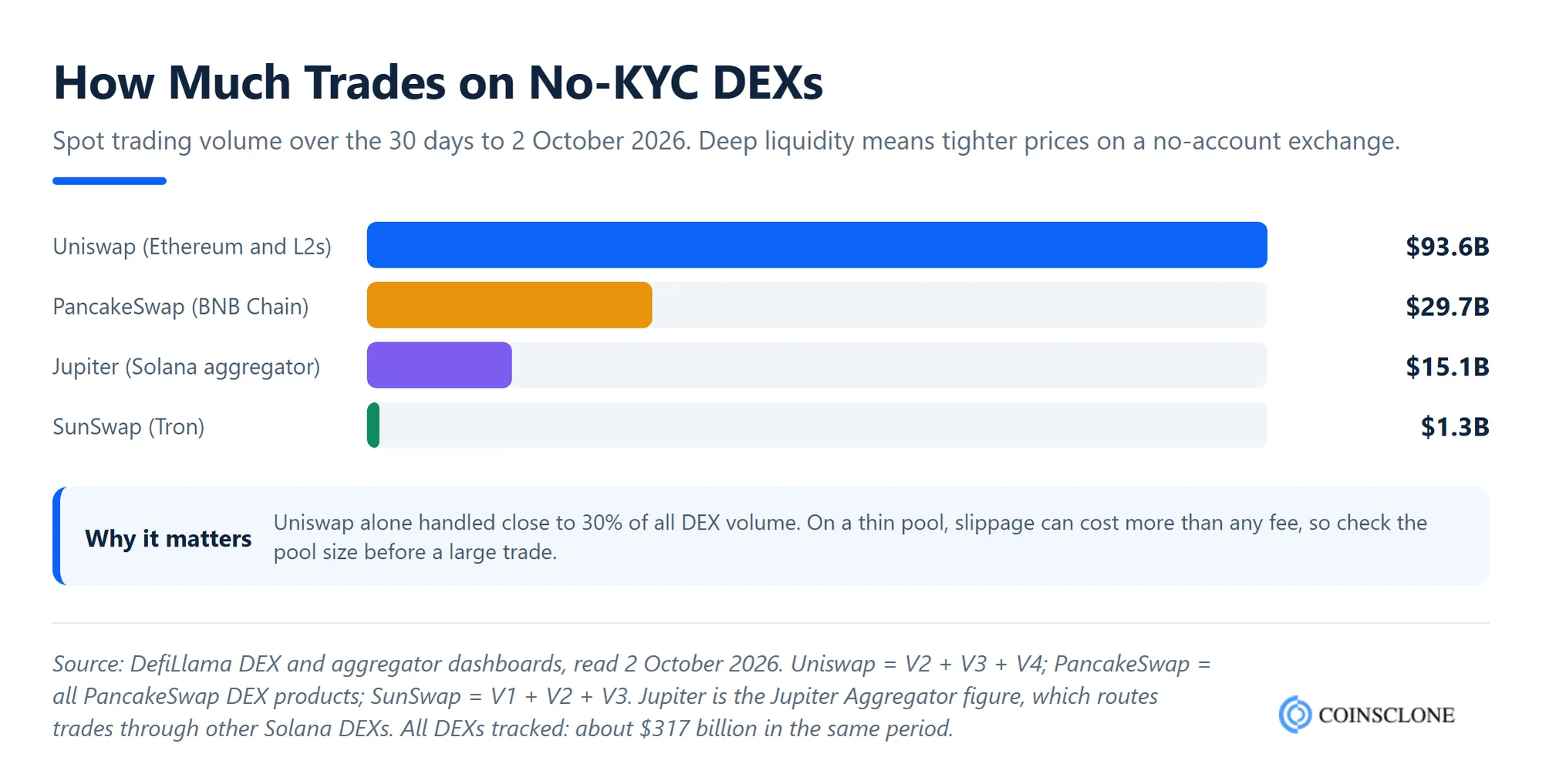
- There is no account, email or password, only a wallet signature for each trade.
- Each trade stays on a public chain for good, so this is pseudonymity, not anonymity.
- Front ends run by known teams are more and more often treated as regulated activity.
Non-Custodial P2P Without KYC
Bisq, HodlHodl and RoboSats let two people trade directly. The crypto sits in escrow that neither the platform nor either trader can move alone. The platform takes no ID and holds no funds. See our list of the top P2P crypto exchanges for the larger, verified options.
- Bisq runs as a desktop app over Tor, with an Android app that runs a full node.
- HodlHodl is browser based with 2-of-3 multisig escrow and is Bitcoin only.
- RoboSats is Lightning native and runs in the Tor browser.
Instant Swap Services: No Account, But Still Checks
Many 2026 lists rank instant swap sites such as ChangeNOW, SimpleSwap or GhostSwap at the top. You paste a wallet address, send coins and get a different coin back. There is no sign-up step.
But these are not DEXs. For a few minutes, the service holds your coins. That gives it the power to pause a swap that its risk tools flag. It can then ask for ID before it releases or refunds the funds. Traders call this “shotgun KYC”.
- Upside: quick, simple swaps across chains, with no account to open.
- Downside: your coins sit with a company during the swap, so a flag can freeze them.
- Tip: read the terms for the words “AML check” or “risk check” before you send a large amount.
How to Trade Crypto Without KYC, Step by Step
The cleanest route keeps your coins in your own wallet from start to end. Here is the order most users follow:
- Set up a self-custody wallet. Pick one for the chain you need, such as MetaMask, Phantom or a hardware wallet. Our guide to the best crypto wallets can help you choose. Back up the seed phrase offline.
- Get your first crypto. Without ID, the usual way is a P2P trade on Bisq, HodlHodl or RoboSats, paid by bank transfer or cash. Otherwise, move coins you already hold.
- Fund the wallet with gas. A DEX trade needs a little of the chain’s own coin, such as ETH, BNB, SOL or TRX, to pay fees.
- Connect to the DEX. Type the address yourself or use a bookmark, since fake front ends are common. Then connect your wallet.
- Check the trade before you sign. Confirm the token contract, the slippage and the price impact. Small pools can cost more than any fee.
- Keep records. Note the date, amount and value of each trade. You will need them for tax, whatever route you used.
Risks of Using a No-KYC Crypto Exchange
Unverified accounts on central exchanges come with capped withdrawals, closed fiat routes, region blocks and no payout if the platform fails. Privacy from a company is usually paid for in price, access and recourse. These are the risks that cost people money most often:
- Frozen funds: a central exchange can demand ID while it holds your deposit, and the coins stay locked until you comply or give up.
- No recourse: on a DEX or P2P platform there is no support desk to reverse a wrong address, a scam token or a bad counterparty.
- Fake front ends: phishing copies of DEX and P2P sites are common, and a signed transaction on a fake site drains the wallet.
- Platform failure: unlicensed exchanges sit outside every deposit protection scheme, so a hack or an exit leaves nothing to claim.
- Reversed payments: in P2P trades the cash leg is never escrowed, so a chargeback or a fraud freeze on the bank side lands on you.
- Legal exposure: using a geo-blocked platform through a VPN breaks its terms, and skipping ID never removes a tax bill.
- Withdrawals can freeze pending an ID check you did not expect. It happens often enough to have a nickname: shotgun KYC.
- Most no-KYC platforms block US and UK users. Using a VPN to get around this breaks the terms and can lock your account.
- Smaller venues quote wider spreads, so the cost shows up in each trade rather than as a fee.
- Tax rules still apply. Skipping ID checks does not remove a tax bill in any country that taxes crypto gains.
Are Non-KYC Crypto Exchanges Safe?
Safety depends on which of the three groups you use, and a simple yes is not an honest answer. Non-custodial platforms remove the risk of a company losing your funds. But they give you no recourse if you make a mistake. Unlicensed central exchanges carry both custody risk and no complaints route.
- Non-custodial trading removes the risk of a third party losing your coins. It also puts the keys and each check fully on you.
- Unlicensed exchanges sit outside any deposit protection or payout scheme.
- When a platform holds your money, a clean security record and published reserves matter more than its ID policy.
What the Rules Now Require
The rules move in one direction only, and they shrink the space for unverified accounts each year. In the European Union, Article 79 of the Anti-Money Laundering Regulation (EU) 2024/1624 bans regulated firms from keeping anonymous crypto accounts or handling privacy coins from July 2027.
- MiCA: any platform serving EU users needs a CASP licence. The grace period for firms under older national rules closed on 1 July 2026.
- EU AMLR: anonymous accounts and privacy coins are banned on regulated EU platforms from July 2027.
- Travel Rule: under Regulation (EU) 2023/1113, firms must send sender and receiver details with each transfer. This is the main reason unverified limits keep falling.
Is It Legal to Use a Crypto Exchange Without KYC?
Using a DEX or trading P2P is legal in most countries. ID rules fall on the firms that provide the service, not on each blockchain transfer. What is not legal anywhere is using a no-ID route to dodge tax, sanctions or money laundering laws.
- EU rules state that the duties apply to crypto service firms, not to P2P transfers made without a middleman.
- Using a platform that is barred from your country, or dodging a geo-block, breaks its terms and may break local law.
- Tax duties are separate from ID checks. They apply wherever you traded.
Taxes Still Apply
Tax offices now get data straight from regulated platforms. So the on-ramp and off-ramp of a no-KYC trade usually leave a record.
- USA: brokers report sales on the new Form 1099-DA, with gross proceeds from the 2025 tax year and cost basis from 2026.
- EU: under the DAC8 rules, crypto firms have collected user data for tax offices since 1 January 2026.
- UK: the same OECD reporting model (CARF) started on 1 January 2026.
- India: gains are taxed at a flat 30%, with 1% TDS at source.
Non-KYC Crypto Exchanges in India
Any platform serving Indian users must register with the Financial Intelligence Unit (FIU-IND) as a reporting entity. Each FIU-registered platform runs full KYC. No registered Indian exchange operates without ID checks. See our list of the best crypto exchanges in India for the registered options.
- India has blocked offshore platforms that did not complete FIU registration.
- Gains are taxed at a flat 30% with 1% TDS, and an unregistered platform shifts the reporting to you rather than removing it.
- DEXs are still reachable, but the tax position on those trades does not change.
Non-KYC Crypto Exchanges in the UK and USA
Both markets are tightly controlled. In the UK, crypto firms need FCA registration. In the United States, exchanges need FinCEN registration plus state money transmitter licences. That is why most no-KYC platforms block both countries outright.
- Most offshore platforms geo-block US and UK IP addresses as policy.
- Serving US users without a licence still carries a real cost. KuCoin pleaded guilty in January 2025 to running an unlicensed money transmitting business, paid close to $300 million and left the US market for two years.
- The practical options in both markets are DEXs and non-custodial P2P, not offshore exchanges.
Platforms That Have Left This Category
Several names on older no-KYC lists no longer belong there. MEXC, long a top pick for its high unverified limit, posted a notice on 5 February 2026. It said users without KYC can no longer deposit, withdraw or trade. KuCoin now requires ID checks before you can use its products. Bitget made checks mandatory in 2023, and Paxful shut down by 1 November 2025.
- MEXC: unverified users can view prices only. Primary KYC unlocks 80 BTC a day in withdrawals.
- KuCoin: new users must pass ID checks before they can trade.
- Paxful: the P2P marketplace wound down all operations after the costs of fixing past compliance failures.
- Bybit, OKX and Kraken: each has tightened its checks over the same period.
The pattern runs one way. Any list of this group starts to age the moment it goes live, so check the terms before you deposit.
How to Evaluate a Platform That Does Not Require Verification
Judge these platforms on custody, track record, location and liquidity, not on the ID policy alone. The key question is what happens to your funds if the platform changes its policy, gets blocked or fails. Start with the decision tree below, then run through the checks.
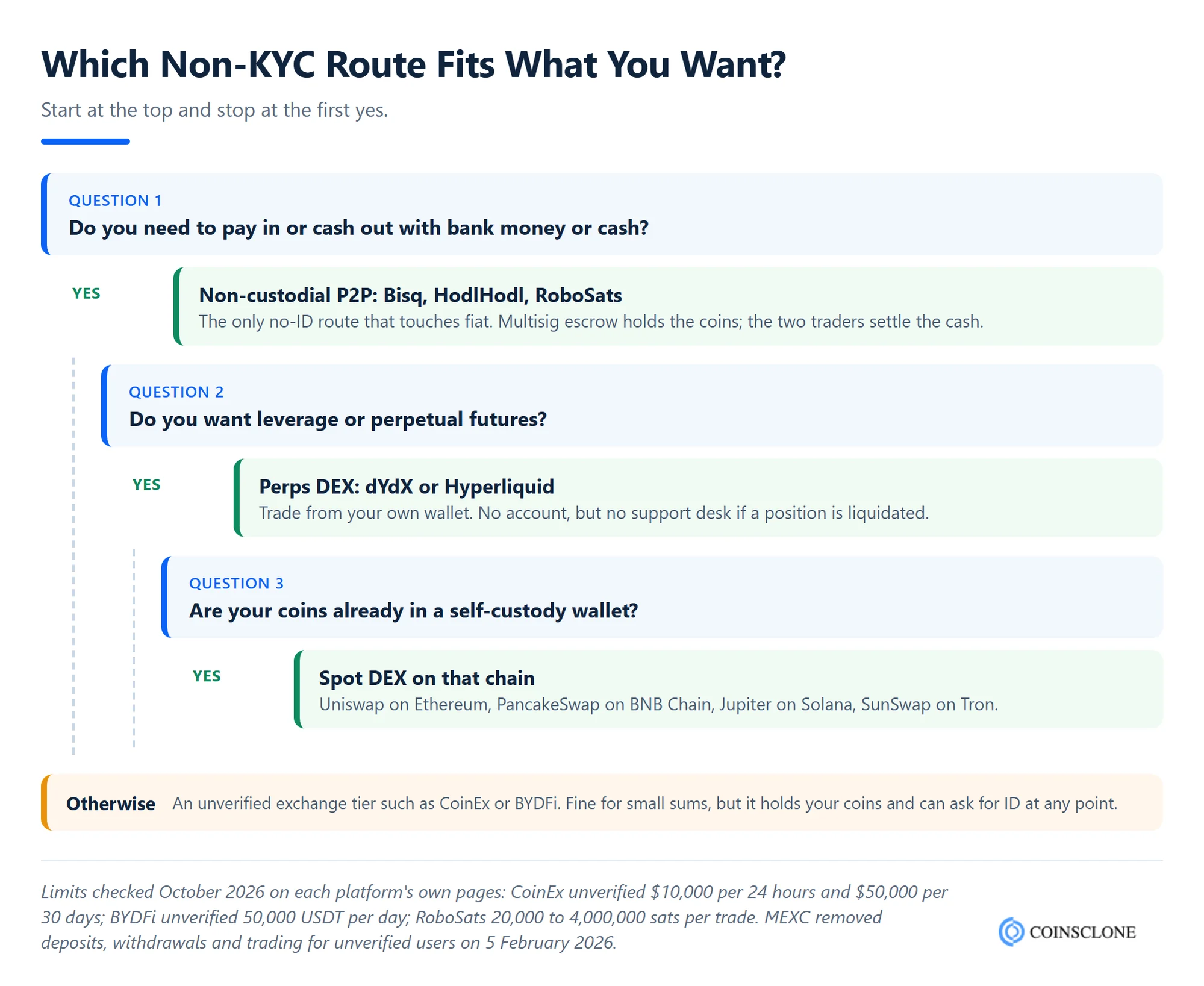
- Custody: does the platform hold your assets? If so, who oversees it?
- Track record: has it had hacks, frozen withdrawals or legal action?
- Location: is it licensed anywhere, and is your country inside or outside its terms?
- Liquidity: check the spread on the pair you trade, since thin books cost more than fees.
- Exit route: can you withdraw the size you plan to deposit, at the tier you plan to stay at?
Frequently Asked Questions
What does non-KYC mean?
It means trading without a full ID check. On a central exchange, that is a tier with limits attached. On a DEX, it follows from the fact that there is no account at all.
Which crypto exchanges do not require KYC?
DEXs such as Uniswap, PancakeSwap, Jupiter and dYdX need no ID by design. So do non-custodial P2P platforms such as Bisq, HodlHodl and RoboSats. Some central exchanges, such as CoinEx and BYDFi, allow capped unverified trading, but those policies change often.
Does Uniswap require KYC?
No. Uniswap is a set of smart contracts, and you trade from your own wallet with no account. Some front ends and wallet apps do screen addresses against sanctions lists, and they may block flagged ones.
Can I buy crypto with fiat without KYC?
Rarely through a regulated on-ramp, because bank routes are where ID rules bite hardest. Non-custodial P2P is the usual route, and it carries the risk of a bad counterparty in return.
Do non-KYC exchanges have withdrawal limits?
Central ones almost always do. As of 23 October 2026, CoinEx caps unverified users at $10,000 a day and $50,000 a month, BYDFi at 50,000 USDT a day and PrimeXBT at $20,000 a day, and all three can change these without notice. MEXC and KuCoin no longer allow unverified withdrawals at all. Non-custodial platforms have no such limits, since they never hold your funds.
Can I trade futures without KYC?
Yes, on a perpetual futures DEX such as dYdX or Hyperliquid, where you trade from your wallet. Some central exchanges also allow futures on an unverified tier, but those tiers are shrinking.
What is shotgun KYC?
It is when a platform that did not ask for ID at sign-up suddenly demands it, usually while it holds your funds. Risk tools often trigger it after a large or unusual deposit. Your coins stay frozen until you comply.
Is non-KYC the same as anonymous?
No. Blockchain trades are public and permanent. So not giving documents to a platform gives you pseudonymity, not anonymity.
Will non-KYC exchanges still exist in 2027?
DEXs and non-custodial P2P will, because there is no operator to regulate in the same way. Unverified tiers on central exchanges are closing steadily, and in the EU they are banned outright from July 2027.
See How Our MVP System Can Help You Build the Best Non-KYC Crypto Exchange
Best Non-KYC Crypto Exchange — privacy-first, performance-ready.
- MVP System : Launch your non-KYC exchange 90% faster with secure smart contracts.
- DeFi-Ready Modules : Peer-to-peer trading, liquidity pools, and staking integrated.
- Brand & Customization : Your tokens, design, and brand identity — no restrictions.
- Revenue Engine : Earn from trading fees, liquidity rewards, and governance models.
Get a free non-KYC exchange demo in just 48 hours — before you invest!
Book a Free Demo to explore how our Non-KYC Exchange System helps you go live fast.
Building a Compliant Exchange with Coinsclone
Coinsclone has built crypto exchanges since 2018, with 350+ platforms delivered for 200+ clients across 20 industries. We help founders decide early where they sit on the ID question, because it sets the licence, the build and the markets they can serve.
Our work covers decentralized exchange development and AMM builds, P2P platforms with multisig escrow, and fully compliant crypto exchange development with tiered KYC, Travel Rule handling and AML checks built in. A white label exchange typically launches in 4-6 weeks, a white label DEX in 5-7 weeks and a white label P2P platform in 4-8 weeks.
We start from a live demo rather than a proposal document. Talk to our team about your target markets and rules, and we will map the build that fits them.