
A crypto wallet does not store coins. It stores the keys that prove you own them, which is why the only comparison that matters is how each wallet protects those keys and what it lets you do with them. This guide ranks the top 10 crypto wallets in 2026, compares the three most people actually choose between, and covers the wallet infrastructure founders use when they want to build one.
See How Our MVP System Helps You Choose & Build the Best Crypto Wallet Faster
Crypto Wallet Development — done right.
- MVP System : Create your wallet inspired by the Top 10 Best Crypto Wallets 90% faster.
- Pre-Built Modules : Security, swaps, staking, and multi-chain support — all ready to go.
- Brand & Customization : Your logo, your theme, your wallet experience.
- Revenue Engine : Monetize through transaction fees, staking rewards & premium add-ons.
Get a free branded demo of your custom crypto wallet in just 48 hours — before you invest a cent.
Book a Free Demo to explore how our Top 10 Wallet-Inspired MVP System can help you launch a world-class wallet in just 8-12 weeks.
10 Best Crypto Wallets in 2026
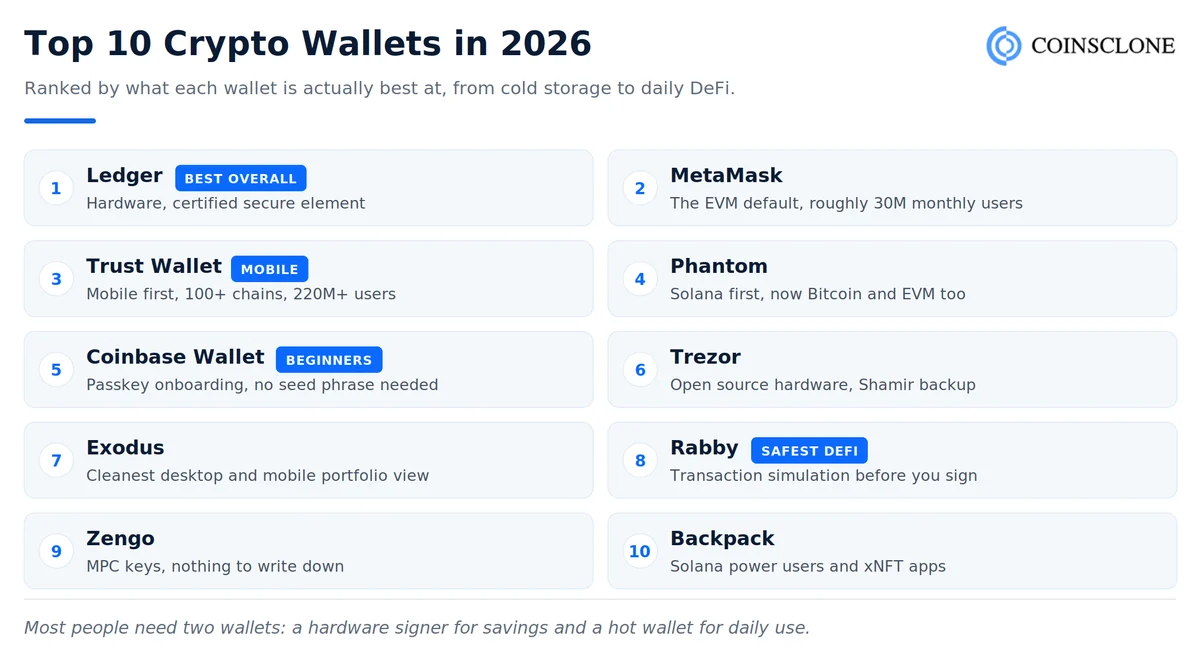
The top 10 crypto wallets in 2026 are Ledger, MetaMask, Trust Wallet, Phantom, Coinbase Wallet, Trezor, Exodus, Rabby, Zengo and Backpack. Each one leads a different category, so the ranking below is by role rather than by a single score.
- Ledger for hardware security
- MetaMask for Ethereum and EVM DeFi
- Trust Wallet for mobile multi-chain use
- Phantom for Solana, Bitcoin and Ordinals
- Coinbase Wallet for beginners moving into self custody
- Trezor for open source hardware
- Exodus for desktop portfolio management
- Rabby for safer DeFi signing
- Zengo for people who do not want a seed phrase
- Backpack for Solana power users
1. Ledger: Best Hardware Wallet
Ledger is the most widely used hardware wallet and the default recommendation for anyone holding more than they would be comfortable losing. Keys are generated and held inside a certified secure element chip, and every transaction has to be approved on the device screen rather than in the browser.
- Type: hardware, cold storage
- Range: Nano X for mobile use over Bluetooth, Flex and Stax for larger touchscreens
- Assets: thousands of coins and tokens managed through Ledger Live
- Best for: long term holdings, and pairing with a hot wallet for daily activity
2. MetaMask: The EVM Default
MetaMask is the most used Ethereum wallet and the one most dApps are built against, with roughly 30 million monthly active users. Since 2025 it has grown well past key management, adding token swaps, bridging, perpetual futures, prediction markets, a spending card and its own stablecoin.
- Chains: Ethereum and every major EVM network, plus Solana support
- Notable: mUSD stablecoin, the MetaMask Card which completed a US rollout across 49 states in February 2026, and the opt-in MetaMask Rewards points programme
- Swap fee: 0.875% on in-wallet swaps, charged on top of network gas
- Best for: DeFi users who live across EVM chains
3. Trust Wallet: Mobile Multi-Chain Leader
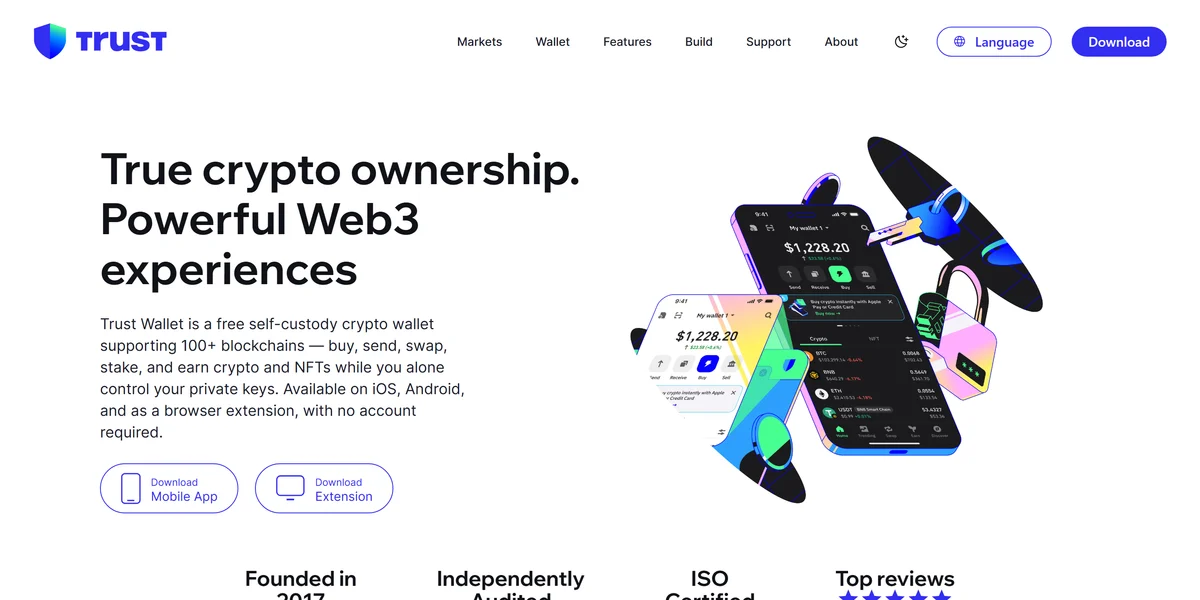
Trust Wallet is the most downloaded self custody mobile wallet, supporting more than 100 blockchains and reporting over 220 million users. It was acquired by Binance in 2018 but operates as a separate entity, and because it is non-custodial, Binance holds no keys and no funds.
- Chains: 100+, including Bitcoin natively, Ethereum, BNB Chain and Solana
- Features: staking on 25+ assets, in-app swaps, dApp browser, security scanner
- Caveat: the browser extension has a worse record than the mobile app, including a December 2025 supply chain compromise that drained roughly 8.5 million dollars
- Best for: mobile users who want the widest chain coverage in one app
4. Phantom: Solana First, Now Multi-Chain
Phantom is the wallet most Solana users start with, and through 2026 it expanded well beyond Solana into Bitcoin and Ordinals, Base, Sui, Monad and selected EVM networks. It keeps the fast, readable signing experience Solana users expect while covering more assets.
- Chains: Solana, Bitcoin, Ethereum, Base, Polygon and others
- Features: SOL staking, in-wallet swaps, NFT viewer, Ledger support
- Swap fee: 0.85% on in-wallet swaps
- Best for: anyone whose activity centres on Solana
5. Coinbase Wallet: Easiest Route Into Self Custody
Coinbase Wallet is the gentlest introduction to self custody because passkey onboarding removes the seed phrase from the first run entirely. It is fully non-custodial and separate from the Coinbase exchange account, despite the shared brand.
- Chains: more than 10, including Base, Ethereum, Solana and Bitcoin
- Features: passkey accounts, gasless transactions, perpetual futures, prediction markets and tokenised stocks
- Note: the app was renamed Base App in July 2025 and renamed back to Coinbase Wallet on 10 September 2026
- Best for: first time self custody users coming from an exchange
6. Trezor: Open Source Hardware
Trezor is the hardware wallet for people who want to verify the code rather than trust a brand, since both its firmware and hardware designs are open source. The Safe series adds a secure element while keeping that transparency.
- Type: hardware, cold storage
- Features: Shamir backup, passphrase protection, Trezor Suite desktop app
- Assets: over a thousand coins and tokens
- Best for: privacy focused holders and anyone who values auditable firmware
7. Exodus: Best Desktop Experience
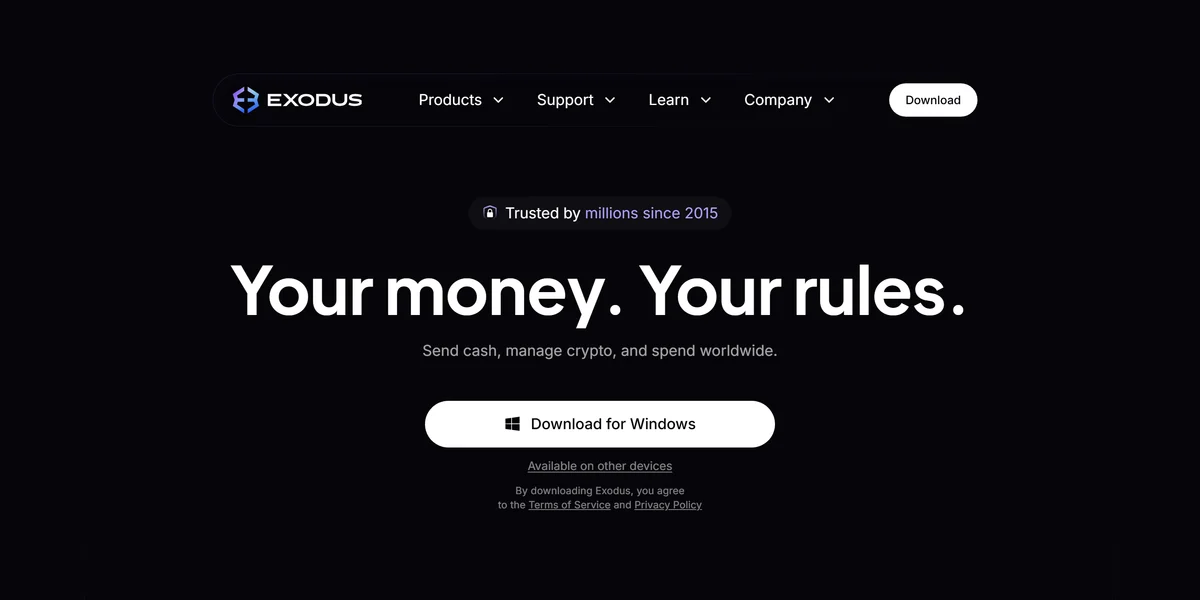
Exodus is the most polished portfolio view in crypto, running across desktop, mobile and browser with live charts and built-in swaps. It supports a wide asset range and pairs with Trezor for cold storage.
- Chains: 50+ networks with in-app swaps
- Features: no registration or KYC, 24/7 support, portfolio tracking
- Trade-off: fewer advanced DeFi controls than MetaMask or Rabby
- Best for: investors who want clear oversight rather than power tools
8. Rabby: Safer DeFi Signing
Rabby is the wallet that shows you what a transaction will actually do before you sign it, simulating the outcome and flagging risky approvals. That single feature addresses the way most people actually lose funds.
- Chains: automatic detection across EVM networks
- Features: pre-sign transaction simulation, risk alerts, approval management
- Best for: active DeFi users who sign many contracts each week
9. Zengo: No Seed Phrase to Lose
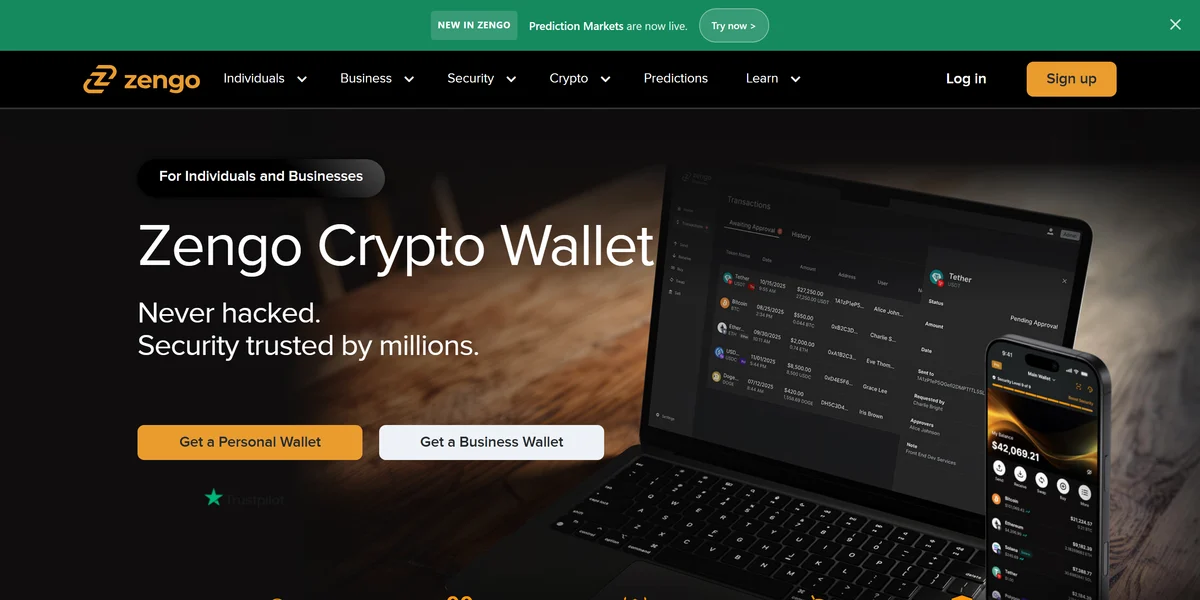
Zengo replaces the seed phrase with MPC, splitting the key into shares so there is no single secret to write down or steal. Recovery runs on biometrics and encrypted backup instead of 24 words on paper.
- Security model: multi-party computation, no private key on the device
- Features: biometric login, encrypted cloud backup, dApp firewall, 24/7 support
- Best for: users who are more likely to lose a seed phrase than to be hacked
10. Backpack: Solana Power Users
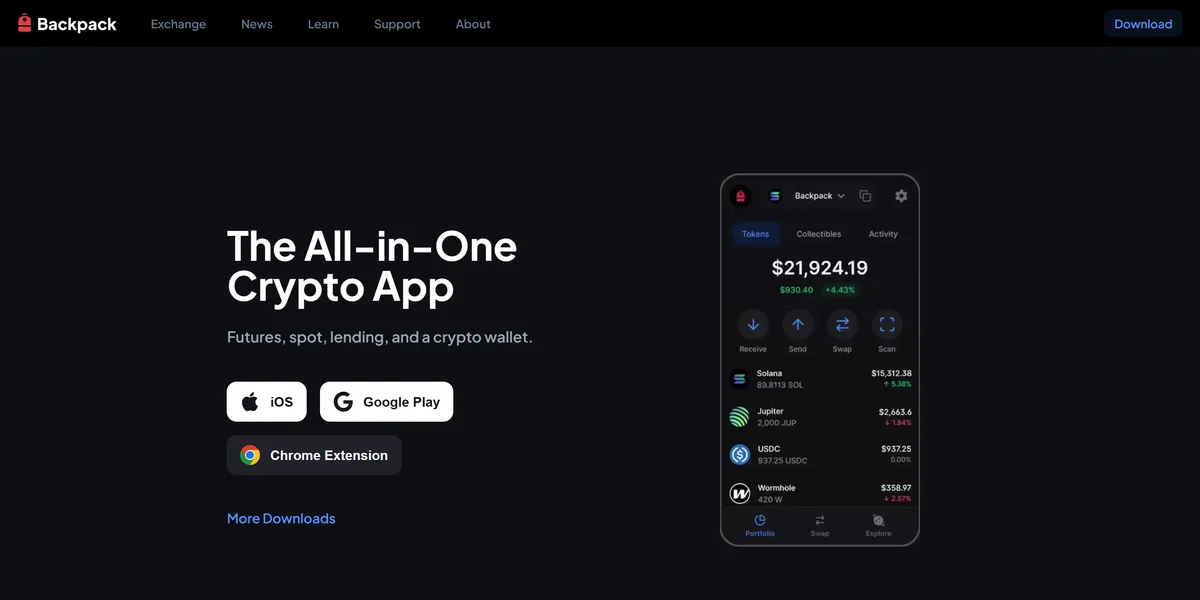
Backpack is built around xNFTs, which are executable NFTs that run as apps inside the wallet, and it adds collection locking so high value NFTs cannot be transferred even if the wallet is compromised. It is a Solana-first tool for people already deep in that ecosystem.
- Chains: Solana with expanding multi-chain support
- Features: xNFT apps, collection locking, compressed NFT support, bulk listing
- Best for: NFT heavy Solana users
What Is the Number One Crypto Wallet?
There is no single number one crypto wallet, because the answer changes with what you hold and how you use it. Ledger is the top pick for storing value, MetaMask leads for EVM DeFi, and Trust Wallet leads for mobile multi-chain use.
- If the question means most used, MetaMask and Trust Wallet are the largest by active users.
- If it means most secure, a hardware signer such as Ledger or Trezor wins by design.
- Most experienced users run both, with savings on hardware and a small daily balance in a hot wallet.
Hot Wallet or Cold Wallet
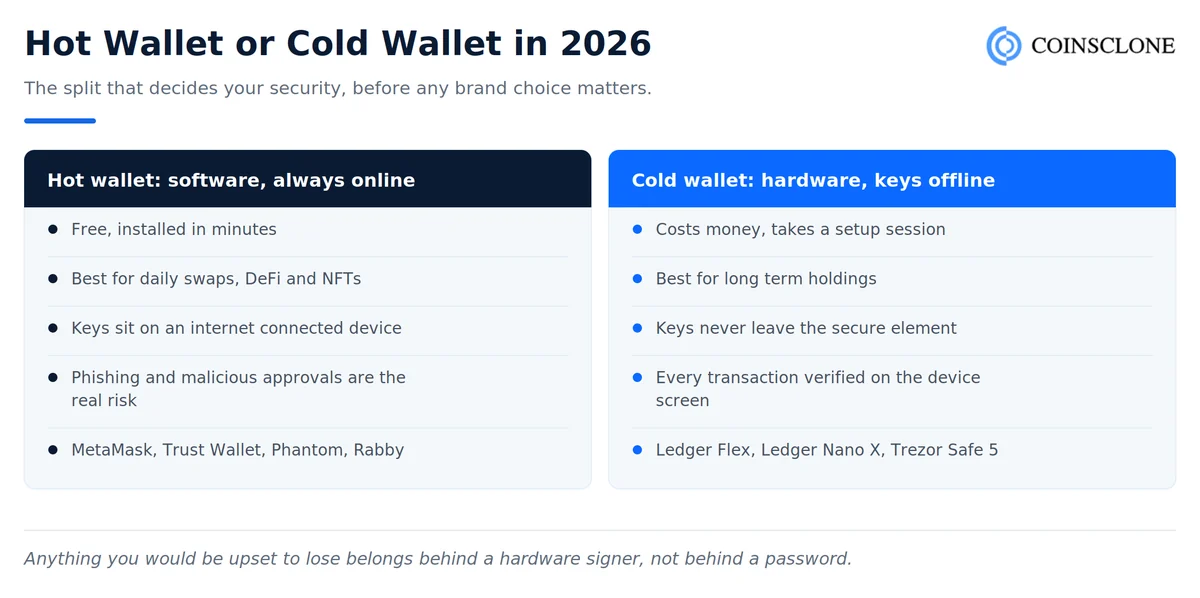
A hot wallet is software connected to the internet and suits daily trading, while a cold wallet is a hardware device that keeps keys offline and suits long term storage. The split matters more than the brand choice that follows it.
- Hot wallets are free and instant, but the keys sit on a device that browses the web.
- Cold wallets cost money and add friction, which is exactly what protects a large balance.
- The common setup is both: a hardware wallet for savings and a hot wallet funded with only what you are actively using.
Top 10 Decentralized Wallets
The top decentralized, non-custodial wallets in 2026 are MetaMask, Trust Wallet, Phantom, Rabby, Exodus, Backpack, Solflare, Zengo, Coinbase Wallet and OKX Wallet. Decentralized here means non-custodial: the keys live with the user, not with the provider.
- Non-custodial means no company can freeze, seize or lose your balance on your behalf.
- It also means no password reset, so recovery is entirely your responsibility.
- Every wallet in the top 10 list above is non-custodial, including the hardware devices.
Trust Wallet vs MetaMask vs Phantom
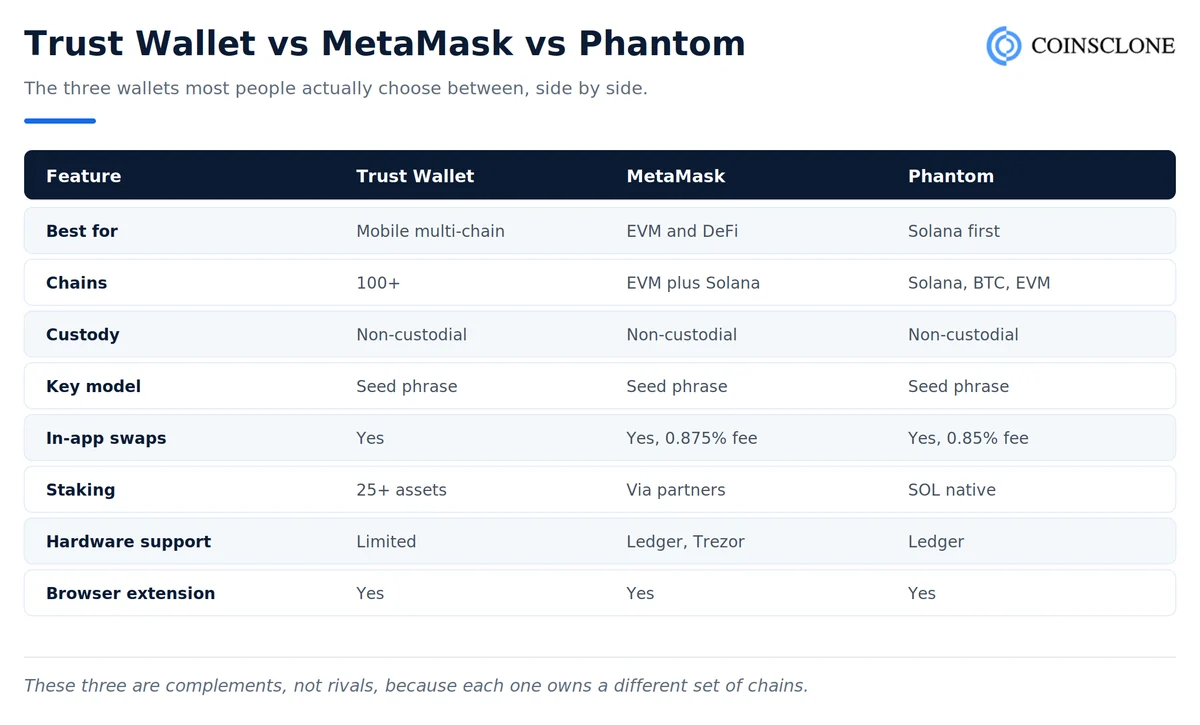
Trust Wallet wins on chain coverage, MetaMask wins on EVM dApp compatibility, and Phantom wins on Solana. All three are non-custodial and free, so the real decision is which chains you use most.
- Choose Trust Wallet if you hold assets across many chains and work mostly on mobile.
- Choose MetaMask if you spend your time in Ethereum DeFi and need maximum dApp compatibility.
- Choose Phantom if Solana, Bitcoin Ordinals or Base are where your activity lives.
Top Rated Secure Crypto Wallets
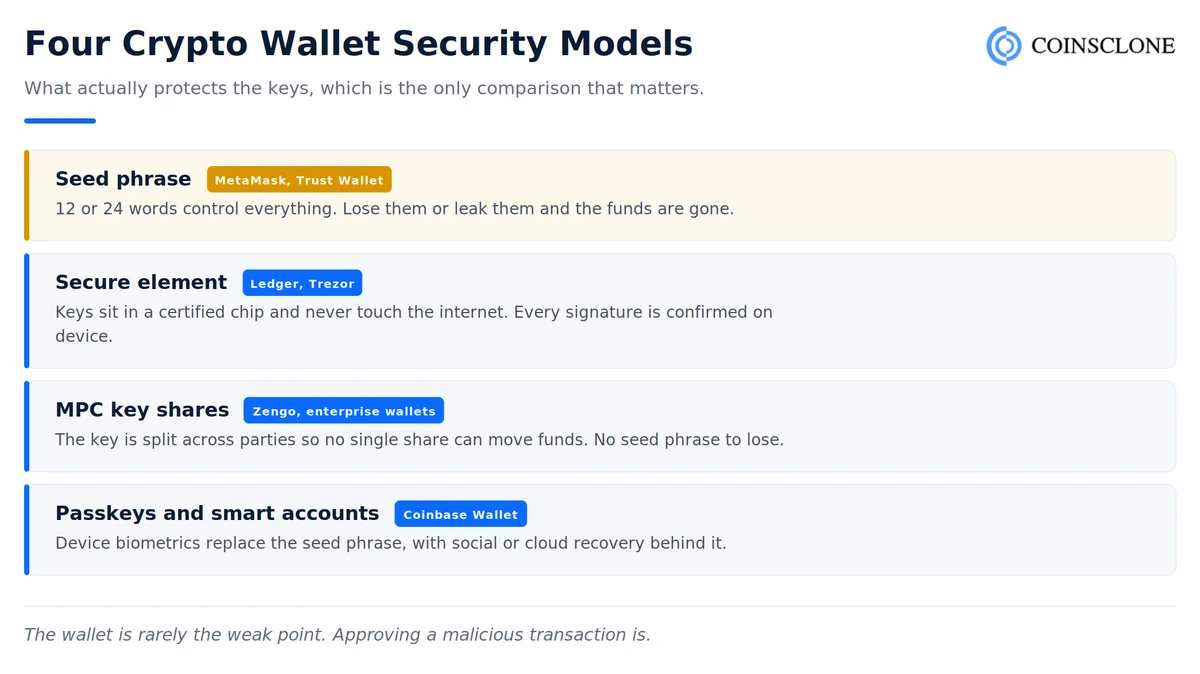
The most secure crypto wallets are the ones where the key never sits on an internet connected device, which means Ledger and Trezor first, followed by MPC wallets such as Zengo. Security comes from the key architecture, not from the feature list.
- Secure element: Ledger and Trezor keep keys in a certified chip and confirm each transaction on device.
- MPC: Zengo and most enterprise wallets split the key into shares, so no single share can move funds.
- Passkeys and smart accounts: Coinbase Wallet and embedded wallets swap the seed phrase for device biometrics with recovery behind it.
Best Crypto Wallets for Digital Asset Security
For digital asset security, pair a hardware signer with a hot wallet used only for small balances, and treat every signature request as the real attack surface. Ledger, Trezor and Zengo cover the three credible security architectures available to individuals.
- Keep the recovery phrase offline and never type it into any website, app or support chat.
- Revoke old token approvals regularly, since a stale approval can be drained long after the original transaction.
- Use a wallet that simulates transactions, such as Rabby, when you interact with unfamiliar contracts.
Most User-Friendly Crypto Wallets with dApp Integration
For dApp integration with an interface a newcomer can follow, MetaMask, Trust Wallet and Coinbase Wallet are the strongest options, with Rabby the better pick once you understand approvals. All four include a built-in browser or connector so dApps open without extra setup.
- MetaMask has the broadest dApp compatibility, since most Web3 apps are tested against it first.
- Trust Wallet has the cleanest mobile dApp browser across the widest chain list.
- Coinbase Wallet removes the seed phrase step entirely, which is where most first-time users give up.
Best Crypto Wallets with Integrated Trading and NFT Marketplaces
Wallets that combine trading and NFT features in one app now include MetaMask, Phantom, Trust Wallet and Coinbase Wallet, all of which carry in-app swaps plus an NFT view. Coinbase Wallet goes furthest, adding perpetual futures, prediction markets and tokenised stocks.
- In-wallet swaps are convenient but carry a platform fee on top of gas, so compare against a DEX for larger trades.
- Phantom and Backpack give the strongest NFT experience on Solana, including bulk actions.
- No major wallet is an NFT marketplace itself, so listings still happen on OpenSea, Magic Eden or a similar venue.
OpenSea Supported Wallets
OpenSea works with the standard set of self custody wallets, including MetaMask, Coinbase Wallet, Phantom, Trust Wallet and anything that connects through WalletConnect. Hardware wallets connect through a software wallet rather than directly.
- For Ethereum and EVM collections, MetaMask is the most reliable connection.
- For Solana collections, Phantom or Backpack is the better fit.
- Connecting a wallet never grants access to your funds, but approving a listing or a transaction does, so read each prompt.
Best Crypto Wallet for Staking
For staking from a self custody wallet, Trust Wallet supports the widest set of assets, Phantom and Solflare are strongest for SOL, and Ledger lets you stake while keys stay offline. Staking through a wallet means you keep custody and also carry the slashing and lock-up risk yourself.
- Trust Wallet supports staking on more than 25 assets including BNB, ATOM, SOL, DOT and TRX.
- Unbonding periods follow network rules, so funds are not instantly available when you unstake.
- Exchange staking absorbs slashing risk on your behalf, which is the trade-off against holding your own keys.
Best Wallet for Polymarket
Polymarket runs on Polygon, so any wallet that supports Polygon and connects through WalletConnect will work, with MetaMask and Coinbase Wallet the most common choices. Polymarket also supports email and social sign-in that creates a wallet for you behind the scenes.
- MetaMask is the standard choice for users who already hold USDC on Polygon.
- Coinbase Wallet suits users who want passkey login rather than a seed phrase.
- Funding happens in USDC, so plan the bridge or on-ramp step before the first trade.
Top Rated Solana Crypto Wallets for Fast Token Swaps
For fast Solana token swaps, Phantom, Solflare, Backpack and Jupiter are the wallets and routes most traders use, with Phantom the default for general use. Solana network fees stay well under a cent, so the wallet swap fee is usually the larger cost.
- Phantom charges 0.85% on in-wallet swaps, which is convenience priced rather than cheapest.
- Routing through Jupiter directly often improves execution on larger trades.
- Backpack suits users who want NFT tooling and trading in the same app.
Best Free Crypto Wallet
Every major software wallet is free, including MetaMask, Trust Wallet, Phantom, Exodus and Rabby, and none of them charge to create an account or hold assets. The costs appear later as network gas and as a platform fee on in-wallet swaps.
- A free wallet is not a cheap wallet if you swap often, since swap fees run around 0.85% to 0.875%.
- Hardware wallets are the only ones with an upfront price, which buys offline key storage.
- If a wallet asks for payment to unlock your funds or to “validate” them, it is a scam.
Best Crypto Wallets by Country
Self custody wallets are global software, so MetaMask, Trust Wallet, Phantom and Ledger work the same way in the United States, Nigeria, the Philippines, Ukraine, Italy and almost everywhere else. What changes by country is the on-ramp and the tax treatment, not the wallet.
- Buying crypto with local currency is the step that varies, through a local exchange, a peer-to-peer service or a card on-ramp partner.
- Card on-ramps inside wallets are geo-restricted in many markets, so funding in crypto is often the more reliable route.
- Sanctioned jurisdictions face service restrictions from most providers, and local rules on holding or trading crypto change frequently, so confirm the current position with a qualified local adviser.
Crypto Wallet Infrastructure for Multi-Chain Wallets
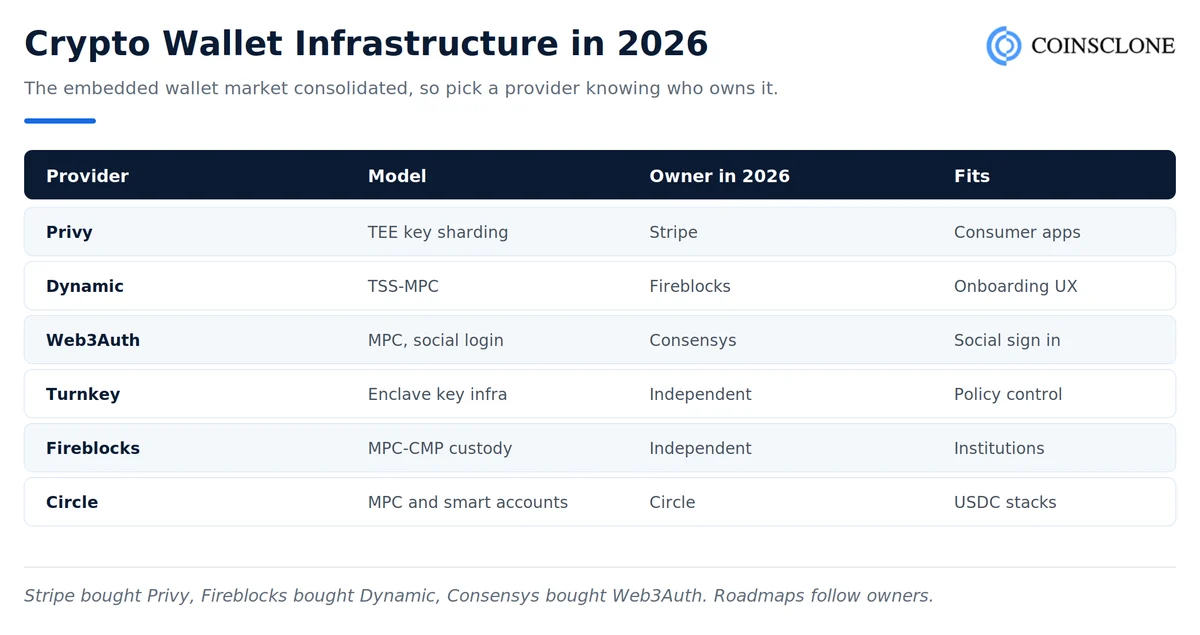
If you are building rather than choosing a wallet, the market has consolidated around a small group of infrastructure providers: Privy, Dynamic, Web3Auth, Turnkey, Fireblocks and Circle. Ownership changed hands in 2025, so the provider you pick now comes with someone else’s roadmap attached.
- Stripe acquired Privy, Fireblocks acquired Dynamic, and Consensys acquired Web3Auth, which now ships as MetaMask Embedded Wallets.
- Turnkey and Fireblocks remain the picks when you need policy controlled signing or institutional custody.
- Circle Programmable Wallets fit naturally when the product is already USDC centric.
Best Wallet SDKs for Custom Crypto Wallets
For a custom wallet, the shortlist is Privy, Dynamic, Turnkey, Web3Auth and Circle, and the choice comes down to who holds the key material and how much signing policy you need. All of them remove seed phrase onboarding, which is the single biggest drop-off point in consumer crypto products.
- TEE or enclave based: Privy and Turnkey generate and use keys inside hardware isolated enclaves.
- MPC based: Dynamic uses threshold signatures, Web3Auth uses Shamir secret sharing, Fireblocks uses MPC-CMP.
- Check key exportability before committing, because it decides whether your users can leave with their assets.
Enterprise Crypto Wallet Solutions
For enterprise use, Fireblocks is the established institutional custody choice, while Turnkey suits teams that want low level key infrastructure with a configurable policy engine. The deciding factors are auditability, approval workflows and spend controls rather than user interface.
- Policy engines enforce spend caps, approved destinations, time windows and multi-party approval before a signature is released.
- MPC custody spreads key shares so no single operator can move funds alone.
- Compliance teams tend to recognise the established names, which shortens procurement.
Scalable Wallet Solutions for Web3 Apps
For a Web3 app that needs wallets to appear invisibly, embedded wallet SDKs create an account from an email, social login or passkey and handle signing behind the scenes. This is the fastest route from signup to a completed on-chain action.
- Account abstraction standards such as ERC-4337 and EIP-7702 enable gas sponsorship and batched transactions.
- Gasless onboarding removes the requirement that a new user already holds the network token.
- Costs are usually per wallet or per active user, so model them against your expected retention before launch.
Simple Wallet Solution for Onboarding New Users Quickly
The quickest onboarding path is a passkey or social login that provisions a wallet in the background, which is what Coinbase Wallet does for consumers and what Privy, Dynamic and Web3Auth do for apps. Removing the seed phrase step is the single largest conversion gain available.
- A seed phrase screen is where most mainstream users abandon the flow.
- Passkeys use the device biometric that people already trust for banking apps.
- Offer key export later, so the convenient start does not trap users in your product.
Solana Wallet Solutions for Institutional Use
For institutional Solana activity, the pattern is a custody or key management provider such as Fireblocks or Turnkey for signing policy, with Solflare or a hardware signer for validator and staking operations. Consumer wallets are not built for approval workflows or audit trails.
- Institutional requirements centre on multi-party approval, spend limits and a complete audit log.
- Validator and staking operations usually need a hardware signer in the path.
- Compressed NFTs and token extensions need an indexer alongside the wallet for complete reporting.
Build or Buy: Which Wallet Model Fits Your Business
Buying an SDK gets a wallet into production in weeks with a vendor dependency and per-user pricing, while building gives full control of key management and UX at the cost of cryptographic expertise and ongoing maintenance. Most teams start by buying and move critical pieces in house later.
- Buy when speed to market matters and your differentiator is the application, not the wallet.
- Build when the wallet is the product, when unit economics break at vendor pricing, or when regulation requires direct control of key material.
- A white label wallet sits between the two, giving a customisable product without starting from an empty repository.
Crypto Wallet Updates in 2026
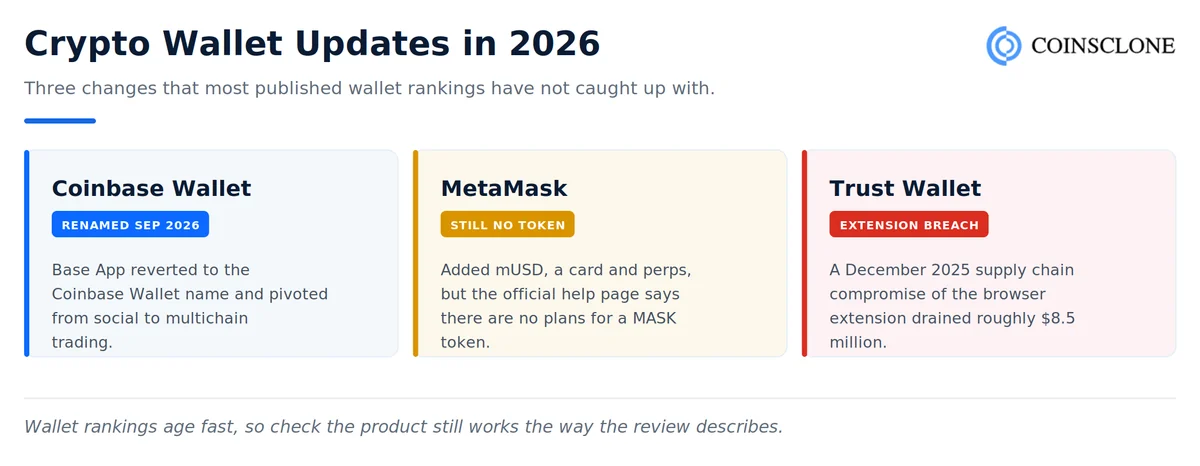
Three changes from 2026 are missing from most published wallet rankings: Coinbase Wallet reverted from the Base App name, MetaMask still has no token despite years of speculation, and the Trust Wallet browser extension suffered a supply chain compromise.
- Coinbase renamed the Base App back to Coinbase Wallet on 10 September 2026 and refocused it on multichain trading after the social features did not land.
- MetaMask’s official rewards help page stated in August 2026 that there are no plans for a MASK token, even though Consensys leadership had previously said one was coming.
- The classic Coinbase Wallet experience closed on 15 August 2026, which removed support for several networks including Dogecoin, Litecoin, XRP and Stellar in that app.
How to Choose a Crypto Wallet
Choose a wallet by matching four things: the chains you use, how much you hold, how often you sign transactions, and what happens if you lose the device. Everything else is preference.
- Chains: a wallet that does not support your network is unusable regardless of its rating.
- Amount: anything you would be upset to lose belongs behind a hardware signer.
- Frequency: heavy DeFi users benefit most from transaction simulation and approval management.
- Recovery: seed phrase, MPC and passkey recovery fail in different ways, so pick the one you can actually execute under stress.
Frequently Asked Questions
What are the top 10 crypto wallets in 2026?
Ledger, MetaMask, Trust Wallet, Phantom, Coinbase Wallet, Trezor, Exodus, Rabby, Zengo and Backpack. Ledger and Trezor are hardware wallets, the rest are software.
What are good crypto wallets for a complete beginner?
Coinbase Wallet for passkey onboarding without a seed phrase, or Trust Wallet for a simple mobile app across many chains. Add a hardware wallet once the balance grows.
Is an online crypto wallet safe?
A browser or mobile wallet is safe enough for small daily balances if you keep the recovery phrase offline and read every signature prompt. Larger holdings belong offline in hardware.
How do hardware wallets differ from software wallets?
Hardware wallets keep private keys in an offline chip and require physical confirmation for each transaction. Software wallets keep keys on an internet connected device, which is more convenient and more exposed.
Can a business build its own crypto wallet?
Yes. Most teams either integrate an embedded wallet SDK or start from a white label wallet, then customise the interface, chain support and revenue model rather than building key management from scratch.
See How Our MVP System Helps You Choose & Build the Best Crypto Wallet Faster
Crypto Wallet Development — done right.
- MVP System : Create your wallet inspired by the Top 10 Best Crypto Wallets 90% faster.
- Pre-Built Modules : Security, swaps, staking, and multi-chain support — all ready to go.
- Brand & Customization : Your logo, your theme, your wallet experience.
- Revenue Engine : Monetize through transaction fees, staking rewards & premium add-ons.
Get a free branded demo of your custom crypto wallet in just 48 hours — before you invest a cent.
Book a Free Demo to explore how our Top 10 Wallet-Inspired MVP System can help you launch a world-class wallet in just 8-12 weeks.
Build Your Own Crypto Wallet with Coinsclone
Coinsclone builds custom and white label crypto wallets for founders who want to own the product rather than rent it. Our work covers multi-chain support, MPC and hardware signer integration, staking and swap modules, dApp connectivity, and the onboarding flow that decides whether new users ever reach their first transaction.
We start from a live demo rather than a specification document, so you can see the wallet before committing to a build. Talk to our team about the chains, custody model and user base you are targeting, and we will map the fastest route to launch.