

Want to know how to start a crypto business in 2026? This guide walks you through the full path in 10 clear steps, from picking a business model to launch day. You will see which licence your model needs, what each step costs, and how long it takes in real weeks.
The market is big enough to reward a careful founder. Crypto is worth about $2.9 trillion, and traders swap about $100 billion a day. Still, the rules got tighter this year, and banks and users now expect proof that your platform is safe. So we focus on the choices that decide whether your crypto company gets off the ground.
In this guide:
- The 10 steps to start a crypto business, in the order that saves time and money
- A simple decision tree that shows which licence your business model needs
- Licence costs and capital rules in the EU, US, UK, Dubai, Singapore, Hong Kong and India
- Real launch timelines, and why your licence file should start before your build
- The common mistakes that sink new crypto companies
Learn How to Start a Crypto Business — The Smart Way!
Build your crypto venture with speed, scalability, and profit in mind.
- Launch Fast : Go live in weeks, not in Months
- Zero Coding Needed : Plug-and-play blockchain modules.
- Full Branding : Your logo, your design, your market.
- Monetize Instantly : Earn from trading, staking, and listings.
Get a free personalized demo of your crypto platform in just 48 hours — no upfront cost.
Book a Free Demo to see how our MVP system helps you start your crypto business effortlessly.
How to Start a Crypto Business in 10 Steps
Starting a crypto company is like starting any business, with two extra layers: licences and security. So the order of your steps matters. If you build first and ask about rules later, you may have to rebuild. Here is the path that works for most founders.
Step 1: Choose Your Crypto Business Model
First, decide what you will sell. A crypto exchange, a wallet, a payment gateway, an NFT marketplace and a DeFi app are all crypto businesses, yet each one earns money in its own way. We cover the main options in the ideas section below, and our list of crypto business ideas compares 18 of them.
While you choose, ask two questions. Will you hold your users’ coins or keys? And will you swap crypto for normal money? These two answers decide most of your licence work, your budget and your launch date. A non-custodial wallet or a trading tool can launch fast. An exchange that holds funds and takes bank deposits needs a full licence first.
Step 2: Take a Deep Look at the Current Market
Next, do plenty of research on the market. Learn how the leading crypto businesses grew and where they still fall short. Study your competitors closely: what they charge, which coins they list, and what their users complain about in reviews.
Then talk to real users before you write any code. A short survey or ten calls with your target traders will tell you more than a long report. Without sound knowledge of the domain, a startup can build the wrong product. So test your idea on paper first, then move on.
Step 3: Pick Your Location
Location shapes everything that follows. Some countries welcome crypto with clear rules, while others limit it or ban parts of it. Your home country also decides which users you can serve, which banks will work with you, and how you pay tax.
Many founders pick a base with clear crypto laws, such as the EU under MiCA, Dubai, Singapore or Hong Kong. Our guide to crypto-friendly countries compares 16 of them for exchange founders. Keep in mind that a licence in one place does not let you serve users everywhere. So plan where your users live, not just where your office is.
Step 4: Set Up Your Company
Now register a legal entity. In the US, many small crypto service firms use an LLC because it is simple and cheap to run. However, if you plan to raise money from venture investors, most of them expect a Delaware C-corporation. Outside the US, a private limited company is the usual choice.
Also plan your tax setup early. Crypto income is taxed in most countries, and some add their own rules. For example, India kept its 30% tax on crypto gains and 1% TDS on trades in the 2026 Budget. A crypto-aware accountant can save you from costly fixes later.
Step 5: Get Legal Advice and the Right Licence
Once you know your model and location, hire a lawyer who knows crypto. A good adviser will tell you which licence you need, which rules apply to your token, and what your terms of service must say. Then apply for the licence so you can start with no doubts.
The decision tree below shows the usual starting point. In short, holding customer funds or swapping crypto for cash brings the heaviest licences.
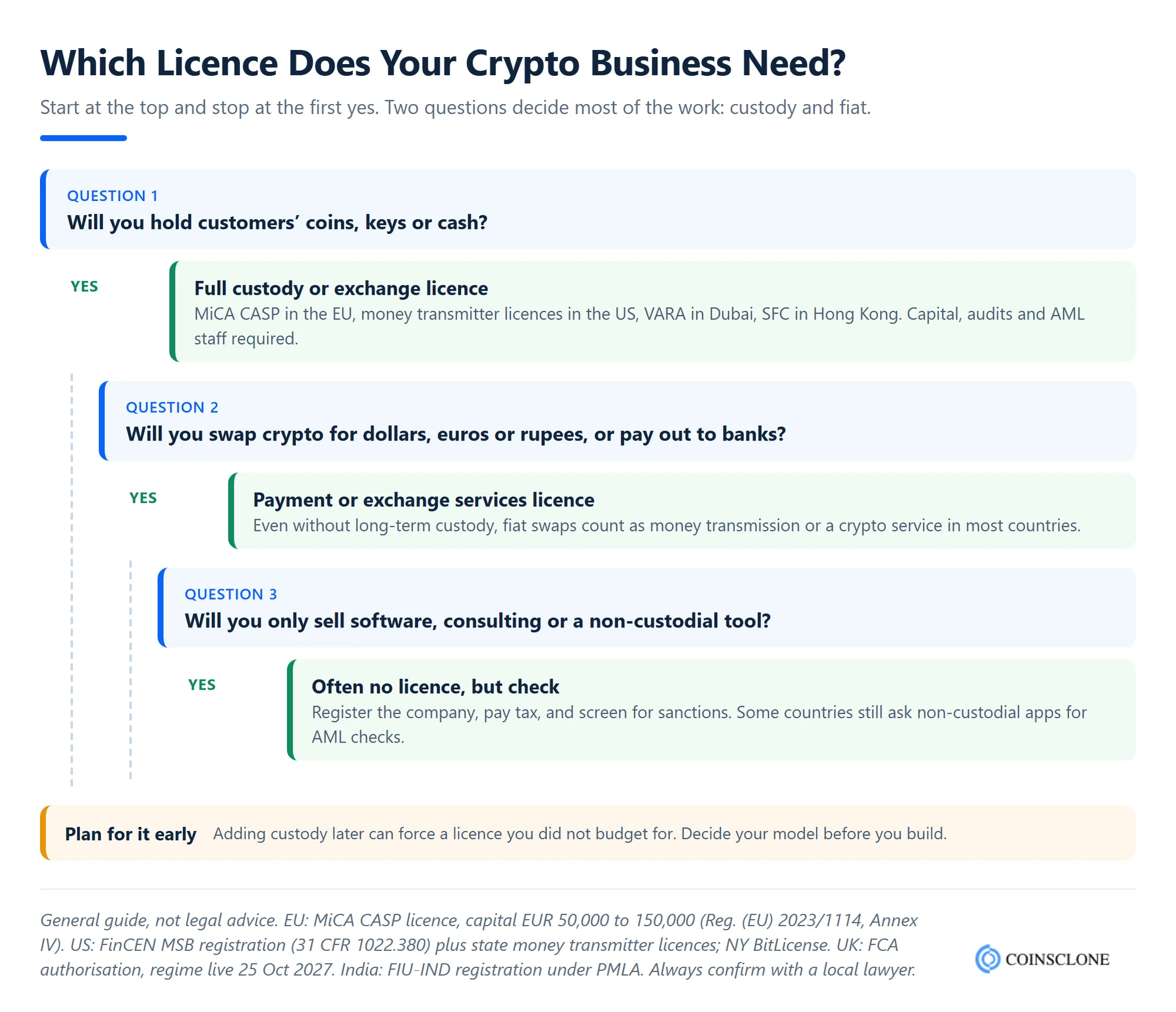
Here is what the main licences cost and require in 2026:
| Region | Licence you need | Capital or fee | What to know |
| European Union | MiCA CASP licence | EUR 50,000 to 150,000 in capital | Review takes up to 25 working days to check the file, then 40 to assess it. One licence covers all EU states. |
| United States | FinCEN MSB registration plus state money transmitter licences | FinCEN filing is free; states set bonds and net worth | New York needs a BitLicense ($5,000 fee). California needs a DFAL licence from July 2026. |
| United Kingdom | FCA cryptoasset authorisation | GBP 28,150 fee for a trading platform; GBP 11,260 for dealing or custody | The application window runs from 30 Sept 2026 to 28 Feb 2027. The new regime starts on 25 Oct 2027. |
| Dubai | VARA licence | AED 100,000 application fee for an exchange; AED 200,000 a year | Covers mainland Dubai. ADGM and DIFC have their own regulators. |
| Singapore | MAS licence under the Payment Services Act | S$250,000 base capital | Firms that serve only overseas users need a separate DTSP licence, which MAS says it will rarely grant. |
| Hong Kong | SFC virtual asset trading platform licence | HKD 5 million paid-up capital | Only 13 platforms held this licence as of May 2026. |
| India | FIU-IND registration under PMLA | No capital floor | Required since March 2023 for crypto service providers, including offshore ones serving Indian users. |
Figures come from the MiCA regulation, NYDFS, FCA, VARA fee schedule and the SFC register of licensed platforms. For fees and paperwork in more places, see our crypto license guide.
Rules also keep moving. The EU’s MiCA grace period ended on 1 July 2026, so EU firms now need the full licence. In the US, the GENIUS Act set rules for stablecoins in July 2025, but the CLARITY Act for exchanges stalled in the Senate in September 2026. And the FATF reports that 83% of surveyed countries have passed Travel Rule laws, which means sender and receiver details must travel with crypto transfers.
Step 6: Plan Your Funding and Budget
Whatever the business, you need enough money to reach launch and survive the slow first months. Funding is one area you cannot cut corners on. Most founders mix their own savings with angel money, a seed round, a grant or a strategic partner.
Your budget should cover five things: the build, the licence and its capital, compliance tools, security audits, and marketing. Many teams forget the running costs. For example, identity checks cost about $1.35 per user on a basic plan, so 10,000 sign-ups add $13,500. We break the numbers down in the cost section below.
Step 7: Open Banking and Fiat Rails
If users will pay in dollars, euros or rupees, you need a bank or payment partner that accepts crypto firms. This is often the hardest step. Many banks still say no, so start talks early and show them your licence plan, your AML policy and your KYC flow.
Also plan how users will move money in and out. Common options include bank transfers, cards through a payment partner, and stablecoins such as USDT and USDC. Exchanges also need crypto liquidity providers or market makers, so the order book looks active on day one.
Step 8: Build Your Platform
Now it is time for your tech team. Your platform needs a simple, user-friendly design that helps traders act fast. Live prices, real-time trading, clear charts and quick deposits all help win users.
You have two main ways to build:
- White label software: A ready, tested platform that is branded and set up for you. It is the fastest and cheapest path, and it suits most first launches.
- Custom build: Code written from scratch for a new idea or special needs. It takes longer and costs more, but every part is yours.
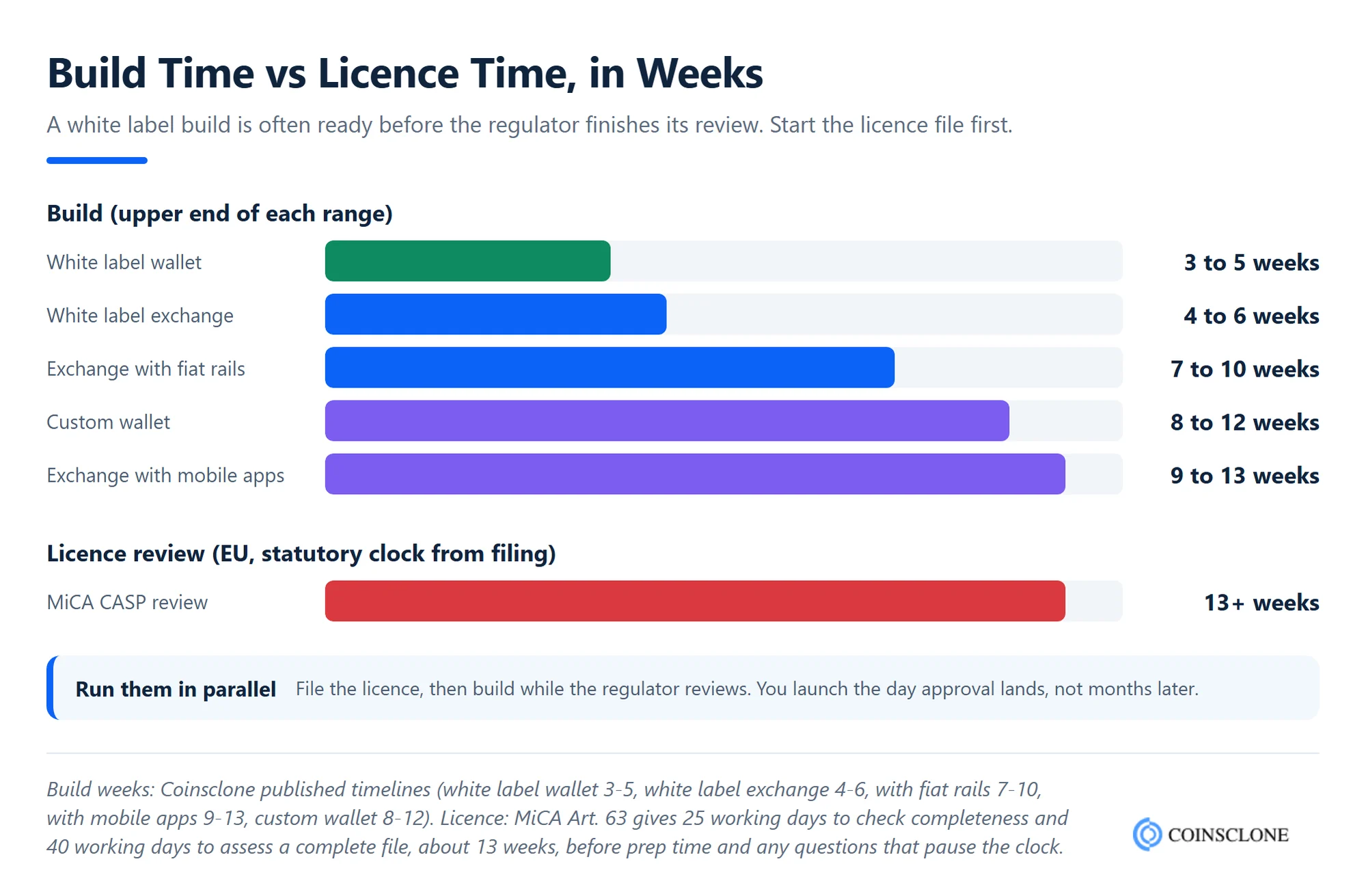
Published 2026 agency cost guides put a white label exchange at about $30,000 to $100,000, and a custom centralised exchange at $150,000 to $420,000 or more. Time matters as much as money. The chart below compares build times with the EU licence review, which is often the slower track.
Security is the key to success. According to Chainalysis, hackers stole $3.4 billion in crypto in 2025, and one attack on Bybit took about $1.5 billion. So use two-factor login, cold storage for most funds, withdrawal limits, and a smart contract audit before launch. Our guide on how to build a non-hackable crypto exchange lists the full set.
Step 9: Run a Beta and Gather Feedback
With the platform ready, go live with a beta test. Invite a small group of target users, watch where they get stuck, and ask what they miss. Then fix the issues and test again.
A beta also tests your back office. Check that KYC checks pass smoothly, deposits land on time and support tickets get answers. These small things decide whether early users stay.
Step 10: Launch With a Marketing Plan and Strong Support
Know your target audience, your competitors and your market before you launch. Then prepare a marketing plan that makes your business easy to find from anywhere. Here are a few plans you can carry out:
- Draft a short business brochure and send it to crypto traders, developers and investors.
- Promote the business through social media and crypto communities on X, Telegram and Discord.
- List your services on popular crypto directories and comparison sites.
- Hire marketing and sales people for direct outreach to partners.
Finally, set up customer support. Users will face issues and have questions, so offer fast help through live chat, email and a help centre. Businesses with quick, friendly support earn trust, and a quick reply from your team shows users that you are reliable.
If you follow these steps, you are well placed to start a crypto company and earn a profit. Still, doing every step alone is hard. This is where a seasoned development partner can make the process faster and safer.
How Much Does It Cost to Start a Crypto Business?
The cost to start a crypto business depends on your model and where you launch. A non-custodial tool may need little more than the build and a lawyer. A licensed exchange needs capital in the bank before it serves its first user. Here are the main cost lines with current figures:
| Cost line | Typical range in 2026 | Source |
| White label platform | About $30,000 to $100,000 | Published 2026 agency cost guides |
| Custom exchange build | About $150,000 to $420,000+ | Published 2026 agency cost guides |
| EU licence capital | EUR 50,000 to 150,000 | MiCA Annex IV |
| Dubai exchange licence | AED 100,000 to apply, AED 200,000 a year | VARA |
| UK licence fee | GBP 11,260 to 28,150 | FCA |
| US federal registration | Free (FinCEN MSB) | FinCEN |
| Identity checks | About $1.35 per user | Sumsub basic plan |
On top of these, plan for legal fees, a security audit, hosting, liquidity and marketing. For a full exchange breakdown by type, see our crypto exchange development cost guide.
Is Starting a Crypto Business Profitable?
A crypto business earns money by serving traders, holders and merchants. Exchanges charge trading and withdrawal fees. Wallets earn on swaps. Payment gateways take a small cut of each payment. So a well-run crypto company has many ways to earn, which is a big reason founders keep entering the space.
The numbers back this up. The top ten centralised exchanges handled $1.95 trillion in spot trades in Q2 2026 alone, per CoinGecko. On-chain, crypto apps earned about $23.8 billion in fees in the past 12 months, according to DefiLlama. Stablecoin issuers led with $8.6 billion, then DEXs with $3.2 billion and derivatives with $2 billion.
However, profit is not spread evenly. NFT marketplaces earned only about $0.4 billion, and most of that went to one platform. So pick a model where fees still flow, and build for trust. As long as people keep using crypto to trade, save and pay, a careful crypto business can be a profitable one.
Benefits of Starting a Crypto Business
The benefits are what keep a crypto company in the market for the long run. Here are the main ones.
Blockchain
Crypto runs on blockchain technology, so records cannot be changed or erased once stored. This builds trust without a middleman. As a result, any business built on blockchain can offer clear, checkable records to its users.
Growing User Base
Crypto users keep growing, and more of them now come from banks, brokers and payment apps. With more users, any business has a better chance of success. The same rule applies here, especially in markets with clear rules.
Many Revenue Streams
A crypto company can earn in many ways at once: trading fees, listing fees, spreads, staking shares, subscriptions and payment fees. This mix helps a business stay steady when one stream slows down.
Global Reach
Crypto moves across borders in minutes. With the right licences, one platform can serve users in many countries, which is hard for a local bank or broker to match.
Once you know the benefits, the next step is to choose an idea.
Crypto Business Ideas to Start in 2026
There are many crypto-related businesses in the market, and picking one of them can bring steady revenue. Here are five popular ones that have proven themselves over the past few years.
Idea 1: Start a Crypto Exchange Business
Crypto exchanges remain the biggest business in crypto. Users visit the exchange to buy, sell or trade coins, and the owner charges a small fee on each trade. Exchanges also earn from listings, withdrawals and margin interest, which makes them a top choice. A white label crypto exchange is the quickest way in.
Idea 2: Start a Crypto Wallet Business
A crypto wallet lets users store and send their coins safely. Since online assets attract hackers, a secure wallet is a must for every crypto user. A wallet business earns from swap fees, on-ramp partners and premium features. Our crypto wallet development team builds both custodial and non-custodial wallets.
Idea 3: Start a Crypto Payment Gateway
A crypto payment gateway lets merchants accept payments in crypto. The gateway charges a small fee whenever it processes a payment. Today, most of this volume runs in stablecoins, which suits shops that want stable prices. See our crypto payment gateway development service for options.
Idea 4: Start an NFT Marketplace
NFTs prove who owns a digital item, such as art, music, tickets or game assets. An NFT marketplace is where people mint, buy and sell them. The market is smaller than in 2021, so the best results now come from niche marketplaces with a clear audience, like games, music or real-world assets.
Idea 5: Start a DeFi Exchange Business
A DeFi exchange is a decentralised platform where users trade without a middleman. Smart contracts hold the funds and match trades, so no one company controls user assets. DEXs earned about $3.2 billion in fees in the past year, so the model still has room once trading volume grows.
Among these, crypto exchanges are still seen as the strongest idea, as they draw the largest crowd of crypto users. Newer models such as stablecoin payments and prediction markets are also growing fast. However, every model comes with hurdles that you should plan for.
Challenges in Starting a Crypto Business
Whatever crypto business you choose, you will face a few common challenges. Knowing them early helps you plan for each one.
- Security: Crypto platforms are prime targets for hackers. One weak point can drain user funds and end your brand.
- Rules and licences: Rules differ by country and keep changing. A licence can take months, and the rules may shift while you wait.
- Banking: Many banks still avoid crypto firms, which slows deposits and payouts.
- Privacy: You must collect KYC data while keeping it safe and following data laws.
- Scaling: A platform that works for 1,000 users may crash at 100,000. Plan for load from day one.
- Trust: Users remember past exchange collapses. Proof of reserves, audits and clear fees help win them back.
You can overcome these challenges with the right legal team and an experienced crypto development company.
Common Mistakes When Starting a Crypto Business
Many crypto startups fail for the same few reasons. Avoid these and you are already ahead of most.
- Building before checking the rules: A custodial feature can trigger a licence you did not plan for, and that can mean a costly rebuild.
- Skipping the security audit: An audit costs far less than a hack, and users and banks now ask for one.
- Ignoring liquidity: An exchange with empty order books loses traders in days.
- Building before testing demand: Talk to users first, then build what they will pay for.
- Underbudgeting running costs: KYC, hosting, support and compliance staff cost money every month, not just at launch.
How Coinsclone Helps You Start a Crypto Business
Coinsclone has been building crypto platforms since 2018. Our team has delivered 350+ platforms for 200+ clients across 20 industries, so we know where new crypto businesses get stuck and how to get them live.
We build every core crypto business model, including cryptocurrency exchange development, crypto wallets, payment gateways, NFT marketplaces and DeFi exchanges. Our white label exchange goes live in 4 to 6 weeks, or 7 to 10 weeks with fiat rails. A white label wallet takes 3 to 5 weeks, and a payment gateway 6 to 9 weeks.
If you are planning to start a crypto company, talk to our team about your model and your target market. We will help you pick the right build path and launch on time.
Frequently Asked Questions
How much does it cost to start a crypto business?
It depends on the model. A white label platform costs about $30,000 to $100,000, per published 2026 agency cost guides, while a custom exchange can pass $400,000. Licensed models also need capital, such as EUR 50,000 to 150,000 under the EU’s MiCA rules, plus legal, audit and KYC costs.
Do I need an LLC for a crypto business?
You need some legal entity, but it does not have to be an LLC. In the US, an LLC suits small service firms, while a Delaware C-corporation suits founders who plan to raise venture money. Outside the US, a private limited company is the usual choice.
Do I need a licence to start a crypto business?
You do if you hold customer funds, run an exchange or swap crypto for cash. In the EU that means a MiCA licence, and in the US it means FinCEN registration plus state licences. Pure software or consulting firms often need no licence, but they still pay tax and may need AML checks.
How long does it take to get a crypto business licence?
It varies by country. Under MiCA, the regulator has 25 working days to check your file and 40 more to decide, so plan for at least three to four months with prep time. US state licences and the UK’s new regime can take longer.
Can I start a crypto business without much money?
Yes, if you choose a light model. A crypto consulting firm, a trading bot, a non-custodial wallet or a white label platform costs far less than a custom exchange. Start small, prove demand, then add licensed services as you grow.
What is the best type of crypto business to start in 2026?
Exchanges, payment gateways and stablecoin services still earn the most fees. For first-time founders, a white label exchange or wallet is often the best start, because it launches in weeks and lets you test the market before you spend on a custom build.
Learn How to Start a Crypto Business — The Smart Way!
Build your crypto venture with speed, scalability, and profit in mind.
- Launch Fast : Go live in weeks, not in Months
- Zero Coding Needed : Plug-and-play blockchain modules.
- Full Branding : Your logo, your design, your market.
- Monetize Instantly : Earn from trading, staking, and listings.
Get a free personalized demo of your crypto platform in just 48 hours — no upfront cost.
Book a Free Demo to see how our MVP system helps you start your crypto business effortlessly.