
A prediction market is a place where people buy and sell contracts on whether a future event will happen. Each contract pays $1 if the event happens and $0 if it does not. So the price of a contract, say 62 cents, works as the crowd’s guess of the odds: a 62% chance.
That simple idea now moves serious money: tracked platforms traded $128 billion in contracts in October 2026. This guide explains what a prediction market is, how prices turn into probabilities, the main types, real examples, and how they differ from gambling. It also covers the US legal fight, dated to 1 November 2026, and the risks traders face.
In this guide:
- How one 62-cent contract makes or loses money, fees included
- The four main types of prediction markets and who uses each
- Why US states and the CFTC are fighting over whether this is gambling
- What the research says about accuracy, and where markets got it wrong
- The real risks, from insider trading to thin markets
What Is a Prediction Market?
A prediction market is an exchange for event contracts. An event contract is a simple Yes or No question with a fixed payout. “Will the Fed cut rates in December?” “Will Team A win the final?” “Will it rain more than 2 inches in Chicago this week?”
You can buy Yes or buy No. When the event is over, the market settles. Every winning contract pays $1 and every losing one pays nothing. Until then, you can sell your contract to someone else at the current price.
The price sits between 1 and 99 cents and moves as people trade. Because a contract pays $1, the price reads as a probability. A Yes price of 25 cents means the market sees about a 25% chance.
The idea is old. The Iowa Electronic Markets, run by the University of Iowa, has let people trade on US presidential elections since 1988. In 2004 HedgeStreet became the first one approved as a federal exchange. Kalshi got its federal license in November 2020, and prediction markets went mainstream after that.
How Does a Prediction Market Work?
A prediction market works like a small stock exchange with only two outcomes. Here is the life of one market:
- Listing: The platform writes a clear question, a close date and a named source that will decide the result.
- Trading: Buyers of Yes and buyers of No post orders. The platform matches them.
- Price moves: News, polls and new information push the price up or down.
- Settlement: When the event ends, the platform checks the named source and pays $1 per winning contract.
How Do Prices Become Probabilities?
A Yes contract and a No contract on the same question always add up to $1. If Yes trades at 62 cents, No costs about 38 cents. Together they pay $1 at the end, no matter what.
So a buyer at 62 cents is saying: “I think the chance is higher than 62%.” A No buyer at 38 cents is saying the chance of Yes is lower than 62%. The price settles where buyers and sellers balance. That number is the crowd’s estimate.
Fees change the math. On Kalshi, the taker fee schedule (effective 7 July 2026) charges 0.07 x contracts x price x (1 minus price). The fee is highest for contracts near 50 cents and lowest near 1 or 99 cents.
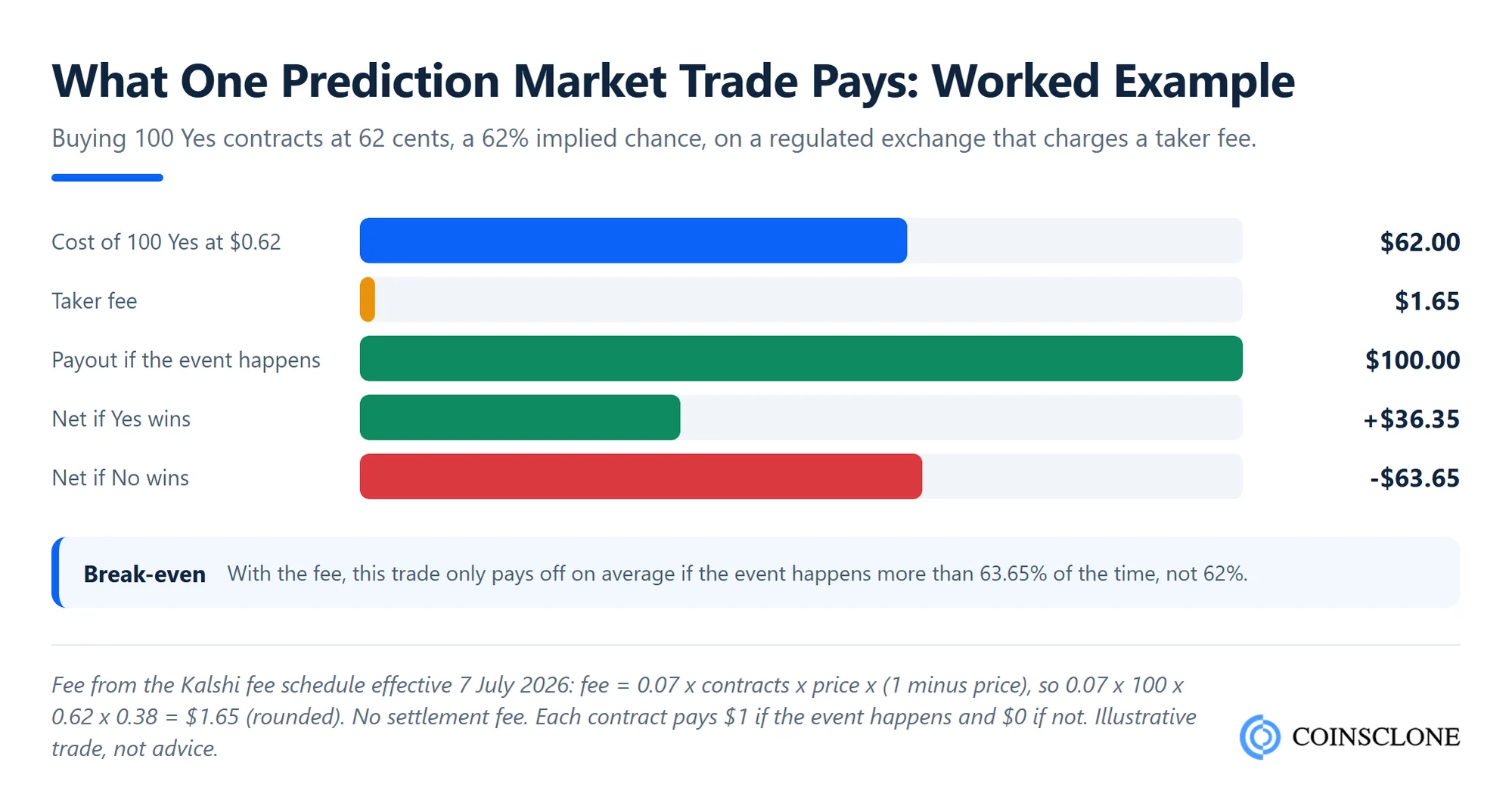
Take 100 Yes contracts at 62 cents. You pay $62, plus a fee of about $1.65. If the event happens, you get $100 and keep $36.35 profit. If it does not, you lose $63.65. To break even over many trades like this, your Yes picks must win more than 63.65% of the time.
Who Is on the Other Side of Your Trade?
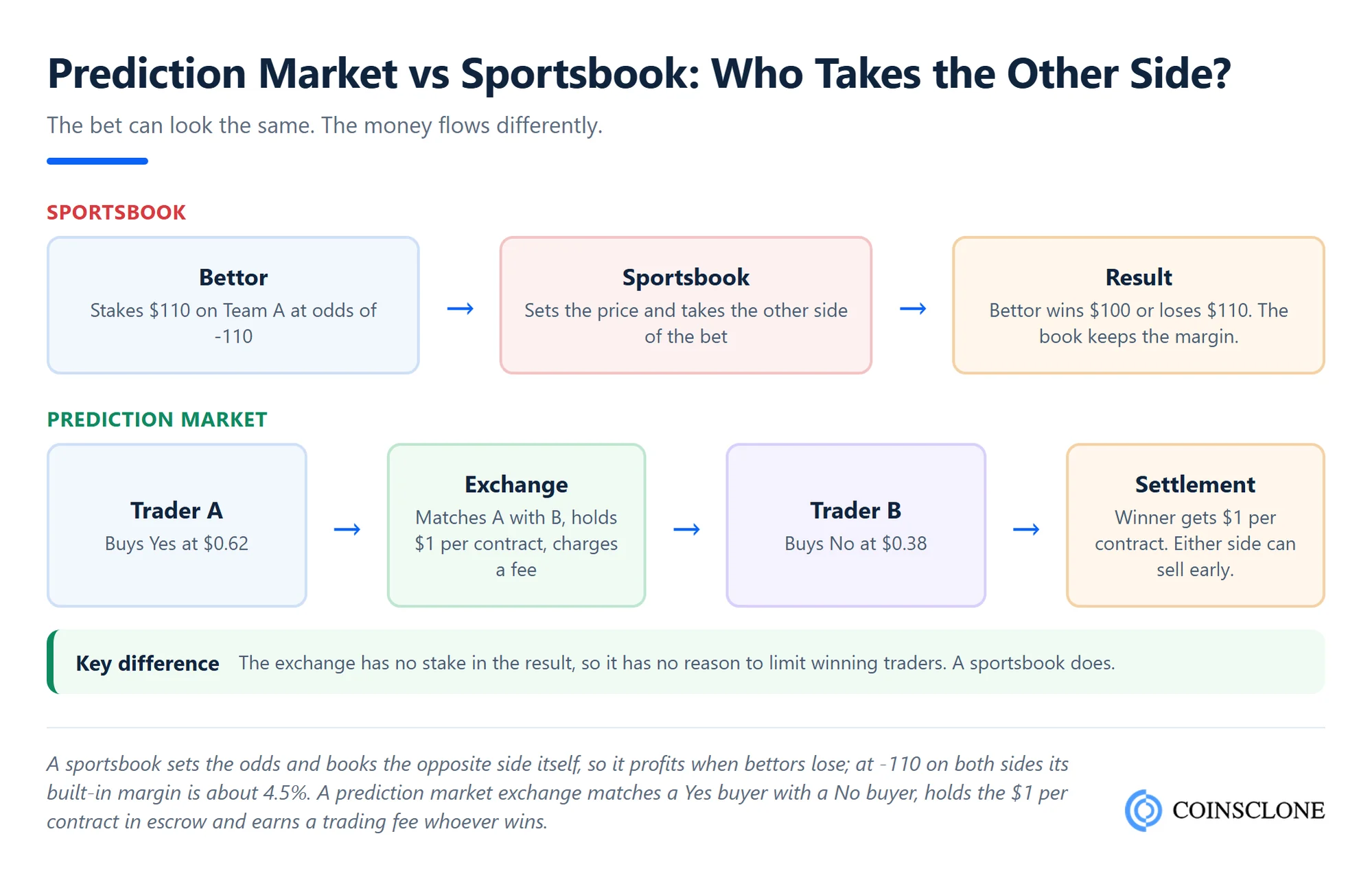
Another trader is. Most prediction markets do not bet against you. They match a Yes buyer with a No buyer and hold the $1 per contract until the market settles.
Traders come in two kinds. Makers post orders that wait in the order book. Takers accept those orders right away. On Kalshi, takers pay the fee on most markets, and makers pay a smaller fee only on some.
How Is a Prediction Market Settled?
Every market names its resolution source in advance. That could be an official election result, a government data release or a league’s final score. When the source reports, the platform settles the market.
Crypto platforms do this on a blockchain. Polymarket’s global site matches orders off-chain and settles trades on the Polygon blockchain. Results are proposed through an outside oracle, UMA, and a proposed answer can be disputed before it becomes final.
What Are the Main Types of Prediction Markets?
There are four main designs. They differ in who sets the price and where the money for trades comes from.
| Type | How the price is set | Main strength | Main weakness | Examples |
| Order book exchange | Traders post bids and asks | Tight prices when busy | Empty books in small markets | Kalshi, Polymarket |
| Automated market maker (AMM) | A formula quotes every price | Always a price to trade at | Operator funds the losses | Early Polymarket, many on-chain apps |
| Peer-to-peer or pooled | Bets are matched or pooled | Very simple to run | Hard to exit before the end | Pool-style and friend-to-friend apps |
| Play money or reputation | Points instead of cash | Legal almost everywhere | No real money at stake | Manifold, Metaculus |
What Is an Order Book Prediction Market?
This is the most common design today. Like a stock exchange, it keeps a list of buy and sell orders and matches them by price. Kalshi runs a central order book. Polymarket moved from an AMM to an order book in late 2022.
In a quiet market, the gap between the best buy and sell price can be wide. That is why new platforms spend so much effort on prediction market liquidity and market makers.
What Is an AMM Prediction Market?
An automated market maker uses a formula to quote a price at any moment. The best-known one is the logarithmic market scoring rule (LMSR), set out by economist Robin Hanson in 2003.
The LMSR has a useful feature: the operator’s worst-case loss is fixed in advance. It equals b x ln(n), where b sets how deep the market is and n is the number of outcomes. For a Yes or No market with b set to 100, the most the operator can lose is about $69.31. That makes it easy to seed new markets that would never attract an order book.
What Are Peer-to-Peer and Pooled Markets?
In a peer-to-peer market, two people agree on a bet and the app holds both stakes. In a pooled (parimutuel) market, everyone puts money into one pot per outcome and winners split the pot. Both are simple, but you usually cannot sell early.
What Are Play Money Markets?
Sites such as Manifold and Metaculus use points or reputation instead of cash. Companies have used the same idea inside their walls. Google, HP, Microsoft and Eli Lilly have all run internal markets to forecast launch dates and project results.
What Are Some Real Prediction Market Examples?
The US market is now led by a few large, federally licensed platforms, with Kalshi far ahead on volume.
| Platform | Status (as of 1 Nov 2026) | How you pay | What it lists |
| Kalshi | CFTC-licensed exchange since Nov 2020 | US dollars | Sports, politics, economics, weather, culture |
| Polymarket US | CFTC amended order, Nov 2025 | US dollars, through its app or brokers | Sports, elections, events |
| Polymarket (global) | Offshore; blocked US users 2022 to Dec 2025 | USDC stablecoin on Polygon | Politics, crypto, world events |
| Robinhood | Brokerage hub, plus its own Rothera joint venture | Brokerage account | Sports, earnings and other events |
| Iowa Electronic Markets | University research market since 1988 | Small cash stakes | Elections |
Polymarket’s path shows how much the rules matter. In January 2022 the CFTC fined Polymarket $1.4 million for offering more than 900 event markets without a license. In July 2025 it bought QCEX, a licensed exchange and clearing house, for $112 million. In November 2025 the CFTC cleared its return to the US through brokers.
Robinhood shows how fast brokers have moved in. Its users traded a record 16.4 billion event contracts in the third quarter of 2026, up more than 7x on a year earlier. The line earned $173 million, per its Q3 2026 earnings release. Its joint venture with Susquehanna, called Rothera, passed $100 million in yearly revenue in its first full quarter.
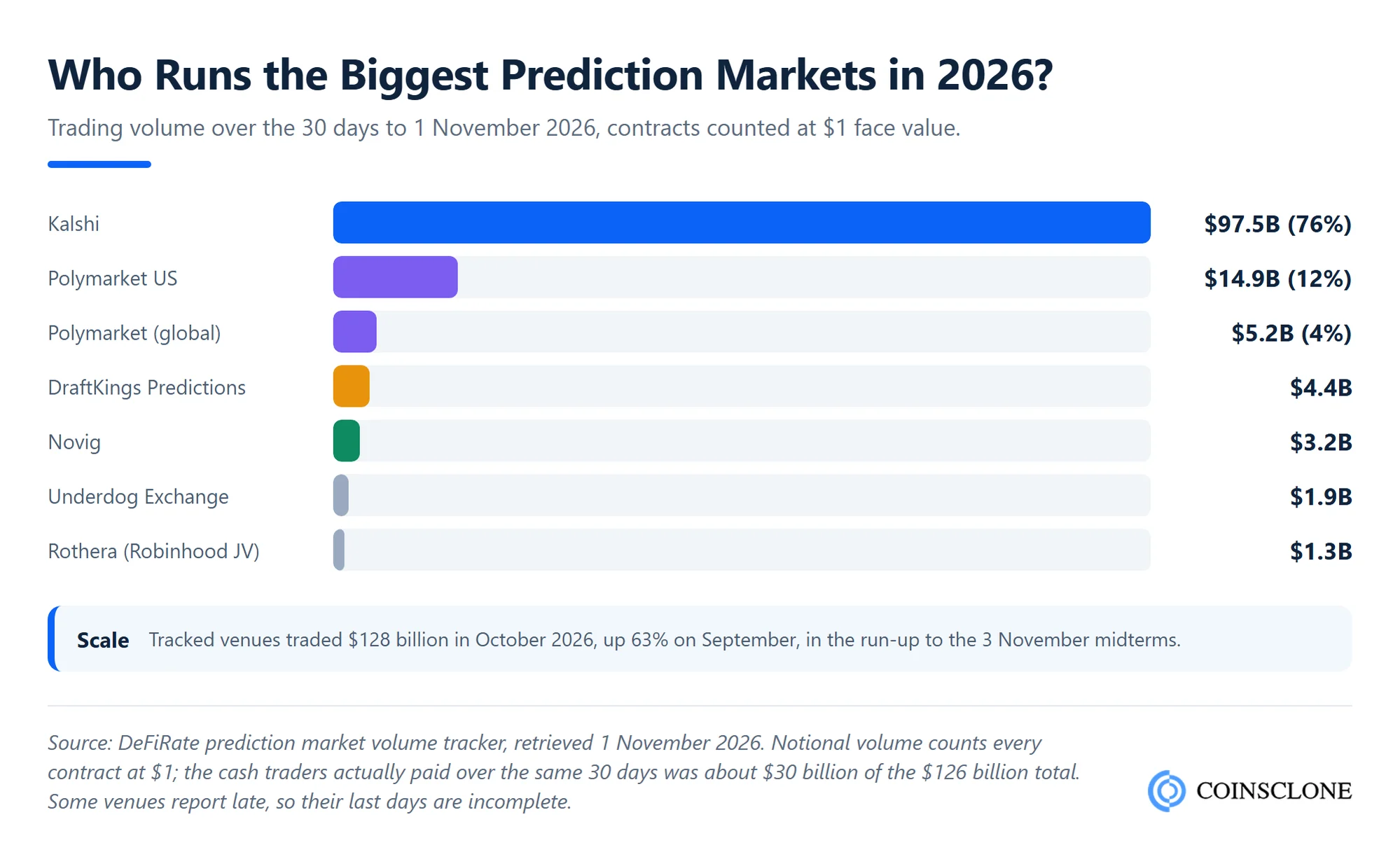
One caution on volume figures. Most headline numbers count every contract at its $1 face value. DeFiRate’s tracker shows $126 billion of volume at face value in the 30 days to 1 November 2026. Yet traders paid only about $30 billion in cash. Both numbers are real. They just measure different things.
Sports drive most of this. Robinhood’s own filings credit its growth mainly to sports contracts. Sports brands such as DraftKings and Underdog now run prediction products too, next to newer sports exchanges such as Novig. Operators planning one can see how a sportsbook prediction market blends the two models.
Prediction Market vs Gambling: What Is the Difference?
A prediction market and a sportsbook can look the same on a phone screen. The real difference is who takes the other side of your bet.
| Question | Prediction market | Sportsbook |
| Who sets the price? | Traders, through supply and demand | The bookmaker |
| Who takes the other side? | Another trader | The bookmaker |
| How does the operator earn? | A trading fee on each matched trade | A built-in margin (the vig) and bettor losses |
| Can you exit early? | Yes, sell at the current price | Sometimes, through a cash-out offer |
| Are winners limited? | No reason to, the house has no stake | Often, winning bettors get limited |
| US regulator | CFTC (federal) | State gaming boards |
Compare the costs. A sportsbook offering -110 on both sides of a game builds in a margin of about 4.5%. On Kalshi, a 50-cent contract carries a taker fee of 1.75 cents, or 3.5% of what you pay. The fee falls for prices far from 50 cents.
For the trader, though, the money logic is close to betting. Before fees, every dollar one trader wins, another loses. A study of more than 300,000 Kalshi contracts by economists at University College Dublin found the average return was minus 22% after fees. Contracts priced under 10 cents lost more than 60% of the money put in.
So is it gambling? Legally, that is exactly the open question in the US. In plain terms, it is a trading venue for bets, with exchange rules on top.
Are Prediction Markets Legal in the US?
Yes at the federal level, but contested at the state level. The CFTC licenses platforms like Kalshi and says event contracts are swaps under its sole control. Many states say sports contracts are sports bets and need a state gaming license.
Here is how the fight stands, in date order:
- April 2026: The Third Circuit sided with Kalshi against New Jersey, finding federal law overrides state gambling law for these contracts. New Jersey asked the Supreme Court to review it in early September.
- 10 June 2026: The CFTC proposed its first prediction market rule. It sets tests for contracts tied to terror, war, killings, gaming and crime.
- 27 July 2026: 44 state attorneys general told the CFTC it lacks power over sports event contracts.
- 31 July 2026: New York sued Kalshi, calling it an illegal gambling business. It sued Polymarket US in September.
- August 2026: The Ninth Circuit ruled that Nevada can regulate sports event contracts.
- 25 September 2026: The Sixth Circuit ruled that Ohio and Tennessee can apply their gambling laws to Kalshi’s sports contracts.
- 9 October 2026: The CFTC proposed a rule that would class sports, politics, culture and weather contracts as swaps by law. A second, same-day rule kept casino games out. Comments close 30 days after its 19 October publication.
- 27 October 2026: The CFTC sued Utah to stop the state’s case against Kalshi. It was the agency’s tenth lawsuit against a state.
As of 1 November 2026, the appeals courts are split and the question is widely expected to reach the Supreme Court. Until then, whether a sports contract is legal can depend on the state you trade from. Most court fights center on sports, though the New York and Utah cases also target election and weather contracts.
Outside the US, rules differ by country, and many places treat event betting as gambling.
How Accurate Are Prediction Markets?
Often quite accurate, but not magic. The best-known study compared the Iowa Electronic Markets with 964 polls across five US presidential elections from 1988 to 2004. The market was closer to the final result 74% of the time. It beat the polls most clearly more than 100 days before the vote.
The University College Dublin study found that Kalshi prices carry real information and grow more accurate as a market nears its close. It also found a clear pattern called the favorite-longshot bias. Cheap long shots win less often than their price suggests, while favorites win slightly more often.
Markets also miss. They leaned heavily toward Remain before the 2016 Brexit vote. They also gave Donald Trump low odds in 2016. In both cases, traders were too slow to update. A price is the crowd’s best guess, not a promise.
What Are the Risks of Prediction Markets?
Before you trade on one, or build one, know these risks:
- Most traders lose: Trading is zero-sum before fees. The UCD study’s average return of minus 22% after fees is a fair warning.
- Insider trading: People with private knowledge can trade on it. In February 2026, Kalshi banned a MrBeast video editor for two years. It banned a man who ran for California governor for five. It said it had opened 200 cases in a year.
- Settlement disputes: Vague wording leads to fights over what really happened. Read the rules and the named source before you buy.
- Legal risk: A court order in your state can close markets or force a platform to block you. In January 2026 a Massachusetts court order forced Kalshi to geofence its sports contracts in that state.
- Thin markets: In small markets, a few trades can swing the price, and you may not be able to sell at a fair price.
- Crypto risks: On-chain platforms add wallet, stablecoin and smart contract risk on top of market risk.
How Do Prediction Market Platforms Make Money?
Platforms earn mainly from trading fees, charged on matched trades. Kalshi’s formula above is a common model. Some platforms also earn from deposit fees, data sales and media deals; CNBC and CNN both signed partnerships with Kalshi in late 2025.
Brokers earn a share by sending customer orders to exchanges, which is how Robinhood built a $173 million quarter. For a closer look at one model, see how Polymarket makes money.
If you plan to launch one, the big choices are order book or AMM, dollars or stablecoins, and licensed or offshore. Our prediction market development cost guide shows what each adds to the budget.
Launch a Prediction Market Traders Trust
Prediction market development, done right.
- Trading engine: Order book or AMM pricing with Yes and No contracts from 1 to 99 cents
- Settlement: Oracle or admin resolution with named sources and a dispute window
- Payments: Fiat rails or USDC wallets, with fees you set per market
- Risk controls: KYC, geofencing, position limits and insider trading alerts
See a live demo of a prediction market platform with sports, politics and crypto markets.
Book a Free Demo to plan your prediction market launch.
How Coinsclone Helps You Build a Prediction Market
Coinsclone builds prediction market platforms from the ground up. That covers order book or AMM trading, wallets and payments, tools to create markets, and settlement by oracle or admin. It also covers an admin panel with risk and KYC controls. Coinsclone has built crypto products since 2018 and delivered 350+ platforms for 200+ clients across 20 industries. A Polymarket clone script launch takes 5 to 7 weeks, and a Kalshi-style platform takes 6 to 8 weeks. See our prediction market platform development service to plan yours.
Frequently Asked Questions
Are prediction markets legal in the US?
Yes, at the federal level. Kalshi and Polymarket US hold CFTC licenses and run under its rules. But many states say sports contracts are illegal bets. As of 1 November 2026, the appeals courts are split on who is right. The issue is expected to reach the Supreme Court.
Why are prediction markets not considered gambling?
Platforms argue that event contracts are swaps, a type of derivative the CFTC regulates, and that users trade with each other rather than against a house. States answer that a bet on a game is a sports bet whatever it is called. The CFTC’s October 2026 proposal would write event contracts into the swap definition, but it is not final.
Are prediction markets accurate?
They are often more accurate than polls, especially far ahead of an event. One study found the Iowa Electronic Markets beat polls 74% of the time across five presidential elections. They still miss, as they did on Brexit and the 2016 US election.
Can prediction markets be manipulated?
Yes, especially small markets where a few large trades can move the price. In large, active markets, other traders tend to push prices back toward fair value. Insider trading is a bigger worry. Kalshi says it opened 200 cases into possible rule breaks in one year.
Do prediction markets use crypto?
Some do and some do not. Polymarket’s global site uses USDC, a dollar stablecoin, on the Polygon chain. Kalshi, Polymarket US and Robinhood use US dollars.
Is Kalshi a prediction market?
Yes. Kalshi is a prediction market licensed by the CFTC as a designated contract market since November 2020. It handled about 76% of tracked prediction market volume in the 30 days to 1 November 2026.
What is the difference between a prediction market and a betting exchange?
They work in a similar way. Both match users against each other and charge a fee. The main gaps are legal and in format. Prediction markets show prices from 1 to 99 cents, and the US treats them as derivatives. Betting exchanges quote odds and hold gambling licenses.
Will prediction markets be banned?
A full ban looks unlikely, since the CFTC is actively defending them in court. The real risk is narrower: some states may win the right to block sports contracts. The Supreme Court is likely to decide that question.